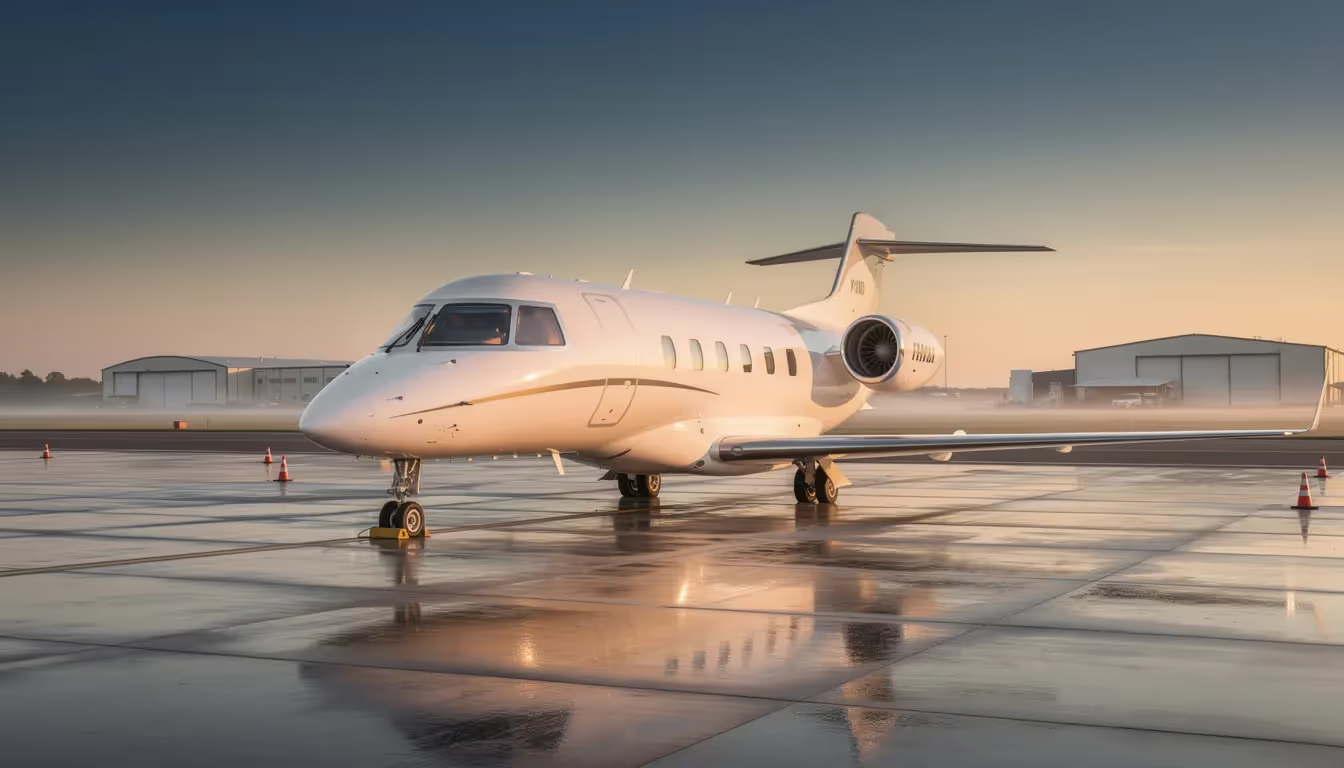
Investing in a 10-million-dollar private jet opens up a world of possibilities beyond the typical luxury image. Whether you’re an executive seeking to maximize productivity, a family desiring seamless travel, or a business owner looking for tailored solutions, this budget offers access to some of the most capable and efficient business jets on the market. From brand-new light jets featuring modern technology and personalized service to pre-owned super-midsize jets with extended range and spacious cabins, the options cater to a range of missions and preferences. This guide explores what a 10 million dollar private jet truly represents in today’s evolving private aviation landscape—highlighting performance, safety, sustainability, ownership considerations, and the real costs involved to help you make an informed decision.
Key Takeaways
A 10 million dollar budget can secure a brand-new light jet like the 2025 Embraer Phenom 300E or a pre-owned super-midsize aircraft like a 2016–2018 Bombardier Challenger 350, offering range capabilities from 1,200 to 3,100 nautical miles.
This price point represents a strategic threshold in private aviation—enough to access jets that save 3–5 hours per trip compared to commercial first class, while opening 5,000+ airports unavailable to airlines.
Safety certifications (Part 135, ARGUS, Wyvern), sustainability practices (carbon offsets, SAF compatibility), and modern avionics are non-negotiable considerations at this investment level.
Full ownership typically makes sense at 200–300+ flight hours annually; Jet Cards and on-demand charter deliver the same aircraft experience without tying up capital.
Whether you’re a founder, family office, or ultra-frequent flyer, understanding the true cost of running these aircraft—often 10–15% of purchase price annually—determines whether ownership or access models better serve your mission.
Why a $10 Million Private Jet Is a Strategic Asset, Not Just a Toy
The post-2020 surge in private aviation wasn’t driven by billionaires seeking status symbols. It was fueled by executives who discovered that commercial airline reliability had become a liability. Flight cancellations, connection failures, and hours lost to security lines pushed decision-makers toward a different calculation: what is my time actually worth?
A 10-million-dollar private jet answers that question with precision. Consider a New York–Dallas day trip. Via commercial business class, you’re looking at a 5:30 AM departure, a connection through Charlotte or Chicago, and arrival around 1:00 PM—assuming nothing goes wrong. The return? Another 6–8 hours of travel. Now picture the same trip aboard a 2024 Cessna Citation CJ3+: depart Teterboro at 7:00 AM, land at a private terminal in Dallas by 10:30 AM local time, conduct your meetings, and return by dinner. You’ve gained nearly a full working day.
The numbers supporting this calculus are stark. Private jets can access over 5,000 airports across the United States—ten times the approximately 500 airports served by commercial carriers. This means landing 15 minutes from your client’s headquarters rather than an hour from the nearest hub. For executives managing plants, offices, or vacation properties in secondary markets, that access translates directly into productivity and allows for efficient travel across the country for regional trips.
BlackJet positions itself precisely at this intersection of efficiency and accessibility. Through Jet Card programs and curated charter solutions, clients can access 10 million dollar-class aircraft with built-in safety auditing and carbon-neutral operations—without the complexity of full ownership. Ensuring the right crew is on board is a key part of BlackJet’s commitment to safety and reliability.
What $10 Million Actually Buys in a Private Jet
Understanding what your budget commands requires distinguishing between new and pre-owned markets. At 10 million, you’re shopping the upper tier of new light jets or gaining entry into larger, longer-range pre-owned aircraft from manufacturers like Gulfstream, Bombardier, and Dassault.
The market breaks into three practical bands:
New light jets ($5–9.5M): This category includes the 2025 HondaJet Elite II (approximately $6.5–7M), the Cessna Citation CJ3+ ($8.5–9M), and the segment-leading Embraer Phenom 300E ($9.7–9.9M). These aircraft seat 6–10 passengers, offer ranges between 1,500 and 2,100 nautical miles, and are typically single pilot certified—reducing crew costs significantly. Storage capacity in this segment is generally optimized for passenger luggage, with dedicated baggage compartments and flexible interior storage solutions.
New “crossover” jets ($10–11M): The Pilatus PC-24 occupies unique territory here. Its STOL capability allows access to 21,000+ airports, including unpaved runways that pure jets cannot touch. The PC-24 is also notable for its large cargo door and generous storage area, making it highly versatile for both passenger and cargo missions. Fully equipped, expect pricing just above the $10M threshold, but the versatility justifies the premium for certain mission profiles.
Pre-owned super-midsize jets ($9–13M): This is where the budget truly stretches. A 2016–2018 Bombardier Challenger 350 with reasonable hours typically trades between $9–11M. A 2014–2017 Gulfstream G280 occasionally dips into the high $9M range for well-maintained examples. These aircraft offer 3,000–3,600 nautical mile range—true coast-to-coast or transatlantic capability, along with spacious cabins and ample storage for both luggage and equipment.
One critical note: published list prices exclude taxes, delivery fees, and most options. Avionics upgrades, custom paint, and interior modifications can push “out the door” costs 10–15% higher. Many buyers at this level split their capital strategically—purchasing a $6–8M aircraft while reserving $2–4M for operating reserves, upgrades, and the inevitable surprises that aircraft ownership brings.
Since 2020, the private jet market has experienced a significant increase in demand. In 2023 alone, over 6,500 pre-owned business jets were listed for sale, reflecting both heightened interest and greater inventory for buyers at the $10 million level.
Best New Private Jets Around the $10 Million Mark
For buyers seeking factory-fresh aircraft with full warranties and the latest technology, several compelling options exist at or below the 10 million threshold. These light jets and crossover designs represent the current state of the art in efficiency, safety, and cabin experience.
The 2025 Embraer Phenom 300E dominates this segment for good reason. Priced at $9.45 million, it delivers a 2,010 nautical mile range at a cruise speed of approximately 464 knots—making it the fastest single-pilot light jet in production. The cabin accommodates up to nine passengers in the longest interior of its class, standing 5’1” at its peak. A facing couch seating arrangement is available, enhancing passenger comfort and promoting social interaction during flights, which is especially valuable for longer journeys or collaborative environments. Prodigy Touch avionics (based on the Garmin G3000 platform) provide synthetic vision and advanced autopilot functions that enhance both safety and pilot workload management. The Phenom 300 series has been the world’s most-delivered light jet for over a decade, with residual values that reflect its market acceptance.
The 2024 Cessna Citation CJ3+ offers a compelling alternative at $8.5–9M. Configured for six to eight passengers, it achieves approximately 2,040 nautical miles of range with Garmin G3000 avionics. The Citation line carries decades of brand heritage, translating to strong resale values and a robust service network. For owners prioritizing reliable dispatch and lower acquisition cost, the CJ3+ delivers proven performance. It is also known for its low operating costs and single-pilot operation capability, making it a versatile choice for both personal and business use.
At the entry point of this range, the 2024 HondaJet Elite II stands out for engineering innovation. Priced around $6.5–7M, its over-the-wing engine mounting creates a remarkably quiet cabin while maximizing interior space. The range extends beyond 1,500 nautical miles with four to six passengers. The aircraft represents an efficient choice for regional missions—think Los Angeles to Aspen or New York to Miami—where speed and comfort matter but transcontinental range is unnecessary.
The 2024 Pilatus PC-24 earns its “Super Versatile Jet” designation through capabilities no pure jet can match. A large cargo door accommodates awkward loads. Rough-field certification opens access to remote destinations from mountain strips to island runways. The cabin is configured for up to ten or eleven passengers across 2,000 nautical miles. Expect pricing between $9.2–10.7M depending on configuration, but for buyers whose missions include remote resorts, construction sites, or destinations with limited infrastructure, no alternative exists.
Each of these aircraft offers cabin experiences that redefine what flying means. Flat-recline club seating, bespoke leather and wood appointments, custom lighting schemes, facing couch options for enhanced comfort and social interaction, and Wi-Fi capable of supporting encrypted corporate work transform the cabin into a mobile office—or a space for genuine rest between meetings.
Popular Light Jets and Their Price Points
For buyers considering options under $10 million, several light jets stand out for their balance of price, performance, and comfort:
Cirrus Vision Jet: Starting at $2.38 million, this single-engine jet seats up to 7 passengers and features a whole-aircraft parachute system, offering unique safety benefits.
Eclipse 550: Priced at $2.995 million, this twin-engine light jet seats 6 and is designed for short, fast trips with minimal passengers.
Embraer Phenom 100 EV: At $4.5 million, it offers a range of 1,178 nautical miles and seats up to 6 passengers, combining efficiency with a bright, modern cabin.
Cessna Citation M2: Priced around $4.7 million, it boasts a 1,550 nautical mile range and seats 6, making it a great choice for regional travel.
Honda Jet Elite S: At $5.4 million, it offers a range of 1,437 nautical miles and a quiet cabin thanks to its unique engine placement.
Cessna Citation CJ3+: Around $8 million, this jet seats 6–8 passengers and offers 2,040 nautical miles of range, with modern avionics and low operating costs.
Bombardier Learjet 75 Liberty: Priced at $9.9 million, it seats 8 passengers and offers 2,080 nautical miles of range, designed for comfort and privacy.
Pre-Owned $10 Million Jets: Stepping Up in Size and Range
The pre-owned market transforms what $10M commands. Instead of shopping light jets, buyers access super-midsize aircraft capable of true transcontinental missions—New York to Los Angeles nonstop, or London to Dubai without fuel stops.
The 2016–2018 Bombardier Challenger 350 represents the sweet spot of this segment. Trading between $9–11M depending on airframe hours and maintenance program status (MSP or JSSI coverage significantly impacts pricing), these aircraft offer approximately 3,100 nautical miles of range with eight to ten passengers. The flat-floor cabin, full galley, and enclosed lavatory create an environment closer to a corporate boardroom than a commuter flight. Challenger 350s equipped with updated avionics and fresh interior refurbishments command premium pricing but deliver enhanced long-term value.
The 2014–2017 Gulfstream G280 occasionally enters the high $9M range for examples with higher hours or upcoming maintenance events. More typically priced at $10–13M, these aircraft boast exceptional 3,600+ nautical mile range—capable of New York to London with eight to ten passengers. The Gulfstream brand carries considerable prestige, with residual values historically outperforming competitors.
For buyers willing to accept older vintage, the 2010–2013 Dassault Falcon 2000LX offers wide-body comfort and a 4,000 nautical mile class range. Well-maintained examples occasionally appear in the $10–12M range. The Falcon’s three-engine heritage (in larger models) and French engineering bring a different cabin feel—arguably quieter and more refined than some competitors.
Earlier examples of the Falcon 900EX or Gulfstream G200 price into high single-digit millions when engine cycles and maintenance records align. These aircraft require careful due diligence but can deliver exceptional value for informed buyers.
Several factors drive pre-owned pricing: airframe hours (under 5,000 typically command a premium), engine and APU program status, avionics upgrades (FANS/ADS-B compliance, WAAS approaches), and interior refurbishment dates. Corrosion history and geographic exposure (coastal operations versus dry climates) also impact structural condition.
Due diligence cannot be overstated. Pre-purchase inspections (PPI), mandatory for pre-owned jets and conducted at certified facilities, comprehensive logbook reviews, and expert interpretation of maintenance histories separate smart acquisitions from expensive mistakes. BlackJet assists clients in navigating these complexities, ensuring that safety standards and value alignment guide every transaction.
Jets Under 10 Million: What Are the Alternatives?
Exploring private jet ownership doesn’t have to mean stretching your budget to the limit. There are several attractive alternatives for those seeking the perfect aircraft under $10 million, each offering a unique balance of price, performance, and luxury. Light jets, such as the Cessna Citation M2 and Eclipse 550, are standout options for new owners. These jets are single-pilot certified, allowing experienced pilots to take the controls themselves and enjoy the freedom of private aviation firsthand. With cruise speeds often exceeding 500 mph and ranges exceeding 1,000 nautical miles, light jets are ideal for business trips, family getaways, or quick hops between cities.
Despite their accessible price point, many light jets are equipped with modern amenities—think plush leather seats, advanced avionics, gourmet galleys, and high-speed Wi-Fi—ensuring every flight is a comfortable and stylish experience. For those who want the benefits of private jets without full ownership, fractional ownership and jet card programs offer flexible, tailored solutions. These options provide access to a fleet of modern aircraft, allowing you to select the right jet for each mission while enjoying predictable costs and personalized service. Whether you’re a business owner looking to enhance your company’s travel capabilities or an individual seeking the luxury of private flight, the world of jets under $10 million offers a wealth of choices to suit your needs and lifestyle.
Light, Midsize, and Super-Midsize at $10M: Which Class Fits Your Mission?
Selecting the right aircraft requires brutal honesty about your actual travel patterns. Distance, passenger count, runway requirements, and flight frequency dictate which class represents the best use of a $10M budget.
Light Jets (~1,200–2,100 NM Range)
Aircraft like the 2025 Embraer Phenom 300E, 2024 Cessna Citation CJ3+, and HondaJet Elite II serve two to six passengers on routes under 2,000 nautical miles. Los Angeles to Aspen, New York to Miami, London to Nice—these missions fit perfectly. Operating costs run approximately $2,000–$2,800 per flight hour, making light jets economical for frequent regional travel.
Cabin experience includes club seating for four, compact galley, and enclosed lavatory—comfortable for two to three-hour legs but not designed for overnight crossings. Most light jets are single-pilot certified, reducing crew costs and scheduling complexity.
Midsize Jets (~2,000–2,500 NM Range)
The Cessna Citation XLS+, Bombardier Learjet 75 Liberty, and Gulfstream G150 occupy this territory. These aircraft serve six to eight passengers on routes like Chicago to San Jose or Paris to Moscow. Operating costs increase to approximately $2,700–$3,500 per flight hour.
Cabins grow taller, baggage holds expand, and galleys become more capable. Midsize jets deliver genuine business-class comfort—room to work, space to recline, and provisions for catering that extend beyond snacks and beverages.
Super-Midsize Jets (~3,000–3,600 NM Range)
Challenger 300/350, Gulfstream G280, and late-model Citation Sovereign+ examples offer true coast-to-coast capability. Eight to ten passengers travel comfortably on transcontinental U.S. routes or Western Europe to the Middle East missions. Hourly operating costs climb to $3,800–$5,000.
Cabins feature flat floors, full-size galleys, enclosed aft lavatories, and advanced connectivity solutions. These aircraft support productive work or genuine rest on six-hour flights—a capability that smaller jets cannot match.
Scenario comparisons help clarify the choice:
A founder flying 200+ hours annually between New York and Houston (approximately 1,400 NM) would optimize with a light jet like the Phenom 300E—lower operating costs, easier airport access, and sufficient range with reserves.
A global family commuting between London and Dubai (approximately 2,900 NM) requires super-midsize capability. The Challenger 350 or G280 handles this mission nonstop with full passenger loads, justifying higher hourly costs through time savings and convenience.
Safety, Certification, and Sustainability at the $10 Million Level
At this investment level, buyers and access clients rightfully expect commercial-grade safety oversight. Equally, sustainability has transitioned from marketing afterthought to genuine decision criterion. Both demands can be met with proper diligence.
Safety Frameworks
Private aviation operates under distinct regulatory structures. FAA Part 91 governs owner-operated flights with relatively light oversight—owners accept responsibility for maintenance and crew qualification. Part 135 certification applies to charter operations, imposing stricter requirements for crew duty limits, maintenance recordkeeping, and operational oversight.
Beyond FAA minimums, third-party audit standards differentiate operators:
ARGUS Platinum (top 1% of operators) requires demonstrated safety management systems, pilot experience thresholds, and operational history review
Wyvern Wingman certification demands similar rigor with emphasis on pilot training and currency
IS-BAO (International Standard for Business Aircraft Operations) establishes global best practices for flight departments
These certifications matter. BlackJet emphasizes ARGUS and Wyvern ratings when selecting operators for Jet Card and charter clients, ensuring that every flight meets or exceeds commercial safety standards.
Modern jets enhance safety through technology: terrain awareness warning systems, traffic collision avoidance, envelope protection (preventing inadvertent stalls or overspeeds), and real-time engine health monitoring. Aircraft like the Phenom 300E and Challenger 350 come equipped with synthetic vision systems that display terrain in low-visibility conditions—a capability that reduces pilot workload during challenging approaches.
Sustainability Practices
Environmental responsibility increasingly influences purchasing and access decisions. Modern aircraft address this through several mechanisms:
Efficient design: Winglets, composite structures, and optimized aerodynamics reduce fuel burn per passenger mile. A 2025 light jet burns 15–20% less fuel than equivalents from fifteen years ago.
Sustainable Aviation Fuel (SAF): Major FBOs now offer SAF blending, reducing lifecycle carbon emissions by up to 80% compared to conventional Jet A. Availability continues expanding across business aviation hubs.
Carbon offset programs: Verified forestry, methane capture, and renewable energy projects can neutralize remaining emissions. BlackJet positions flights as carbon-neutral by default through vetted offset partners—clients achieve climate-conscious travel without additional cost or complexity.
Whether purchasing or accessing via Jet Card, clients can—and should—demand documentation on safety ratings and environmental policies. These factors reflect operator quality and increasingly influence resale values and corporate travel policies.
Ownership vs Jet Card vs Charter: The $10 Million Decision
Having $10M available does not automatically make ownership the optimal choice. Capital efficiency, utilization patterns, and risk tolerance all factor into the equation. Consider whether tying up funds in the bank is the best use of your assets, or if investing in a private jet aligns better with your financial goals. Three distinct paths exist, each suited to different circumstances.
If you are interested in flexible access and exclusive perks, join our Jet Card program to unlock premium benefits tailored to your travel needs.
For more information, contact BlackJet today or visit our website to start your private jet journey.
Full Ownership
Ownership makes financial sense when annual flight hours exceed 200–300. At this utilization level, fixed costs spread across enough hours to compete with hourly access models. Ownership also delivers:
Bespoke interiors tailored to personal or corporate preferences
Guaranteed availability without advance booking requirements
Branding opportunities (corporate livery, consistent presentation)
Asset appreciation potential in strong markets
The trade-offs include high fixed costs—hangar fees can exceed $100,000 annually depending on location, crew salaries ranging from $150,000 to $400,000 per pilot annually, insurance costs between $10,000 and $30,000 per year for a $10 million aircraft, navigation database subscriptions, and maintenance program reserves. Owners also bear depreciation risk and market timing exposure when selling.
Jet Card Access
Jet Cards provide predictable hourly rates with guaranteed availability on 24–48 hours’ notice. Clients prepay for blocks of flight time (typically 25–100 hours), accessing a curated fleet from light to super-midsize categories without capital outlay or asset risk.
BlackJet’s Jet Card approach emphasizes safety auditing (ARGUS/Wyvern-rated operators only), carbon-neutral operations through integrated offsets, and technology-enabled booking that simplifies scheduling. This model suits 25–150 annual flight hours—enough travel to justify dedicated access but insufficient to amortize ownership costs.
Key advantages include no upfront capital commitment, no crew management, no maintenance surprises, and the flexibility to match aircraft size to each mission rather than owning a single aircraft that may be oversized or undersized for specific trips.
On-Demand Charter
For travelers logging fewer than 50 hours annually or flying irregular patterns (occasional European holidays, Caribbean vacations, family events), on-demand charter provides maximum flexibility. Aircraft selection varies trip-by-trip—sample a Phenom 300 one journey and a Challenger 350 the next.
BlackJet orchestrates charters meeting specific cabin, safety, and sustainability criteria, eliminating the variable quality that plagues unvetted charter markets.
The Hybrid Path
Many clients begin with Jet Card or charter access, establishing clear usage patterns and aircraft preferences before transitioning to ownership. This approach reduces risk—you discover whether a light jet suffices or super-midsize capability is essential before committing $10M to a specific aircraft. Starting with access also builds relationships with operators, maintenance providers, and aviation professionals who prove invaluable when ownership eventually makes sense.
The Real Cost of Running a $10 Million Jet
Aircraft acquisition represents only the beginning. Annual operating costs typically run 10–15% of aircraft value—a light jet purchased for $8M may require $800,000–$1.2M annually to operate. Understanding this reality prevents unpleasant surprises.
Light Jet Operating Costs (e.g., Phenom 300E)
Crew salaries (2 pilots): $250,000–$350,000
Hangar: $40,000–$80,000 (hangar fees can exceed $100,000 depending on location)
Insurance: $50,000–$100,000 (insurance costs for a $10 million aircraft range between $10,000 and $30,000 per year)
Training, subscriptions, management: $100,000–$150,000
Total Fixed Costs: $600,000–$900,000
Variable costs add approximately $2,500–$3,000 per flight hour, covering fuel (which accounts for 25–35% of total operating costs for light/mid-size jets), maintenance reserves, and landing/handling fees. An owner flying 250 hours annually might budget $625,000–$750,000 in variable costs, bringing total annual expenditure to $1.2–1.6M.
Super-Midsize Operating Costs (e.g., Challenger 350)
Crew salaries (2 pilots): $350,000–$500,000
Hangar fees: $80,000–$150,000
Insurance: $100,000–$150,000
Training, subscriptions, and management: $150,000–$200,000
Total Fixed Costs: $680,000–$1,000,000 (to be calculated based on above)
Variable costs run $3,800–$5,000 per flight hour. The same 250 annual hours generate $950,000–$1,250,000 in variable expenses, pushing total annual costs to $1.8–2.5M.
Maintenance Programs
Engine and APU maintenance programs (MSP Gold, JSSI, OEM-backed options) stabilize budgeting by converting unpredictable major repairs into predictable hourly reserves. These programs also enhance resale value—buyers strongly prefer aircraft enrolled in comprehensive coverage. Expect hourly contributions of $300–$600 for light jets and $600–$1,200 for super-midsize aircraft.
Ownership vs. Access Cost Comparison
Consider 250 annual flight hours on a midsize jet:
Ownership path: $10M acquisition + $1.5–2M annual operating costs = $6M+ over five years (plus residual value recovery at sale)
Jet Card path: 250 hours × $5,000–$7,000/hour = $1.25–1.75M annually, or $6.25–8.75M over five years with zero capital at risk and no resale timing exposure
The break-even point depends heavily on utilization, aircraft appreciation/depreciation, and tax treatment. For many buyers, keeping $10M deployed in their core business or investment portfolio while purchasing access delivers superior risk-adjusted returns.
How to Choose the Right $10 Million Jet (or Access Model)
Selection requires systematic analysis rather than emotion-driven decisions. The perfect aircraft for your neighbor may prove completely wrong for your mission profile.
Step 1: Define Your Mission in Detail
Quantify your actual travel patterns:
Distances: Are most flights under 800 nautical miles, or do you regularly need 2,000+ NM legs?
Passengers: Solo executive travel, family of six, or corporate team plus support staff?
Airports: Which departure and arrival points do you use? What runway lengths and surfaces are available?
Frequency: How many annual flight hours do you realistically anticipate?
Honest answers prevent purchasing aircraft that are simultaneously too expensive for light-duty missions and incapable of your longest routes.
Step 2: Decide on Capital vs. Flexibility
Determine whether you want an asset on your balance sheet or prefer deploying $10M elsewhere while purchasing access. Consider:
Depreciation schedules and potential tax advantages (consult qualified tax advisors for specifics)
Liquidity impact of tying up capital in aircraft
Your appetite for asset management, crew oversight, and operational complexity
Market timing—are you buying at peak valuations or during buyer’s markets?
Step 3: Prioritize Safety, Technology, and Sustainability
Establish non-negotiable requirements:
Documented safety ratings (ARGUS Platinum, Wyvern Wingman) for any operators involved
Pilot experience minimums (total hours, type-specific hours, recency)
Must-have technologies: Wi-Fi class, avionics generation, cabin management systems
Sustainability expectations: carbon offset requirements, SAF availability at home base
Step 4: Engage Experts
Private jet ownership is not a DIY endeavor. Quality acquisitions require:
Brokers with transaction experience in your target aircraft category
Aviation attorneys for purchase agreements, registration, and liability structuring
Technical inspectors for pre-purchase evaluations and logbook analysis
Tax advisors familiar with aircraft-specific depreciation and deduction rules
BlackJet provides consultative support across all three paths—ownership search, Jet Card selection, and curated charter solutions—ensuring that safety, sustainability, and mission alignment guide every decision.
Elevate Your Travel Strategy
Whether you choose private jet ownership, a Jet Card program, or curated charter access, the 10 million dollar threshold opens doors to aircraft that fundamentally transform how you travel. Time savings of three to five hours per trip, access to 5,000+ airports, and the ability to work or rest in genuine privacy—these advantages compound across every journey.
The right path depends on your mission profile, capital strategy, and priorities around safety and sustainability. For many travelers, the Jet Card model delivers premium aircraft access with built-in safety vetting and carbon-neutral performance—no capital outlay, no crew management, no maintenance surprises.
Explore how BlackJet can reshape your travel. Discover Jet Card programs designed for the discerning traveler who demands seamless, premium private flight with safety, sustainability, and flexibility built in from the first call.
Don't miss out on the latest luxury private jet reviews and travel tips—subscribe to our channel for exclusive content on 10 million dollar private jets and more. Comment below with your favorite private jet and let us know what you'd like to see next!
FAQ: $10 Million Private Jet Questions Answered
Can I buy a long-range jet like a Gulfstream G650 for $10 million?
Ultra-long-range jets such as the G650, Global 6000, or Falcon 8X typically trade well above $10M, even for pre-owned examples. A 2015 G650 with reasonable hours still commands $25–35M. At 10 million, you’re realistically shopping late-model super-midsize aircraft like Challenger 350s or G280s, or older large-cabin jets with higher hours and potentially greater maintenance exposure. The longest range accessible at this price point is approximately 3,600–4,000 nautical miles with aircraft like the Falcon 2000LX or G280.
How long does it take to complete a private jet purchase?
For a straightforward pre-owned transaction, expect 45–90 days from accepted offer to closing. This timeline accommodates pre-purchase inspection, logbook verification, financing documentation, and title/registration transfer. New aircraft orders involve longer lead times—often 12–24 months depending on OEM backlog and slot availability. Aircraft in high demand (Phenom 300E, for example) may require patience or premium pricing for near-term delivery positions.
Can I offset ownership costs by chartering out my $10M jet?
Many owners place aircraft on Part 135 certificates to generate charter revenue when not using the plane personally. This arrangement requires partnering with a qualified operator, accepting higher utilization (more wear on the aircraft), and adhering to commercial maintenance and crew standards. Charter revenue typically offsets a portion—not all—of annual fixed and variable costs. Expect 30–50% cost recovery in well-managed programs, though this varies significantly by aircraft type, home base location, and market conditions.
Do $10M jets come standard with high-speed Wi-Fi?
Most modern jets in this class (Phenom 300E, CJ3+, Challenger 350, G280) are delivered with at least basic connectivity. Many buyers upgrade to Ku-band or Ka-band systems supporting video conferencing, VPN access, and streaming capability that matches or exceeds business-class commercial offerings. Retrofitting older pre-owned aircraft with modern connectivity costs $200,000–$500,000, depending on system complexity and aircraft modifications required.
How does BlackJet help if I’m not ready to buy a jet?
BlackJet offers Jet Card programs and curated charter access to aircraft in the $10M class and above. Every operator meets rigorous safety vetting requirements (ARGUS Platinum or Wyvern Wingman certification), and flights are carbon-neutral through verified offset programs at no additional cost. Clients can experience different aircraft types—sampling Phenom 300s, Challenger 350s, and other models—to clarify preferences before making ownership decisions. This approach reduces risk while delivering the convenience, privacy, and personalized service that define premium private aviation.
Conclusion
Investing in a 10-million-dollar private jet offers unparalleled access to a world of luxury, efficiency, and personalized service tailored to your unique travel needs. Whether you choose a brand-new light jet with cutting-edge technology or a pre-owned super-midsize aircraft with extended range and spacious cabins, this budget empowers you to optimize your time, enhance productivity, and enjoy the freedom of private aviation. Careful consideration of your mission profile, safety standards, and operational costs is essential to selecting the perfect aircraft or access model that fits your lifestyle and business goals.
For those seeking flexible and hassle-free private jet experiences without the complexities of ownership, BlackJet provides expertly curated Jet Card programs and charter solutions. With a focus on safety, sustainability, and personalized service, BlackJet is your trusted partner in navigating the private aviation market. To learn more about how BlackJet can elevate your travel strategy, visit our BlackJet Private Jet Services page and explore your options today.


 Sign up with google
 Sign up with Apple