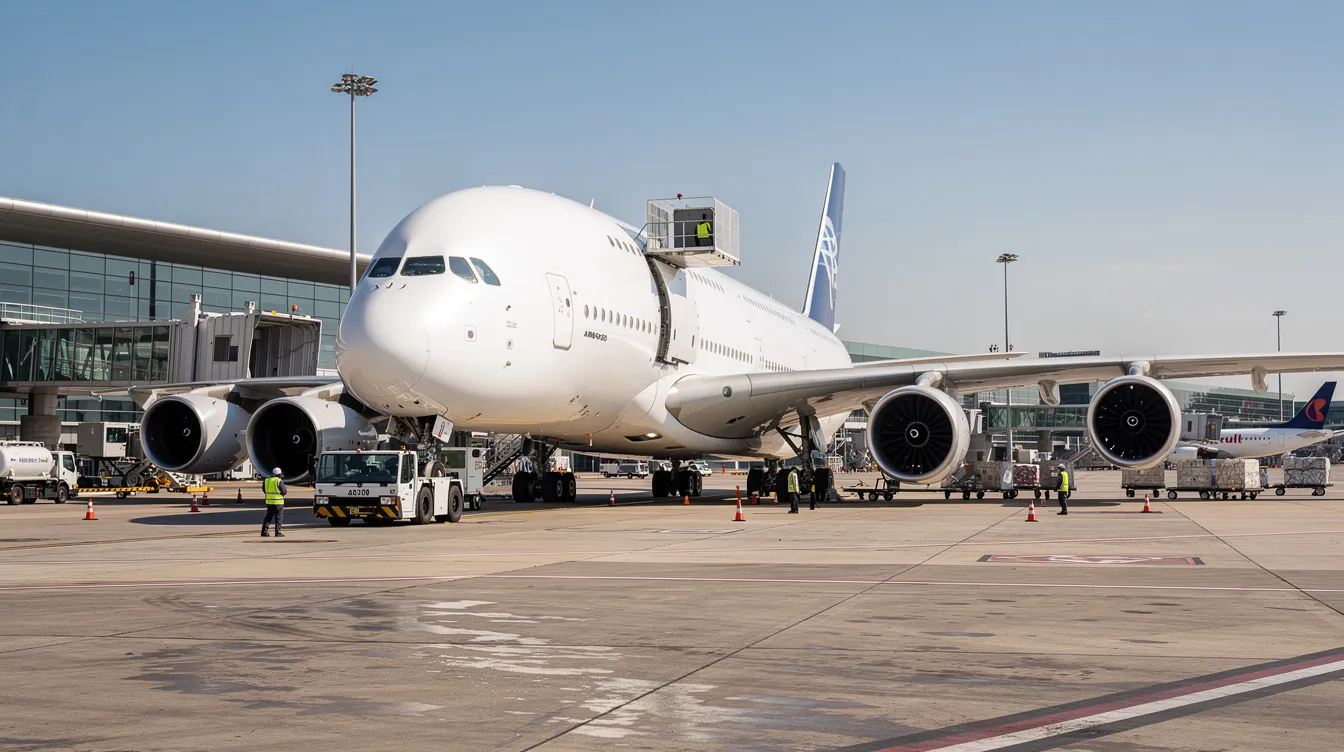
The Airbus A380 is the largest passenger aircraft ever built, a double-deck marvel of engineering and a recognized icon across the world that pushed global aviation to rethink what a commercial airliner could carry, how far it could fly, and what airports needed to support it. At a maximum takeoff weight of approximately 575 tonnes, every aspect of this aircraft—from its wing design to its landing gear-was engineered around the challenge of managing extraordinary mass. Here is everything you need to know about the A380's weight envelope, what it means for airlines and airports, and what it reveals about choosing the right aircraft for the way you travel.
Quick facts: Airbus A380 weight at a glance
The weight of the Airbus A380 is central to its performance, its airport requirements, and its operating economics. These certified limits define how much fuel the aircraft can carry, how many passengers it can transport, and which runways it can use. As the heaviest operational passenger airliner ever mass-produced, the A380 occupies a category of its own.
Here are the headline numbers for the standard A380-800:
Maximum takeoff weight (MTOW): ~575,000 kg / 575 t (~1,268,000 lb)
Operating empty weight (OEW): ~277,000 kg / 277 t (~610,700 lb)
Maximum landing weight (MLW): ~394,000 kg / 394 t (~869,000 lb)
Maximum zero fuel weight (MZFW): ~361,000 kg / 361 t (~796,000 lb)
Typical maximum payload: ~84,000 kg / 84 t (~185,000 lb)
Maximum passenger capacity: 853 passengers in an all economy configuration
For context, a Boeing 747-400's MTOW is approximately 396 tonnes—meaning the A380 outweighs it by roughly 45%. Understanding these figures is essential for airlines planning routes, airports managing infrastructure, and even private operators evaluating VIP conversions. Weight shapes fuel burn, range, and the minimum runway length required for safe operations.
Why A380 weight matters for high‑end and private aviation clients
For BlackJet clients accustomed to the agility of private jets, the Airbus A380 represents the opposite extreme of scale and mass. It is a machine built for mass transport on the world's densest routes—not for schedule control, airport flexibility, or door-to-door efficiency.
An aircraft's weight drives nearly every operational constraint that matters to a discerning traveler:
Runway requirements increase dramatically with takeoff weight, limiting the A380 to a small subset of major international hubs.
Slot availability tightens because heavier aircraft generate stronger wake turbulence, requiring greater separation between planes.
Airport compatibility depends on pavement strength, gate dimensions, and ground-handling capacity-all scaled to mass.
Operating cost per hour rises with weight, fuel burn, and the four engines needed to move 575 tonnes.
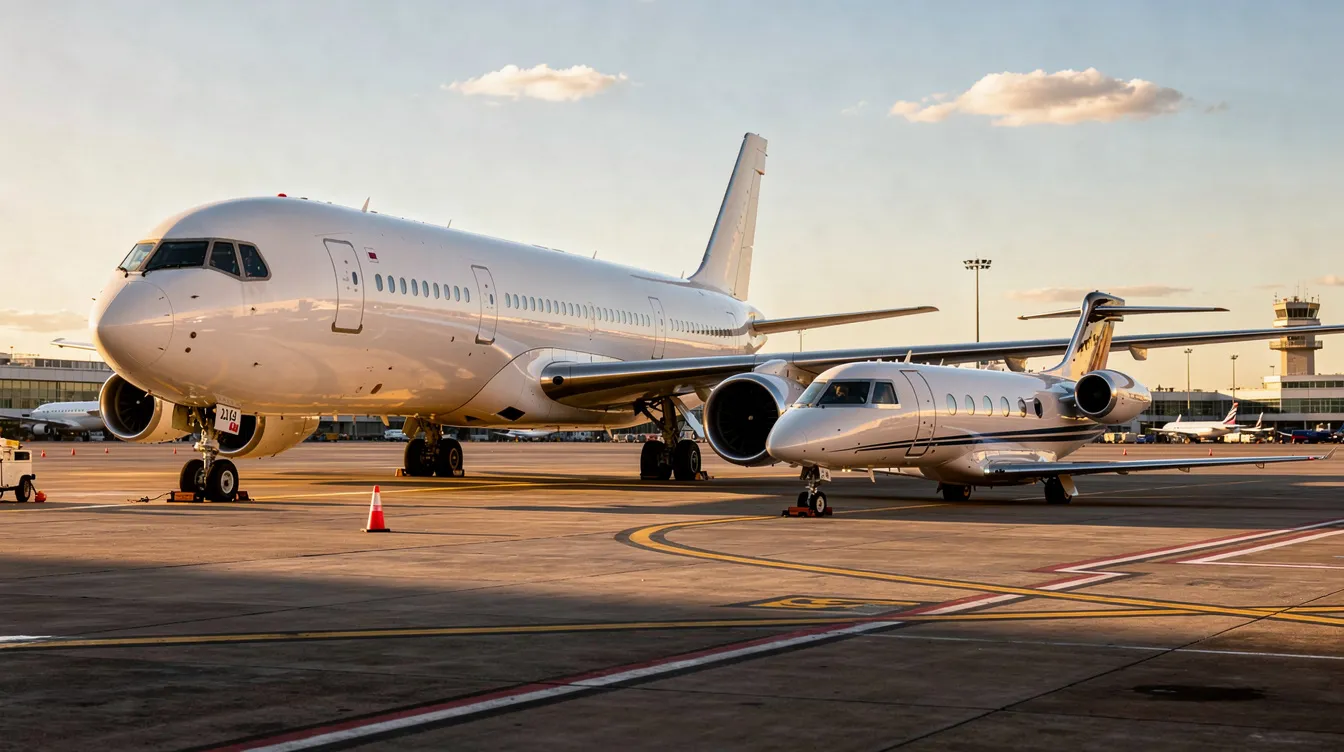
Consider the contrast: a Gulfstream G650, one of the most capable large-cabin business jets, has a MTOW of roughly 45 tonnes. That is less than one-tenth of the A380's maximum takeoff weight. The difference translates directly into flexibility—shorter runways, more airports, faster turnarounds, and a fundamentally different travel experience.
Some early concepts explored an Airbus A380 VIP or corporate shuttle configuration, but the weight, infrastructure demands, and utilization economics made these impractical compared to modern long-range private jets accessible through a BlackJet Jet Card. Understanding the engineering behind "big iron" like the A380 helps travelers appreciate why flexible, right-sized aircraft deliver more strategic value.
Airbus A380-800: basic aircraft overview
The A380-800 is the only aircraft in the A380 family to reach full production and commercial service. It entered service on October 25, 2007, when Singapore Airlines flew the inaugural A380 flight from Singapore to Sydney—a milestone that redefined what passengers could expect from a commercial aircraft.
Key dimensions that drive the airframe's structural weight:
When people discuss Airbus A380 weight, they are almost always referring to the A380-800 passenger model. The shelved A380F freighter and proposed stretch variants like the A380-900 remained studies and were never flown in commercial service.
The aircraft's double deck design, massive wing, four powerful engines (Rolls-Royce Trent 900 or Engine Alliance GP7200), and 20-wheel main landing gear all contribute directly to a structural mass that surpasses any other passenger aircraft ever built.
Core weight definitions: MTOW, OEW, MLW and more
"Weight" in aviation is not a single number. It is a collection of specific, certified limits—each governing a different phase of operation and directly shaping flight planning decisions.
Maximum takeoff weight (MTOW): the certified upper limit for safe takeoff. For later A380-800 variants, this is approximately 575,000 kg (1,268,000 lb). The aircraft cannot legally or safely begin its takeoff roll above this figure, regardless of runway length or engine performance.
Operating empty weight (OEW): the weight of the aircraft with standard equipment, crew, and unusable fluids (oils, residual fuel) but excluding passengers, cargo, and usable fuel. For a typical A380-800, OEW sits around 277,000 kg (610,700 lb). This figure shifts slightly depending on airline interior configuration.
Maximum landing weight (MLW): approximately 394,000 kg (869,000 lb) for the A380. Landing above this weight risks structural damage to the airframe and landing gear. If an aircraft must land shortly after takeoff with heavy fuel loads, it may need to burn fuel in a holding pattern.
Maximum zero fuel weight (MZFW): around 361,000 kg (796,000 lb). This is the maximum combined weight of the empty aircraft plus payload, excluding usable fuel. It constrains how much cargo and how many passengers can be carried even on short legs where fuel weight is minimal.
These limits interact constantly in flight planning. MTOW governs the fuel-versus-payload tradeoff on every departure. MLW determines whether a diversion or early landing requires fuel dumping. MZFW prevents structural overload from payload alone.
Detailed Airbus A380 weight specifications
This section consolidates the official weight figures most often cited for the A380-800, drawing from Airbus's aircraft characteristics documentation.
MTOW: 575,000 kg (1,268,000 lb) for the higher-weight variants (WV005/WV011). Earlier variants ranged from 560,000 to 569,000 kg, reflecting incremental improvements over the production run.
OEW: approximately 277,000 kg (610,700 lb), with slight variation based on airline-specific cabin furnishings and equipment.
MLW: 394,000 kg (869,000 lb).
MZFW: around 361,000 kg for baseline variants, up to approximately 369,000–373,000 kg for later high-weight options.
Typical maximum structural payload: about 84,000 kg (185,000 lb).
Maximum fuel capacity: around 320,000 litres (~84,000 US gallons), translating to approximately 250,000–260,000 kg of Jet A-1 when tanks are full.
Cabin configuration substantially affects practical payload. Emirates' A380s feature a two-class layout with 615 seats, while typical three class configurations accommodate about 525 passengers. A high-density all-economy layout can seat up to 853 passengers. Each configuration changes the balance between passenger weight, cargo capacity, and fuel load, shifting the in-service weight profile meaningfully even though the certified limits remain the same.
How fuel, passengers, and cargo build up total weight
Understanding Airbus A380 weight requires seeing how the empty airframe transforms into a fully laden departure aircraft, tonne by tonne.
The build-up follows a straightforward sequence:
Start at OEW (~277 tonnes): the bare aircraft with crew, standard equipment, and unusable fluids.
Add passengers and baggage: with 500–550 passengers at approximately 100–110 kg per person (including checked luggage, carry-on, and personal items), this adds roughly 50–60 tonnes.
Add cargo and mail: airlines typically carry an additional 10–20 tonnes of revenue cargo on long-haul routes.
Add usable fuel: anywhere from approximately 100 tonnes for shorter segments to over 250 tonnes for ultra-long-haul sectors pushing the A380's range of about 8,000 nautical miles.
Consider a concrete example. On a long-haul flight such as Dubai to Sydney (~7,500 km):
That approaches the 575-tonne MTOW limit. The payload-range tradeoff means the A380 rarely flies with both maximum fuel and maximum payload simultaneously. Airlines routinely reduce cargo or restrict passenger numbers on the longest routes to remain within certified limits. On shorter legs, more passengers can board because less fuel weight is needed.
Engineering strategies to control Airbus A380 weight
Keeping the world's heaviest passenger aircraft within viable weight limits required structural innovation at every level. Without these advances, the A380's empty weight would have been prohibitively high, eroding payload capacity and fuel efficiency.
Key lightweight materials and techniques include:
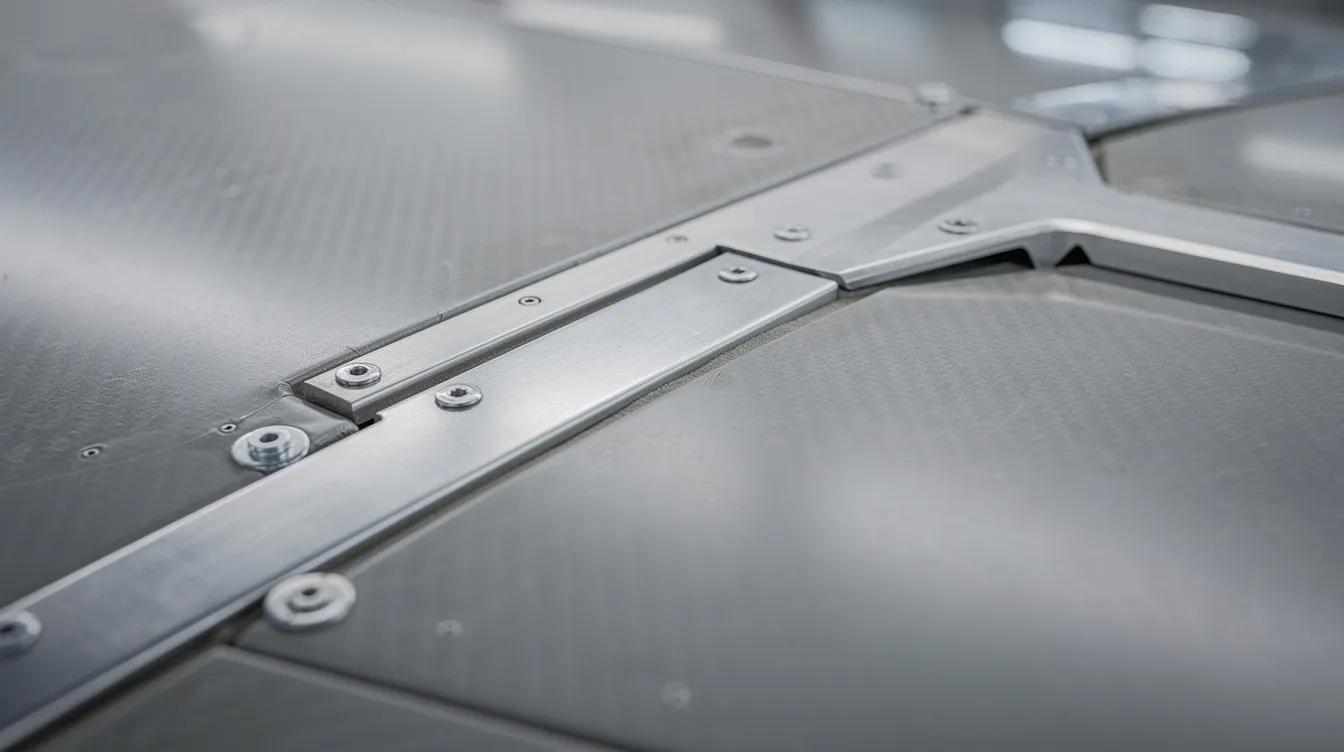
Carbon-fiber reinforced plastic (CFRP) in the central wing box, tail sections, rear fuselage panels, and other secondary structures. The A380 uses carbon-fiber reinforced plastic extensively—more than any other commercial aircraft of its generation-to reduce structural mass without compromising strength.
GLARE (glass-fibre reinforced aluminum laminate) in upper fuselage sections, which reduces weight while improving fatigue resistance and damage tolerance over conventional aluminum.
Advanced aluminum-lithium alloys in wing cover panels. Airbus achieved approximately 740 kg of weight reduction by re-optimizing lower wing skins with Al-Li alloys, using techniques like chemical pocketing to remove material from non-load-bearing areas.
Laser beam welding on fuselage skins, eliminating heavy riveted lap joints and reducing material overlap.
Systems integration designed to minimize wiring mass: shared avionics modules, consolidated power distribution, and optimized routing all contribute to holding down the operating empty weight.
Despite these innovations, the fundamental demands of the double-deck layout—two full passenger floors, interconnecting staircases, additional floor beams, windows on both levels-combined with four engines and their pylons, nacelles, and fuel systems, still produce the highest OEW of any passenger aircraft in service.
Technological innovations linked to weight management
Beyond materials, the A380 introduced technological innovations specifically aimed at managing and monitoring mass across the aircraft's lifecycle.
The A380 was the first to use a full digital mock-up (DMU) in its design. This digital mock-up allowed engineers to virtually fit every system—wiring, hydraulics, avionics, cabin structures—before physical assembly, identifying and eliminating redundant components and unnecessary structural reinforcement. The result was a leaner, more precisely engineered airframe.
Integrated Modular Avionics (IMA) consolidated computing functions into shared processing modules, dramatically reducing the number of separate avionics boxes, dedicated wiring harnesses, and cooling systems. The weight savings from this system-level approach are significant across an aircraft this size.
The A380's wings incorporate wingtip fences to improve fuel efficiency by reducing induced drag, which effectively lowers the fuel weight required for a given range. The wing itself is sized for high-MTOW operations with aerodynamic tailoring—advanced high-lift devices and load-alleviation functions—that offset the weight penalties of such a large planform.
The A380 features a Brake-to-Vacate (BTV) system for optimized runway usage. While BTV does not change certified weight limits, it enables pilots to calculate the ideal braking point for a specific runway exit, reducing average landing roll and allowing lower fuel reserves. Over thousands of flights, this translates to measurable fuel weight savings.
New technologies like these defined the A380's approach to weight reduction: tackling mass not just through lighter structures, but through smarter systems that reduce operational fuel weight across the fleet.
How Airbus A380 weight evolved during development and upgrades
Early A380-800s and later production aircraft differ meaningfully in their certified weight limits, reflecting a decade of structural fine-tuning and performance optimization.
Initial deliveries (2007–2010): the baseline MTOW stood at approximately 560,000 kg (560 t), suitable for the A380's launch routes but limiting range on the longest sectors.
Post-2010 structural strengthening: Airbus introduced Load Alleviation Function enhancements, using faster gust-detection sensors to allow more efficient use of structural margins. By approximately 2012–2013, MTOW increased by about 6 tonnes, with corresponding gains of roughly 3 tonnes to MZFW and MLW, extending range by around 100–150 nautical miles without major redesign.
Airbus delivered the 100th A380 on March 14, 2013, by which point improved weight variants were standard for new orders.
2017 A380plus study: Airbus proposed further enhancements including MTOW of approximately 578 tonnes, large winglets, cabin densification options, and maintenance interval extensions targeting a 13% improvement in cost per seat. While some elements were incorporated, the full A380plus package was never adopted by operators.
By December 2021, the A380 fleet had carried over 300 million passengers across all operators. Emirates received its last A380 on December 16, 2021, marking the end of production deliveries.
Throughout this evolution, the approach was consistent: extract more performance from existing structural margins through material substitutions, smarter load management, and updated certification data—without fundamental airframe redesign.
Operational implications of such a high maximum takeoff weight
A 575-tonne MTOW drives a set of airport and operational requirements that no other commercial aircraft demands.
Runway length and pavement strength: the A380 requires runways of approximately 3,000 meters or longer at sea level under standard conditions, with pavement classification numbers (PCN) high enough to withstand repeated loading from a 20-wheel main gear system distributing over half a million kilograms. Many regional and secondary airports simply cannot accommodate this weight on the ground, limiting the A380 to a network of roughly 100–120 airports worldwide.
Wake turbulence category "Super": the A380 is the only aircraft in this category. Its weight and wingspan generate exceptionally strong wake vortices, requiring greater separation minima between it and following traffic—sometimes 6–8 nautical miles on approach. This reduces airport slot throughput and affects scheduling at capacity-constrained hubs.
Takeoff performance sensitivity: at MTOW, the A380's rotation speed and takeoff distance are highly sensitive to temperature and elevation. Hot-and-high airports reduce air density, which degrades engine thrust and wing lift. Airlines operating from places like Johannesburg may need to restrict payload to maintain safe performance margins.
The contrast with private aviation is stark. A typical large-cabin business jet can operate from runways as short as 1,500 meters, access thousands of airports globally, and requires no special pavement considerations—advantages that flow directly from carrying a fraction of the A380's weight.
Weight, fuel burn, and environmental performance
While the A380 is extremely heavy in absolute terms, its fuel burn per passenger can be remarkably competitive when the cabin is full—a counterintuitive result of sheer scale.
The A380 consumes about 3.1 litres of fuel per 100 passenger-kilometres in typical 500–550 seat layouts. That figure rivals or beats many smaller widebodies on a per-seat basis.
In a maximum-density all-economy layout seating 853 passengers, theoretical fuel efficiency could approach approximately 2.4 litres per 100 passenger-kilometres—among the best figures in commercial aviation.
The A380's fuel efficiency improves with its large passenger capacity, meaning the aircraft's environmental case depends heavily on high load factors.
However, the A380's heavier empty weight per seat compared to newer twin-engine widebodies (like the Airbus A350 or Boeing 787) erodes this advantage when cabins are less than full or configured with more personal space in premium classes.
The A380's advanced design reduces CO2 and NOx emissions relative to the previous generation of four-engine aircraft, and the A380 produces half the noise of the Boeing 747-200. The A380's innovative technologies lower environmental impact compared to older aircraft, but total fuel burn per flight remains substantial—hundreds of tonnes on long sectors.
For business aviation, BlackJet focuses on carbon-neutral private flights through verified offsets and efficient aircraft selection. Understanding how weight drives emissions helps pilots and operators plan realistic CO₂ and sustainable aviation fuel (SAF) strategies, whether for a 575-tonne airliner or a 45-tonne business jet.
Comparison with other large aircraft and private jets
Contextualizing Airbus A380 weight against other aircraft categories reveals just how far beyond conventional limits this aircraft sits.
<table> <thead> <tr> <th>Aircraft</th> <th>MTOW</th> </tr> </thead> <tbody> <tr> <td>Boeing 747-8</td> <td>~447,700 kg (~448 t)</td> </tr> <tr> <td>Boeing 777-300ER</td> <td>~351,500 kg (~352 t)</td> </tr> <tr> <td>Airbus A350-1000</td> <td>~319,000 kg (~319 t)</td> </tr> <tr> <td>Antonov An-225 Mriya</td> <td>640,000 kg</td> </tr> <tr> <td>Bombardier Global 7500</td> <td>~52,400 kg (~52 t)</td> </tr> <tr> <td>Gulfstream G700</td> <td>~48,000 kg (~48 t)</td> </tr> <tr> <td>Airbus A380-800</td> <td>~575,000 kg (~575 t)</td> </tr> </tbody> </table>
These business aircraft weigh less than 10% of the A380, which translates directly into operational advantages: access to thousands more airports, shorter runways, faster climb rates, similar or higher cruise speeds, and direct point-to-point routing that often beats the hub-and-spoke schedules built around very large planes.
The Airbus A380 remains the reference point for maximum weight among passenger aircraft, but for individual and corporate travelers, right-sized aircraft in BlackJet's curated fleet deliver more practical performance and flexibility.
Airbus A380 weight and economic performance
Weight directly shapes airline economics. For an aircraft as heavy as the A380, fuel burn, maintenance costs, airport fees, and load-factor sensitivity are all amplified.
Absolute operating costs are high: industry estimates place the A380's cost at approximately $26,000 per flight hour. In a high-density layout, that can translate to roughly $50 per seat hour—competitive on busy routes, but only when most seats are sold.
The break-even load factor for the A380 is demanding. Because fixed costs (fuel to move 277 tonnes of empty weight plus four-engine maintenance and crew) are substantial regardless of how many passengers board, airlines need consistently high occupancy to justify the aircraft economically.
When demand dips—seasonally, during economic downturns, or in the aftermath of disruptions—the combination of high OEW and limited market flexibility makes smaller twin-engine widebodies more economical. This dynamic contributed directly to early A380 retirements and the broader industry shift toward aircraft like the A350 and 787.
For private aviation, the economic logic is fundamentally different. Business jets carry fewer passengers but prioritize time savings, schedule control, and strategic flexibility. A Jet Card program allows travelers to access the right aircraft for each trip, optimizing cost against the value of time and privacy rather than pursuing the lowest possible cost per seat.
Maiden flight and certification: validating the A380's weight envelope
The Airbus A380's maiden flight took place on 27 April 2005 from Toulouse, France. Much of the early test program was devoted to validating handling characteristics and performance across the full range of certified weights—from near-empty ferry configurations to simulated maximum-load departures.
Five test aircraft were built to explore progressively demanding scenarios:
Low-weight and high-weight takeoffs and landings, confirming rotation speeds, climb gradients, and braking distances at each extreme.
Stall margins and high-angle-of-attack behavior under heavy fuel and payload conditions, ensuring adequate safety margins even at weights exceeding 500 tonnes.
Structural tests, including an ultimate wing-load test where the wings were bent to 150% of their maximum design load to validate assumptions for a 575-tonne airframe.
Certification by EASA and FAA followed in December 2006. To earn type approval, Airbus demonstrated safe operation across the full certified weight envelope-including an emergency evacuation test where 853 simulated passengers exited the aircraft in under 90 seconds, meeting the regulatory requirement for maximum passenger capacity.
These same certification frameworks apply, in scaled form, to every aircraft in BlackJet's network. Whether validating a 575-tonne airliner or a 45-tonne business jet, the principles are identical: rigorous weight-and-balance testing, structural proof loads, and demonstrated safety margins before a single revenue passenger boards.
How Airbus A380 weight affects passenger experience
A heavier, larger airframe can deliver a smoother ride and quieter cabin when engineered correctly—and the A380 demonstrates this clearly.
Reduced turbulence sensitivity: the A380's sheer mass and large wing area give it greater inertia against gusts and clear-air turbulence compared to smaller commercial aircraft, resulting in a noticeably smooth ride for passengers on both decks.
Lower cabin noise: the A380 produces half the noise of the Boeing 747-200. On the upper deck especially, passengers benefit from modern engine isolation, structural damping, and the aircraft's mass acting as a natural sound barrier.
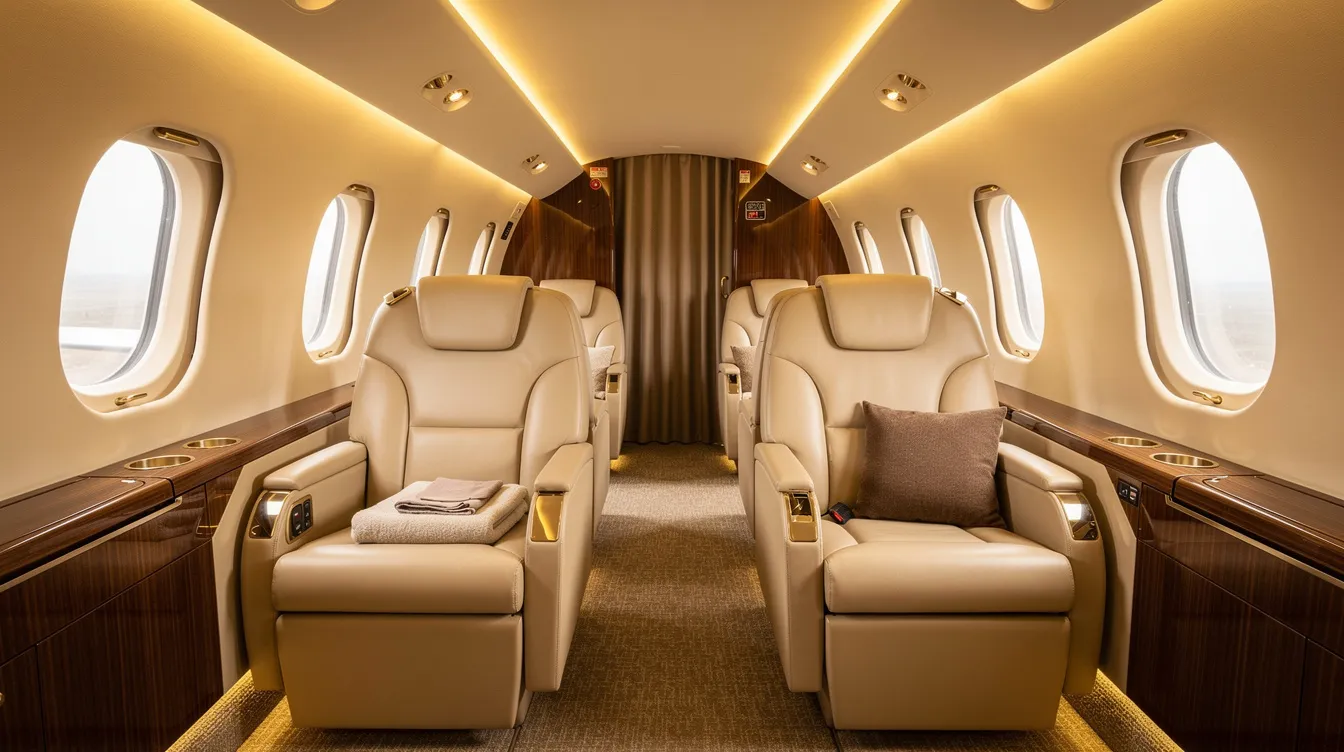
Spacious cabin architecture: with a cabin area of 550 square meters of usable floor space spread across two decks, the A380 accommodates features that other aircraft simply cannot. Emirates, the largest operator of the type, offers onboard shower spas and lounges. Singapore Airlines configured its A380s with wider seats, more personal space, and expansive first-class suites. Qatar Airways and British Airways have similarly invested in premium cabins that take advantage of the A380's generous dimensions. Korean Air and Nippon Airways also configured their A380 fleets to emphasize passenger comfort, making the type a passenger favorite on transoceanic routes.
Typical seating in business class and first class layouts delivers genuinely more personal space than any other commercial aircraft. However, for travelers who prioritize privacy, schedule control, and direct routing, private jets accessed through BlackJet offer even more personalized space per passenger—trading mega-airliner grandeur for intimacy, efficiency, and control over every element of the journey.
Safety, structure, and redundancy at extreme weights
Safely lifting and landing more than half a million kilograms demands structural design with multiple layers of redundancy built into every system.
The A380's 20-wheel main landing gear system spreads the aircraft's enormous weight across a wide footprint, protecting both the airframe and the runway surface. This distributed load design is essential for operating at weights that would destroy conventional pavement under fewer contact points.
The A380's hydraulic system operates at 350 bar pressure—significantly higher than previous-generation airliners. This higher operating pressure allows smaller, lighter actuators to control the aircraft's large flight surfaces despite its mass, contributing to overall weight reduction in the hydraulic system itself.
Structural safety factors ensure that primary components—wing spars, fuselage frames, landing gear struts—withstand loads significantly beyond anything encountered in normal flight, including worst-case turbulence, hard landings, and emergency maneuvers.
The safety record reinforces the engineering. As of early 2025, the A380 has had no hull-loss accidents despite over a decade and a half of heavy commercial operations, with the most significant incidents related to engines rather than core airframe failure. The type is consistently ranked among the safest passenger planes in service.
BlackJet applies the same philosophy to its fleet. While the aircraft are smaller, each operates under rigorous certification standards, with precise weight-and-balance controls verified before every departure. Safety is not a function of size-it is a function of discipline, engineering, and standards.
Weight, range, and long‑haul route planning
The classic payload-range tradeoff governs every long-haul flight: more weight in payload usually means less fuel or shorter range, and vice versa. For the A380, this tradeoff plays out at an enormous scale.
The A380-800's design range of approximately 15,200 km (about 8,000 nautical miles) assumes a realistic payload—not maximum structural payload. Airlines balance fuel weight against passenger and cargo loads on every route.
On ultra-long-haul city pairs such as Dubai to Los Angeles or Singapore to London, the A380 operates near its optimal weight-for-range envelope, carrying close to MTOW on departure.
Hot-and-high airports—Johannesburg (elevation 1,694 m), Mexico City (2,230 m) — or airports with shorter runways may require payload restrictions. At high elevation and warm temperatures, reduced air density degrades engine thrust and wing lift, meaning the aircraft cannot safely depart at full weight.
Pilots and dispatchers perform detailed performance calculations for every sector, balancing fuel weight, passenger count, cargo mass, and atmospheric conditions to ensure the aircraft remains within all certified limits.
BlackJet's flight support teams perform analogous calculations for every private jet departure. The scale is different—lighter jets, shorter required runways-but the discipline is identical: optimizing fuel, payload, and route to ensure safety margins are never compromised, regardless of aircraft size.
Airbus A380-800 variants, proposed upgrades, and weight considerations
Only the A380-800 passenger model entered full production, but Airbus studied several other aircraft variants with distinct weight targets:
A380F freighter: certificated but never brought into full commercial service, the freighter concept planned for a maximum payload of approximately 150 tonnes with a MTOW similar to or slightly above the passenger version (~590 tonnes). The structural reinforcement required would have further increased empty weight.
A380-900 stretch: a proposed longer-fuselage variant expected to carry more passengers and potentially push weights higher without major wing redesign. It remained a study.
A380plus and A380neo concepts: the 2017 A380plus study proposed an MTOW of approximately 578 tonnes alongside large winglets, cabin densification, and maintenance interval extensions. A re-engined A380neo was also discussed but never formally launched.
Each proposed variant had to contend with the same constraint: higher MTOWs would further restrict accessible airports, raise pavement requirements, and increase operating costs. None reached production. The limited market for ultra-large aircraft, combined with airlines' pivot toward flexible, lighter twin-engine operators, sealed the fate of heavier A380 derivatives.
The story of these variants illustrates a broader truth in aviation: weight targets do not exist in isolation. They interact with infrastructure, economics, and market demand in ways that determine whether an aircraft program succeeds or remains a study on paper.
FAQs about Airbus A380 Weight
Q1: What is the maximum takeoff weight (MTOW) of the Airbus A380?A1: The Airbus A380 has a maximum takeoff weight of approximately 575,000 kg (575 tonnes or 1,268,000 pounds), making it the heaviest operational passenger airliner ever mass-produced.
Q2: How does the operating empty weight (OEW) affect the A380's performance?A2: The OEW, around 277,000 kg (277 tonnes), represents the aircraft's weight without passengers, cargo, or usable fuel. It influences fuel efficiency and payload capacity, with lighter OEW enabling more passengers or fuel for longer range.
Q3: What is the maximum passenger capacity related to the A380's weight?A3: The A380 is certified to carry up to 853 passengers in an all-economy configuration, but typical three-class layouts seat about 525 passengers. Passenger count directly impacts the aircraft's total weight and fuel requirements.
Q4: Why does the A380 require special airport infrastructure?A4: Due to its high maximum takeoff weight and large size, the A380 needs runways capable of supporting its weight and gates designed for its wingspan and height. Pavement strength, wake turbulence separation, and ground handling equipment are all scaled to its mass.
Q5: How does the A380's weight compare to private jets?A5: The A380's MTOW is roughly 10 times that of large-cabin private jets like the Gulfstream G650, which weighs around 45 tonnes. This vast difference explains the contrasting operational flexibility and airport access between the two aircraft types.
Q6: What materials help reduce the A380's structural weight?A6: The A380 extensively uses carbon-fiber reinforced plastic (CFRP), GLARE (glass-fiber reinforced aluminum laminate), and advanced aluminum-lithium alloys to reduce weight while maintaining strength and safety.
Q7: How does the A380's weight influence its fuel efficiency? A7: While heavy, the A380's large passenger capacity allows it to achieve competitive fuel burn per passenger-kilometer, especially when fully loaded. Its advanced aerodynamics and lightweight materials also contribute to efficiency.
Q8: Can the A380 operate from any airport?A8: No, the A380 is restricted to a limited number of airports worldwide that can accommodate its runway length, pavement strength, gate size, and wake turbulence category.
Q9: How has the A380's maximum takeoff weight evolved over time?A9: The MTOW increased from about 560 tonnes in early models to approximately 575 tonnes in later variants, reflecting structural improvements and performance optimizations.
Q10: What impact does the A380's weight have on passenger comfort?A10: The aircraft's size and weight contribute to a smoother ride with reduced turbulence sensitivity and lower cabin noise, enhancing passenger comfort on long-haul flights.
What Airbus A380 weight teaches about right‑sizing aircraft for travelers
The A380 proves what is technically possible at the extreme of passenger-aircraft weight. It is an engineering triumph—an aircraft that safely carries 575 tonnes off the ground, cruises for 8,000 nautical miles, and lands with surgical precision. But it also illustrates the limits of "bigger is better."
Key takeaways:
Very high MTOW demands concentrated traffic flows, specialized infrastructure, and consistent high demand. When any of those elements falter, the economics deteriorate rapidly.
Economic performance is outstanding only when seats are filled, routes are optimized, and the aircraft flies at high utilization. The A380 cannot hide empty seats.
Flexibility, frequency, and airport access often matter more than raw capacity. A smaller aircraft that departs on your schedule, from your preferred airport, and lands closer to your destination can save hours that a 500-seat airliner cannot.
Consider a scenario: a CEO based in New York needs to reach a meeting in Geneva. The commercial option involves a connecting flight through a major hub, potentially on an A380 for the transatlantic leg, adding layover time, ground transfers, and schedule rigidity. The alternative is a nonstop private jet arranged through a BlackJet Jet Card, departing Teterboro and landing at Geneva's city-center airport. The A380 may carry more passengers at a lower cost per seat, but the private jet delivers something no airliner can: total control over time.
The Airbus A380 remains a technological icon and a useful benchmark in global aviation. But for travelers who measure success in hours saved and experiences gained, the right aircraft is rarely the biggest one. It is the one that fits your mission precisely.
Discover how BlackJet's Jet Card programs match you to the ideal aircraft for every journey. Explore premium jet access tailored to your schedule—not an airline's.


 Sign up with google
 Sign up with Apple