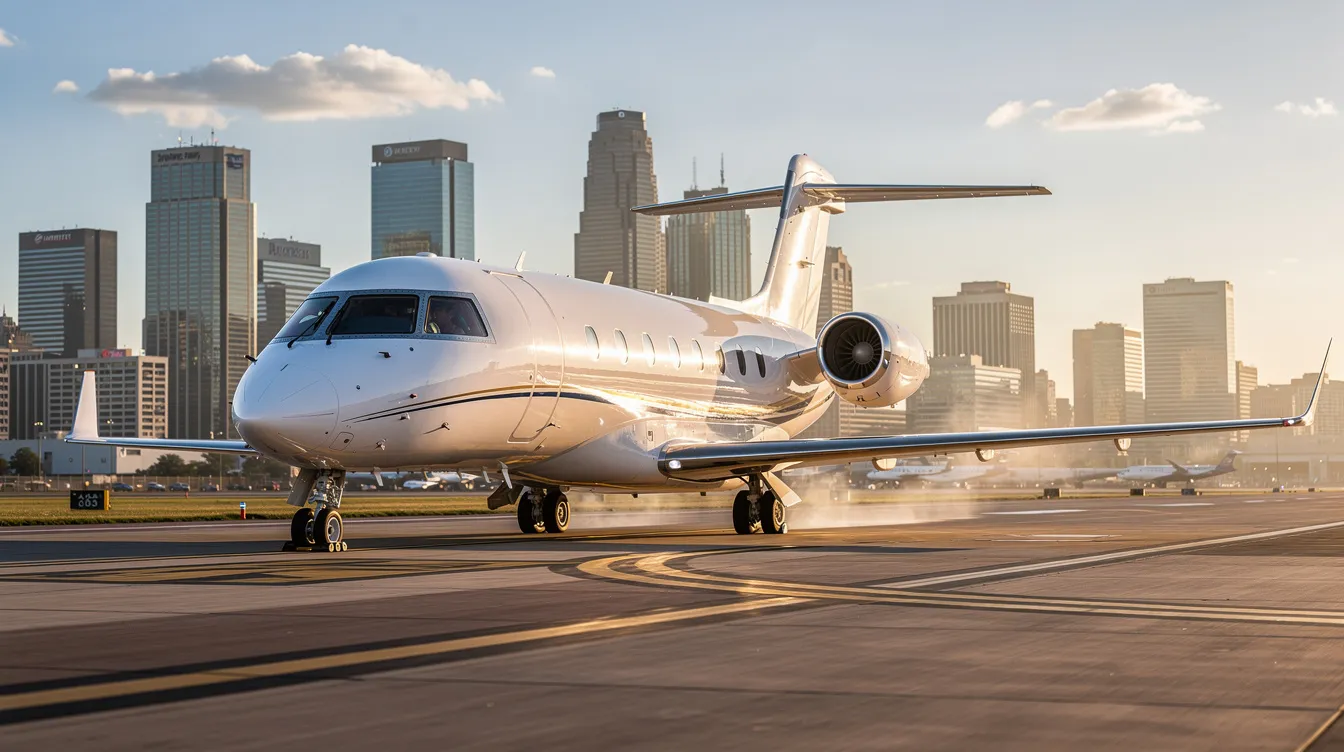
The BlackJet 25-Hour Light Jet Card gives frequent regional flyers a fixed, published entry point into private aviation. BlackJet lists this card at $50,000 with a base hourly rate of $5,484, and that rate is stated to include fuel surcharges and U.S. Federal Excise Tax. This page lays out the price, the aircraft you can expect, and which fees sit inside that rate versus which ones stay trip-dependent.
BlackJet 25-Hour Light Jet Card Price and What It Includes
Immediate answer (as of Jul 26, 2026): BlackJet lists a 25-hour Light Jet Card priced at $50,000 with a published base hourly rate of $5,484 that includes fuel surcharges and U.S. Federal Excise Tax. Other trip costs, such as airport fees, de-icing, international handling, catering upgrades, and ground transportation, can be trip-dependent, so review the fees section below for the full picture.
That inclusion detail matters more than most buyers expect. Many programs advertise a lower headline number, then add the 7.5% tax and a fuel surcharge at billing. BlackJet folds both into its published Light rate, which makes 25 hour jet card pricing easier to compare against quotes that read "plus tax." The BlackJet 25-Hour Light Jet Card price is published up front, not buried in fine print.
All-in pricing means the quoted hourly rate already includes mandatory taxes and surcharges that many providers add later, most commonly the 7.5% Federal Excise Tax and fuel surcharges. For market context, jet card hourly rates in 2026 typically run from roughly $5,000 to $7,500 per hour for light jets, according to Jettly's pricing guide.
| | | | Price snapshot for the BlackJet 25-Hour Light Jet Card |
Card type | Hours | Published base hourly rate | Published inclusions | Confirm in agreement |
|---|
BlackJet 25-Hour Light Jet Card | 25 | $5,484/hour | Fuel surcharge: Yes. FET: Yes. | De-icing, airport and handling fees, international handling, catering, ground transport |
These fixed hourly rates give you a clean starting number for budgeting. For a deeper look at package math, see our guide to 25-hour jet card costs.
What a 25-Hour Jet Card Is and How BlackJet's Version Works
A 25-hour jet card is a prepaid or pre-arranged block of flight time that lets you book private flights under a single pricing structure, instead of re-quoting every trip in the open charter market. BlackJet offers both a 25-Hour Jet Card and a 50-Hour Jet Card, and it sorts fleet access into four cabin classes: Light, Midsize, Super-Midsize, and Large Cabin. This page covers the Light Jet tier.
A fixed hourly rate is a published price per flight hour that doesn't shift with day-to-day market demand. The real question is which taxes and surcharges live inside that fixed number.
BlackJet publishes two ways to buy the 25-hour program: a Pay-As-You-Fly option at $50,000 and a Fully-Funded 25-Hour Jet Card at $225,000. Confirm the exact billing mechanics for how hours draw down in your agreement, since programs differ on that point. Booking runs through the BlackJet mobile app on iOS and Android, by text message quote and booking, or through the cardholder web portal, with 24/7 support behind it.
"A light jet card is designed to make frequent regional travel more predictable by replacing repeated market shopping with a consistent pricing framework. The real value comes from understanding exactly what's included in that published rate before comparing it with other programs."
- Justin Crabbe, CEO
One distinction shapes every jet card decision. Guaranteed availability commits a provider to source an aircraft within set rules. Marketplace availability depends on what happens to be for sale that day, a contrast explained well in Jettly's availability breakdown. Among private jet card providers 2026 shoppers compare, the ones worth shortlisting publish both their rates and their inclusions. For a primer on the category, read what a jet card is.
Aircraft You Can Expect on the BlackJet Light Jet Card
BlackJet's light jet category seats up to 7 passengers, with an average speed of 516 mph and an average range of 1,149 statute miles, roughly a New York to Atlanta run. A light jet is a private jet category built for short to mid-range missions, typically seating up to about 6 to 7 passengers with lower operating costs than midsize or large-cabin aircraft.
BlackJet Certified light jets include the Citation Bravo, Citation CJ2+, Citation CJ3+, Citation Encore+, Citation M2, HondaJet, Learjet 70/75, Lear 40XR, Phenom 300, and Beechjet 400A. These sample aircraft cover everything from efficient short hops to faster, roomier light cabins.
"The best aircraft for most private flights isn't necessarily the biggest one, it's the aircraft that efficiently matches the passenger count, route, and baggage requirements. Light jets remain one of the most practical categories because they balance performance, accessibility, and operating efficiency for a wide range of missions."
- Justin Crabbe, CEO
These aircraft examples show sample aircraft and their best-fit trips.
| | | Light jet examples on the BlackJet Light Jet Card |
Aircraft model | Typical seats | Best for | Notes |
|---|
Phenom 300 | Up to 7 | Faster regional legs, popular light cabin | Strong range for the class; baggage varies by configuration |
Citation CJ3+ | Up to 7 | Efficient 1 to 3 hour trips | Comfortable light cabin |
HondaJet | Up to 5 | Short hops, smaller airports | Efficient operating profile |
Learjet 75 | Up to 7 | Speed on medium light-jet legs | Roomier light cabin |
Citation M2 | Up to 6 | Cost-aware short trips | Entry light cabin |
Match the aircraft to the mission. Light jets shine on 1 to 3 hour trips, regional hops, and access to smaller airports. For longer legs or more cabin room, step up to midsize choices like the Citation XLS+ or a super-mid, all covered under BlackJet's cabin class options. One practical note: aircraft is typically assigned by category, not by a guaranteed specific tail or model unless you contract for one, which matches how the wider industry allocates lift per Jettly.
How BlackJet Light Jet Card Pricing Math Actually Works
Start with one line: estimated flight cost = published hourly rate × billable flight time (+ trip-dependent pass-through charges). Plug BlackJet's fixed hourly rates into the formula and the math gets simple.
Take a non-peak, domestic, same-day out-and-back with 2.0 occupied hours in the air. That works out to 2.0 × $5,484 = $10,968. This example leaves out trip-dependent pass-through charges like de-icing or certain airport fees, covered in the fees table further down. A common route like Teterboro to Miami runs roughly 2.5 to 3.0 occupied hours; at $5,484 that lands near $13,710 to $16,452 before any pass-through items.
An occupied hour is the time you're actually on board the aircraft in flight, as billed by the program, not necessarily the total time the aircraft spends repositioning or waiting.
Here is where quotes get confusing. Many providers list a rate "plus 7.5% Federal Excise Tax (FET)," and some quote "inclusive of fuel, plus 7.5% FET," as shown in this Northern Jet card example. Normalize the tax and an all-in pricing number and a plus-FET number can land in the same place, a point Jettly makes in its pricing guide.
| | | All-in versus plus-FET, normalized (illustrative) |
Quoting approach | Quoted rate | Add 7.5% FET | Effective all-in hourly |
|---|
All-in quote (BlackJet style) | $5,484 | Already included | $5,484 |
Plus-FET quote | $5,101 | +$383 | $5,484 |
"When evaluating any jet card, buyers should separate the published hourly rate from the total trip cost. A transparent program clearly identifies which taxes and surcharges are already included, explains which expenses remain trip-dependent, and allows travelers to budget with confidence before they fly."
- Justin Crabbe, CEO
Before you sign, confirm these four items, since they move your real jet card price:
Daily or segment minimums
Taxi-time billing rules
Peak day rules and how they change notice or cost
Interchange ratios if you move up a cabin class
BlackJet also lists up to 15% efficiency discounts on eligible round-trip flights, which can lower effective cost on out-and-back routes. Our jet card tax guide digs deeper into how FET applies.
What Fees Are Included Versus Billed Separately
The published BlackJet Light rate explicitly includes two things buyers usually watch for: fuel surcharges (FSC) and the 7.5% Federal Excise Tax. That is the answer to what fees are included at the rate level. Most other charges depend on the specific trip.
Included as program features, not line-item fees, you also get BlackJet Certified safety vetting with access to a pre-flight Safety Report, sustainability offsets at zero cost to clients since the beginning of 2021, complimentary Wi-Fi, 24/7 support, and booking by app, text, or web.
Trip-dependent items commonly billed as pass-throughs include de-icing, airport and landing and handling fees, international permits and handling, overnight crew costs, special catering, ground transportation, pet or special handling where offered, and international taxes and fees. Many jet card programs bill these as pass-throughs, so confirm BlackJet's treatment of each in your agreement.
A pass-through fee is a cost charged by airports, handlers, or third parties that a jet card provider bills to you at cost or near cost, instead of bundling it into the hourly rate.
Fuel surcharges deserve special attention. They often move with fuel indexes and can appear as a separate, variable add-on that surprises buyers, as JetCards.org explains in its fuel surcharge explainer. BlackJet's published Light rate states fuel surcharges are already included, which removes one moving part. Policies vary by provider and over time; a 2026 report notes that NetJets says no fuel surcharge for its current jet card customers. Peak-day surcharges and fee add-ons also range widely across the market per Jettly. Competitor pricing guides frequently highlight hidden fees and peak-day traps, as Fly Elite Jets does in its 2026 pricing guide, which is exactly what a clear matrix prevents.
| | BlackJet Light Jet Card fees matrix |
Included per BlackJet published rate | Often billed separately in jet card programs (confirm) | Optional upgrades |
|---|
Fuel surcharges | De-icing | Premium catering |
7.5% Federal Excise Tax (FET) | Airport, landing, and handling fees | Ground transportation upgrades |
BlackJet Certified vetting and Safety Report | International permits and handling | Larger cabin for a given leg |
Emissions offsets at zero cost | Overnight crew and international taxes | Special handling requests |
Wi-Fi and 24/7 support | Pet or special handling (where offered) | Concierge and partner experiences |
For a plain-English foundation, see our jet card pricing basics.
Fixed Rates, Guaranteed Availability, and Peak-Day Questions to Ask
Guaranteed availability is a contract-backed promise to provide an equivalent aircraft category when you book within required notice and follow peak-day and service-area rules. In private aviation, guaranteed availability usually means a guaranteed category of aircraft within a required notice window, not a specific tail number on demand, a definition drawn from Jettly's guide.
Three terms shape how that plays out. A callout window is the minimum notice you must give to trigger guaranteed service. A peak day is a contract-defined high-demand date when notice requirements or pricing can change. A substitution is when the provider supplies a different aircraft of the same category if the first choice is unavailable.
BlackJet states its 50-Hour Jet Card rates are guaranteed fixed for 12 months and that Jet Card hours never expire. Treat that as a related program fact, and confirm in writing how fixed hourly rates, peak-day rules, and any peak day surcharge apply to the 25-hour Light card for your travel pattern. On the operations side, the BlackJet app shows when an aircraft has completed its safety checks and gives access to a pre-flight BlackJet Certified Safety Report.
Ask these seven questions before you buy:
What notice is required for guaranteed availability?
How are peak days defined, and can they change?
What happens if the assigned aircraft goes AOG (a maintenance issue) before departure?
Is there a written substitution hierarchy, and what credits apply for a downgrade?
How is billable time calculated (taxi time, daily minimums, segment minimums)?
What is included in the fixed hourly rate beyond fuel surcharges and FET?
Can you switch cabin size at fixed rates, and how is it debited?
| | Jet card terms that change your total cost |
Term | Plain-English meaning | Why it changes your cost or risk |
|---|
Guaranteed availability | Category guaranteed within notice rules | Sets whether you can fly on demand during busy periods |
Callout window | Minimum notice to trigger service | Short notice may cost more or fall outside the guarantee |
Peak day | Defined high-demand date | Can add a peak day surcharge or longer notice |
Substitution | Equivalent aircraft swapped in | Affects cabin, baggage, and comfort on the day |
Industry lead times often fall in a 10 to 72 hour range depending on program and peak days, per Jettly. To watch your balance across trips, see how to track jet card hours.
BlackJet Versus NetJets, Jet Linx, Magellan, and Marketplace Charter
Comparing jet cards is hard since providers quote rates differently. An apples-to-apples comparison means converting every quote into an effective hourly cost that includes the same taxes and surcharges, above all FET and fuel. When comparing jet cards, the headline hourly rate is meaningless unless you confirm whether Federal Excise Tax and fuel surcharges are included.
BlackJet publishes its Light card at $50,000 and $5,484 per hour, fuel and FET included. NetJets, per a 2026 report, states no fuel surcharge for its current jet card customers, and it frames its options around cost predictability in its membership comparison. Jet Linx markets fixed hourly rates and no peak-day surcharges on its jet card page. Magellan Jets promotes fixed, transparent hourly rates and no peak-day surcharges as well. Marketplace charter platforms price dynamically, trading guaranteed availability for spot-market flexibility. Other names buyers weigh include Flexjet and Sentient Jet. Some providers keep a fuel surcharge capped at a set ceiling, so read each policy closely.
| | | | | Jet card provider comparison |
Provider | Pricing style | Fuel surcharge approach | Peak-day approach | Best for | Source |
|---|
BlackJet | All-in (fuel + FET included) | Included in published Light rate | Confirm rules in agreement | Fixed-rate light jet entry | BlackJet |
NetJets | Membership, varies | No fuel surcharge for current jet card customers | Varies | Large branded fleet | report |
Jet Linx | Fixed hourly | Stated policy on card page | States no peak-day surcharges | Local base model | Jet Linx |
Magellan Jets | Fixed, transparent hourly | Stated policy on card page | States no peak-day surcharges | Tiered card hours | Magellan |
Marketplace charter | Dynamic pricing | Varies by quote | Demand-based | On-demand flexibility | Jettly |
The simplest way to avoid surprise add-ons is to prioritize programs that state clearly what sits inside the quoted hourly rate. BlackJet does that by including fuel surcharges and FET in its published Light rate, a strong mark among the best private jet card programs on transparency. For a deeper competitor breakdown, see our explainer on NetJets jet card cost.
How to Book and Use the BlackJet 25-Hour Light Jet Card
Once your card is active, booking can be as fast as opening the app. The flow is short and built around the BlackJet Certified safety layer.
BlackJet Certified is BlackJet's multi-step safety and quality vetting process that individually certifies operators, aircraft, pilots, and flights before they can serve cardholders, checking operators against recognized ratings such as ARGUS, Wyvern, and IS-BAO.
Choose your card structure, Pay-As-You-Fly or Fully-Funded, and confirm the terms.
Request a quote in the BlackJet app, by text message, or through the web platform.
Review the aircraft details and the BlackJet Certified Safety Report.
Confirm passenger count, baggage, pets or special requests, catering preferences, and ground transportation.
Book a private jet in-app and get real-time updates, with 24/7 support on call.
BlackJet cardholders can request quotes and book flights through the mobile app, by text message, or through the cardholder web platform at app.blackjet.com. To see how pricing comes together for your routes, get an accurate quote before you commit to a jet card program.
Frequently Asked Questions
How much does the BlackJet 25-Hour Light Jet Card cost?
BlackJet lists its 25-hour Light Jet Card at $50,000, with a published base hourly rate of $5,484 that includes fuel surcharges and U.S. Federal Excise Tax. Trip-dependent pass-through items, like de-icing or certain airport fees, can still apply, so confirm what is bundled in your agreement.
Is Federal Excise Tax included in BlackJet's hourly rate?
For the BlackJet 25-hour Light Jet Card, BlackJet states the published $5,484 hourly rate includes the 7.5% Federal Excise Tax. Many competitors quote "plus FET," so normalizing that one line item can change your effective hourly cost, as the Northern Jet example and Jettly's guide both show.
Are fuel surcharges included with the BlackJet 25-Hour Light Jet Card?
Yes, BlackJet states the published Light Jet Card hourly rate includes fuel surcharges. Fuel surcharges can otherwise be a separate, variable add-on tied to fuel indexes, which is why JetCards.org flags them as a line to verify with any provider.
What aircraft can I fly on a BlackJet Light Jet Card?
BlackJet Certified light jets include models such as the Phenom 300, Citation CJ3+, Citation CJ2+, Citation M2, HondaJet, and Learjet 70/75. The category seats up to 7 passengers, averages 516 mph, and covers about 1,149 statute miles, enough for a New York to Atlanta run.
Does BlackJet offer fixed rates, and do they change during peak travel periods?
BlackJet publishes a fixed base hourly rate for its Light Jet Card, and you should confirm in writing how peak-day rules and substitutions apply to your travel pattern. Guaranteed availability always carries conditions, such as a callout window and peak-day definitions, so the details belong in your agreement.
How do I book a flight with BlackJet?
BlackJet cardholders can request quotes and book through the BlackJet mobile app, by text message, or through the cardholder web platform, with 24/7 support. The app also gives access to a pre-flight BlackJet Certified Safety Report before you fly.
Does BlackJet do anything about sustainability?
BlackJet states that since the beginning of 2021, every flight flown by Jet Card Owners is offset to be both carbon and emissions neutral at zero cost to clients. Its program offsets 300% of each flight's impact, going past CO2 to cover water vapor, aerosols, and nitrous oxide.
How does BlackJet compare to NetJets, Jet Linx, and Magellan Jets?
The cleanest way to compare providers is to normalize every quote to an effective hourly rate that includes the same taxes and surcharges, above all FET and fuel. BlackJet includes both in its published Light rate; NetJets states no fuel surcharge for current jet card customers, and Jet Linx and Magellan Jets market no peak-day surcharges on their pages.
The Bottom Line on the BlackJet Light Jet Card
The BlackJet 25-Hour Light Jet Card stands out for one reason above the rest: it publishes the number and states what the number includes. $50,000 for the card, $5,484 per hour, fuel surcharges and FET built in. That clarity makes budgeting and provider comparison far easier than reading a quote that hides tax and fuel until billing. Your total jet card price still depends on trip-specific pass-throughs, so confirm them up front.
Request a BlackJet Light Jet Card quote to confirm your all-in rate, peak-day rules, and any pass-through fees for your most common routes. If you already know your typical city pairs, include them for an apples-to-apples comparison. Call 1-866-321-JETS (5387) or email info@blackjet.com.
How We Built This Page
Pricing and product details reflect BlackJet's published figures for the 25-Hour Light Jet Card as of Jul 26, 2026, including the $50,000 card price and the $5,484 base hourly rate stated to include fuel surcharges and Federal Excise Tax. Market context, competitor policies, and fee mechanics come from the linked sources in the references. Variable items are labeled "confirm in your agreement" where terms differ by trip or change over time. For verification, contact BlackJet at 1-866-321-JETS (5387) or info@blackjet.com.
References
Jet Card Pricing and Rates, Jettly. 2026 hourly ranges, all-in versus plus-FET framing, and fee categories.
Guaranteed Availability vs Marketplace Availability, Jettly. Definitions of guaranteed availability, callout windows, peak days, and substitution.


 Sign up with google
 Sign up with Apple