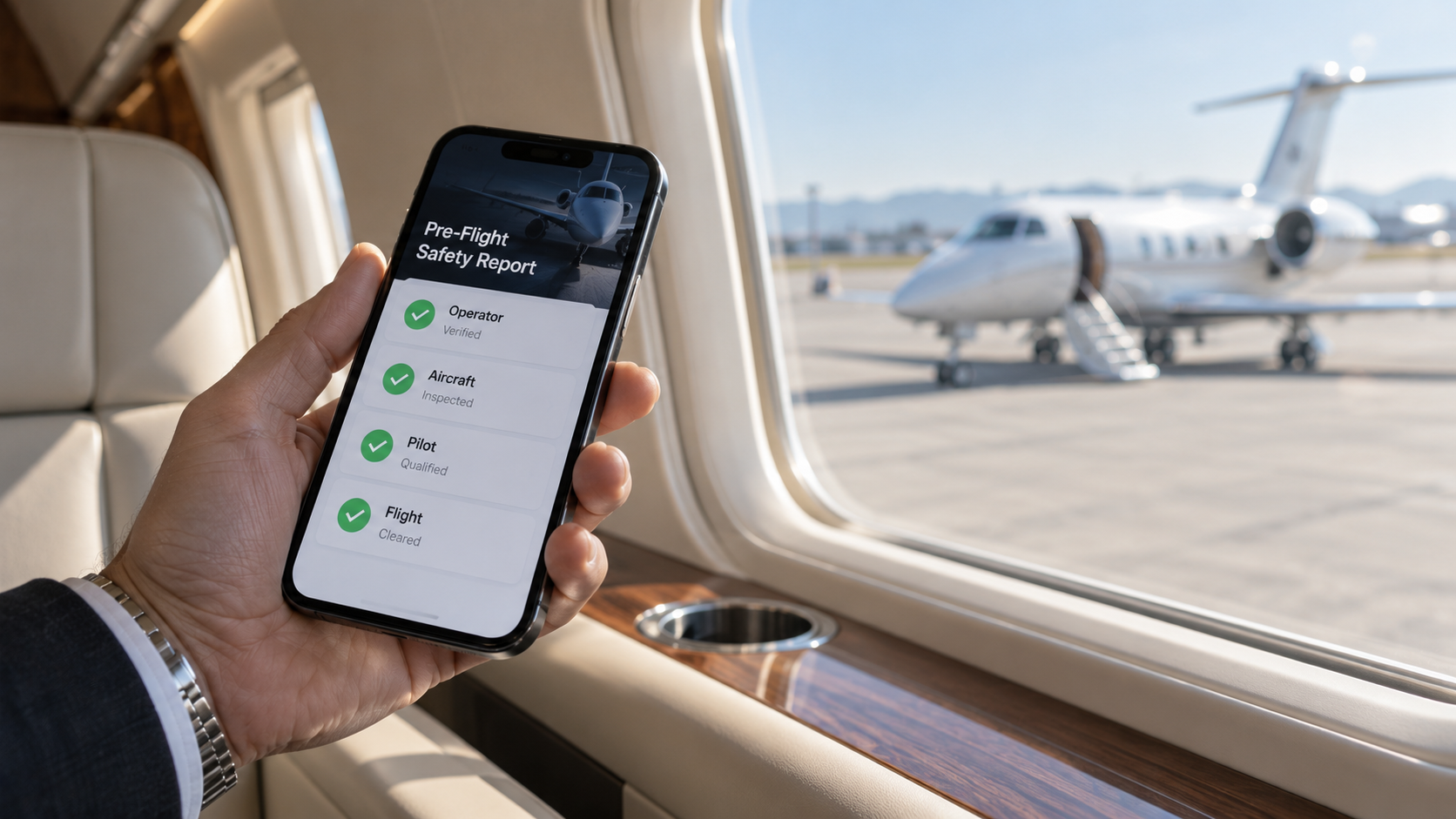
Private jet safety at BlackJet is built on a documented, flight-by-flight system you can verify before you book and before you fly. Most private aviation companies say safety comes first. Far fewer show you the mechanics behind that claim. BlackJet safety standards work as a documented operating system, not a slogan, built on three connected parts for private aviation customers—especially frequent flyers who want transparent, verifiable standards before every trip. BlackJet safety standards are BlackJet's documented, flight-by-flight safety program that certifies the operator, aircraft, pilot, and flight, adds independent oversight through a Safety Advisory Board, and provides a Pre‑Flight Safety Report in-app before departure. This article explains how that process screens operators and aircraft, sets pilot standards, handles safety escalations, and compares BlackJet's approach with FAA baselines and third-party ratings, so travelers can judge risk with flight-specific information instead of broad promises.
What Are BlackJet Private Aviation Safety Standards
BlackJet safety standards combine a four-part BlackJet Certified Process (operator, aircraft, pilot, and flight), independent oversight from a Safety Advisory Board, and a flight-specific Pre‑Flight Safety Report that confirms key safety checks are complete before departure. Flights are operated by certified operators, commonly FAA Part 135 operators in the U.S., and BlackJet layers its own screening on top of that baseline.
BlackJet Certified Process screens the operator, aircraft, pilot, and the specific flight.
Safety Advisory Board provides governance-level oversight of how standards are set and updated.
Pre‑Flight Safety Report shows, in the app, that required checks are done for your trip.
Certified operator baseline means each flight runs on an FAA Part 135 or EASA-certified operator.
Before every flight review ties approval to the exact operator, tail number, and crew assigned.
You can review the program next to the BlackJet Jet Card to see how safety fits the wider membership. BlackJet states that fewer than 30% of the more than 575 charter jet operators in the U.S. pass the certification required to serve its clients, even though FAA Part 135 charter flights operate against a measurable accident rate baseline of 0.76 per 100,000 flight hours. BlackJet is designed to make private jet safety verifiable by showing a flight-specific Pre‑Flight Safety Report in the app, not just a generic safety claim.
BlackJet Safety Standards at a Glance
Private aviation safety works in layers. Picture a stack: a regulatory baseline, provider-level controls, then a flight-specific review of the exact trip you are taking. Layered like a formal aviation safety management system, these controls move from broad rules down to the single flight in front of you. This layered view is the simplest way to picture BlackJet safety standards.
The first layer is the regulatory baseline. In the U.S., charter flights are typically flown by an FAA Part 135 operator that holds an air carrier certificate and meets federal operating rules. In the broader air transportation landscape, commercial airlines operate under a lower fatal accident rate of about 0.006 per 100,000 flight hours, so comparing private jets with commercial flights starts with different oversight models and safety records rather than assumptions about overall safety. Scheduled commercial airlines recorded zero passenger fatalities in 2023, while private aviation tends to post higher accident rates even though fatalities are far rarer than in broader general aviation, which matters to passengers evaluating private jets. The second layer is BlackJet Certified, BlackJet's proprietary operator vetting across operator, aircraft, and pilot, plus a review at the flight level. The third layer is governance, where an independent Safety Advisory Board works alongside Chief Safety Officer Jake Miller to review how standards are set. The fourth layer is transparency: the Pre‑Flight Safety Report sits in the BlackJet app and updates in real time as checks are completed.
BlackJet says its safety program draws on more than 10 years of proprietary data, including over 300 million data points on certified aircraft, pilots, airports, and operational details, gathered from thousands of flights for more than 5,000 Card Owners. A flight-specific safety review is a pre-departure verification process that evaluates the specific operator, tail number, pilots, and operational conditions for the exact trip you're about to fly. BlackJet's safety program is structured around flight-specific verification, so approval is tied to the actual operator, aircraft, pilot, and trip, not just the brand name on the booking.
Readers new to the model can start with a short explainer on what a jet card is before comparing safety programs.
Pillar | What it does | What the traveler can see |
|---|
BlackJet Certified Process | Screens operator, aircraft, pilot, and flight | Certified status inside the app |
Safety Advisory Board | Reviews policy, criteria, and escalation standards | Governance described in BlackJet safety materials |
Pre‑Flight Safety Report | Confirms checks for your specific trip | Pre‑Flight Safety Report in app |
What BlackJet Certified Means and What It Does Not
Certification is not a guarantee of risk-free flight. BlackJet Certified is documented screening, not a promise that nothing can go wrong. Being clear about that distinction is part of honest private aviation safety standards.
BlackJet Certified is BlackJet's proprietary vetting designation indicating that the operator, aircraft, pilot, and flight have passed BlackJet's safety screening for that trip. The BlackJet Certified Process runs in four parts and repeats per flight. BlackJet states its pilots must meet standards that exceed FAR Part 135 requirements across multiple categories. BlackJet typically coordinates with FAA Part 135 operators in the U.S. or EASA-certified operators in Europe, vetting them against its own criteria rather than relying on a certificate alone.
This matters most for people who fly often. Frequent flyers rarely take the same aircraft twice. A consistent BlackJet Certified Process reduces variability when trips span multiple operators and tail numbers. BlackJet says fewer than 30% of the more than 575 U.S. charter operators pass its requirements, and it says it arranges more flights than any other charter procurement company in the nation. BlackJet Certified is a screening and verification process; it does not eliminate aviation risk, but it is designed to reduce preventable risk through documented checks and clear escalation. In private aviation, pilot error drives roughly 75% of accidents, which is why reducing operational risks starts with rigorous crew screening on every private plane. Mechanical failures account for a much smaller share, about 18% in general aviation, which helps explain why screening both pilots and aircraft matters.
What it is | What it isn't | Why it matters |
|---|
Documented aircraft safety screening of operator, aircraft, pilot, and flight | A guarantee of a risk-free flight | Sets a repeatable bar across many operators |
A per-trip verification tied to your booking | A one-time badge that never changes | Catches issues that appear between trips |
BlackJet's own criteria on top of regulation | A replacement for the operator's legal responsibility | Adds screening without removing accountability |
If you are weighing programs, a broader jet card options guide shows where safety due diligence fits alongside pricing and access.
The BlackJet Certified Process Step by Step
The BlackJet Certified Process is a four-part certification that runs in sequence and repeats before every flight. Here is the workflow BlackJet describes, from operator screening through the final gate decision.
Operator eligibility screening. BlackJet reviews certificate status and operating history, treating third-party safety ratings as inputs rather than the sole decision-maker.
Aircraft screening. Each aircraft passes an evaluation of operational history and maintenance reliability, plus a detailed inspection of critical safety elements, comfort, and condition.
Pilot screening. Crew licensing, currency, and experience are checked against standards BlackJet says exceed the Part 135 baseline.
Flight risk review. Route, airport, and operational conditions for the specific trip are assessed, and flight crews analyze comprehensive route planning data before departure as part of flight operations oversight.
Real-time task force checks. A dedicated safety operations task force and real-time alerts confirm that required checks are complete prior to departure.
Report generation. BlackJet generates and publishes the Pre‑Flight Safety Report in the app.
Decision gate. The flight is approved, held for review, reassigned to a substitute aircraft or operator, or canceled if a concern cannot be resolved.
Post-flight logging. Trip data feeds the proprietary dataset, part of the 300+ million data points BlackJet uses for continuous improvement.
A decision gate is a required approval checkpoint where a flight is either cleared to proceed, put on hold for additional review, or rerouted to a different operator or aircraft. This is where operator and aircraft vetting turns into a yes, a hold, or a swap. BlackJet Certified is a four-part certification of the operator, aircraft, pilot, and flight, backed by real-time pre-departure checks and an in-app Pre‑Flight Safety Report. The result is verified safety documentation that clients can open before departure, and flexible scheduling can sometimes help avoid poor weather before flying to create a safer trip.
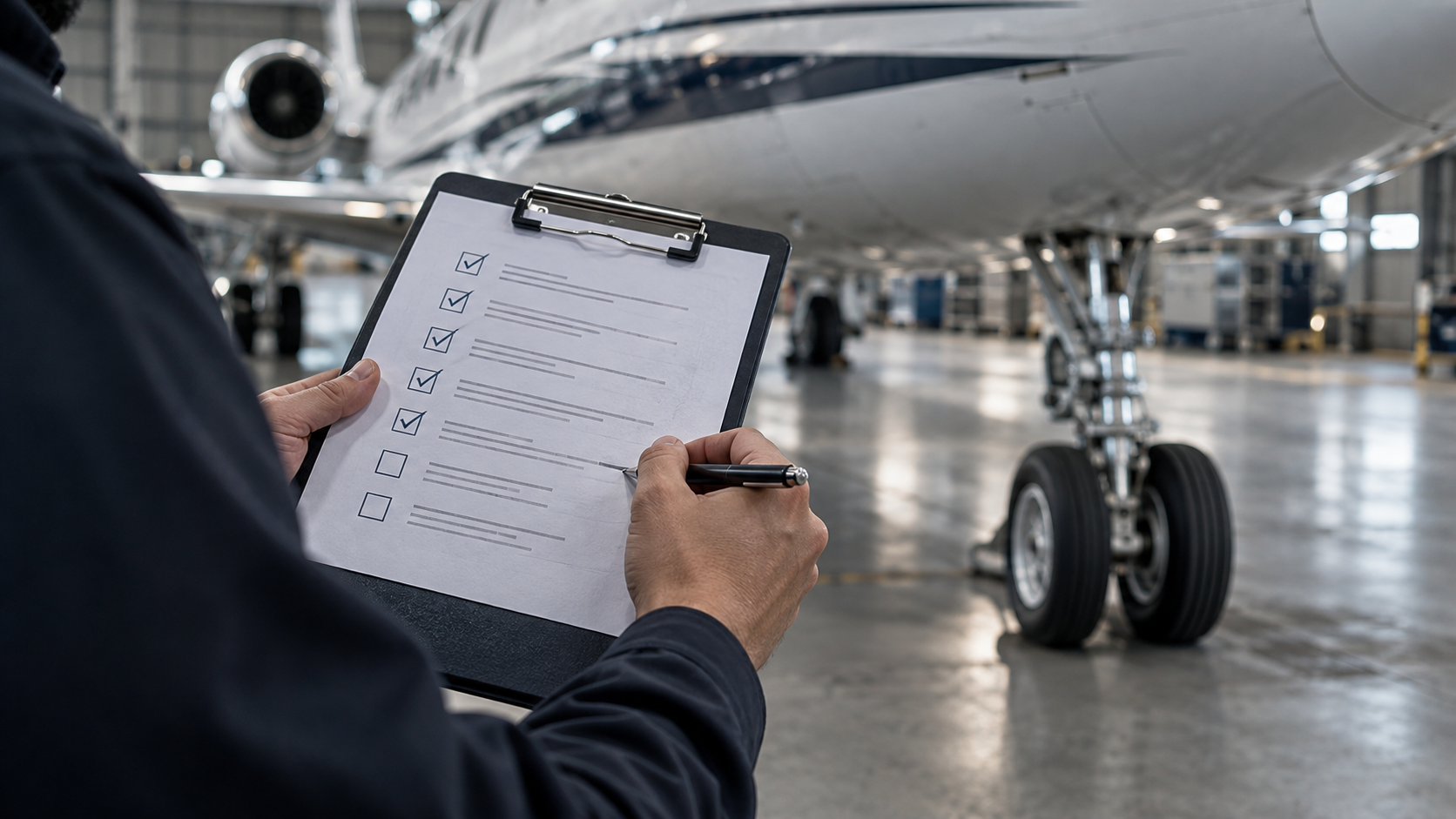
The BlackJet Certified Process moves from operator to aircraft to pilot to flight, then to report and gate decision.
Stage | What's verified | Evidence examples (client-safe) | When rechecked |
|---|
Operator | Certificate status and operating history | Operator certificate verification | At onboarding and before each trip |
Aircraft | Operational history and maintenance reliability | Maintenance status confirmed | Before each trip and after maintenance events |
Pilot | Licensing, currency, and experience | Pilot currency confirmed | Before each crew assignment |
Flight | Route, airport, and operational conditions | Flight conditions reviewed | Before departure, updated on changes |
Report | All checks consolidated for the trip | Pre‑Flight Safety Report generated | Reissued if trip details change |
Gate decision | Final clearance to proceed | Cleared, held, or substituted | At final review before wheels-up |
To see where these checks sit in the timeline, read how BlackJet handles private jet booking from request to departure.
The BlackJet Safety Advisory Board and Independent Oversight
BlackJet's Safety Advisory Board comprises former FAA and NTSB leaders and works alongside the company's Chief Safety Officer, Jake Miller. BlackJet describes it as the first of its kind in private aviation. Independent safety oversight is a governance layer where experienced aviation leaders review safety policy, risk trends, and decision standards to strengthen accountability beyond day-to-day operations.
The board's remit centers on the design of the program, not the piloting of any single flight. Members review how certification criteria are written, study incident and risk trends, weigh in on updates to screening rules, and help set escalation standards. That work feeds directly into how the Chief Safety Officer runs daily safety decisions. Any advisory model should manage conflicts of interest by keeping review functions separate from commercial pressure, so recommendations reflect safety first.
One thing the Safety Advisory Board does not do: it does not exercise operational control over a flight. Operational control stays with the certified operator and its crew. The board strengthens the rules and the accountability around them. BlackJet's Safety Advisory Board adds governance-level accountability by reviewing how BlackJet Certified standards are set and updated, working alongside the Chief Safety Officer.

Board responsibility | What it impacts |
|---|
Review certification criteria | How operators, aircraft, and pilots qualify for BlackJet Certified |
Analyze incident and risk trends | Updates to screening rules and thresholds |
Set escalation standards | How holds, substitutions, and cancellations are handled |
Advise on policy design | The structure of the BlackJet Certified Process |
Support the Chief Safety Officer | Daily safety decisions and accountability |
Safety governance is part of what you pay for in a membership model, which is worth keeping in mind when you compare jet card pricing.
How BlackJet Vets Operators and Aircraft
Here is what gets verified before an aircraft earns BlackJet Certified status. The point is not a single badge; it is a repeatable operator vetting routine that holds up trip after trip.
Operator checks start with certificate status and a review of operating history across private jet companies. Top-tier providers commonly point to standards such as ARGUS and IS-BAO, alongside ratings like Wyvern Wingman, as inputs where available and relevant to different regulatory requirements. Aircraft checks cover an evaluation of operational history and maintenance reliability, with newer aircraft often benefiting from advanced technology and the advanced avionics found in modern turbine-powered private jets, followed by a detailed inspection of critical safety elements, comfort, and condition before certification. Aircraft maintenance reliability is a measure of how consistently an aircraft's maintenance history and operational record support dependable, airworthy operation without recurring safety-critical discrepancies.
A static "certified aircraft list" is not enough on its own. Aircraft change status between trips, so each flight still gets a review that ties back to the Pre‑Flight Safety Report. Operators must follow strict manufacturer-recommended maintenance schedules and mandatory 100-hour inspections where applicable. That per-trip step is the difference between a one-time approval and ongoing aircraft safety screening. Some aircraft maintenance records and audit files are held under security and compliance controls and are not published publicly, which is normal for verified safety documentation of this kind. BlackJet Certified aircraft must pass an operational-history and maintenance-reliability evaluation plus a detailed inspection before being offered to Card Owners.

Check | Why it matters | When it's reverified |
|---|
Operator certificate status | Confirms the operator is authorized to fly charter | At onboarding and before each trip |
Operating history review | Surfaces patterns in performance and reliability | Periodically and before each trip |
Third-party safety ratings | Independent audit signals feed the review | When credentials renew or lapse |
Aircraft maintenance records | Shows the aircraft is airworthy and consistently maintained | Before each trip and after maintenance events |
Aircraft condition inspection | Confirms critical safety elements, comfort, and condition | Before certification and on a recurring basis |
Flight-level review | Ties the certified aircraft to your specific trip | Before every departure |
Trip details shape which aircraft and operator fit best, which in turn shapes the review. You can get a private jet quote to see how routing and passenger count affect aircraft selection.
Pilot Vetting and Standards
In private aviation, the pilot and operator matter as much as the aircraft. Strong qualifications from experienced pilots are a core part of passenger protection, and thorough pilot training is a central part of private jet safety. BlackJet says its pilots must meet standards that exceed FAR Part 135 requirements across multiple categories.
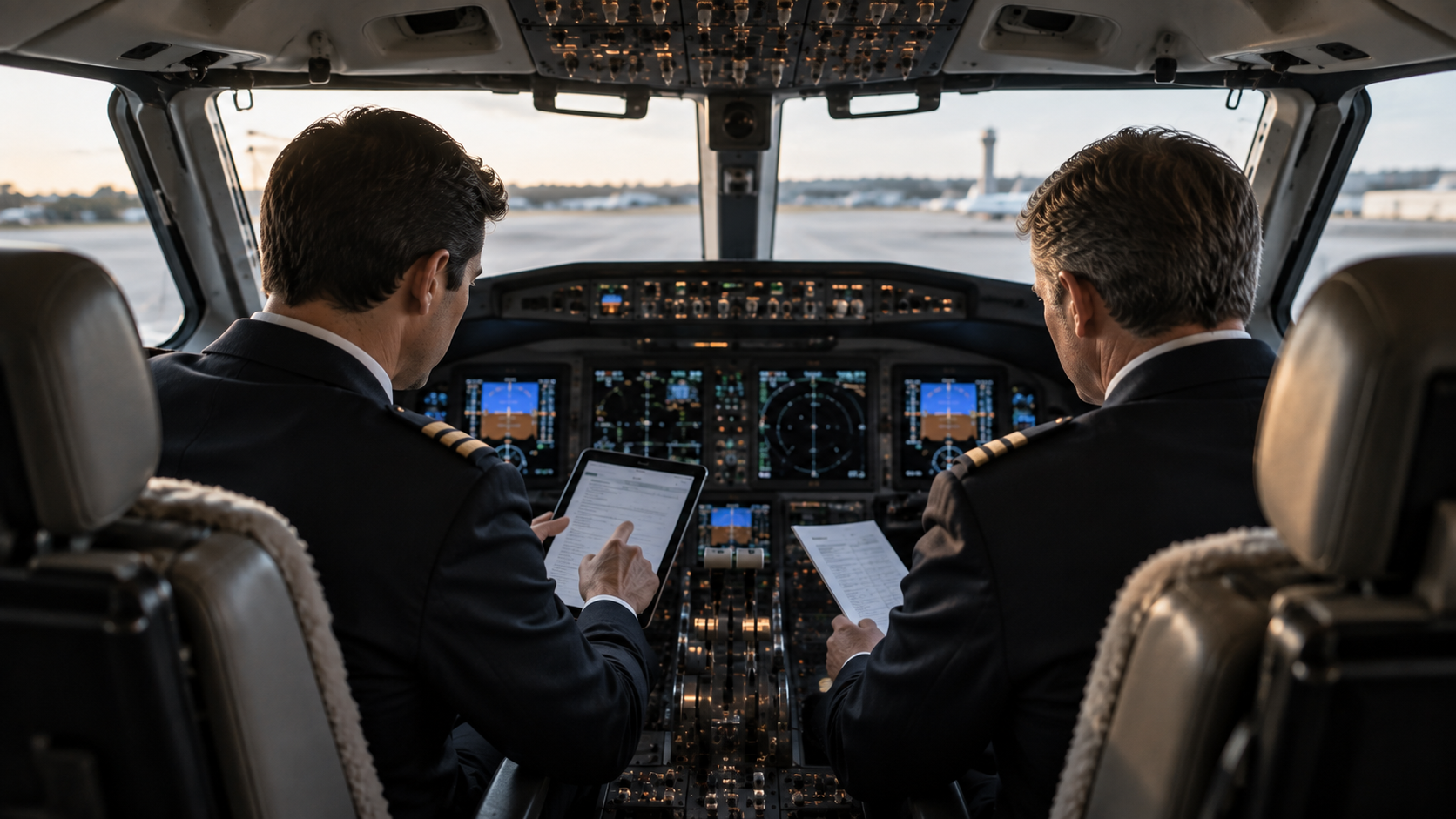
Pilot screening spans several categories: licensing and ratings, medical certification, recency and currency, recurrent simulator training, aircraft-specific experience, model-specific training, and regular emergency drills. Pilot currency means a pilot has completed the recent training, checks, and experience needed to legally and safely conduct a specific type of operation. The Federal Aviation Administration also imposes strict training and duty-limit rules, and charter operators often set high minimum flight hours for crews. Currency is flight-specific by nature, since night operations, instrument conditions, and aircraft type each carry their own recency expectations. That is why pilot qualifications are checked against the assignment, not just held on file.
Some of this information can surface in your report. Depending on report design, a pilot qualification indicator may show that crew licensing and currency were reviewed for your trip. BlackJet's pilot screening is designed to confirm that the crew assigned to your trip meets experience and currency standards that BlackJet says exceed FAR Part 135 baselines, including pilot experience supported by extensive flight hours and regular drills.
Pilot check | What it reduces |
|---|
License and ratings verification | Risk of an underqualified crew |
Medical certification | Risk from unaddressed fitness issues |
Recency and currency | Mismatch between recent experience and the operation |
Recurrent training | Skills drift between checkrides |
Aircraft-specific experience | Gap between mission complexity and pilot familiarity |
Commercial airlines operate with two pilots for safety, and airline captains typically qualify only after at least 1,500 flight hours, so private-jet crew standards should be viewed against that benchmark.
Consistent usage patterns help you plan which cabin category you tend to book, which can affect pilot and aircraft matching. A quick habit of learning to track jet card hours makes that planning easier.
The BlackJet Pre‑Flight Safety Report and How to Read It
A Pre‑Flight Safety Report is a flight-specific summary that documents the operator, aircraft, and pilot verification steps completed for the exact trip you're about to fly. It lives in the BlackJet app, which provides real-time updates showing when an aircraft has completed all safety checks and gives instant access to the pre-flight BlackJet Certified Safety Report. Where relevant to the assigned aircraft, it can also reflect checks tied to onboard safety systems and advanced avionics.
The report appears pre-departure. BlackJet's safety operations team reviews the underlying checks, and the Card Owner can open the report in the app. Each report carries a timestamp and a "valid as of" reference so you know how current the information is. This page was last reviewed on September 21, 2026, and the report you see in-app carries its own live timestamp for your specific flight. That freshness detail is what makes the report a genuine flight-specific safety review rather than a static document.
Limitations matter here. No report can promise a risk-free flight; it documents that required checks were completed. Depending on the aircraft, technologies that help crews make informed decisions can include weather radar and traffic-awareness tools. Specific examples include Enhanced Flight Vision Systems, Traffic Collision Avoidance Systems, Runway Overrun Awareness Systems, and Terrain Awareness and Warning Systems, which can be especially relevant to landing risk management. If a last-minute substitution occurs, a new report is issued for the replacement aircraft or operator, so the version you fly with always matches the trip. The BlackJet Pre‑Flight Safety Report is designed to show, in one place, that the operator, aircraft, and crew for your specific flight have cleared BlackJet Certified checks before every flight.
Report field | Why it matters |
|---|
Operator identity | Confirms who holds operational control of the flight |
Certificate verification indicator | Shows the operator's authorization was checked |
Aircraft make and model | Matches the aircraft to your booking |
Tail number (unique aircraft identifier) | Ties the report to one specific airframe |
Maintenance status indicator | Signals maintenance checks were confirmed |
Pilot qualification indicator | Shows crew licensing and currency were reviewed |
Departure and arrival airports | Confirms the routing under review |
Flight date and time window | Anchors the report to your trip |
Safety check completion status | Shows required checks are complete |
Report timestamp | Records when the report was generated |
Reviewer role title | Identifies the safety function that signed off |
A 90-second walkthrough of where to find the report in the app and how to read each field.
Multi-leg itineraries can generate more than one report, since each leg gets its own review. If you fly out and back, learn how round trips with a jet card map to per-leg reporting.
What Happens When a Safety Concern Is Identified
A clear escalation process is a documented, step-by-step method for holding a flight, resolving safety questions, approving a substitute option, and notifying the traveler before departure. BlackJet's sequence runs in four moves.
Hold. The flight is paused as soon as a check raises a question.
Investigate. The safety operations task force reviews the issue using real-time alerts and the underlying data.
Substitute or approve. BlackJet either clears the original flight or reassigns to a certified substitute aircraft or operator.
Notify. The Card Owner is informed of any change and receives an updated Pre‑Flight Safety Report.
A safety concern, at a high level, might be a documentation discrepancy, a maintenance reliability red flag, a pilot currency mismatch, or an operational constraint such as weather or airport limits; some private flights also use smaller airports or regional fields with simpler infrastructure, which is why airport-specific review matters. The dedicated safety operations task force and real-time alerts exist to catch these before departure, not after. From the traveler's side, the experience is straightforward: you are told what changed, whether that is the aircraft, the timing, or the routing, and the updated report reflects the new details. Access to thousands of smaller airports can be a benefit, but each location still requires a flight-specific safety review. If a BlackJet Certified check raises a concern, the flight can be placed on hold while BlackJet reviews the issue, and the aircraft or operator may be substituted before a new Pre‑Flight Safety Report is issued.
Consider an anonymized example. A planned aircraft was replaced after a pre-departure maintenance discrepancy surfaced during final review. BlackJet placed the leg on hold, sourced a substitute aircraft that cleared BlackJet Certified checks, and issued a new report before the trip departed. That is operator and aircraft vetting doing its job at the gate.
[Pending verification: number of safety-related substitutions or escalations in the last quarter, with methodology note; last reviewed September 21, 2026.]
Concern type | Typical resolution | What the traveler sees |
|---|
Documentation discrepancy | Re-verify or substitute operator/aircraft | Possible aircraft swap and updated report |
Maintenance reliability red flag | Hold and inspect, or substitute aircraft | New tail number and reissued report |
Pilot currency mismatch | Reassign qualified crew | Crew change reflected in the report |
Operational constraint | Adjust timing or routing | Updated schedule and report |
How BlackJet Standards Compare to FAA Baselines and Third-Party Ratings
Three ideas often get blurred together: compliance, certification, and ratings. Compliance is the legal floor set by regulators. Certification, in BlackJet's sense, is a private program layered on top. Ratings are independent audits of an operator. Keeping them separate makes private aviation safety standards easier to judge.
FAA rules define the legal baseline, and many charter trips run under an FAA Part 135 operator that holds an air carrier certificate. In business aviation, a private charter operating under Part 135 shows about 0.76 accidents per 100,000 flight hours, compared with roughly 0.9 to 1.1 fatal accidents per 100,000 flight hours in general aviation and far lower rates typically associated with airlines. On-demand charter flights under Part 135 post a 0.201 fatal accident rate per 100,000 flight hours, lower than general aviation overall, while owner-flown light aircraft have the highest accident rates. Third-party safety ratings are independent operator assessments that can indicate safety practices and auditing status, but they do not guarantee that any specific flight is risk-free. Programs such as ARGUS, Wyvern Wingman, and IS-BAO are widely recognized in the industry, and consumer guides that rank the best jet card programs often list them as decision factors. Operator marketing frequently leans on these badges, with audit status and safety management language featured prominently.
BlackJet uses those signals as inputs, then adds its own layer: the four-part BlackJet Certified Process plus a flight-specific Pre‑Flight Safety Report. FAA compliance is the legal baseline; BlackJet Certified adds additional screening and a flight-specific Pre‑Flight Safety Report so travelers can see that key checks were completed for their trip. For anyone searching for the best jet card programs for frequent private flights, safety consistency belongs next to pricing transparency in the value equation.
Dimension | FAA baseline | Third-party ratings | BlackJet Certified + Report |
|---|
Operator oversight | Certificate and federal rules | Independent operator audit | Operator vetted plus flight-level review |
Pilot standards | Minimum legal requirements | Audited training programs | Standards BlackJet says exceed Part 135 |
Aircraft maintenance | Required airworthiness | Program audits | Maintenance reliability checked per trip |
Flight risk review | Operator responsibility | Not trip-specific | Reviewed for your exact flight |
Transparency to traveler | Limited | Badge or rating | Pre‑Flight Safety Report in app |
Escalation mechanics | Operator-led | Not covered | Documented hold, substitute, notify |
Cost predictability and safety investment tend to move together in a membership model. If you are budgeting, start with the 25-hour jet card costs and compare them against a benchmark before weighing each program's safety transparency. For context, owned-fleet programs frame their structure differently from a procurement partner like BlackJet, and because private aircraft generally fly fewer total hours than major commercial airliners, rate-based comparisons are more useful than raw totals when judging safety regulations on a commercial plane or across commercial aircraft.

Frequently Asked Questions
What is the BlackJet Certified Process?
The BlackJet Certified Process is BlackJet's proprietary vetting system that certifies each operator, aircraft, pilot, and flight before a trip is cleared to fly. It runs in four parts, repeats per flight, and feeds the workflow diagram shown earlier, so safety approval is tied to flight-specific data rather than provider-level promises.
What is included in a BlackJet Pre‑Flight Safety Report?
A BlackJet Pre‑Flight Safety Report summarizes the verified operator, aircraft, and crew checks for your specific flight and indicates when required safety checks are complete. The field-by-field table above lists what appears, including the report timestamp and the reviewer role. If details change before departure, a new report is issued to match the aircraft you actually fly.
Who is on the BlackJet Safety Advisory Board?
BlackJet states its Safety Advisory Board includes former FAA and NTSB leaders who provide governance-level oversight alongside the Chief Safety Officer. The board reviews certification criteria, risk trends, and escalation standards, which shapes how the program is set and updated. BlackJet describes it as the first of its kind in private aviation.
How does BlackJet safety compare to FAA Part 135 requirements?
FAA Part 135 rules set the legal baseline for many charter operations, and BlackJet adds additional screening plus a flight-specific safety report to increase transparency and consistency. The comparison table above breaks this down across operator oversight, pilot standards, maintenance, flight risk review, transparency, and escalation.
Does BlackJet require ARGUS, Wyvern, or IS-BAO?
BlackJet evaluates operator safety credentials, including widely recognized third-party programs like ARGUS, Wyvern, and IS-BAO, as part of its broader BlackJet Certified review. These credentials are inputs that support confidence in an operator; they do not, on their own, guarantee a specific flight outcome, which is why each trip still gets its own review.
What happens if a safety issue is found before departure?
If a concern is identified, BlackJet can place the flight on hold, investigate, and substitute the aircraft or operator before issuing an updated Pre‑Flight Safety Report. The four-step sequence, hold, investigate, substitute or approve, and notify, keeps the traveler informed and the report matched to the final trip.
Can a Pre‑Flight Safety Report guarantee my flight is risk-free?
No pre-flight screening can guarantee a risk-free flight, but a flight-specific report can document completed checks and reduce preventable risk. The report shows that required verification steps happened for your trip; it does not remove the inherent risk of flight, which no program can eliminate.
How do I access the Pre‑Flight Safety Report?
BlackJet Card Owners can access the Pre‑Flight Safety Report in the BlackJet app, which also shows real-time status updates as safety checks are completed. The app is available on the Apple App Store and Google Play, and it also supports on-demand booking and 24/7 live chat.
The Bottom Line on Verifiable Safety
Safety claims are easy to write. Verifiable safety is harder, and that is the point. Many travelers focus only on raw accident counts and miss the longer-term gains seen in private aviation in recent years. BlackJet turns private jet safety into auditable mechanics: a four-part BlackJet Certified Process, an independent Safety Advisory Board, and a Pre‑Flight Safety Report you can open before every flight. Preliminary data shows private aviation fatalities dropped nearly 35% from 2023 to 2024, with 21 private-jet accident fatalities worldwide in 2024. Private aviation accidents have also declined by about 25% since 2002. Want to see what gets verified before you fly? Request a BlackJet safety walkthrough and the team will show you a redacted sample Pre‑Flight Safety Report and explain the BlackJet Certified decision gates, with passenger safety as a top priority and the added benefit of reduced exposure to illness from fellow passengers. If you are still comparing options, you can also explore the BlackJet Jet Card to see how safety fits the full program.


 Sign up with google
 Sign up with Apple