A family of four flying on every school break faces different problems than a solo traveler hopping between two cities. You need room for people, room for bags, sometimes room for a small dog, and you need all of it on the exact dates when demand runs highest. This family private jet membership checklist turns those problems into questions you can ask out loud and get answered in writing. Print it, paste it into an email to any provider, and score the answers before you sign anything.
The 5-Minute Family Private Jet Membership Checklist
A family private jet membership works best as a buying decision, not a luxury purchase. Before you buy a family private jet membership or jet card, confirm five things in writing: the cabin size and layout you will actually get, usable luggage space for your real bags, the per-trip process for approving a small dog in the cabin, peak travel days rules and lead times, and cancellation, credit, and aircraft-substitution policies. This private jet membership checklist keeps every provider answering the same seven questions.
Cabin size and layout that fits your tallest passenger and your seating preference.
Usable luggage space for your exact bag list, not a brochure number.
Small dog or pet approval handled per trip by the operator.
Peak-day rules covering lead times, minimums, and pricing.
All-in cost including taxes, trip fees, and change penalties.
Cancellation and credit terms you can read before you pay.
Backup aircraft and substitution policy for busy dates.
One point trips up first-time buyers: an aircraft category is not the same as an exact aircraft model. A quote for a "midsize jet" can arrive as any of several airframes, each with its own seat map, baggage hold, and interior setup. Treat category as a starting range, then confirm the specific tail or configuration for your trip.
Gather this before you call anyone: passenger count, your tallest passenger's height, a written bag list, your dog's weight with carrier dimensions, and your preferred dates and airports. Hand the same packet to every provider so the quotes compare cleanly.
An FBO (Fixed-Base Operator) is the private terminal facility at an airport where private jet passengers check in, meet the crew, and depart without the main commercial terminal. You will hear this term constantly, so learn it early.
BlackJet publishes category seat caps you can use as a planning baseline: light jets seat up to 7, midsize up to 8, super-midsize up to 8, and large cabin up to 12. For family travel, the right aircraft is the smallest cabin that comfortably fits your people and your real luggage, because baggage volume is usually the first thing that breaks a "seats available" quote.
Item to confirm | Why it matters | What proof looks like |
|---|
Cabin layout | Seat count alone hides whether four people and bags share the aisle | A seat map or cabin photos for your trip |
Luggage | Payload shrinks on longer legs with full fuel | Written confirmation your bag list fits the route |
Pet approval | Rules change by operator and aircraft | An email approving your specific dog and carrier |
Peak-day rules | Holidays and events tighten supply | The written peak policy and a sample holiday quote |
Substitution | The "next best" jet can change your price | A clause stating when it applies and what you pay |
If you are still sorting out the differences between programs, our guide to jet cards vs memberships lays out the models side by side.

Know What You Are Buying Across Membership, Jet Card, Charter, and Fractional
People use "membership" as a catch-all, and that confusion costs money. Four models dominate private aviation, and each handles cabin size, luggage, pets, and peak days differently.
A membership is a program you pay to join, which then grants access to aircraft and member rates under set terms. A jet card is a private aviation program where you purchase flight time (usually in 25- or 50-hour blocks) and then book flights against those hours under the program's availability and pricing terms. On-demand charter prices each trip individually, with no pre-commitment but less predictability on crowded dates. Fractional ownership means buying a share of a specific aircraft plus paying monthly management and occupied-hour fees, a structure that can suit very high annual usage. Our explainer on fractional ownership covers how shares and fees stack up.
BlackJet offers both 25-hour and 50-hour Jet Cards across light, midsize, super-midsize, and large cabin categories. BlackJet 50 Jet Card hourly rates are guaranteed fixed for 12 months, and card hours never expire, which removes two variables that usually complicate peak planning.
If you fly mostly on school breaks and holidays, prioritize three things: guaranteed access, clear peak-day rules, and a defined booking process. For families who travel on peak dates, the best program is usually the one with the clearest written rules on availability, lead time, and what happens if your requested aircraft category is not available. A short private jet booking window during a holiday week is the stress test every program should pass.
Model | Predictability on peak days | Pricing transparency | Best for family scenarios |
|---|
BlackJet 25- and 50-hour Jet Cards | High, with fixed rates and category access | Published hourly rates by cabin | Repeat school-break and holiday travel |
Membership (general) | Varies by program terms | Depends on the contract | Frequent flyers wanting member perks |
On-demand charter | Lower on crowded dates | Trip-by-trip quotes | Occasional or last-minute trips |
Fractional ownership | Guaranteed by contract, higher commitment | Share cost plus monthly fees | Very high annual hours |
Cabin Size and Layout Beyond Just Seats
A family or group of four often fits several categories on paper. Luggage and a pet setup can quietly push you up a cabin class, so plan the interior, not the seat count.
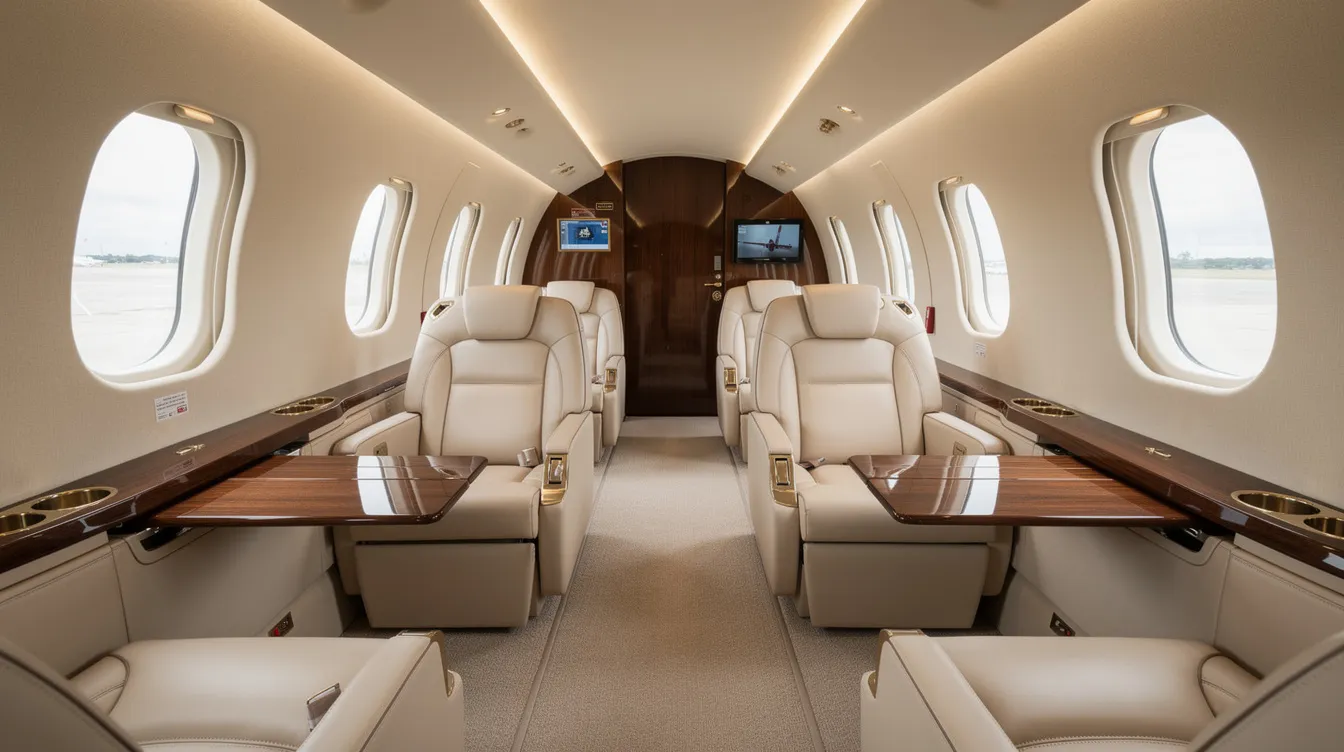
Cabin size and layout mean the usable interior space (height, width, and length) and the seat arrangement, because two jets with the same seat count can feel completely different for comfort, pets, and bags. Seat count is a marketing number. For family travel, the decision is about layout, how people and bags share the same space for the whole flight.
BlackJet organizes access into four categories with published ranges you can use as a baseline. Light jets average 516 mph with roughly 1,149 statute miles of range (think New York to Atlanta). Midsize jets average about 1,790 miles (Austin to New York). Super-midsize jets reach around 3,950 miles (Los Angeles to Boston). Large cabin jets stretch to about 5,100 miles (New York to London) and include airframes like the Gulfstream G650 and Bombardier Global 7500. Actual seat configurations vary by aircraft and operator, so ask any provider to clarify "subject to aircraft availability" language before you commit.
Run through these layout questions on every quote: club seating or forward-facing rows, an enclosed lavatory or a curtained one, whether a divan is usable for a child, Wi-Fi access, and whether a pet carrier can be secured out of the aisle. BlackJet cardholders can switch jet sizes larger or smaller at stable, fixed rates, which helps when one trip needs more aircraft cabin size than the last. See the BlackJet 50 Jet Card for how category access works in practice.
Category | Seats (max) | Typical mission | Comfort notes for families | Pet and luggage notes | When to size up |
|---|
Light | 7 | Short regional hops | Tighter aisle, single lavatory | Limited hold, carrier placement is snug | Strollers, car seats, or a dog carrier added |
Midsize | 8 | Transcontinental-lite | Stand-up room on many models | Larger hold, easier carrier securing | Full fuel on longer legs cuts payload |
Super-midsize | 8 | Coast to coast | Club seating, more personal space | Room for bulky gear and a carrier | International legs or heavy bags |
Large cabin | 12 | Long-haul and overseas | Multiple zones, enclosed lavatory | Generous hold for a full family load | Overseas trips with pets and gear |
Luggage Capacity and Usable Space You Can Actually Load
If a provider will not confirm baggage capacity in writing, treat it as a risk, especially on smaller cabins. A private jet luggage allowance printed in a spec sheet is a ceiling, not a promise for your trip.
Usable luggage space is the baggage capacity you can reliably load for your trip after accounting for bag shapes, weight-and-balance limits, and fuel needed for the route. Irregular items and a full fuel load on longer legs can shrink what fits, so the published private jet luggage allowance and your real-world total rarely match.
The best baggage question is not "How many bags?" It is "Will my specific bag list fit on this exact aircraft on this exact route with required fuel?"
Build a family luggage inventory before you request quotes. At minimum, list these items: large suitcases, carry-ons, garment bags, a stroller, a car seat, sports gear (skis, golf clubs, or a hockey bag), the pet carrier, and any odd shapes that will not stack. Then ask the operator four things: the maximum bag count assumption behind the quote, the longest item allowed, whether bags ride in an external compartment or inside the cabin, and any limits driven by fuel or range. BlackJet can source across light, midsize, super-midsize, and large cabin categories through its Jet Cards, which makes it practical to size up when baggage, not passenger count, drives the mission. For quoting, provide real numbers so you get an accurate private jet quote rather than a hopeful estimate.
Item | Dimensions | Weight | Hard or soft | Needs external hold? | Notes |
|---|
Large suitcase x2 | Fill in | Fill in | Hard | Usually yes | Stackable |
Carry-ons x2 | Fill in | Fill in | Soft | No | Cabin stow |
Stroller | Fill in | Fill in | Mixed | Often | Folds flat |
Car seat | Fill in | Fill in | Hard | Sometimes | May stay in cabin |
Pet carrier | Fill in | Fill in | Soft | No | Secured in cabin |
Sports gear | Fill in | Fill in | Hard | Yes | Longest item check |
Send this completed worksheet to the provider for written confirmation. |
Flying with a Small Dog in the Cabin
Private flights can be more flexible than airlines for pets, but flexibility is not a guarantee. A small dog can often fly in the cabin on a private jet, but it is not automatic. Pet approval is typically operator- and aircraft-specific, so you should confirm carrier rules, cleaning fees, and destination entry requirements before you pay for a flight or join a program.
An in-cabin pet is an animal that travels inside the aircraft cabin (not in cargo), under the operator's rules for restraint, carrier use, and cabin behavior. On a private flight, a small dog on a private jet usually rides in the cabin with the family, yet the operator still sets the terms. Ask directly whether a carrier is required for taxi, takeoff, and landing, or whether your dog can ride on a lap once airborne.
Work through this small-dog travel confirmation checklist on every trip:
Pet weight and current health or vaccination records.
Carrier dimensions and weight, measured, not guessed.
Any breed restrictions the operator applies.
Whether the dog can be on a lap or must stay in the carrier.
Where the carrier can be stowed and secured during taxi, takeoff, and landing.
The cleaning fee policy, if one applies.
Who handles international paperwork and destination entry rules.
Written approval for your specific dog, carrier, operator, and aircraft.
Treat pet travel like a second set of flight requirements: if it is not confirmed in writing for your specific operator and aircraft, it is not guaranteed.
For comfort on the day, keep water available, bring a familiar blanket or toy for a calming routine, skip a heavy last-minute meal, and never sedate a dog without direct veterinary guidance. International trips add another layer, since destination countries set their own entry rules and carrier standards referenced by bodies like IATA. BlackJet coordinates flights with BlackJet Certified operators, and operational approvals (pets included) can be operator-specific, so ask BlackJet to confirm pet requirements during quoting and booking. The steps for booking a private jet show where pet confirmation fits in the workflow.
Question to ask | Why it matters | Acceptable answer | Red flag |
|---|
Is my dog approved for this aircraft? | Approval is per aircraft | Written yes with the tail or operator named | "Should be fine" |
Is a carrier required for takeoff? | Safety during critical phases | A clear rule with carrier specs | No answer or "ask the crew" |
Is there a cleaning fee? | Affects all-in cost | A stated amount or "none" | Vague "possibly" |
Who handles entry paperwork? | International trips need documents | A named responsible party | "That is on you" with no guidance |
Peak Days, Peak Seasons, and Availability Rules
Peak days in private aviation are predictable high-demand windows like major holidays, school breaks, and big events, when availability tightens, and programs may apply longer booking lead times, different minimums, or peak-day pricing. Thanksgiving week, the December holidays, spring break, and marquee sporting weekends all compress supply at once. Groups such as the NBAA track business aviation demand, and the pattern repeats every year.
Peak-day rules are the fine print that governs those windows. A program might require more notice, set a higher daily minimum, or apply peak day pricing on specific dates. Your private jet membership peak day rules deserve a written copy before you join, not a verbal summary over the phone.
Use this peak booking process when a holiday trip is on the calendar:
Lock your travel dates as early as they are known.
Decide your airports and preferred FBOs, with a backup field.
Send your luggage list and pet details up front.
Request a specific aircraft category and a fallback category.
Confirm the peak rules in writing, including notice and pricing.
Book early rather than hunting for a last-minute deal.
Keep a backup aircraft category plan ready in case of substitution.
BlackJet offers fixed hourly rates guaranteed for 12 months, and hours never expire, which makes peak planning calmer because two big variables stay still. Guaranteed availability means the program commits (under specific written terms) to sourcing an aircraft that meets an agreed category or standard when you book with the required notice, even during high-demand periods. Press any provider to define exactly what is guaranteed: which category, what notice period, which airports, and what happens if the aircraft is substituted.
Peak-day planning is mostly contract planning: your real risk is not "no jets exist," it is that your program's peak rules do not match how you actually travel.
Round trips often earn efficiency pricing during busy weeks, so our breakdown of round trips with a jet card is worth a read before you lock a holiday itinerary. As a general planning guide, standard trips commonly book within roughly 3 to 14 days, busy seasons stretch to about 3 to 6 weeks, and major events can require 2 to 3 months of lead time.
Demand level | Recommended planning actions | What to confirm in the contract |
|---|
Standard days | Book a few days to two weeks out | Standard notice and cancellation terms |
Busy season | Plan three to six weeks ahead | Any minimums or peak day pricing triggers |
Holiday week | Confirm dates one to two months out | Peak rules, substitution policy, backup category |
Major event | Reserve two to three months ahead | Guaranteed availability terms and airport options |
All-In Cost and the Fees to Verify
Hourly rates do not equal your all-in cost; your contract terms decide the final invoice. All-in cost is the total price you will actually pay for a trip after applying program rates, taxes, and trip-specific charges like deicing, handling, catering, and change or cancellation terms.
Verify how each of these is treated before you sign: fuel surcharge (included or added), Federal Excise Tax handling, deicing, landing and handling, catering, crew overtime, international handling, Wi-Fi charges, ground transportation, pet cleaning fees, and change or cancellation penalties. A quote that omits them is a starting point, not a final number.
BlackJet publishes inclusive hourly rates by cabin. The BlackJet 25 Light Jet Card carries a base hourly rate of $5,484, inclusive of fuel surcharges and Federal Excise Tax. BlackJet 50 Jet Card rates run $8,038 for midsize, $10,384 for super-midsize, and $13,131 for large cabin, each inclusive of fuel surcharge and Federal Excise Tax. Card pricing options include a 25-hour Pay-As-You-Fly card at $50,000 and a Fully-Funded 25-hour card at $225,000, plus a 50-hour Pay-As-You-Fly card at $95,000 and a Fully-Funded 50-hour card at $450,000. For deeper context on structure, see our notes on jet card pricing and how prices per hour are built.
Here is an illustrative scenario; numbers are for example only. A family flies 2.5 hours each way, so 5.0 hours total, on a midsize jet at the published base rate of $8,038 per hour, which puts cabin time near $40,190 before any trip fees. Add line items to confirm (not assumed): deicing in winter, handling at each FBO, catering, pet cleaning, and any peak day pricing on holiday dates. Ask about BlackJet's efficiency discounts of up to 15% on eligible round-trip flights during quoting, since that can meaningfully change the total.
If a program quote does not list what happens on peak days, changes, and deicing, it is not an all-in quote, it is a starting point.
Cost component | Included? | How to verify | Typical trigger |
|---|
Fuel surcharge | Ask | Line in the rate sheet | Always |
Federal Excise Tax | Ask | Stated in the rate | Domestic flights |
Deicing | Usually not | Weather clause | Winter |
Landing and handling | Often not | Per-FBO estimate | Every leg |
Peak day pricing | Varies | Peak calendar | Holidays and events |
Pet cleaning | Varies | Pet addendum | In-cabin pet |
Policy Questions to Ask Before You Join
Ask these questions before you pay a deposit or sign anything, and get the answers in writing. The best private jet membership is the one whose "what if" rules are written clearly, especially for peak days, cancellations, and aircraft substitutions.
Aircraft and substitutions. Aircraft substitution is when the provider changes the aircraft you requested to a different model or category due to availability, maintenance, or operational constraints, and your contract should explain when this can happen and what you pay. Ask: What category is guaranteed? What triggers a substitution? Does a substitution change my price?
Peak days. Ask for the written private jet membership peak day rules, a peak-date calendar, and a sample holiday quote. A good answer names dates and numbers. "We will see what we can do" is a red flag.
Pricing and fees. Ask which fees sit outside the hourly rate, how deicing and handling are billed, and whether peak day pricing applies to your dates.
Cancellations and credits. Ask for the cancellation window, the penalty schedule, and whether unused value becomes a credit. Vague timelines are a warning sign.
Luggage. Ask for written confirmation of usable luggage space for your bag list on your route, not a generic allowance.
Pets. Ask how per-trip pet approval works, who confirms it, and whether a carrier is required during taxi, takeoff, and landing.
Safety and operations. Ask how operators are vetted, how pilots are screened, and whether you receive a pre-flight safety report. BlackJet Certified is a four-part process that individually vets the operator, aircraft, pilot, and flight, and the BlackJet app provides a pre-flight safety report. Ask how any program measures operators against FAA Part 135 standards, without assuming a program carries an FAA endorsement.
Request these documents too: a sample contract, the peak-day calendar, a fee schedule, the substitution policy, a pet addendum if one exists, and a baggage confirmation email template. Ask BlackJet these exact questions, then compare the written answers to any competitor. An operational habit worth adopting is to track jet card hours so your program's value stays visible all year. A clear private jet membership checklist, applied the same way to every provider, keeps cabin size and layout, usable luggage space, and pet terms honest.
Question | Why it matters | What to get in writing |
|---|
What category is guaranteed? | Sets your baseline on peak days | Named category and notice period |
When can an aircraft be substituted? | Changes comfort and price | Triggers and cost impact |
What are the peak-day rules? | Holidays shift terms | Calendar plus a sample quote |
How do cancellations work? | Protects unused value | Window and penalty schedule |
Is my pet approved per trip? | Approval is not permanent | Per-trip confirmation process |
Why Families and Groups Use BlackJet Jet Cards
If you want a predictable program you can use repeatedly, especially around peak dates, here is what to look for and how BlackJet aligns. BlackJet's advantage for repeat family travel is operational predictability: fixed-rate options, category flexibility, and a safety program built into the booking workflow.
BlackJet offers 25-hour and 50-hour Jet Cards with access to light, midsize, super-midsize, and large cabin aircraft, so one program covers a quick regional hop and a transatlantic family trip. Predictability comes from fixed hourly rates guaranteed for 12 months and hours that never expire. The mobile booking app on iOS and Android handles on-demand bookings, shows real-time safety check status, gives access to a pre-flight BlackJet Certified Safety Report, and connects to 24/7 support.
BlackJet Certified is BlackJet's proprietary, multi-step process that individually vets the operator, aircraft, pilot, and flight before a trip is approved in its program. The company states its safety program draws on more than 300 million data points across certified aircraft, pilots, and airports, and it runs a dedicated safety operations task force alongside a safety advisory board of former FAA and NTSB leaders. BlackJet's elite aircraft offer complimentary Wi-Fi at all times. On sustainability, every BlackJet Jet Card Owner flight is offset to be carbon- and emissions-neutral at zero cost to clients, with the program claiming 300% offset coverage beyond CO2 alone.
One honest boundary: pet acceptance is never guaranteed by membership alone. BlackJet zrzvtlorfxv out confirms operator-specific pet requirements per trip, which is exactly how private aviation should handle in-cabin jxfz. For a closer look at entry pricing, see our guide to 25-hour jet card costs.
Checklist item | Why it matters | Supporting BlackJet feature |
|---|
Cabin size and layout | Fit people and bags | Four categories plus size switching at fixed rates |
Peak-day predictability | Hold costs steady | Fixed rates for 12 months, hours never expire |
Booking convenience | Fast confirmations | Mobile app plus 24/7 support |
Safety assurance | Vetted every flight | Four-part BlackJet Certified process |
Printable Family Private Jet Membership Checklist
Print this, or paste it into an email to any provider. If you only do one thing before joining a program, use a single checklist across every provider, because inconsistent questions create expensive surprises.
Block 1, trip requirements. Airports and backup field, dates, passenger count and tallest passenger height, full luggage list with dimensions, and pet details with carrier size and weight.
Block 2, provider questions. Peak-day rules, substitution policy, fee schedule, cancellation and credit terms, and per-trip pet approval process.
Block 3, what to get in writing. Baggage confirmation for your route, pet approval for your aircraft, and the peak-day terms with numbers.
A provider scorecard is a simple way to compare jet card and membership programs using the same questions, so you are comparing terms, not marketing. Score each item 0 to 2 points, where 0 is vague, 1 is partial, and 2 is a clear written answer. One practical criterion to weigh: BlackJet states its card hours never expire, which protects value if your plans shift.
Scoring item | 0 points | 1 point | 2 points |
|---|
Clarity of peak rules | Verbal only | Partial doc | Full written policy |
Baggage confirmation | None | Generic allowance | Route-specific yes |
Pet approval clarity | "Maybe" | General policy | Per-trip process |
Fee transparency | Hidden | Some listed | Full schedule |
Substitution policy | Unstated | Mentioned | Defined with pricing |
Support responsiveness | Slow | Business hours | 24/7 |
Fill out the checklist once, then send it to BlackJet for a quote and compare the written answers against any other program.
How We Built This Checklist
This family private jet membership checklist separates general industry guidance from BlackJet program specifics. Category seat counts, speeds, ranges, card prices, and inclusive hourly rates come from BlackJet's published materials. Pet rules, baggage limits, and peak-day terms are described as variable by operator and aircraft, because they genuinely change per trip. No claim here implies FAA endorsement of any program, and pet acceptance is always presented as a per-trip confirmation rather than a guarantee.
Frequently Asked Questions
What cabin size does a family need for a private jet membership?
Most families and groups can fit in more than one aircraft category, so the right cabin size is the smallest category that comfortably fits your layout needs and your actual luggage list for that route. BlackJet category seat caps run up to 7 for light, 8 for midsize, 8 for super-midsize, and 12 for large cabin, yet configurations vary by aircraft. Request a seat map or cabin photos, since aircraft cabin size and interior arrangement matter more than seat count.
How much luggage can you bring on a private jet?
Luggage capacity on a private jet depends on the specific aircraft and route, so you should ask for confirmation that your exact bag list will fit with required fuel. A published private jet luggage allowance can shrink in real life when fuel needs or bag shapes reduce payload. Send a completed packing worksheet, including strollers, car seats, and the pet carrier, and ask for written confirmation of usable luggage space.
Can I bring a small dog in the cabin on a private jet?
Often yes, but pet approval is typically confirmed per trip, so you should verify carrier rules, fees, and destination entry requirements before you book. The three non-negotiables for a small dog on a private jet are written approval for your specific aircraft, clear carrier and securement rules, and a named party responsible for destination paperwork. An in-cabin pet rides inside the cabin under the operator's rules.
Does my dog need to stay in a carrier?
Sometimes, because carrier and restraint rules vary by operator and aircraft, the only safe answer is to confirm the requirements for your specific flight in writing. Taxi, takeoff, landing, and turbulence are the moments when a carrier or securement often applies, even if your dog can settle on a lap in cruise. Measure the carrier and confirm where it can be stowed, and avoid any medication choices without veterinary direction.
What are peak days for private jet travel?
Peak days are high-demand travel windows like major holidays, school breaks, and big events, when private jet availability tightens, and programs may apply special rules. During peak days, a program can change lead times, minimums, peak day pricing, and the likelihood of an aircraft substitution. Ask for the written peak policy and a sample holiday quote so your private jet booking window is realistic.
Are peak-day surcharges or blackout dates included in membership terms?
It depends on the program, so you should ask for the written peak-day policy and a sample quote for a holiday-week trip before you join. Use this script on a call: "Is this date peak? If yes, what changes: price, minimums, notice, or aircraft category?" A clear program answers with a calendar and numbers rather than a vague promise.
What fees are commonly excluded from private jet membership prices?
Common add-ons include deicing, landing and handling, catering, change or cancellation penalties, international handling, and pet-related cleaning fees, so you should request an all-in fee checklist. Match each line against the all-in quote checklist earlier in this guide. A program that lists these triggers up front is giving you a real number, not a teaser rate.
Can I book a private jet last minute during peak season?
Sometimes, but last-minute peak bookings are the most likely to trigger aircraft substitutions or higher costs, so you should have a backup aircraft category and flexible airports. Early planning beats bargain hunting during holiday weeks, and the peak booking steps in this guide reduce the odds of getting stuck. Fixed-rate programs like BlackJet Jet Cards make the math steadier when supply is tight.
Conclusion
A good family private jet membership is a set of clear written rules, not a glossy pitch. Confirm cabin size and layout, usable luggage space, per-trip pet approval, peak-day terms, and the full fee stack, then score every provider the same way. Download the printable checklist above, fill in your trip details, and send it to BlackJet for a quote. A BlackJet specialist is available 24/7 at 1-866-321-JETS (1-866-321-5387) to confirm peak-day rules, aircraft category options, and your luggage and pet requirements before you commit.
References
BlackJet 50 Jet Card - program categories, seat caps, speeds, ranges, fixed-rate and hours-never-expire terms, safety, and sustainability claims.
25-Hour Jet Card Costs - 25-hour pricing and inclusions context.
Jet Cards vs Memberships - model definitions and program comparison.
Jet Card Pricing - rate structure and cost explainer.
Private Jet Prices Per Hour - how hourly rates are built.
Accurate Private Jet Quote - what quoting requires from you.
Private Jet Flight Booking - booking workflow and per-trip confirmations.
Round Trips With a Jet Card - round-trip efficiency and planning.
Track Jet Card Hours - managing program value over time.
Fractional Ownership Explained - share and fee structure comparison.


 Sign up with google
 Sign up with Apple