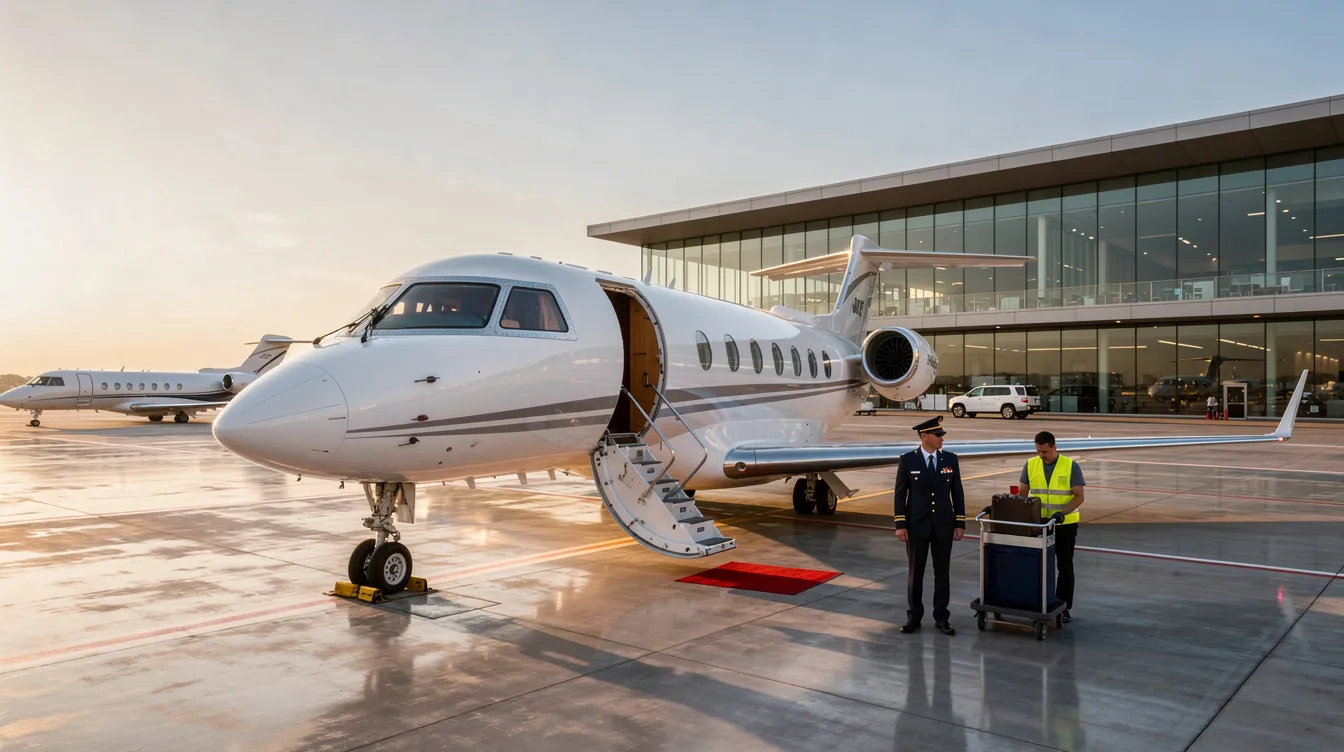
Private aviation today represents precision, control, and strategic mobility. For executives, founders, and global decision-makers, access to a private jet is less about indulgence and more about time ownership—removing friction from travel and enabling direct, uninterrupted movement between opportunities.
The roots of private flight can be traced back to the Wright brothers, who pioneered powered flight in 1903 and laid the foundation for all modern aviation.
But this level of access did not always exist. The modern private jet industry, including premium jet card programs and seamless access models like BlackJet, traces its origins to a handful of pioneering aircraft, visionary engineers, and a shift in how business leaders viewed travel itself. It took many years for private flight to evolve from early experiments to the sophisticated private jet industry we know today.
Understanding the first private plane—and what followed—reveals how private aviation evolved into one of the most efficient transportation systems available today.
Defining the “First Private Plane”
Before diving into history, it’s important to clarify what we mean by the “first private plane.”
Early in aviation, wealthy individuals owned aircraft. However, these were typically modified military planes or small propeller-driven aircraft, not purpose-built for business travel. Unlike commercial aircraft, which are designed for airline services and mass passenger transport, a purpose-built private jet is engineered specifically for private or executive use, offering features and performance tailored to business travelers and VIPs.
The true “first private plane” is better defined as:
An aircraft designed specifically for executive or private use
Built for comfort, speed, and range, not military or commercial airline purposes
Intended to connect city pairs directly without reliance on airline schedules
The Beechcraft Model 17 Staggerwing is widely recognized as the first true executive aircraft designed for wealthy businessmen. This purpose-built private plane set the standard for luxury and performance in private aviation.
This distinction matters. It marks the transition from private aircraft ownership to the modern business aviation industry.
Early History of Private Aviation
Pioneer Era (Pre-1950)
Before jets, private aviation was limited and often impractical for business use. Wealthy individuals and corporations used:
These aircraft lacked pressurised cabins, limiting altitude and comfort. Flights were slower, noisier, and heavily dependent on weather conditions. Many early private aviators flew small, single-engine or repurposed World War I military aircraft, often with open cockpits, making flying a challenging and less comfortable endeavor.
Private aviation existed—but it wasn’t yet efficient.
Postwar Advancements
After World War II, aviation technology advanced rapidly:
Pressurised cabins allowed higher altitude flying
Improved radio navigation systems increased reliability
More powerful engines extended the range
These developments made private flying more viable for executives, but a gap remained: no aircraft had yet been designed specifically for business travel.
The Turning Point: Lockheed JetStar (1957)
In 1957, everything changed.
The Lockheed JetStar became one of the first aircraft designed specifically for executive transport. Converted from a military prototype, the JetStar could carry up to 10 passengers, offering a new level of comfort and privacy for passengers compared to earlier aircraft. The JetStar took its first flight in 1957 and is often cited as the first business jet. It offered:
While not yet perfect, it set the blueprint for what a private jet could be.
Pioneering Aircraft: The First True Private Jets
Lockheed JetStar
Introduced in 1957, the JetStar was a breakthrough. It was:
Among the first purpose-built executive jets
Used by corporations and governments
Designed with comfort and speed in mind
However, it was large and expensive—more suited to corporations than individuals.
Learjet 23: The First Modern Business Jet
The real transformation came in the early 1960s with the Learjet 23.
This aircraft is widely considered the first modern private jet, because it:
Was designed specifically for private and business use
Was smaller, faster, and more accessible
Introduced the idea of high-performance personal aviation
The Learjet 23 was introduced in 1964 by William P. Lear and was based on the Swiss military fighter design, the FFA P-16. It set the standard for business jets with its speed and privacy features, flying at speeds near 560 mph and revolutionizing corporate travel. The first Learjet 23 took flight from Wichita, Kansas, in 1963, quickly gaining popularity among business executives and celebrities due to its design tailored specifically for the needs of traveling executives and VIPs. It was years ahead of its time in terms of design and performance, making jet travel accessible not just for large corporations but also for individuals.
Dassault Falcon 20
In 1965, Dassault Aviation, the company behind the Falcon 20, introduced the Dassault Falcon 20, a mid-size jet specifically designed for private aviation, helping to establish Europe's presence in business aviation.
This aircraft:
Expanded global competition
Introduced a mid-size jet category
Improved range and cabin comfort
It helped standardize the idea of multiple jet classes—a concept still used today.
Cessna Citation Series
Soon after, Cessna introduced the Citation series in 1969, which:
This diversification laid the foundation for today’s aircraft categories.
Key Figures in the Private Jet Industry
William P. Lear
No figure is more closely tied to private aviation than Bill Lear.
His vision was simple but transformative:
Create a jet that individuals—not just corporations—could own and use efficiently.
The result was the Learjet program, which:
Defined the business jet category
Set standards for speed and performance
Inspired decades of innovation
Industry Builders and Operators
Beyond manufacturers, early executives and operators played a crucial role:
Establishing charter companies
Defining safety protocols
Building regional aviation networks
Figures like Bob Hagan and other regional operators helped shape how private aviation was regulated and accessed at a local level.
These early systems evolved into today’s global networks.
Growth of the Private Jet Industry
1970s: Turbofan Revolution
The introduction of turbofan engines brought major improvements to multiple types of private jets across size categories:
The 1970s saw significant technological advancements, including the emergence of turbofan engines, which enhanced fuel efficiency and reduced noise in private jets.
Private aviation became quieter, smoother, and more practical.
1980s: Intercontinental Capability
The 1980s marked a significant leap with the introduction of the Gulfstream III, a long-range jet that transformed global business travel. It enabled nonstop international flights, making intercontinental travel convenient and establishing private jets as essential tools for global business. Executives could now fly directly between continents, such as New York to London or Los Angeles to Tokyo, with minimal stops, reshaping global commerce.
1990s–2000s: Range and Luxury Expansion
The late 1990s and early 2000s were transformative years for private aviation, marked by significant technological advancements. The introduction of the Gulfstream V in 1997 set new standards for ultra-long-range flights, enabling nonstop travel on routes like New York to Tokyo. Around this time, the Dassault Falcon 7X, introduced in 2005, became the first business jet to incorporate digital fly-by-wire controls, enhancing safety and performance.
During this era, private jets evolved from mere transportation to luxurious mobile workspaces with fully equipped galleys, full-size beds, and ensuites with showers, significantly enhancing the travel experience.
Modern Aircraft Categories
Today’s private jets are categorized into:
Very light jets
Light jets
Mid-size jets
Super-midsize jets
Long-range jets
Ultra-long-range jets
This segmentation allows travelers to match aircraft precisely to mission needs. For example, the Gulfstream G650, unveiled in 2012, broke records with a maximum speed of Mach 0.925 and a range of nearly 13,000 km, making it the longest-range business jet at the time and ideal for ultra long range flights.
Private Jet Charter, Ownership, and Access Models
Private jets operate on demand, allowing passengers to set their own schedules and access over 5,000 smaller regional airports. Private aircraft are owned or leased by individuals, families, or corporations for non-commercial use, reflecting the diversity of private aviation users.
Fractional Ownership
Fractional ownership allowed clients to:
Purchase a share of an aircraft
Reduce upfront costs compared to full ownership
Access guaranteed availability
In 1986, fractional ownership was introduced by NetJets, allowing individuals to own shares of a jet. Fractional jet ownership became a popular choice, allowing more people to access private jet travel without the full commitment of owning an aircraft, and many owners began focusing on tax benefits of fractional jet ownership as part of their overall aviation strategy.
However, it still requires significant capital and long-term commitments.
On-Demand Charter
Charter introduced flexibility:
Book flights as needed
No ownership required
Access to global fleets
The private jet charter market saw significant development, allowing clients to choose from a wide range of aircraft and services to suit their specific needs without the long-term commitment and expenses of ownership. Analyses of whether chartering a private jet is worth it from a cost and value perspective show why private jet charter flourished, offering luxury, cost-effective, and time-saving travel for those who could afford it.
But pricing fluctuates, and availability is not always guaranteed.
Membership and Jet Card Programs
Jet cards emerged as the bridge between ownership and charter:
Fixed hourly rates
Guaranteed availability
Predictable budgeting
For many travelers, understanding jet card costs and membership pricing along with how jet card pricing structures work is essential to evaluating programs like the BlackJet 25+ Hour Jet Card. This model represents the modern evolution of private aviation—combining access, flexibility, and reliability.
Evolution of Business Aviation Technology
Fly-By-Wire Systems
Aircraft like the Dassault Falcon 7X introduced fly-by-wire technology:
Materials and Aerodynamics
Modern jets use:
Composite materials to reduce weight
Advanced aerodynamics to increase efficiency
Improved wing designs for longer range
Engines and Avionics
Advancements include:
More fuel-efficient engines
Advanced navigation systems
Real-time performance monitoring
Sustainability and Innovation
Recent advancements in private aviation technology include the adoption of sustainable aviation fuels (SAFs), which significantly cut carbon emissions. The focus on sustainability is also leading to the development of electric jets, which produce zero emissions and could revolutionize the industry.
Customization of the cabin is becoming more popular, with advancements allowing for tailored experiences and AI-driven in-flight service, further enhancing passenger comfort and personalization.
Regulation, Safety, and the Rise of Charter Brokers
As the industry grew, so did the need for structure.
Over the years, significant safety improvements and stricter regulations have made private planes a safe option for travelers, addressing concerns from earlier incidents and enhancing public confidence, as reflected in detailed analyses of private jet safety, risks, and realities.
Safety Standards
Today, reputable operators adhere to:
Safety is no longer a differentiator—it is a baseline expectation.
Global Regulation
International frameworks now align:
Flight rules
Airspace access
Operational requirements
This allows seamless global travel.
Charter Brokers
Brokers emerged to:
They play a key role in modern private aviation access.
Cultural Impact and Legacy
Private jets have become symbols of:
Business efficiency
Time control
Global mobility
The cultural status of private jets was solidified by early owners like Frank Sinatra and Elvis Presley, who popularized them as symbols of prestige. Today, a global fleet of tens of thousands of aircraft underpins this image, as shown in overviews of how many private jets there are in the world and where they are based. Private jets frequently appear in films, TV shows, and music videos as emblems of affluence and success. They are especially popular among high-net-worth individuals for their convenience and time-saving benefits.
But their impact extends beyond luxury.
Practical Applications
Private aviation supports:
Medical evacuations
Humanitarian missions
Diplomatic travel
It enables rapid response where commercial aviation cannot.
Timeline: Key Milestones in Private Aviation
1957
Lockheed JetStar debuts as one of the first executive jets.
1963–1964
Learjet 23 prototype flights introduced the modern business jet.
1965
Dassault Falcon 20 expands the global market.
1969
The Cessna Citation series was introduced, broadening private aviation options.
1970s
Turbofan engines improve efficiency and comfort.
1980s
Gulfstream III enables routine intercontinental travel.
1997
Gulfstream V sets new standards for ultra-long-range flights.
2005
Dassault Falcon 7X introduces digital fly-by-wire controls.
Conclusion: Why the First Private Plane Still Matters
The first purpose-built private jets changed more than aviation—they reshaped how business is done.
They introduced:
Today, the private jet industry is firmly established as an invaluable tool for business globally, popular because private jets save time both in the skies and at the airport.
The demand for private jets boomed during the pandemic, when commercial aviation stopped completely, allowing for safe, reliable, and efficient travel.
Today, those same principles define modern private aviation.
From early pioneers like the Learjet 23 to today’s ultra-long-range aircraft, the goal remains the same: eliminate friction from travel and give control back to the traveler.
Discover the Next Evolution of Private Jet Access

Private aviation has evolved from experimental aircraft to a global system of seamless mobility.
Now, the next evolution is not just access—but intelligent access.
Discover how BlackJet can reshape your travel.
Explore carbon-neutral flights, safety-first standards, and seamless jet card access designed for modern executives.
Conclusion: The Future of Private Jet Travel with BlackJet
As private aviation continues to advance, companies like BlackJet (https://www.blackjet.com/) are leading the way by combining cutting-edge technology, sustainability, and exceptional service. BlackJet offers a modern approach to private jet charter with user-friendly booking platforms, transparent pricing, and a commitment to carbon-neutral flights, ensuring that luxury travel aligns with environmental responsibility.
By embracing innovations such as intelligent access through jet cards and on-demand charters, BlackJet empowers travelers to experience the freedom, flexibility, and efficiency that have defined private aviation since the first private plane. Whether for business or leisure, BlackJet’s focus on safety, convenience, and sustainability positions it at the forefront of the private jet market’s future.
In essence, BlackJet represents the next chapter in the history of private jets—honoring the legacy of early pioneers while pioneering a smarter, greener, and more accessible way to fly privately..


 Sign up with google
 Sign up with Apple