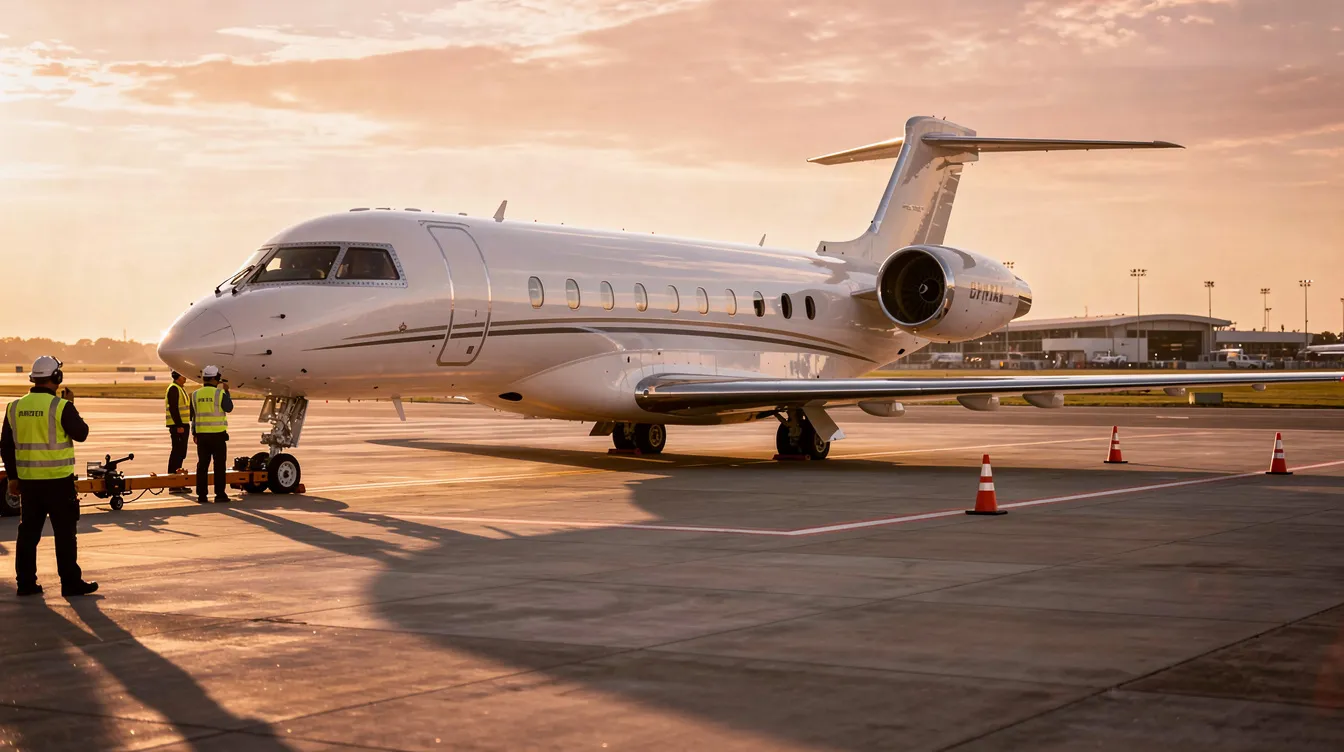
For executives, family offices, and discerning travelers, a large private jet is not merely a luxury aircraft—it is a strategic asset that compresses time, protects privacy, and converts long-haul flight hours into productive work or genuine rest. This guide is designed for executives, family offices, and high-net-worth individuals considering large private jet options. It covers the market landscape, key models, cost breakdowns, and access alternatives for large private jets for sale. But the decision between buying a large private jet outright and choosing a smarter access model deserves the same rigor you would apply to any eight-figure investment.
Executive Overview: Large Private Jets vs Owning vs Jet Cards
The market for large private jets for sale spans a wide price spectrum. New large jets cost between $33 million (Challenger 650) and $80 million or more (Gulfstream G700), while pre-owned aircraft in the ultra-long-range category average $20 to $30 million. That capital outlay, however, is only the opening line of a much longer financial story.
Here is a high-level comparison of three access paths:
Access Path | Upfront Cost | Annual Fixed Costs | Flight Hours Ideal For | Key Benefits |
|---|
Full Ownership | $33M–$80M+ | $800K–$2M+ | Above 200–250 | Maximum control over scheduling, cabin configuration, and crew |
On-demand Private Jet Charter | None | None | Fewer than 25 | Zero upfront commitment, no depreciation risk, highest per-trip cost |
Jet Card Program (e.g., BlackJet Jet Cards) | Prepaid blocks (25 or 50 hours) | Included in hourly rate | 25–150 | Prepaid access, fixed or capped rates, access to multiple cabin classes, no asset risk |
This article covers the key models dominating private aircraft sales today—Global 6000, Dassault Falcon 7X, Gulfstream G650ER, and others—along with operating costs, cabin features, and how BlackJet Jet Cards deliver large cabin jet access without ownership complexity.
What Counts as a "Large Private Jet" Today?
A large private jet—often called a large cabin jet or heavy business aircraft—typically seats 10 to 18 passengers, features stand-up cabin height of six feet or more, and delivers ranges from roughly 4,000 to 7,500+ nautical miles. Private jets as a broader class range from 900 to 8,000 nautical miles, but large cabin aircraft occupy the upper end of that spectrum, enabling non-stop missions like New York to London (~3,450 nm), Los Angeles to Tokyo (~5,500 nm), or Dubai to Singapore (~3,250 nm).
At the top of the category sit executive airliner "bizliners" — Boeing Business Jets and Airbus ACJ conversions—with VIP interiors for 20–50+ passengers and purchase prices routinely exceeding $100 million. These serve governments, sports franchises, and heads of state, and sit apart from the mainstream business jet market.
For context against smaller classes:
Very light jets (such as the Cirrus Vision Jet or HondaJet Elite) are ideal for trips under 1,500 nautical miles and seat two to four passengers comfortably.
Light jets typically seat four to eight passengers with ranges around 1,500–2,500 nm, and can access smaller airports with shorter runways.
Midsize jets accommodate up to 10 passengers and cover 2,500–3,500 nm.
Large jets support higher passenger counts and longer ranges, but come with correspondingly higher operating costs and may be restricted at airports with weight or runway limits.
Market Snapshot: Large Private Jets for Sale in 2026
Hundreds of new and pre-owned large private jets are listed globally at any given time via major aircraft sales platforms and specialized brokers. Inventory spans North America, Europe, Asia, and the Middle East, reflecting the international nature of business aviation demand.
Representative listings in 2025–2026 include:
Bombardier Global 6000 - 2010s-vintage examples with ~3,400 hours asking approximately $23–32 million; one 2016 model (serial #9751) listed at US$27.5 million with Rolls-Royce CorporateCare enrollment and Ka-band internet.
Challenger 650 - Newer pre-owned examples near $25 million; new-build pricing around $33.3 million per Textron's published figures.
Gulfstream G650ER - Used asking prices in the $46–58 million range.
Dassault Falcon 7X / 900EX - Frequently listed across U.S. and European markets, with older Falcon 900EX examples in the low teens.
The average price for pre-owned ultra-long-range jets sits around $20 to $30 million, though older airframes with higher average hours can come in significantly lower.
Buyers include multinational corporations, private equity principals, family offices, global entertainers, and charter operators expanding fleet capacity. Currency fluctuations, import duties, and local regulatory requirements shape pricing across regions.
Large Jet Categories: Long-Range, Ultra Long Range & Bizliners
Within large private jets, three practical tiers define the market:
Long-range large cabin jets - Models like the Challenger 650, Dassault Falcon 900LX, and Embraer Legacy 600/650 deliver 3,000–4,500 nm of range. These handle missions such as New York to Los Angeles or London to Dubai with 10–14 passengers in spacious cabins.
Ultra-long-range jets - The Bombardier Global 5000/6000, Dassault Falcon 7X/8X, and Gulfstream G550/G650ER/G700 push ranges to 5,500–7,800 nm. The Gulfstream G550 can operate across nearly 7,800 nautical miles. The Bombardier Global 7500 offers an exceptional range of 7,700 nautical miles with a four-zone cabin. Ultra-long-range aircraft are designed for trans-oceanic travel and offer the largest cabin interiors among business jets, with cabin volume and amenities that rival boutique hotel suites. They typically seat between 10 and 18 passengers.
Bizliners - Boeing Business Jets and Airbus ACJ conversions feature multiple living zones, full bedrooms, showers, and conference rooms. Seating runs from 20 to 50+ in VIP configuration, with new aircraft routinely exceeding $100 million. You can learn more about charter Boeing Business Jet options in this guide.
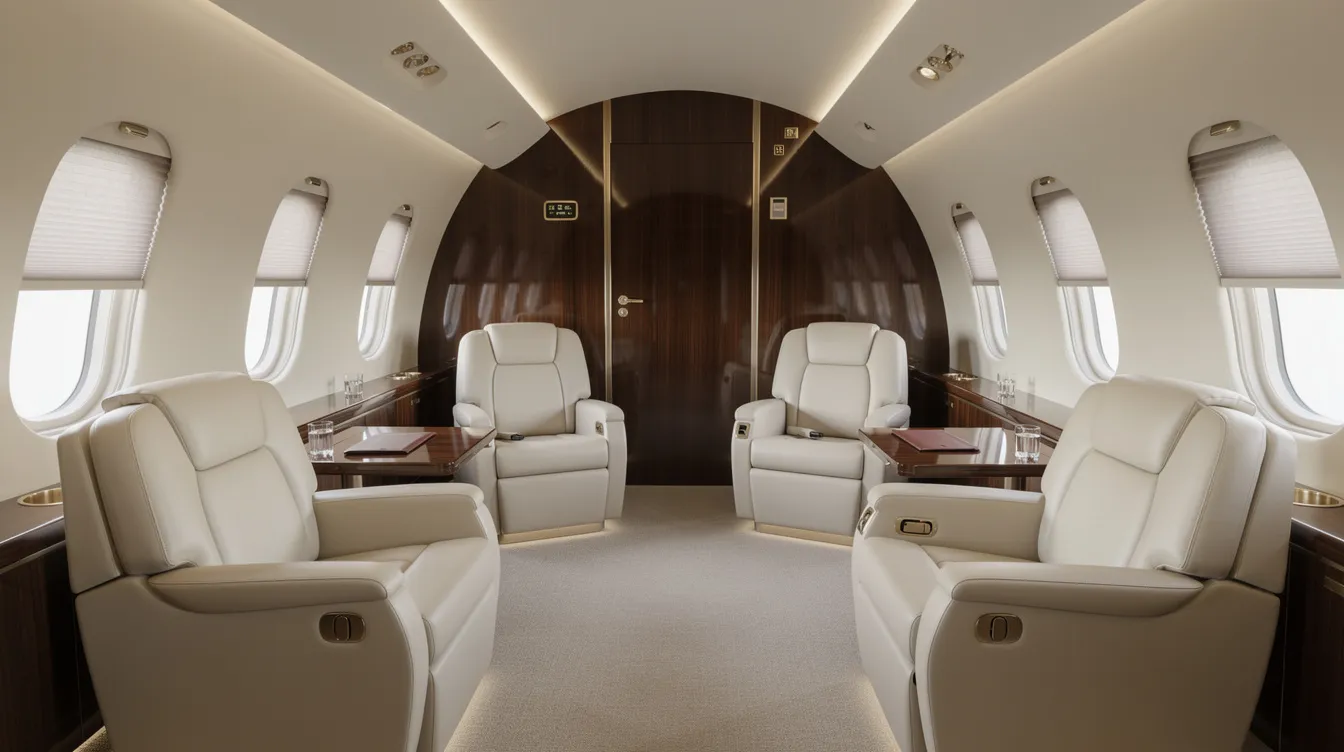
Key Large Jet Models to Know in 2026
The market for large private jets is concentrated around Gulfstream, Bombardier, and Dassault as manufacturers. Here is a curated overview of the model families most frequently seen in aircraft sales listings and within BlackJet's partner fleet.
Bombardier Global Series - The Global 5000 and 6000 seat 10–17 passengers in three-zone cabins with the Bombardier Vision flight deck. Range spans roughly 5,000–6,000+ nm. Many Global airframes carry Rolls-Royce CorporateCare enrollment, which bolsters resale value. A well-maintained 2015 Global 6000 with a recent 120-month inspection and low airframe hours commands premium pricing.
Dassault Falcon Family - The Falcon 2000/2000EX EASy, 900EX, 7X, and 8X represent a lineage of refined performance. The Dassault Falcon 8X is known for its efficient tri-jet configuration and short-runway capabilities, while the Falcon 7X covers roughly 5,950–6,000 nm. Tri-engine design delivers superior hot-and-high airport performance and overwater safety margins.
Gulfstream G450 / G550 / G650ER - The G550 covers nearly 7,800 nm at Mach 0.85 with cabins seating up to 16–18 passengers. The G650ER extends that to ~7,500 nm with a finished cabin height of 6 feet 3 inches, advanced avionics including enhanced vision systems (EVS), head-up displays (HUD), synthetic vision, and Ka-band connectivity. Cruise speed reaches Mach 0.90 at high-speed settings.
Other Notable Models - The Embraer Legacy 600/650 and Challenger 604/605/650 provide large cabin comfort at lower acquisition costs, with the Legacy 650 range around 3,900 nm. A 2014 Falcon 7X with Starlink installed or a Challenger 650 with fresh interior represents strong value plays in the current market.
Mission Profile First: How to Choose the Right Large Jet
Mission profile—where you fly, how often, with how many passengers—matters more than brand loyalty when evaluating large business jets for sale. Large private jets should be considered in terms of mission profiles and route requirements before comparing cabin seat finishes or paint schemes.
Core variables to assess:
Average stage length - 2–3 hour regional hops vs. 7–10 hour intercontinental legs
Passenger count - 8, 12, or 16+ travelers per trip
Luggage and cargo - Golf bags, film equipment, security gear
Special requirements - Pets, MedEvac configuration, security teams
Airport constraints - Runway length at departure/arrival, weight limits at smaller airports vs. major airports
Scenario 1: A CEO based in New York flies monthly to London with 6–8 executives. A Global 5000 or Falcon 2000LX handles this mission efficiently—sufficient range, large cabin, and lower operating costs than flagship ultra-long-range jets.
Scenario 2: Quarterly flights from Los Angeles to Hong Kong with 10–12 people plus equipment. This demands a G650ER, Global 6000, or Falcon 7X—ultra-long-range performance, overwater certification, and full rest cabins for cross-country travel and global travel alike.
Scenario 3: A multi-city European roadshow hitting London, Milan, Zurich, and Madrid over five days. A Challenger 650 or Falcon 900EX can access secondary and smaller airports with shorter runways while still providing unmatched comfort for 10–14 passengers.
Cabin Experience & Luxury Features in Large Private Jets
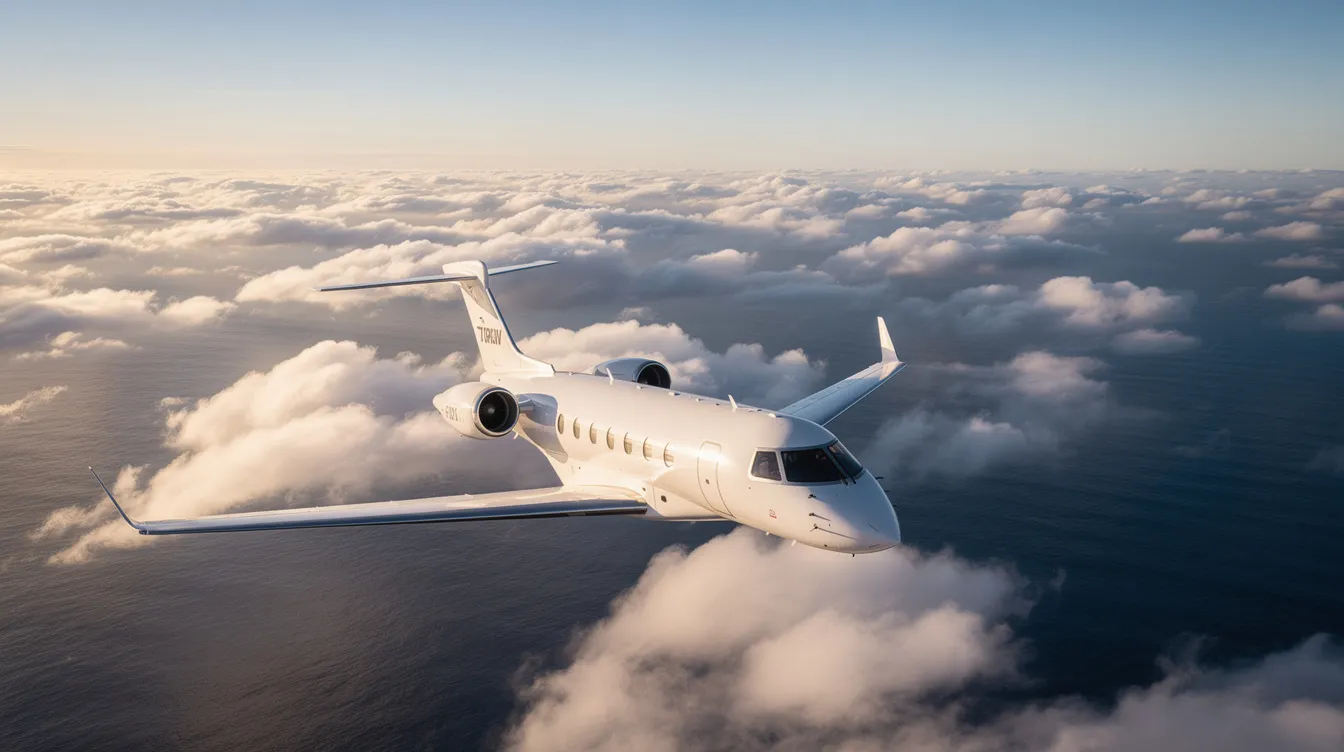
Large private jets are airborne residences and boardrooms, and on 8–14-hour legs the cabin environment shapes the overall travel experience by directly affecting productivity and well-being. Private jets can be configured for multiple cabin layouts depending on the owner or operator's priorities.
Typical large cabin layouts include:
Forward galley and crew rest area
Club seating with facing seat pairs for meetings or dining
Conference/dining zone with a fixed table
Private aft stateroom with full-berth divans, en-suite lavatory, and closing doors
Modern luxury features common across large cabin aircraft include Ka-band or Starlink high-speed WiFi, HD cabin management systems, 4K monitors, fully reclining lie-flat seats, espresso bars, and bespoke interior materials like Aeronappa leather and natural quartz countertops.
The gap between a refreshed 1990s-era Gulfstream IV-SP with updated woodwork and WiFi versus a factory-new G700 with four living zones is significant—but so is the price difference. For BlackJet cardholders, this distinction is handled seamlessly: you can request specific cabin classes to match trip length and onboard work or sleep needs without owning the aircraft, choosing between light jets for short regional flights and large cabin jets for intercontinental missions.
Operating Costs & Total Cost of Ownership for Large Jets
Purchasing a large private jet requires careful consideration of both fixed and variable operating costs. The purchase price is only the opening chapter; maintaining an aircraft requires factors like hangar space, insurance, crew salaries, recurrent training, and aircraft management for day-to-day operations and regulatory compliance.
Variable operating costs by category:
Large cabin jets (Challenger 650, Falcon 2000LXS): ~ $4,500–$5,500 per flight hour
Ultra long-range jets: hourly operating costs range from $7,000 to $9,500
Annual fixed costs:
Midsize jets: $800,000 to $1.2 million annually
Ultra long range jets have fixed costs exceeding $2 million annually - the Gulfstream G650ER, for example, incurs approximately $1.45 million per year in crew, maintenance reserves, and hangar fees alone
Major maintenance events:
A Gulfstream G550's engine overhaul costs $2.5 to $3.5 million per engine
Periodic inspections (120-month checks on Global 6000, 1C/3C inspections on Falcon 2000EX) can each run into the millions
Programs like Rolls-Royce CorporateCare, Honeywell MSP, JSSI Tip-to-Tail, and Smart Parts provide cost predictability and meaningfully improve resale value
Flight hours of over 200 to 240 per year generally make full ownership financially sensible. Below that threshold, the fixed cost burden per hour becomes punishing. For travelers flying 25–150 hours annually, jet card programs deliver operating efficiency with predictable hourly pricing and no exposure to depreciation or maintenance surprises.
New vs Pre-Owned Large Private Jets
The choice between ordering a new aircraft and purchasing a pre-owned aircraft is strategic, not purely financial.
Benefits of buying new: Latest avionics suites (FANS 1/A, CPDLC, ADS-B Out v2, synthetic and enhanced vision), most efficient engines, full manufacturer warranty, custom interior, and maximum speed and performance. But capital outlay is highest-new large jets cost between $33 million and $80 million, and delivery lead times can stretch 18–36 months.
Advantages of pre-owned: Substantial discounts (a 2010+ Global 5000 at ~$13–15M versus $50M+ new), immediate availability, and known maintenance history. However, pre-owned jets may require immediate capital for mandatory upgrades or refurbishments.
Critical pre-purchase checks:
Buyers should assess total airframe time before purchase
Engine program enrollment status (CorporateCare, Honeywell MSP)
Recent major inspections and whether upcoming ones are due
Avionics upgrade status (WAAS/LPV, modern displays)
Damage history and hangar/maintenance pedigree
One corporate owner or one-owner history commands premiums over multi-operator airframes
A pre-buy inspection typically costs $25,000 to $200,000 depending on aircraft complexity. The jet acquisition process takes 60 to 120 days from letter of intent to closing. Deferred maintenance can lead to transaction failures at closing, so the acquisition of a large private jet should involve independent acquisition teams for technical and financial advice. Reputable brokerage firms can facilitate acquisitions safely, and tax and legal structures significantly impact aircraft purchase and ownership strategies.
BlackJet sidesteps this entire process. As a non-broker access solution, BlackJet allows clients to fly on both new and late-model pre-owned large jets via its vetted operator network—avoiding acquisition risk while benefiting from modern cabins and rigorous safety standards.
Safety, Technology & Sustainability in Large Business Aircraft
For BlackJet's clients, safety and reliability outrank even luxury. Large jets are certified under the same or higher structural and pressurization standards as commercial airliners.
Core safety technologies in today's large business aircraft include:
Head-up displays (HUD), enhanced vision systems (EVS), and synthetic vision
FANS 1/A and CPDLC for oceanic communication
ADS-B Out v2 for global surveillance compliance
Dual- and tri-redundant flight systems
BlackJet partners exclusively with operators meeting top safety certifications-ARG/US, Wyvern, IS-BAO—with experienced crews type-rated on specific large cabin jets from Gulfstream, Bombardier, and Dassault Falcon families.
On sustainability, modern large jets like the Dassault Falcon 8X and Gulfstream G700 incorporate more efficient engines and wing designs that reduce fuel burn per cabin seat mile. Sustainable aviation fuel (SAF) availability continues to expand across major airports worldwide. BlackJet ensures every flight is carbon neutral through verified offset programs—at no additional cost to cardholders.
Accessing Large Private Jets with BlackJet Jet Cards
Many travelers who research large private jets for sale ultimately prefer premium access over full ownership. High-net-worth individuals often purchase jet cards for prepaid access to private aviation services, and for good reason: the economics, flexibility, and simplicity are compelling.
BlackJet's Jet Card model-available in 25-hour and 50-hour blocks—unlocks on-demand access to multiple business aircraft categories. Through BlackJet's 24/7 digital booking platform and real-time flight support, cardholders can request light jets for short hops or large cabin jets for long distances and intercontinental missions, all from a single account.
The advantages over buying a private jet outright are clear: no asset depreciation, no crew management, predictable hourly pricing that already factors in operating costs, maintenance, and carbon-neutral offsets. Executive travel becomes seamless without the complexity of aircraft management or the capital risk of a multi-million-dollar airframe.
Ready to experience luxury air travel on your terms? Explore BlackJet Jet Cards and discover large cabin jet access before or instead of committing tens of millions to ownership.
Frequently Asked Questions About Large Private Jets
What is the typical range and seating capacity of a large private jet?
Large private jets generally seat 10 to 18 passengers and cover 4,000 to 7,800 nautical miles non-stop. Ultra long range jets can fly over 7,700 nautical miles, enabling direct trans-oceanic routes without refueling.
How much does a large jet cost to buy versus operate per hour?
New large jets range from approximately $33 million to $80 million. Pre-owned ultra-long-range jets average $20 to $30 million. Variable operating costs run $7,000 to $9,500 per flight hour for ultra-long-range models, plus annual fixed costs exceeding $2 million for crew, hangar, and insurance.
How do light jets, midsize jets, and large cabin jets differ?
Light jets seat four to eight passengers with ranges under 2,500 nm. Midsize jets accommodate up to 10 passengers. Large cabin jets carry 10–18 passengers over much longer ranges with significantly greater cabin volume, amenities, and privacy—ideal for global network connectivity and overnight flights.
How long does an aircraft sales transaction take?
A typical acquisition process runs 60 to 120 days from letter of intent through closing, including pre-buy inspection, legal review, and regulatory transfer.
Are pre-owned large jets reliable?
Yes, when properly vetted. Key factors include total airframe time, engine program enrollment, damage history, and recent inspection status. Independent acquisition teams provide critical technical and financial guidance.
When does ownership make more sense than a jet card?
Ownership tends to make financial sense above 200 to 250 flight hours per year. Below that threshold, a jet card like BlackJet's typically delivers better value when all fixed and variable costs are considered.
How does BlackJet vet the large jets in its network?
BlackJet partners only with operators holding ARG/US, Wyvern, or IS-BAO certifications, with crews specifically type-rated on the aircraft they fly and real-time maintenance tracking via systems like CAMP.
Conclusion: Making the Right Choice in Large Private Jet Access
Choosing how to access large private jets—whether through ownership, charter, or jet card programs—is a strategic decision that balances financial prudence, operational flexibility, and lifestyle needs. Full ownership offers unrivaled control and customization but demands significant capital and ongoing costs, making it ideal for those flying over 200–250 hours annually. On-demand charter provides ultimate flexibility without commitment but at a premium cost per flight. Jet cards, like BlackJet's, strike a compelling middle ground, delivering predictable pricing, access to a broad fleet of large cabin jets, and seamless booking without ownership complexity.
By focusing on mission profile, passenger needs, and travel frequency, executives and high-net-worth travelers can optimize their private aviation strategy. BlackJet’s commitment to safety, sustainability, and technology ensures that every flight is not only luxurious but responsible and secure.
Explore the benefits of premium access with BlackJet Jet Cards and experience the strategic advantage of private aviation tailored to your unique lifestyle—without the burdens of ownership. Discover how BlackJet can reshape your travel today.
If you are unsure whether your travel patterns call for ownership, fractional access, or a jet card, BlackJet's team can map your real usage to the right model—whether that means large cabin jets for transoceanic missions or a flexible mix that includes regional hops on lighter aircraft. Discover how BlackJet can reshape your travel.


 Sign up with google
 Sign up with Apple