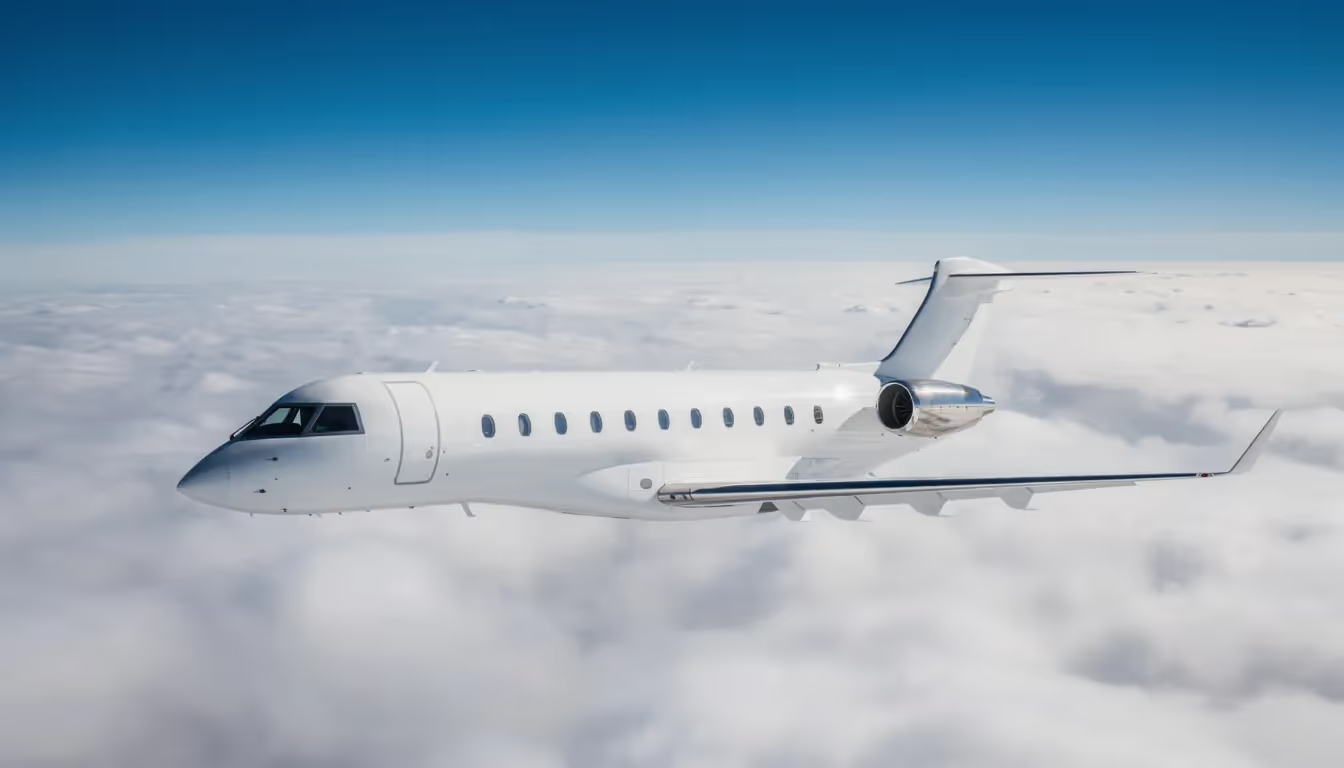
Private jets offer a travel experience that stands apart from commercial aircraft, combining luxury, flexibility, and efficiency in every journey. One of the most significant advantages private jets offer is their ability to fly at higher altitudes—often between 35,000 and 51,000 feet—well above the majority of commercial air traffic. This altitude advantage allows private jets to avoid congested airspace, resulting in fewer delays and a smoother, more comfortable ride for passengers. By flying higher, private jets can also take more direct routes, reducing overall flight time and enhancing fuel efficiency. These benefits make private jet travel especially appealing to business executives, celebrities, and anyone seeking a seamless, time-saving, and luxurious way to reach their destination. As demand for private jet travel continues to rise, more travelers are discovering the unique advantages of flying above the crowds and enjoying a truly elevated experience.
Key Takeaways
Most private jets cruise between 35,000 and 45,000 feet, with select ultra-long-range models like the Gulfstream G650ER and Bombardier Global 7500 certified up to 51,000 feet
Private jets fly higher than commercial airlines (which typically operate at 30,000–40,000 feet), delivering smoother flights, more direct routes, and meaningful time savings for business and UHNW travelers
Altitude selection is dynamic—pilots and dispatch optimize based on aircraft type, weight, weather conditions, and air traffic control clearances rather than defaulting to a fixed number
High altitude flight improves fuel efficiency by reducing drag in thinner air, supporting both cost control and sustainability initiatives like BlackJet’s carbon-neutral flight commitment
Safety and certification define the upper limits: each aircraft’s service ceiling, pilot training requirements, and regulatory frameworks like Class A airspace govern how high private jets can safely operate
Why Private Jet Altitude Matters for Elite Travelers
When a private jet climbs above 41,000 feet—well beyond the crowded corridors where commercial airplanes operate—something fundamental changes. The flight path straightens. Turbulence diminishes. And the hours that most commercial flights lose to congestion, indirect routing, and weather delays simply disappear from the equation. Within the aviation industry, these differences in altitude and routing reflect broader standards and practices that distinguish commercial airlines from private jets.
For executives and discerning travelers who measure value in time reclaimed, this altitude advantage translates directly to a competitive edge. While commercial airlines typically cruise around 35,000 feet, many private jets routinely operate between 41,000 and 45,000 feet, with some models reaching 51,000 feet. That 10,000 to 16,000-foot difference means flying above 90% of weather disruptions, bypassing the dense bands of commercial air traffic, and accessing more direct routes that shave significant minutes off every sector. Private jets fly at higher altitudes specifically to avoid commercial air traffic and experience less air traffic, which reduces congestion and allows for more efficient, comfortable flights.
Consider a CEO departing London for New York in a Gulfstream G650ER. At FL510 (51,000 feet), the aircraft clears most North Atlantic traffic and weather systems entirely, enabling a smooth, uninterrupted flight where productive work or genuine rest becomes possible. Compare this to commercial business class: even the most premium cabin cannot escape the 38,000-foot corridor shared with dozens of other widebodies, the resultant turbulence, or the routing constraints imposed by air traffic regulations.
BlackJet positions its Jet Card programs to capture precisely this advantage. Through a safety-vetted fleet, carbon-neutral flight operations, and technology-enabled routing, cardholders access aircraft capable of exploiting optimal cruise altitudes on the routes that matter most to high-performance travelers. The result is not merely a flight, but a strategic tool for those who refuse to let travel diminish their day.
How High Do Private Jets Typically Fly?
Private jets typically cruise between 35,000 and 45,000 feet, with the upper band extending to 51,000 feet on select long-range aircraft. These altitudes place private aviation firmly within the lower stratosphere—above the majority of weather systems and well clear of most commercial aircraft. Light jets generally fly between 30,000 and 41,000 feet, while midsize jets reach altitudes between 41,000 and 45,000 feet.
By contrast, commercial airliners like the Boeing 737 usually operate at cruising altitudes between 33,000 and 42,000 feet. Commercial planes are optimized for high-altitude, large-scale flights, and their altitude capabilities are designed for operational efficiency and passenger comfort, often overlapping with but sometimes lower than the maximum altitudes reached by private jets.
Common altitude bands for private jets:
FL350–FL410 (35,000–41,000 feet): Standard cruise for light and midsize jets on regional to transcontinental routes
FL410–FL450 (41,000–45,000 feet): Optimal range for super-midsize and large cabin jets, balancing speed and fuel burn
FL470–FL510 (47,000–51,000 feet): Available on ultra-long-range models for intercontinental sectors
By contrast, commercial airliners like the Boeing 737 and Airbus A320 family typically cruise between 30,000 and 40,000 feet. The Boeing 777 and Airbus A350 may reach 43,000 feet on lighter loads, but the practical average for most commercial flights remains around 35,000–38,000 feet due to weight, traffic density, and air traffic control constraints.
Representative service ceilings by aircraft:
Cessna Citation CJ4: Light Jet with a service ceiling of 45,000 ft
Embraer Phenom 300: Light Jet with a service ceiling of 45,000 ft
Bombardier Challenger 350: Super-Midsize Jet with a service ceiling of 45,000 ft
Gulfstream G650ER: Ultra-Long-Range Jet with a service ceiling of 51,000 ft
Bombardier Global 7500: Ultra-Long-Range Jet with a service ceiling of 51,000 ft
Understanding the distinction matters: service ceiling represents the maximum altitude an aircraft is certified to reach, while typical cruising altitude sits somewhat lower to maintain safety margins, cabin comfort, and optimal fuel efficiency. Private jet pilots routinely operate several thousand feet below the certified ceiling, stepping up to higher flight levels as fuel burns off and the aircraft becomes lighter.
Typical Altitudes by Private Jet Category
Aircraft category—light, midsize, super-midsize, or large/ultra-long-range—serves as one of the primary determinants of how high a private jet flies. Each class balances engine performance, aerodynamic design, and mission profile to optimize for different route lengths and passenger expectations.
Light Jets: Efficient Regional Altitudes
Light jets such as the Cessna Citation CJ3+, Embraer Phenom 300, and Learjet 75 Liberty typically cruise between 35,000 and 41,000 feet, with service ceilings reaching 45,000 feet on many modern designs. However, altitude selection depends heavily on sector length.
On short 300–600-mile flights—Los Angeles to Napa or Paris to Zurich—private jets may level off around 33,000 to 37,000 feet simply because the climb and descent phases would otherwise consume disproportionate portions of such brief trips. Longer regional sectors of 1,000–1,500 miles justify climbing to FL410 or higher, positioning the aircraft above much of the regional airline traffic and light weather.
Modern avionics and pressurization systems in this class maintain cabin comfort even at FL450, allowing passengers to work or rest without the fatigue associated with high cabin altitudes. For executives on quick hops between major business centers, light jets offer the altitude advantage of flying at higher altitudes without the footprint of larger aircraft.
Midsize and Super-Midsize Jets
Midsize jets, including the Hawker 900XP, Cessna Citation XLS+, and Learjet 60XR, generally operate between 37,000 and 43,000 feet on three-to-five-hour sectors. These aircraft balance range capability with efficient climb performance, making them well-suited for transcontinental North American routes and Western European connections.
Super-midsize jets—the Bombardier Challenger 3500, Gulfstream G280, and Cessna Citation Longitude—push this envelope further, with typical cruise in the 39,000 to 45,000-foot band. Their enhanced wing loading and thrust allow more aggressive climb profiles and sustained operations near their service ceilings.
A practical example: a BlackJet cardholder flying New York–Aspen in a Challenger 350 might initially level at FL410, then receive clearance to step-climb to FL430 as fuel burns off and the aircraft's weight decreases. This step-climb technique, common in private aviation, exploits the relationship between aircraft weight and optimal altitude for fuel efficiency.
These categories dominate coast-to-coast US flights and routes between Western Europe and the Middle East precisely because they can sustain higher altitudes for better fuel burn and smoother air while offering cabin space suitable for productive work.
Large Cabin and Ultra-Long-Range Jets
Large and ultra-long-range jets represent the apex of private aviation altitude capabilities. Aircraft like the Gulfstream G600/G650ER, Bombardier Global 6500/7500, and Dassault Falcon 8X typically cruise between 41,000 and 45,000 feet, with maximum altitude reaching 51,000 feet on the flagship models.
These aircraft may begin an intercontinental flight at FL390–FL410 and execute multiple step-climbs over 10–14 hours, eventually reaching FL450–FL510 as fuel load decreases and the optimum altitude rises. The power-to-weight ratio of their engines—often Rolls-Royce Pearl or similar high-thrust turbofans—sustains climb capability even at extreme altitudes where most commercial jets would struggle.
Route examples illustrate the advantage: Dubai–London or New York–Tokyo in a Global 7500 at FL470 means routing above North Atlantic or Siberian traffic, flying higher than commercial jets operating below, and remaining clear of turbulence bands that form in the 35,000–40,000-foot range. The result is a direct, efficient crossing with minimal deviation.
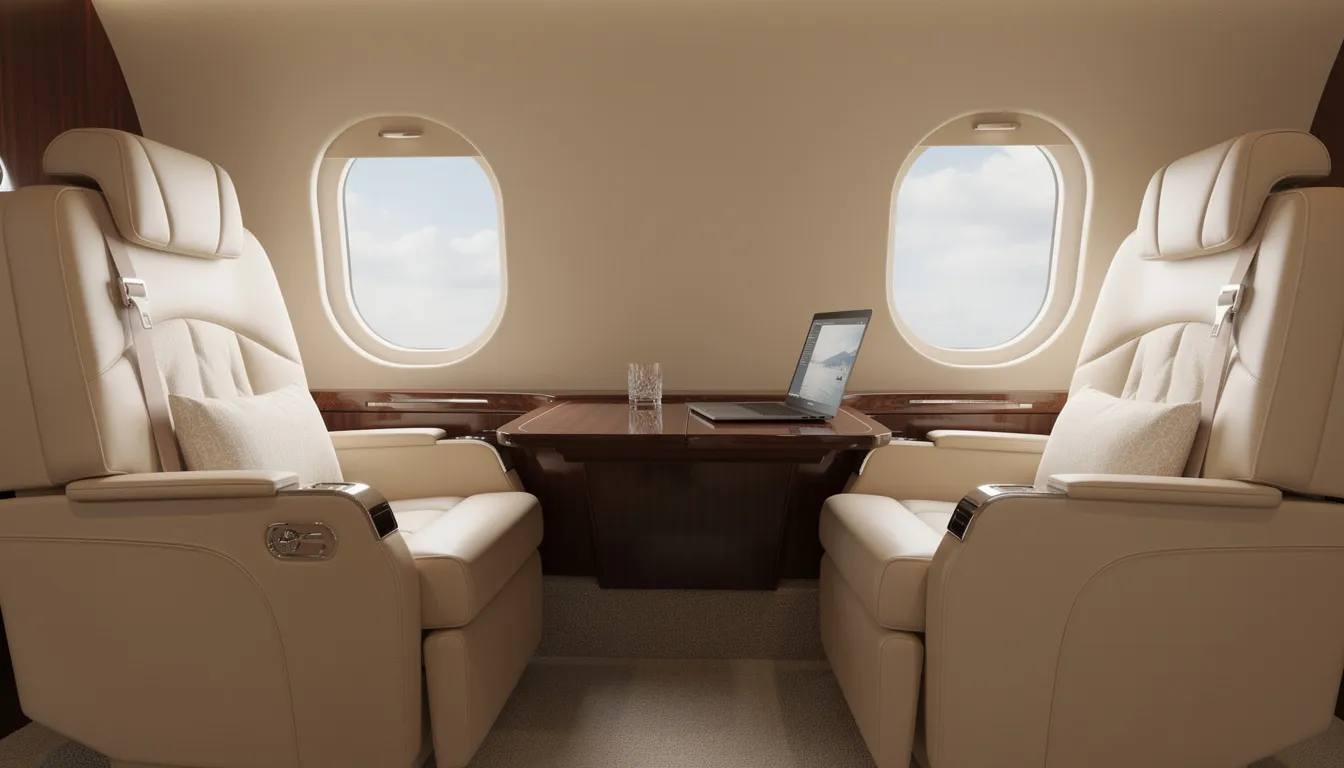
Cabin technology in these jets matches the performance envelope. Many maintain cabin pressure equivalent to 4,500–6,000 feet altitude even when cruising at FL450, significantly lower than commercial first class (typically 6,000–8,000 feet equivalent). This enhanced pressurization reduces passenger fatigue, improves sleep quality, and allows executives to arrive ready for immediate business rather than requiring recovery time.
Why Private Jets Fly Higher Than Commercial Airlines
The altitude gap between private and commercial aviation exists for concrete operational reasons, not merely prestige. Three primary factors explain why private jets fly higher: less traffic congestion, smoother ride quality, and superior fuel efficiency at altitude, including optimized fuel usage at higher altitudes.
Commercial jets cruise at 30,000 to 40,000 feet partly because their wing designs are optimized for these altitudes at high passenger loads, and partly because air traffic control must stack dozens of aircraft along major corridors within this band. Private jets, with their lower wing loading and higher thrust-to-weight ratios, can climb efficiently into thinner air where less air resistance enables both speed and economy advantages.
At 45,000 feet, air density drops to roughly one-quarter of sea-level values. This thinner air means less drag, allowing private jet engines to maintain high Mach numbers (typically Mach 0.80–0.90) and achieve maximum speed with significantly lower fuel flow than at mid-30,000-foot altitudes. The physics is straightforward: a jet at 25,000 feet might achieve 370 knots true airspeed, while the same aircraft at 45,000 feet reaches 470 knots with comparable engine power—a 27% speed gain with similar or lower fuel consumption. Additionally, the reduced air pressure at higher altitudes impacts engine efficiency and overall aircraft performance, further contributing to the benefits of high-altitude flight.
BlackJet’s flight planning and partner operators actively target these optimal altitudes, using real-time data on winds, traffic, and weather to select the cruise level that delivers the shortest block time with maximum fuel efficiency. This systematic approach to altitude optimization translates directly to reliable schedules and on-time performance for time-critical cardholders.
Avoiding Congested Airspace and Wake Turbulence
The busiest commercial traffic corridors—North Atlantic tracks, transcontinental US routes, European trunk routes—stack airliners in narrow bands between FL330 and FL390. These aircraft follow the same flight paths, separated vertically by 1,000-foot increments under RVSM (Reduced Vertical Separation Minimum) rules.
Private jets can climb above this congestion into less-trafficked flight levels between FL410 and FL450. Flying at higher altitudes accomplishes two objectives: it provides access to more direct routing options, and it moves the aircraft away from wake turbulence generated by heavy commercial airplanes—the invisible horizontal tornadoes trailing behind Boeing 777s and Airbus A350s that can severely disrupt smaller aircraft. Operating at these altitudes also helps reduce the risk of mid-air collisions by maintaining greater separation from other aircraft.
A Paris–New York private jet at FL430 may fly a more direct track than airline traffic below, saving 15–30 minutes on the crossing while experiencing a smoother ride. The reduced deviation from great-circle routes also means less fuel consumption and lower emissions over the sector.
Importantly, air traffic control still manages separation and safety at these altitudes. Higher flight levels give controllers and private jet pilots additional routing flexibility within the managed airspace system, not free flight, but the practical effect is fewer constraints and more efficient flight paths than commercial airlines typically access.
Fuel Efficiency, Speed, and Sustainability
The relationship between altitude and efficiency underpins modern private aviation economics. At higher altitudes where thinner air prevails, aerodynamic drag decreases substantially—20–30% less drag above 40,000 feet compared to FL350. This reduction allows jets to maintain cruising speed with lower fuel flow, extending range and reducing cost per mile.
Even modest percentage improvements in fuel burn compound over long sectors. A 7-hour transcontinental flight that saves 8% fuel represents a significant cost reduction and, more importantly, meaningful CO₂ emissions reduction. The Gulfstream G700, for example, can cover 7,500 nautical miles in part because its efficient high-altitude cruise maximizes range from each pound of fuel.
BlackJet pairs altitude-optimized flight planning with verified carbon offsets and, where operationally available, sustainable aviation fuel (SAF) to maintain carbon-neutral flights at no additional cost to Jet Card holders. This approach treats efficiency and sustainability as complementary rather than competing priorities: better altitude selection reduces emissions at the source, while offsets neutralize the remainder.
The connection is precise and measurable. Optimal altitude selection isn’t an environmental marketing exercise—it’s operational best practice that happens to align with sustainability goals.
Avoiding Weather and Turbulence Bands
Most significant weather phenomena—thunderstorms, icing, convective turbulence—form in the troposphere, generally below 35,000 feet on many routes. The tropopause (the boundary between troposphere and stratosphere) varies by latitude and season but often sits around 36,000 feet in temperate regions and higher near the equator.
Private jets exploit their climb performance to ascend above many cloud tops, jet stream shear layers, and convective cells that would cause discomfort or require deviations at lower altitudes. Flying at higher altitudes means operating in the calmer, drier air of the lower stratosphere, where turbulence becomes increasingly rare.
Consider a flight from Miami to São Paulo during tropical storm season. While commercial flights at FL350 may require extensive deviations around storm tops and turbulent cells, a Gulfstream G650 can request FL450, clearing the cloud tops entirely and flying a more direct route. The result: less time in the air, reduced fuel burn, and a smooth cabin environment suitable for sleep or work.
Onboard weather radar, satellite data uplinks, and professional dispatch support enable mid-flight altitude adjustments when conditions warrant. This flexibility—unavailable to most commercial flights locked into rigid traffic flows—allows private jet travelers to avoid unfavorable weather conditions rather than simply enduring them.
Factors That Determine How High a Private Jet Flies
Altitude selection in private aviation is a dynamic calculation, not a fixed setting. Before and during every flight, pilots and dispatchers balance aircraft performance capabilities, weight considerations, route requirements, weather patterns, and air traffic control directives to determine the optimal cruising altitude for that specific mission.
Understanding these factors helps explain why a Gulfstream G650ER with a 51,000-foot ceiling might cruise at FL450 on one sector and FL410 on another—and why both choices represent optimal decision-making rather than underperformance.
Aircraft Performance and Certification
Each aircraft carries a certified service ceiling defined by regulatory authorities (FAA, EASA, and equivalents) based on demonstrated engine performance, aerodynamic characteristics, pressurization system capability, and safety margins. This ceiling represents the altitude at which the aircraft can still sustain a minimum climb rate—typically 100 feet per minute—under specified conditions.
Several technical factors influence this certification:
Engine thrust at altitude: Jet engines produce less thrust in thin air; high power-to-weight ratio designs maintain climb capability even at 45,000+ feet
Wing loading and aerodynamics: Lower wing loading allows efficient operation at altitude range extremes
Pressurization system design: Cabin pressure differential limits determine maximum safe operating altitude
Structural certification: Airframe must withstand pressure differential and aerodynamic loads at altitude
Comparing examples illustrates the range: a Cessna Citation XLS+ is certified to 45,000 feet, while a Gulfstream G700 reaches 51,000 feet. This 6,000-foot difference shapes each aircraft’s typical cruise levels and route capabilities.
BlackJet works exclusively with operators whose aircraft are maintained to manufacturer and regulatory standards. High-altitude capability is only valuable when supported by rigorous maintenance, trained crews, and functioning safety systems.
Weight, Distance, and Flight Profile
Aircraft weight at takeoff directly influences initial cruising altitude capability. A jet departing with full fuel tanks and maximum passenger load may initially level at FL370–FL390, then step-climb to FL410 or higher as fuel burns off over the first hours of flight.
This step-climb technique, standard in long-range private jets operations, means the aircraft operates continuously near its optimal altitude for the current weight rather than compromising at a fixed, suboptimal level.
Trip distance also matters. Very short flights of 200–300 miles may never justify climbing to maximum altitude because:
Climb and descent phases would consume disproportionate flight time
Fuel savings from higher cruise wouldn’t offset the climb fuel expenditure
Passenger comfort favors gentler altitude transitions on brief sectors
Rule-of-thumb planning (e.g., targeting FL300–400 for a 1,000-mile trip) provides rough guidance, but modern flight management systems calculate precise optimal altitudes based on real-time aircraft weight, forecast winds, and performance data.
Example comparison:
Route: London–Geneva
Distance: ~470 miles
Optimal Initial Cruise: FL350–FL370
Final Cruise: FL370–FL390
Route: London–Dubai
Distance: ~3,400 miles
Optimal Initial Cruise: FL390–FL410
Final Cruise: FL430–FL450
The shorter sector never requires the altitude capabilities of an ultra-long-range jet, while the longer sector fully exploits step-climb optimization over seven hours of flight.
Weather, Jet Streams, and Air Traffic Control
Jet streams—high-altitude wind corridors typically flowing between FL300 and FL400—can either accelerate or impede flight depending on direction. Eastbound transatlantic flights often seek jet stream tailwinds, while westbound sectors may climb above or route around headwind cores.
Air traffic controllers assign and restrict flight levels based on traffic flow, military aircraft operations, and special airspace restrictions (NOTAMs for major events, temporary flight restrictions, and similar). A pilot’s preferred FL430 might be adjusted to FL410 or FL390 for traffic separation—a routine accommodation that trades theoretical optimum for practical safety and flow management.
Professional operators serving BlackJet cardholders maintain constant coordination with air traffic control and meteorology services, refining altitude selections before departure and adjusting en route as conditions evolve. This proactive flight operations management ensures each flight operates at the best achievable altitude given real-world constraints.
Lower Altitudes and Private Jets
While private jets are renowned for their ability to soar at high altitudes, there are times when operating at lower altitudes is necessary or optimal. Light jets, for instance, often cruise between 30,000 and 40,000 feet, while midsize jets can reach up to 45,000 feet depending on the mission profile and aircraft performance. Flying at lower altitudes can expose private jets to increased air traffic and a higher likelihood of turbulence, which may affect both comfort and efficiency.
Private jet pilots must carefully assess each flight, considering factors such as air traffic control regulations, current air traffic density, weather conditions, and the specific capabilities of their aircraft. Selecting the optimal cruising altitude is crucial—not only does it help minimize fuel consumption and emissions, but it also ensures a smoother, more enjoyable journey for passengers. By leveraging their expertise and real-time data, private jet pilots consistently strive to find the perfect balance between altitude, efficiency, and passenger comfort.
Safety, Airspace Rules, and the Upper Limits of Private Jet Flight
Safety and regulatory frameworks—not merely technology—define how high private jets may operate in routine service. Understanding these limits provides context for the altitude capabilities discussed throughout this article.
In the United States and most of Europe, controlled Class A airspace extends from 18,000 feet to FL600 (60,000 feet). All flight operations in this airspace require instrument flight rules (IFR), ATC clearances, and specific equipment certification. Private jets operating at 41,000–51,000 feet remain fully within this managed environment, subject to the same separation standards and controller oversight as commercial flights.
While military aircraft and certain experimental vehicles can operate far higher, civilian business jets are bound by their own certification limits and practical operational requirements. No production business jet currently holds certification above 51,000 feet, and most operate well within this boundary for safety, efficiency, and regulatory compliance.
BlackJet’s partner operators adhere to strict regulatory frameworks—Part 135, Part 91K, or equivalent international standards—and maintain internal safety management systems that govern altitude selection alongside all other operational parameters.
Air Traffic Control and Flight Levels
Flight levels provide a standardized altitude reference that accounts for atmospheric pressure variations across regions. FL410 means the aircraft’s altimeter reads 41,000 feet when set to the standard pressure of 29.92 inches of mercury, regardless of actual ground-level barometric pressure.
Air traffic controllers manage aircraft altitudes through a clearance process:
Departure clearance: Initial climb altitude assigned (e.g., “climb and maintain FL240”)
En route clearance: Higher levels granted as traffic permits (“climb FL410”)
Step climbs: Progressive increases approved as weight decreases or airspace opens
Descent clearance: Managed return to approach altitudes at destination
Above FL290, RVSM (Reduced Vertical Separation Minimum) rules apply, requiring 1,000-foot vertical separation between aircraft and mandating specific altimetry equipment and crew training. This system allows more aircraft to operate in high-altitude airspace while maintaining safe separation—essential for both private jet operators and air traffic controllers managing busy routes.
Cabin Pressurization and Passenger Wellbeing
Although a jet may cruise at 45,000–51,000 feet, the cabin interior maintains pressure equivalent to a much lower altitude—typically 4,000–8,000 feet depending on aircraft design. This pressurization is what makes high altitude flight safe and comfortable for passengers.
New-generation business jets offer particularly impressive cabin altitude performance:
Gulfstream G700: Cruise altitude FL510 with a cabin altitude equivalent of approximately 4,850 feet
Bombardier Global 7500: Cruise altitude FL510 with a cabin altitude equivalent of approximately 5,680 feet
Dassault Falcon 8X: Cruise altitude FL470 with a cabin altitude equivalent of approximately 6,000 feet
Lower cabin altitude means more available oxygen, better hydration, improved sleep quality, and reduced jet lag effects. Private jet travelers on overnight transatlantic sectors often report arriving more alert than after comparable commercial flights, partly due to this physiological advantage.
Safety systems supporting high-altitude operations include redundant pressurization packs, automatic oxygen deployment in case of depressurization, and strict maintenance protocols mandated under Part 135 and equivalent regulations. Crew training addresses rapid depressurization response, hypoxia recognition, and emergency descent procedures.
BlackJet’s operator vetting process specifically evaluates maintenance standards, crew qualifications, and safety system compliance to ensure passenger safety matches altitude capabilities.
Aerospace Engineering and Private Jets
The remarkable performance of private jets at high altitudes is made possible by cutting-edge aerospace engineering. Modern private jets are crafted using lightweight materials and advanced aerodynamic designs, allowing them to achieve impressive speeds and ranges while maintaining safety and efficiency. Powerful jet engines provide the thrust needed to climb quickly and sustain flight at altitudes where the air is thinner, while sophisticated avionics and flight control systems give private jet pilots the precision and confidence to navigate even the most challenging weather conditions. These engineering advancements not only enhance the safety and reliability of private jets but also contribute to their reputation for luxury and performance. As aerospace technology continues to evolve, private jets are becoming even more efficient, comfortable, and capable—making them the preferred choice for discerning travelers around the world.
Private Jet Operations
Behind every seamless private jet journey is a complex web of operations designed to ensure safety, efficiency, and luxury. Private jet operators are responsible for maintaining their aircraft to the highest standards, ensuring compliance with all regulatory requirements, and providing highly trained pilots for every flight. Flight operations begin with meticulous planning, including route selection, weather analysis, and coordination with air traffic control to secure clearances and avoid congested airspace. Throughout the flight, private jet pilots maintain constant communication with air traffic controllers, navigating through busy skies and adjusting as needed to ensure a smooth and timely arrival. In addition to operational excellence, private jet operators focus on delivering exceptional in-flight services, catering to the unique needs and preferences of their clients. By combining rigorous safety protocols with personalized service, private jet operators create an unparalleled travel experience from takeoff to touchdown.
How Altitude Enhances the BlackJet Experience
Every technical advantage of high-altitude private flight—time savings, route efficiency, cabin comfort, reduced turbulence—translates directly to client value. For BlackJet Jet Card holders, altitude optimization isn’t an abstract capability; it’s a tangible benefit experienced on every flight. As a luxury private jet charter, BlackJet delivers a premium, high-end service that combines altitude performance with comfort, exclusivity, and a tailored travel experience.
BlackJet’s access programs prioritize aircraft capable of operating at optimal cruise levels on key business routes. A Jet Card member flying New York–San Francisco in a super-midsize jet at FL450 experiences not only the smooth, turbulence-free cruise that altitude enables, but door-to-door timing that commercial business class simply cannot match. Factor in FBO departures (15 minutes before flight versus 90+ minutes at commercial terminals), direct routing overhead mid-country terrain, and arrival at a convenient general aviation terminal, and the total time advantage often exceeds three hours.
The pillars supporting this experience work in concert:
Safety: Audited operators flying in controlled high-altitude airspace under rigorous regulatory frameworks
Sustainability: Efficient cruise at optimal altitude combined with verified carbon offsets for carbon-neutral operations
Technology: Digital tools for routing optimization, real-time weather integration, and seamless scheduling
Private aviation at its best treats altitude not as a technical specification but as a strategic resource. For those who measure success in productive hours and minimized friction, flying private at 45,000 feet represents travel transformed into competitive advantage.
Elevate your travel — effortlessly — by choosing private jet access that makes full use of the sky above airline traffic.
Future of Private Jet Flight
The future of private jet flight is bright, driven by ongoing innovation in technology, materials, and design. Manufacturers are investing in electric and hybrid-electric propulsion systems, which promise to reduce emissions and operating costs, making private jet travel more sustainable and accessible. Advances in lightweight materials and manufacturing techniques are enabling private jets to fly farther and more efficiently, while new avionics and automation technologies are enhancing safety and performance. As private jet travel continues to grow in popularity, the industry is evolving to meet travelers' changing needs—offering greater flexibility, improved efficiency, and a continued commitment to luxury. With these advancements on the horizon, private jets are set to remain the gold standard for those seeking a high-end, efficient, and environmentally conscious way to travel.
FAQ: How High Do Private Jets Fly?
Do passengers feel any different when a jet flies at 41,000 ft versus 51,000 ft?
Passengers primarily notice cabin altitude and ride smoothness rather than the aircraft’s actual flight level. Modern private jets maintain comfortable cabin pressure (typically equivalent to 4,000–6,000 feet altitude) whether cruising at FL410 or FL510. The main perceptible differences are slightly smoother air at extreme altitudes and potentially quieter cabin noise. Most passengers cannot distinguish between 43,000 and 49,000 feet based on feel alone—what they notice is the quality of pressurization, temperature control, and absence of turbulence.
Can a private jet fly higher to “get there faster” on every trip?
Higher isn’t universally better. On short routes under 500 miles, climbing to maximum altitude wastes time and fuel because the climb and descent phases consume disproportionate portions of the flight. Additionally, prevailing winds may favor lower altitudes on certain headings, and ATC constraints sometimes require specific flight levels regardless of aircraft capability. Professional pilots select the optimal altitude for each specific route, balancing distance, winds, traffic, and efficiency rather than defaulting to maximum altitude.
Are there health risks to flying so high in a private jet?
Cabin pressurization eliminates the primary altitude-related health risks. Because private jet cabins maintain pressure equivalent to 4,000–6,000 feet—often lower than commercial aircraft—many passengers with demanding schedules specifically prefer flying private to reduce fatigue and dehydration. Standard aviation medicine guidance applies: passengers with specific cardiovascular or respiratory conditions should consult physicians before any flight, but pressurized high-altitude flight poses no additional risk compared to commercial travel. Some travelers actually report fewer symptoms on private jets due to superior cabin altitude performance.
Do all BlackJet flights use the maximum altitude of the aircraft?
No. BlackJet’s partner operators select the optimum altitude for safety, efficiency, and comfort on each route—not necessarily the aircraft’s certified maximum. A typical transcontinental flight involves step climbs from an initial cruise level (selected based on departure weight) to progressively higher altitudes as fuel burns off. Aiming directly for the service ceiling on every departure would be inefficient and potentially uncomfortable. The goal is optimal performance, not maximum altitude for its own sake.
Can a private jet fly over bad weather like a hurricane simply by going higher?
While private jets can overfly many storm systems by climbing above cloud tops, extremely powerful weather systems extend high into the atmosphere—some tropical systems reach 50,000+ feet. Pilots and dispatchers address severe weather through a combination of routing (flying around the system), altitude selection (climbing above when possible), and timing (departing before or after system passage). Simply trying to fly over every weather system isn’t always possible or advisable. The advantage of private aviation lies in the flexibility to combine all available options rather than being locked into a commercial airline’s fixed route and schedule.
Conclusion
Flying at higher altitudes is one of the key advantages that private jets offer over commercial aircraft. By cruising between 35,000 and 51,000 feet, private jets can avoid congested airspace, reduce turbulence, and take more direct routes—resulting in faster, smoother, and more fuel-efficient flights. This altitude flexibility enhances passenger comfort and safety while enabling private jet operators to optimize flight performance and fuel consumption. Whether for international flights or shorter regional trips, the ability to fly higher than commercial jets is a defining feature of private jet travel, offering unmatched convenience, efficiency, and luxury. As technology and regulations evolve, private jets will continue to push the boundaries of altitude optimization, ensuring an exceptional flying experience for discerning travelers worldwide. For those seeking to elevate their travel experience, platforms like BlackJet provide access to a curated fleet of luxury private jets, combining the benefits of high-altitude flight with seamless booking and personalized service, making private jet travel more accessible and enjoyable than ever before.


 Sign up with google
 Sign up with Apple