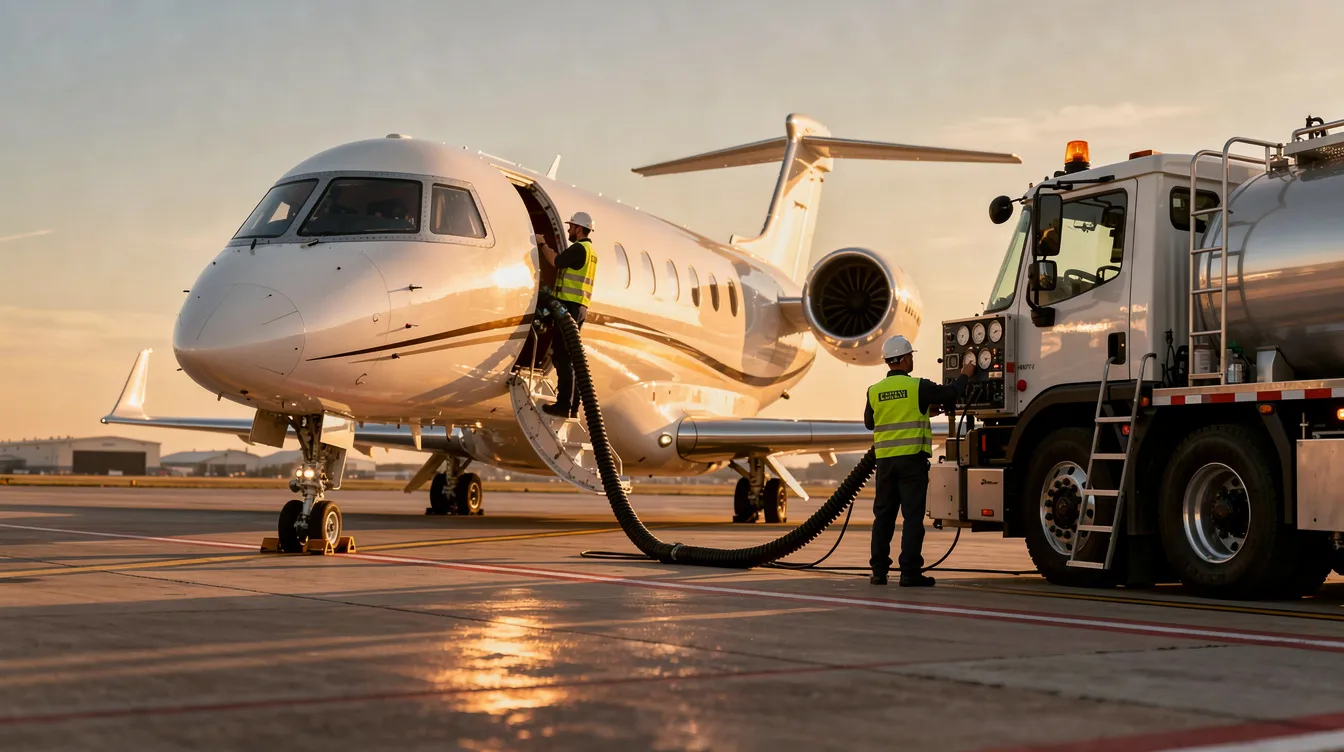
Jet fuels are specialized petroleum-based or synthetic fuels engineered for aircraft turbine engines, and they quietly shape every aspect of private aviation-from how far you can fly nonstop to how reliably your aircraft performs in extreme winter conditions. For discerning travelers who value precision and safety, understanding what powers your jet is not trivial. It is strategic.
This guide breaks down every major fuel grade, the science behind key properties, and how fuel decisions influence range, routing, and aircraft selection. Whether you are planning a transatlantic crossing or a multi-city domestic roadshow, the information here will sharpen your perspective on one of aviation's most critical yet overlooked variables.
Why Jet Fuel Choice Matters for Private Jet Travelers
For private jet travelers, fuel type is not an academic distinction-it directly determines where you can fly nonstop and how confidently your crew can plan winter operations. A light jet like the Citation CJ3 burns roughly 150 to 200 gallons per hour, while a large-cabin, long-range aircraft like the Gulfstream G650 or Bombardier Global 7500 consumes 450 to 500 gallons per hour at cruise. At those consumption rates, even small differences in energy content, freezing point, or fuel quality translate into meaningful changes in range, payload, and safety margins.
Consider a New York to London flight at approximately 3,450 nautical miles. A full fuel load of Jet A-1, with its lower freezing point, allows the crew to fly higher and more direct polar routes. Substitute that with Jet A, which has a higher freezing point, and the operator may need to accept warmer cruise altitudes or carry additional reserves, potentially forcing a fuel stop. Similarly, departing Aspen or Teterboro on a cold winter morning, the difference between Jet A and Jet A-1 specifications can influence whether fuel in wing tanks risks approaching dangerous crystallization temperatures during climb.
So what fuel do jets use? The short answer: mostly kerosene-based Jet A or Jet A-1, with alternative grades reserved for extreme cold or military applications. Everything conforms to strict ASTM, DEF STAN, or MIL specifications. For BlackJet Jet Card members, fuel quality, sourcing, and specifications are managed through vetted operators, freeing you to focus on schedule and comfort.
What Is Jet Fuel? Core Definitions for Modern Aviation
Jet fuel is a refined, kerosene-based aviation fuel designed for gas turbine engines-turbojets, turbofans, and turboprops. It is fundamentally different from aviation gasoline (AVGAS), which is a high-octane, high-volatility fuel formulated for small piston engine airplanes and piston engine aircraft, not suitable for turbine powered aircraft.
The primary categories of jet fuel are kerosene-type and wide-cut (naphtha-type) fuels. Kerosene-based jet fuels like Jet A and Jet A-1 consist of hydrocarbon chains typically in the C8 to C16 range, with boiling ranges roughly from 150°C to 300°C. Jet fuel contains over 260 hydrocarbon compounds, making it a complex mixture of paraffins, cycloparaffins, and aromatic hydrocarbon compounds. Wide-cut fuels like Jet B include lighter components down to approximately C5 or C6, yielding higher volatility.
Terminology varies across the aviation sector. "Jet fuel" is the common term; "aviation turbine fuels" is the more formal designation used by regulators. Standards bodies like ASTM (which publishes D1655 for Jet A and Jet A-1), the UK's DEF STAN, NATO fuel designations, and AFQRJOS all define grades and fuel specifications. Military designations such as JP-8 correspond to specific additive packages and performance additives layered onto base fuel chemistry.
Main Jet Fuel Types Used in Civil and Business Aviation
Civil aviation relies on a handful of well-defined fuel grades. Here is a concise overview of the types of jet fuel you will encounter:
Fuel Grade | Composition | Typical Use | Key Differentiator |
|---|
Jet A | Kerosene-type, C8–C16 | US domestic, business jets | Max freezing point −40°C |
Jet A-1 | Kerosene-type, tighter specs | International flights worldwide | Max freezing point −47°C; mandatory antistatic additives |
Jet B | Wide-cut (kerosene naphtha blend) | Arctic, remote cold regions | Freezing point ~−60°C; higher volatility |
TS-1 | Russian-spec, cold-adapted | Russia, CIS countries | Freezing point below −50°C |
Jet fuel types differ in freezing point, flash point, volatility, density, and intended operating environment. For BlackJet members, the vast majority of flights worldwide run on Jet A or Jet A-1. Jet B and TS-1 appear mainly in extreme climates-northern Canada, Siberia, or Arctic operations where standard aviation kerosene may not suffice.
All fuels used across BlackJet's network must conform to recognized fuel specifications such as ASTM D1655, ensuring that fuel choice translates directly into safety and reliability. The sections below dive deeper into each grade, including their enhanced cold-weather performance and fuel efficiency implications.
Jet A: The Standard Jet Fuel in the United States
Jet A is a kerosene-based fuel defined by ASTM D1655 and is primarily used in the United States. It is the default fuel type at most US FBOs and business aviation airports, fueling everything from light business jets to long-range aircraft when conditions permit.
Key properties of Jet A include:
Maximum freezing point of −40°C (−40°F)
Minimum flash point of approximately 38°C (100°F)
Aromatics limited to ≤25% by volume
Sulfur content ≤0.30% by weight
These parameters make Jet A well-suited for typical US domestic and transcontinental flights where ambient temperatures and cruise altitudes remain within moderate ranges. Jet A is among the most commonly used fuels in American general aviation and commercial aviation fuel operations.
One consideration: some Jet A formulations in the US do not include static dissipater additives, which are mandatory in many international specifications. Reputable flight operators and FBOs mitigate this through proper bonding and grounding procedures during fueling, along with rigorous water detection and filtration protocols.
A practical example: a BlackJet member flying from Los Angeles to Chicago to Miami on a super midsize jet encounters no special cold-weather constraints. All legs are domestic, airports sit at moderate elevations, and winter conditions remain well above the −40°C threshold. Jet A suffices with standard safety margins, and fuel availability at US FBOs is strong. For a deeper look at fuel weight considerations, see our guide on understanding the weight of Jet A per gallon.
Jet A-1: The International Workhorse With Lower Freezing Point
Jet A-1 is the standard fuel for international flights and serves as the primary kerosene-based fuel outside the United States. It meets ASTM D1655, DEF STAN 91-091, AFQRJOS requirements, and NATO F-35 equivalence, making it the jet fuel commonly uplifted at virtually every major international airport.
The critical differentiator: Jet A-1 has a lower maximum freezing point of −47°C, compared to Jet A's −40°C. This seven-degree advantage may sound modest, but for long-haul international flights at cruise altitudes above FL400-where ambient temperatures can plunge to −70°C-those extra degrees of margin can be the difference between a safe, uninterrupted flight and a diverted one.
Jet A-1 contains mandatory antistatic additives for safety. Static dissipator additives reduce static electricity buildup during fueling and in flight, addressing a risk that is particularly relevant during high-altitude operations and rapid refueling sequences.
Jet A-1 must meet ASTM specification D1655 and is preferred or required on routes including:
Transatlantic crossings (New York–London)
Transpacific sectors (Los Angeles–Tokyo)
Middle East–Europe corridors (Dubai–Geneva)
Polar routes between North America and Asia
For BlackJet members planning international or winter-heavy itineraries, Jet A-1 availability underpins nonstop capabilities and schedule certainty. Lower freezing points in jet fuel provide better operating margins for high-altitude flights, enabling crews to select optimal altitudes and more direct routing.

Jet B and Other Wide-Cut Fuels for Enhanced Cold Weather Performance
Jet B is a wide-cut aviation fuel-a blend of kerosene and gasoline with a lower freeze point and higher volatility, used in cold regions where even Jet A-1 may not perform adequately. Its composition is roughly 70% lighter gasoline fractions and 30% kerosene, which yields a very low freezing point of approximately −60°C.
Higher volatility in fuels like Jet B aids cold-weather engine starting but raises fire hazards. The lower flash point means more evaporative losses, greater vapor explosion risk, and more rigorous fire safety requirements during ground handling. Jet B is less commonly used due to its high flammability despite its benefits in cold climates, and it requires aircraft with fuel systems specifically designed to handle wide-cut constituent chemicals.
Where is Jet B actually used? Remote northern Canada (Yukon, Northwest Territories), parts of Alaska, and certain Arctic operations where ramp temperatures drop far below −40°C.
TS-1 is a related grade—the common Russian jet fuel — with a freezing point below −50°C and higher volatility than standard Jet A-1. It is used widely across Russia and the former Soviet republics. TS-1 is the only other jet fuel grade commonly available in CIS-region operations, and operators must ensure aircraft seals and fuel systems are compatible.
While most BlackJet flights use Jet A or Jet A-1, partner operators may encounter Jet B or TS-1 during remote repositioning or ferry segments. In such cases, strict specification checks and safety protocols apply.
Military Jet Fuels: JP-8 and Related Grades
JP-8 is used by NATO military forces as the standard battlefield aviation fuel. It is essentially Jet A-1 with an additional military additive package: fuel system icing inhibitor (FSII), corrosion inhibitor/lubricity improver, and static dissipator additive. JP-8 includes anti-corrosion additives for military aircraft, extending engine and fuel system life under demanding operational conditions. Its freezing point matches Jet A-1 at −47°C, with a minimum flash point around 38°C.
Other military fuels worth noting:
JP-5 (NATO F-44): features a much higher flash point (~60°C) for safer shipboard operations aboard aircraft carriers
JP-4 (NATO F-40): a wide-cut fuel with a very low freezing point (~−58°C) but largely phased out due to safety concerns
JP-8+100: includes additives that raise thermal stability by 100°F for high-heat operations
The US Air Force has also shifted toward F-24 for continental operations-essentially Jet A with the military additive package-illustrating the convergence between civilian and military fuels interchangeably used across various aircraft engines.
While BlackJet does not operate military aircraft, many safety and performance standards in private aviation trace their roots to military fuel research. The additive requirements and jet propulsion standards developed for combat environments have directly informed civil aviation fuel specifications.
Key Physical and Chemical Properties That Define Jet Fuels
Understanding a handful of core properties explains why fuel choice matters for range, safety, and maintenance across various aircraft:
Energy content: Jet A and Jet A-1 deliver approximately 42.8 MJ/kg (~18,400 BTU/lb). Higher energy density means more range per kilogram of fuel uplifted.
Flash point: The lowest temperature at which fuel vapors can ignite. Kerosene-type fuels require a minimum flash point of around 38°C. Wide-cut fuels have a lower flash point, increasing ground handling risk.
Freezing point: The temperature at which wax crystals form, risking filter blockage. The maximum freezing point differs by grade and directly constrains high-altitude and cold-weather operations.
Viscosity: Must remain within defined limits (~8.0 centistokes maximum at −20°C for Jet A/A-1) so fuel flows properly through pumps and injectors.
Volatility and boiling range govern how well raw fuel vaporizes for combustion and affect carbon deposit formation in hot sections.
Aromatics and sulfur: Aromatics improve energy density but increase soot; sulfur must stay below 0.30% by weight to limit corrosion and emissions.
Jet fuels must remain stable under extreme temperature fluctuations during flight, from hot ramp conditions on the ground to −70°C at cruise altitude. Additives in jet fuel prevent the formation of harmful chemical species, protecting both the engine and the environment. Fuel specifications from ASTM D1655 and DEF STAN 91-091 set allowable ranges for all these parameters, ensuring compatibility across jet aircraft and airports worldwide.
Energy Content and Fuel Efficiency in Private Jets
Jet fuels have broadly similar energy content, affecting range and payload minimally between grades. Jet A and Jet A-1 both deliver roughly 42.8 MJ/kg, or about 125,000 to 130,000 BTU per gallon, depending on density. By comparison, automotive gasoline has lower energy density per kilogram, which is one reason aviation kerosene remains the preferred fuel for turbine engines.
Higher energy content and optimized fuel efficiency translate into longer range, fewer fuel stops, and lower emissions per mile. Here is how this plays out across jet categories:
Aircraft Class | Typical Fuel Burn | Approximate Range |
|---|
Light jet (e.g., Citation CJ3) | 150–200 gal/hr | 1,500–2,000 nm |
Super midsize | 250–350 gal/hr | 2,800–3,500 nm |
Large-cabin long-range (e.g., G650) | 450–500 gal/hr | 6,000–7,500 nm |
If fuel energy content drops due to off-spec quality, water contamination, or higher wax content, the range can decrease by several percent. On a long leg, that can be the difference between nonstop and a mandatory tech stop. For a detailed breakdown, see how much fuel a private jet uses.
Aircraft manufacturers and flight operators work together to optimize fuel efficiency through weight management, flight planning, modern avionics, and aerodynamic improvements like winglets. BlackJet's digital booking tools help members choose aircraft and routings that minimize fuel burn while maintaining schedule and comfort.
Flash Point, Safety, and Ground Handling
Flash point is the lowest temperature at which jet fuel vapors can ignite when exposed to an ignition source. Jet A and Jet A-1 have minimum flash points around 38°C, enhancing safety during handling on hot ramps, in hangars, and around fueling equipment. Jet fuels have higher flash points than piston-engine gasoline, making them less volatile and safer to handle-a critical distinction for ground personnel and facilities.
By contrast, wide-cut fuels like Jet B have a substantially lower flash point, increasing the risk of vapor ignition during fueling and storage. JP-5, developed for shipboard use, raises the bar further with a flash point around 60°C.
Regulators, airports, and FBOs set ground handling procedures based on flash point classifications. These include:
Bonding and grounding during every fueling operation to prevent static sparks
Certified fire suppression systems within reach of fueling areas
Filtered fueling lines with water detection and removal
Trained personnel following IATA and JIG (Joint Inspection Group) guidance
BlackJet requires partner operators to use FBOs and ground handlers with robust fire safety systems and adherence to these standards. Even when the fuel specification is correct, mishandling can compromise safety.
Freezing Point, Cold Soak, and High-Altitude Performance
The freezing point is the temperature at which wax crystals begin forming in jet fuel, risking filter blockage and flow restrictions that can lead to engine flame-outs. Specific values by grade:
Jet A: maximum freezing point of −40°C
Jet A-1: lower maximum freezing point of −47°C
Jet B: approximately −60°C
TS-1: below −50°C
The "cold soak" effect compounds this risk. On long-distance flights at cruise altitudes above FL400, fuel in wing tanks contacts cold external skin surfaces, and its temperature can drop well below the surrounding air temperature-sometimes approaching or crossing the fuel's freezing point. This is particularly those flights over polar regions where ambient conditions reach −70°C or colder.
A concrete example: a Gulfstream flying from Dubai to New York via a polar route cruises at FL470. With Jet A-1's −47°C specification, dispatchers maintain a 3 to 5°C safety margin above the freezing point throughout the flight. Had the aircraft uplifted only Jet A (−40°C max), the crew might need to descend to warmer altitudes or reroute, burning more fuel and potentially requiring a stop.
BlackJet's partner operators monitor fuel temperature in flight and follow strict procedures, choosing routes and altitudes that maintain adequate margins. For members, the result is seamless-no disruptions, no surprises.

Viscosity, Fuel System Compatibility, and Engine Health
Viscosity describes how easily fuel flows. If jet fuel becomes too thick at cold temperatures, pumps cavitate, and nozzles cannot atomize fuel properly for combustion. If it is too thin or volatile, vapor lock or seal leakage can occur. Aviation turbine fuels must stay within defined viscosity ranges-typically a maximum of 8.0 centistokes at −20°C for Jet A and Jet A-1-across temperature extremes encountered in flight operations.
Fuel systems in jet aircraft include precision-machined components: fuel controls, boost pumps, transfer valves, and combustor nozzles. Off-spec viscosity or contamination can damage these components, increasing maintenance costs and potentially affecting safety. Elastomer seals must also be compatible with the fuel type-particularly important when operators encounter wide-cut fuels like Jet B, where lighter fractions can cause seal swelling or shrinkage.
Reputable fuel suppliers and labs perform routine viscosity checks as part of the quality chain. BlackJet's safety protocols include working only with operators and FBOs that adhere to regular fuel testing and filtration standards, protecting engine health across every mission.
Fuel Specifications, Standards Bodies, and Quality Assurance
The global aviation fuel supply chain operates under a layered system of specifications and oversight:
ASTM D1655 defines Jet A and Jet A-1 properties (freezing point, flash point, sulfur, aromatics, additives)
DEF STAN 91-091: the UK standard for Jet A-1, which allows certain additives, including antistatic and anti-icing agents
AFQRJOS Checklist: harmonizes quality requirements across international fuel suppliers
NATO F-35: military equivalence specification for Jet A-1
ASTM D7566: governs aviation turbine fuel containing synthesized hydrocarbons (SAF blends)
Jet fuel testing conforms to ASTM, IP, and IATA standards at every stage of the supply chain. From refinery to airport, the quality chain includes refining, storage, pipeline or ship transport, terminal handling, and in-plane fueling, with sampling and analysis at each point. Jet fuel testing detects free water exceeding 30 ppm, and fuel must be free from water contamination during testing to pass specification. Jet fuel may contain biocides to prevent microbial growth in storage tanks, particularly those in humid climates.
BlackJet's safety and certification model requires operators to source from suppliers that meet or exceed these international fuel standards, ensuring consistent fuel quality regardless of airport or region.
From Crude Oil to Wing: How Jet Fuel Is Manufactured
The journey from crude oil to your aircraft's wing tanks follows a precise refining process:
Distillation: Crude oil is heated in atmospheric and vacuum distillation columns, separating fractions by boiling point. The kerosene fraction-the basis for most jet fuel-is collected as a "straight-run" cut.
Hydroprocessing: The kerosene fraction undergoes hydrotreating to remove sulfur, nitrogen, and olefins. In some refineries, hydrocracking breaks heavier fractions into lighter, specification-compliant kerosene.
Sweetening: Processes like Merox treatment remove mercaptans and other corrosive sulfur compounds.
Additive blending: Antistatic agents, corrosion inhibitors, icing inhibitors, and other performance additives are injected to meet the target specification (Jet A, Jet A-1, or JP-8).
The resulting refined kerosene-based fuel contains hydrocarbons typically ranging from C6 to C17+, though the exact composition varies with crude source and refinery configuration. Impurity limits on sulfur (≤0.30% by weight), aromatics (≤25% by volume), and olefins (<1%) balance engine seal compatibility, fuel combustion products, emissions, and thermal stability.
What started as a simple refining process decades ago has become an exacting science. Major refiners and aviation fuel suppliers maintain strict quality management systems-an important factor when BlackJet selects fuel providers across its global network.
Alternative Fuels and Sustainable Aviation Fuel (SAF)
Alternative fuels represent one of the most significant shifts in aviation's fuel landscape. Sustainable Aviation Fuel (SAF) is derived from renewable resources and lowers the lifecycle carbon footprint compared to conventional jet fuel. These are designed as "drop-in" replacements that meet the same fuel specifications as kerosene-based hydrocarbon fuels, enabling use without engine modifications.
The main SAF pathways include:
HEFA/HVO: Hydroprocessed esters and fatty acids from vegetable oils, used cooking oil, and waste fats
Fischer-Tropsch (FT): Synthetic fuels produced from syngas derived from biomass, natural gas, or municipal waste. Fischer-Tropsch synthetic fuels are certified for 50% blending with conventional jet fuel under ASTM D7566.
Alcohol-to-Jet (ATJ): Converts ethanol or methanol into jet-range hydrocarbons
Biofuels could reduce flight-related greenhouse gas emissions by 60 to 80% over the full lifecycle, depending on feedstock and production pathway. Synthetic jet fuels can also reduce pollutants like SOx and NOx, improving local air quality near airports. In a notable milestone, KLM's 2021 flight used 500 liters of synthetic kerosene, demonstrating the viability of these synthetic fuels in commercial operations.
Challenges remain: limited production capacity, feedstock supply constraints, and a cost premium over other fuels. But momentum is building. Both Airbus and Boeing are working toward full SAF capability by approximately 2030, and EU regulations now mandate minimum SAF usage for airlines.
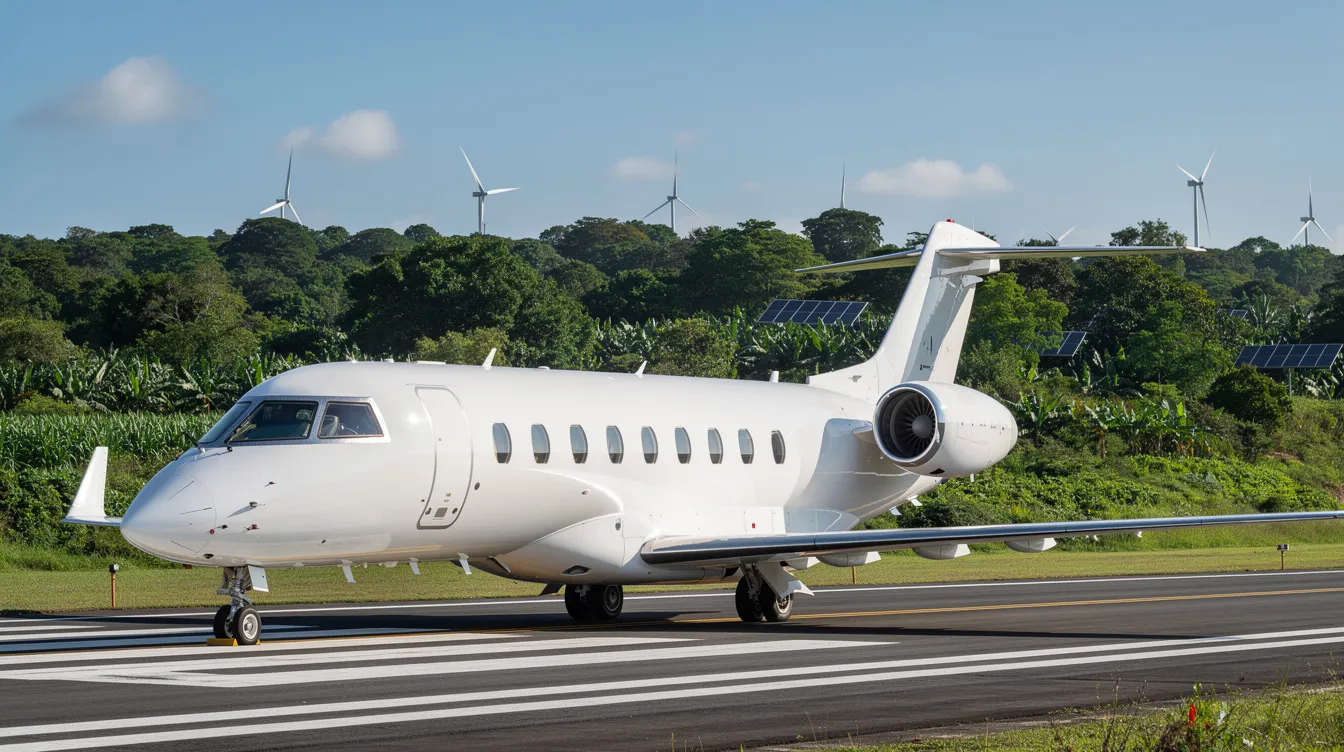
BlackJet's sustainability commitment includes carbon-neutral flights via high-quality carbon offsets at no extra cost to members, combined with active interest in SAF adoption where available and continuous focus on fuel efficiency through smart routing.
Environmental and Health Considerations of Jet Fuel Use
The aviation industry emits 2 to 3% of global CO₂ emissions, and over 60 billion gallons of jet fuel are consumed annually worldwide. While individual private jet flights represent a small fraction of this total, the environmental footprint of every flight matters-particularly to environmentally conscious travelers.
Key environmental impacts include CO₂, NOx, particulate matter, and carbon monoxide emissions, especially during takeoff and climb. Local air quality around busy airports is affected by the aromatic hydrocarbon compounds and sulfur present in fuel combustion products.
For ground personnel, occupational exposure to jet fuel vapors carries documented health risks. Exposure to jet fuel can cause respiratory disorders, and jet fuel vapors can cause dizziness and headaches during acute exposure. Dermal exposure to jet fuel can lead to skin irritation, and research has shown that chronic exposure to JP-8 can impair neurocognitive functioning. These risks are managed through ventilation systems, protective equipment, and monitoring programs governed by worker right-to-know laws and national environmental standards.
BlackJet's commitment to safety extends beyond the cabin to partners' ground operations. The company prefers operators who follow rigorous health, safety, and environmental practices, including choosing greener private jet options where feasible.
Jet Fuel in Commercial Aviation vs Private Aviation
Commercial aviation and private aviation use the same core fuels-Jet A and Jet A-1-but within fundamentally different operating models.
Airlines operate massive fleets on fixed schedules, leveraging bulk fuel contracts and hedging strategies to manage price volatility. They fly hub-and-spoke networks, optimizing fuel loads across thousands of predictable routes. Commercial aviation fuel procurement is a centralized, high-volume operation.
Private jet operators, including Jet Card providers like BlackJet, prioritize flexibility. Flights often route through smaller airports with variable fuel availability. Scheduling is bespoke rather than fixed. The cost per gallon-plus handling fees, uplift surcharges, and delivery premiums at remote FBOs-is more visible to charter and Jet Card customers than it is to airline passengers, where fuel cost is buried in ticket pricing.
Consider the contrast: fueling a long-range jet for a nonstop New York-to-London flight involves a single, large fuel uplift at a major hub. A multi-leg private itinerary-New York to Nantucket to Miami to Aspen-requires repeated refueling at varied airports, each with different fuel suppliers, pricing, and handling standards. For context on how these costs play out, see Understanding Private Jet Fuel Costs.
Despite these differences, both sectors rely on identical global fuel specifications and quality assurance systems to maintain safety. The fuel type is the same. The business model surrounding it is not.
How Fuel Choices Affect Range, Routing, and Aircraft Selection
Fuel capacity, fuel efficiency, and freezing point together determine practical nonstop range and routing options. Here are concrete scenarios:
New York to London (~3,450 nm): Requires a large-cabin jet with a full fuel load. Jet A-1 is preferred for polar routing and cold-soak margin. Aircraft selection: Gulfstream G650 or Bombardier Global 6000, nonstop capable.
Los Angeles to Hawaii (~2,100 nm): Manageable for a super midsize jet with Jet A. No extreme cold concerns, but headwinds can extend the effective distance significantly.
Zurich to Dubai (~2,600 nm): Jet A-1 standard at European FBOs. A midsize or super midsize jet handles this leg comfortably nonstop.
Operational variables-alternates, headwinds, temperature aloft, and payload-can nudge any trip from nonstop to one-stop. Particularly, those scenarios with high passenger count, heavy luggage, and strong headwinds might force a tech stop on what should be a nonstop leg.
BlackJet's advisors and digital tools help members select the most appropriate aircraft category and fuel planning for their itinerary. Fuel strategy preserves both passenger comfort-avoiding midnight tech stops-and time efficiency, ensuring you arrive rested and on schedule.
BlackJet's Safety and Fuel Quality Philosophy
Fuel quality is inseparable from BlackJet's overall safety and certification model. Every operator in BlackJet's network must meet rigorous criteria:
Source fuel from reputable suppliers adhering to ASTM D1655, DEF STAN 91-091, and AFQRJOS standards
Follow IATA and JIG fuel handling guidelines at every fueling point
Maintain documented fuel quality control procedures, including lab test certificates and spot-check records
Use filtered fueling systems with water detection and removal protocols
Conduct regular tank inspections and strictly adhere tothe aircraftt manufacturer's fuel specifications
BlackJet's 24/7 real-time support team monitors operational conditions-weather, alternates, fuel availability-and can adjust plans proactively to maintain safety margins. If a remote airport's fuel supply raises any concern, the team identifies alternatives before you are affected.
The result: members never need to think about which aviation fuels are being uplifted. BlackJet ensures every leg meets or exceeds global jet fuel standards.
Technology, Data, and Smarter Fuel Use in Private Aviation
Modern avionics, flight planning software, and data platforms work together to optimize altitude, speed, and routing for minimum fuel burn while preserving schedule reliability. Advanced trajectory planning tools incorporate real-time wind data, temperature aloft forecasts, and aircraft-specific performance models to identify the most fuel-efficient flight profiles.
BlackJet's digital booking and trip management tools integrate with operators' planning systems to forecast fuel needs and select efficient routings. For a Jet Card member scheduling a multi-city business roadshow-say, New York to Dallas to Los Angeles to San Francisco-optimized sequencing reduces repositioning flights and fuel use, lowering both cost and environmental footprint.
Emerging innovations are pushing the envelope further. AI-based trajectory planning can dynamically adjust cruise altitude and speed in real time, responding to changing weather conditions mid-flight. Research into fuel-efficient aircraft design continues to yield improvements: winglets, laminar flow surfaces, and next-generation engines all reduce consumption per hour.
These technology layers complement SAF adoption and carbon offset strategies, creating a holistic approach to responsible private aviation.
Frequently Asked Questions About Jet Fuels and Private Jets
What is the difference between Jet A and Jet A-1?
The primary difference is the freezing point. Jet A has a maximum freezing point of 6�C and is primarily used in the United States. Jet A-1 has a lower maximum freezing point of 47�C, includes mandatory static dissipator additives, and is the standard fuel for international flights. Private jets can use both, depending on aircraft certification and regional fuel availability.
Can private jets run on sustainable aviation fuel (SAF)?
Yes. SAF blends of up to 50% with conventional jet fuel are currently certified under ASTM D7566. No engine modification is required when the blend meets specification. Availability at FBOs is growing but remains limited, and a cost premium applies.
Does fuel type affect the in-cabin experience?
Not directly. The fuel type does not change cabin pressure, air quality, or comfort systems. However, fuel type and availability affect whether nonstop routing is possible, which significantly influences passenger comfort and schedule.
How do fuel prices impact Jet Card rates?
Private jet providers generally pass through fuel cost fluctuations. Fuel type differences-rarity, remote location, or additive content-may affect price per gallon. A transparent Jet Card model should clearly specify what fuel scenarios may incur a premium. For details, explore jet card pricing structures.
Is fuel quality consistent between large hub airports and smaller FBOs?
Quality standards are identical, but smaller FBOs may have older storage infrastructure, more transportation legs, or less frequent lab testing. The risk of water contamination or degraded additive effectiveness is slightly higher. BlackJet's vetting process examines supplier quality records, lab testing frequency, and handling practices.
What role does fuel play in flight range and aircraft selection?
Fuel capacity, energy content, and freezing point together determine how far an aircraft can fly nonstop. Choosing the right aircraft category for a given route and ensuring the correct fuel is available is a core part of mission planning. BlackJet's advisors model these variables for every itinerary.
Are there hazardous materials concerns with jet fuel?
Jet fuel is classified as a hazardous material and requires careful handling. It contains aromatic hydrocarbon compounds that pose health risks with prolonged exposure. Proper ventilation, protective equipment, and regulatory compliance at the ground-handling level are essential.
Jet Fuel, Sustainability, and the Future of Private Aviation
The trajectory of jet fuel technology points toward a cleaner, more efficient future. Industry targets call for net-zero emissions by 2050 through a combination of SAF scale-up, more efficient aircraft and turbine engines, improved air traffic management, and high-quality carbon offsetting. Current SAF production covers only a fraction of the jet fuel worldwide demand, but investment is accelerating, supported by US tax credits of $1.25 to $1.75 per gallon for qualifying producers and EU mandates for minimum SAF blending ratios.
For high-net-worth travelers, expectations are shifting. Environmental responsibility is no longer optional-it is increasingly a baseline requirement. Private aviation brands that commit to offsetting emissions, adopting SAF where available, and optimizing fuel efficiency through every aspect of flight operations are winning the confidence of discerning clients.
BlackJet positions itself as a proactive participant in this transition. Carbon-neutral flights come standard at no extra cost to members. Where SAF is available, BlackJet supports its use. And continuous focus on fuel efficiency-through smarter routing, optimal aircraft selection, and advanced flight planning-complements these broader sustainability efforts.
As jet fuel chemistry and aviation fuels continue to evolve, BlackJet's mission remains constant: to deliver safe, seamless, and responsible private jet access that lets you focus on what matters most.
Explore BlackJet's Jet Card programs and discover how technical rigor in areas like fuel quality translates into a smoother, more strategic travel experience.


 Sign up with google
 Sign up with Apple