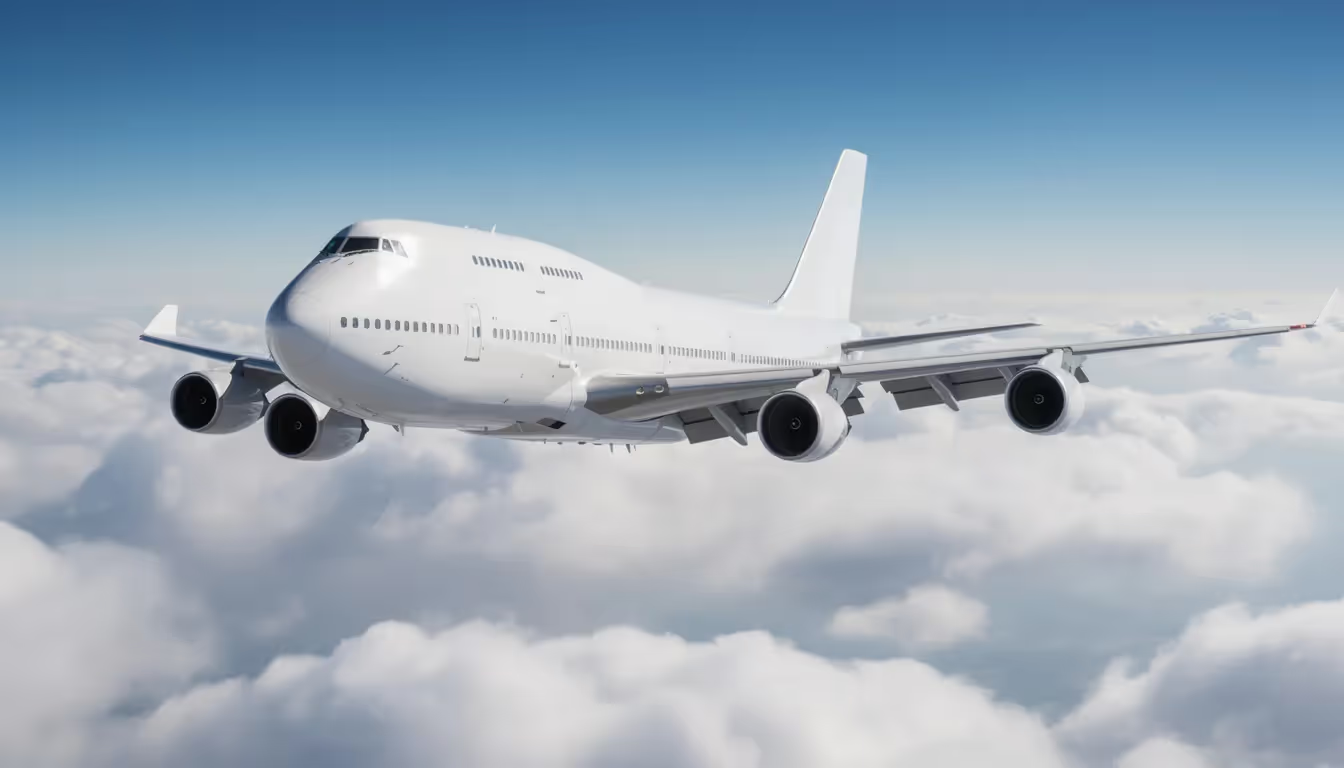
Imagine soaring above the clouds in a flying mansion, where luxury knows no bounds, and every detail is tailored to your comfort. Private jumbo jets like the Boeing 747 and Airbus A380 redefine what it means to travel in style, offering unparalleled space, privacy, and convenience for large groups. Whether you're a global executive, a royal family, or a professional sports team, this guide unveils everything you need to know about experiencing the pinnacle of luxury air travel aboard these iconic aircraft.
Key Takeaways
Private jumbo jets like the Boeing 747-8i BBJ and Airbus A380 represent the pinnacle of business aviation, offering ultra-high-net-worth families, governments, and global corporations a strategic asset with unmatched range (up to 8,875 nm), space (4,500–6,500 sq ft of cabin), and the ability to move 25–100 VIP passengers nonstop between virtually any two major cities on Earth.
Beyond opulence, these aircraft deliver measurable advantages over commercial first class: complete schedule control, true privacy for sensitive discussions, customized interiors featuring boardrooms and master bedrooms, and the elimination of airport queues—saving executives 20–30 hours per round trip on ultra-long-haul routes.
Private jets minimize contact with crowds in airports, providing a significant health and security advantage by reducing exposure to large groups and long lines.
Core operational pillars differentiate elite operators: rigorous safety certifications (FAA Part 135, IS-BAO, ARGUS Platinum), sustainability initiatives including carbon offsets and Sustainable Aviation Fuel compatibility, and cutting-edge technology from encrypted satellite connectivity to circadian lighting systems.
Access to private jumbo jets extends beyond full ownership—charter, fractional programs, and jet cards provide flexible entry points, enabling organizations to deploy a flying residence on their schedule without the capital commitment of acquisition and the operational complexity of fleet management.
For large groups traveling intercontinental distances regularly, per-seat economics on a jumbo jet charter can rival or undercut last-minute commercial business-class fares while delivering an incomparably superior experience.
It is important to note that private jets have a significantly larger carbon footprint per passenger than commercial flights due to fewer passengers on board, though sustainability efforts like carbon offsets and SAF usage aim to mitigate this impact.
Hourly rates for large and ultra-long-range jets typically range from $8,000 to over $20,000 per hour, making chartering significantly more expensive than commercial flights. Booking a private charter requires considerable coordination for flight schedules, catering, and ground transportation.
What Is a Private Jumbo Jet?
A private jumbo jet refers to VIP or corporate-configured versions of wide-body commercial airliners—aircraft like the Boeing 747-400, Boeing 747-8i BBJ, Airbus A340, and Airbus A380—repurposed exclusively for private, governmental, or high-end charter missions. These are not standard business jets with expanded legroom; they are complete transformations of airliners originally designed to carry 400–500 commercial passengers, now reconfigured into flying palaces for as few as 25–100 discerning travelers.
The distinction from typical large jets in private aviation is substantial. While a Gulfstream G700 or Bombardier Global 7500 offers exceptional range and comfort for 14–19 passengers across roughly 2,500 square feet of cabin, a private 747 or A380 delivers multi-deck layouts exceeding 4,000–6,500 square feet. This is the difference between a luxury penthouse suite and an entire flying mansion.
Key characteristics that define private jumbo jets:
Heritage airframes
Based on proven commercial platforms with millions of flight hours of operational data
Multi-zone interiors
Reception lounges, formal dining rooms with dining tables large enough for huge family dinners, conference facilities, master suites, and dedicated staff areas
Wide-body dimensions
Cabin widths of 19+ feet and ceiling heights exceeding 7 feet, allowing for true architectural design
Ultra-long range
Nonstop capability from New York to Singapore, London to Sydney, or Dubai to Los Angeles
Dedicated crew complements
Flight crews of 4–6, plus cabin staff of 8–15 for white-glove service
Private jumbo jets often feature enormous cabin areas that can include offices, conference rooms, bedrooms, dining facilities, and entertainment areas. Many include master bedrooms with king-sized beds and ensuite bathrooms equipped with walk-in showers, spa-style bathrooms, and onboard cinemas or even car garages, making them ideal for both leisure and business purposes.
The production landscape adds to their exclusivity. Boeing delivered its final 747-8 in the early 2020s, and Airbus concluded A380 production in 2021. The handful of VIP examples in existence—perhaps fewer than 20 Boeing 747 VIP variants and a small number of private A380s globally—are finite assets, making them among the rarest collectible aircraft in the world.
Why Private Jumbo Jets Are a Strategic Advantage
For global organizations and ultra-high-net-worth individuals, a private jumbo jet transcends luxury—it becomes a strategic instrument. The value proposition centers not on opulence but on control, predictability, and productivity at an intercontinental scale.
Consider the contrast: a Fortune 100 board flying commercial first class from London to Singapore faces check-in procedures, security queues, potential delays, limited working space, and the impossibility of conducting confidential discussions. The same 60 executives aboard a BBJ 747-8 configured with conference rooms, private offices, and lounges arrive having held productive strategy sessions, reviewed sensitive documents on encrypted networks, and rested in proper bedrooms—stepping off the aircraft boardroom-ready rather than jet-lagged.
Time Savings That Compound
The mathematics of time recovery on private jumbo jets extends far beyond flight duration:
• Airport arrival time: 2–3 hours before departure for commercial first class vs. 20–30 minutes before departure for private jumbo jet
• Security processing: Standard screening lines for commercial first class vs. private terminal access for private jumbo jet
• Boarding efficiency: Group boarding procedures for commercial first class vs. immediate embarkation for private jumbo jet
• Customs/immigration: Standard queues on arrival for commercial first class vs. expedited or planeside processing for private jumbo jet
• Schedule flexibility: Fixed airline timetables for commercial first class vs. departure on your timeline for private jumbo jet
• Layover elimination: Often required on ultra-long routes for commercial first class vs. nonstop anywhere for private jumbo jet
For a New York to Tokyo round trip, executives using a private 747 can reclaim 20–30 hours compared to commercial alternatives when accounting for airport inefficiencies, layovers, and ground delays.
Privacy and Security as Mission-Critical Assets
The ability to control who boards your aircraft and what information flows through your airspace transforms how sensitive business gets conducted:
Controlled passenger manifests: Only authorized personnel have access to the aircraft
Secure data networks: Encrypted satellite connectivity for video conferences and document transmission
Acoustic privacy: No adjacent passengers, no overheard conversations
Strategy sessions in flight: Full conference rooms with secure telepresence capabilities
Government and diplomatic applications: Heads of state rely on this environment for transit briefings
Operational Considerations
Private jumbo jets allow passengers to set their own itineraries and access thousands of airports worldwide, offering flexibility commercial airlines cannot match. They can utilize many major international airports and select regional ones, although their size restricts use of smaller business-aviation fields. Weather sensitivity can affect private jets, making them more prone to delays compared to larger commercial planes, which have more robust operational buffers.
Economic Realities: Beyond Sticker Shock
While hourly charter rates for large and ultra-long-range jets typically range from $8,000 to over $20,000 per hour, VIP-configured 747s can reach $30,000–$50,000 per hour. Despite this, the per-seat economics shift dramatically when moving large groups. A 9-hour transatlantic sector at $40,000 per hour carrying 80 VIP passengers translates to roughly $4,500 per person—comparable to or below peak-season business-class fares on many routes, with incomparably superior service and convenience.
The softer benefits compound this value: the aircraft becomes a moving flagship for global product launches, a consistent environment for multi-city roadshows, and a platform where corporate culture and service standards travel with you worldwide.
Types of Private Jumbo Jets & Flagship Models
The category of popular private jumbo jets encompasses several distinct platforms, each with particular strengths for specific mission profiles. Understanding these options is essential for matching aircraft capability to operational requirements.
Primary categories include:
Boeing Business Jets (BBJ)
VIP derivatives of 737, 777, 787, and 747 platforms, factory-supported with dedicated completion partner networks
Airbus Corporate Jets (ACJ)
VIP versions of A320, A330, A340, A350, and the massive A380
Custom VIP conversions
Commercial airframes acquired on the secondary market and converted by specialized completion centers
Boeing 747‑8i BBJ: Iconic Private Jumbo Jet
The Boeing 747-8i BBJ represents the definitive expression of the private jumbo jet concept—the largest purpose-built VIP aircraft platform delivered by Boeing, offering approximately 420 square meters (5,179 square feet) of interior space distributed across its iconic two-deck configuration.
Performance specifications:
Key performance specifications of the Boeing 747-8i BBJ include:
Maximum range: approximately 8,875 nautical miles (16,437 kilometers)
Cruise speed: Mach 0.84 to 0.85 (~914 km/h or 567 mph)
Typical VIP passenger capacity: 25 to 100
Flight crew: 4 to 6 pilots operating in multi-crew configuration
Cabin crew: 8 to 15 members, depending on the interior configuration
Engines: four General Electric GEnx-2B67 turbofan engines
Interior completions for these aircraft involve the industry’s premier design houses. Cabinet Alberto Pinto has created interiors featuring vaulted ceilings, grand lounges with coffee table arrangements, and formal dining rooms with dining tables seating 12–16 guests. Greenpoint Technologies—Boeing’s primary BBJ completion partner—has delivered configurations including private master bedroom suites with full ensuite bathrooms, spacious offices, and entertainment lounges.
Notable operators and uses include Middle Eastern royal flights, high-level government transport, and—most significantly—the airframe serves as the basis for the modernized Air Force One program (VC-25B), underscoring its suitability for the world’s most demanding head-of-state mission.
The aircraft’s ramp presence remains unmatched: the four-engine silhouette, the distinctive 747 hump, and sheer scale communicate authority and capability before a single word is spoken. For governments and large groups requiring a single platform to replace entire fleets of smaller aircraft, the 747-8i BBJ delivers without compromise.
Airbus A380 VIP & Other Wide-Body Bizliners
If the 747-8i BBJ is a flying residence, the private Airbus A380 is a flying mansion without qualification. The largest private jet configuration available, A380 VIP interiors leverage dual full-length decks with total usable floor area exceeding 6,000 square feet—larger than many celebrities’ homes and capable of accommodating features that would be impossible on any other airborne platform.
A380 VIP specifications:
Interior space: 550–600+ square meters (5,900–6,500 sq ft) configurable area
Deck arrangement: Two full-length passenger decks connected by stairs or private elevators
Range: 8,000+ nm depending on configuration and payload
Cruise speed: Mach 0.85
Typical capacity: 50–100 VIP passengers
The interior possibilities border on the extraordinary. Documented A380 VIP configurations include multi-room apartments with separate sleeping, living, and office areas; majlis gathering spaces for cultural entertaining; full mirror-equipped dressing rooms; wellness suites with steam rooms and rainfall showers; formal dining facilities for 14+ guests; dedicated cinema rooms with tiered seating; and even garage-style spaces for vehicles transported to remote destinations.
Middle Eastern royals represent the primary operators of these aircraft, where the A380 serves as a mobile palace capable of accommodating entire delegations in unified luxury while traversing continents nonstop.
Other significant wide-body platforms include:
Airbus A340-500 VIP: Capable of flights like Sydney–New York or Dubai–Los Angeles nonstop, operated by several heads of state and ultra-high-net-worth owners
Boeing 777 VIP: The 777-200LR offers up to 9,370 nm range with exceptional twin-engine economics; multiple governments operate VIP 777s
Airbus A330 VIP: A more accessible entry point to wide-body VIP travel with 6,000+ nm range
The finite nature of these assets cannot be overstated: with A380 production ended in 2021 and 747 production concluded shortly after, existing VIP examples represent the complete global population. No new ones will be manufactured, adding collectible value to operational capability.
Inside a Private Jumbo Jet: Layouts, Design & Amenities
Walking from a private jet terminal directly into a 747-8i BBJ shatters expectations formed by commercial aviation. The ground-level entry door opens into a reception lounge with full-height ceilings, custom lighting, and the immediate sense of entering an architectural space rather than an aircraft. A sweeping staircase or private elevator leads to the upper deck, where the master suite occupies the quietest section of the fuselage, forward and above the wing.
Common zoning within private jumbo jet interiors:
Reception/entry lounge
First impression space with seating for 8–12, coat storage, and initial bar service
Main lounge
Primary social area with club seating, conversation groupings, and entertainment systems
Formal dining room
Oval or rectangular dining tables for 10–16 guests, integrated galley service
Conference room/boardroom
Seats for 12–20 with secure video conferencing, presentation systems
Private offices
Individual workspaces with desks, encrypted connectivity, privacy partitions
Master suite
King-sized bed, full ensuite bathroom with shower, walk-in closet, dedicated climate control
Guest suites/cabins
Additional bedrooms with ensuite facilities
Staff quarters
Crew rest areas, secondary galley, staff seating
Service zones
Multiple galleys, storage, laundry facilities on larger configurations
The industry’s leading design houses bring architectural vision to these interiors. Beyond Cabinet Alberto Pinto and Greenpoint Technologies, firms like Jet Aviation Basel, Lufthansa Technik, and Winch Design execute completions using materials including African Wakapou wood, Italian marble veneers, hand-stitched leather panels, and acoustic treatments that reduce engine noise to conversation-friendly levels.
Luxury Amenities: From Sky Spas to Private Cinemas
The amenity possibilities within a private jumbo jet extend far beyond anything achievable in conventional business jets. With 4,000–6,500 square feet of configurable space, owners can incorporate features that truly replicate ground-based residences.
Spa and wellness features documented on VIP jumbo jets:
Full-size king beds and full-height walk-in showers linked to master bedrooms
Steam rooms and sauna spaces
Massage rooms with professional treatment tables
Dedicated fitness equipment areas
Advanced humidification systems maintain 20%+ cabin humidity versus 5–10% on commercial flights
Entertainment facilities:
Dedicated cinema rooms with 100+ inch projection screens and studio-grade surround sound
Separate gaming lounges with oversized OLED displays
Music rooms with integrated audio systems
Upper deck lounges with panoramic window configurations, all available on select BlackJet 25+ Jet Card flights.
Social and entertaining spaces:
Bar areas with back-lit stone counters and custom glassware storage
Club-style lounges with designer furniture and coffee tables
Majlis-style seating for cultural gatherings
Children’s play areas on family-configured aircraft
Some bespoke configurations have pushed boundaries further: bowling alleys, full mirror ballrooms for huge family dinners and celebrations, and expandable conference rooms with secure telepresence systems allowing owners to host live board meetings while crossing oceans. For those considering NetJets jet card options, understanding their true costs is essential.
The key distinction from smaller aircraft is not merely the presence of amenities but their scale. A dining room aboard a 747-8i BBJ can seat 16 around a formal table with the same amenities as a private residence—silverware, china, linen service, and gallery-quality art on the walls. This is luxury air travel that genuinely replicates the ground experience rather than compromising toward it.
Ownership & Operating Costs
Owning a private jumbo jet is a significant investment and commitment. The list price for a new BBJ 747-8 is approximately $367 million, but this cost only covers a 'green' aircraft without an interior fitted. Designing and fitting the interior typically adds another $25–$50 million, depending on design complexity and materials. This customization process can take up to two years and involves collaboration with world-class design firms.
Annual upkeep for a private jumbo jet is around 10% of the purchase price, covering maintenance, crew salaries, insurance, and other operational expenses. Owning and operating such an aircraft requires hiring pilots, flight attendants, and a ground crew team to ensure safe and efficient operations. Hangar and storage costs at major airports can reach up to $500,000 per year.
Operating costs per flight hour are substantial; for example, the Boeing 747 burns approximately 10–12 tons of fuel per hour, contributing to hourly operating costs that can exceed $20,000.
Examples of Private Jumbo Jets
Examples of popular private jumbo jets include the Boeing Business Jet (BBJ) 747-8, BBJ 787 Dreamliner, and converted Airbus A380s. The 747-8i Boeing Business Jet (BBJ) is the largest private jet in the world, often described as a flying palace due to its luxurious features and vast cabin area of 5,179 square feet, which allows for various configurations including lounges, dining rooms, and bedrooms.
The Boeing 747-400 variant, a predecessor to the 747-8, has a maximum range of approximately 7,260 nautical miles, making it suitable for ultra-long-haul flights.
The Airbus A380, owned by Saudi Prince Alwaleed bin Talal, is another example of a large private jet, priced at over $500 million, and featuring extraordinary interior amenities.
Conclusion
Private jumbo jets offer a truly unique travel experience, combining the space and luxury of a flying mansion with the operational flexibility of private aviation. They are ideal for large groups such as corporate executives, professional athletes, royal families, and heads of state who require privacy, comfort, and efficiency on intercontinental journeys.
Whether accessed through ownership, charter, or structured programs, private jumbo jets redefine luxury air travel and provide a strategic advantage for those who demand the best in the skies.
Explore BlackJet’s Jet Card Programs


 Sign up with google
 Sign up with Apple