Private aviation stands apart as a dynamic and fast-paced industry, delivering unparalleled service to clients who expect the very best. Whether it’s a private jet charter for a business leader or a bespoke travel experience for a family, private aviation is built on a strong foundation of safety, expertise, and customer focus. The industry brings together a dedicated team of professionals—pilots, flight attendants, flight support specialists, and human resources teams—who work in harmony to ensure every flight is seamless, secure, and memorable.
At the heart of private aviation is a commitment to excellence. Flight attendants provide personalized service that anticipates every client's need, while pilots and support teams maintain the highest safety standards in the industry. From pre-flight planning to in-flight hospitality and post-flight logistics, every detail is managed with precision and care. This full spectrum of support allows clients to enjoy the convenience, privacy, and luxury that only private aviation can offer.
As demand for private jet travel continues to rise, the industry’s reputation for safety, reliability, and exceptional service makes it the preferred choice for individuals and businesses around the globe. However, in 2025, the private aviation sector faces a critical shortage of qualified professionals, driving high demand and competitive compensation across all roles. This shortage creates unique opportunities for those seeking careers in this elite field.
For those seeking a rewarding career in aviation, private aviation offers a world of opportunity to work with cutting-edge aircraft, deliver best-in-class service, and be part of a team that sets the standard for excellence. Lean teams in private aviation provide professionals with more responsibility and cross-functional experience, allowing skill building at a faster pace and fostering rapid career growth.
Key Takeaways
Private plane jobs position professionals at the center of high-stakes, high-reward travel for ultra-high-net-worth individuals, corporate leaders, and VIPs—a world fundamentally different from commercial airlines in pace, expectations, and compensation.
Careers span pilots, cabin crew, maintenance technicians, dispatch, sales, information technology, and sustainability roles, with strong demand driven by private jet movements that have consistently exceeded pre-2019 levels since 2020.
Leading employers prioritize rigorous safety standards (ARGUS Platinum, IS-BAO, Wyvern certifications), modern aircraft technology with advanced avionics, and increasingly carbon-neutral operations that clients expect as standard.
Compensation, schedules, and lifestyle advantages often surpass comparable commercial roles, but expectations for professionalism, discretion, and flexibility are correspondingly elevated—this is not simply a job, but a trusted position within elite travel ecosystems.
This guide provides actionable guidance on qualifications, career paths, and how to position yourself for premier roles in private aviation, whether you’re transitioning from airlines, military, hospitality, or corporate backgrounds.

Why Private Plane Jobs Are a Strategic Career Move
Picture this: a CEO boards a Gulfstream G650 at Teterboro at 7 AM, lands at London City Airport by 7 PM local time, and walks directly into a waiting car—no security lines, no connections, no lost productivity. That same trip via commercial first class would consume 18+ hours door-to-door, with the executive arriving exhausted rather than prepared. The professionals who make this experience possible—pilots, cabin crew, dispatchers, maintenance teams—operate in an environment where excellence isn’t aspirational; it’s required.
Here’s what drives demand for skilled private aviation staff:
Time as currency: Executives bypass TSA lines, access secondary airports minutes from final destinations, and save 4-6 hours per transatlantic trip. This creates mission-critical roles for teams who deliver on that promise.
Productivity in flight: Private jets function as airborne offices with secure connectivity, meaning crew members become enablers of billion-dollar decisions made at 45,000 feet.
Privacy and security: High-profile clients—from Fortune 500 CEOs to political figures—require staff who understand discretion as a professional baseline, not a bonus skill.
Since 2020-2021, private jet flight hours in North America and Europe have consistently exceeded pre-2019 levels, creating stable career opportunities for qualified professionals. This isn’t a post-pandemic anomaly; it reflects a permanent shift in how decision-makers approach travel.
Private plane jobs support clients who treat time as their scarcest resource. This positions these careers as part of mission-critical infrastructure rather than luxury tourism. Leading brands in this space—those attracting the strongest talent—emphasize safety protocols that exceed FAA Part 135 standards, sustainability through verified carbon offsets at no extra client cost, and technology that enables 99% on-time performance. Employees aren’t just associated with this high-trust environment; they actively create it.
Core Career Paths in Private Aviation
Private plane jobs span two broad categories: front-of-cabin roles, including pilots and flight attendants, and ground-side positions encompassing maintenance, flight operations, sales, and corporate functions. These roles are organized into specific departments such as the Sales department, Flight Support Department, and Logistics department, each contributing to the seamless experience clients expect when they step aboard.
This section covers the primary career clusters:
Flight deck: Captains and first officers operating diverse fleets
Cabin experience: Flight attendants delivering unparalleled service at altitude
Technical and maintenance: Engineers and technicians ensure airworthiness
Operations and scheduling: Dispatchers and coordinators managing 24/7 global movements
Sales and client management: Advisors structuring jet card programs and charter solutions
Corporate and technology: Finance, human resources team functions, IT, and sustainability specialists supporting the mission
AirX Charter is a dynamically growing company in the Air Chartering business with a diverse fleet operating worldwide and is currently looking for outstanding future Pilots as Apprentices who are willing to work in their Sales department. Jet Linx offers career opportunities not only in flight and flight operations but also in client service, finance, information technology, human resources, and sales departments.
Nicholas Air emphasizes the importance of selecting only the best aviators in the industry for their flight line, ensuring a culture of professionalism and excellence.
Each path offers distinct responsibilities, qualifications, and lifestyle expectations detailed in the following sections.
Pilot Careers on Private Jets
A Captain and first officer operating a Citation Latitude, Challenger 350, or Gulfstream G600 navigate a fundamentally different world than their airline counterparts. Missions range from a 90-minute hop from Dallas to Aspen with a family heading to their ski property, to a 14-hour transatlantic crossing for a board meeting in Geneva—often with less than 48 hours’ notice.
Core responsibilities include:
Flight planning in coordination with dispatch, accounting for weather, fuel, and payload
Operating under Part 91 or Part 135 rules (or EASA equivalents internationally)
Conducting passenger safety briefings tailored to each aircraft configuration
Maintaining impeccable safety and professionalism standards throughout every phase of flight
Standard qualifications:
Airline Transport Pilot License (ATPL) or Commercial license with multi-engine and instrument ratings
Minimum 1,500+ total flight hours for Captain roles; 250+ for entry-level positions; private jet pilots typically require 3,000 to 4,000 total flight hours
Clean safety record with no certificate actions
Type ratings on relevant aircraft, where applicable
Private jet flying differs from airline operations in meaningful ways. Routes are smaller and more diverse, with frequent use of secondary airports like Teterboro, Van Nuys, or Nice Côte d’Azur. Pilots interact directly with owners and charter clients, creating expectations for concierge-level service alongside technical proficiency. Discretion isn’t optional—it’s foundational.
Schedule patterns vary by operator: 7-on/7-off rotations, 8-on/6-off models, or reserve-based schedules. Many operators offer home-based schedules providing flexibility for pilots. Salary bands reflect aircraft category, with senior Captains on large cabin jets reaching competitive six-figure packages. At operators like Nicholas Air, Captain compensation ranges from $150,000 to $340,000, with first officer positions between $100,000 and $290,000. Nicholas Air pilots can earn an additional 15% above their base tier salary through company flight incentives. Performance bonuses—$10,000 at 1,000 hours flown, $20,000 at 2,000, $30,000 at 3,000—reward consistency and commitment.
Safety programs shape daily routines: Flight Operations Quality Assurance (FOQA), Safety Management Systems, and recurrent simulator training every 6-12 months. Certifications like ARGUS Platinum or IS-BAO Stage 3 aren’t marketing badges; they represent operational standards that pilots live by.
Technical interviews for pilots verify their technical knowledge, minimum logbook requirements, and situational responsiveness, ensuring only the most qualified candidates join the ranks.

First Officer Roles in Private Aviation
First officer positions in private aviation are essential to the success and safety of every flight. As integral members of the flight crew, first officers work closely with captains to execute flight operations with precision and professionalism. Their responsibilities extend from meticulous pre-flight planning and navigation to real-time communication with air traffic control, ensuring that every private jet journey is smooth, efficient, and safe.
Air Traffic Controllers, a highly regulated role, require specific ATC training and a bachelor's degree, coordinating closely with flight crews to ensure safe and efficient airspace management.
Beyond technical expertise, first officers in private aviation are also ambassadors of service. They interact directly with clients, providing a level of attention and care that reflects the industry’s commitment to excellence. Whether assisting with passenger needs or adapting to last-minute changes in schedule, first officers play a key role in delivering the best service possible.
To embark on a career as a first officer, candidates typically need a commercial pilot’s license and a minimum of 250 hours of flight experience. As private aviation continues to expand, opportunities for advancement are abundant—first officers can progress to captain roles, specialize in different aircraft, or move into leadership positions within flight operations. For pilots who are passionate about aviation, service, and working as part of a high-performing crew, the first officer role offers a strong foundation for long-term career success in a thriving industry.
Cabin Attendants and In-Flight Service Experts
Private jet cabin crew occupy hybrid roles: safety professionals first, high-end hospitality experts second. Where commercial flight attendants manage 150+ passengers with standardized service, private aviation professionals curate experiences for a handful of ultra-discerning clients who expect their preferences anticipated, not requested.
Core duties encompass:
Safety demonstrations and emergency equipment checks before every departure
Cabin preparation, including custom amenities, preferred reading materials, and climate settings
Curated catering coordination—from specific Michelin-level requests in New York or London to dietary accommodations in Dubai
Discreet, anticipatory service that reads passenger needs without intrusion
Flight attendants must have a high school diploma, undergo airline training, and possess strong customer service skills to ensure passenger safety and comfort. Salaries for private jet flight attendants typically range from $60,000 to $120,000 in 2025, often supplemented by tips.
Schedules can involve multi-day trips, short-notice repositioning, and on-call days that require flexibility. However, with fewer passengers and less repetitive routing than commercial airlines, many cabin professionals find the variety rewarding rather than exhausting.
Leading operators invest in their flight crews through annual recurrent cabin safety training, food safety and hygiene certifications, and service academies teaching fine dining protocols, wine service, and cross-cultural etiquette. This training reflects the expectation that every interaction reinforces the brand.
Maintenance, Engineering, and Technical Support
Private jets operate on business-critical schedules where a mechanical delay doesn’t just inconvenience passengers—it can derail board meetings, deal signings, or family obligations that clients consider non-negotiable. Maintenance and engineering teams stand at the center of safety and reliability.
Primary roles include:
A&P (Airframe and Powerplant) or EASA Part-66 licensed aircraft maintenance technicians, typically requiring FAA Airframe and Powerplant (A&P) certification and 2+ years of experience with corporate jets
Avionics specialists working with systems like Garmin G3000, Collins Pro Line, and Honeywell platforms, requiring a specific certificate or associate degree in avionics along with FAA-approved training
Line and base maintenance engineers conducting scheduled inspections
Quality and safety inspectors ensuring regulatory compliance
Core tasks involve:
Scheduled inspections (A-checks, phase checks) at intervals of every 100 flight hours—significantly more frequent than commercial airlines’ 600-hour intervals
Troubleshooting advanced avionics on modern fleet aircraft
Implementing service bulletins from OEMs, including Gulfstream, Bombardier, Embraer, and Textron
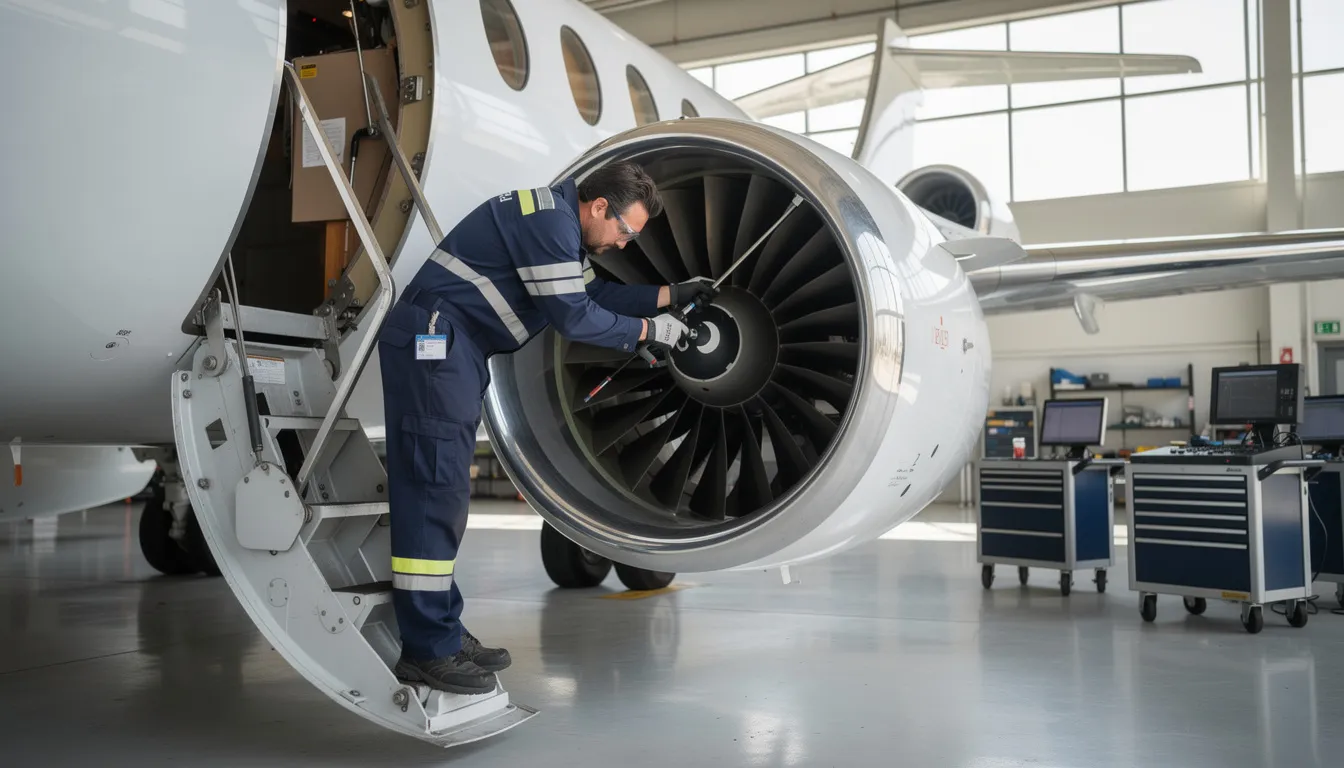
Companies with financial stability support technicians through manufacturer training courses, paid certifications, and benefits packages including healthcare and retirement contributions from day one. Roles can be hangar-based at key hubs like Teterboro, Van Nuys, or Farnborough, or mobile AOG (Aircraft on Ground) positions supporting aircraft grounded at remote locations worldwide.
Operations, Dispatch, and Scheduling Roles
Operations centers function as the nervous system of private aviation, running 24/7 to manage flight dispatch, crew scheduling, and real-time flight support for aircraft operating across the globe.
Dispatcher responsibilities include:
Flight planning with fuel calculations, payload considerations, and performance data
Weather analysis and route optimization accounting for winds aloft and alternate requirements
Coordination with ATC and FBOs across different regions and time zones
Managing real-time adjustments when clients change destinations or timing
Scheduler duties encompass:
Assigning flight crews within duty-time limits while optimizing utilization
Balancing fleet availability across a diverse fleet of aircraft types
Coordinating positioning flights to stage aircraft for upcoming missions
Handling last-minute client changes with minimal operational disruption
These roles demand proficiency with modern flight planning software and crew management platforms, plus the ability to make calm decisions under time pressure. The fast-paced environment rewards problem-solvers who thrive when variables shift unexpectedly.
Career progression moves from junior coordinator roles into senior dispatch, then potentially into operations team management, safety and quality positions, or leadership in network and fleet planning.
Sales, Client Services, and Jet Card Programs
Private aviation revenue flows through three primary channels: charter sales, aircraft management, and membership programs like jet cards aimed at frequent fliers. The sales and client services team translates operational excellence into client relationships and revenue.
Key positions include:
Private Jet Advisors consulting with clients on travel solutions
Membership sales executives structuring jet card programs
Client services managers handling ongoing relationship management
Account directors serving high-net-worth individuals, family offices, and corporate travel departments
Daily tasks involve:
Structuring charter quotes based on route requirements and passenger counts
Recommending appropriate aircraft—light jet for Dallas-Aspen vs. large cabin for New York-London
Walking clients through jet card options, explaining deposit structures ($150,000-$1 million for 10-100 hours), and contrasting with charter and ownership alternatives
Coordinating with the operations team to deliver on promised service levels
These roles blend consultative selling with operational knowledge, often with performance-based compensation tied to flight hours sold, memberships closed, or revenue targets achieved. Commission structures mean high performers can significantly exceed base salaries.
Technology, safety credentials, and sustainability now feature prominently in client conversations. Advisors who can articulate how carbon-neutral flights work, explain ARGUS Platinum ratings, or discuss fleet composition create an edge that translates directly to closed business.
Corporate, Technology, and Sustainability Careers
Behind every flight stands a corporate backbone, including finance, human resources team functions, legal, information technology, data science, and sustainability specialists. These roles are organized within specific departments such as the IT department, HR department, and Finance department, and rarely touch aircraft directly, but enable everything that happens when wheels leave the ground.
Examples across departments:
IT teams building booking platforms, mobile apps, and client-facing portals
Data analysts optimizing fleet utilization and identifying scheduling efficiencies
HR and Talent Acquisition professionals recruiting pilots, technicians, and sales talent
Sustainability specialists managing carbon offset programs and SAF (sustainable aviation fuel) partnerships
Marketing professionals developing brand positioning for competitive markets
Finance teams managing aircraft acquisition, leasing, and operational budgets
Private aviation companies often seek candidates who are experienced aviation specialists or recent graduates for these roles.
Professionals from outside aviation—software engineers, digital marketers, ESG analysts—can transition into private aviation by learning regulatory basics and operational constraints specific to the industry. The sector actively recruits from adjacent fields, particularly for technology and sustainability roles.
These positions support initiatives including Safety Management Systems, cybersecurity for onboard connectivity, and transparent reporting of carbon-neutral operations—all increasingly important to clients who expect their travel providers to operate responsibly.
Qualifications and Training for Private Plane Jobs
Entry standards in private aviation often exceed those in commercial operations because clients expect flawless safety, discretion, and performance. A missed connection at a commercial airport is an inconvenience; a service failure on a private jet can cost millions in lost deals or irreparably damage client relationships.
This section outlines education, licenses, and soft skills valued across cockpit, cabin, technical, and corporate roles. Understanding these requirements before applying positions candidates for success at top-tier operators.
Licenses, Ratings, and Technical Credentials
For pilots:
ATPL or Commercial license with multi-engine and instrument ratings as minimum entry requirements
Total time benchmarks for charter operations: 1,500-3,000+ hours for Captains, lower for first officer positions
Type ratings on popular private jets (Citation, Challenger, Gulfstream, Phenom series) significantly increase competitiveness
Clean medical certification maintained per FAA or EASA requirements
For maintenance professionals:
A&P license (U.S.) or EASA Part-66 certification (Europe) as foundational credentials
Recurrent OEM training from manufacturers like Gulfstream, Bombardier, Embraer, or Pilatus
Human factors and SMS training modules are increasingly expected
For dispatch and operations:
FAA aircraft dispatcher certificate or equivalent, where applicable
Training on international procedures, ETOPS, and performance-based navigation
Proficiency with flight planning and scheduling software platforms
For cabin crew and customer service:
Flight attendants require a high school diploma, airline training, and customer service skills
Customer Service Representatives often require a high school diploma, strong hospitality experience, and multilingual skills are preferred
Many operators offer structured pathways and tuition support once hired, but foundational licenses and clean records remain essential for initial selection. Background checks and drug testing apply universally.
Education, Experience, and Soft Skills
Formal educational backgrounds vary by role:
Aviation degrees, engineering, or military training for technical and flight positions
Hospitality management for cabin crew
Business, finance, or IT degrees for corporate functions
Relevant hands-on experience is often valued equally to formal degrees
Essential soft skills across all roles:
Discretion: Handling confidential itineraries, passenger identities, and business activities without breach
Communication: Polished interaction with senior executives who expect professionalism without pretension
Problem-solving: Resolving issues under time pressure when client's schedules depend on rapid decisions
Cross-cultural sensitivity: Managing diverse passengers and crews on global missions
Private aviation favors candidates with prior exposure to luxury service (five-star hotels, superyachts, premium retail) or high-reliability environments (airlines, military aviation, emergency services). Clean background checks, airport security clearances, and the ability to obtain visas for international travel are prerequisites rather than preferences.
Ongoing Training, Safety Standards, and Certifications
Recurrent training is non-negotiable in private aviation. Flight crews complete annual or semi-annual simulator sessions, medical recertifications, and emergency procedure refreshers. Cabin professionals undergo safety training updates and service standard reviews.
Top operators use third-party safety audits (ARGUS, Wyvern, IS-BAO) alongside internal Safety Management Systems to continuously review and improve operations. These audits assess everything from pilot training records to maintenance documentation to operational control procedures.
Many companies train all staff—including sales and client services team members—in basic aviation safety awareness. This enables confident communication with clients about risk management, a topic increasingly important to sophisticated travelers.
Candidates who demonstrate a safety mindset and familiarity with SMS concepts stand out in the hiring process. Documented training history and certifications can significantly enhance attractiveness for promotion into leadership positions.
The Private Jet Industry: Market Overview and Trends
The private jet industry is experiencing unprecedented growth, fueled by a global demand for flexible, secure, and luxurious travel solutions. As a worldwide leader in private aviation, the sector boasts a diverse fleet of aircraft—from agile light jets to ultra-long-range business jets—catering to the unique needs of clients across the globe. This diversity allows operators to match the right aircraft to each mission, ensuring optimal safety, comfort, and efficiency.
Recent trends highlight a strong focus on sustainability and innovation. Leading companies are investing in advanced technologies, modernizing their fleets, and adopting environmentally responsible practices such as carbon offset programs and sustainable aviation fuel. These initiatives not only reduce the industry’s carbon footprint but also align with the values of today’s discerning clients.
With its unwavering commitment to safety, service, and operational excellence, the private jet industry continues to set the standard for business aviation. The combination of a strong foundation in regulatory compliance, a client-centric approach, and a forward-looking focus on sustainability positions the industry for ongoing success and growth. For professionals seeking a career in a dynamic and prestigious field, private aviation offers unmatched opportunities to be part of a business that is shaping the future of global travel.
Industry Events and Networking Opportunities
Staying connected and informed is vital in the ever-evolving world of private aviation. The industry hosts a variety of events—ranging from international conferences and trade shows to specialized seminars—that bring together professionals from every corner of aviation. These gatherings are more than just opportunities to showcase the latest aircraft or technology; they are essential forums for sharing expertise, building knowledge, and strengthening professional networks.
For recent graduates and those new to the industry, attending these events can be a game-changer. They offer direct access to industry leaders, hands-on workshops, and insights into the latest trends in safety, service, and operations. Whether you’re part of the operations team, a flight attendant, or a pilot, these events provide a platform to learn from the best, exchange ideas, and discover new career paths.
Networking at industry events also opens doors to mentorship, collaboration, and career advancement. By engaging with peers and experts, professionals can stay ahead of industry developments, expand their knowledge base, and position themselves for future success. In private aviation, where teamwork, expertise, and a focus on excellence are paramount, these events are invaluable for anyone committed to building a rewarding and impactful career.
Lifestyle, Pay, and Benefits in Private Plane Jobs
Private aviation professionals experience a fundamentally different lifestyle from commercial airline staff. Teams are smaller, client relationships closer, and destinations more varied—from major business hubs to resort locations that rarely see scheduled airline service.
This section covers schedule patterns, compensation structures, travel perks, and how companies support work-life balance in a 24/7 global business where flexibility and reliability must coexist.
Schedules, Travel Patterns, and Work–Life Balance
Common roster formats include:
Fixed rotations: 7/7 (seven days on, seven off), 14/14, or 8/6 patterns
Floating schedules with guaranteed monthly days off
Rapid-response roles for on-demand charter operations with higher on-call requirements
Travel patterns include overnight stays in destinations like London, Geneva, Dubai, Aspen, and Nice, with varying trip lengths from single-day missions to week-long international circuits.
Some employers allow pilots and crew to choose home bases or use virtual basing models where the company positions them to aircraft. Others require relocation to core hubs like Teterboro, Van Nuys, or specific European locations.
Work-life balance policies tie directly to safety commitments. Larger, well-funded operators typically enforce rest rules and fatigue management programs that exceed regulatory minimums, recognizing that fatigued crew members pose unacceptable safety and service risks.
Private aviation companies often provide flexible workplace environments to support work-life balance, recognizing that how they work is just as important as the work itself. NetJets, for example, emphasizes a culture of respect and acceptance among its team members, fostering an environment where professionals can thrive both personally and professionally.
Compensation, Bonuses, and Non-Salary Benefits
Pilot and maintenance roles offer highly competitive compensation. Bureau of Labor Statistics data shows median commercial pilot pay at $122,670 annually, but private aviation often exceeds these figures significantly. Senior Captains and technical leaders at premium operators reach strong six-figure packages, with some positions at companies like Black Jet ranging from $300,000 to $500,000, including bonuses and day-rate premiums.
Sales roles benefit from commission structures that reward performance, potentially exceeding base salary for consistent producers.
Typical benefits packages include:
Employer-paid or heavily subsidized medical, dental, and vision coverage from day one, with no monthly premiums as offered by NetJets
401(k) or pension contributions with employer matching; NetJets provides an unprecedented company match
Performance bonuses tied to flight hours, safety metrics, or revenue targets
Safety bonuses reward milestone hours without incidents
Unique perks in private aviation:
Access to empty-leg or ferry flights for employees and sometimes immediate family members
Discounted travel with partner airlines or hospitality brands
Paid training days at premium simulation centers
Type rating sponsorship for high-potential candidates
Private jet flight attendants manage high-end catering and cabin setup, with salaries typically ranging from $60,000 to $120,000 in 2025, often supplemented by tips.
These rewards correspond to high expectations. Availability, professionalism, and adaptability aren’t optional—they’re the price of admission. Candidates should balance potential income against lifestyle preferences and personal obligations.
Culture, Prestige, and Professional Growth
Culture at leading private aviation companies blends aviation discipline with high-end hospitality sensibility. Crews are small and tight-knit, with cross-functional collaboration between flight, maintenance, and client services teams. The environment suits professionals who prefer variety and responsibility over anonymity and routine.
Prestige elements include:
Operating modern fleets with average aircraft ages under 5-10 years
Serving notable business leaders, public figures, and high-profile families who frequently choose charter flights
Association with top safety and sustainability standards is recognized industry-wide
Being recognized as a worldwide leader in service excellence
Professional growth opportunities:
Advancement from smaller jets to larger cabin aircraft with higher compensation
Transition from frontline roles into training, safety, or management positions
Movement between operations, sales, and corporate functions based on interest and expertise
Leadership development through mentoring programs, tuition reimbursement, and internal academies
Companies investing in career development recognize that growth opportunities attract and retain the best talent. Employees who develop a strong foundation in one area often advance into positions they didn’t anticipate when first joining.
How to Enter and Advance in Private Plane Jobs
While private aviation is competitive, there is a clear pathway for aspiring professionals who prepare strategically and understand what employers value most. Success belongs to candidates who combine technical qualifications with the soft skills that distinguish good from exceptional.
For more information about career pathways, available roles, and benefits, visit our site, which serves as a central hub for learning about programs and growth opportunities.
This section provides step-by-step guidance: building experience, tailoring applications, succeeding in interviews, and leveraging networking and professional associations. When applying, please note that we are an equal opportunity employer, committed to diversity and inclusion throughout our hiring process.
Breaking In: First Steps for Different Backgrounds
For pilots:
Build time in regional airlines, flight instruction, or cargo operations before transitioning
Log relevant multi-engine and IFR hours that meet charter minimums
Target entry-level right-seat positions on light jets as stepping stones
Consider operators expanding fleets, as recent graduates with strong records may find accelerated pathways
For cabin crew:
Start with commercial airlines, cruise lines, luxury hotels, or superyachts
Build customer service portfolios documenting exceptional experiences delivered
Obtain recognized cabin safety and medical certifications
Develop language skills and cross-cultural competence for international operations
For maintenance professionals:
Pursue apprenticeships, technical schools, or military aviation backgrounds
Gain type experience on commonly chartered aircraft families (Citation, Challenger, Gulfstream, Phenom)
Document troubleshooting achievements and maintenance successes
Maintain immaculate training records demonstrating commitment to excellence
For corporate and technology candidates:
Gain domain knowledge through short aviation courses and industry publications
Pursue cross-functional projects that touch operations or safety in current roles
Join industry associations to build a network and demonstrate interest
Research specific operators to understand their technology stacks and business models
Applications, Interviews, and Assessment Processes
Tailoring applications:
Highlight safety mindset with specific examples of risk management or incident prevention
Demonstrate reliability through consistent employment history and performance references
Emphasize client-facing experience and work in regulated environments
Address any resume gaps or transitions proactively and professionally
Typical hiring steps:
Online application with resume and cover letter
HR screens for basic qualifications and cultural alignment
Technical interviews: scenario-based questions for pilots, logbook reviews, or sales case studies
Culture and values interviews with team members and leadership
Background checks, drug testing, and reference verification
Pilots may undergo simulator evaluations or technical boards. Sales and client services candidates may complete relationship-building exercises or problem-solving under time pressure. Maintenance candidates should expect technical knowledge assessments and hands-on troubleshooting scenarios.
Prepare specific examples demonstrating:
Discretion in handling sensitive information
Crisis handling with positive outcomes
Teamwork on complex or last-minute missions
Commitment to continuous learning and improvement
Networking, Professional Associations, and Career Mobility
Industry events worth attending:
NBAA Business Aviation Convention (U.S.)—the largest gathering of private aviation professionals
EBACE (European Business Aviation Convention & Exhibition)
Regional events hosted by flight departments, FBOs, and manufacturers
Professional associations offering resources:
National Business Aviation Association (NBAA)
European Business Aviation Association (EBAA)
Women in Aviation International
Professional Aviation Maintenance Association
Career mobility in private aviation often happens through referrals. Former colleagues, trainers, check airmen, and FBO contacts recommend candidates for new fleet expansions or base openings. Maintaining professional relationships matters.
Positioning for opportunities: Explore premium Jet Card programs with BlackJet to elevate your private aviation experience.
Maintain polished LinkedIn profiles highlighting aviation experience and certifications
Engage with private aviation content and thought leadership
Stay informed about fleet additions and new base announcements
Be open about interest in new opportunities when appropriate
Develop expertise in emerging areas like sustainability or technology
Safety, Technology, and Sustainability in Private Plane Careers
Modern private aviation is defined by three pillars: safety, advanced technology, and sustainability. Career success increasingly depends on understanding all three—not as abstract concepts, but as operational realities that shape daily work and client expectations.
Why Safety Protocols Matter in Private Aviation
Safety in private aviation is structured, audited, and continuously improved:
Safety Management Systems (SMS): Formal frameworks for hazard identification, risk assessment, and incident reporting
External audits: ARGUS Platinum, Wyvern Wingman, and IS-BAO Stage 3 certifications representing verified operational excellence
Just culture principles: Encouraging honest reporting without punitive responses to enable learning and improvement
Employees at all levels—from pilots and engineers to client service representatives—receive training on incident reporting and risk assessment. This isn’t bureaucratic compliance; it’s recognition that safety lapses in private aviation can destroy reputations and end careers.
Real-world scenarios like weather diversions or mechanical irregularities are handled within strict standard operating procedures, prioritizing safety above schedule pressure. Clients may be demanding, but responsible operators never compromise safety to accommodate unrealistic timelines.
Candidates who demonstrate a proactive safety mindset and familiarity with SMS concepts—even from adjacent industries—stand out in hiring processes.
Technological Innovation and Its Impact on Roles
Key technologies shaping private aviation:
Advanced avionics suites (Garmin G3000, Collins Pro Line Fusion) are reducing pilot workload
Satellite connectivity enabling airborne offices with secure communications
Electronic Flight Bags (EFBs) are replacing paper charts and manuals
AI-supported scheduling systems optimizing crew and fleet utilization
Digital maintenance tracking with predictive analytics reduces unscheduled downtime
These tools affect daily work across departments:
Pilots use real-time performance data and weather integration for decision-making
Dispatchers leverage optimized routing algorithms accounting for winds, airspace, and fuel
Technicians use predictive maintenance alerts to address issues before they cause delays
Sales teams use CRM analytics to identify client needs and timing opportunities
Employers value tech-savvy candidates who are comfortable learning new systems, mobile applications, and data-driven processes. Evolving technology creates new roles in data science, cybersecurity, and user-experience design specifically tailored to private aviation—opportunities for candidates bringing expertise from other sectors.
Sustainability and Carbon-Neutral Private Jet Travel
Private aviation faces environmental scrutiny, and leading operators respond with tangible programs rather than defensive deflection:
Carbon-neutral flight programs: Purchasing verified offsets that sequester or eliminate emissions equivalent to each trip—often at no additional client cost
Sustainable Aviation Fuel (SAF): Blending lower-carbon fuels where available at major hubs in Europe and the U.S.
Fleet modernization: Newer aircraft with 10-20% better fuel efficiency per seat-mile through direct routing and advanced engines
Sustainability roles intersect with operations: calculating emissions per flight, managing offset partnerships, coordinating SAF procurement, and reporting ESG metrics to clients and stakeholders.
Sales and client services teams increasingly discuss environmental options. Some operators automatically offset all flights; others allow clients to choose higher-SAF blends for specific missions or purchase enhanced offset packages.
Professionals who understand both technical and reputational aspects of sustainability help shape the next generation of private aviation and differentiate their employers in a market where sophisticated clients expect responsible operations as standard.

FAQs About Private Plane Jobs
These questions address common concerns not fully covered in the main guide, providing practical answers for candidates at different stages and backgrounds.
How long does it typically take to move from a regional airline or military flying into a private jet captain role?
Most pilots spend 3-7 years building time in regional airlines, cargo operations, or military roles before transitioning to private aviation. The timeline depends on how quickly they accumulate multi-engine turbine hours and meet charter minimums.
Once hired by a private aviation operator, advancing from first officer to Captain on mid-size jets typically takes another 2-5 years. Fleet growth, individual performance, and type-rating experience significantly influence this timeline.
Strong safety records, willingness to relocate to high-demand bases, and schedule flexibility can shorten the path. Some operators offer accelerated pathways during rapid fleet expansions, creating opportunities for well-prepared candidates to advance faster than industry averages.
Can I work in private aviation if I am based outside major hubs like New York, London, or Dubai?
Many companies operate networked bases and “virtual base” models, allowing pilots and crew to live in secondary cities while commuting to aircraft or being positioned by the company. This flexibility has expanded significantly as operators compete for talent.
Maintenance and operations roles are more likely tied to specific hangars or operations centers at busy business aviation airports. Research which operators have aircraft or managed fleets near your region, and be prepared for relocation or commuting arrangements if necessary.
Corporate roles—IT, marketing, finance, data analysis—increasingly offer hybrid or fully remote options depending on the employer. The pandemic accelerated acceptance of distributed teams, though companies still value periodic in-person collaboration.
Is it possible to move into private plane jobs later in my career or as a career changer?
Many professionals join private aviation after careers in airlines, military service, hospitality, technology, or finance, bringing transferable skills including leadership, customer service, and risk management that operators value.
Key steps include acquiring mandatory licenses (for technical roles), building industry familiarity through courses and publications, and clearly articulating how previous experience adds value in a high-end aviation context.
Career changers often start in roles aligned with their background—finance professionals in financial planning, IT specialists in technology, sales veterans in client services—then build deeper aviation knowledge over time. Focus on professionalism, adaptability, and commitment to learning regulatory and safety frameworks.
Do private aviation employers prefer experience on specific aircraft types?
Operators value experience on aircraft types in their fleets—Citation, Challenger, Global, Gulfstream, or Phenom series—but also consider transferable skills from similar-class aircraft. A pilot with Hawker experience transitioning to Challenger will bring relevant knowledge even without the specific type rating.
Type ratings on in-demand models make candidates more competitive and reduce training costs for employers. Some companies sponsor type ratings for strong candidates during fleet expansions; others prefer applicants who already hold relevant qualifications.
Research each operator’s fleet composition before applying and tailor training investments accordingly. A type rating on an aircraft nobody operates in your target market provides limited value.
What are the prospects for remote or hybrid work in private aviation?
Frontline roles—pilots, cabin crew, maintenance technicians—require physical presence at aircraft and hangars. The nature of the job means you can’t fly a plane or fix an engine remotely.
However, operations, sales, and corporate roles increasingly incorporate remote or hybrid arrangements—sometimes even requiring frequent travel. For those considering luxury travel solutions, unlimited private jet flight memberships can offer unmatched convenience and flexibility.
Sales advisors working remotely while meeting clients in key markets
Schedulers and dispatchers using cloud-based systems from distributed operations centers
IT, marketing, and finance teams based away from the main facilities
Companies still value periodic in-person collaboration to maintain safety culture and communication effectiveness. Candidates interested in location flexibility should focus on technology, marketing, finance, and membership sales roles where remote work is more common.
Next Steps
Private aviation offers careers that combine technical precision with exceptional service delivery—roles where excellence matters and is recognized. Whether you’re a pilot building toward the cockpit of a Gulfstream, a hospitality professional ready to deliver unparalleled service at 45,000 feet, or a technology expert who wants to apply skills in a dynamic environment, the pathway exists for those who prepare thoughtfully.
The industry rewards professionals who understand that private plane jobs are about more than flying aircraft or serving passengers. They’re about enabling the world’s most successful people to accomplish what matters most to them, safely and efficiently.
Elevate your career in aviation. With operators like BlackJet, private flight careers combine rigorous safety, carbon-neutral operations, and the flexibility that attracts the industry’s best talent. Explore opportunities in an industry where your expertise directly supports mission-critical travel—and where success is measured in excellence delivered, not just hours logged.
Join the world of private aviation where professionalism meets purpose, and every flight represents an opportunity to demonstrate what exceptional truly means.


 Sign up with google
 Sign up with Apple