Semi-private flights are shared-seat flights on smaller jets or regional aircraft that depart from private terminals, delivering roughly 80–90% of the private aviation experience at a fraction of the cost of chartering an entire aircraft.
This guide is for business travelers and leisure flyers considering alternatives to commercial airlines. Semi-private flights offer a unique blend of convenience, comfort, and efficiency for discerning travelers.
For business executives and high-net-worth leisure travelers who value time, privacy, flexibility, safety, and comfort—but are not ready to book a full private charter on every trip—this hybrid model offers a practical upgrade over commercial air travel. This guide breaks down how semi-private flights work, where they make the most sense, how they compare with commercial and fully private options, what to expect from routes, aircraft, cabins, luggage, safety, and sustainability, and how to book them, including through BlackJet.
Why Semi-Private Flights Are Exploding in Popularity Right Now
Consider a same-day round trip from Los Angeles to Las Vegas. On commercial airlines, you're looking at arriving 90 minutes early at LAX, navigating long security lines, waiting at a crowded gate, and repeating the whole process on the return. Door-to-door, a trip that should take a few hours consumes the better part of a day.
Flying semi-private, you drive to a private terminal, arrive 15–30 minutes before departure, walk across the tarmac, and step onto a jet with fewer passengers and spacious seating. The flight time is about one hour. You're on the ground in Las Vegas with energy to spare.
Semi-private flights offer the accessibility of per-seat tickets with the speed of private aviation. Passengers bypass TSA-style queues, board through private terminals, and travel in cabins holding typically 15–30 people instead of 150–300. The result is a calmer travel experience that eliminates much of what makes commercial air travel exhausting.
BlackJet specializes in Jet Card programs and on-demand private charter, and we see semi-private as a natural gateway into private jet travel. For frequent travelers - especially business travelers and high-end leisure flyers - semi-private is a practical upgrade for work trips, saving hours per trip without always requiring full charter commitment.
What Exactly Is a Semi-Private Flight?
Semi-private flights are a hybrid air travel model. Passengers buy individual seats on smaller aircraft with 10–30 seats. Regional jets or turboprops used in semi-private flights accommodate 4 to 30 passengers.
Semi-private flights are a category of shared-seat travel on smaller jets or regional aircraft, operating from private terminals rather than main commercial concourses. Instead of 150–300 passengers crammed into a narrow-body airliner, you're sharing a cabin with roughly 10–30 other passengers who've each purchased individual seats on a smaller aircraft.
This model sits squarely between commercial flights and full private charter, and a semi-private jet is a common plain-language way to describe it. Passengers buy individual seats - or even an entire aircraft for groups - but enjoy many hallmarks of a private flight experience: FBO departures, tarmac boarding, relaxed screening, and personalized service.
Aircraft Types
Semi-private flights typically use light jets or turboprops, along with regional jets configured for comfort. Common aircraft include the Embraer ERJ-135/145, Pilatus PC-12, and various light and midsize business jets. Regional jets or turboprops used in semi-private flights accommodate 4 to 30 passengers, depending on the specific aircraft, configuration, and maximum capacity.
For context on capacity:
Light jets accommodate 4–7 passengers for short hops
Midsize jets can seat up to 9 passengers comfortably
Super midsize jets accommodate up to 10 passengers
Large jets can carry a maximum of 14 passengers
Semi-private configured regional jets hold 16–30 passengers
Cabin Layouts
Cabins feature 2–1 or 1–1 layouts—no middle seats—with generous legroom and club-style seating pods. The layouts are designed for comfort and privacy, making the experience more enjoyable than standard airline cabins.
Passenger Experience
Semi-private flights are less crowded and more personalized than commercial flights, offering enhanced comfort and luxury compared to standard airline cabins. They provide access to smaller airports and private-terminal convenience, and they're preferred by travelers seeking a balance between commercial air travel and full private aviation.
Semi-Private vs Commercial Flights vs Fully Private Charter
Understanding how semi-private jet flights stack up against both ends of the spectrum helps clarify when each option makes sense.
Cost Comparison
Semi-private flights are more expensive than traditional commercial tickets but generally offer a lower cost than full private jet charters.
The cost is shared among passengers, which keeps per-seat pricing reasonable.
Prices for semi-private flights range from $209 to $1,800 one way on most routes, with some promotional fares that can start around $39 per seat.
Flights from LA to Vegas typically cost between $500 and $1,200 per seat.
By comparison, chartering a light jet on the same route runs $6,000–$9,000 each way, while commercial first class pricing on a major carrier might be $400–$1,000.
The cost of semi-private flights is typically moderate to high compared to commercial airlines, but they're often cheaper than chartering a private jet outright.
Time Savings
This is where semi-private travel wins decisively:
Arrive 20–30 minutes before departure at a private terminal versus 90–120 minutes at commercial airports in New York, Los Angeles, or Las Vegas.
Semi-private flights typically provide faster airport processing and better comfort than commercial airlines.
They offer access to smaller, less crowded airports like Henderson Executive Airport or North Las Vegas Airport, which often helps travelers avoid connecting flights and layovers.
Flexibility
Commercial flights win on frequency and network reach.
Semi-private operates on fixed routes with set schedules.
Full private charter—or a BlackJet Jet Card—delivers total schedule and route control with more flexible scheduling options, preferred aircraft selection, and departure from virtually any airport.
Experience
Semi-private cabins are quieter, less chaotic, and designed for productivity or relaxation.
Full charter takes this further with complete cabin control.
Commercial flights, even in first class, can't match either for privacy.
Popular Semi-Private Routes: From New York, Los Angeles, and Beyond
Semi-private airlines tend to follow high-demand leisure and business corridors rather than blanketing every city pair. The model works best where predictable passenger flows justify pre-scheduled flights on a regular basis.
Top U.S. Semi-Private Routes
Los Angeles–Las Vegas: The flagship corridor. Los Angeles to Las Vegas flights typically last 1 hour, and Las Vegas is a top destination for semi-private flights year-round. Departures from Van Nuys or Burbank avoid LAX entirely.
New York–Miami / Palm Beach: New York to Miami flights take about 2 hours from Westchester County or Teterboro, landing at exclusive airports like Opa-locka. Winter escapes drive heavy seasonal flight demand.
Los Angeles–Aspen / Dallas–Aspen: Ski season routes that utilize private terminals at mountain airports too small for major carriers.
Southern California hops: San Diego to Las Vegas, Orange County to San Francisco—short flights that eliminate brutal freeway drives.
Semi-private flights also connect Los Angeles to Cabo San Lucas and various Caribbean destinations, adding international resort access. London to Paris is a popular semi-private flight route in Europe, signaling the model's global expansion.
Semi-private flights operate on fixed schedules and designated routes, and they use private terminals allowing faster boarding. This scheduled service model works for repeated, predictable flows—weekend Vegas trips from Southern California, winter ski runs, holiday Florida escapes from New York.
When your travel plans call for routes outside these popular lanes, a BlackJet on-demand charter or Jet Card provides access to virtually any airport worldwide.

What You Actually Fly On: Aircraft Types and Cabin Experience
Semi-private isn't a single aircraft type—it's a service model that can deploy business jets, regional jets, or premium-configured turboprops depending on the route and operator.
Common Aircraft Types
Light jets: Citation CJ3, Embraer Phenom 300—ideal for short-haul routes with smaller passenger counts
Midsize jets: Hawker 800XP, Learjet 60—more cabin room for routes of two to three hours
Regional jets: Semi-private flights often feature modern aircraft like the Embraer E135, configured with 16–30 seats in spacious layouts
Turboprops: Pilatus PC-12, King Air 350—efficient on shorter routes where runway length matters
Cabin Layouts
Cabin layouts eliminate middle seats entirely.
Expect generous pitch, leather seating, and club configurations that allow small groups to face each other.
Overhead bins accommodate standard roll-aboard luggage.
Passenger Experience and Amenities
Amenities typically include wi-fi (often Starlink on U.S. regional jets), power outlets, and USB ports.
Travelers can enjoy premium amenities like complimentary snacks and beverages on semi-private flights.
Longer routes may feature upgraded catering.
Fewer passengers typically mean a quieter atmosphere on semi-private flights—fewer announcements, minimal crowds, and faster boarding through a single door rather than a jetway queue.
For BlackJet Jet Card members chartering a full aircraft, we tap similar aircraft categories but in even more spacious private layouts with tailored in-flight services, from custom catering to specific aircraft requests.
Luggage Restrictions and On-the-Ground Logistics
While semi-private flights are more relaxed than commercial airlines on many fronts, luggage restrictions still apply. Smaller aircraft have limited hold space and strict weight-and-balance requirements.
Luggage Policies
Most semi-private carriers allow one standard checked bag plus one carry-on per passenger—typically around 20–25 kg total.
Oversized items like skis, golf clubs, or surfboards usually require advance notice and may incur additional fees.
Passengers can often bring pets into the cabin on semi-private flights, but crate dimensions and breed restrictions vary by operator, so confirming ahead is essential.
How luggage policies compare:
Commercial flights: Strict carry-on policing, oversized fees, baggage carousel waits
Semi-private: More relaxed screening, but weight limits matter on smaller aircraft
Full private charter: Maximum flexibility as long as the aircraft's weight envelope is respected
Ground-Side Conveniences
Many operators offer parking adjacent to the private terminal, with short walks from car to lounge.
Some provide curbside check-in.
Ground transportation coordination—whether a car service to the Strip in Las Vegas or a transfer to Midtown in New York—is often available through the operator or a concierge.
A practical example: planning a Las Vegas weekend from Los Angeles with two checked bags per person?
BlackJet's flight support team pre-confirms luggage and special item needs with operators on Jet Card and charter trips. Understanding how private jet logistics work helps eliminate surprises at the terminal.
What the Semi-Private Flight Experience Feels Like
Picture a Friday afternoon departure from Van Nuys to Las Vegas. You drive directly to a private terminal—no circling a parking garage, no terminal shuttle. You park steps from the door.
Inside, check-in involves one or two staff members rather than a crowded counter with roped-off queue lanes. You show your ID, confirm your own seat assignment, and step into a quiet lounge. Compared to commercial airlines, semi-private flights usually offer less waiting time—there's no overhead announcement chaos, no gate changes, no boarding groups.
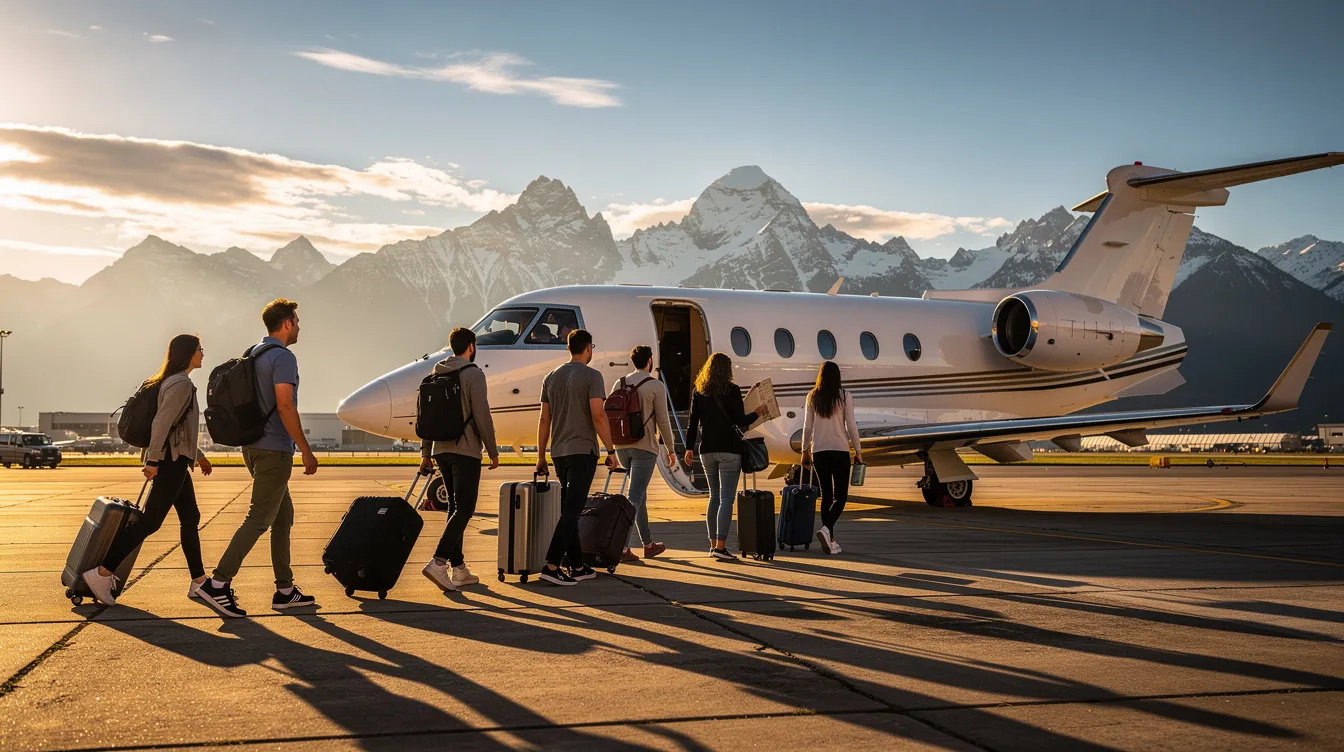
When it's time, you walk across the tarmac and step directly onto the jet. The crew greets you—they already know the short passenger list. Passengers can arrive just 30 minutes before departure, so the entire pre-flight process rarely exceeds 40 minutes from car to cabin.
Onboard, the atmosphere is calm. Fewer passengers result in more legroom and comfort. You can hold a business conversation at normal volume, take a call before pushback, or simply decompress. Attentive service is immediate—drinks appear without flagging a flight attendant working 30 rows. The personalized service extends to knowing your preferences if you're a repeat flyer.
Arrival mirrors the simplicity of departure. At Henderson Executive Airport or North Las Vegas Airport, you deplane directly onto the ramp. No baggage carousel—bags come to you. A car or rideshare waits steps away. The entire Los Angeles to Las Vegas journey, door to door, takes less time than most people spend just getting through LAX security and boarding.
The overall effect is less stress, less unpredictability, and more control over your energy and schedule. These benefits are amplified further on BlackJet full charter or Jet Card flights, where every element is customized to your specifications.
Safety, Certification, and Operational Standards in Semi-Private Aviation
A common misconception holds that smaller aircraft or semi-private flights are less regulated than commercial airlines. In reality, reputable operators follow strict FAA safety management systems and certification requirements that govern everything from pilot training to maintenance intervals.
Third-Party Safety Accreditations
The most recognized include:
ARGUS Gold / Platinum / Platinum Elite: Evaluates operator history, pilot experience, and maintenance documentation
Wyvern Wingman: Assesses real-time operational safety data and crew qualifications
IS-BAO (Stage 1–3): International Standard for Business Aircraft Operations, a progressive safety management framework
Most semi-private operations run under FAA Part 135, which governs charter and commuter operations. Aircraft carry FAA type certifications, operators hold Air Carrier Certificates, and crews meet or exceed Commercial Pilot License requirements—with many holding Airline Transport Pilot (ATP) ratings. Two-pilot crews are standard on most routes, and rigorous maintenance programs mirror or exceed airline-level intervals.
While semi-private providers operate on different economic models than major carriers, their weather decision-making, crew rest protocols, and aircraft maintenance are equally regulated. The difference is scale, not standards.
BlackJet vets every partner operator based on third-party audits and internal criteria, ensuring that clients stepping up from semi-private to full private charter never compromise on safety. Understanding whether flying private is worth it starts with knowing the safety infrastructure behind every flight.
Always ask any semi-private or charter vendor about operator certificates, safety ratings, and crew experience before booking.
Sustainability and the Environmental Angle of Semi-Private Flights
Any form of flying—commercial, semi-private, or fully private—carries environmental impact. Acknowledging that reality is the starting point for meaningful progress.
Efficiency and Emissions
Semi-private can be more efficient than empty repositioning flights or under-filled large jets.
Operators that consistently fill 15–30-seat aircraft on high-demand city pairs reduce per-passenger emissions compared with sparsely loaded commercial regional jets running the same corridors.
Key U.S. semi-private corridors report seat-fill rates around 78%, which helps justify the per-seat environmental footprint.
Sustainability Measures
Carbon offset programs integrated into ticket pricing
Investment in sustainable aviation fuel (SAF) by operators and fuel suppliers
Route and network design that minimizes unnecessary repositioning legs
Fleet modernization toward newer, more fuel-efficient aircraft types
BlackJet is committed to carbon-neutral flights for Jet Card and charter clients, building offset structures that complement the semi-private flying many travelers already do. For eco-conscious flyers, choosing newer aircraft, combining trips to reduce total flight hours, and asking providers for transparent emissions data are all practical steps.
Sustainability is becoming a core pillar of premium air travel. The semi-private and private aviation sectors will increasingly integrate SAF and advanced fleet technology over the next decade—a shift that benefits everyone who flies.
When Semi-Private Makes Sense—and When to Step Up to Full Private with BlackJet
The decision between semi-private and full private comes down to a handful of practical criteria: passenger count, route flexibility, timing precision, luggage complexity, and the need for privacy or in-flight meetings.
When to Choose Semi-Private
You're traveling solo or as a couple on popular lanes—Los Angeles to Las Vegas weekends, New York to Miami winter escapes, seasonal flights to ski destinations.
You're flexible on exact departure times and comfortable with fixed schedules.
Your luggage is standard, and your travel plans are straightforward
You want a private experience without the high cost of chartering a specific aircraft
When to Choose Full Private Charter or a BlackJet Jet Card
You need multi-city itineraries or destinations off semi-private networks like Martha's Vineyard or remote mountain airports
Tight board-meeting schedules demand precise departure times and last-minute flights capability
Confidential work discussions require a cabin with no other passengers
You're traveling with a group, oversized equipment, or pets that need more accommodation
You want a cost-effective option with predictable per-hour pricing across multiple aircraft categories
Consider a company that flies executives monthly between New York and mid-size cities without semi-private scheduled service. A BlackJet Jet Card—available in 25-hour or 50-hour programs—delivers guaranteed access, consistent pricing, and 24/7 support. These are advantages that semi-private, seat-based models typically can't match, along with better service consistency and flexible scheduling options across the entire flight network.
Semi-private is a powerful tool in a broader mix of air travel options. BlackJet serves as your partner when you need the next level of control, exclusivity, and an exclusive experience tailored to your exact requirements.
How to Book Semi-Private Flights—and How BlackJet Handles Private Charter
Booking semi-private follows a straightforward flow. Most semi-private flights require online booking—you browse available flights on fixed routes, select per-seat options, and review luggage and pet policies. Booking can be done via apps like Blade, Surf Air, or Jettly, or directly through operator websites. Booking policies vary by airline and should be reviewed carefully, especially cancellation rules and membership fees.
Steps for Booking Semi-Private Flights
Compare departure airports: Weigh major commercial fields against smaller airports and exclusive airports with private terminal access.
Verify luggage restrictions: Confirm weight limits, oversized item policies, and any additional fees.
Check change and cancellation rules: Semi-private operators vary widely on refund and rebooking flexibility.
Book early for peak events: Dynamic pricing during events like CES in Las Vegas or Art Basel in Miami pushes fares sharply higher; early booking secures a more affordable alternative.
Booking Full Private Charter and Jet Card Access with BlackJet
For full private charter and Jet Card access, BlackJet's process is built for precision:
Request on-demand quotes via phone or digital booking tools.
Receive aircraft category suggestions based on your route and passenger count.
Work with a flight planning team that handles catering, ground transportation, pets, and special equipment.
Every detail—from the preferred aircraft to the in-cabin temperature—is handled before you arrive.
Many travelers find that mixing both models delivers the best results: semi-private for predictable leisure hops, and BlackJet for high-stakes business travel or complex family itineraries that demand fully private control.
The main advantages of having both options in your toolkit? You fly smarter on every trip—matching the right level of service and cost benefits to the mission at hand.
Explore BlackJet Jet Card membership or request a bespoke charter quote for your next journey that calls for a truly private travel experience.


 Sign up with google
 Sign up with Apple


