In a world where time is the ultimate luxury, flying private has become the go-to choice for discerning travelers seeking unmatched convenience, comfort, and exclusivity. Whether you're a busy executive, a jet-setting entrepreneur, or someone who values seamless travel experiences, knowing which private jet companies lead the industry can make all the difference. This guide dives into the top 5 private jet companies dominating the skies in 2025, revealing what sets them apart and how they can elevate your next journey.
Key Takeaways
This article focuses on the top 5 private jet companies by global presence, safety standards, and service depth: NetJets, Flexjet, Vista Global (VistaJet/XO), Wheels Up, and FlyExclusive.
NetJets operates approximately 780 aircraft worldwide and logged over 196,000 North American departures in H1 2025, while Flexjet achieved 178.2% growth since 2019, demonstrating the sector’s robust expansion.
All featured companies maintain rigorous safety certifications (ARGUS Platinum, Wyvern Wingman, IS-BAO) and are investing in sustainable aviation fuel and carbon offset programs.
The guide compares private jet access models—jet cards, fractional ownership, and on-demand charters—to help you identify which approach matches your travel patterns.
A practical FAQ section addresses common questions about international travel, safety verification, and environmental considerations.
Why the “Top 5 Private Jet Companies” Matter for Serious Travelers
Flying private is fundamentally different from commercial aviation, even when compared to first-class cabins on premium carriers. Consider the math: a typical commercial journey from New York to London involves arriving at JFK two hours early, navigating crowded terminals, enduring boarding procedures, and potentially facing delays at customs. The total time investment often exceeds 12-14 hours for what should be a 7-hour flight.
Private jets eliminate these inefficiencies. Executives report saving 40+ hours monthly when they switch from commercial to private aviation—time recaptured through 15-minute check-ins at private FBO terminals, direct routing to 5,000+ airports (versus roughly 500 served by commercial carriers), and the ability to work productively in a private cabin configured as a mobile office.
The top 5 private jet companies are recognized as key players within the private jet charter industry, shaping market positioning and influencing service standards through their extensive history, innovative service offerings, and significant market share.
At the top end of the private jet market, however, the differences between operators become more nuanced. Every serious provider offers access to private aircraft. What separates the leading companies is their safety culture, fleet depth across aircraft classes, availability guarantees during peak periods, technology integration, and commitment to sustainability. These pillars determine whether your private aviation experience is merely convenient or truly exceptional. Membership-based models and flexible options offered by these companies are making private aviation more accessible and affordable, allowing more travelers to experience the benefits of private flight.
Evaluation Pillars for Ranking
The top private jet companies distinguish themselves across six critical dimensions:
Safety & Certification: ARGUS Platinum/Gold ratings, Wyvern Wingman status, IS-BAO Stage II/III registration
Fleet Size & Range Coverage: Light jets for regional hops through ultra-long range jets for intercontinental missions. The quality and diversity of these fleets are shaped by leading private jet manufacturers, whose ongoing private jet manufacturing innovation drives advancements in luxury, performance, and technology.
Premium Service: High-quality, personalized, and exclusive experiences, including superior customer service, customized interiors, and dedicated crews, set top companies apart.
Global Reach: Operational presence across North America, Europe, the Middle East, and Asia
Technology: Real-time booking apps, transparent pricing, flight tracking, and digital concierge services
ESG/Sustainability: Carbon offset programs, sustainable aviation fuel adoption, and net-zero commitments
When Choosing the Right Operator Matters Most
Imagine a New York-based CEO who needs guaranteed availability during Davos week—one of the most congested periods in private aviation. With thousands of executives converging on Switzerland simultaneously, aircraft availability becomes precious. The right operator doesn’t just offer access; they guarantee it through fleet redundancy and advanced positioning.
Or consider a family planning a multi-stop summer itinerary: Martha’s Vineyard to Aspen to Jackson Hole, with a child starting camp mid-trip. Commercial connections would transform this into a logistical nightmare. The right private aviation company handles the complexity seamlessly, adjusting schedules and aircraft types to match each leg’s requirements.
Each of the five companies profiled below excels overall but leads in a particular niche: market scale, global consistency, technology-driven access, membership value, or growth-oriented service.
Methodology: How We Selected the Top 5 Private Jet Companies
This ranking is curated for 2025 based on publicly reported 2023–H1 2025 data and industry analysis, not paid placement. The selection reflects operators that serious travelers and corporate flight departments actually engage with for fractional ownership, jet card programs, or charter services. In evaluating the top 5 private jet companies, we considered their standing within the broader private jet industry, including their reputation among industry leaders and recent entrants. We also assessed the influence of private jet manufacturers, whose innovations and aircraft designs have shaped the competitive landscape and set standards for luxury and performance in private aviation.
Primary Criteria:
Fleet size and diversity spanning light jets to ultra-long-range aircraft
Verified safety ratings (ARGUS Platinum/Gold, Wyvern Wingman, IS-BAO certifications)
Annual departures and flight hours as indicators of operational scale
Geographic coverage across key business travel corridors
Strength of membership products accessible to HNW and corporate clients
Additional Considerations:
Financial stability and ownership structure (e.g., Berkshire Hathaway backing NetJets, Directional Aviation owning Flexjet)
Operational track record spanning decades of service
Technology platforms enabling seamless booking and trip management
Data points referenced (such as departures or fleet counts) are anchored to the latest available reporting periods—primarily H1 2025 and full-year 2023—and described as “latest reported” where exact current figures may fluctuate quarter to quarter.
1. NetJets – The Benchmark for Fractional Ownership and Jet Cards
NetJets stands as the world’s largest and most established private jet operator. As the first private aviation company to achieve high safety standards under the FAA's SMS program, NetJets has played a pioneering role in shaping the industry. Founded in 1964 and acquired by Berkshire Hathaway in 1998, the company pioneered the fractional ownership model that transformed private aviation from exclusive whole-aircraft ownership into an accessible investment for executives flying 50+ hours annually. Today, NetJets operates the largest fleet of private jets in the world, with approximately 780 aircraft across more than 10 different models, spanning light, midsize, super-midsize, and large-cabin classes.
The numbers underscore market leadership. In H1 2025, NetJets logged approximately 196,053 North American departures—up 10.4% year-over-year and 61.8% since 2019. The company leads in fractional ownership flight hours, with over 600,000 charter hours flown in 2023 alone, nearly triple any rival.
Programs and Access Models
NetJets offers three primary access pathways:
Fractional Ownership: 50-800+ annual hours with a multi-year share purchase commitment, offering guaranteed availability, dedicated crews, and equity in the aircraft.
Leasing: Varies in annual hours with a fixed-term lease, providing access without ownership commitment.
Jet Cards: Starting at 25+ prepaid flight hours, featuring fixed hourly rates without requiring share ownership, ideal for travelers seeking predictability without long-term commitments.
Jet card programs starting around $100,000 provide guaranteed availability and fixed hourly rates without requiring share ownership—ideal for travelers flying 25-75 hours annually who value predictability without ownership complexity.
Safety and Certification
NetJets operates under FAA Part 135/91K regulations with ARGUS Platinum certification, IS-BAO Stage III registration, and was among the first private aviation operators to achieve the FAA’s highest Safety Management System (SMS) level. This isn’t merely certification collection; it reflects a safety culture embedded in daily operations, pilot training, and maintenance protocols.
Fleet Composition
The global fleet covers virtually every mission profile. For those considering options for access, understanding jet card costs and private jet membership pricing can help you make an informed decision.
Light Jets: Citation Latitude, Phenom 300 for 2-3 hour regional trips, accommodating up to eight passengers
Midsize/Super-Midsize: Citation XLS, Challenger 350 for cross-country flights, with capacity for up to eight passengers
Large Cabin: Bombardier Global 6000, Global 7500 with 7,700 nautical miles range for transatlantic missions
Client Profile and Use Case
Typical NetJets clients include Fortune 500 companies, ultra-high-net-worth individuals flying 50- 200+ hours per year, and family offices seeking long-term, predictable access. The company operates as a strategic partner rather than a transactional vendor.
Practical scenario: A Chicago-based executive uses a NetJets share to fly weekly to coastal offices in New York and San Francisco. During scheduled maintenance on their primary aircraft, backup aircraft are automatically provided with no interruption to travel schedules. When business demands a last-minute London trip, a Global 6000 is positioned and ready.
Sustainability Initiatives
NetJets participates in sustainable aviation fuel programs where available, offers carbon offset options, and continues investing in newer, more fuel-efficient aircraft. While not yet claiming full carbon neutrality, the company’s fleet renewal strategy prioritizes reduced emissions per flight hour.
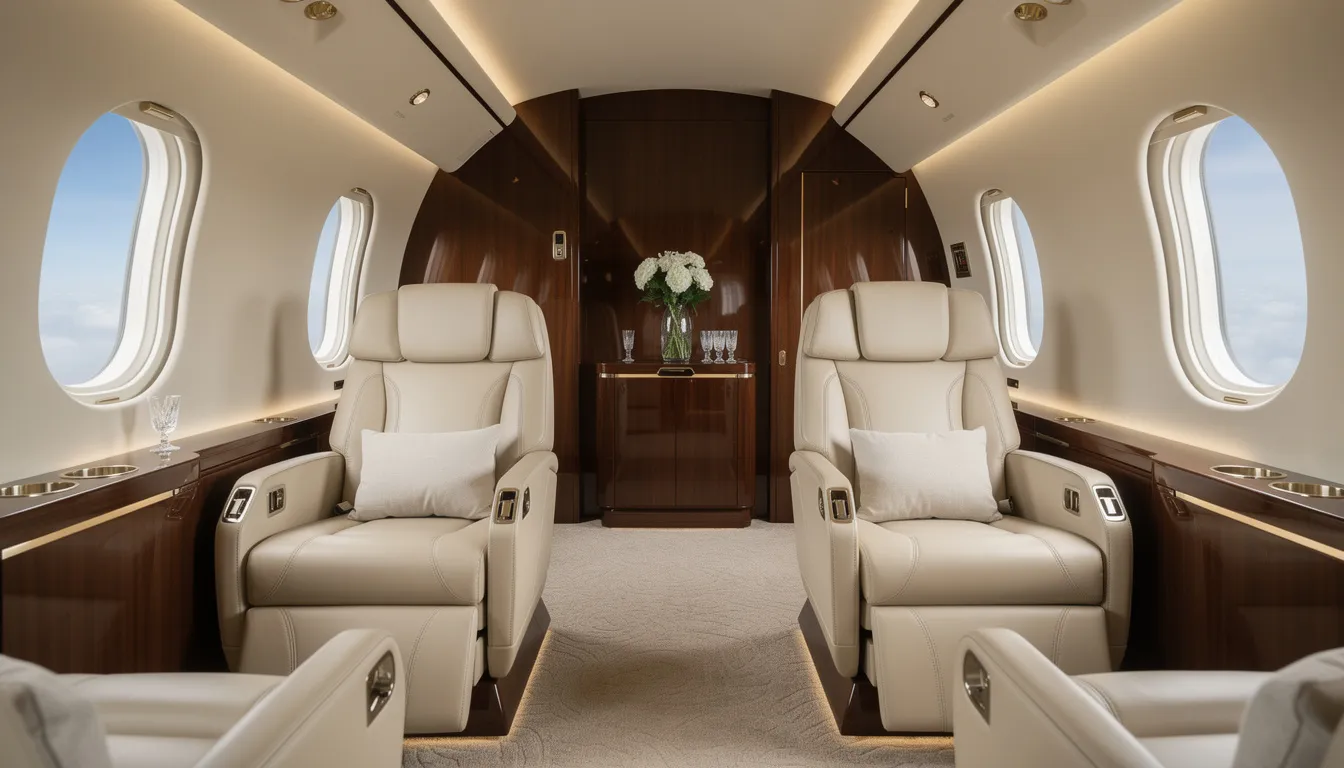
2. Flexjet – High-Touch Service and Rapidly Expanding Premium Fleet
Flexjet emerged in 1995 under Bombardier and now operates as a subsidiary of Directional Aviation. Flexjet is the second-largest operator of private jets, with a significant increase in departures year-over-year. While NetJets claims scale leadership, Flexjet has carved a distinct position as the premium boutique alternative—delivering premium service with personalized experiences, luxury, and dedicated crews that appeal to the most demanding private travelers.
The growth trajectory speaks volumes. In H1 2025, Flexjet recorded approximately 78,322 North American departures, representing greater than 17.5% year-over-year growth and a staggering 178.2% increase since 2019. This momentum reflects both market share gains and an expanding appetite for luxury private jets among HNW travelers.
Programs and Offerings
Flexjet’s product suite includes:
Fractional Ownership: Share-based access with guaranteed availability
Leasing: Flexible terms for consistent aircraft access
Jet Cards: Prepaid hour blocks with fixed rates—learn more about charter flights and how they compare
Aircraft Management: For owners seeking operational support
The signature differentiator is Flexjet’s Red Label program, featuring dedicated crews assigned to specific owners, designer interiors crafted in partnership with brands like BMW Designworks, and a level of personalized service that transforms air charter service into a curated experience.
Fleet Composition
Flexjet’s diverse fleet emphasizes super-midsize and large-cabin aircraft suited for both domestic and long-range international travel:
Gulfstream G650 (ultra-long range capability)
Embraer Praetor 600 (4,018 nm range)
Bombardier Challenger 3500 (Bombardier is a leader in innovation, offering diverse jets, including the Global series, known for extreme range and advanced technology)
Embraer Phenom 300E (popular light jet)
Dassault Aviation (renowned for advanced engineering and performance in private aviation)
Safety and Operations
The company holds ARGUS Platinum and IS-BAO certifications with a reputation for meticulous maintenance oversight. Flexjet’s operational discipline extends to crew training, where pilots undergo recurrent simulator sessions and maintain type ratings on specific aircraft.
Service Philosophy
Where some private jet operators treat each flight as a transaction, Flexjet emphasizes relationship continuity:
Dedicated owner services team for each client
Curated catering programs with regional specialties
Real-time trip management through proprietary technology
Cabin design consultations for fractional owners
Practical scenario: A European-US frequent flier uses Flexjet’s Praetor 600 to shuttle between London, New York, and Miami on a monthly rotation. The same Red Label crew greets them on each leg, knowing their preferences for sparkling water during boarding, specific workspace configuration, and ground transportation arrangements.
Sustainability Position
Flexjet participates in carbon offset programs and prioritizes fleet renewal with fuel-efficient aircraft like the Praetor series. While the company hasn’t announced a specific carbon-neutral target date, operational efficiency improvements and offset availability position it as environmentally conscious within the luxury private aviation segment.
3. Vista Global (VistaJet & XO) – Global Reach and Technology-Driven Access
Vista Global represents the consolidation play in modern private aviation. As a major force in the private jet industry, Vista Global has significantly impacted private jet manufacturing through its strategic acquisitions and rapid fleet expansion. Founded in 2018 and headquartered in Dubai, the company owns VistaJet and XO while having expanded aggressively through acquisitions, including Air Hamburg, Apollo Jet, Talon Air, Jet Edge, and Red Wing Aviation. This strategy has created one of the world’s largest private aviation platforms.
Two Distinct Client Brands
VistaJet operates as the premium, globally consistent product. The signature silver-and-red fleet—exclusively Bombardier Challenger and Global aircraft—provides subscription and program-based access with guaranteed availability worldwide. Whether departing from Teterboro, Dubai, or Singapore, clients experience identical cabin products, service standards, and crew professionalism.
XO delivers technology-driven flexibility. The app-based platform offers on-demand charter access to a network of 2,000+ vetted jets (owned and partner aircraft), transparent dynamic pricing, and the ability to book entire aircraft or individual seats on shared flights. It’s private flying reimagined for the smartphone era.
Market Position
Vista Global ranks among the top three private aviation groups worldwide by flight hours, operating across Europe, North America, the Middle East, and Asia. The company operates 70+ owned Bombardier aircraft plus access to 1,500+ partner jets through XO. Key manufacturers in their fleet and partner network include Gulfstream Aerospace, renowned for ultra-luxury and high-performance private jets, and Dassault Aviation, famous for its Falcon jets with advanced aerodynamics, efficiency, and short-field performance.
Program Structure
VistaJet: Membership/Program model ideal for global executives needing consistency, offering the same cabin experience worldwide.
XO: App-based charter service catering to flexible travelers and ad-hoc trips, providing instant quotes and transparent pricing.
Technology Integration
XO’s platform exemplifies how technology is reshaping private jet charter:
Instant online and app-based booking
Real-time dynamic pricing without phone calls
Ability to see and book shared flights for cost efficiency
Access to empty leg flights at reduced rates
Sustainability Leadership
Vista Global has made public commitments to carbon-neutral operations, targeting net-zero by mid-decade through carbon offset programs and early SAF adoption on select routes. This positions the company favorably with corporate clients whose ESG reporting requires documented environmental mitigation.
Practical scenario: A global business leader flies from New York to Dubai on a VistaJet Global 7500, enjoying the predictable cabin experience and consistent crew. Meanwhile, their regional team uses XO to arrange ad-hoc flights between European cities, booking within hours of travel and selecting right-sized aircraft for each leg.
Safety Framework
Vista Global emphasizes operational excellence across its platforms, with operating entities and vetted partners maintaining ARGUS, Wyvern, and IS-BAO ratings. The company’s scale enables investment in robust safety management systems and compliance oversight.

4. Wheels Up – Membership-Led Private Jet Access in the US
Wheels Up launched in 2013 with a vision to democratize private jet travel through membership-based access. The company popularized tiered membership plans that lowered entry barriers for individuals and corporations who found traditional fractional ownership models too capital-intensive.
Recent performance demonstrates continued relevance. In H1 2025, Wheels Up recorded approximately 20,155 departures—an 81.1% increase year-over-year—while having evolved its business model and partnership structure to stabilize operations after earlier financial volatility.
Core Offerings
Wheels Up provides multiple access pathways:
Membership Plans: Tiered options for individuals and corporations with varying benefits
On-Demand Charter Flights: Pay-as-you-go access without membership
Aircraft Management: Services for private aircraft owners
Partner Network: Access to 300+ owned/leased aircraft plus 1,500+ partner jets
Fleet Composition
The combined fleet spans aircraft classes for virtually any domestic or regional mission:
King Air 350i: Turboprop class, 1,500 nm range, ideal for short-haul regional flights, accommodates up to 8 passengers
Citation XLS: Light-Mid class, 2,200 nm range, suited for cross-country US travel, seats up to 8 passengers
Citation X: Super-Mid class, 3,700 nm range, designed for coast-to-coast flights, capacity up to 8 passengers
Gulfstream G450: Large class, 4,350 nm range, built for international travel, carries up to 14 passengers
Several aircraft in the fleet, such as the Citation Excel/XLS, are designed to accommodate up to eight passengers, offering spacious and comfortable travel for small groups, whether for private or business purposes.
Technology Platform
The Wheels Up mobile app serves as the primary interface for members. For those interested in comparing private aviation options, including Flexjet Jet Card cost and programs, more information is available.
Instant flight quoting and booking
Empty leg visibility for flexible travelers
Shared flight options for cost reduction
Integration with loyalty programs and partner benefits
Safety Framework
Wheels Up utilizes vetted Part 135 operators and pursues ARGUS and Wyvern standards across its network. In-house safety and operations teams oversee partner compliance, though the distributed model differs from vertically integrated operators like NetJets.
Practical scenario: A frequent flyer based in New York uses Wheels Up for monthly trips to Nashville and Miami. The membership provides guaranteed aircraft availability without fractional ownership commitment. When a last-minute meeting emerges, the app delivers quotes within minutes and confirms booking before the competitor can even reach their charter broker.
Sustainability Programs
Wheels Up offers carbon offset options and promotes efficient aircraft utilization, aligning with corporate ESG expectations. The company’s turboprop fleet (King Air series) provides particularly efficient options for shorter regional trips.
5. FlyExclusive – Fast-Growing, Value-Focused US Operator
FlyExclusive represents the entrepreneurial success story in contemporary private aviation. Founded in 2015 in Kinston, North Carolina, this charter company has grown from regional operator to national competitor with 90+ jets serving North America, the Caribbean, and international destinations including Europe.
The growth statistics are remarkable. FlyExclusive achieved over 213% increase in flight activity since 2019, with continued single-to-double-digit yearly growth into 2024. This positions it among the top US charter operators by departures and flight hours.
Product Mix
FlyExclusive appeals to cost-conscious but demanding business and leisure travel clients:
On-Demand Charter Services: Immediate access without commitment
Jet Card Programs: 25+ hour blocks with fixed rates
Fractional Ownership Model: Share-based access
Empty Leg Flights: Discounted repositioning flights for flexible travelers
Fleet Overview
The jet company's fleet emphasizes popular, efficient aircraft:
Embraer Phenom 300: Light class, accommodates up to eight passengers, with a range of 1,971 nautical miles
Citation CJ3/CJ4: Light class, seats 6-7 passengers, with a range exceeding 2,000 nautical miles
Citation Excel/XLS: Midsize class, accommodates up to eight passengers, with a range of 2,100 nautical miles
Citation X: Super-Midsize class, seats 8-9 passengers, with a range of 3,460 nautical miles
Both the Phenom 300 and Citation Excel/XLS are ideal for private or business travel, offering spacious cabins that accommodate up to eight passengers comfortably.
Safety and Operations
FlyExclusive operates under FAA Part 135 certification and pursues ARGUS and Wyvern standards. Notably, the company maintains in-house MRO (maintenance, repair, overhaul) capabilities, ensuring fleet consistency and reducing dependence on external service providers.
Value Proposition
FlyExclusive’s appeal lies in delivering modern aircraft, solid safety standards, and predictable pricing at accessible entry points:
Lower capital commitment than NetJets or Flexjet
More personalized service than larger aggregators
Strong regional airport coverage
Attractive empty leg pricing for flexible schedules
Practical scenario: A midsize company headquartered in Dallas uses FlyExclusive’s jet card for quarterly roadshows visiting investors in Boston, Chicago, and San Francisco. The card delivers quick turnarounds and access to smaller regional airports near final destinations, eliminating ground transportation hassles that commercial flights would require.
Sustainability Steps
FlyExclusive invests in newer, more fuel-efficient aircraft and offers optional carbon offsets. As fleet renewal continues, emissions per flight hour decline through improved engine technology and aerodynamics.
How the Top 5 Private Jet Companies Compare
Each of the leading companies serves a distinct sweet spot in the private aviation market. These top 5 private jet companies are recognized as key players in both the private jet industry and the private jet charter industry, each holding a strong market position through their unique service offerings and innovations. Understanding these differences helps match your travel patterns with the right partner.
NetJets vs. Flexjet represents the classic fractional ownership rivalry. NetJets offers unmatched scale and fleet redundancy—if guaranteed availability during peak periods is paramount, their 780+ aircraft provide confidence no competitor can match. Flexjet counters with Red Label personalization, dedicated crews, and designer interiors that appeal to travelers prioritizing relationship continuity over pure scale.
Vista Global excels for truly global executives. The VistaJet program delivers a consistent cabin experience whether departing from Geneva or Hong Kong, while XO’s technology platform enables ad-hoc bookings with unprecedented speed. For clients whose travel patterns span continents rather than coasts, Vista’s global fleet offers advantages that domestic-focused competitors cannot replicate.
Wheels Up captures the US-centric membership market—individuals and corporations wanting private jet access without fractional ownership capital requirements. The technology platform and tiered membership structure lower barriers to entry while maintaining service quality.
FlyExclusive serves value-conscious private travelers who refuse to compromise on safety or aircraft quality. For businesses flying 25-75 hours annually who find NetJets pricing prohibitive, FlyExclusive delivers exceptional service at more accessible price points.
Matching Operator to Scenario
Frequent global executive (150+ hrs): Primary recommendation is NetJets or VistaJet, with Flexjet as an alternative.
US corporate flyer (75-150 hrs): Primary recommendation is Flexjet or NetJets, with Wheels Up as an alternative.
US business travel (25-75 hrs): Primary recommendation is Wheels Up or FlyExclusive, with a jet card from NetJets as an alternative.
Value-focused, safety-aware travelers: Primary recommendation is FlyExclusive, with Wheels Up on-demand as an alternative.
Safety and sustainability function as universal baselines among these five operators. NetJets and Flexjet lead in top-tier certifications and fleet investment; Vista Global leads in early, broad carbon-neutral commitments.
Private Jet Ownership Models in 2025
The private aviation landscape in 2025 offers a variety of ownership and access models designed to suit diverse travel needs and budgets. These range from fractional shares, which grant a stake in an aircraft with guaranteed usage hours, to on-demand apps that provide maximum flexibility without capital commitment.
Fractional Ownership
Ideal for frequent flyers logging 50-200+ hours annually, fractional ownership offers predictable costs, consistent aircraft availability, and personalized service. Companies like NetJets and Flexjet pioneered this model, which remains popular among executives seeking reliability and equity participation.
Jet Card Programs
Jet cards require prepaid flight hours, usually between 25 and 200+, offering fixed hourly rates and guaranteed access without ownership responsibilities. These programs come with perks such as 24-hour concierge services and discounted pricing, making them attractive to frequent flyers who want flexibility without long-term commitments.
On-Demand Charter Services
On-demand charters provide the greatest flexibility, allowing travelers to book flights as needed with no upfront investment. However, this model generally incurs higher per-hour costs and may face availability constraints during holidays and peak demand periods.
Empty Leg Flights
Empty leg flights are discounted repositioning flights when a private jet travels without passengers. These offer significant savings for travelers with flexible schedules and are increasingly promoted by leading private aviation companies to optimize aircraft utilization.
Membership Models
Companies like Wheels Up operate membership-based access to extensive fleets (over 1,500 aircraft), blending the benefits of fractional ownership and on-demand charters. These memberships often include additional perks such as concierge services and exclusive event access.
Market Growth
Reflecting the growing demand for private aviation, the industry recorded 1.8 million global departures in the first half of 2025, with North American business jet departures totaling 1,312,317—a 27.4% increase compared to pre-pandemic 2019 levels.
Luxury Amenities and Technology in Private Jets
Flying private in 2025 means enjoying plush seating, fine dining, and exceptional in-flight entertainment. Private jet cabins feature spacious interiors equipped with the latest technology, allowing travelers to work, relax, or socialize in comfort. Leading companies continuously upgrade their fleets with advanced avionics and connectivity solutions to enhance the passenger experience.
Sustainability and Innovation
Private aviation is increasingly focused on environmental responsibility. Major operators are investing in electric and hybrid aircraft development, signaling a commitment to long-term ecological solutions. Leading companies also provide detailed sustainability metrics and offset verification to support client ESG reporting, while pioneering programs like Clay Lacy Aviation’s carbon offset initiatives set industry standards.
Safety: The Non-Negotiable Standard
Safety remains paramount in private aviation. Leading operators hold certifications such as ARGUS Platinum and IS-BAO, and comply with stringent FAA Part 135 regulations, which include crew duty time limitations and mandatory crew resource management training. Transparency in publishing safety records and maintenance protocols underscores their commitment to operational excellence.
Private Jet Travel Costs in 2025
Charter costs vary widely, typically ranging from $2,000 to $25,000 per hour depending on aircraft size and type. Light jets start around $2,500 per hour for regional flights, while ultra-long-range jets command premium rates above $15,000 per hour. Jet card programs usually require prepaid commitments between $100,000 and $500,000. Direct charter flights for popular destinations like Las Vegas can begin at approximately $15,000.
Additional Noteworthy Operators
Beyond the top five, several notable private jet companies contribute to the vibrant private aviation sector:
GrandView Aviation: Known for its commitment to safety, operating a fleet of Embraer Phenom 300 jets.
Magellan Jets: Operates via a network-based model, accessing thousands of aircraft through independent owners.
Jet Linx Aviation: Provides personalized service with over 20 local base locations across the United States.
Clay Lacy Aviation: Renowned for innovation and pioneering carbon offset programs.
XO: Popularized by-the-seat private travel, allowing individuals to book single seats on shared flights.
Conclusion: Elevate Your Travel Experience with the Top 5 Private Jet Companies
Choosing the right private jet company is more than just selecting an aircraft—it’s about partnering with a provider that aligns with your travel needs, safety expectations, and sustainability values. The top 5 private jet companies—NetJets, Flexjet, Vista Global, Wheels Up, and FlyExclusive—each bring unique strengths to the private aviation market, from unmatched fleet diversity and global reach to innovative technology platforms and premium personalized service.
Whether you prioritize guaranteed aircraft availability through fractional ownership, the flexibility of jet card programs, or the convenience of on-demand charter services, these industry leaders offer tailored private aviation solutions that transform how you fly. Their commitment to operational excellence, rigorous safety standards, and environmental responsibility ensures that your private jet travel is not only luxurious and efficient but also conscientious.
As private aviation continues to evolve, these companies set the benchmark for what modern luxury air travel should be—combining cutting-edge technology, exceptional service, and a focus on sustainability. Elevate your travel in 2025 and beyond by choosing a trusted partner from the top 5 private jet companies, and experience the true freedom and convenience of flying private. For more information on private jet options and services, explore our comprehensive BlackJet guide.


 Sign up with google
 Sign up with Apple