The Silence Metric: Which Private Jets Have The Quietest Cabins?
June 23, 2026
Private jet operators and corporate flight departments face a critical challenge: Cabin noise that disrupts executive work and rest at altitude.
There’s a perception that private aircraft are primarily put to use as places for celebrities and the super rich to party as they jet to their next vacation destination. However, the vast majority of private flights operate in a fundamentally different environment in terms of the atmosphere in the cabin, with corporate leaders and high-net-worth individuals (HNWI) putting their time in the air to use for work and rest.
As a result, the intrusion of external noise that might disrupt the peace and quiet of a private jet’s cabin requires aggressive mitigation. As BlackJet, a private jet card program operator, outlines below, great efforts are taken to insulate aircraft in this category, allowing passengers to concentrate on high-level tasks or rest undisturbed.
Over 22,000 private aircraft operate internationally today. However, the ultra-long-range business jets engineered for premium cabin acoustics represent a distinct, limited market segment where manufacturers compete intensely on sound performance.
Acoustic Engineering: Measuring dBA and dBSIL
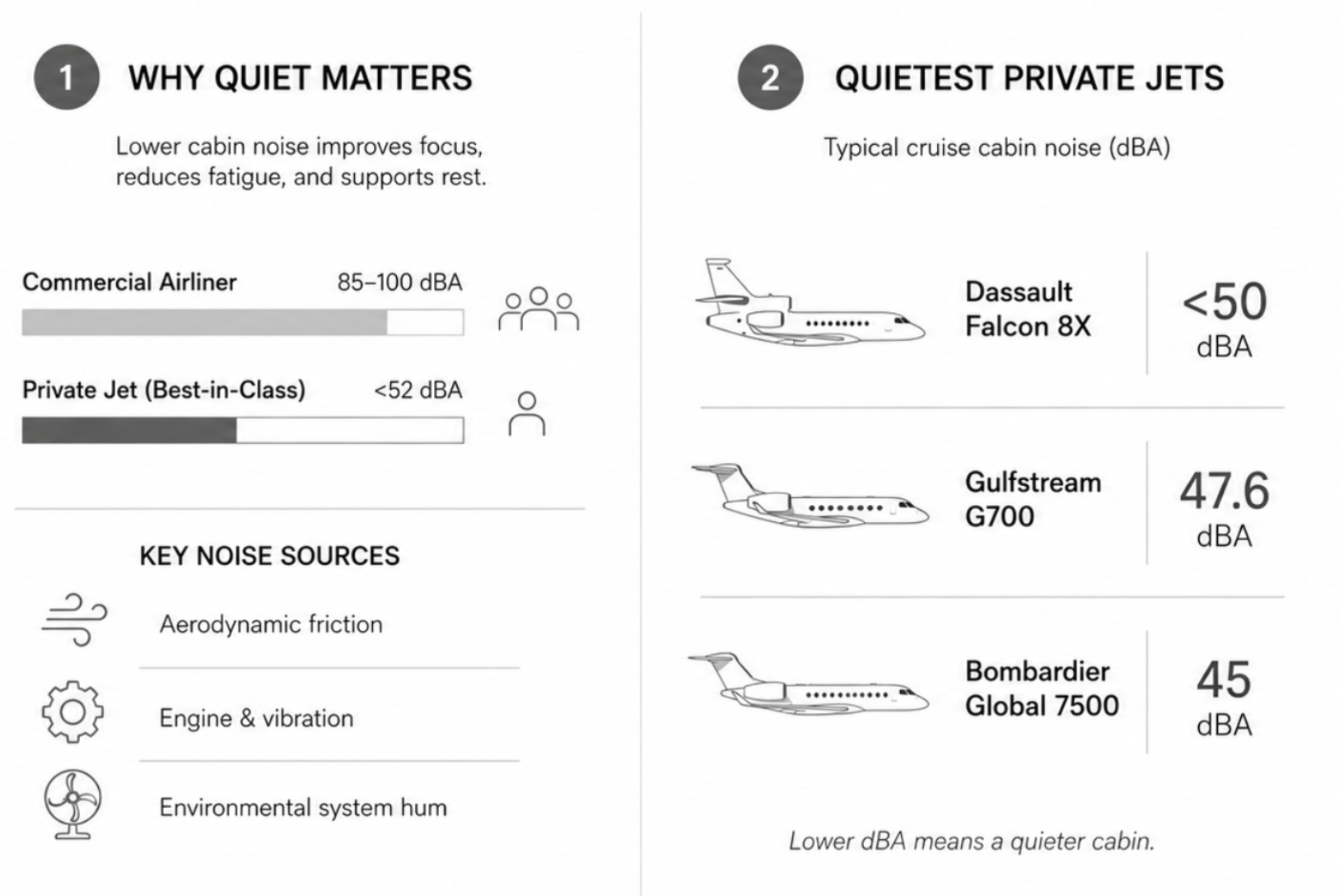
Engineers measure internal aircraft noise using two distinct metrics: dBA, which quantifies audible frequencies, and speech interference level (dBSIL), which evaluates how background noise disrupts human conversation. In a standard commercial airliner, ambient cabin noise routinely hovers between 85 and 100 dBA, with research data confirming this. Experts recommend that 85 dBA is the upper limit for prolonged periods of exposure. During takeoff, levels of 102 dBA are common. Even at the lower end, this volume forces passengers to elevate their voices and compounds mental fatigue over international flight routes.
Generally, business leaders and HNWIs have a lower tolerance for the negative side effects of noisy cabins, which is why private aviation suits this market segment. The modern ultra-long-range business jet market establishes an entirely different aural baseline, using advanced insulation and structural dampening to bring internal volume levels below 52 dBA in the optimal cases. The engineering challenge requires mitigating three specific sound vectors:
Aerodynamic friction generated by high-speed airflow over the fuselage skin
Low-frequency mechanical vibrations transmitting from the engine mounts through the airframe
Environmental control system hum derived from internal cabin air circulation
Dassault Falcon 8X
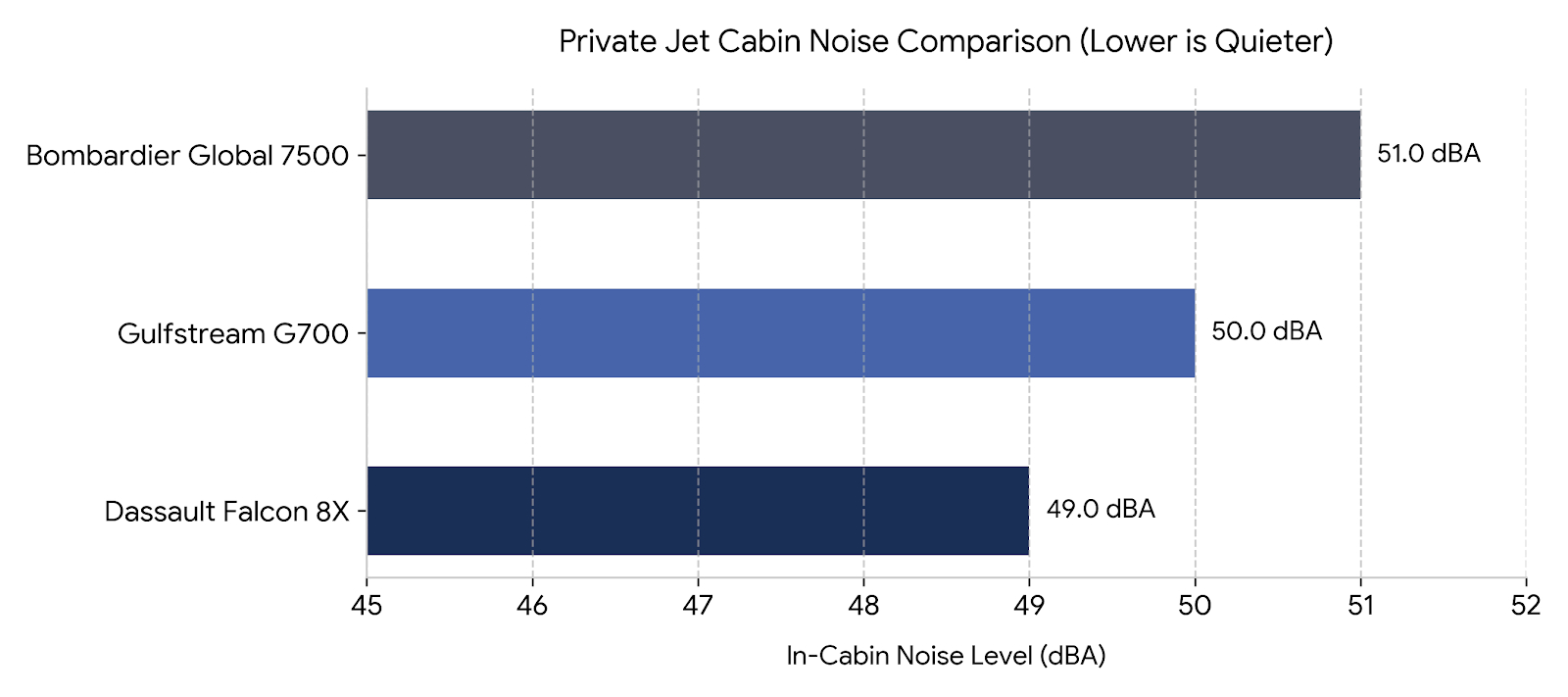
Dassault leverages its military aerospace heritage to optimize civilian cabin environments. The Falcon 8X achieves an internal sound level below 50 dBA, with market-leading performance of 49 Effective Perceived Noise in decibels (EPNdB) SIL cited by the manufacturer's specification. It uses custom-tuned soundproofing blankets that damp specific frequencies without adding excessive structural weight. The tri-jet configuration also allows the center engine to vent exhaust further behind the pressure bulkhead, mitigating a significant portion of traditional cabin resonance.
Gulfstream G700
The flagship Gulfstream G700 also records an impressive 47.6 dBA cruise volume, a feat achieved through a strategic partnership with Rolls-Royce to develop ultra-quiet Pearl 700 engines. This mechanical isolation is paired with optimized cabin air ducts that slow down linear airflow, removing the high-frequency hiss commonly associated with high-altitude climate control.
Bombardier Global 7500
Bombardier relies on a sophisticated mix of passive and active sound management. The Global 7500 records 45 dB in the bedroom and pairs heavy-density structural dampeners with a proprietary audio system that introduces subtle, localized noise-canceling frequencies throughout its four distinct living zones.
The Operational Cost of Acoustic Procurement
For prospective operators, procuring these acoustic environments requires balancing asset utilization against upfront capital deployment. Acquiring a factory-new ultra-long-range jet commands a massive capital expenditure. If a corporate flight department or family office records fewer than 400 flight hours per year, full asset ownership generally results in severe utilization inefficiency.
Fixed operating costs—crew, training, hangar fees, and depreciation—must be spread across annual flight hours. For organizations operating under this 400-hour threshold, transitioning to fractional shares or structured leasing models protects capital liquidity and shifts the cost structure from unpredictable capital expense to predictable annual payments. This operational shift allows corporations to maintain access to pristine acoustic environments without carrying a depreciating asset on the corporate balance sheet.
Future Benchmarks in Laminar-Flow Aerodynamics
As the market transitions toward next-generation airframes, the focus on cabin acoustics continues to intensify. Upcoming flagships like the Dassault Falcon 10X are engineering new benchmarks by introducing advanced laminar-flow aerodynamics and wide-body fuselages designed specifically to deflect sound waves away from the passenger cabin.
For the modern executive, cabin silence is a vital business asset that guarantees arrival at their destination sharp, rested, and fully prepared to execute complex global strategies.


 Sign up with google
 Sign up with Apple