Why luxury aircraft cabins are becoming wellness spaces
November 17, 2026
Executives and high-net-worth individuals (HNWIs) are the primary audience for private aviation, with luxury aircraft cabins offering an antidote to the stresses and strains of commercial flights. It's a matter of prioritizing cabin comfort for its strategic advantages, with wellness framed as a means to an end for people who must stay productive mid-flight and mentally sharp when they land.
Mindful travel, achieved through a focus on onboard wellness, is, of course, about preserving human capital, but it can also encompass other aims and concerns. According to BlackJet, a jet card program operator, several changes and technologies have been introduced to meet luxury aircraft passengers' expectations, creating experiences that merge the boardroom with the health spa.
Addressing the Physiological Toll of Traditional Flight
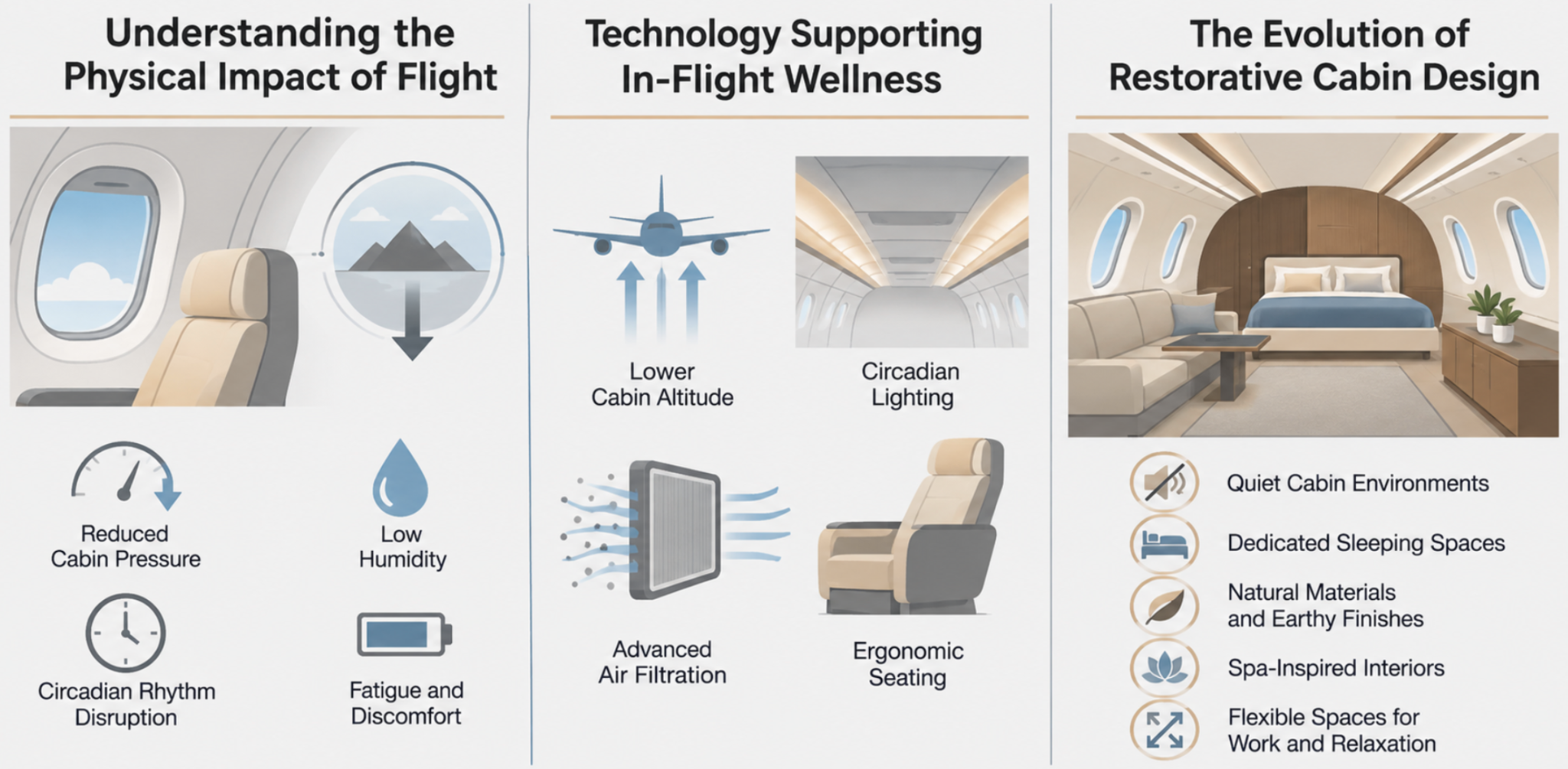
Our bodies face several unusual external impacts during flight, and the UK's Civil Aviation Authority provides an overview of the physiological effects that may be triggered in a standard commercial aircraft. Hypoxia, when body tissues don't receive enough oxygen from the blood, is a concern for people with certain health conditions, since blood oxygen saturation drops to 90% at typical cabin altitudes of up to 8,000 feet. Similarly, cabin pressure can worsen other conditions, including sinus pain and inner ear complaints.
Low humidity below 20% is another reality of standard commercial flights, well below the 50% humidity standard indoor spaces at ground level offer. While this shouldn't cause dehydration concerns, it can dry out skin and mucous membranes exposed to the air, increasing thirst and fatigue.
Finally, jet lag has a near-universal impact because long-haul flying disrupts the body's circadian rhythm. Beyond affecting mental and physical performance, jet lag can also raise concerns for those taking medication regularly, given the disruption to timing and dosage.
C-suite executives and HNWIs are focusing on the wellness aspects of luxury aircraft cabins for these reasons. The industry is responding with technical specifications and design features intended to optimize cabin comfort.
Jets Making a Difference
One of the market's leading examples of a jet that puts luxury interiors and onboard wellness at the top of the agenda is the Bombardier Global 8000. While it can reach a top speed of Mach 0.95, making it faster than any business jet before it, except for Concorde, and travel 8,000 nautical miles on a single tank of fuel, its design and specifications also emphasize passenger wellness.
Given the impact cabin altitude has on passenger health and comfort, the Global 8000's 2,691-foot cabin altitude is both class-leading and game-changing. For context, the manufacturer compares this to the air pressure you'd feel standing at the top of the world's tallest building, Dubai's Burj Khalifa. The idea is to eliminate discomfort and reduce the potential for jet lag.
The Global 8000's luxury cabin also addresses circadian rhythm disruption with a lighting system called Soleil. It's the first of its kind, integrating with dedicated software to simulate the natural day-night cycle and adjust it based on the time of day at the departure and arrival destinations.
Air quality is another detail, with the Pur Air system introduced onboard to eliminate 99.99% of particles that pass through it. It removes airport odors and gases, including volatile organic compounds that can harm health, along with allergens and bacteria. It also delivers higher in-cabin humidity than systems that rely on fresh air delivery alone.
Lastly, the Nuage seat pushes the envelope with its so-called zero-gravity setup, positioning the occupant so they feel as if they're floating on air. Again, the intention is to improve comfort and support passenger well-being throughout a flight, rather than letting air travel degrade it.
Sleep Science and Acoustic Comfort
The value of sleep as a wellness tool is hard to overstate: Adults need 7 to 9 hours of rest a night to feel and function optimally, according to the National Institute of Neurological Disorders and Stroke. The problem for passengers on commercial flights is that a range of environmental stressors makes airborne rest difficult to initiate, let alone sustain for long periods.
Owning or renting luxury aircraft reduces some external sleep-disrupting factors that can't otherwise be controlled, like other passengers being present. Beyond that, cabin design and mechanical performance can be adjusted to deliver a quiet, calm in-cabin experience.
The Gulfstream G700 is a modern example of this, with its efficient Rolls-Royce Pearl 700 engines using less fuel than older models and, in turn, intruding on the cabin space to a lesser extent. The manufacturer promises a whisper-quiet ambient audio level and offers the option to configure the interior into up to four distinct areas, making it easier for people to sleep and work simultaneously without disturbing one another.
The Evolution of Biophilic and Holistic Jet Design
The latest conceptual frameworks in private aviation interior design draw on high-end terrestrial spas, incorporating biophilic elements and tactile natural materials. Design houses are introducing expansive washrooms, soothing earthy color palettes, and open lounge areas that encourage light movement during extended flights.
Bombardier's Global 8000, a collaboration with ELIE SAAB, exemplifies this trend, with the manufacturer calling it the haute couture of aviation. These holistic layouts move away from rigid, cramped seating arrangements in favor of fluid spaces that support mental clarity and relaxation.
The Future of Restorative Aviation
As private aviation evolves, advanced wellness infrastructure is becoming a baseline expectation for high-net-worth buyers and charter clients alike. The convergence of aerospace engineering and human physiology ensures that time in the air supports traveler health rather than depleting it.


 Sign up with google
 Sign up with Apple