Introduction to Private Jets
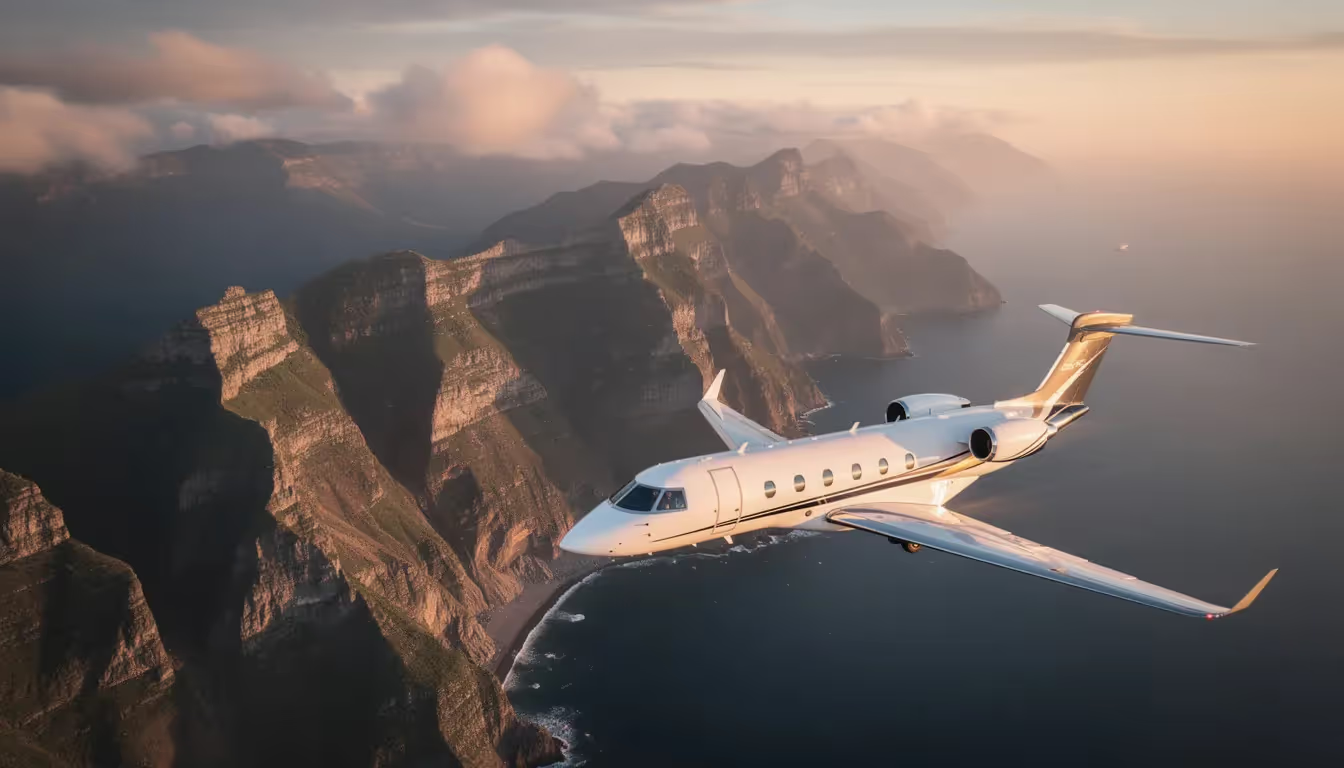
Private jets represent the pinnacle of travel flexibility, comfort, and efficiency for both individuals and businesses. As an aircraft owner, you gain access to a world where your schedule dictates your flights, not the other way around. Private aviation eliminates the hassles of commercial terminals, long security lines, and rigid timetables, allowing you to maximize productivity and enjoy a personalized travel experience.
The private jet industry offers a wide range of aircraft to suit different needs and budgets. Light jets, such as the HondaJet Classic, are particularly popular for their blend of speed, efficiency, and cabin comfort. With the advanced performance modification group (APMG) package, the HondaJet Classic delivers enhanced range, improved takeoff performance, and state-of-the-art avionics—making it a standout choice for those seeking a high-performance, cost-effective solution in private aviation.
Whether you’re flying for business or leisure, the benefits of private jets are clear: you can reach more airports, create custom itineraries, and enjoy a level of privacy and service unmatched by commercial airlines. For many, the ability to operate on their own terms is the ultimate luxury, and with the right aircraft, private aviation becomes an indispensable tool for both work and life.
Key Takeaways
A 5 million dollar jet in 2025 typically secures a well-maintained pre-owned light or midsize aircraft from the late 2000s to early 2010s—think Embraer Phenom 300, Cessna Citation XLS+, or Hawker 800XP—rather than a brand-new ultra-luxury large cabin.
The purchase price is just the beginning of the financial and operational commitments; it represents only 10–20% of the five-year cost of ownership, with annual operating costs commonly reaching $1–$2 million when you factor in crew, fuel, hangar, insurance, and maintenance.
For travelers flying fewer than 200 hours annually, structured access models like jet cards and on-demand charter often deliver better economics and far less complexity than owning outright.
Safety standards, sustainability options (including sustainable aviation fuel and carbon offsets), and advanced technology (high-speed connectivity, modern avionics, enhanced vision systems) have become core decision factors for the modern buyer.
Whether you own, charter, or fly via a jet card program, the strategic value of private aviation lies in time saved, schedule control, and the ability to transform travel into productive or restorative time.
The best place to start when considering buying a private jet is by working with an expert in the industry.
What Kind of Private Jet Does $5 Million Actually Get You in 2025?
Let’s start with clarity: five million dollars in 2025 does not buy you a brand-new Gulfstream with a bedroom suite and marble bathroom. What it does secure is a well-maintained pre-owned light or midsize jet, typically 8–15 years old, with proven reliability and solid capability for regional and transcontinental missions. And if you’re wondering about the salary of private jet pilots needed to operate such jets, earnings can be significant and vary by experience and jet type.
In this price range, jets vary in size but generally accommodate 6 to 10 passengers comfortably. Cabin heights typically range from 5'7" to 5'10" and widths from 5 to 7 feet, making them suitable for most business and leisure needs.
These aircraft usually seat 6–9 passengers and excel on routes like New York–Dallas, Los Angeles–Chicago, or Miami–Teterboro. They’re built for business-focused travel, not flying penthouse suites. The model you’re likely evaluating? A 2014–2018 Embraer Phenom 300—a popular pre-owned jet option priced around $5 million, known for its spacious cabin and great performance—a 2011–2015 Cessna Citation XLS+, which features a comfortable stand-up interior and is priced around $5.8 million, or a late-2000s Hawker 800XP with recent avionics upgrades. In 2025, buyers can find modern aircraft with advanced technology and comfortable cabins for between 6 to 10 passengers in the $5 million range.
Performance figures cluster around Mach 0.75–0.80 cruise speeds, with max range in the 2,000–3,500 nautical mile band and max passenger capacity typically up to 10. Most aircraft at this tier feature modern glass cockpits (Garmin G3000 or Pro Line 21 systems), high-speed Wi-Fi, and refreshed interiors. These jets often feature modern avionics, Wi-Fi connectivity, and a private lavatory. For flights under 4 hours, most users find the cabin space of these jets sufficient. This price point is about practical capability and schedule control—the ability to operate on your terms, access airports closer to your business or home, and reclaim the hours commercial travel steals.
Cabin Space and Seating: Comfort vs. Footprint
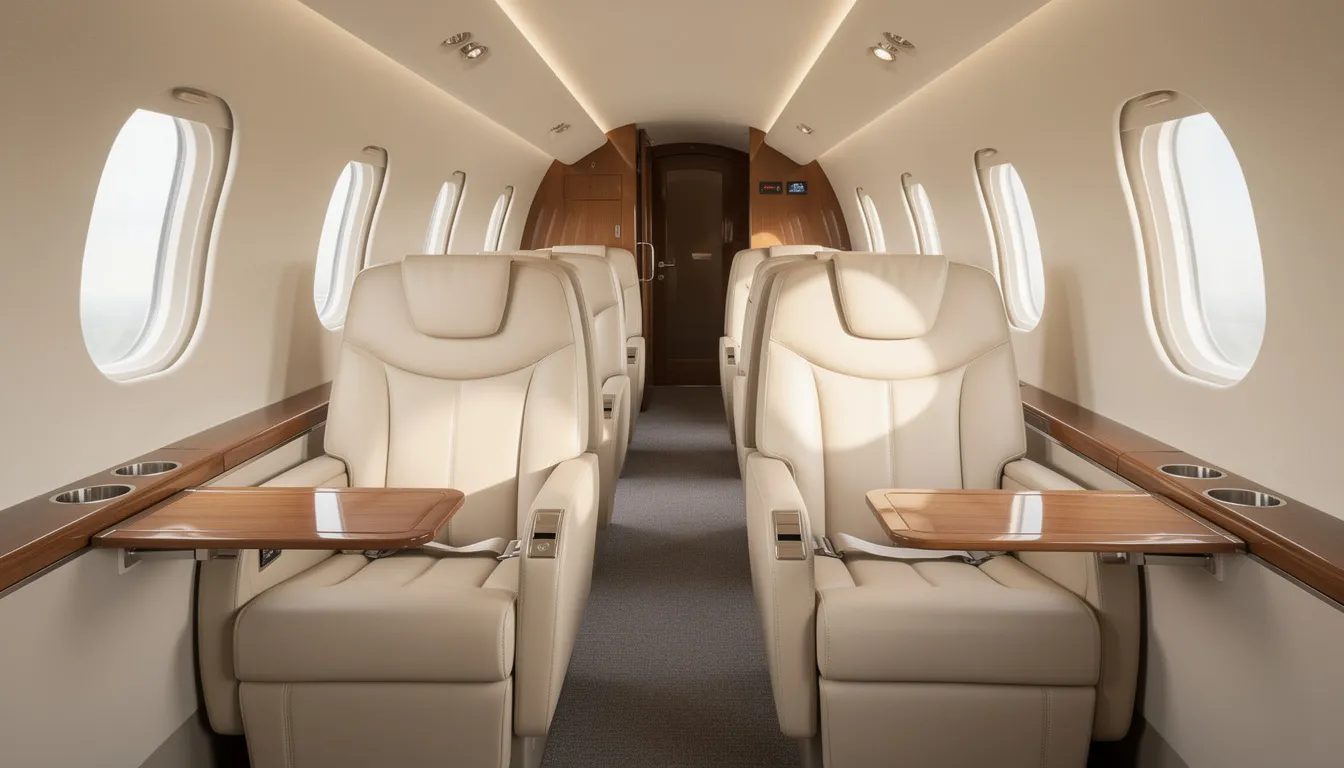
Cabin dimensions in the 5 million dollar jet category typically fall between 5 ft 7 in and 5 ft 9 in in height, with widths ranging from 5 to 6.5 ft. Full stand-up headroom is rare, particularly for taller passengers, though the Hawker 800XP offers approximately 5 ft 7 in—enough for most travelers to move comfortably.
Common layouts include a four-seat club arrangement plus two aft seats or a small divan. You’ll find a single enclosed lavatory, a compact forward galley or refreshment center, and pull-out worktables at each seat. Cabin comfort has improved significantly in recent refurbishments: expect refreshed leather upholstery, LED lighting packages, upgraded soundproofing, and modern cabin management systems for lights and temperature. For those interested in experiencing these upgraded amenities, consider private jet solutions that offer flexible programs tailored to frequent flyers.
How does this compare to commercial first class? You’ll have more privacy, complete schedule control, and the ability to work or meet without disruption. But in raw volume, a widebody lie-flat cabin may offer more physical space per passenger. The difference is everything around that space: no security lines, no boarding delays, no strangers, and no fixed schedules.
Regarding wellness and noise levels, these cabins are typically quieter than most airline cabins—often under 80 dB on the HondaJet Classic, for example—though they don’t match the whisper-quiet environments of ultra-long-range flagships like the Gulfstream G700 or Global 7500.
Range and Mission Profile: Where a $5M Jet Can Take You
Typical range for aircraft in this category spans 2,000–3,500 nautical miles, unlocking nonstop routes like New York–Houston, Los Angeles–Chicago, London–Marrakesh, or Dallas–Bogotá, depending on the specific model.
True nonstop oceanic flights like New York–London are challenging or impossible for most 5-million-dollar jets without a tech stop. The sweet spot is North America, the Caribbean, Mexico, and Central/South America—missions where these aircraft operate efficiently and avoid the complexity of long-haul commercial connections.
Performance varies with conditions. A full passenger load on a hot summer day in Phoenix will shorten the effective range considerably. Lighter loads and cooler departure conditions unlock the upper limits of the published specifications. Experts recommend optimizing your mission profile—average leg length, typical passenger count, expected baggage—rather than chasing the longest possible range on paper.
One significant advantage: the ability to use shorter runways than commercial airlines require. This grants access to executive airports like Teterboro (TEB) near Manhattan, Van Nuys (VNY) in Los Angeles, or London Farnborough (FAB), where you can be wheels-up or wheels-down without the chaos of major hub terminals.
What’s Included in the Cabin — and What Isn’t
At the 5 million dollar mark, core amenities typically include:
High-speed Wi-Fi enabling productive flights
Club seating with adjustable configurations
Pull-out worktables and in-seat power
A small galley with espresso capability and space for catered meals
Fully enclosed lavatory
Climate control and LED mood lighting
What’s normally absent at this tier: full bedrooms, stand-up showers, large conference tables, and multi-zone “apartment” style layouts. Those features appear on aircraft like Boeing Business Jets or Gulfstream G700s—assets trading at $20 million and well beyond.
Think of the cabin as an elevated boardroom plus living room: ideal for 2–4 hour business sprints, family weekends, or productive cross-country flights where you need to work, rest, or simply arrive refreshed. Most jets here are equipped with modern avionics suites (Garmin G1000/3000, Pro Line 21) that support advanced navigation, WAAS LPV approaches, and enhanced safety features.
The goal is to set realistic expectations while maintaining a premium experience. This is business aviation at its most practical and strategic.
Comparing $2M, $3M, and $5M Jets: How Far Does Your Money Go?
The pre-owned market operates in tiers, and understanding where your budget lands is essential to making an informed purchase decision. A buyer’s mission profile and risk tolerance should drive which tier makes sense—not just the appeal of a larger cabin or higher cruise speed.
At $2 million, you’re typically looking at very light jets or 1980s–1990s airframes with older technology. These jets are smaller in size, often seating 4-6 passengers with limited cabin space. At $3 million, early-2000s midsize models became available, offering a noticeable increase in size and cabin capacity, usually accommodating 6-8 passengers more comfortably. At $5 million, you access later-generation light and midsize jets with even larger size, more spacious cabins, stronger technology, better support networks, and more favorable operating economics.
None of these tiers includes ultra-long-range flagships like the Gulfstream G700 or Global 7500—those are 8-figure assets even in the pre-owned market. The question is which tier delivers the best value for your specific travel patterns.
$2 Million Jets: Entry-Level Access
At the $2 million price point, typical aircraft include very light jets and aging light jets: the Citation Mustang, Eclipse 500, or early-2000s Citation CJ1/2. Jets in this price range are limited in size, with smaller cabins and less passenger capacity compared to more expensive options. These often seat 2–4 passengers comfortably with ranges under 1,500 nautical miles.
Use cases are specific: short regional hops like Los Angeles–Las Vegas, Miami–Nassau, or London–Geneva. For owners flying frequently on simple, predictable routes, these can serve well.
Common compromises include tighter cabins, limited luggage space, shorter range requiring fuel stops on longer legs, and sometimes older or less integrated avionics suites. Airframes approaching major life events (engine overhauls, mandatory inspections) or requiring avionics upgrades to meet current regulatory standards (ADS-B, future mandates) can create unexpected costs.
Compared to premium commercial travel, a $2 million jet is often faster and more flexible for short routes—but not necessarily more spacious per passenger than long-haul business class.
$3 Million Jets: Aging Midsize Workhorses
Representative examples at this tier include the early-2000s Citation Excel, Learjet 60, and first-generation Embraer Phenom 100EV. These typically offer 6–8 seat cabins and approximately 2,000–2,500 nautical miles range. In terms of size, $3 million jets generally provide a moderate increase in cabin size compared to $2 million jets, but are still smaller than the more spacious $5 million jets.
The airframe is often structurally sound, but interiors may be dated, inflight connectivity solutions may be older (or absent), and cockpits may feature more analog instruments unless recently upgraded. For buyers who prioritize function and payload over aesthetics—especially for intra-continental business travel—these can be compelling.
Comprehensive refurbishment covering interior, paint, and avionics can lift the aircraft significantly, but pushes total investment closer to the $4–5 million band. Rigorous pre-buy inspections and logbook reviews are critical at this age bracket. Deferred maintenance surprises can quickly erase any perceived price advantage.
$5 Million Jets: The Balanced Sweet Spot
Strong examples at this tier include 2015+ Embraer Phenom 300/300E, Citation XLS+, late Hawker 800XP, and Learjet 60XR with modern avionics and interiors.
Jets in the $5 million range typically offer a larger cabin size compared to lower price tiers, providing more comfort and space for passengers. These aircraft combine respectable range, attractive cabins, and contemporary safety technology—WAAS/LPV approaches, synthetic vision, and auto-throttle in some types. Operating economics tend to be more favorable thanks to newer, more efficient engines and better support from OEMs and maintenance programs.
This tier often has better resale resilience than older jets, making it attractive to owners planning a 5–8 year holding period. At this level, the jet becomes a powerful strategic asset for executives making frequent multi-city trips in a single day, saving 4–6 hours per transcontinental mission compared to commercial first class.
The Phenom 300E, in particular, is often cited as the best all-around option, with cruise speeds of 521 mph and dispatch reliability approaching 99.9% according to industry data.
How Fast Will Your $5M Jet Depreciate?
Depreciation is a significant factor in any aircraft purchase calculation. A typical business jet loses 15–20% of its value in the first year if bought new. Pre-owned aircraft in the 8–15 year range may depreciate closer to 5–8% annually.
Concrete example: a $5 million jet acquired in 2025 might be worth roughly $3–3.5 million by 2030, assuming normal utilization and good maintenance. Neglected upgrades or inconsistent records can accelerate that decline significantly.
Avionics and connectivity upgrades—adding modern FANS, ADS-B Out, or high-speed Wi-Fi—can slow depreciation by keeping the aircraft commercially relevant. Tax strategies, such as bonus depreciation in the U.S. (depending on current legislation), can partially offset book depreciation for qualifying business use.
A holistic view should combine cash costs, depreciation, and the time/value advantages relative to commercial travel and charter alternatives. For many owners, the calculation isn’t purely financial—it’s strategic.
The Real Cost of Owning a $5 Million Jet
The acquisition price is just the beginning of your financial commitment. The serious commitment is the annual operating budget and the management effort required to run a safe, compliant operation.
A reasonable estimate for annual costs at typical U.S. or European cost levels runs $1–$2 million per year for 200–400 flight hours. This includes both fixed and variable expenses across several major categories:
Fuel: $200,000–$500,000+
Maintenance & Engine Reserves: $300,000–$500,000
Crew Salaries & Training: $300,000–$500,000
Hangar & Insurance: $70,000–$160,000
Administration & Management: $50,000–$150,000
Typical operating costs for a $5 million jet can total between $1.9 million and $3.2 million per year, including crew, hangar, and maintenance expenses. Engines alone can cost $1 million or more for an overhaul every 3,000 to 5,000 flight hours. Salaries for experienced captains range from $150,000 to $250,000 per year, plus benefits. Insurance premiums for mid-size jets can start at $30,000–$60,000 per year for well-qualified buyers. Maintenance bills can shock you, with many jets coming with $500,000 in deferred maintenance. Without proactive management, your $5 million jet can spiral into a seven-figure liability before year two.
Safety and compliance are non-negotiable spend areas. Skimping on training, inspections, or approved parts undermines both safety and asset value. Many sophisticated aircraft owners choose professional aircraft management companies to maintain safety oversight, regulatory compliance, and operational reliability.
Maintenance and Engine Programs
Scheduled maintenance (A/B/C checks, inspections) and unscheduled repairs can total $300,000–$500,000 per year for a midsize jet flown regularly. Engine overhaul cycles typically fall between 3,000–5,000 flight hours, and overhauls can cost $1 million or more for a pair of engines without program coverage.
Hourly maintenance and engine programs—JSSI, Rolls-Royce CorporateCare, and similar offerings—smooth cash flow and protect resale value, though they require significant annual premiums. Enrollment in these programs is often considered essential for maintaining the aircraft’s value and ensuring you can operate without unexpected capital calls.
The safety dimension cannot be overstated: adherence to manufacturer and regulatory maintenance schedules is central to ensuring airworthiness and insurability. Buyers should insist on a thorough pre-buy inspection and logbook audit before closing any $5 million aircraft purchase.
Crew, Training, and Safety Standards
Most 5-million-dollar category jets require two professional pilots, and many owners also engage a cabin attendant for longer or VIP missions.
Salary expectations for experienced crew:
Captain: $150,000–$250,000+ annually (North America/Europe)
First Officer: $80,000–$150,000 annually (North America/Europe)
Flight Attendant: $60,000–$100,000 annually (North America/Europe)
Recurrent training at facilities like FlightSafety or CAE typically costs $30,000–$50,000 per pilot annually, depending on type rating and simulator access requirements. This training isn’t optional—it’s the foundation of safe operation.
Safety and certification benchmarks like IS-BAO (Stage II or III), Wyvern Wingman, and ARGUS Platinum ratings signal that an operator exceeds basic FAA requirements. Even owners who fly with a single, trusted crew should use third-party audits and standardized training protocols to maintain institutional safety discipline.
Hangar, Insurance, and Administrative Overhead
Hangar costs vary dramatically by market:
New York/Teterboro: $80,000–$120,000+ annually
Los Angeles/Van Nuys: $60,000–$100,000 annually
Regional U.S. Cities: $40,000–$70,000 annually
London Area: £40,000–£90,000 annually, depending on location and hangar type. Range of the aircraft and operational requirements can influence hangar needs and costs.
For frequent flyers looking to optimize travel costs, exploring options like the best jet cards for frequent flyers can provide valuable benefits and flexibility.
Insurance for a 5-million-dollar jet typically runs $30,000–$60,000+ per year, with premiums affected by pilot experience, hull value, and loss history. If you're interested in learning more about charter flights, their benefits, and considerations, check out our detailed article.
Additional costs include dispatch and scheduling staff, accounting and legal services, regulatory compliance, and flight planning tools. Many owners outsource these functions to a management company that charges a monthly fee but delivers 24/7 support and operational oversight.
This professionalization isn’t just convenience—it supports safety, regulatory compliance, and optimized asset utilization. For busy executives, it removes the burden of managing operational details and lets them focus on what the aircraft is for: strategic mobility.
Ownership vs. Jet Cards and Charter: What Makes Sense at $5M?
The smartest travelers start with “How often do I really fly, and where?” rather than “Which jet can I buy for $5M?” The right access model should solve your real travel needs and problems, not just offer a product.
Access to private aviation comes in several distinct models:
Full Ownership: Best for CEOs and founders with consistent, heavy travel, typically flying 250–400+ hours annually.
Fractional Ownership: Suitable for regular users who want a shared ownership structure, flying about 50–200 hours per year.
Jet Cards: Ideal for flexible travelers with predictable needs, generally flying 25–150 hours annually.
On-Demand Charter: Best for occasional travelers with variable patterns, usually flying under 50 hours per year.
Outright owning typically becomes financially logical above roughly 200–250 hours per year. Below that threshold, structured access like jet cards and on-demand charter often wins on both economics and simplicity.
Chartering allows for flexibility without the overhead costs associated with ownership, such as maintenance and crew salaries.
Fractional ownership offers a compromise between full ownership and chartering, providing guaranteed hours but less flexibility.
Premium jet card programs—such as those offered by providers like BlackJet—combine predictable pricing with guaranteed access, rigorous safety standards, and sustainability options like carbon-neutral flights. For many discerning travelers, this combination delivers the benefits of private aviation without the full burden of ownership.
When Owning the Jet is the Right Move
Typical ownership profiles include CEOs or founders flying 250–400+ hours per year between recurring city pairs (New York–Miami, London–Zurich, Los Angeles–Seattle) who need total schedule control.
Non-financial benefits of ownership include:
Consistent aircraft and crew familiarity
Full control over cabin layout and branding
Dedicated security protocols
Ability to leave personal items on board
Instant availability without scheduling constraints
Potential tax advantages exist in some jurisdictions—U.S. bonus depreciation for business-dedicated aircraft, for example—though buyers must seek specialized tax and legal advice.
Some owners offset costs by chartering the aircraft when not in personal use. This adds utilization, wear, and regulatory complexity, but can provide meaningful cost offset when structured properly.
Ownership makes most sense when the jet is integral to the operating rhythm of the business—not a sporadically used perk.
When Jet Cards or On-Demand Charter Are Better
Travelers flying fewer than approximately 150 hours per year often achieve lower all-in costs and far less complexity by using jet cards or high-quality on-demand charter.
A premium jet card offers:
Guaranteed availability with fixed hourly rates
Safety-vetted operators meeting or exceeding FAA standards
Fleet flexibility across light, midsize, and large cabin aircraft
No fixed overhead: no hangar, no crew payroll, no long-term maintenance exposure
Consider this scenario: a family office flying 60–100 hours annually between New York, Aspen, and Palm Beach. Instead of buying a 5 million dollar jet and absorbing $1.5 million in annual operating costs, they deposit $150,000–$200,000 in a 25–50 hour jet card and pay primarily for hours flown.
Providers like BlackJet embed strict safety criteria, technology-enabled scheduling, and carbon-neutral or SAF-supported options as standard. The heavy decision-making is removed—you simply book and fly.
Fractional Ownership: Middle Ground with Trade-Offs
Fractional programs allow clients to buy 1/16 to 1/4 of an aircraft (representing approximately 50–200 hours per year) with guaranteed access but a shared ownership structure.
Fractional can be cost-effective for regular users who don’t want full ownership responsibility. Trade-offs include scheduling rules, repositioning fees, and less control over specific tail numbers.
Contracts are complex. Exit provisions, residual value formulas, and surcharge structures require careful review with aviation-specialized counsel.
Compared to jet cards, fractional is more “asset-based” while cards are “access-based.” Cards typically provide more flexibility to scale hours up or down each year. Sophisticated buyers often combine solutions—a fractional share plus on-demand charter for overflow or special missions.
New vs. Pre-Owned for $5M: Space, Tech, and Risk
At the 5 million dollar mark, most buyers face a choice between a newer, smaller jet or an older, larger jet. Each path has distinct advantages.
Before making a purchase, buyers should carefully review available aircraft for sale and understand current market conditions to ensure they are making an informed decision.
“New” at this price typically means very light or smaller light jets. “Larger pre-owned” means older midsize or even early large-cabin models with more space but higher upkeep.
Pre-buy inspections, pedigree (ownership and maintenance history), and proper records are pivotal in either scenario. Safety and future supportability—parts availability, avionics support, regulatory compliance pathways—should outweigh cosmetic preferences.
The Pre-Owned Advantage: More Jet for the Money
A well-kept pre-owned midsize jet like a late-model Hawker 800XP, Learjet 60XR, or Falcon 50EX trading near $5 million with fresh inspections offers tangible gains over new very light jets at a similar price:
More cabin volume and stand-up capability
Longer range for multi-leg days
Larger baggage holds
More comfortable multi-hour missions
Working with independent experts can help you locate the best pre-owned jet options in the market, ensuring you find an aircraft that fits your needs and budget.
Major inspections recently completed (4C, 6C, 192-month) and enrollment in engine programs significantly de-risk older aircraft. Avionics retrofits—modern FMS, ADS-B Out, synthetic vision, and satellite connectivity—can bring the airframe up to current operational and safety expectations.
Due diligence with independent experts is essential. Inheriting deferred maintenance liabilities can quickly erase any price advantage.
Newer Jets: Technology, Efficiency, and Warranty
Alternatively, buyers might target a relatively new light jet—a 2020+ Phenom 300E, Citation CJ4, or HondaJet Elite II—where transaction prices can approach or exceed $5 million depending on specification.
Advantages of newer aircraft:
Factory warranties reduce near-term maintenance risk
Cutting-edge avionics suites with synthetic vision and enhanced safety features
Improved fuel efficiency (15%+ better in some models)
Safe Return and Emergency Autoland systems on select aircraft
Optimized compatibility with sustainable aviation fuel (SAF). Some newer jets, such as the HondaJet, utilize sustainable aviation fuel during testing and operation, and programs offering flexible private jet travel ensure access to these advanced aircraft.
Trade-offs include smaller cabins and sometimes shorter range versus older midsize jets. Buyers valuing reliability, reduced downtime, and long-term technological relevance may accept less cabin volume to gain these advantages.
Verifying History and Safety Before You Buy
Key steps before any purchase:
Detailed pre-buy inspection at a reputable maintenance facility
Full logbook audit examining complete maintenance history
Database checks against aviation authority records for incidents or damage history
Maintenance tracking review (CAMP or equivalent) for engine program status and AD/SB compliance
Third-party operational audit, particularly if the aircraft spent time in charter or demanding environments
Engage an independent aviation consultant or management company early in the process—not just at contract signing. Technology compatibility and future upgrade paths are as important as the current cosmetic state of the interior.

Safe Return Systems and Emergency Protocols
Safety is the cornerstone of private aviation, and today’s private jets are equipped with advanced systems designed to protect both passengers and crew. Modern aircraft, like the HondaJet Elite II, feature cutting-edge safety technologies such as the Safe Return emergency autoland system. In the event of a pilot incapacitation or other critical emergency, Safe Return can automatically take control of the jet, communicate with air traffic control, and safely land the aircraft—providing an unprecedented level of security and peace of mind.
Private jet owners and operators are also held to rigorous safety standards set by the Federal Aviation Administration (FAA) and other regulatory bodies. These protocols cover every aspect of flight operation, from crew training and maintenance to emergency procedures and passenger safety briefings. By adhering to these strict guidelines, private aviation operators ensure that every flight meets the highest standards of safety and reliability.
For owners, investing in advanced safety features and maintaining compliance with FAA regulations not only protects their passengers and crew but also safeguards the value and reputation of their aircraft. Ultimately, these measures create a travel environment where confidence and peace of mind are built into every journey, allowing you to focus on the benefits of private aviation without compromise.
Safety, Sustainability, and Technology: Non-Negotiables for the Modern Buyer
For serious travelers, a 5 million dollar jet is not just about leather and speed. It’s about uncompromising safety, responsible environmental impact, and intelligent technology that enhances every flight, giving owners and passengers advanced safety features and seamless connectivity.
These factors apply equally whether you own, charter, or fly via jet card or fractional programs. Top-tier operators and providers make them core to their offering—not optional extras.
Safety and Certification: Beyond the Minimums
All jets must meet regulatory requirements from the FAA, EASA, or equivalent authorities. But discerning owners and charter clients often demand higher voluntary standards.
Key benchmarks to look for:
IS-BAO Stage II/III: Comprehensive safety management system
Wyvern Wingman: Rigorous operational and crew standards
ARGUS Platinum: Enhanced due diligence and audit history
Practical safety levers include standardized operating procedures, crew duty/rest rules, and recurrent simulator training. These aren’t check-boxes—they’re the difference between confidence and risk.
Advanced safety technology increasingly common in modern jets includes emergency autoland systems (HondaJet Elite II, Cirrus Vision Jet with safe return capability), predictive landing performance, and advanced weather radar. Ask specific safety questions of sellers or operators: training cadence, audit history, incident reporting culture, and maintenance oversight processes.
Sustainability in Private Aviation
Environmental scrutiny of private aviation is real. Sustainability is a responsibility, not a marketing flourish.
Key sustainability approaches:
Sustainable Aviation Fuel (SAF): Business jets, including the HondaJet, have demonstrated 100% SAF compatibility in test flights, with SAF reducing lifecycle CO₂ emissions significantly compared to conventional jet fuel. Industry targets call for 10% SAF adoption by 2030.
Carbon Offset and Insetting Programs: Reputable providers use independently verified projects (often forestry-based) with transparent accounting. Leading access programs and management firms increasingly offer carbon-neutral flight options by default, with costs integrated into hourly or management fees.
BlackJet, for example, ensures every journey is carbon neutral at no extra cost to clients—a standard that contrasts sharply with commercial aviation’s challenges in addressing the 2.5% of global CO₂ emissions from flights.
Owners and cardholders should adopt policies prioritizing SAF where available and track annual flight footprint as part of broader ESG reporting.
Technology and Connectivity: Turning Flight Time into Asset Time
High-speed in-flight connectivity transforms a jet into an airborne office. Systems comparable to Gogo AVANCE L5 or Starlink Aviation deliver 50 Mbps or better, enabling video conferencing, large file transfers, and seamless productivity at altitude.
Modern avionics—Garmin Perspective Touch+, Pro Line Fusion, or comparable suites—improve safety and reduce pilot workload through integrated automation. Flight stream capabilities allow real-time weather and traffic overlay for optimized routing.
Mobile and web tools let operators and cardholders view schedules, maintenance status, and trip details from their phones. Technology also improves operational efficiency: route optimization reduces fuel burn, weather avoidance tools prevent delays, and predictive maintenance analytics minimize unscheduled downtime.
For many BlackJet-style clients, the goal is making private flying feel invisible: seamless booking, real-time updates, and reliable cabin productivity without micromanagement.
Is a $5 Million Jet a Smart Move for You?
The smartest decision may not be spending $5 million on metal at all. It may be investing in the right access strategy for your specific travel pattern. As you evaluate your options, consider your next step—whether that's exploring ownership, fractional programs, or jet cards—to ensure your choice aligns with your needs.
Key considerations to weigh:
Annual Flight Hours: Am I above or below 200 hours consistently?
Typical Routes: Are they predictable city pairs or variable?
Control Requirements: Do I need instant availability or is 24-48 hour notice acceptable?
Operational Appetite: Do I want to manage an operation or simply fly?
Sustainability Goals: Am I prepared to prioritize SAF and carbon-neutral options?
Profile A: Tech Founder, flying 300 Hours Annually. Consistent travel between San Francisco, Austin, and New York. High value on time, needs to take meetings in-flight. Ownership or fractional ownership makes sense—the jet is a business tool integral to the operational rhythm.
Profile B: Family Office Flying 80 Hours Annually, Seasonal travel to vacation homes, occasional business trips. Schedule is flexible. Jet card delivers all the benefits of private aviation without capital lock-up or management burden.
Time saved, control over schedule, and privacy can justify substantial spending when aligned with business outcomes and family priorities. The key is matching the solution to the actual pattern, not the aspirational one.
FAQs About 5 Million Dollar Jets
Can I reliably cross the Atlantic nonstop in a $5M jet?
Usually not with a full cabin and a comfortable payload. Most 5-million-dollar light and midsize jets are optimized for North American missions and shorter oceanic segments. Routes like New York–London with reserves and full passengers generally require a tech stop (Newfoundland, Iceland, or Ireland) or push buyers into higher price tiers and older large-cabin aircraft with true transatlantic range.
How many flight hours per year justify owning instead of using a jet card?
As a rule of thumb, ownership begins to make economic sense above approximately 200–250 hours per year. Below that threshold, jet cards and charter are typically more rational financially and operationally, especially once fixed costs like crew salaries, hangar fees, insurance, and management overhead are fully accounted for. The break-even varies with specific aircraft operating costs and jet card hourly rates.
How long does a private jet last before it needs to be replaced?
With proper maintenance, business jets often remain airworthy and commercially viable for 25–30+ years. Airframe age matters less than maintenance pedigree, modernization (avionics, interior), and ongoing regulatory compliance. A well-maintained 1995 Hawker can still be a capable, safe aircraft if properly updated—though it may not match the efficiency or technology of a 2020 model.
Are $5M jets safe for flying into smaller regional airports?
When operated by professional crews under robust safety management systems, these jets are specifically designed to operate from many regional and secondary airports with runways under 5,000 ft. Each runway and weather scenario must be assessed via proper performance calculations and operator standards. The flexibility to access airports like Teterboro, Scottsdale, or smaller regional fields is one of the core value propositions of this aircraft category.
Can I make money chartering out my $5M jet when I’m not using it?
Charter can offset some ownership costs, but it rarely transforms the aircraft into a profit center. Extra utilization increases maintenance intervals and accelerates depreciation. Owners should view charter as a partial cost offset within a well-modeled business plan rather than a standalone investment strategy. The decision involves weighing revenue potential against wear, regulatory complexity, and the inconvenience of scheduling around third-party charters.
Explore Smarter Private Jet Access
For many discerning travelers, the advantages of a 5 million dollar jet—schedule control, privacy, productivity, and strategic mobility—don’t require locking capital into ownership at all. Programs built on rigorous safety vetting, carbon-neutral performance, and technology-driven ease of booking deliver the same benefits with none of the operational burden. If your travel patterns call for 25 to 150 hours of private flying annually, a Jet Card program offers the most efficient path to seamless, premium travel. Discover how refined, meaningful travel becomes your new standard with a confidential consultation to map your routes, hours, and requirements to the most intelligent access solution.


 Sign up with google
 Sign up with Apple