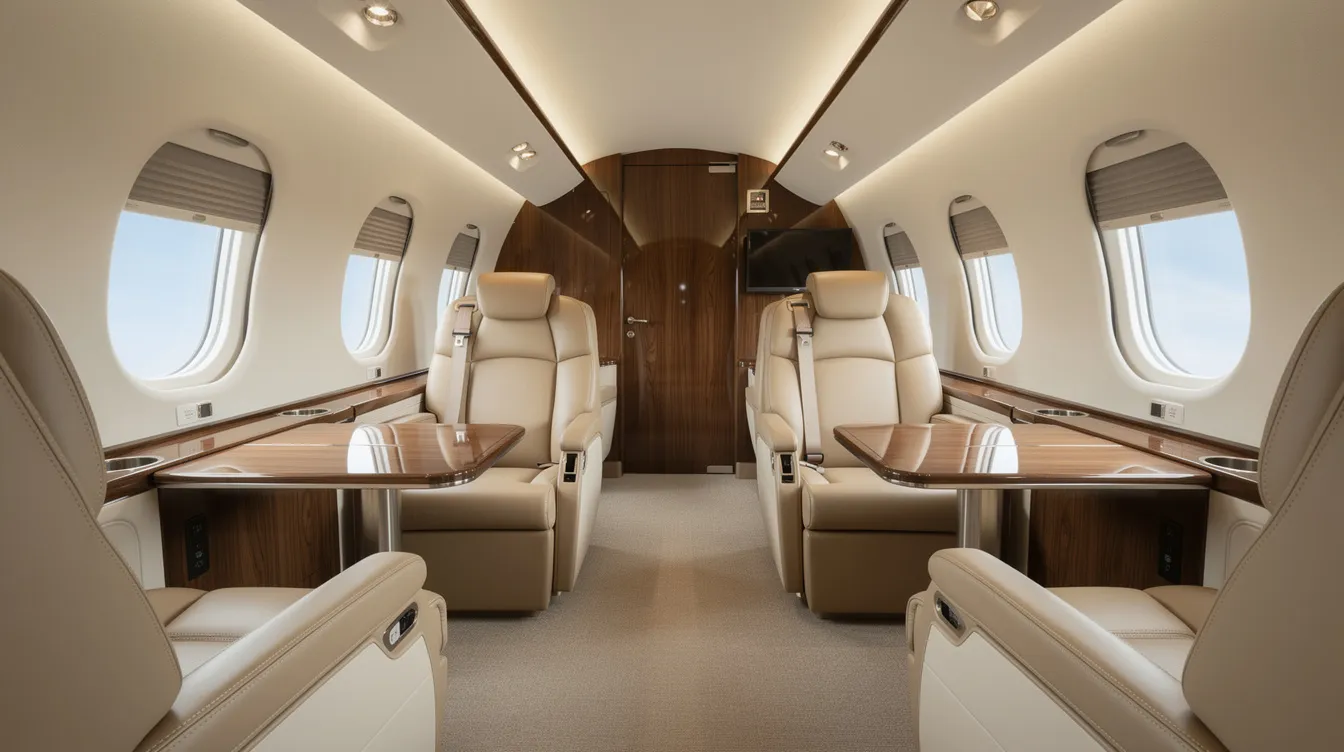
In the complex hierarchy of commercial and private aviation, 50-seat aircraft occupy a distinctive position. These regional jets and turboprops bridge the gap between smaller planes and large narrowbodies, serving both scheduled airline routes and bespoke group charter operations. For discerning travelers and corporate decision-makers, understanding this aircraft class unlocks strategic advantages that neither turboprops nor full-size airliners can match.
Key Takeaways
50-seat aircraft sit at the crossroads of regional airline economics and high-end private group travel, offering capabilities that contrast sharply with both turboprops and large narrowbodies such as the Boeing 737 and Airbus A320 family.
In 2026, 50-seat regional jets are declining in scheduled commercial service across North America, yet remain strategically vital for small-city connectivity and increasingly attractive for private charter conversion.
These aircraft can be repurposed as private-jet–style cabins that accommodate 25–40 passengers, providing a cost-effective alternative to owning a jet or chartering a VIP widebody airliner.
Safety certification and emerging sustainability solutions—including SAF and verified carbon offsets—keep 50-seat aircraft relevant for both US regional airlines and discerning private travelers seeking responsible group travel.
BlackJet is a premium access solution that sources 50-seat aircraft for bespoke corporate, sports, and event travel, with carbon-neutral options and rigorous safety standards built into every flight.
What Is a 50 Seat Aircraft?
The term “50 seat aircraft” refers to regional jets and turboprops originally designed to seat 45–52 passengers, typically arranged in 1–2 or 2–2 seating configurations. These aircraft were designed to fill a specific market niche: routes too long or demand levels too high for smaller turboprops, yet insufficient to justify a full narrowbody operation.
Within this category, three distinct aircraft types emerge:
Commercial 50-seat jets include the Bombardier CRJ200 and Embraer ERJ-145 family, primarily used for scheduled regional airline service. The Embraer ERJ-145, for example, offers a range of approximately 2,870 km (1,783 miles), while turboprops like the ATR 42 have a shorter range of about 1,555 km (966 miles).
VIP-configured airliners such as the Boeing 737-500 VIP and the Airbus A319 Corporate Jet accommodate private charters for 30–50 guests. These are examples of commercial aircraft converted for private or luxury charter use. They operate differently from private jets by adhering to commercial safety standards and regulatory compliance, and are often chosen by large passenger groups seeking a bridge between commercial and private aviation.
Turboprops in the 40–50-seat range, including the De Havilland Dash 8-300/315 and ATR 42-500/600, are used for short-haul regional and remote community service.
These aircraft typically operate flights of 300–700 nautical miles, connecting smaller cities to major hubs or serving charter groups requiring mid-size capacity. While “50 seat” represents a design benchmark, luxury and corporate refits routinely reduce capacity to 30–40 seats, enhancing comfort with club seating, upgraded galleys, and conference areas that transform a regional aircraft into a flying boardroom.Private jets accommodating 50 passengers offer luxury features such as conference rooms, dining areas, bedrooms, advanced entertainment systems, and extensive customization options tailored to the preferences of high-end clientele.
Charter costs for private jets vary significantly by aircraft type, flight distance, and seasonal demand, ranging from $15,000 to $50,000+ per hour, as detailed in guides on how much it costs to charter a small plane. A standout feature of private jet charter is the ability to customize the aircraft's interior and amenities extensively, tailoring the experience to the specific needs of business or leisure travelers. Despite the high hourly rates, private jet charter can often be less expensive than the best group travel offers from scheduled airlines for large parties, especially when considering the value of flying together with a cohesive group.
Interestingly, the average party size for private jet charters is approximately 4.1 passengers per flight, highlighting the exclusivity of this travel option. 16-seat private jets, alongside larger Boeing Business Jets renowned for their luxurious interiors, offer everything from private bedrooms to conference rooms, ensuring unmatched comfort and functionality for groups of up to 50 passengers.
Evolution of 50 Seat Regional Jets
The history of 50-seat jets traces a compelling arc from explosive growth to strategic decline, shaped by economics, labor agreements, and shifting passenger expectations. The development of regional jets has seen significant evolution in aircraft design and technology, with manufacturers introducing new models to improve efficiency, capacity, and noise reduction, and continually adapting to meet operational needs and regulatory standards.
The 1990s–2000s Boom
The early 1990s marked the birth of the modern 50-seat jet era:
1991: Bombardier introduced the Canadair Regional Jet (CRJ100/200), establishing the template for 50-seat jet operations. Over 1,000 CRJ200s were eventually built, forming the backbone for United Express, Delta Connection, and American Eagle networks. Regional jets like these were widely used by commuter airlines such as SkyWest and American Eagle.
1996–1999: Embraer countered with the ERJ-135/140/145 family, offering a similar range (approximately 1,500–2,000 nautical miles) and capturing significant market share with its 1-2-seat configuration, which passengers preferred for aisle access.
Turboprop displacement: These jets rapidly replaced 30–40 seat turboprops on routes under 500–600 miles, as passengers demonstrated a clear preference for jet service over propeller aircraft. The 50-seat regional jet was initially popular for its smoother flights and faster speeds compared to turboprops.
Historical roots: The first aircraft considered part of the regional jet category was the Sud-Aviation Caravelle in 1959, marking the beginning of purpose-built short-haul jetliners.
The Scope Clause Factor
The proliferation of 50-seat jets was fundamentally driven by scope clauses—provisions in pilot contracts at American Airlines, Delta, and United that limited outsourced regional flying to specific seat counts (typically 50–76 seats) and maximum takeoff weights. This created a precise demand for 50-seat aircraft from regional partners such as SkyWest Airlines, Envoy, and CommuteAir. The 50-seat regional jets were used to feed larger airline hubs without violating pilot contracts, enabling regional airlines to operate efficiently within labor agreements.
Post-2008 Economic Shift
The calculus changed dramatically after the 2008 financial crisis:
Rising fuel prices and maintenance costs made 70–90-seat jets (Embraer E170/E175, CRJ700/900) more attractive on a cost-per-seat-mile basis.
Pilot shortages beginning in the mid-2010s intensified pressure, as two pilots are required regardless of whether the jet carries 50 or 100 passengers.
COVID-19 accelerated retirements during 2020–2022, removing hundreds of 50-seat jets from service.
Production Endpoints
Key production milestones mark the industry’s evolution:
Bombardier ended CRJ200 passenger production in the mid-2000s, with the final CRJ-series delivery occurring in 2020, following Mitsubishi's acquisition of the program.
Embraer ceased production of the ERJ-145 family for mainline passenger clients in the 2010s, with limited subsequent roles in special-mission and regional markets.
By 2021, major US carriers had placed no new orders for 50-seat aircraft, with approximately 300 aging units facing 25-year retirement cycles by 2030—creating what industry analysts call the “50-seat problem.”
50 Seat Aircraft in Today’s Airline Networks (2026 Snapshot)
Despite declining numbers, 50-seat jets retain a strategic footprint in North American airline operations. These small regional jets play a critical function in the US airline network by feeding larger hubs, maintaining route frequencies, and supporting overall network revenue. However, the 50-seat regional jet market is economically challenged by high pilot wages and insufficient revenue. While larger 76-seat aircraft like the E175 number in the thousands, several hundred 50-seat jets continue to fly—a scale measured in the hundreds rather than the thousands.
Strategic Role in Hub Feeding
These aircraft serve essential functions:
Hub connectivity: Feeding major airports such as Chicago O’Hare, Denver, Dallas–Fort Worth, and Atlanta from small cities that cannot support larger aircraft.
Essential Air Service routes: Maintaining service to remote communities where frequency matters more than aircraft size.
Thin business markets: Supporting routes where multiple daily departures with smaller capacity outperform fewer flights on larger jets.
The 50-seat aircraft are crucial for maintaining high frequency on routes that feed into larger airline networks. Removing 50-seat aircraft from service could result in a significant loss of revenue for major airlines, estimated at around $1 billion annually. The Big 3 U.S. airlines depend on regional aircraft operations for approximately 30% of their revenue, underscoring the importance of these jets despite economic challenges.
Scope Clause Constraints
The Big 3 US carriers (American, Delta, United) remain capped on regional jet numbers above certain seat counts, preserving a protected niche for 50-seat aircraft. This regulatory environment forces trade-offs between fleet simplification (favoring larger regional jets) and network coverage (requiring some 50-seat operations).
Recent Innovations
United Airlines has pioneered creative solutions:
CRJ550 (launched 2019): A 70-seat airframe reconfigured to 50 seats with an upscale, multi-class layout featuring first-class seats, complying with scope limits while enhancing passenger appeal. This modification allows airlines to offer premium, lower-density cabins to maximize revenue.
CRJ450 upgrade program: Retrofitting older CRJ200s with a new configuration, including 41 seats with first-class and economy plus options to enhance the onboard experience, while maintaining low seat counts and extending the useful life of proven aircraft. The CRJ450 will also include Starlink Wi-Fi, considered the fastest Wi-Fi service in the airline industry. United Airlines plans to operate 50 CRJ450s by 2028, with bases at Chicago O'Hare and Denver International airports.
Non-US Markets
Elsewhere, the picture differs substantially. In Europe, Latin America, and parts of Asia, regional airlines have largely transitioned to larger regional jets and turboprops. The 50-seat aircraft type survives primarily in niche operations—remote community service, ad-hoc charters, and specialized roles where runway constraints favor smaller aircraft.
Commercial vs Private Use of 50 Seat Aircraft
The contrast between scheduled airline service and private charter operations reveals two fundamentally different approaches to deploying 50-seat aircraft. While airlines often use these aircraft to bridge the gap between smaller regional jets and larger commercial planes, the choice of plane size directly impacts operational efficiency, route flexibility, and market positioning.
For private and charter use, 50-seat aircraft offer a unique blend of capacity and exclusivity. Private jet charter offers the convenience of traveling on your own schedule, with direct access to thousands of airports worldwide. This flexibility makes them ideal for corporate groups, sports teams, or special events requiring tailored travel solutions.
Commercial Scheduled Use
Regional airline operations prioritize:
Single-class, high-density 48–50 seat layouts.
Minimal extra amenities beyond standard economy.
Frequency and connectivity over luxury.
Cabin environments resemble narrowbody economy class, though recent upgrades are increasingly focused on enhancing the customer experience, transforming the flying experience, and boosting overall satisfaction.
For US carriers, these aircraft function as network tools—moving passengers efficiently to major hubs where they connect to larger flights.
Private and Charter Use
Private operators transform the same airframes into premium experiences:
Reduced capacity: 25–40 seat configurations with spacious club layouts.
Enhanced amenities: Upgraded galleys, premium Wi-Fi, conference setups.
Diverse clientele: Corporate shuttles (tech campuses, manufacturing hubs), sports teams, touring artists, and incentive trips.
The High-Net-Worth Proposition
For group travel, a 50-seat aircraft can deliver significant advantages, especially when compared with a private jet for 30 passengers:
Economics: More economical than chartering a VIP Boeing 737 or Airbus A319 Corporate Jet for regional travel.
Access: Shorter positioning times and secondary airport capabilities.
Time value: Outperforms commercial first class when factoring door-to-door transit for groups.
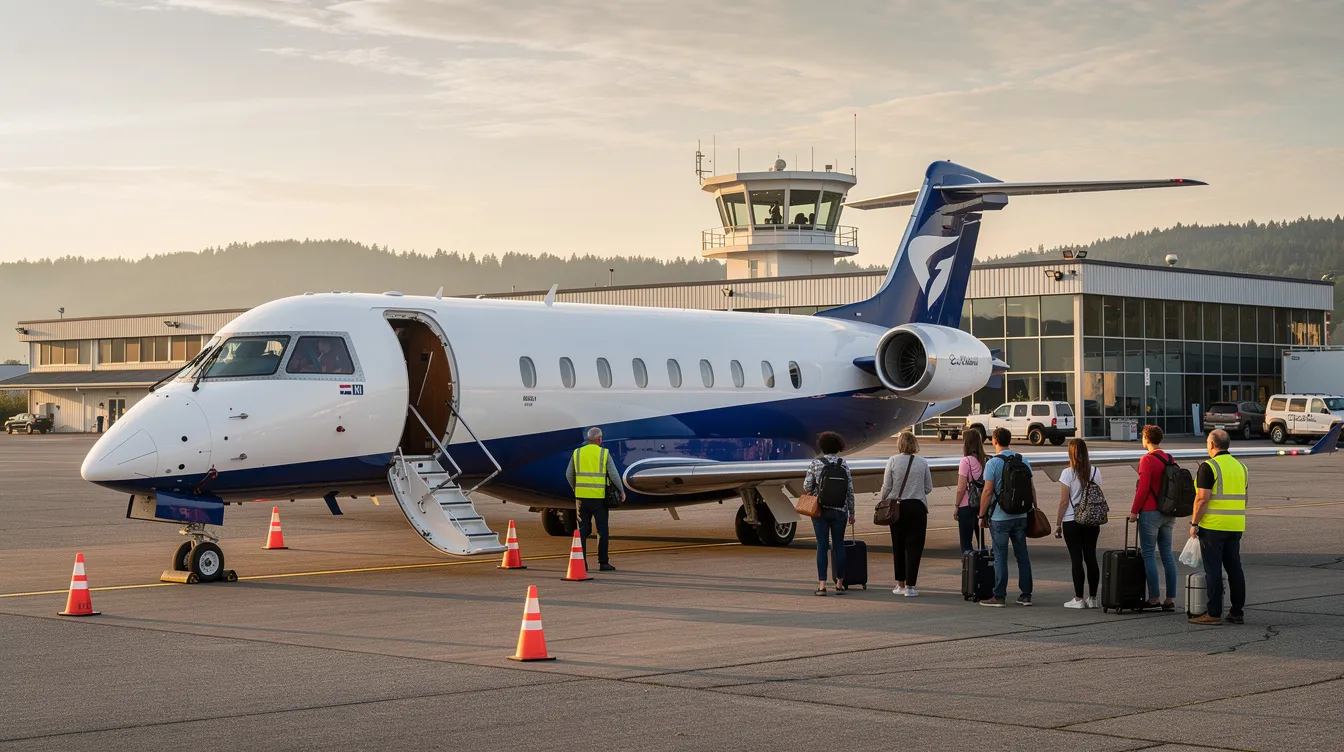
BlackJet’s Approach
BlackJet sources both regional-jet and VIP-narrowbody capacity through its vetted operator network, advising clients when a 50-seat platform is optimal over smaller super-midsize jets or larger VIP airliners. The company leverages its expertise, high safety standards, and personalized services to ensure a seamless and secure travel experience for every client. Whether through Jet Card access or on-demand charter solutions, BlackJet structures arrangements to accommodate recurring corporate shuttles or one-off events—matching the right aircraft to each mission.
Key 50 Seat Aircraft Types
Understanding the fleet landscape helps inform smart aircraft selection. Small aircraft, such as 50-seat aircraft, play a crucial role in regional aviation by connecting smaller airports to larger hubs. They offer cost efficiency and better access to city airports than larger aircraft, but may have limited range and passenger capacity compared to both larger jets and turboprops. Each platform offers distinct capabilities suited to specific mission profiles.
Bombardier CRJ200
Typical capacity: 50 seats (all-economy).
Range: 1,500–1,600 nautical miles.
Configuration: 2-2 seating.
Status: Retired from new production; active in charter, cargo, and special missions.
Once the backbone of US regional fleets operated by United Express, Delta Connection, and American Eagle, the CRJ200 now finds new life in charter operations. Its well-documented maintenance history and airframe availability make it attractive to operators seeking a proven track record of performance at lower acquisition costs.
Embraer ERJ-145 Family
The ERJ family encompasses multiple variants:
The 1-2 seating configuration remains popular for its aisle access and superior cabin feel. These aircraft continue to operate with American Eagle and various European and African operators, as well as on ad hoc charters requiring proven regional capability.
Turboprops: 40–50 Seat Class
Two primary models serve this market:
De Havilland Canada Dash 8-300/315: 44–50 seats in airline configurations.
ATR 42-500/600: 50 seats with a range of approximately 966 miles (1,555 km) and a baggage capacity of 2,646 lbs.
Ideal for shorter routes under 300–400 nautical miles, these turboprops offer superior runway performance and fuel efficiency. Emerging hybrid-electric retrofit projects position them for environmentally focused operations where low cost per seat mile matters.
VIP Narrowbodies (~50 Passengers)
For missions requiring intercontinental range:
Boeing 737-700/800 BBJ: 30–50 passengers, range 4,000–6,000+ nautical miles.
Airbus A319 Corporate Jet: 50+ seats, range 4,200 nautical miles.
Boeing 757-200 VIP: Configurable to approximately 50 passengers in luxury layouts, range 4,487 km.
These aircraft serve heads of state, global corporations, and high-end charter for events and tours where the regional jet range proves insufficient. The 737-500 VIP, for example, offers 56 seats with 40+ inch pitch in a 2-2 layout—a true private jet experience for larger groups.
Economics of 50 Seat Aircraft
Airlines and private users evaluate 50-seat aircraft through fundamentally different economic lenses. For airlines, developing an effective strategy involves careful fleet management and route planning to maximize profitability and maintain a competitive edge in the market.
Airline Economics
For carriers, the math centers on cost per available seat mile (CASM) and revenue per available seat mile (RASM):
Fixed costs dominate: Pilots (representing 30–40% of operating costs after post-2010s wage increases), fuel, and maintenance create substantial per-flight expenses regardless of passenger count.
Pilot economics: Two pilots are required, whether operating 50- or 100-seat aircraft, making larger aircraft more efficient per passenger.
Strategic trade-offs: Many 50-seat routes are economically marginal but strategically essential for network feed.
The result: airlines increasingly up-gauge to 70–90-seat aircraft where route demand permits, yet retain some 50-seat jets for thin markets, where more flights with smaller capacity beat fewer flights with larger planes. Major airlines are phasing out 50-seat jets due to higher per-seat operating costs compared to larger jets such as the Embraer E175. The operational costs of 50-seat aircraft are higher per seat-mile than those of larger aircraft, making them less economically viable.
Private and Charter Economics
For charter clients, the calculus shifts:
Per-passenger efficiency: 50-seat aircraft deliver lower per-passenger costs than smaller business jets when 30–40 passengers fly together, while larger VIP airliners become compelling for groups approaching 100 travelers, as explored in guides to charter plane costs for 100 passengers.
Cost positioning: Significantly below VIP widebody charters (A319CJ at $25k–35k/hour versus BBJ 787 at $45k–55k) for regional hops.
Value beyond price: Schedule control, time savings, and unified on-board experiences (meetings, corporate branding, briefings) create strategic value beyond direct cost comparisons.
Comparison with Alternatives
Commercial first class is best for individual travelers but often involves longer door-to-door times and lacks privacy or customization.
Owning a jet (Part 91) suits very frequent users but comes with high fixed costs, regulatory burdens, and crew management responsibilities, though some clients may still pursue premium UK private jets for sale as a long-term strategic asset.
Chartering via BlackJet offers flexible demand management with variable expenses, curated quality, and no ownership burden, which detailed analyses consistently highlight as a key advantage.
For organizations that move teams frequently, charter transforms aircraft access from fixed capital expense to variable operational cost—predictable, scalable, and professionally managed.
Safety, Certification, and Regulatory Context
Whether in scheduled service or private charter, 50-seat aircraft operate under stringent safety and regulatory frameworks that ensure consistent protection for passengers.
Airline Operations
Regional jets flying scheduled routes operate under Part 121 (US) or equivalent EASA large-aircraft rules in Europe:
Strict training requirements for pilots and crew.
Mandated duty time limitations.
Comprehensive maintenance protocols.
Regular fleet inspections and airworthiness directives.
Even when contracted to regional operators like SkyWest Airlines or GoJet Airlines, Big 3 US carriers overlay their own safety audits, data monitoring, and standardization policies—creating multiple layers of oversight.
Charter and Private Use
Chartered 50-seat aircraft typically fall under Part 135 or equivalent commercial charter regulations:
Additional oversight for crew experience and dispatch procedures.
Documented maintenance histories and inspection records.
Third-party safety ratings (ARGUS, Wyvern) provide independent verification.
For high-profile groups—sports teams, executive delegations, and top performers—selecting operators with proven credentials protects both passengers and the organization's reputation.
BlackJet’s Safety Commitment
BlackJet partners exclusively with vetted operators who meet or exceed regulatory requirements:
Proactive attention to training documentation and record-keeping.
Fleet age and condition evaluation before aircraft assignment.
Curated selection based on safety credentials, not just price.
Clients benefit from aircraft selection that prioritizes consistent safety and service quality over lowest-cost sourcing.
Sustainability and 50 Seat Aircraft
Environmental performance is increasingly shaping fleet decisions across both scheduled and charter aviation, with smaller jets attracting scrutiny for their per-seat emissions.
Airline Sustainability Trends
Airlines are addressing environmental concerns through:
Fleet evolution: Gradually replacing 50-seat jets with larger, more fuel-efficient regional jets and turboprops to reduce emissions per passenger.
SAF adoption: Sustainable aviation fuel trials at major hubs beginning in the early 2020s, with expanded availability through 2024–2026.
Turboprop renaissance: ATR eyes replacing approximately 200 US 50-seat jets with turboprops on shorter routes, leveraging superior fuel efficiency.
Private and Charter Solutions
Operators and brokers increasingly offer:
Emissions calculation: Trip-specific carbon accounting for corporate ESG reporting.
High-quality offsets: Verified carbon offset or inset programs that meet recognized standards.
SAF availability: Growing options at large business aviation airports in North America and Europe, though currently at a premium cost.
BlackJet’s Commitment
BlackJet ensures every journey can be carbon-conscious:
Carbon-neutral options on 50-seat aircraft charters through verified offset projects.
SAF uplift arrangements were available and practical.
Post-trip sustainability reporting for corporate ESG teams requiring exclusive reporting on environmental impact.
This approach balances environmental responsibility with travel practicality—helping clients fly better, not simply more.
Use Cases: When a 50 Seat Aircraft Makes Strategic Sense
Not every trip warrants a 50-seat aircraft, but specific scenarios unlock outsized strategic value that commercial alternatives cannot match.
Corporate Roadshows and Investor Tours
Consider a leadership team visiting five cities in three days across the United States or Europe:
A 30–40-seat, refitted regional jet keeps the entire delegation together.
Flight time transforms into productive working sessions.
Onboard branding and presentations maintain corporate identity throughout.
Arrival times align perfectly with meeting schedules.
Sports Teams and Performance Groups
Professional and elite amateur teams gain distinct advantages:
Equipment storage and specialized seating accommodate player needs.
Identical departure times ensure team unity and coordination.
Privacy supports performance, recovery, and media management.
Dedicated aircraft eliminates airline scheduling dependencies.
One example: A professional team chartered a 737-500 VIP for Frankfurt-Baku transport, combining gear storage with recovery-focused cabin configuration.
Luxury Events, Incentives, and Destination Buyouts
For incentive trips, rewarding top performers:
Fly 40 executives and partners directly to a resort-adjacent airport.
Tailored catering and custom amenities create memorable experiences.
Seamless ground transfers coordinated from touchdown.
The journey itself becomes part of the reward.
Shuttle Operations for Industry or Campus Hubs
Organizations moving teams frequently benefit from a recurring shuttle service:
Weekly or daily flights between headquarters and manufacturing or R&D sites.
Replaces fragmented commercial itineraries with predictable schedules.
Enhanced data security for sensitive business discussions.
Significant time savings compound over multiple trips.

How BlackJet Uses 50 Seat Aircraft Within Its Access Model
BlackJet operates not as an aircraft owner but as a curator of premium lift—including 50-seat aircraft — where it serves clients best.
Jet Card and On-Demand Integration
Jet Card members can access larger aircraft for specific high-capacity missions without requiring a separate program:
Consult: Define route, dates, passenger count, and special requirements.
Specify: Outline branding, catering, and logistical needs.
Source: BlackJet proposes suitable 50-seat or larger options from vetted operators.
This process ensures each mission receives appropriate aircraft, whether a 50-seat regional jet, VIP narrowbody, or multiple smaller jets.
Safety, Comfort, and Customization
BlackJet prioritizes aircraft with:
Modern interiors and reliable Wi-Fi connectivity.
Credible safety credentials from established operators.
Avoidance of outdated, poorly maintained regional jets.
Available customizations include cabin branding, tailored menus, onboard meeting setups, and comprehensive coordination of ground logistics.
Sustainability and Reporting
For organizations with ESG commitments, BlackJet provides:
Post-trip sustainability reports with detailed carbon accounting.
Verified offset arrangements through recognized environmental projects.
SAF blend arrangements on select routes where operator capability exists.
Explore Premium Access
Whether your organization moves teams weekly or plans a single transformative event, 50-seat aircraft offer a strategic middle ground between intimacy and capacity. The right aircraft transforms travel from logistics into a competitive advantage, especially when paired with structured access solutions like the BlackJet 25+ Hour Jet Card.
Discover how refined, meaningful group travel becomes your new standard—explore BlackJet’s Jet Card programs for seamless, premium private access with safety, sustainability, and flexibility built in.
FAQ
Are 50-seat aircraft still safe if they are older models?
Many 50-seat aircraft currently operating were built in the late 1990s and 2000s, yet they remain safe because they operate under strict maintenance and inspection regimes mandated by regulators and major airline oversight programs. Airworthiness depends on the quality of ongoing maintenance, not age alone—aircraft are not like cars with simple mileage-based depreciation.
Reputable charter providers and partners like BlackJet work exclusively with operators meeting rigorous safety and audit standards, including ARGUS and Wyvern certifications. Many older airframes have received avionics upgrades and interior refurbishments that improve safety margins, reliability, and passenger experience beyond their original delivery specifications.
How far can a typical 50-seat regional jet fly without a fuel stop?
Typical 50-seat regional jets like the CRJ200 or ERJ-145 offer ranges of 1,200–1,600 nautical miles under standard passenger and baggage loads. This comfortably covers most domestic US routes, intra-European legs, or regional missions across the Middle East and Asia.
For longer missions requiring transcontinental or intercontinental range, BlackJet may recommend stepping up to larger VIP narrowbodies (4,000–6,000 nm) or widebodies purpose-built for 10,000+ nautical mile operations.
Is chartering a 50-seat aircraft cheaper than booking commercial first class?
On a per-person basis, commercial first-class or business-class tickets are typically less expensive. However, this comparison ignores time savings, schedule flexibility, and the strategic value of keeping an entire group on one aircraft.
When 25–40 passengers travel together, the total cost of a 50-seat charter can be comparable to—or sometimes lower than—the cost of purchasing 40 separate premium tickets on complex itineraries. For smaller groups or individuals, understanding how to buy a seat on a private jet opens additional access models beyond full-aircraft charter. BlackJet can model both scenarios for corporate clients, factoring in productivity gains, hotel nights eliminated, and operational control to reveal true cost comparisons.
Can 50-seat aircraft access smaller airports than large airliners?
Many 50-seat regional jets and turboprops were specifically designed for shorter runways and regional airports, enabling access to destinations that cannot accommodate large narrowbodies or widebodies. This capability significantly reduces ground transfer times, particularly for resorts, remote industrial sites, or secondary city airports.
Final feasibility depends on runway length, aircraft performance data, and local regulations—all of which BlackJet and its operators evaluate during trip planning to ensure safe and efficient operations.
What level of onboard service can I expect on a 50-seat private charter?
Service levels are highly customizable, ranging from efficient, businesslike shuttles with simple catering to fully bespoke experiences featuring premium dining, branded amenities, and tailored cabin layouts. Flight attendant staffing, catering quality, and onboard equipment (Wi-Fi, AV systems) are specified during booking.
BlackJet aligns these elements with corporate standards or event themes, encouraging clients to think of the aircraft as an extension of their boardroom or hospitality suite—capable of hosting team briefings, client presentations, or celebratory atmospheres at 35,000 feet.
Conclusion: The Strategic Advantage of 50 Seat Aircraft and BlackJet’s Premium Access
50-seat aircraft continue to hold a unique and strategic role in modern aviation, bridging the gap between small regional jets and larger narrowbodies. Their ability to serve thin routes, connect remote communities, and offer exclusive group travel experiences makes them indispensable despite the industry's economic and operational challenges.
For corporate groups, sports teams, and incentive trips, these aircraft provide an unmatched combination of flexibility, efficiency, and comfort—especially when configured as private charters with luxurious amenities. Operators like BlackJet specialize in sourcing and managing access to these aircraft, ensuring clients benefit from a proven track record of safety, customization, and seamless service.
By leveraging BlackJet’s curated network, travelers gain access to 50-seat aircraft tailored to specific mission needs, offering a better way to fly with the convenience of private-jet scheduling and the capacity to accommodate large groups. Whether for business roadshows, special events, or connecting smaller airports, 50-seat aircraft remain a vital asset in the evolving landscape of aviation.
To explore premium access to 50-seat aircraft and experience the next level of group travel, visit BlackJet.com and discover how tailored, secure, and sustainable private aviation can transform your journeys.


 Sign up with google
 Sign up with Apple