Introduction: Why "the best fighter jet" matters in 2026
In 2026, the Lockheed Martin F‑35 Lightning II is widely regarded as the best military jet in the world. The F‑22 Raptor remains the gold-standard air superiority fighter, but the F-35's combination of stealth, sensor fusion, multirole capability, and deployment across more than 20 allied air forces puts it at the top of every serious ranking.
Defining the best fighter jet today goes far beyond raw speed. Modern air combat rewards low observability, advanced avionics, weapons flexibility, and the ability to share real-time data across a networked battlespace. The jet that sees first, shoots first, and survives first wins—regardless of its maximum speed.
For those of us at BlackJet, the parallels to private aviation are striking. National air forces pursue air superiority and information dominance; high-net-worth travelers pursue schedule control, route flexibility, and privacy. Both demand precision, reliability, and technology that evolves continuously. Innovations born in fighter jets—composites, fly-by-wire controls, engine efficiency—eventually shape the private jets our members fly.
Key Takeaways: The best fighter jet at a glance
The F‑35 Lightning II is the best overall fighter jet in 2026, combining stealth technology (Stealth technology reduces radar, infrared, and acoustic signatures of modern military jets.), advanced sensor fusion (Sensor fusion allows pilots to synthesize data from various sources into a single operational picture.), and multirole capability across more than 20 partner air forces.
The F‑22 Raptor is still the world's best pure air superiority fighter, but its small fleet size (~180 aircraft) and US-only operation limit its overall ranking.
Aircraft like the Chengdu J‑20, Sukhoi Su‑57, Eurofighter Typhoon, Dassault Rafale, and F‑15EX Eagle II excel in specific roles and remain among the best jets in the world.
Fifth-generation stealth fighters dominate military jets as of mid-2026. Internal weapons bays, helmet-mounted displays, and networked warfare matter more than maximum Mach number.
As military jets evolve around data, awareness, and readiness, BlackJet builds similar principles into its jet card programs—always-ready access, real-time information, and safety-first operations.
Summary Table: Top Military Jets in 2026
Aircraft | Role | Top Speed (Mach) | Stealth Level | Weapons Payload (lbs) | Notable Features | Fleet Size (Approx.) | Unit Cost (Million USD) |
|---|
F-35 Lightning II | Multirole Fighter | 1.6 | Radar cross-section ~ golf ball | Internal & external, up to ~22,000 lbs | Advanced sensor fusion, networked warfare, multiple variants (A/B/C) | 1,335+ delivered, 880+ active | 110 |
F-22 Raptor | Air Superiority Fighter | 2.25 | Radar cross-section ~ marble | Moderate payload | Supercruise at Mach 1.8, thrust vectoring, unmatched agility | ~180 active | 140+ |
Chengdu J-20 | Stealth Interceptor | 2.0 | Limited stealth, larger RCS | 24,000 | Long-range missiles, interceptor role, export restricted | ~500 | Unknown |
Sukhoi Su-57 | Multirole Stealth Fighter | 2.45 | Moderate stealth (less refined) | Moderate payload | 3D thrust vectoring, agility, cost-effective | ~42 (limited) | 35-50 |
Eurofighter Typhoon | Multirole Fighter | >2.0 | Non-stealth (4.5 gen) | Moderate payload | Agile, AESA radar, supercruise ~ Mach 1.5 | 500+ | Unknown |
Dassault Rafale | Multirole Fighter | 1.8 | Reduced RCS (4.5 gen) | 20,000+ | Advanced electronic warfare (SPECTRA), omnirole capability | 200+ | Unknown |
F-15EX Eagle II | Heavy Weapons Platform | 2.5 | Non-stealth | Nearly 30,000 | Largest weapons payload, fast, modernized F-15 | ~25 | Unknown |
How experts define the "best" military jet today
Stealth and Sensor Fusion
Modern rankings weigh a constellation of factors:
Stealth (Stealth technology reduces radar, infrared, and acoustic signatures of modern military jets.)
Air superiority performance
Multirole flexibility
Weapons payload
Combat radius
Survivability
Advanced avionics
Maintenance demands
Exportability
No single specification crowns a winner. Stealth technology reduces radar, infrared, and acoustic signatures of modern military jets, but it means nothing without the sensors to exploit that advantage or the logistics to keep aircraft flying.
Sensor fusion allows pilots to synthesize data from various sources into a single operational picture. Fifth-generation fighter aircraft prioritize low observability and sensor fusion, enabling the "first see, first shoot, first survive" doctrine that defines modern air combat.
Fourth vs Fifth Generation Fighters
Modern military jets emphasize low observable technology and advanced avionics over brute-force performance metrics like climb rate or sustained turn radius.
By contrast, fourth-generation fighter and 4.5-generation platforms—like the Eurofighter Typhoon, Rafale, and Gripen E—offer exceptional agility and firepower but lack true all-aspect stealth and fully internal weapons bays. They remain formidable, especially when pilot training, tactics, and air force doctrine compensate for hardware gaps.
Real-World Capability vs Specifications
A well-trained crew in a slightly "inferior" airframe can outperform a superior jet flown by a less experienced pilot.
BlackJet clients think in similar terms. They prioritize a mix of performance (range, runway access), safety certification, availability, and cost—mirroring how air forces trade off specs for real-world capability rather than chasing a single number.
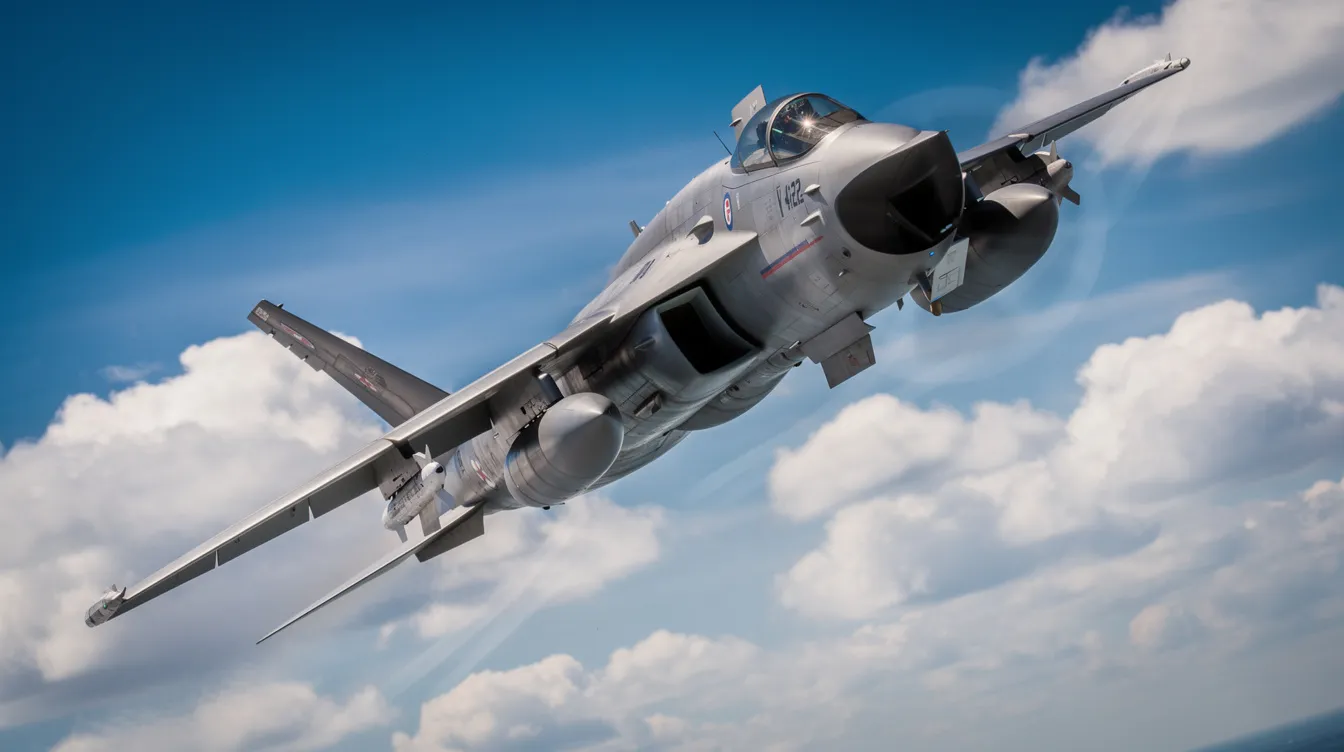
Lockheed Martin F‑35 Lightning II: The best overall fighter jet
The Lockheed Martin F‑35 Lightning II is the best all-around military aircraft in 2026. Developed under the Joint Strike Fighter program for the United States Air Force, United States Navy, United States Marine Corps, and more than 20 allied nations, it entered service with the USMC in July 2015 and has since become the backbone of Western air power.
Key specifications tell the story:
Generation: Fifth-generation fighter
Top speed: Mach 1.6
Combat radius: ~1,000 km depending on mission profile
Deliveries: Over 1,335 aircraft delivered globally by mid-2026, with over 880 units in active service
Radar cross section: Equivalent to a golf ball, thanks to stealth shaping and internal weapons bays
Unit cost: Approximately $110 million per unit
The F‑35 is more than a classic air superiority fighter. Its multirole capability spans air-to-air engagements, precision strike, electronic attack, close air support, and intelligence/surveillance missions. This flexibility allows air forces to retire multiple older aircraft types, replacing them with a single platform.
Despite being an expensive fighter jet program—with total lifecycle costs projected at $1.196 trillion—per-unit flyaway costs have fallen through mass production. Continuous upgrade paths, including Block 4 software and Tech Refresh 3 hardware, keep the jet evolving as a software-defined weapons system through the 2040s.
For BlackJet members, the analogy is direct: just as the F-35 evolves through software without replacing the airframe, BlackJet's digital booking platform and real-time support within its premium private jet card programs continually improve without clients needing to change how they travel.
Inside the F‑35: advanced avionics, sensor fusion, and variants
Advanced Avionics and Sensor Fusion
Avionics and data—not just aerodynamics—are what truly make the F‑35 the best fighter jet in 2026. The aircraft's AN/APG-81 Active Electronically Scanned Array (AESA) radar offers improved detection and jamming resistance. Active Electronically Scanned Array (AESA) radar offers improved detection and jamming resistance. Its Distributed Aperture System provides 360-degree infrared coverage and missile warning. The AN/ASQ-239 electronic warfare suites handle threat detection, jamming, and electronic attack simultaneously.
Advanced sensor fusion is the F-35's defining advantage. Sensor fusion allows pilots to synthesize data from various sources—radar, infrared, electronic signals, and data links—into a single operational picture displayed on the pilot's helmet-mounted displays. Instead of managing separate screens and systems, the pilot sees one unified battlespace. This is what separates fifth-generation platforms from everything that came before.
F-35 Variants and Their Roles
The F-35 comes in three variants, each matched to a specific operating environment:
F‑35A: Conventional takeoff and landing. Primary users: US Air Force, NATO partners.
F‑35B: Short takeoff/vertical landing (STOVL). Primary users: United States Marine Corps, Royal Navy, Italian Navy.
F‑35C: Carrier operations with catapult launch. Primary users: United States Navy, deployed from aircraft carriers.
In "stealth mode," the jet carries AIM-120 AMRAAM, AIM-9X, JDAMs, and Small Diameter Bombs internally. In "Beast Mode," external pylons push total ordnance to roughly 22,000 lb—sacrificing stealth for sheer firepower and weapons integration flexibility.
This approach mirrors how BlackJet curates aircraft categories for members—from light jets to long-range large-cabin aircraft—drawing on deep expertise in types of private jets for different travelers and matching configuration to mission just as militaries choose F-35 variants for their theater of operations.

F‑22 Raptor vs F‑35 Lightning II: air superiority fighter or multirole king?
The F‑22 Raptor is the world's premier air superiority fighter. The F-35 is the best overall multirole jet. Understanding why experts still pick the F-35 as the "best military jet" requires examining what each platform was built to do.
The F-22 Raptor is recognized as the top air superiority fighter in 2026. Its credentials are extraordinary:
Maximum speed: ~Mach 2.25
Supercruise: The F-22 can supercruise at Mach 1.8 without afterburners, sustaining supersonic speeds without the fuel penalty of afterburning turbofan engines
Radar cross section: Comparable to a marble—smaller than the F-35's golf ball signature
Thrust vectoring: 3D nozzles enabling exceptional agility in air-to-air combat against enemy fighters
Unit cost: Over $140 million per unit
So why does the F-22 lose the "overall" crown? Only a handful of factors, but they matter enormously. The fleet is small—roughly 180 aircraft in active service. Production ended years ago. It is US-only, with no exports permitted. Maintenance costs are steep, and the closed production line constrains upgrades compared to the F-35's continuously evolving software architecture.
Think of it in private aviation terms: owning a single ultra-specialized private aircraft is like fielding a pure air superiority fighter—magnificent in one role, limiting in every other. A flexible BlackJet Jet Card lets you choose different aircraft categories for each mission, whether it's a board meeting in London or a last-minute client visit.
Other top contenders: Eurofighter Typhoon, Rafale, J‑20, Su‑57, and F‑15EX
No discussion of the most advanced fighters is complete without examining what the F-35 is measured against. Here are the jets that keep strategists debating.
Eurofighter Typhoon. The Eurofighter Typhoon is well-regarded for its agility and air combat performance. Originally designed as an air superiority fighter, it has evolved into a capable multirole platform with a top speed exceeding Mach 2 and supercruise near Mach 1.5. Over 500 have been produced, with ongoing upgrades adding AESA radar (Captor-E) and enhanced electronic warfare systems. Its limitation: no all-aspect stealth or internal weapons bays.
Dassault Rafale. The Dassault Rafale is considered a 4.5-generation jet with advanced electronic warfare capabilities, centered on its SPECTRA suite. Combat-proven since Afghanistan and Libya, it carries ordnance across 14 hardpoints, reaches Mach 1.8 top speed, and has been exported to Egypt, India, Qatar, and Indonesia. The French Air Force relies on it as its primary multirole fighter.
Chengdu J-20 Mighty Dragon. China's long-range stealth aircraft and fifth-generation interceptor carries PL-15 long-range missiles internally. The Chengdu J-20 has a weapons payload of 24,000 lbs and an estimated fleet of ~500 airframes in People's Liberation Army Air Force service. Export-restricted and with contested stealth quality in some Western assessments, it nonetheless represents a massive investment in advanced stealth.
Sukhoi Su-57 Felon. The Sukhoi Su-57 is a multirole stealth aircraft featuring advanced sensor technology, 3D thrust vectoring, and the Su-57 can reach speeds of Mach 2.45. The Su-57 Felon costs between $35–$50 million per unit—far cheaper than Western rivals. However, production remains limited to roughly 42 aircraft built (including prototypes), with Algeria cited as the first export customer.
Boeing F-15EX Eagle II. The F-15EX Eagle II is a heavily armed fourth-generation "weapons truck." The F-15EX can carry nearly 30,000 lbs of weapons, making it the go-to platform for saturating enemy defenses with long-range missiles and anti-ship missiles. Its Mach 2.5 top speed makes it among the fastest fighter jet platforms still in production, complementing stealth fighter fleets in the US Air Force.
Each jet might be "best" in a specific niche—payload, agility, or cost—but none match the F-35's overall blend of stealth, avionics, and global deployment.
Fifth‑generation fighters and the future of air combat
A fifth-generation fighter combines four defining features: stealth-first airframe design, internal weapons bays, advanced avionics with sensor fusion, and secure data links enabling networked warfare. Key technologies in stealth fighters include stealth design, sensor fusion, and supercruise—the ability to sustain supersonic speeds without afterburners.
What separates fifth-gen from earlier generations is philosophy. Previous designs optimized for speed, climb rate, or close-in maneuverability. Fifth-gen platforms optimize for information dominance. Air combat increasingly prioritizes sensor superiority and networking capabilities over speed. The jet that detects an enemy aircraft first and fires a missile before the adversary even knows it's there wins the engagement—regardless of who can pull more g's in a turning fight.
As of 2026, operational fifth-gen jets include the F-22 Raptor (USAF), the F-35 Lightning II (US and 20+ allies), the J-20 (China), and the Su-57 (Russia). Emerging carrier variants like China's J-35 derivative are also approaching service.
Network-centric warfare enables real-time data sharing among different military platforms, turning individual jets into nodes in a larger "kill web." Software-defined architecture allows major performance leaps via updates—new radar modes, weapons integration, or electronic warfare tactics—without changing the airframe. Modern fighters use electronic warfare systems to jam enemy sensors and communications, and these capabilities improve through code rather than metal.
At BlackJet, we see the same shift: decisions driven by real-time information—weather, NOTAMs, fleet availability—rather than hardware alone.
Special categories: fastest, most advanced, and most expensive fighter jets
"Best" can be sliced into sub-categories—fastest jet, most advanced technology, and most expensive fighter jet program—though none of these alone define combat effectiveness.
Fastest fighter jet. Experimental aircraft and legacy interceptors hold speed records. The MiG-25 Foxbat exceeded Mach 3.0 in specific profiles, and the Su-57's Mach 2.45 capability puts it among the quickest modern jets. But extreme speed compromises stealth and engine life, which is why modern jets generally operate between Mach 1 and 2 in combat. Radar visibility matters more than a speedometer reading.
Most advanced air-to-air technology. The F-22 Raptor still edges other aircraft in pure air superiority thanks to its combination of advanced stealth, supercruise, thrust vectoring, and a radar cross section comparable to a marble. Even as newer jets rival its electronics, no other aircraft matches its integrated air-to-air lethality.
Most expensive fighter jet program. The F-35 program's total cost is projected at $1.196 trillion through the 2070s, making it the most expensive military acquisition in history. The F-22 Raptor costs over $140 million per unit, while the F-35 Lightning II costs approximately $110 million per unit. Nations accept these costs because shared development, large production runs, and interoperability between allied air forces spread the burden—and the platform stays relevant for decades via software upgrades.
The parallel to private aviation is clear: just as air forces spread costs across partners rather than each building a unique jet from scratch, travelers invest in a jet card informed by a solid understanding of jet card cost and pricing rather than purchasing a whole aircraft.
From air superiority to multirole capability: how missions shape design
Mission Categories of Military Aircraft
Military aircraft fall into distinct mission categories, each shaping airframe design:
Air superiority fighters: F-15C Eagle, F-22, Eurofighter Typhoon—optimized for air-to-air dominance against enemy aircraft
Multirole fighters: F-16, Rafale, Gripen E, F-35—balancing air to ground strike missions with air combat capability
Strike/attack jets: Su-34, F-15E Strike Eagle—prioritizing ground attack and precision strike with heavy ordnance
Electronic warfare platforms: EA-18G Growler—dedicated to suppressing enemy radar and communications
Design Philosophy and Flexibility
A pure air superiority fighter emphasizes climb rate, maneuverability, and air-to-air weapons. Multirole aircraft balance those traits with weapons payload, range, and sensors for ground attack and reconnaissance. Advanced avionics and precision weapons have blurred these lines: many former air superiority platforms now perform strike missions using guided munitions. During Operation Desert Storm, F-15Es and F-16s demonstrated this versatility, shifting between air and ground roles within the same sortie.
The F-35 was conceived as a multirole jet from day one, designed to replace the F-16, A-10, AV-8B, and F/A-18 across US services. Its new aircraft philosophy prioritizes flexibility over single-mission dominance.
BlackJet applies the same logic: just as air forces assign different aircraft to different threats, we match aircraft categories—light, midsize, super-midsize, large-cabin—to each client itinerary, whether it's a short-haul city pair or a transatlantic crossing, helping travelers understand private jet sizes and the right fit for each mission.
How fighter jet innovation shapes private and business aviation
Many safety and performance features in today's business jets were pioneered in military fighters. Fly-by-wire controls, composite airframes, advanced navigation systems, and cockpit ergonomics all trace their lineage to programs like the F-16, F-22, and F-35.
Stealth-driven composite work now feeds into long-range civilian aircraft like the Gulfstream G700. Military-grade GPS, inertial navigation, and weather radar improve route safety and fuel efficiency in private jets. Engine developments for fighters—higher temperature materials, better thermodynamic cycles—filter down into quieter, more efficient turbofans on other aircraft used in commercial aviation and private aviation alike.
The military emphasis on situational awareness led to glass cockpits with large displays, synthetic vision, and enhanced vision systems now standard in top-tier business jets. Aviation enthusiasts often notice how fighter cockpit philosophy directly influences what they see aboard modern private aircraft.
At BlackJet, we specifically curate operators whose aircraft leverage these proven technologies, often using platforms drawn from the best private jets in the world. Consider a BlackJet member flying New York to London overnight on a carbon-neutral large-cabin jet—benefiting from navigation, materials, and avionics originally refined for advanced fighters.

BlackJet Jet Cards: precision access inspired by military readiness
An air force maintains ready squadrons of air superiority fighters and strike aircraft, prepared to launch on short notice. BlackJet maintains reliable, on-call private jet access across fleets and cabin classes for its members—built on the same principles of readiness, flexibility, and operational precision.
Here's how Jet Cards work in practice, building on the same principles outlined in our guide to the best jet cards for frequent flyers:
Prepaid hours: Purchase 25-hour or 50-hour blocks at transparent hourly rates, with options ranging from a dedicated 50-hour jet card cost structure to BlackJet's own 25+ Hour Jet Card program
Guaranteed access: Vetted aircraft categories spanning light jets to large-cabin, long-range platforms
Minimal surprises: Transparent pricing with reduced repositioning or hidden fees
Technology-driven: Digital booking tools, 24/7 real-time support, and fast turnaround flight confirmations mirror the rapid tasking of a modern air force operations center
Consider a CEO needing to reach three cities in 48 hours. Through a Jet Card, they schedule last-minute legs with the same decisiveness a commander uses to dynamically allocate fighter sorties during a crisis. The aircraft, crew, and routing are handled seamlessly.
Every Jet Card flight is carbon-neutral through verified offset projects, echoing how modern militaries increasingly factor sustainability and fuel efficiency into operational planning and aligning with the comprehensive economics of jet card pricing. This isn't a marketing afterthought—it's embedded in every mission.
The tone here is strategic, not indulgent. Jet Cards are the way frequent travelers "own the airspace" of their schedules without the burden of owning a private aircraft.
Safety, certification, and sustainability: civil standards, military mindset
Just as the best military jet must be survivable and reliable under extreme conditions, the best private aviation experience must prioritize safety, operational discipline, and responsible environmental impact.
BlackJet's safety approach mirrors military rigor:
Operator vetting: Rigorous selection based on top industry safety ratings
Crew standards: Qualification checks, recurrent training, and duty-limit compliance
Maintenance discipline: Continuous performance monitoring, adherence to manufacturer maintenance schedules
Contingency planning: Alternate airports, weather windows, and redundancy protocols
These practices parallel how military units conduct pre-flight checks, redundancy planning, and strict training standards before every sortie. The mindset is the same: assume nothing, verify everything, and always have an alternate plan.
BlackJet's carbon-neutral commitment works simply. Emissions are calculated for each flight leg, and investments flow into verified carbon offset projects—reforestation, renewable energy, and methane capture, all factored into our broader private jet price framework and options. Learn more about our approach to green private aviation.
Picture a BlackJet member flying Los Angeles to Aspen on a super-midsize jet. Route planning accounts for mountain terrain and weather. De-icing contingencies are prepared. Carbon offsets are quietly handled in the background. The member experiences none of the complexity—only the confidence that every detail has been managed.
For discerning travelers, the appeal of private jets is not only privacy and time saved. It's confidence that every mission is run with a mindset closer to an air force operations center than a casual charter broker.
FAQs: best fighter jets, civilian access, and private jet alternatives
Is the F-22 or F-35 the better fighter jet?
The F-22 Raptor is superior in pure air-to-air combat, with its radar cross section comparable to a marble, supercruise at Mach 1.8, and thrust-vectoring agility. But the F-35 is more versatile, more numerous, and available to allied air forces worldwide. When analysts name the best fighter jet overall, the F-35 wins on the balance of stealth, multirole capability, and global deployment.
Why aren't sixth generation fighters on this list?
Programs like the US NGAD, UK-Japan-Italy GCAP/Tempest, and European FCAS are still in development. Sixth-generation fighters will likely enter service in the 2030s, incorporating AI-driven autonomy and even more advanced stealth. Until they're operational, fifth-generation platforms define the top tier—just as many frequent flyers today still find a 100-hour jet card cost structure to be the most practical benchmark for serious private travel.
Can civilians fly in a stealth fighter like the F-35?
Frontline military jets are restricted to military use. Occasional demonstration flights are rare and tightly controlled. For aviation enthusiasts who want a taste of high-performance flight, options include ex-military trainers or high-performance civilian aircraft. But no civilian aircraft replicates the experience of a stealth fighter at supersonic speeds.
Does speed still matter in modern air combat?
Less than you might think. Modern air combat values low observability, sensor fusion, and networking more than absolute top speed. Similarly, private jets optimize range, efficiency, and cabin experience over raw Mach number—a parallel that surprises many first-time private flyers.
How do Jet Cards differ from ad-hoc charter?
A Jet Card provides predictable pricing, guaranteed aircraft availability, and seamless support. Ad-hoc charter means sourcing each flight individually, often with variable pricing and less consistency. For frequent travelers, Jet Cards deliver the reliability of a standing military squadron versus scrambling for resources flight by flight.
Can I use my Jet Card for international trips?
Absolutely. BlackJet Jet Cards support cross-border operations with full coordination of customs, overflight permits, and ground handling—making international travel as streamlined as a domestic leg, similar in spirit to how established providers structure NetJets jet card costs and programs for global access.
Conclusion: commanding the skies—nations with fighters, travelers with BlackJet
In 2026, the F-35 Lightning II stands as the best military jet in the world overall, blending advanced stealth, sensor fusion, networked warfare capability, and multirole flexibility that no rival can match across the board. Niche leaders remain critical—the F-22 in pure air superiority, the F-15EX in sheer weapons payload, the Rafale and Typhoon in versatile 4.5-generation roles, and the J-20 and Su-57 as rising challengers reshaping the balance in the Indo-Pacific and beyond.
The evolution from raw speed to information dominance in air combat mirrors a parallel shift in private aviation. It's no longer enough to simply "fly private." Discerning travelers now expect intelligent, always-ready access tailored to each trip—safety-vetted, carbon-neutral, and supported by advanced technology and round-the-clock operations. That's precisely what BlackJet delivers through its Jet Card programs, operating with the same discipline and preparation that defines a well-run air force.
If you value time, privacy, and control over your schedule, explore how a BlackJet Jet Card can make every journey feel as deliberate and strategic as a precision strike mission—without the noise, g-forces, or afterburners, whether you're flying solo or coordinating the best private jet for 20 passengers on a critical group trip.


 Sign up with google
 Sign up with Apple


