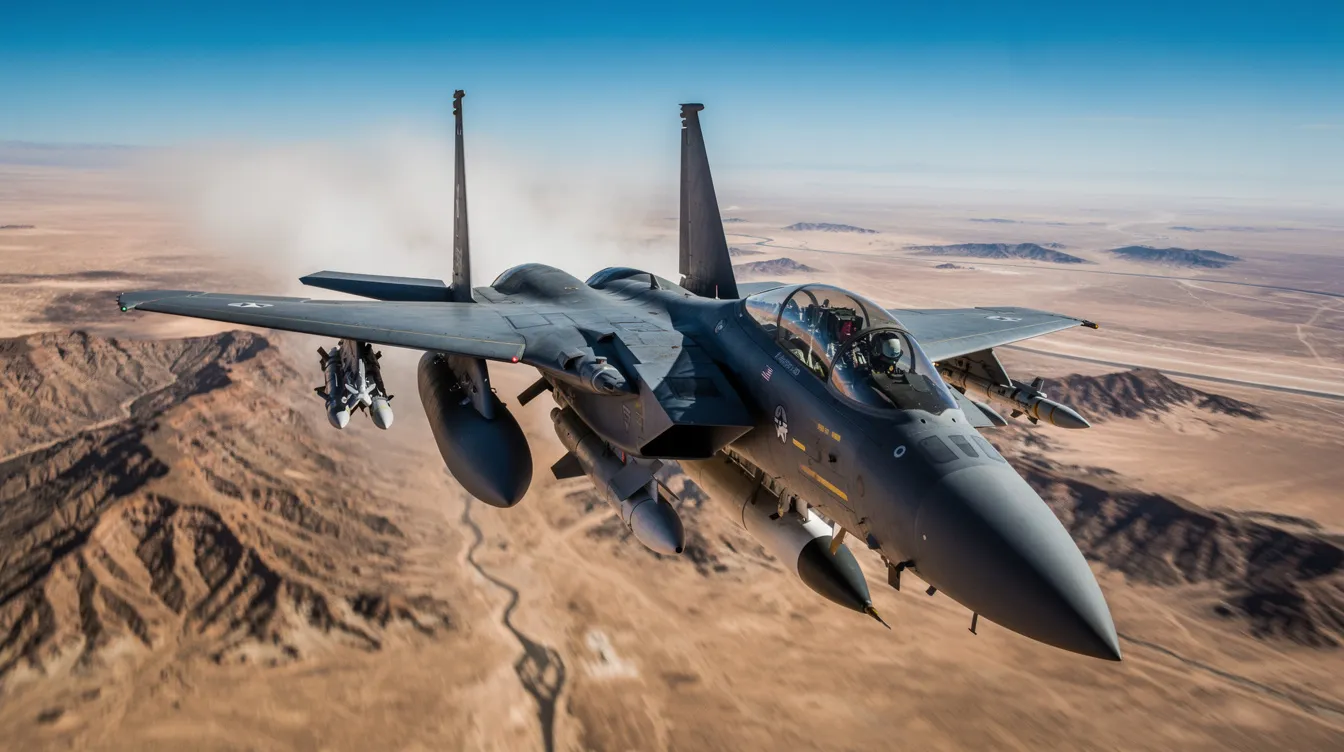
Few combat aircraft have shaped American airpower as decisively as the F-15E Strike Eagle. The F-15E is the U.S. Air Force's primary dual-role fighter, built to carry out deep strike missions with precision while retaining the speed, range, and self-defense capability to win in air-to-air combat. For aviation enthusiasts, military professionals, defense analysts, and anyone tracking modern combat aircraft, it remains one of the clearest examples of how reliability, reach, safety, and multirole flexibility translate into real battlefield value.
Born from a family of air superiority legends, the F-15E evolved into the Air Force's most versatile dual-role fighter-blending deep strike precision with the raw performance of a dogfighter. Here's everything you need to know about its history and design lineage, technical specifications, avionics, weapons, combat operations, upgrades, training, safety record, cultural impact, and future role in airpower, along with how BlackJet's philosophy aligns with the aircraft's emphasis on mission precision and operational dependability.
Answering the Core Question: What Is the F-15E Strike Eagle Today?
The f 15e is the United States Air Force's primary dual-role fighter, designed for deep strike missions and air superiority combined. Deep strike missions refer to the F-15E's ability to attack targets far behind enemy lines, while air superiority refers to its capability to dominate enemy aircraft in aerial combat. It descends from the original f 15 family of air dominance platforms but adds capabilities that transform it into a totally integrated fighter capable of destroying ground targets hundreds of miles behind enemy lines while defending itself against enemy aircraft along the way.
Where the f 15a and f 15c were built almost exclusively for the air-to-air role, the Strike Eagle adds a second crew member, conformal fuel tanks, reinforced structures, and advanced avionics that enable precision attack against ground targets in any weather conditions. The aircraft is distinguished by high speed, massive payload capacity, and all-weather capability-qualities that keep it central to Air Force planning even as the F-15EX and F-35 expand across the fleet.
As of 2026, roughly 217 F-15Es remain in the USAF inventory, with combat squadron deployments spanning the Middle East, Indo-Pacific, and Europe. The aircraft's ability to combine air superiority with long-range precision strike answers modern strategic demands: defeating integrated air defenses, projecting power at distance, and maintaining persistent presence over contested battlespace.
Design Lineage: From F-15A Air Superiority to F-15E Strike Eagle
Understanding the f 15e requires tracing the F-15 family from the late 1960s F-X program to today's Strike Eagle derivatives. Every chapter of that lineage built toward the multirole machine that dominates USAF strike operations now.
The story begins in 1967, when public revelations about the Soviet MiG-25 "Foxbat" alarmed Western air planners. The MiG-25's reputed speed and altitude performance pushed the USAF to launch the F-X program in 1968, seeking a dedicated air superiority fighter with no compromises. That program produced the F-15 Eagle.
The first-generation variants- the F-15A (single-seat) and F-15B (two-seat trainer)-achieved first flight in 1972 and 1973, respectively. The first Eagle delivered to a USAF unit arrived on 13 November 1974. These jets carried the APG-63 radar, which offered a range of 100 miles (160 km), and were optimized for air-to-air combat above all else. Israeli F-15s later demonstrated the platform's dominance in combat, downing 41 Syrian aircraft in 1982 during the Lebanon War. F-15s were first used in combat by the U.S. in Grenada in 1983.
F-15C and D models entered production in 1978, introducing greater internal fuel capacity, additional internal fuel provisions, and increased maximum takeoff weight. These improvements, along with the ability to mount conformal fuel tanks, expanded the flight envelope significantly and set the stage for a strike-focused derivative. The F-15 Multistage Improvement Program began in February 1983, further refining the platform's avionics and radar. With the USAF needing a replacement for aging F-111 Aardvark bombers capable of deep interdiction, the Eagle destined for ground attack duty was about to be born.
Enhanced Tactical Fighter Program and Birth of the F-15E
The Enhanced Tactical Fighter (ETF) program, launched in 1981, sought a strike aircraft capable of penetrating deep behind enemy lines without needing fighter escort or dedicated jamming support. The goal was a single airframe that could fight its way in, destroy tactical targets, and fight its way out.
Two competitors emerged:
McDonnell Douglas's F-15E proposal, modifying an existing F-15B two-seat airframe into a dual-role striker
General Dynamics' F-16XL, an extensively redesigned F-16 with a cranked-arrow delta wing
The F-15E was selected on February 24, 1984. Key factors included lower development cost (approximately $270 million versus $470 million for the F-16XL), twin-engine redundancy for improved safety during operations, existing growth potential for larger radars and weapons, and reduced program risk. Each production Eagle package would leverage proven Eagle components while adding strike-specific systems.
Program milestones came quickly:
Over 200 evaluation flights validated 16 distinct weapons-carry configurations
The first F-15E prototype achieved first flight in December 1986, reaching approximately Mach 0.9 and 40,000 feet
Low-rate production began in 1988, with the first aircraft delivered to Luke AFB in April of that year
Initial operational capability was declared in September 1989
Total USAF procurement reached approximately 236 F-15Es by 2001
The design philosophy was clear: retain the F-15's air-to-air weaponry and performance while adding robust air-to-ground mission capability, structural reinforcement, and the avionics and weapons controls needed for one weapon system that could do both jobs.
Airframe, Engines, and Performance
The F-15E airframe is a twin-engine, two-seat fighter engineered for high thrust, heavy payloads, and low-altitude penetration through defended airspace. It features tandem two-seat cockpits with a pilot and a Weapons Systems Officer, a reinforced wing box, strengthened landing gear, and structural margins that allow sustained high-g operations even under maximum load.
The most visible upgrade over the f 15c is the pair of conformal fuel tanks mounted along the lower fuselage corners at the engine intakes. These CFTs hold approximately 750 gallons each and extend the aircraft's range without compromising weapon capacity-the tanks themselves even carry hardpoints for air-to-air weapons on their corners. With CFTs fitted, the F-15E carries a maximum range of 2,762 miles. Add three external fuel tanks and the combat range extends over 3,500 miles with external fuel tanks, giving commanders enormous operational reach. Total fuel capacity makes the Strike Eagle one of the longest-legged tactical fighters ever built.
It is powered by two Pratt & Whitney F100 engines, either the -PW-220 or the higher-thrust -PW-229 variant, producing approximately 29,000 pounds of thrust in afterburner. The F-15 has a thrust-to-weight ratio exceeding 1:1, meaning the aircraft can accelerate vertically. The F-15 can climb to 30,000 feet in about 60 seconds. Maximum speed reaches Mach 2.5-roughly 1,875 mph-while the F-15E has a maximum takeoff weight of 81,000 lb, far exceeding the F-15C.
Low wing loading combined with the generous wing area and high thrust allow the F-15E to turn tightly and retain air superiority–grade agility even when loaded with bombs. This stands in sharp contrast to dedicated bombers or strike aircraft like the F-111, which the Strike Eagle replaced. The F-111 carried more internally, but the F-15E's flight control systems, thrust, and aerodynamic design offer survivability the Aardvark never could. Twin-engine redundancy adds a critical safety margin during high-speed penetration of hostile territory, and the broad flight envelope means the jet remains effective from treetop level to above 60,000 feet.
Avionics and Sensors: Making the Strike Eagle a True Multirole Platform
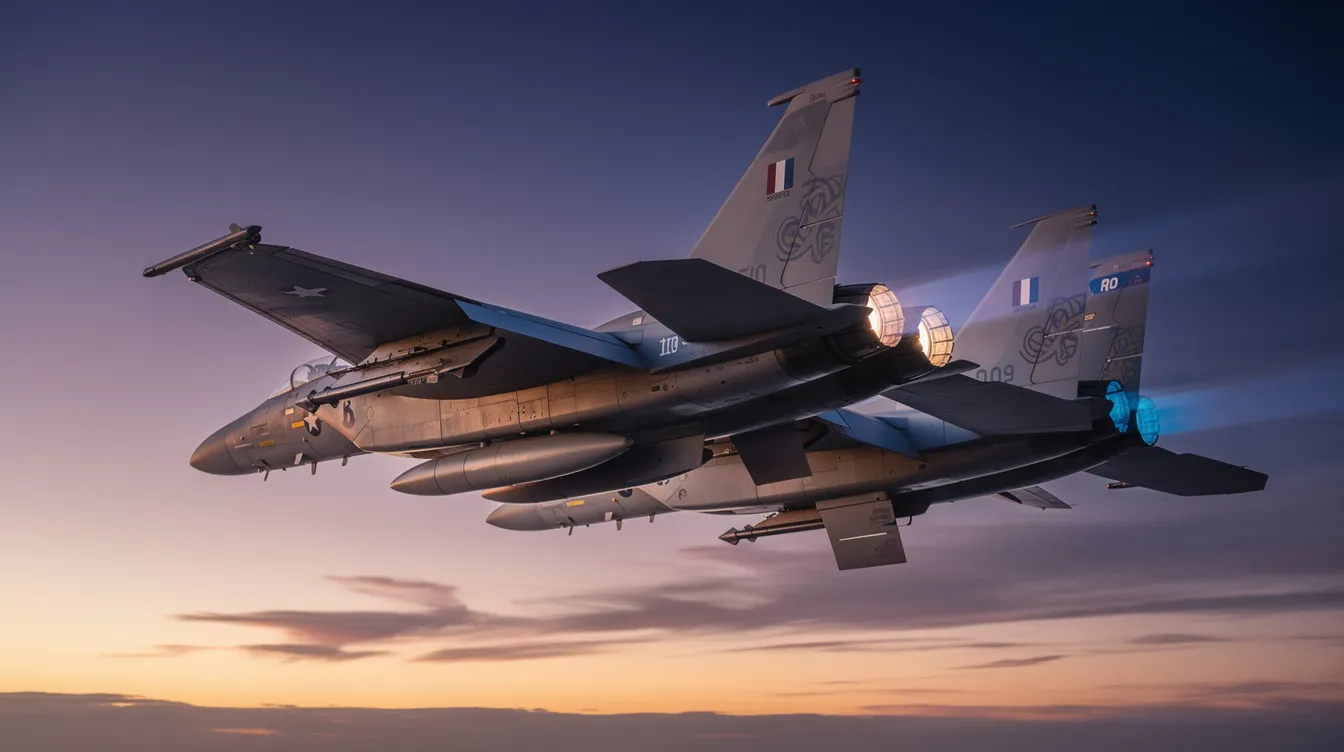
What transformed the F-15E from a capable airframe into a precision strike platform is its integrated avionics system. The electronic systems aboard the Strike Eagle give crews the ability to detect ground targets, track aircraft, and deliver weapons with extraordinary accuracy in adverse weather, at night, or at extreme range.
The primary radar lineage began with the mechanically scanned APG-70 in early F-15Es. Today, the aircraft is equipped with advanced avionics including the APG-82 AESA radar-a modern active electronically scanned array that provides synthetic aperture radar mapping, air to ground map modes for terrain identification, and air-to-air mode for engaging both low flying targets and high-flying targets simultaneously. The advanced radar can track small high-speed targets at extended range while simultaneously providing precision ground mapping. Meanwhile, F-15C models received AN/APG-63(V)3 AESA radar starting in 2010, sharing sensor technology across the Eagle family. The radar feeds target information directly to the weapons management system, enabling rapid engagement.
Navigation relies on an inertial navigation system paired with GPS, feeding the digital moving map display and mission computers. Essential flight information gathered from these sensors appears on the head-up display, giving the pilot essential flight information without looking away from the canopy. The upgraded central computer processes all inputs-navigation, radar, threat data-and drives the cockpit displays in both seats.
The LANTIRN system was revolutionary when introduced: two pods (navigation and targeting) enabled crews to navigate at low altitude at night and identify ground targets with infrared precision. Advanced targeting pods enable precision attacks in all weather conditions, and newer pods continue to supplement or replace the original LANTIRN hardware.
For survivability, the tactical electronic warfare system (TEWS) originally provided threat warning and automatic countermeasures. The Eagle Passive/Active Warning Survivability System was planned for F-15s as a digital replacement, and EPAWSS installations began reaching operational units in early 2025. This modern suite detects, identifies, and counters radar and missile threats across the full spectrum, keeping the aircraft's position masked and the crew informed. The tracking system continuously updates situational awareness for both crew members, allowing them to monitor aircraft threats and manage the battlespace.
Crew Concept: Pilot and Weapons Systems Officer (WSO)
The F-15E's two-person crew is central to its effectiveness. The pilot sits in the front cockpit, managing flight instruments, air-to-air combat maneuvering, defensive reactions, and overall mission command. The WSO occupies the rear cockpit, controlling radar modes, navigation, electronic warfare systems, and complex air-to-ground weapon employment.
The pilot flies the aircraft using the control stick and engine throttles with HOTAS (Hands On Throttle And Stick) integration, where weapons controls located on the stick and throttle allow rapid engagement without removing hands from primary flight controls. The WSO's rear cockpit features multi-function displays for radar returns, digital maps, and targeting pod video. In modernized jets, both cockpits receive large-area glass displays. The WSO can check aircraft or weapons status, switch between sensor feeds, and monitor weapons status across all stations.
Consider a night strike against a mobile missile launcher in mountainous terrain defended by SAM sites. The pilot flies at low altitude, managing terrain clearance and evasive routing. The WSO simultaneously monitors threat radar emissions, navigates via GPS and inertial reference, identifies the target through a targeting pod, and designates it for weapons delivery day or night. Each crew member handles a distinct portion of the workload, and neither could manage both roles alone under such pressure.
Compared to single-seat multirole fighters like the F-16 or F-35, the two-crew concept adds weight and cost-but in high-workload strike environments where electronic warfare, precision targeting, and air-to-air combat may overlap in seconds, having a dedicated WSO remains a decisive advantage.
Weapons and Stores: Air-to-Air and Air-to-Ground Arsenal
The F-15E was designed to carry a massive load of both air-to-air weapons and precision ground attack munitions, enabling "self-escorted strike" missions where the aircraft needs no fighter cover.
For the air-to-air role, typical loadouts include:
AIM-9 Sidewinder heat-seeking missiles on wingtip rails
AIM-120 AMRAAM beyond visual range missiles on wing and fuselage pylons
An internally mounted M61A1 20 mm Vulcan cannon with 500 rounds
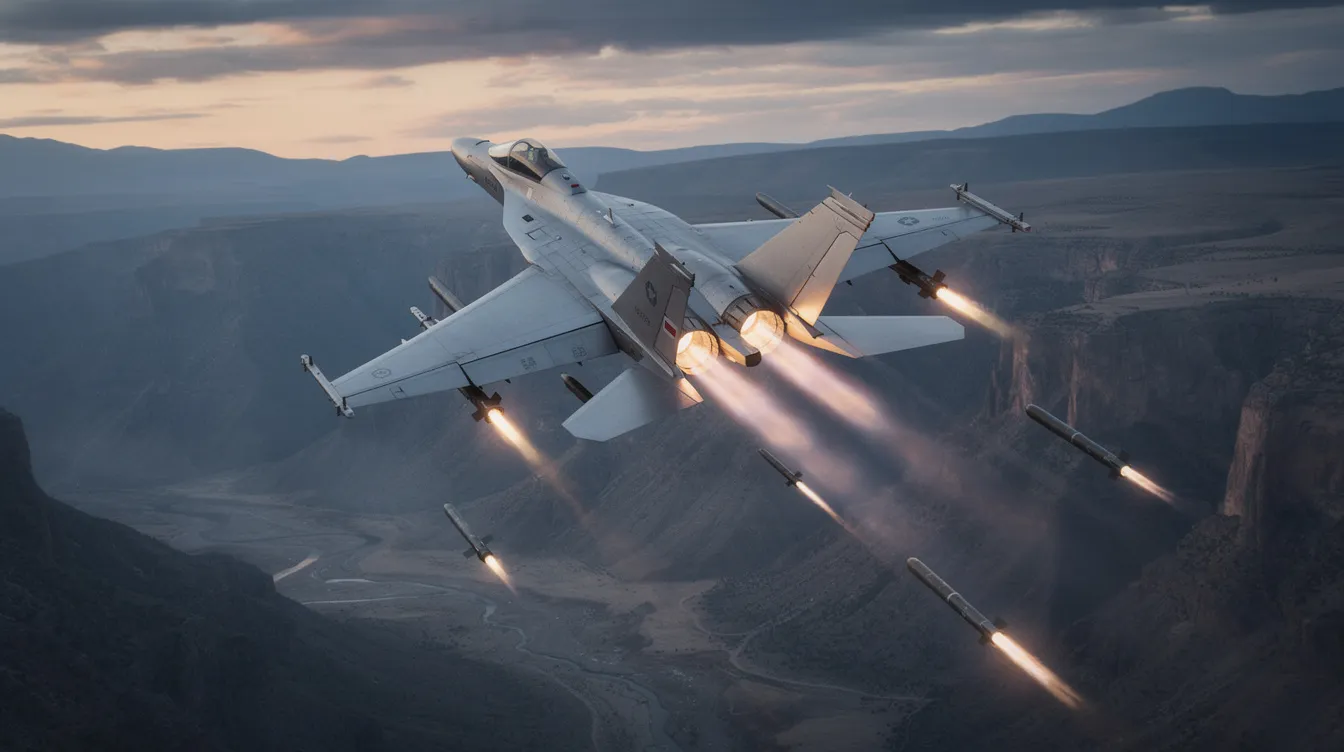
The F-15E can carry up to 16 missiles with quad-pack racks on its pylons, giving it formidable air-to-air combat capability even while loaded for strike. The automated weapon system enables rapid target engagement, and the pilot or WSO can switch between air-to-air and ground modes in seconds.
For air-to-ground work, the arsenal runs deep. The aircraft employs joint direct attack munitions and laser-guided bombs as primary precision weapons. Additional options include:
Unguided weapons (Mk 82/83/84 series)
GBU-10 and GBU-12 laser-guided bombs
Small Diameter Bombs (SDB)
GBU-53/B StormBreaker all-weather smart munitions
JASSM long-range cruise missiles
B61 Mod 12 nuclear gravity bombs
The F-15E can carry up to 15 JDAMs in a single sortie-a capability demonstrated in USAF loading tests that underscore the jet's extreme payload capacity. Testing has also validated carriage of five JASSMs, enabling long-range standoff precision attack against heavily defended targets.
The automated weapon system, combined with HOTAS controls and the head up display, streamlines target designation and effective weapons delivery. The WSO manages weapons management tasks through the rear cockpit displays, ensuring accurate weapons delivery day or night. Whether the mission calls for one weapon system type or a mixed load of air-to-air and air-to-ground ordnance, the Strike Eagle's flexibility is unmatched among its contemporaries.
Air Superiority Meets Deep Strike: Concept of Operations
The F-15E Strike Eagle embodies the USAF's ambition to merge air superiority with deep strike capability in a single platform-eliminating the Cold War–era division between "pure" fighters and dedicated bombers.
In practice, F-15Es fly in mixed packages where they can defend themselves in air to air combat while prosecuting ground targets. The F-15E retains substantial air-to-air combat capability alongside strike capabilities, allowing crews to engage enemy aircraft beyond visual range with AMRAAMs, then switch to ground attack seconds later. This "swing-role" flexibility means a combat squadron of Strike Eagles can begin a sortie focused on counter-air operations near the front lines, then shift to attack ground targets once airborne threats diminish.
During Desert Storm operations in 1991, Strike Eagles routinely carried both AMRAAMs and precision bombs, ready to counter both aircraft and surface threats on the same mission. In later no-fly-zone enforcement as part of an allied force over Iraq, the same dual loadout persisted. F-15s have a combat record of 104 kills and no losses in air-to-air engagements across all variants-a record that gives any adversary pause.
This multirole capability has shaped USAF fighter force structure decisions for decades, influencing the current debate about balancing legacy airframes like the F-15E with stealth platforms. The Strike Eagle may not be invisible to radar, but its combination of speed, payload, sensors, and self-defense capability means it can operate effectively in many contested environments, especially after initial air defenses have been degraded by stealth assets or standoff weapons.
Combat Debut: Operation Desert Storm and Early 1990s Operations
The aircraft's first deployment was during Operation Desert Storm in 1991, just two years after reaching initial operational capability. The Strike Eagle's combat baptism validated nearly every design decision made during the ETF program.
During operation desert storm, F-15Es executed deep interdiction strikes against Iraqi Scud missile launchers, airfields, artillery sites, and command-and-control nodes. Many missions were flown at night, leveraging the lantirn system to navigate at low altitude through hostile territory and identify targets with infrared precision. The threat environment was severe-Iraqi anti-aircraft artillery and surface-to-air missile batteries created dense defensive networks that tested crew skill and aircraft survivability.
The F-15E scored one confirmed air-to-air kill during the war: a Mil Mi-24 Hind helicopter destroyed with a laser-guided bomb, demonstrating the platform's unconventional flexibility. Meanwhile, F-15C Eagles flying air superiority missions achieved 36 of 39 U.S. air-to-air victories in the Gulf War, and Strike Eagles complemented this dominance by eliminating tactical targets on the ground that sustained Iraqi military capability.
Notable missions included "tank plinking"-using precision munitions to destroy individual Iraqi armored vehicles from altitude-and Scud-hunting patrols in western Iraq designed to protect coalition allies from ballistic missile attacks. These sorties carried significant risk, with several F-15Es damaged and two lost to ground fire.
Post-war, the Strike Eagle transitioned to no-fly-zone enforcement over Iraq and participated in Balkans campaigns during the mid-to-late 1990s, including operations over Kosovo as part of Allied Force commitments. Each deployment reinforced the aircraft's reputation for reliability and precision under fire.
From Desert Storm to Operations Southern Watch, Iraq, Syria, and Beyond
The 1990s cemented the F-15E as the USAF's workhorse in sustained, long-duration campaigns. What began as a sprint capability during Desert Storm became a marathon of continuous operations spanning decades.
During operations Southern Watch- enforcing no-fly zones over southern Iraq through the 1990s-Strike Eagles maintained constant strike readiness. Missions involved precision engagement of Iraqi air defenses, radar installations, and hostile ground forces that violated ceasefire terms. Crews operated in a joint force environment alongside Navy and allied coalition aircraft, coordinating with AWACS platforms and frequently flying night sorties against targets identified in real time.
It has participated in major conflicts including Iraq and Afghanistan after 2001. In Afghanistan, F-15Es provided close air support to ground forces, struck insurgent command nodes, and conducted rapid retargeting during dynamic engagements where the situation on the ground shifted minute to minute. In Iraq, Strike Eagles worked alongside A-10s, F-16s, and unmanned platforms to dismantle insurgent networks and IED infrastructure.
During anti-ISIS campaigns in Iraq and Syria from the mid-2010s onward, the F-15E's precision capability was essential. Crews delivered weapons against targets embedded in urban environments where collateral damage had to be minimized, often using Small Diameter Bombs and JDAMs guided by advanced targeting pods. These missions sometimes occurred in airspace contested by Russian and Syrian air defense systems, raising the operational complexity considerably.
Through the 2020s, Strike Eagles continued striking Iranian-backed militia positions in Syria and Iraq, demonstrating the aircraft's enduring relevance in high-tempo Middle Eastern operations. Incidents during these campaigns-including disputed reports of losses and coalition coordination challenges-highlighted both the platform's resilience and the inherent risks of operating in dense, multi-party threat environments.
Recent and Ongoing Operations: Middle East, Iran Conflict, and NATO Deterrence
As of mid-2026, the F-15E remains deeply committed to high-end combat operations, particularly in the Middle East and across NATO's eastern flank.
In the Iran theater, Strike Eagles have flown missions deeper into Iranian territory once coalition air superiority was established, targeting air defense networks, command infrastructure, and Iranian-backed proxy forces. The aircraft has supported maritime security operations and strategic blockade enforcement, leveraging its long range and heavy payload to provide persistent strike coverage.
The risks are real. In April 2026, an F-15E from the 494th Fighter Squadron was shot down over southern Iran. A massive Combat Search and Rescue operation involving approximately 176 aircraft and hundreds of personnel succeeded in recovering both crew members-a testament to joint force coordination and the value placed on every aviator. Earlier, in March 2026, several F-15s were reportedly lost to friendly fire during Operation Epic Fury over Kuwait, prompting urgent reviews of identification procedures, rules of engagement, and situational awareness protocols in congested airspace.
Beyond the Middle East, F-15E squadrons deployed to RAF Lakenheath in the United Kingdom and rotational locations in Estonia continue to bolster NATO air policing and deterrence. With the USAF's F-15C fleet fully retired as of April 2025, the Strike Eagle and incoming F-15EX have absorbed air policing and rapid strike roles previously held by the older air superiority variant.
Large-scale exercises on the Arabian Peninsula, Red Flag–style drills, and joint US–allied exercises involving over 100 aircraft test the Strike Eagle's interoperability with partner nations and next-generation platforms. These events consistently reveal both the F-15E's strengths-payload, range, crew coordination-and vulnerabilities exposed by operating against advanced SAMs, drones, and sophisticated electronic warfare systems.
Advanced Eagle Family: F-15SA, F-15QA, F-15IA, and F-15EX Eagle II
The "Advanced Eagle" lineage represents the logical evolution of the f 15e design, combining the classic airframe's strengths with modern digital systems for both export customers and the USAF itself.
Export variants include Saudi Arabia's F-15SA, Qatar's F-15QA, and Israel's proposed F-15IA. These advanced versions share key enhancements:
Digitally controlled fly-by-wire flight control systems (replacing the mechanical/hydraulic systems in legacy Eagles)
Strengthened wings with two extra hardpoints per side
Advanced digital cockpits with large-area displays
AESA radars and modern electronic warfare suites
These export configurations directly informed the USAF's F-15EX Eagle II, now being procured to replace aging F-15C/D fleets and complement remaining F-15Es. The EX features open-architecture avionics, APG-82(V)1 or APG-63(V)3 AESA radars, General Electric F110-GE-129 engines validated through field service evaluations showing 99.8% mission completion rates, and full EPAWSS integration.
Political and budget debates continue to shape procurement. The USAF initially planned around 144 F-15EX aircraft, but numbers have been reconsidered as defense priorities shift. Congress has pushed for more jets and spare parts while simultaneously blocking proposed F-15E retirements-21 aircraft were saved from retirement in FY2026 alone.
While the F-15EX is not stealthy like the F-35, its capacity for hypersonic weapons carriage, long-range air-to-air missile loads, and high mission-capable rates make it valuable in contested environments where stealth is less critical. Export orders from Saudi Arabia and Qatar help amortize upgrade costs, creating economies of scale for radar, electronic warfare, and cockpit display technologies that benefit the entire Eagle family.
Upgrade Roadmap and Service Life: Keeping the F-15E Relevant Beyond 2025
The F-15E's airframe is rated for approximately 8,000 flight hours at its baseline design, but structural inspections and depot-level repairs have pushed many jets well beyond that threshold. One particular airframe, nicknamed "Lucky," crossed 15,000 flight hours in 2024. It underwent significant modernization to maintain relevance into the 2030s and beyond.
Key modernization programs include:
APG-82(V)1 AESA radar replacing the legacy APG-70
EPAWSS electronic warfare suite replacing older TEWS
Digital cockpit upgrades with large-area glass displays for both crew positions
Advanced weapons integration: GBU-53/B StormBreaker, JASSM-ER, B61 Mod 12, and potentially future hypersonic missiles
The USAF plans to cut the F-15E fleet roughly in half by 2029, retaining approximately 99 late-model jets equipped with higher-thrust PW-229 engines. These retained aircraft receive priority for EPAWSS installation, AESA radar, and weapons upgrades. A dedicated "Speedline" at Warner Robins Air Logistics Complex opened in mid-2026 to accelerate EPAWSS installations independent of full depot maintenance cycles.
Challenges remain: aging structures demand increasing inspection frequency, diminishing manufacturing sources complicate spare parts procurement, and workforce constraints slow upgrade timelines. Still, the remaining F-15Es are positioned to operate alongside fifth-generation fighters like the F-35 and F-22, and potentially alongside emerging unmanned Collaborative Combat Aircraft.
The Strike Eagle's future role will shift from centerpiece to specialized heavy-strike and missile-launch platform-still lethal, still relevant, but increasingly complementing rather than leading the force.
F-15E in Training, Exercises, and High-Profile Events
Beyond combat, the Strike Eagle plays a vital role in training, readiness, and public engagement that demonstrate USAF capability and build aircrew proficiency.
F-15E crews regularly participate in major exercises including Red Flag at Nellis AFB, Checkered Flag at Tyndall, and large joint drills with allies across the Middle East, Europe, and Indo-Pacific. These exercises integrate fourth- and fifth-generation fighters in complex scenarios involving electronic warfare, dynamic retargeting, and contested airspace-preparing crews for the highest-threat conflicts.
Competitions like the William Tell weapons meet showcase weapons employment skills, sortie generation rates, and maintenance excellence. F-15E units routinely demonstrate their ability to generate high sortie rates under pressure, reflecting the aircraft systems' reliability and crew proficiency.
Public engagements keep the Strike Eagle visible to the communities it defends. F-15Es have performed Super Bowl flyovers and airshow demonstrations, sometimes wearing unique heritage paint schemes honoring World War II aviation units. Developmental testing continues as well: carriage tests for large weapon loads (15 JDAMs, five JASSMs), experiments with controlling semi-autonomous drones, and low-cost munitions trials all shape the aircraft's future operational employment.
Safety, Accidents, and Resilience in Service
Any combat aircraft serving for over three decades accumulates incidents. The F-15 family has maintained an excellent overall safety record, though that record includes honest acknowledgment of losses and the lessons drawn from each one.
Historically, around 175 F-15s of all variants were lost from all causes by 2016-a relatively low rate for a fleet of this size and operational tempo. The 2007 grounding following a Missouri Air National Guard F-15C structural failure led to comprehensive inspections and structural repairs across the entire fleet, strengthening confidence in the aircraft's continued airworthiness.
F-15E-specific incidents include emergency landings, landing gear collapse events, and the combat losses described in recent operations. The friendly fire incidents during coalition operations in March 2026 drove urgent improvements in identification protocols and rules of engagement. In each case, crew survival rates have been high-a reflection of robust ejection systems, crew training, and twin-engine design philosophy.
The aircraft's durability is evidenced by jets returning to service after multi-year repairs and airframes exceeding 15,000 flight hours while remaining mission capable. Safety enhancements are continuous: structural reinforcement programs, updated inspection regimes, pilot training improvements, and coalition coordination protocols all evolve with operational experience.
Cultural Impact: Media, Simulation, and Enthusiast Communities
The F-15E, like the earlier F-15C, has become one of the most recognizable symbols of American airpower in popular culture. Its distinctive twin-tail silhouette and combat reputation have made it a fixture across entertainment, education, and enthusiast communities.
F-15 variants appear prominently in documentaries like the IMAX film Fighter Pilot: Operation Red Flag, Tom Clancy's aviation writing, and dozens of flight simulation titles. Modern combat games frequently feature the Strike Eagle as a playable aircraft across fictional and historical conflicts, reflecting its perceived versatility and desirability among virtual pilots worldwide.
The model kit and collectibles market around the F-15E Strike Eagle remains robust, driven by the aircraft's distinctive profile, combat heritage, and photogenic qualities. Stock photography libraries feature thousands of Strike Eagle images from deployments, exercises, and airshows.
What fuels the legend most is performance: the F-15 family's combat record of 104 kills and zero air-to-air losses, milestone airframes exceeding 15,000 flight hours, and continued front-line service decades after introduction all contribute to an enduring mystique that few aircraft can match. For aviation enthusiasts, the Strike Eagle represents the intersection of raw performance and technological sophistication-a combination that never goes out of style.
F-15E, Air Superiority, and the Future Fighter Mix
The F-15E occupies a distinct position in the USAF's evolving fighter force structure-a non-stealth, high-payload platform that complements rather than competes with fifth-generation aircraft like the F-22 and F-35.
Where the F-22 provides stealth air superiority, and the F-35 offers multirole stealth capability, the F-15E excels at heavy strike and massed missile carriage after initial air defenses have been degraded. Its ability to carry enormous payloads-including potential future hypersonic weapons-makes it a valuable "magazine" aircraft that multiplies the combat power of a stealth-led force package.
Policy debates continue about Air Force size and force structure. Senior leaders have acknowledged the service is "probably" too small for its global commitments, and decisions to delay or accelerate F-15E retirements fluctuate with threat environments and budget realities. Congress has repeatedly intervened to preserve F-15E capacity, recognizing that pure stealth fleets cannot yet generate the sortie volume or payload mass that current operations demand.
Low-cost munitions, unmanned "loyal wingman" drones, and hypersonic weapons are all reshaping how aircraft like the F-15E will operate in future high-threat theaters. The Strike Eagle may not serve as the tip of the spear in the most heavily defended airspace, but its combination of range, payload, mature aircraft systems, and two-crew mission flexibility will keep it valuable in a wide range of scenarios for years to come. The F-15E's future is not retirement-it's specialization.
What the F-15E Means for Modern Airpower – and How BlackJet Fits In
The F-15E's four-decade story is ultimately about a principle that transcends military aviation: the most effective platforms are those that combine reliability, range, safety, and mission flexibility into a single, trusted system. It is not merely a technological showpiece. It is a strategic advantage-proven across thirty-five years of continuous combat operations.
That same principle drives modern private aviation at its best. The qualities that make the Strike Eagle effective-twin-engine redundancy, rigorous maintenance standards, advanced avionics, mission-ready reliability-mirror the standards that discerning travelers should demand from their own aviation providers. When you step aboard a private aircraft, you are trusting your safety, time, and productivity to a system of overlapping safeguards. The margin for compromise is zero.
At BlackJet, we approach private aviation with the same disciplined philosophy. Our Jet Card programs offer rapid, tailored access to the right aircraft for each mission-whether that's a light jet for a regional hop, a midsize cabin for cross-country business, or a large-cabin aircraft for transcontinental travel—and our guide to jet card cost and membership pricing helps frequent flyers understand how these programs are structured financially. Like military planners matching F-15Es or other platforms to specific missions based on range, payload, and threat, we match aircraft to your itinerary with precision.
Every BlackJet flight meets rigorous safety certification standards, with vetted operators, real-time digital booking, and 24/7 mission support that echoes the disciplined planning and situational awareness keeping F-15E crews safe in the world's most complex operations, and our private jet price list guide explains the costs and options behind building that level of capability. And where military aircraft consume enormous quantities of fuel, BlackJet ensures every journey is carbon neutral-at no extra cost to you-because modern high-end travelers can enjoy the benefits of airpower with a smaller environmental footprint, whether they’re flying between U.S. hubs or using private jet charters in Karachi and other global gateways.
If you appreciate the precision, strategic edge, and uncompromising standards embodied by aircraft like the F-15E Strike Eagle, explore how BlackJet's Jet Card programs can bring that same sense of assured, on-demand airpower to your own travel life.
Conclusion: The Enduring Legacy and Future of the F-15E Strike Eagle
The F-15E Strike Eagle stands as a testament to the power of combining proven air superiority with cutting-edge strike capabilities. Its unmatched range, payload, and multirole flexibility have ensured its relevance across decades of evolving combat environments. While newer stealth platforms like the F-22 and F-35 take center stage in modern air forces, the F-15E’s ability to deliver precision strikes deep into contested territory while defending itself remains invaluable.
As the USAF transitions toward a future integrating hypersonic weapons, unmanned systems, and advanced electronic warfare, the F-15E and its Advanced Eagle derivatives will continue to fill critical roles—providing reliable, high-capacity strike options that complement stealth assets. Its legacy of safety, operational dependability, and mission versatility offers lessons not only for military aviation but also for any sector where precision, reliability, and adaptability define success.
For discerning travelers and executives who value efficiency, safety, and tailored performance in private aviation, the F-15E’s story resonates. At BlackJet, we share this commitment to excellence, delivering seamless, mission-ready private jet access that meets the highest standards of safety and operational precision. Discover how our Jet Card programs can elevate your travel experience, offering the same strategic advantage in the skies that the F-15E Strike Eagle provides on the battlefield.


 Sign up with google
 Sign up with Apple