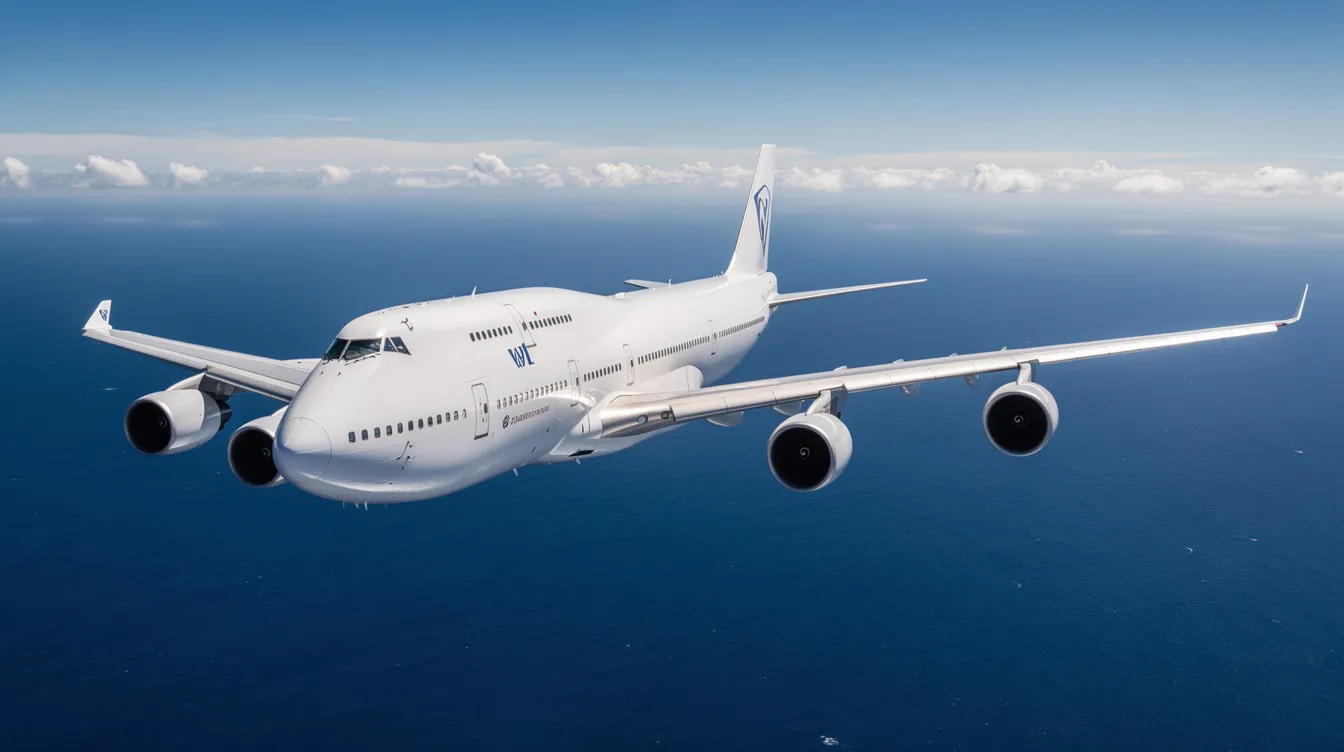
The Boeing 747-8 remains one of the most recognizable aircraft in the skies-an airplane that blends engineering ambition with sheer scale. Whether you are evaluating widebody charter options, comparing fleet capabilities, or simply curious about what it takes to keep a four-engine giant airborne, understanding the 747-8's fuel system is essential. Here is everything you need to know about its fuel capacity, burn rates, efficiency, and what those numbers mean for high-end travel.
747-8 fuel capacity in a nutshell (answer first)
The Boeing 747-8's maximum fuel capacity is 63,034 gallons in its standard passenger configuration-the 747-8 Intercontinental (747-8I). The freighter version of the Boeing 747-8 has a usable fuel capacity of approximately 59,734 US gallons. In certain configuration references, Boeing lists the Boeing 747-8 passenger version as holding 64,225 US gallons and the Boeing 747-8 freighter version as holding 60,925 US gallons, depending on measurement standards and optional tank configurations. Either way, this aircraft carries an extraordinary volume of jet fuel.
A full load of fuel for the Boeing 747-8 weighs approximately 422,000 pounds. To put that in perspective:
Empty weight of the 747-8I is roughly 485,300 lb
The maximum takeoff weight of the 747-8 is 975,000 pounds (some configurations cite up to 987,000 lb)
Fuel alone represents over 40% of maximum takeoff weight
The Boeing 747-8 uses Jet A and Jet A-1 fuel-a kerosene-type aviation fuel with a density of about 6.7 lb per US gallon. Unlike automotive gasoline, Jet A has a higher flash point and lower volatility, making it significantly safer for the temperature extremes and pressure differentials encountered at altitude. It is refined with fewer lighter hydrocarbons, producing a more stable fuel that resists igniting under casual exposure.
The passenger version-the 747-8 Intercontinental-includes a tail fuel tank housed in the horizontal stabilizer, which the 747-8F freighter does not have. That tail tank accounts for the several-thousand-gallon difference in fuel capacity between the two variants. The 747-8 can carry 467 passengers over 8,000 nautical miles in a high-density layout, a capability made possible directly by this massive fuel load.
Where the Boeing 747-8 stores its fuel
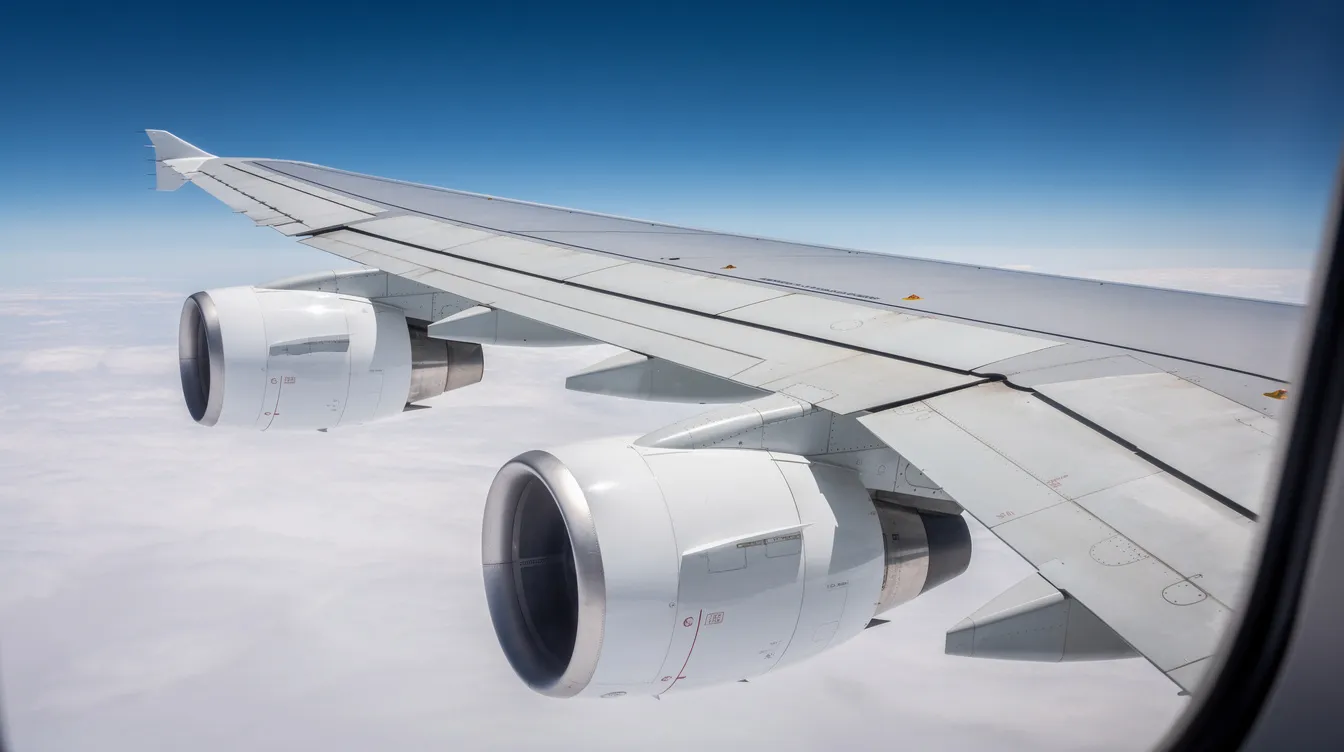
The Boeing 747-8 uses a "wet wing" design, meaning fuel is stored inside sealed structural compartments within the wings themselves, rather than in separate bladder-style tanks. Fuel is stored in wing tanks, center wing box tanks, and optional tail tanks. The center wing tank sits in the fuselage between the wing roots, while the inboard and outboard wing sections each hold substantial volumes. On the 747-8I, the horizontal stabilizer houses an additional tail fuel tank that extends total capacity beyond what the 747-8F carries.
Fuel storage in wings helps counteract aerodynamic lift forces, enhancing structural efficiency. As the wings generate lift in flight, the weight of fuel stored within them acts as natural bending relief-reducing stress on the wing spars and allowing Boeing to build a lighter, stronger structure. With a wingspan of 224 ft 5 in, this structural advantage is critical. The tail fuel tanks on the passenger version also help manage center of gravity, particularly on ultra-long-range legs.
The 747-8F lacks those tail fuel tanks, which is why its capacity sits lower at roughly 59,734 US gallons versus the 747-8I's 63,034.
During flight, fuel is sequenced carefully:
Center wing tank fuel is burned first during cruise
Wing tanks supply fuel next
Tail tank (747-8I only) is used last to maintain aerodynamic balance
This sequencing preserves structural margins and handling characteristics throughout the flight
747-8 fuel capacity vs earlier Boeing 747 models
The Boeing 747 family evolved substantially across generations, and fuel capacity grew alongside each redesign. The 747-200B carried roughly 52,410 US gallons. The 747-300 bumped that to about 53,985 gallons. The 747-400-the dominant variant for decades with airlines like Lufthansa, Korean Air, and Air China-held between 54,000 and 57,285 gallons depending on whether operators installed optional tail tanks or body tanks.
The 747-8 Intercontinental pushed capacity to approximately 63,034 gallons through a combination of deeper, re-profiled wings with raked wingtips (a technology connection borrowed from the 787 program), a redesigned center wing tank, and the inclusion of the horizontal stabilizer tank. These incremental changes across generations weren't just about carrying more fuel-they reflected innovative new technologies in aerodynamics and materials that improved how efficiently each gallon was burned.
Despite carrying more fuel, the Boeing 747-8 is 16% more fuel-efficient than the 747-400. Better miles per gallon per seat, lower fuel burn per nautical mile, and reduced CO₂ emissions per passenger made the 747-8 a genuine leap forward even though its fuel tanks grew larger.
For comparison, the Airbus A380 has a fuel capacity of around 84,000 US gallons-more than the 747-8-but serves a different market segment with its double-deck, high-density layout.
Variant | Fuel Capacity (US gal) | Typical Range (nm) | Era |
|---|
747-200B | ~52,410 | ~6,500–6,800 | 1970s–1980s |
747-300 | ~53,985 | ~6,800 | 1980s–1990s |
747-400 | ~54,000–57,285 | ~7,200–7,700 | 1989 onward |
747-8I | ~63,034 | ~7,730–8,000 | 2012 onward |
Fuel consumption and real-world burn rates
A heavily loaded Boeing 747-8 at cruise typically burns between 3,300 and 3,600 US gallons of fuel per hour-roughly one gallon per second. The 747-8F has a fuel burn of 4,842 gallons per hour under maximum-weight conditions early in cruise, reflecting its heavier cargo loads. During climb, burn rates spike higher; during descent, they drop considerably. Fuel consumption can improve as the aircraft becomes lighter during a flight, since less thrust is needed to maintain altitude and speed as fuel is burned off.
Using a standard fuel density of about 6.7 lb per gallon, a cruise burn of 3,500 gallons per hour translates to approximately 23,450 lb per hour. At full fuel capacity (~63,000 gallons), that supports roughly 18 hours of uninterrupted cruise-though regulatory reserves, diversion fuel, and climb/descent phases reduce the practical endurance.
Consider a concrete example: a 747-8I flying JFK to Tokyo, roughly 6,700 nautical miles. The cruise portion alone burns approximately 44,000–48,000 gallons over 13–14 hours. Add taxi, climb, descent, and mandatory reserves, and total trip fuel approaches 50,000+ gallons. On a shorter segment like Frankfurt to Los Angeles (~5,150 nm), a 747-8F hauling near-maximum cargo might burn around 4,000 gallons per hour early in cruise, tapering to 3,300 as weight decreases-a clear demonstration of how payload and routing reshape the numbers.
Fuel efficiency: 747-8 vs cars and other aircraft
In a typical three-class configuration of around 410 seats, the 747-8I burning 3,400 gallons per hour at Mach 0.86 (~560 mph) consumes roughly 0.14–0.16 gallons per mile for the entire airplane. Divide that across 410 passengers and you get approximately 57–65 passenger-miles per gallon. In a high-density layout, the aircraft can carry up to 467 passengers in a typical configuration, and the Boeing 747-8 can achieve roughly 100 miles per gallon per passenger while cruising under optimal conditions.
Compare that to a luxury sedan carrying a single occupant at 25 mpg-the 747-8I delivers two to four times more passenger-miles per gallon when fully loaded. The math shifts further when you consider that most cars on the highway carry just one or two people.
747-8I (full load): ~57–100 passenger-miles per gallon depending on configuration
Luxury sedan (1 occupant): ~25 passenger-miles per gallon
Modern twin-engine widebodies (787, A350): can exceed 80–100+ passenger-miles per gallon
Modern twin-engine jets can achieve comparable or superior range metrics due to higher fuel efficiency, which is why fuel efficient airplanes have increasingly dominated airline fleets. Understanding the different types of jet fuel and their properties also plays a role in optimizing performance and safety. Still, the 747-8 holds its own on high-demand, long-haul routes where its seat count dilutes fixed fuel costs effectively.
How payload, routing, and weather affect 747-8 fuel use
Imagine a 747-8F freighter departing Frankfurt for Los Angeles-roughly 5,150 nautical miles. At near-maximum structural payload (~140,000 lb of cargo on the main deck), the airplane is heavy. Heavier loading requires more thrust and thus more fuel, even at identical cruise speeds. On this route, the operator might restrict cargo weight or limit fuel load to meet takeoff performance on available runway length. The fuel weight can limit the ability to carry maximum payload on long flights due to weight restrictions-a constant trade-off in commercial service.
Weather compounds these calculations. A 40-knot tailwind at cruise altitude can reduce time en route and fuel burned by approximately 10–15% on a transatlantic or trans-Pacific sector. Headwinds do the opposite, sometimes adding thousands of pounds of extra fuel burn. Airlines and flight planners use flight management software to optimize altitude, speed profiles, and routing-selecting step climbs, adjusting Mach numbers as weight decreases, and choosing wind-favorable tracks to squeeze every mile from each gallon.
The 747-8F often flies weight-limited legs on very long sectors, meaning operators cannot fill both tanks and cargo hold to capacity. They trade payload for fuel or vice versa, balancing operator economics against customer delivery requirements. Almost all intercontinental freighter missions require this kind of careful optimization.
Fuel capacity and range: 747-8 Intercontinental vs 747-8F
Fuel capacity directly influences an aircraft's long-range operational capabilities, and the difference between the 747-8I and 747-8F illustrates this clearly.
747-8 Intercontinental (747-8I): With approximately 63,034 gallons of usable fuel and the Boeing 747-8 having a design range of approximately 7,730 nautical miles in standard passenger configuration, the 747-8I can fly routes like New York to Hong Kong non-stop. The 747-8's fuel capacity allows for a range of 8,000 nautical miles in lighter configurations, and the aircraft has a range of 8,000 nautical miles under optimal conditions. Airlines like Lufthansa and Air China flew the 747-8I on their longest intercontinental routes, leveraging this range to connect major hubs without refueling. Atlas Air also operates 747-8 variants on demanding global routes.
747-8F Freighter: Holding roughly 59,734 US gallons without tail fuel tanks, the 747-8F's maximum range at full structural payload is significantly shorter-approximately 4,325 nautical miles. With reduced cargo, range extends considerably. The freighter doesn't simply fill tanks every time; operators balance runway limits, payload revenue, and fuel load against each mission's economics. A 747-8F flying Chicago to Los Angeles (~1,800 nm) carries far less fuel than capacity allows, freeing weight for revenue cargo.
Fuel weight, performance limits, and fuel dumping
Fuel weight constitutes a massive share of the Boeing 747-8's operating weight envelope. The Boeing 747-8 has a maximum take-off weight of 975,000 lb, while its maximum landing weight sits around 688,000 lb. That gap-nearly 287,000 lb-means a fully fueled 747-8 cannot land immediately after takeoff without either burning off fuel in flight or, in emergencies, dumping it.
The aircraft is equipped with high-capacity dump nozzles located near the wing trailing edges. These systems can jettison fuel at rates of approximately 2 tons per minute, allowing the crew to reduce weight rapidly for an emergency landing. Airlines normally avoid fuel dumping for environmental and cost reasons, reserving it strictly for medical diversions or technical emergencies soon after departure.
In routine operations, flight planning ensures that by the time of landing, fuel weight has decreased through normal burn to a level below maximum landing weight. On shorter flights where planes fly well below maximum fuel load, this isn't a concern. On ultra-long sectors where tanks are nearly full at takeoff, crews may need to extend flight time or hold in patterns to burn down to safe landing weight if an early return becomes necessary.
Operational economics: what 747-8 fuel burn means in dollars
Fuel efficiency is important for airlines as fuel represents a significant portion of operating expenses-often 25–35% of total costs. To understand the economics of 747-8 operations, consider a working jet fuel price of approximately $4.00 per gallon; frequent private fliers often compare these dynamics to their own jet card cost per hour when budgeting annual flight use.
At cruise, burning roughly 3,400 gallons per hour, fuel cost alone runs about $13,600 per hour. Cruising at approximately 520 knots, that translates to roughly $26 per nautical mile in fuel. On an intercontinental route like New York to Tokyo (~6,700 nm), cruise fuel cost over 13 hours reaches approximately $176,800. Add taxi, climb, descent, and reserves, and total fuel cost per trip can approach $200,000–$220,000 per sector.
For the airline customer, these costs are distributed across hundreds of seats and cargo revenue. For a freighter operator, fuel cost per ton-mile becomes the critical metric. For private or government operators, fuel is a large but manageable line item-accepted as the cost of capability, though many individuals still explore the cheapest private jet options to balance comfort with operating expense.
These economics drove airlines toward more fuel efficient twin-engine aircraft for many routes. Even though the 747-8 offered compelling range and payload, the operating cost per seat on lower-density routes made twin-engine alternatives more attractive for most carriers.
Fuel efficiency improvements on the 747-8 vs legacy 747s
The 747-8's design incorporates advanced aerodynamic and engine technologies to improve fuel efficiency. It is powered by four General Electric GEnx-2B67 engines-high-bypass turbofans derived from the same family powering the 787. These GenX engines feature advanced fan blades, composite nacelles, and an optimized low pressure turbine shaft design that collectively reduce specific fuel consumption compared to the CF6 and PW4000 engines on the 747-400.
Boeing claimed roughly 16% better fuel burn and CO₂ emissions versus the 747-400, along with a 30% smaller noise footprint. The 747-8F offers a 16% lower ton-mile operating cost than the 747-400F, making it the most economical freighter in its class. Re-profiled wings with raked tips, updated flap track fairings, and modern flight management software all contributed.
After the first flight and initial deliveries, Boeing proposed and implemented an engine performance improvement package (sometimes called "Project Ozark"), which added roughly 1.5–1.8% further efficiency through software refinements, aerodynamic tweaks, and engine calibration updates. Boeing began certification testing on these improvements through a dedicated flight test program, with a test flight series conducted at both Paine Field and Boeing Field.
The shift toward twin-engine operations-enabled by ETOPS regulatory changes-meant that three engines or four engines were no longer required for most over-ocean routes. This fundamentally altered the competitive landscape, as modern twin-engine jets could match the 747-8's range with meaningfully lower fuel burn per seat.
Special missions: 747-8 fuel capacity for Air Force and state operators
The 747-8's combination of range, fuel capacity, and iconic upper deck profile made it the natural selection for the US Air Force's VC-25B program-the next-generation "Air Force One." The Air Force valued the aircraft's ability to fly non-stop from Washington to virtually any destination in Asia or Europe without refueling, reducing security exposure and overflight dependencies. Similar capabilities underpin some of the most expensive private jets in the world, many of which are based on widebody airliners like the 747-8.
Government and state configurations typically trade seating or cargo volume for additional communications systems, defensive measures, and entertainment or business equipment. Some configurations include a separate stairway, sliding doors between compartments, and small individual compartments for staff and security personnel. The curved ceiling and crown space of the upper deck provide room for specialized systems. Despite these modifications, the base airframe's fuel capacity remains unchanged, giving state operators the full range capability of the commercial aircraft.
Fuel planning for such missions prioritizes reliability and large safety reserves over absolute fuel efficiency. Where an airline customer might calculate reserves to regulatory minimums, government operators carry substantially more contingency fuel-accepting higher burn in exchange for mission assurance. Boeing forecast continued demand for this type of specialized 747-8 even as commercial passenger orders wound down.
What 747-8 fuel performance means for private and VIP travel
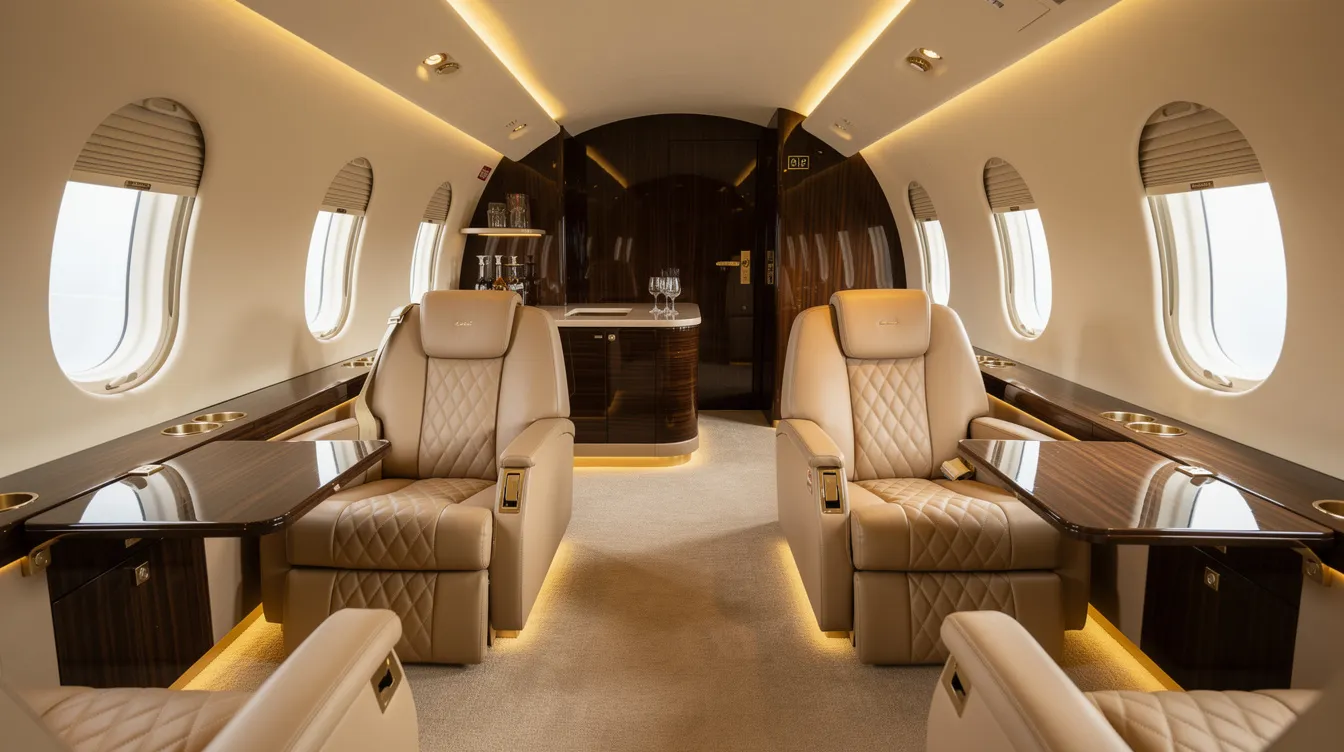
The BBJ 747-8 and VIP-configured 747-8 Intercontinental represent the ultimate "flying palace"-a passenger jet with cabin layouts that shrink seating to perhaps 50–100 VIP guests while retaining the full fuel capacity and range of the standard airliners. Full-deck suites, conference rooms, and private lounges fill the main deck and upper deck, turning the airplane into a self-contained environment with all necessary business equipment.
In VIP use, the high fuel burn per flight is accepted as the cost of unparalleled space and prestige; for slightly smaller groups, choosing the best private jet for 15 passengers can deliver similar comfort with far lower fuel consumption. A private VIP 747-8 flying New York to London (~3,460 nm) with 50 guests might spend $100,000+ on fuel alone per leg. The aircraft flew on such missions for a handful of royal families and heads of state-the largest operator of such configurations being government fleets rather than private individuals, while large private groups more commonly opt for the best private jet for 20 passengers instead of a full-size 747-8.
For regular high-end travel, however, the calculus changes entirely. Long-range private jets like the Gulfstream G650 or Bombardier Global 7500 offer comparable or better range with dramatically lower fuel burn and operating cost. For larger entourages, the best private jet for 50 passengers will usually be a VIP airliner or specially configured large-cabin aircraft rather than a full 747-8. Chartering or owning a 747-8 as a private jet is rare and restricted to ultra-rare UHNW individuals, while Jet Card programs make more efficient, right-sized aircraft available on demand for discerning travelers who might otherwise explore ways to buy a seat on a private jet through shared or semi-private services.
Fuel efficiency, sustainability, and BlackJet's carbon-neutral approach
A single intercontinental 747-8 flight can burn over 45,000 gallons of jet fuel, producing approximately 9.57 kg of CO₂ per gallon-totaling well over 180 metric tons of carbon dioxide per trip. At this scale, the environmental impact of widebody operations is substantial and increasingly relevant to travelers who align their decisions with sustainability goals.
Modern private jets in BlackJet's network are selected for fuel efficient performance relative to payload and mission profile. Rather than deploying four-engine widebodies for missions that a large-cabin twin can handle, BlackJet ensures each flight uses the greenest viable aircraft, reducing total emissions meaningfully compared to oversized alternatives.
BlackJet's carbon-neutral flights include mandatory carbon offsetting for every Jet Card hour flown. Options like the BlackJet 25+ Hour Jet Card lock in predictable hourly rates while maintaining this sustainability commitment. Offsets are calculated from actual fuel burn data for each mission, converted to CO₂ using accepted emissions factors, and verified through recognized sustainability programs-at no extra cost to the member. For corporations and high-net-worth individuals navigating ESG commitments, this built-in accountability transforms private aviation from a reputational liability into a responsible choice.
Choosing the right aircraft: 747-8 capabilities vs private jet solutions
The Boeing 747-8 still makes sense where it was designed to excel: high-density long-haul routes operated by airlines, large cargo operations for carriers like Atlas Air, and rare VIP or head-of-state missions requiring unmatched space and range. For the scale at which private aviation normally operates, however, the 747-8 is dramatically oversized, and most missions are better served by different types of private jets matched to range and cabin needs.
BlackJet matches aircraft category and fuel profile to each mission. Its core premium private jet cards and Jet Card programs give members structured access across categories. For many flyers, a 50 hour jet card offers an ideal balance between commitment and flexibility. Light and midsize jets handle regional hops. Super-midsize and large-cabin jets cover transcontinental and transatlantic flights. Ultra-long-range jets serve intercontinental missions that might otherwise seem to require widebody aircraft.
Consider two sample itineraries:
New York to London (~3,460 nm): A large-cabin private jet burns roughly 600–800 gallons per hour, completing the trip in about 7 hours with total fuel cost well under $25,000-versus $100,000+ on a VIP 747-8.
Los Angeles to Tokyo (~5,500 nm): An ultra-long-range business jet handles this non-stop with a fraction of the fuel burn and a far smaller environmental footprint than any four-engine widebody.
Through the Jet Card model, high-end travelers gain repeatable access to these aircraft without managing the massive fixed and variable costs-including jet fuel-associated with owning or chartering something on the scale of a Boeing 747. For very active users, understanding a 100 hour jet card cost structure is key to comparing it with outright ownership. A detailed look at overall jet card cost and pricing helps clarify when this structure makes financial sense versus ad-hoc charter.
Frequently asked questions about 747-8 fuel capacity and private aviation
How much fuel can a Boeing 747-8 hold?
Capacity depends on the variant and configuration. The 747-8 Intercontinental is commonly cited at approximately 63,034 US gallons, while Boeing configuration references list 64,225 gallons. The 747-8F freighter is commonly cited with about 59,734 US gallons usable, with some references listing 60,925 gallons. These figures reflect different measurement and tank-configuration references.
How far can a 747-8 fly on a full load of fuel?
The passenger 747-8 has a design range of approximately 7,730 nautical miles, and published figures reach about 8,000 nautical miles in suitable configurations. Actual range varies with payload, weather, routing, reserves, and aircraft configuration; a freighter carrying maximum payload typically has a shorter range.
Why does the 747-8 have less fuel capacity in freighter configuration?
The 747-8F has lower stated capacity than the passenger version because its configuration does not include the passenger variant’s tail fuel tank. The freighter also balances fuel against cargo weight: on long flights, taking additional fuel may require reducing payload to remain within weight limits.
Is the 747-8 more fuel-efficient than the 747-400?
Boeing states that the 747-8 is about 16% more fuel-efficient than the 747-400. Its redesigned wing, raked wingtips, and GEnx engines contribute to that improvement. Modern twin-engine aircraft can nevertheless offer comparable range with lower fuel consumption, making them a more practical fit for many airline and private-travel missions.
How does private jet access compare with flying on a 747-8?
A 747-8 is designed for high-capacity airline, cargo, or specialized VIP operations. Most private trips need a smaller aircraft matched to the passenger count and route. A Jet Card gives members prepaid access to suitable cabin classes without the fixed costs and management responsibilities of owning an aircraft. BlackJet also provides certified operator screening, digital booking, real-time support, and carbon-neutral flights through offsets.
What safety and sustainability factors should travelers consider?
For any private flight, verify that the operator meets recognized safety standards and has qualified crews, sound maintenance practices, and robust flight-planning procedures. Sustainability depends in part on choosing an appropriately sized aircraft and avoiding unnecessary repositioning. BlackJet’s Jet Card flights include carbon offsetting at no additional cost to members.
How BlackJet optimizes fuel, safety, and technology for members
BlackJet partners exclusively with operators holding rigorous third-party safety certifications that meet or exceed FAA, ICAO, and EASA standards. Travelers often compare this approach with other major providers, making it useful to understand NetJets jet card cost and structure when benchmarking value. Every operator in the network is audited for fuel planning accuracy, weight and balance systems, and crew qualifications-ensuring that feasibility studies and operational data back every flight plan.
BlackJet's digital booking and real-time support tools help members choose aircraft and routings that minimize fuel waste. For true power users, unlimited private jet membership concepts can be a reference point when evaluating whether fixed-hour or all-you-can-fly structures best align with expected usage. Boeing proposed many of the efficiency principles now embedded in modern flight planning software-optimal cruise altitudes, speed profiles, and alternate selection-and BlackJet's operator partners apply these rigorously to every mission. By avoiding unnecessary repositioning legs and right-sizing cabin class to passenger count, each trip uses only the fuel it needs.
By aggregating member demand via Jet Card programs, BlackJet leverages fleet efficiency across multiple operators. Guides to the best jet cards for frequent flyers explain how different structures compare for heavy users. This split evenly between cost savings and environmental responsibility creates a model where luxury and sustainability coexist-without compromise.
Elevate your travel-effortlessly. With BlackJet, private flight is accessible on your terms through our Jet Card programs, complete with rigorous safety, carbon-neutral performance, and unmatched flexibility. Whether the mission calls for a light jet to the coast or an ultra-long-range cabin across the Pacific, BlackJet ensures every gallon counts.
Explore BlackJet's Jet Card programs and discover how refined, responsible travel becomes your new standard, and review our complete guide to jet card pricing to understand how costs are structured behind the scenes.


 Sign up with google
 Sign up with Apple