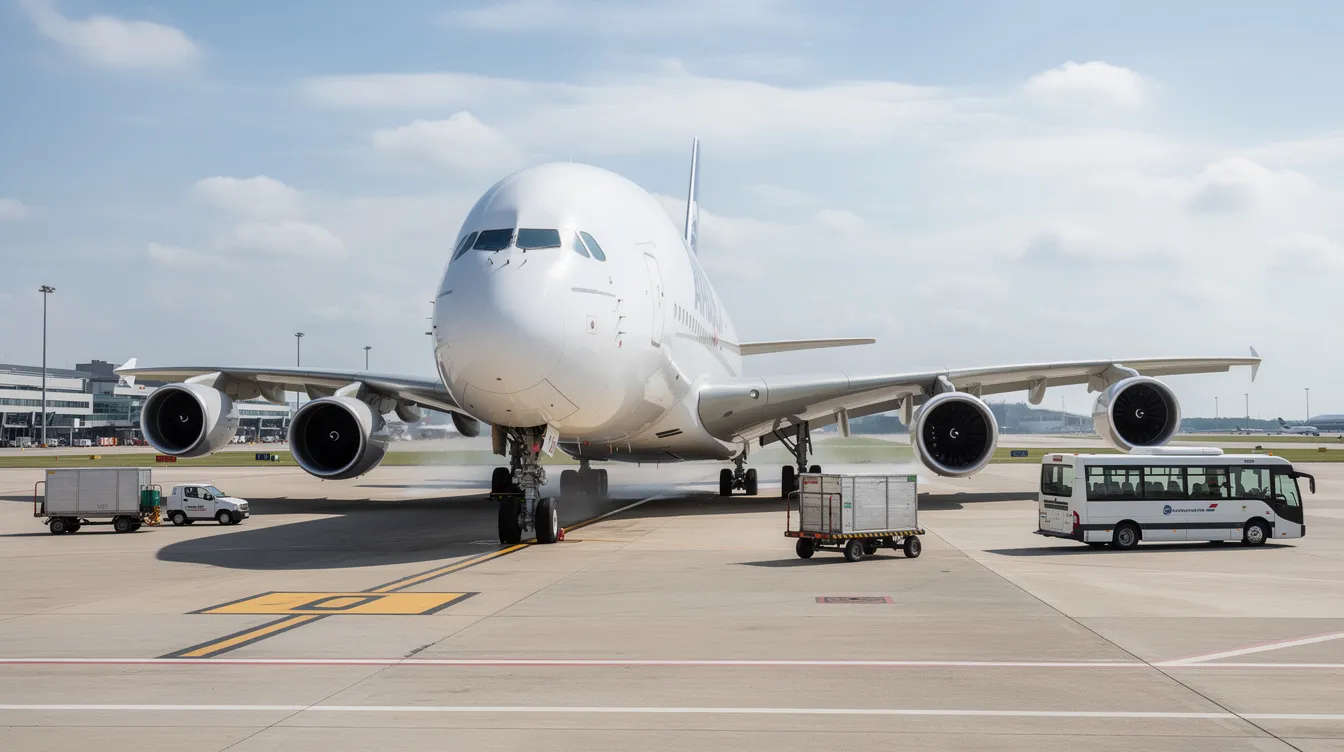
Introduction: Why Airbus A380 Weight in Tons Matters
The Airbus A380 has a maximum takeoff weight of approximately 575,000 kg, or 575 metric tonnes, making it the heaviest operational passenger airliner in aviation history. For aviation professionals, enthusiasts, frequent business or high-net-worth travelers, and private aviation clients comparing commercial and charter options, that single figure explains far more than size alone: it determines where the aircraft can operate, how much fuel it burns, what it costs to fly, and why aircraft selection matters.
When aviation professionals and enthusiasts discuss Airbus A380 weight in tons, they are referencing metric tonnes (1,000 kg each), the standard unit used throughout global aviation. This article examines the A380’s weight specifications, the operational impact of its 575-tonne takeoff weight, airport and runway requirements, engineering choices behind the aircraft, environmental and cost considerations, and how those factors compare with private jets and right-sized travel alternatives.
That 575-tonne figure is not just an engineering curiosity. It shapes nearly every dimension of how this aircraft operates:
A takeoff weight of 575 tonnes demands runways of approximately 3,000 meters, restricting the A380 to roughly 100–120 airports worldwide that can support its pavement loads and gate infrastructure.
Fuel burn at maximum weight is substantial. The aircraft's four engines consume fuel at rates that only become efficient on a per-seat basis when hundreds of seats are filled consistently.
Runway length, airport fees, and maintenance costs all scale with an aircraft's weight, making the A380 one of the most expensive commercial airliners to operate per flight hour.
For airlines operating the type, airline economics hinge on filling 500+ seats on dense hub-to-hub routes where demand justifies the sheer mass.
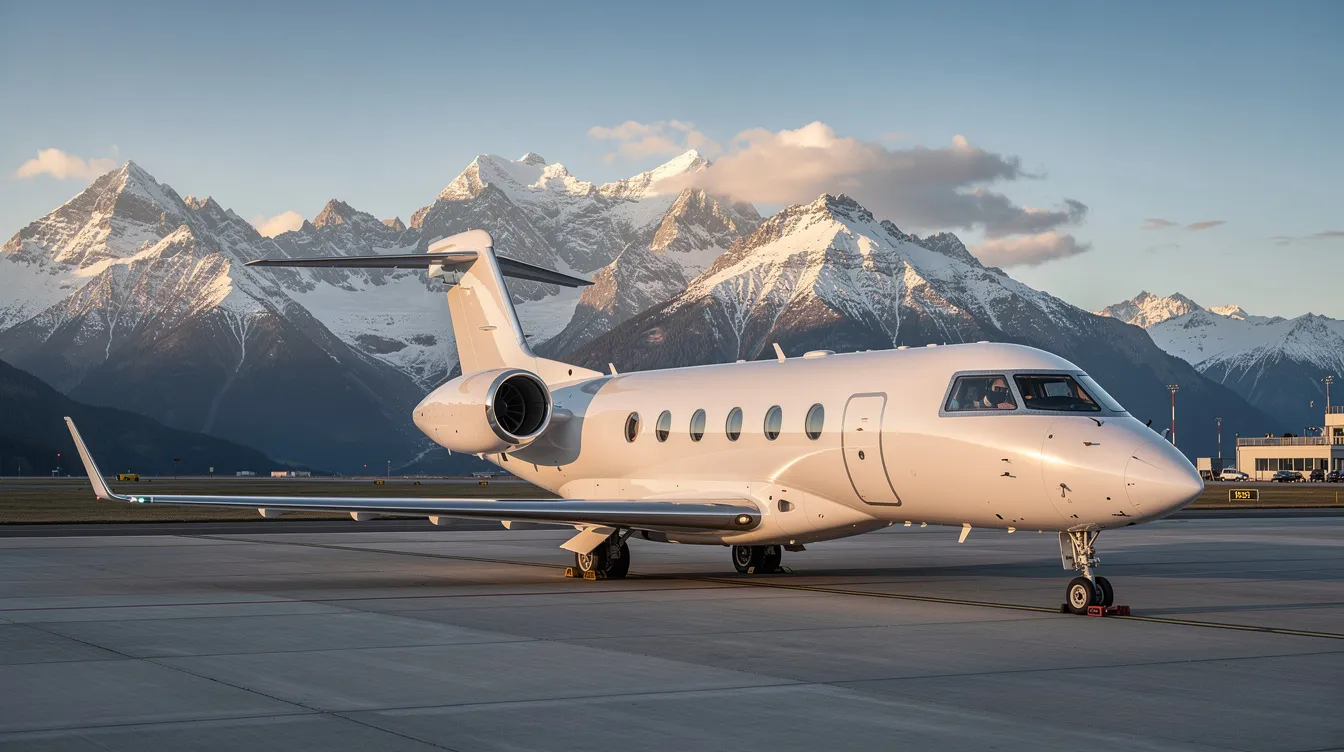
From BlackJet's perspective, the A380 represents the opposite end of the spectrum from private aviation. Where the superjumbo demands massive infrastructure and high load factors, right-sized private jets used in Jet Card programs offer flexibility, direct routing, and access to thousands of airports the A380 could never reach. Understanding what 575 tonnes really means helps discerning travelers appreciate why matching aircraft to mission-rather than defaulting to the biggest option-is a strategic advantage.
Key Takeaways: Airbus A380 Weight at a Glance
The A380-800's highest certified maximum takeoff weight is approximately 575 tonnes (575,000 kg), with some earlier variants certified around 560 tonnes.
Operating empty weight sits at roughly 277,000 kg (277 tonnes) for a standard three-class interior, though luxury configurations can push this closer to 297 tonnes.
Maximum landing weight is approximately 394,000 kg (394 tonnes), creating a significant gap of about 181 tonnes between maximum takeoff weight and maximum landing weight-fuel that must be burned before landing.
Maximum zero fuel weight ranges from 361,000 to 373,000 kg, yielding a typical maximum payload of about 84 tonnes once operating empty weight is subtracted.
Maximum fuel capacity is 320,000 liters of usable fuel, equaling roughly 254 tonnes, which accounts for about 44–45% of the total takeoff weight at maximum loading.
For context, a Gulfstream G700-one of the largest private jets in the world-has a maximum takeoff weight of about 48 tonnes. The A380 outweighs it by more than tenfold.
Core Weight Definitions: MTOW, OEW, MLW, MZFW
Every aircraft operates within a set of certified weight limits that protect its structure, wings, and landing gear from loads beyond design tolerances. For the Airbus A380, these core weight definitions are certified by EASA and the FAA through formal Type Certificate Data Sheets, and each number has direct implications for operations, route planning, and safety.
Maximum take-off weight (MTOW): the heaviest weight at which the A380 may legally begin its takeoff roll. For the highest-certified A380-800 variants, MTOW is 575,000 kg (575 tonnes). This includes the empty aircraft, all fuel, passengers, baggage, cargo, crew, and onboard supplies.
Operating empty weight (OEW): the weight of the aircraft ready to fly-with crew, unusable fluids, fixed cabin equipment, galleys, and emergency gear-but excluding passengers, cargo, and usable fuel. The A380's operating empty weight is around 277,000 kg for a standard configuration.
Maximum landing weight (MLW): the heaviest weight at which the aircraft is certified to touch down safely. The A380's maximum landing weight is approximately 394,000 kg (394 tonnes). There is a significant gap between the maximum takeoff weight and the maximum landing weight, reflecting how much fuel must be consumed in flight before a safe landing.
Maximum zero fuel weight (MZFW): the maximum weight of the aircraft with everything aboard except usable fuel. For the A380-800, MZFW ranges from about 361,000 to 373,000 kg depending on variant. Any weight above MZFW must come from fuel carried in the wings, which helps distribute loads and relieve bending stress during flight.
These same concepts-MTOW, OEW, MLW, MZFW-govern every aircraft in private aviation, including the business jets in BlackJet's network. The scale differs dramatically (a Gulfstream's weight is measured in tens of tonnes, not hundreds), but the engineering logic is identical.
Detailed Airbus A380 Weight Specifications by Variant
The Airbus A380 can have different maximum takeoff weights depending on the operational variant, a flexibility that allows airlines to match the aircraft's capabilities to their route networks.
The A380-800 was certified across multiple weight variants (designated WV000 through WV014 in EASA documentation). MTOW ranges from about 480,000 kg for lighter, shorter-range variants up to 575,000 kg for the highest weight options.
OEW fluctuates by several tonnes depending on interior fit. An all-economy configuration with minimal galleys might weigh less than 277 tonnes empty, while an ultra-luxury three-class layout with onboard bars, shower suites, and premium cabins can push OEW toward 296,600 kg.
MZFW differences across variants-roughly 361,000 to 373,000 kg-directly determine maximum structural payload. With an OEW around 277 tonnes and a MZFW of 361 tonnes, the resulting maximum payload is approximately 84 tonnes.
The Airbus A380's maximum ramp weight is approximately 577 metric tons, slightly above MTOW to account for fuel burned during taxi before reaching the runway threshold.
Later production aircraft benefited from higher weight options introduced around 2012–2013. These raised MTOW from the original ~560 tonnes to 573 and then 575 tonnes, extending range by roughly 100–150 nautical miles at similar payloads without requiring major structural redesign. Airbus engineers achieved this by exploiting existing structural margins and implementing incremental refinements.
From Empty Shell to Full Load: How Airbus A380 Takeoff Weight Builds Up
Understanding how an empty aircraft transforms into a 575-tonne giant at the runway threshold requires tracing each weight component, step by step.
Start with operating empty weight: approximately 277 tonnes. This is the empty shell plus crew, fixed equipment, unusable fluids, and all cabin furnishings-everything excluding passengers and usable fuel.
Add passengers and baggage. The Airbus A380 typically can carry around 545 passengers in a three-class layout. How many passengers board depends on the configuration, but at roughly 100 kg per passenger (including carry-on and checked baggage), 520–540 passengers add approximately 52–54 tonnes. The actual passenger count varies by airline-Emirates runs around 489 in a premium-heavy layout, while some carriers seat 600+ in denser configurations.
Add cargo and mail. Belly cargo on a long-haul A380 flight might contribute 10–20 tonnes, depending on route demand and how much cargo space passengers' checked luggage already occupies.
Add fuel. This is where the numbers climb dramatically. On a medium-haul sector (say, London to Dubai at roughly 5,500 km), an A380 might carry 100–120 tonnes of fuel. On ultra-long-haul routes of 14–15 hours, fuel weight can reach 230–250+ tonnes, pushing the aircraft near its 575-tonne MTOW.
Consider a concrete example: an Emirates A380 departing Dubai for Sydney (approximately 12,000 km) with a full cabin of around 489 passengers. The combination of passengers, baggage, cargo, and the roughly 230+ tonnes of fuel needed for the sector pushes the aircraft very close to its maximum weight at the runway threshold.
Dispatchers and load planners constantly trade payload against fuel to respect MTOW. If a long sector demands maximum fuel, the passenger count or cargo may be reduced. These same payload-range trade-offs apply to long-range private jets serving BlackJet clients, albeit on a much smaller scale-where a few extra golf bags might mean a fuel stop on a transatlantic crossing.
Fuel Weight, Fuel Burn, and Range for the Airbus A380
Fuel dominates the A380's weight equation. On a fully loaded ultra-long-haul departure, fuel weight alone can approach the combined mass of everything else aboard.
Maximum fuel capacity is 320,000 liters (approximately 253,000–260,000 kg of usable fuel at standard Jet A density). That fuel weight represents roughly 44–45% of the aircraft's maximum takeoff weight-a proportion consistent with long-range widebody design.
The A380's fuel burn is about 3.1 liters per 100 passenger-kilometers in a typical three-class layout of around 500–550 seats. In an all-economy configuration with 800+ seats, fuel efficiency can reach 2.4 liters per 100 passenger-kilometers, rivaling some of the most efficient modern twins on a per-seat basis.
Heavier takeoff weight drives higher initial fuel burn. At 575 tonnes, the four engines must produce substantially more thrust during takeoff and climb than at lighter departure weights, consuming fuel at peak rates. As fuel is burned en route and the aircraft lightens, aerodynamic efficiency improves and fuel burn per hour decreases-a natural benefit of long-haul operations.
This weight-driven fuel burn directly ties into CO₂ emissions and environmental performance. Every additional tonne at departure translates to measurable increases in carbon output. Understanding this relationship is essential context for the sustainability commitments increasingly demanded across both commercial aviation and private aviation-including BlackJet's carbon-neutral flight program, where fuel burn is factored into offset and insetting initiatives.
Runway Length and Airport Compatibility at 575 Tonnes
The A380's weight dictates where it can physically operate, and that list is far shorter than most travelers realize.
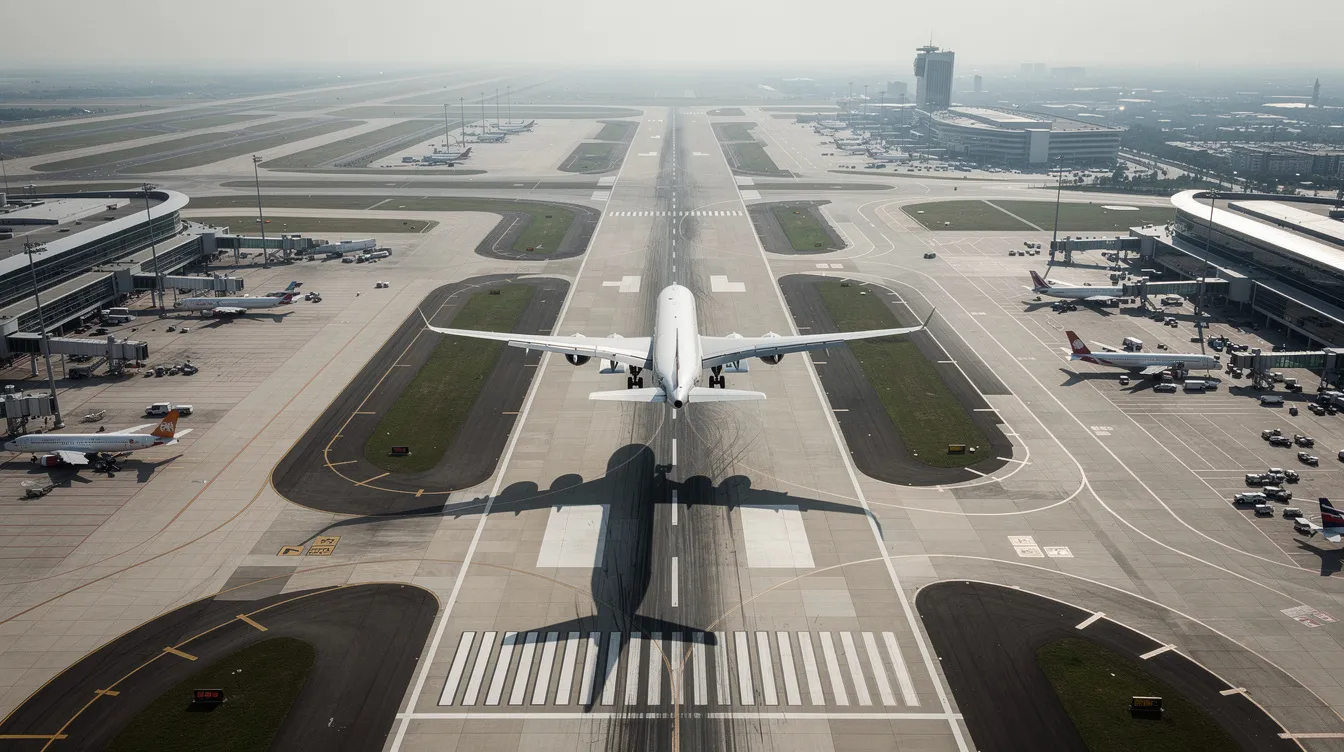
The A380 requires runways of approximately 3,000 meters for takeoff at or near maximum takeoff weight under standard sea-level, ISA atmospheric conditions. This minimum runway length effectively excludes thousands of airports worldwide.
Higher airfield elevation, hotter ambient temperatures, and uphill runway slopes all increase required takeoff distance. A 575-tonne A380 departing a high-altitude, high-temperature airport may need 3,500 meters or more.
The A380 is classified in the wake turbulence category "Super"-the only aircraft in this category-requiring larger separation distances from following traffic, which affects airport throughput.
The A380 requires pavement classification numbers high enough for its weight, meaning runway, taxiway, and apron surfaces must be engineered (or reinforced) to handle concentrated loads distributed across 22 wheels. Many airports have invested millions in pavement upgrades specifically for A380 operations.
The A380's weight limits operational flexibility to about 100–120 airports globally-the major international hubs with infrastructure capable of supporting this very large aircraft.
Compare this with private jets, which can operate from runways under 2,000 meters. Many aircraft requiring smaller runways access secondary airports closer to city centers, resort destinations, and business districts that no commercial airliner-let alone a 575-tonne superjumbo-could ever reach.
Landing Gear, Brakes, and Supporting Over 500 Tonnes
The A380's landing gear is an engineering achievement designed to distribute and absorb loads that would destroy most runway surfaces.
The aircraft features a nose gear assembly plus four main landing gear assemblies, totaling 22 wheels. Two body-mounted gear units each carry six wheels, and two wing-mounted units each carry four, spreading the aircraft's weight across a wide footprint to protect pavement.
Wheel count and bogie layout are calibrated so that no single tire or gear leg bears an unsustainable share of the roughly 395-tonne landing mass. Tire pressures and sizes are chosen to match the pavement bearing capacity of Class F airports.
High-energy carbon brake systems and sophisticated anti-skid technology absorb the kinetic energy of a landing at maximum landing weight-approximately 394 tonnes of aircraft decelerating from roughly 260 km/h. The braking energy at maximum landing weight is enormous, requiring brake packs capable of absorbing heat equivalent to what would melt several tonnes of steel.
For comparison, a Bombardier Global 7500 or Gulfstream G700 uses 10–14 wheels and brakes sized for aircraft weighing under 52 tonnes-roughly one-eighth the A380's landing mass. The engineering principles are the same; the scale is a different universe.
Engineering the World's Heaviest Passenger Jet
The story of the A380's weight begins in the early 1990s, when Airbus began studying concepts for a very large aircraft capable of challenging the Boeing 747's dominance on high-density long-haul routes.
The formal A3XX program launched in 2000, with weight control as a primary design objective. Airbus aimed for 15% lower operating costs per seat than the Boeing 747-400, which meant the A380 had to carry significantly more passengers without a proportional increase in empty weight.
The "weight spiral" was the central engineering challenge: heavier structure demands larger wings, which require more fuel, which adds weight, which demands stronger structure. Airbus engineers attacked this spiral with advanced materials, optimized load paths, and digital design tools.
Digital mock-ups helped eliminate redundant components in design. The A380 was among the first commercial aircraft fully designed using a digital mock-up, allowing engineers to identify interference, remove unnecessary structure, and refine systems integration before cutting metal.
The A380's wings incorporate wingtip fences to reduce induced drag and improve fuel efficiency, lowering the thrust required at a given weight and reducing fuel consumption and thus fuel mass required for a given range.
The A380's maiden flight took place on 27 April 2005, proving that the world's largest passenger airliner could fly within its target weight envelope. The aircraft entered service with Singapore Airlines in October 2007, weighing in with an MTOW of about 560 tonnes in its initial variant.
Materials, Structure, and Core Weight-Saving Technologies
The A380 was a proving ground for materials and manufacturing techniques that would reshape how large aircraft are built.
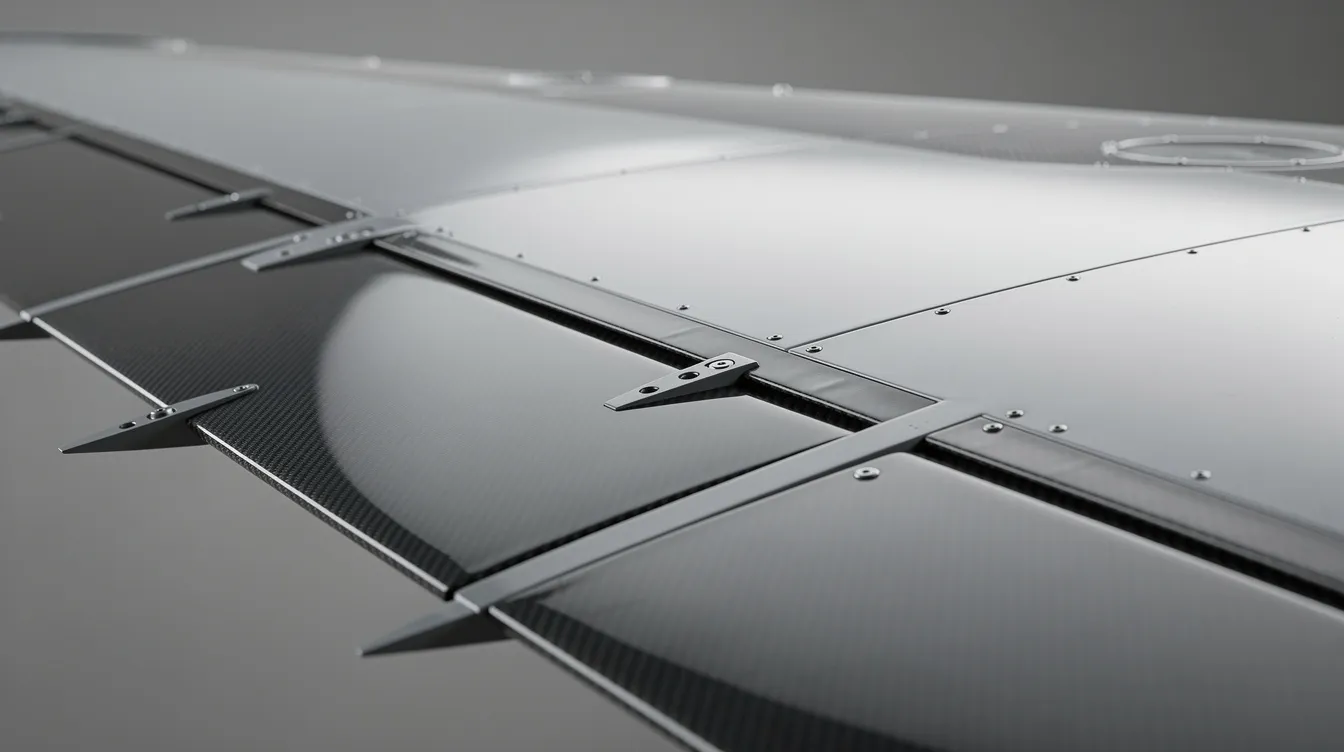
The A380 uses carbon fiber reinforced plastic extensively in the central wing box-one of the most structurally critical components of any aircraft. CFRP was also applied to tail surfaces (vertical and horizontal stabilizers), floor beams, and other secondary structures, saving thousands of kilograms compared with equivalent aluminum designs.
GLARE panels improve fatigue resistance and reduce weight in the upper fuselage. This glass-fiber reinforced aluminum laminate is lighter than traditional aluminum skin panels and more resistant to fatigue cracking, extending inspection intervals and improving long-term structural integrity.
Advanced aluminum-lithium alloys were selected for wing spars and select fuselage skins, offering weight reduction of roughly 5–10% compared to conventional aluminum alloys at equivalent strength.
Laser beam welding replaced thousands of rivets in fuselage panel joints, yielding smoother surfaces (less drag), lighter seams, and faster assembly. The weight reduction from eliminating rivets and their associated doublers was significant at the full-airframe scale.
These innovations, first validated on a 500+ tonne commercial airliner, later influenced newer widebodies like the A350 and high-end business jets that private aviation clients regularly fly on. The composite-intensive structure of today's Gulfstream and Bombardier flagships owes a design debt to the lessons learned at A380 scale.
Avionics, Systems, and "Invisible" Weight Reduction
Not all weight savings come from materials. On an aircraft as complex as the A380, system-level engineering decisions collectively saved hundreds of kilograms that never appear in marketing brochures.
Integrated modular avionics reduce wiring mass significantly. By consolidating dozens of discrete computing functions into shared processing modules, Airbus eliminated entire racks of standalone avionics boxes and the copper wiring harnesses connecting them. The result: a lighter, more maintainable avionics bay.
The hydraulic system operates at 350 bar (5,000 psi), nearly double the pressure of traditional 210-bar systems found on previous-generation airliners. Higher pressure means smaller actuators, thinner tubing, and less hydraulic fluid-all translating directly to weight reduction.
"Power-by-wire" technology shifts certain flight control and utility functions from hydraulic actuation to electric, reducing the need for heavy hydraulic plumbing runs throughout the airframe.
Environmental control systems, cabin pressurization components, and electrical distribution were all optimized for mass. When every kilogram saved at system level can be converted into payload or fuel reserve without exceeding maximum weight, the engineering incentive is relentless. These incremental savings-difficult to see but impossible to ignore in aggregate-kept the A380's operating empty weight within certifiable targets for a 575-tonne design.
From Maiden Flight to High-Weight Options: A380 Weight Evolution
The A380's weight story did not end at entry into service. Over a decade, Airbus progressively unlocked higher capabilities from the existing airframe.
Early production A380-800s entered service around 2007 with Singapore Airlines, certified at an MTOW of approximately 560 tonnes. These initial aircraft served routes that did not demand the absolute maximum range.
By roughly 2010, incremental structural refinements and exploitation of existing structural margins raised available MTOW options to about 569–573 tonnes, with later production aircraft benefiting from OEW reductions of approximately 1.8 tonnes through the FAST (Fuel And Structural Technology) enhancement program.
The full 575-tonne MTOW certification arrived around 2012–2013, along with matching increases in MLW and MZFW. Higher engine thrust ratings from both Engine Alliance (GP7200) and Rolls-Royce (Trent 900) supported the heavier operations.
In 2017, Airbus proposed the A380plus concept, exploring an MTOW increase to about 578 tonnes alongside winglet modifications and cabin densification. The concept was never fully commercialized, and Airbus ceased A380 deliveries in 2021-but the engineering work demonstrated that the airframe still had margin.
Weight, Fuel Burn, and Environmental Performance
The relationship between the A380's mass and its environmental footprint is nuanced. On paper, it can be remarkably efficient-but only under specific conditions.
When cabins are full, the A380 achieves strong per-seat fuel efficiency. In an all-economy configuration seating up to 853 passengers, fuel burn can drop to about 2.4 liters per 100 passenger-kilometers, rivaling or beating modern twin-engine widebodies. In a typical three-class layout with fewer passengers, the figure rises to about 3.1 liters per 100 passenger-kilometers—just as the value of a 50-hour jet card depends on consistently flying enough to spread fixed costs over more passenger trips.
The A380's heavy weight increases fuel burn and operating costs in absolute terms. Four engines and a structure weighing 277+ tonnes empty mean that even before a single passenger boards, the aircraft consumes substantially more fuel per hour than lighter twins like the A350 or 787.
Empty weight per seat is relatively high in premium-heavy configurations. Airlines operating the A380 with first-class suites, onboard lounges, and shower facilities trade fuel efficiency for passenger experience-seats go down, weight per seat goes up, and per-passenger emissions rise accordingly.
Lightly loaded flights amplify the inefficiency. If an A380 departs with 300 passengers instead of 500, fuel burn per passenger roughly doubles compared with a full cabin, making the aircraft environmentally questionable on routes where demand is inconsistent.
These dynamics drive the broader sustainability conversation in both commercial aviation and private aviation. BlackJet's carbon-neutral commitment addresses the fuel-burn reality of every flight, with fuel consumption data and advanced flight time planning tools factored into offset programs that ensure every journey has a net-zero carbon footprint-regardless of aircraft size.
Comparing Airbus A380 Weight with Other Large Aircraft
The A380's weight advantage over other passenger aircraft is not marginal-it is categorical.
Airbus A380-800: MTOW ≈ 575 tonnes, a scale far beyond even the largest private jet for 20 passengers
Boeing 747-8: MTOW ≈ 447 tonnes, still over an order of magnitude heavier than a typical private jet for 30 passengers
Boeing 777-300ER: MTOW ≈ 352 tonnes, compared with VIP-configured private jets for 50 passengers that deliver large-group travel at significantly lower weights
Airbus A350-1000: MTOW ≈ 316 tonnes
In practice, these weight differences dictate gate size requirements, runway length needs, airport pavement specifications, and the ground-handling equipment required. The A380 demands infrastructure that smaller widebodies simply do not, which is why the concept of a private jet Airbus A380 remains an ultra-rare, bespoke solution for only the most specialized missions.
While the A380 holds the crown as the world's largest passenger airliner, newer twin-engine aircraft often achieve better economics due to lower empty weight, fewer engines, and the ability to serve point-to-point routes with fewer passengers at similar or lower cost per seat.
The A380 is the only aircraft assigned to the "Super" wake turbulence category, requiring increased separation from following traffic-a constraint no other passenger aircraft imposes.
Most airports that can accept an A380 can easily accommodate any large private jet. The reverse is categorically untrue: the vast majority of airports suitable for private jets-numbering in the thousands worldwide-cannot handle A380 loads, widths, or pavement requirements.
A380 Weight vs Private Jets: Scale, Flexibility, and Private Aviation
The weight gap between the A380 and the business jets used in private aviation is so vast that it reshapes every operational consideration.
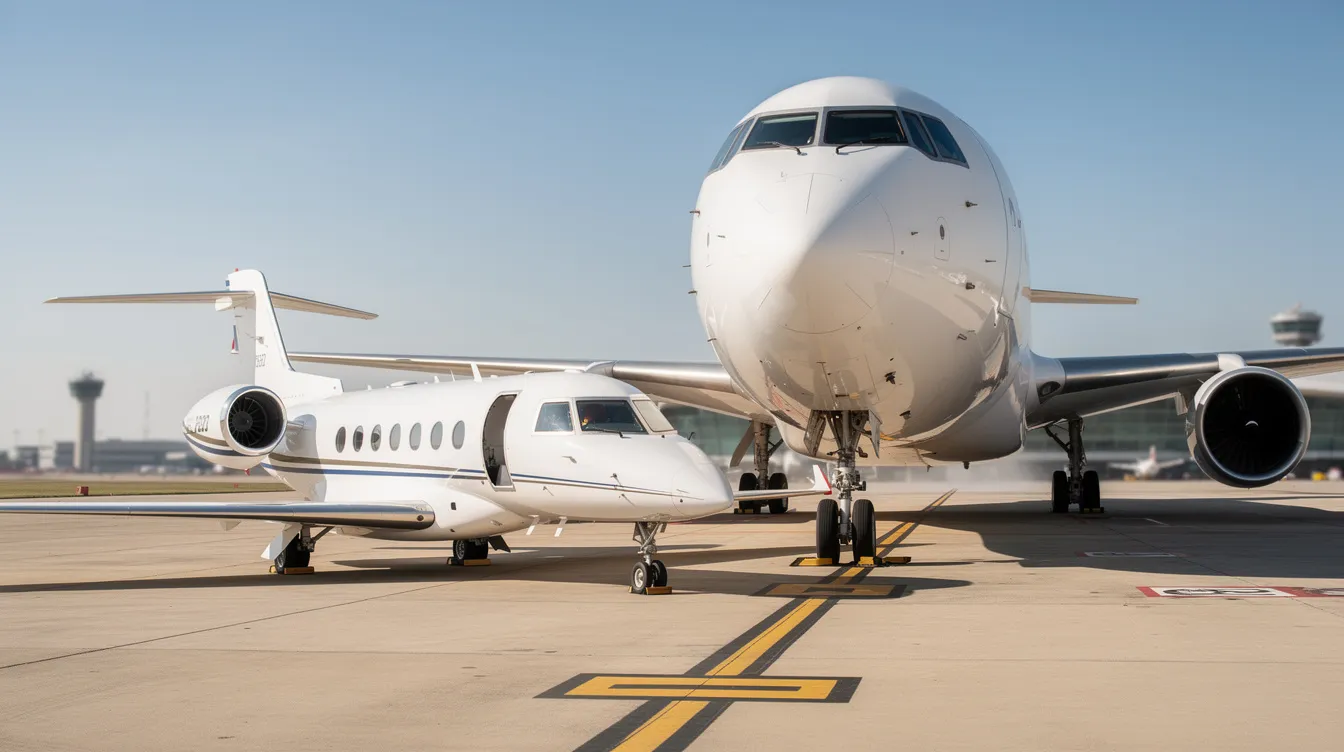
The A380's MTOW of approximately 575,000 kg dwarfs the weight of a private jet. A Gulfstream G650 has an MTOW of roughly 45 tonnes. The A380 outweighs a Gulfstream G650 by about ten times. A Gulfstream G700 sits at about 48 tonnes; a Bombardier Global 7500 at roughly 52 tonnes; a Dassault Falcon 8X at about 33 tonnes—figures that sit at the upper end of the spectrum of types of private jets for every traveler.
These weight differences translate directly into runway access. Where the A380 needs 3,000 meters of reinforced pavement, a large-cabin business jet can operate from 1,500–2,000 meters-or less. This opens thousands of secondary airports, regional fields, and destinations that no commercial airliner can reach.
While the A380 can carry up to 853 passengers in an all-economy configuration, its typical seating in commercial service is far lower, while a private jet usually seats 8–19. For larger parties, 16-seat private jet options and similar large-cabin aircraft bridge the gap, but the value proposition is fundamentally different: private aviation clients prioritize time savings, privacy, direct routing, and schedule control over passenger capacity.
BlackJet's Jet Card programs use detailed weight and performance data to match members with right-sized private jets across its network. Rather than filling superjumbos on hub routes, private aviation focuses on placing the right aircraft-whether light jet, super-midsize, or large cabin-on the mission at hand, maximizing airport access and minimizing wasted capacity.
Operational Economics: How Weight Drives A380 Cost per Hour
The A380's operating costs are among the highest of any commercial aircraft, and weight is the central driver.
Approximate A380 operating cost runs around USD 24,000–28,000 per flight hour, encompassing fuel, crew, maintenance, insurance, and reserves—figures that dwarf typical jet card cost per hour in the private aviation world. The A380's operating costs are high due to its four-engine design, which doubles engine maintenance events compared with twin-engine competitors.
Airports charge higher fees based on the A380's maximum takeoff weight. Landing fees, parking charges, navigation surcharges, and ground handling costs at major international hubs are typically calculated using MTOW as a multiplier, making the A380 one of the most expensive aircraft to park and turn.
Airlines rely on high load factors-often 80%+ cabin fill-to dilute these fixed, weight-driven costs across hundreds of passengers, in much the same way that a 100-hour jet card cost becomes more compelling for travelers who know they will consistently use the hours purchased. When passenger counts drop below break-even, the A380 bleeds money faster than smaller widebodies because its absolute operating costs remain stubbornly high regardless of how many seats are occupied.
In private aviation, cost per seat is inherently higher, but the value equation is different. Lower operating costs per flight hour (relative to an A380) combine with time saved bypassing hub connections, direct routing to smaller airports, and the privacy of a dedicated cabin. For BlackJet members evaluating how much to rent a private jet, the relevant metric is not seat-mile cost but total trip value: hours saved, meetings made, and the quality of the journey itself.
Weight, Ride Quality, and Passenger Experience
Mass is not always a disadvantage. In the air, the A380's sheer weight and dimensions deliver a passenger experience that lighter aircraft struggle to match.
The A380's mass and large wing area (845 m²) contribute to a smoother ride. Heavier aircraft are inherently more resistant to turbulence-induced acceleration, and the A380's wing loading characteristics mean fewer passengers reach for the armrest during rough weather.
Airbus designed the A380 to produce half the noise footprint of previous-generation airliners like the 747-400, achieved through engine nacelle acoustics, airframe shaping, and the structural mass that naturally dampens vibration. Cabin noise levels are notably lower than on other aircraft, especially on the upper deck.
The aircraft offers approximately 550 m² of usable floor space spread across two full-length decks, with a cabin length of about 50 meters on each level. This generous usable floor space enables airlines to install features unthinkable on smaller commercial aircraft.
Airlines like Emirates, Singapore Airlines, and Korean Air leveraged the A380's weight-supported structure to install onboard bars, shower spas, and private suites. These features-each adding hundreds of kilograms to OEW-are only possible because the A380's structural capacity can absorb them within its certified weight limits.
Compare this to the tailored, small-group privacy of modern private jets, where BlackJet focuses on intimate, customizable experiences. A private jet cabin may be one-twentieth the size of an A380's, but for the executive who values a direct routing to a meeting in 90 minutes rather than transiting a mega-hub, that intimacy is the point.
Safety Margins and Structural Strength at Extreme Weights
Operating at weights approaching 575 tonnes demands structural integrity that goes far beyond ordinary engineering margins.
Certification required the A380's wings and fuselage to withstand 150% of the maximum design load in static tests. During wing destruction testing, the structure held beyond 145% before failure, validating that the aircraft operates with substantial reserve strength in service.
The A380 has had no hull loss accidents as of mid-2026, despite over a decade of service at takeoff weights regularly approaching 575 tonnes on long-haul flights operated by more than a dozen airlines. This record reflects both the structural conservatism of the design and the operational discipline of airlines operating the type.
Multiple redundant hydraulic, electrical, and flight control systems are dimensioned specifically for the aircraft's weight. Each hydraulic system is sized to handle the loads of moving control surfaces on a 575-tonne aircraft in extreme conditions, and triple-redundant fly-by-wire ensures control authority even with multiple system failures.
These rigorous safety standards parallel the principles governing private aviation safety. BlackJet selects operators that adhere to top-tier safety certifications-ARGUS Platinum, Wyvern Wingman, and equivalent programs-grounded in the same physics-based safety philosophy that keeps a 575-tonne aircraft intact through decades of service.
Weight, Range, and Long-Haul Route Planning
Flight planning for the A380 is fundamentally an exercise in managing the tension between payload, fuel, and distance.
Payload-range charts for the A380 show clear trade-offs: at the typical maximum payload of approximately 84 tonnes, range is limited to roughly 8,000 nautical miles. Reducing payload allows more fuel and extends range further, though most airlines optimize for the revenue-maximizing balance rather than absolute distance.
On shorter trunk routes-London to Dubai, Singapore to Sydney-airlines may fly well below MTOW, maximizing passenger count and cargo while carrying only the fuel needed for the sector plus reserves. These flights might depart at 500–530 tonnes, excluding passengers from the weight concern entirely.
On ultra-long sectors, the calculus shifts. How much cargo the aircraft can carry drops as fuel requirements rise. A fully fueled A380 departing for a 14-hour sector may sacrifice several tonnes of belly cargo-or even limit passenger sales-to remain within MTOW.
Maximum landing weight (~394 tonnes) introduces another constraint. If an A380 must divert shortly after a heavy takeoff, it may need to burn fuel in a holding pattern or, in rare emergencies, dump fuel to reduce weight below MLW before landing safely.
For long-range private jets used by BlackJet clients, payload-range planning follows identical principles at a smaller scale. A member flying from New York to London on a large-cabin jet must account for passenger count, luggage weight, and non-stop leg length-much as an airline dispatcher does, but with the added flexibility to adjust departure airports, timing, and routing in real time.
A380 Weight and the Evolution of Large Aircraft Design
The A380 represents a zenith-and arguably the practical upper limit-of commercial airliner weight in the current era.
At 575 tonnes MTOW, the A380 proved that a double-deck, four-engine superjumbo could serve a niche of dense hub-to-hub routes where demand justified its scale. Routes like Dubai to London, Singapore to Sydney, and major Asian trunk sectors became its natural habitat.
Market trends, however, shifted toward lighter, twin-engine aircraft that balance weight, fuel burn, and flexibility for point-to-point networks. The Boeing 787 and Airbus A350 families-at roughly 250–316 tonnes MTOW-can serve many of the same city pairs with better economics and access to more airports.
Some A380s have been retired or redeployed as traffic patterns evolved, particularly after the disruptions of 2020. Sheer size and maximum weight are not always strategic advantages; operational flexibility, lower operating costs, and network versatility increasingly win.
Lessons from A380 weight management-advanced composites, high-pressure hydraulics, integrated modular avionics, digital design-cascade down to new generations of aircraft, including business jets favored in private aviation. The technologies that kept 575 tonnes airborne now help keep 50-tonne private jets lighter, more efficient, and more capable than ever.
What Airbus A380 Weight Teaches About Right-Sizing Aircraft for Travelers
The A380 is a masterclass in how "bigger and heavier" can be efficient only under very specific conditions-and deeply inefficient otherwise.
The A380 delivers impressive per-seat economics and fuel efficiency when 500+ passengers board every departure. Remove that demand concentration, and the aircraft's weight becomes a liability rather than a strength, with absolute fuel burn and operating costs remaining high regardless of how many seats are filled.
Private aviation clients face fundamentally different requirements: smaller groups, variable schedules, multiple destinations per trip, and the need to access airports closer to final meetings, resorts, or residences.
Right-sized aircraft-from light jets at 8 tonnes to large-cabin business jets at 50 tonnes-balance weight, fuel burn, runway length, and cabin comfort around much smaller passenger counts. Many of the best private jets in the world are engineered around exactly this balance, and the result is a travel experience built for precision rather than volume.
BlackJet's Jet Card model and on-demand services are built around this right-sizing principle, with jet card pricing structured to reflect aircraft size, mission profile, and expected utilization. Rather than forcing every trip into a one-size-fits-all mold, each journey is matched with the aircraft whose weight and performance profile is optimized for the mission-whether that is a two-hour hop to a mountain resort or a transatlantic crossing.
How BlackJet Uses Weight and Performance Data in Private Aviation
Behind every BlackJet itinerary is a set of calculations that would be familiar to any A380 dispatcher-scaled to the private jet world.
BlackJet's platform considers MTOW, runway length requirements, climb performance, cruise altitude, and fuel burn when recommending aircraft for member itineraries, recognizing that how high a private jet flies also influences efficiency and ride quality. A member requesting a flight into Aspen (elevation 7,820 feet, runway 8,006 feet) will be matched to an aircraft whose weight and high-altitude performance ensure safe operations-unlike an A380, which could never land there.
Consider a scenario: a Jet Card member flying from New York to London receives a large-cabin jet recommendation based on range, passenger count, and baggage. The same member flying New York to Aspen gets a super-midsize jet that handles the altitude, shorter runway, and mountain approach. Tools like a private jet flight time calculator help refine these choices, but aircraft weight and runway length ultimately shape every recommendation.
Lighter, efficient jets can access smaller airports and minimize block times, which is often more valuable than flying on the largest possible aircraft. Proximity to the final destination-not aircraft size-drives the time savings that matter.
All flights arranged through BlackJet are carbon-neutral. Fuel burn-directly tied to aircraft weight-is factored into high-quality offset programs, ensuring that whether a member flies a 10-tonne light jet or a 50-tonne large-cabin aircraft, the carbon footprint is addressed comprehensively.
Frequently Asked Questions About Airbus A380 Weight
How heavy is the Airbus A380 in tons?
The A380-800's maximum takeoff weight is approximately 575 metric tonnes (575,000 kg), making it the heaviest passenger airliner in regular service. Some earlier variants were certified at around 560 tonnes. For readers accustomed to US short tons (2,000 lbs each), 575 metric tonnes equals roughly 634 short tons. This maximum weight encompasses the aircraft structure, fuel, passengers, baggage, cargo, crew, and all onboard systems at the moment the takeoff roll begins.
How does Airbus A380 weight compare to private jets used in BlackJet's ecosystem?
A large private jet like the Gulfstream G650 has an MTOW of roughly 45 tonnes-under 10% of an A380's maximum takeoff weight. Super-midsize jets weigh 15–20 tonnes at maximum takeoff; light jets may be as low as 8–10 tonnes. The A380 is tens of times heavier than the aircraft BlackJet members typically fly. These weight differences are precisely why private jets can operate from far shorter runways and access thousands of airports that no commercial airliner-let alone a 575-tonne superjumbo-could ever serve. For high-net-worth travelers comparing first class on an A380 to a private jet via BlackJet, the practical difference is not just cabin size but the entire logistics chain: airport proximity, customs clearance speed, and schedule independence.
Does the A380's maximum takeoff weight always get used on every flight?
Airlines only approach MTOW on very long or heavily loaded flights. Many shorter sectors-for example, a London to Frankfurt positioning flight-might see the A380 depart at 450–500 tonnes, well below its 575-tonne ceiling. Flying below MTOW reduces required runway length, improves climb performance, and lowers per-flight fuel burn. Dispatchers and load planners adjust the passenger count, cargo weight, and fuel load for every departure based on route distance, forecast weather conditions, alternate airport requirements, and operational constraints. In practice, the 575-tonne figure represents a ceiling, not a daily reality.
How much fuel does an A380 carry in tons?
The A380's maximum fuel capacity is 320,000 liters-approximately 254 tonnes of usable fuel at standard Jet A density. This fuel weight alone is roughly five times the entire maximum takeoff weight of a Gulfstream G650. Not every flight carries full fuel; shorter sectors may load only 100–120 tonnes.
How does weight affect A380 runway length requirements?
At maximum takeoff weight, the A380 requires approximately 3,000 meters of runway under standard sea-level conditions. Every additional tonne increases the takeoff distance. High elevation, high temperature, or a tailwind component can push the required runway length well beyond 3,000 meters. For perspective, most private jets operate comfortably from runways of 1,500–2,000 meters-or even shorter-opening access to airports the A380 could never use.
Are there lighter or heavier certified A380 variants?
Yes. The A380-800 was certified across more than a dozen weight variants. The lightest (designed for shorter, high-frequency routes) have MTOWs around 480 tonnes, while the heaviest-optimized for ultra-long-haul operations-reach 575 tonnes. Each variant has corresponding differences in MLW, MZFW, and certified engine thrust ratings.
Elevate Your Travel - On Your Terms
The Airbus A380 is a remarkable feat of engineering-575 tonnes of structure, fuel, and ambition designed to move hundreds of people between the world's busiest hubs. But for travelers who value time, flexibility, and access over volume, the superjumbo model is a study in trade-offs that do not align with how they want to move.
BlackJet exists at the other end of that spectrum. Our Jet Card programs deliver the precision of right-sized aircraft, the efficiency of direct routing, and access to thousands of airports that no commercial airliner can reach. Every flight is carbon-neutral. Every journey is built around you, not around filling 500 seats.
Explore BlackJet's Jet Card programs, including flexible options like the 25-hour jet card, in-depth resources on jet card cost, focused analyses of NetJets jet card cost, broader jet card pricing comparisons, and the dedicated BlackJet 25+ Hour Jet Card, and discover how refined, purposeful travel becomes your new standard.


 Sign up with google
 Sign up with Apple