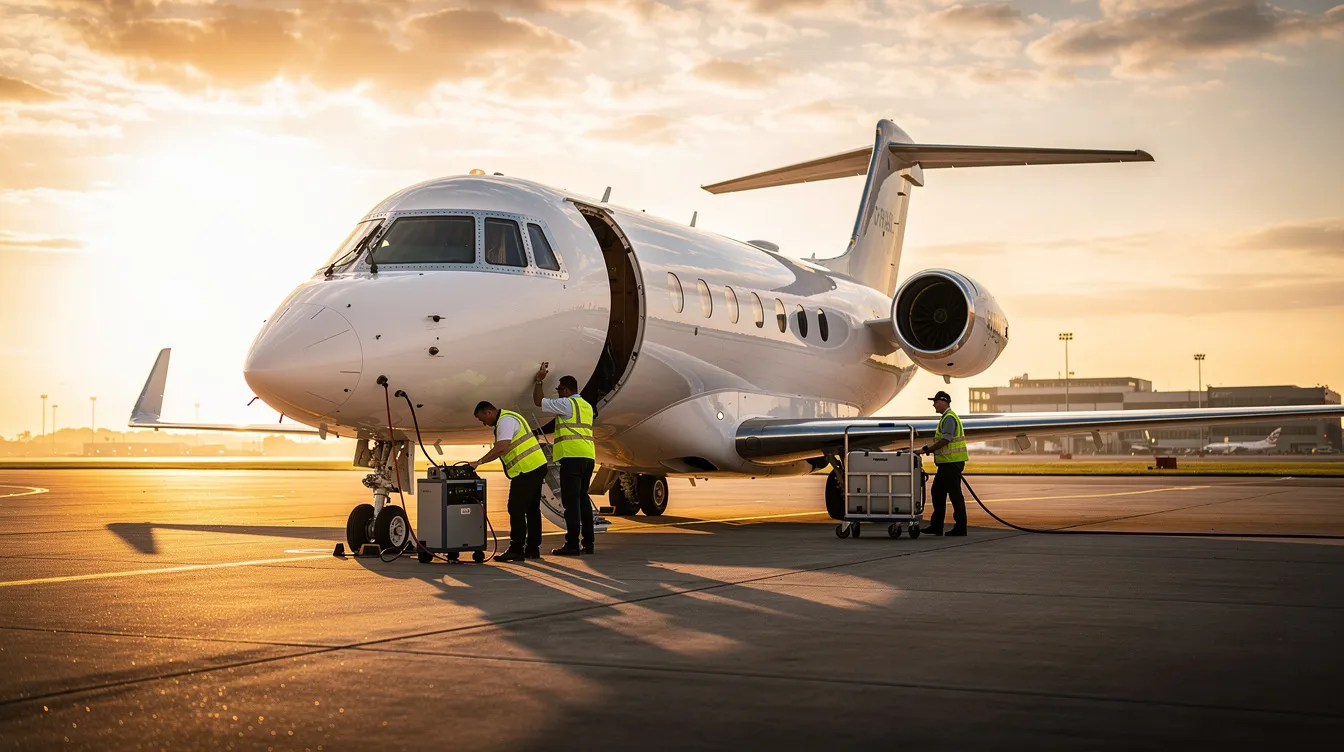
Not all first-class flights are created equal. A handful of airlines have pushed the boundaries of commercial aviation so far that their flagship cabins now resemble private apartments rather than airplane seats. Yet even the most lavish first-class suites operate within constraints that matter deeply to high-net-worth travelers: fixed schedules, hub-centric routing, and shared cabins with strangers. This guide is for frequent international travelers, business executives, and luxury seekers evaluating the world's best first-class suite airlines and private jet alternatives. Choosing the right first-class suite airline can dramatically impact your comfort, privacy, and travel efficiency—especially when compared to private jet options. If you are searching for the best first-class suite airline, this page directly addresses your query by comparing the top contenders and private jet solutions.
What is a First Class Suite?
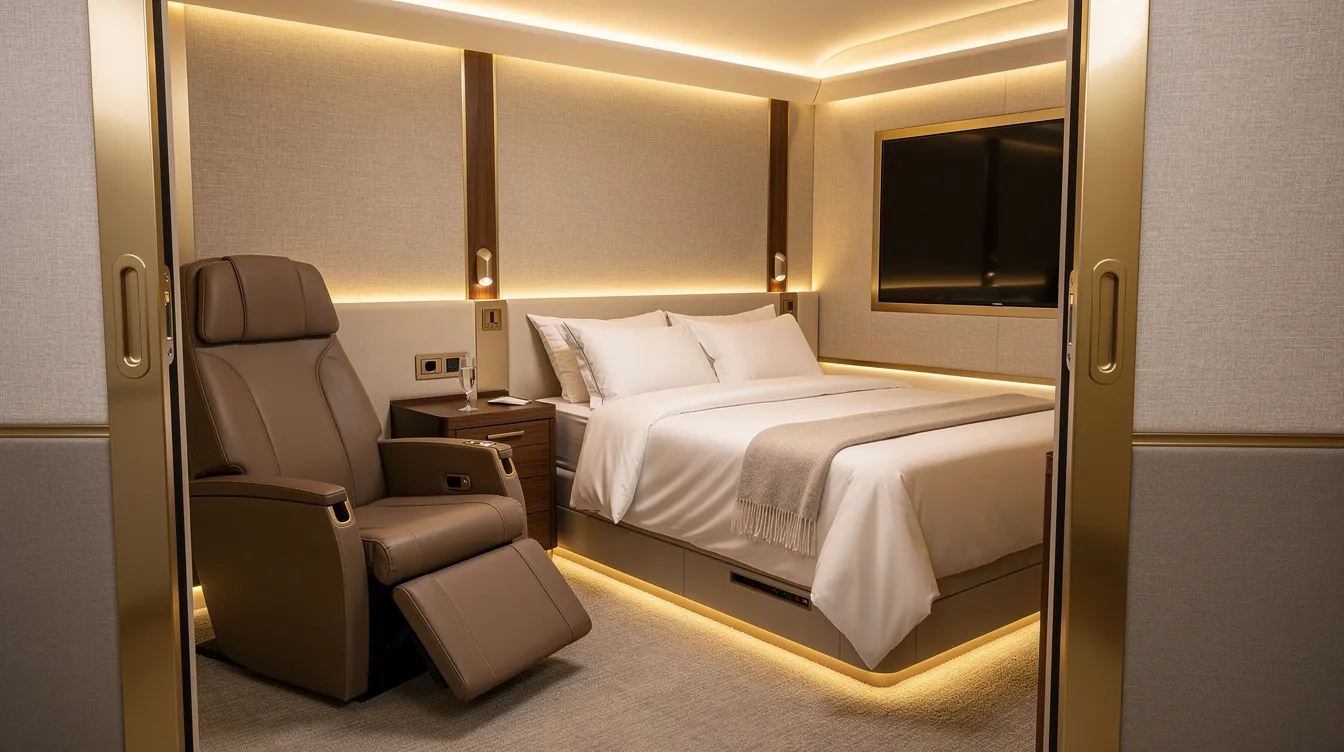
A first class suite is a premium airline cabin product that offers a fully enclosed or near-enclosed private space, often with floor-to-ceiling privacy doors, sliding partitions, or curtains. Unlike standard first class or business class, first class suites provide enhanced privacy, spacious seating, flat beds, and high-end amenities such as gourmet dining, personal minibars, and luxury bedding. Airlines known for private first class suites include Singapore Airlines, Etihad Airways, and Emirates, with features like fully enclosed suites (Emirates 777-300ER), curtained suites (Air France La Première), and sliding doors (Etihad First Apartments). These suites are designed to deliver a level of exclusivity and comfort that surpasses traditional premium cabins.
This guide profiles every first class suite worth knowing in 2025, explains when the best first class suite airline genuinely rivals a private jet—and when it falls short. If you fly international flights in premium cabins several times a year, the comparison could reshape how you spend both your money and your time.
Why First Class Suites Still Matter in a Private Jet World
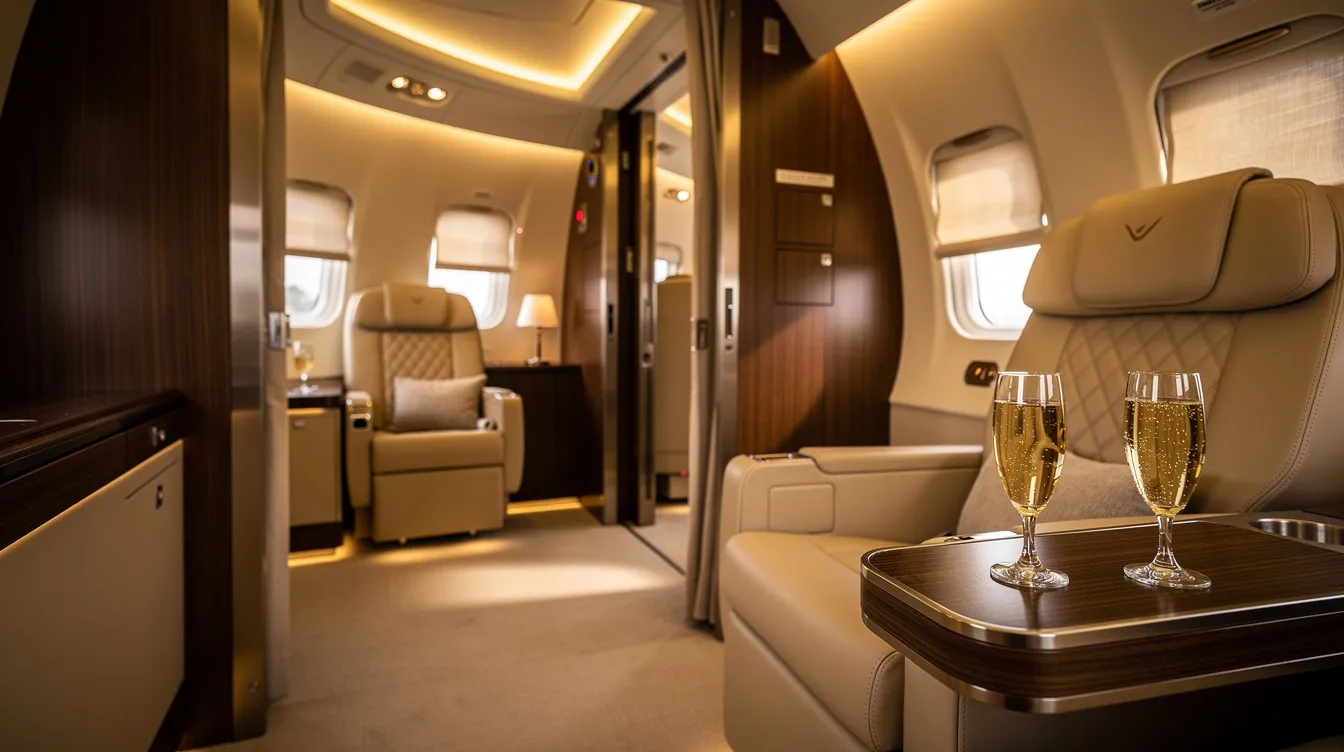
Commercial first-class suites have evolved dramatically. The best now offer fully enclosed spaces with closing doors, flat-bed sleeping surfaces exceeding six feet, personal minibars, and crew-to-guest ratios that approach fine-dining restaurants. Many airlines elevate the first class experience to resemble a lavish hotel stay, complete with first class amenities that often include high-end dining options and spacious seating. Airlines known for private first class suites include Singapore Airlines, Etihad Airways, and Emirates—each investing hundreds of millions in hard-product innovation.
Yet a round-trip first class ticket on these carriers typically costs $10,000–$25,000, depending on route and season. A traveler purchasing three or four such trips per year may spend $60,000–$80,000 on first-class flights alone. Compare that to a Jet Card program that locks in prepaid hours on light, midsize, or large-cabin aircraft—often with total annual costs in a similar range but with radically different advantages in scheduling, routing, and privacy.
At BlackJet, we benchmark the world's finest first-class suites because many of our members fly both. They choose Emirates, first class for a Dubai overnight, then call us for a same-day hop from London Farnborough to Geneva that no airline schedule can match. The strategic question is never "which is better" in the abstract. It is: which tool fits this particular trip?
This article covers the Emirates Game Changer on the Boeing 777-300ER, Singapore Airlines Suites on the Airbus A380, Air France La Première on the 777-300ER, All Nippon Airways first class, Cathay Pacific first class, Etihad's Apartments, and more. We then lay out a practical framework for deciding when the best first class suite airline is enough—and when a BlackJet Jet Card is the sharper choice, outlining how BlackJet premium private jet cards and programs can complement or replace commercial first class for frequent travelers.
The Shortlist: Best First Class Suite Airlines in 2025
Only a handful of carriers still operate genuine first-class suites—enclosed or near-enclosed spaces with doors, partitions, or floor-to-ceiling curtains that deliver real personal space. Here are the headline contenders as of mid-2025:
Airline | Aircraft Model | First Class Suite Features | Privacy Level | Notable Amenities | Routes & Availability |
|---|
Emirates | Boeing 777-300ER | Fully enclosed suites with floor-to-ceiling doors, zero-gravity seats, and virtual windows | Highest (fully enclosed) | In-suite minibar, large HD screens, onboard showers on A380 | Limited to 9 aircraft; routes include Dubai–Geneva, Dubai–Brussels, select US routes |
Singapore Airlines | Airbus A380 | 50 sq ft suites with separate bed and armchair, sliding doors, and combined double suites | Highest (fully enclosed) | Book the Cook meal pre-selection, luxury wines, and private sedan transfers. | Seasonal routes from Singapore to Sydney, London, Frankfurt, and New York |
Air France La Première | Boeing 777-300ER | Four curtained suites, 38 sq ft, two 32-inch 4K screens, personal wardrobe | High (curtained suites) | Michelin-starred dining, private sedan transfers, exclusive lounge | Paris CDG to New York, Los Angeles, Tokyo, Singapore |
ANA "The Suite" | Boeing 777-300ER | Eight enclosed suites, 43-inch 4K monitors, and individual closets | High (fully enclosed) | Japanese omakase dining, Krug Champagne | Tokyo to New York JFK, London |
Cathay Pacific | Boeing 777-300ER | Six seats in a 1-1-1 layout, open suites without doors, spacious flat beds | Moderate (open suites) | The Pier's first-class lounge, dining, and face-to-face | Limited routes, mostly Hong Kong hub |
Etihad Airways First Apartments | Airbus A380 | Sofa-bed suites with sliding doors, a shower room, and dine-on-demand | High (fully enclosed) | The Residence three-room suite, onboard bar | Abu Dhabi to London, New York, Paris |
SWISS First | Boeing 777-300ER | Eight suites with sliding partitions, large screens | High (partitions) | Swiss dining, personalized service | Limited availability, mostly Europe hub |
Luxury first-class airlines offer floor-to-ceiling privacy doors and expansive cabins at their best. This list focuses on products where the class cabin consists of genuine suites, not recliner-style first-class seats rebranded from business class.
Worth noting: Qatar Airways' first class on certain routes has been scaled back, but its Qsuite business class product often rivals legacy first class cabins in privacy and comfort. Similarly, Korean Air, British Airways, and American Airlines' flagship products occupy a tier just below the suites listed above. Lufthansa first class, with full-height doors and individual temperature controls plus free Wi-Fi, also deserves mention.
The sections below dive deep into each flagship first-class suite, then compare them directly to BlackJet private jet access.
Emirates Game Changer First Class – Boeing 777-300ER
Hard Product
Emirates offers fully enclosed first-class suites with floor-to-ceiling doors arranged in a 1-1-1 layout. The Emirates first-class suite features zero-gravity seats that recline into a fully flat bed, customizable mood lighting, and individual temperature controls. Middle suites get virtual "windows"—HD exterior-view displays that replicate the outside view in real time. Each fully enclosed suite includes an in-suite minibar, a large HD entertainment screen, and ample storage.
Only nine Boeing 777-300ER aircraft currently carry the full Game Changer configuration, making this a rare find. Emirates rotates these frames seasonally; winter 2025 routes included Dubai–Geneva and Dubai–Brussels, with select U.S. routes appearing periodically.
Soft Product
First-class passengers enjoy Dom Pérignon, Emirates offers unlimited caviar in first class, and a full meal service is available on demand. Amenity kits come from Bvlgari. Pajamas and slippers are provided. The onboard service is attentive service at its finest—each flight attendant in the first-class cabin serves only a handful of guests.
Unlike the A380, the 777-300ER Game Changer does not include in-flight showers. Emirates offers onboard showers in first class only on A380 aircraft, which matters to travelers who consider the shower spa a non-negotiable.
How It Compares to Private Jets
The Emirates Game Changer delivers fantastic service and privacy that few class flights can match. But it still requires routing through Dubai's DXB hub, operating on fixed airline schedules, and sharing the cabin with up to five other first-class passengers. A BlackJet charter or Jet Card flight removes every one of those constraints—custom departure times, choice of airport, and a private cabin for your party alone.
Singapore Airlines A380 Suites – The "Apartment in the Sky"
Hardware
Singapore Airlines' A380 Suites offer 50 square feet of space per suite, with a separate bed and a swiveling leather armchair. Sliding doors provide full enclosure. Singapore Airlines' first class features a tablet for controlling settings, including lighting, entertainment, and window shades. Adjacent pairs (1A+2A and 1F+2F) can be combined into a roughly 100-square-foot double suite—large enough for couples or business partners who want to dine face to face or share double beds.
Routes
Singapore Suites commonly operate on routes from Singapore to Sydney, Singapore to London, and Singapore–Frankfurt–New York during specific seasons. A380 deployment is seasonal and subject to change, so always confirm equipment before booking.
Dining and Ground Experience
Singapore Airlines provides a "Book the Cook" service for meal selection, letting first-class passengers pre-order from an extensive menu weeks before departure. Singapore Airlines allows pre-selection of meals through "Book the Cook," which includes options like lobster Thermidor, caviar, and Japanese kaiseki. High-end wines include Krug and Dom Pérignon.
On the ground, the Private Room class lounge at Changi Airport offers a dedicated space for suite passengers, with à la carte dining, private security, and chauffeur services where available. Luxury ground services are part of the first-class experience at leading airlines, and Singapore sets the standard. A private sedan transfer to the aircraft door is available at select stations.
Pricing
Saver awards in Singapore Airlines suites are extremely limited via KrisFlyer—realistic ballpark figures sit at 150,000–225,000 miles one-way on popular routes. Cash fares for Singapore Airlines first class on long-haul sectors routinely exceed $15,000 round-trip, a price point at which many travelers begin comparing those tickets to the structure and value of a 25-hour Jet Card program.
Contrast with BlackJet
For families or executive teams wanting to sit together and move freely, a midsize or large-cabin private jet through a Jet Card delivers similar privacy without sharing a cabin with strangers—and without routing through Changi.
Air France La Première – Boeing 777-300ER Élégance
The Suite
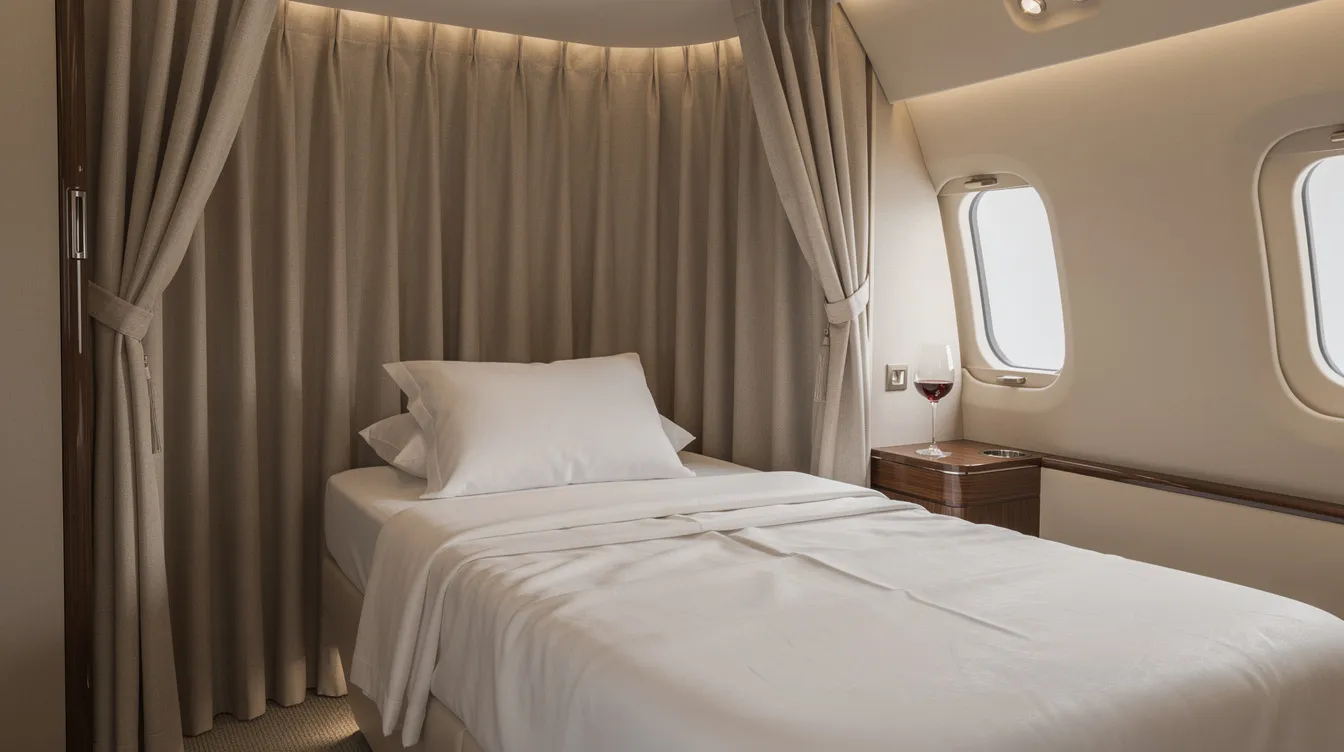
Air France La Première is the most exclusive European airline's first-class product, with just four suites in a single row on select Boeing 777-300ER frames. Air France uses floor-to-ceiling curtains for privacy in first class, transforming each space into a curtained "Parisian bedroom" at 35,000 feet. Air France's La Première cabin has exclusive curtained suites and Michelin-quality dining.
Each suite spans roughly 38 square feet. The wide seat converts into a two-meter flat bed with high-thread-count linens. Two 32-inch 4K screens provide entertainment. Floor-level drawers replace overhead bins, and a personal wardrobe holds garments wrinkle-free. Air France's next-generation La Première debuted on the Paris–New York JFK route in April 2025, with Los Angeles, Tokyo-Haneda, and Singapore added through summer and fall 2025.
Ground Experience
The Air France La Première ground experience at Paris CDG is unmatched in Europe: private check-in, dedicated security lane, and chauffeured transfer directly across the tarmac in a private sedan. The La Première lounge access features dining designed by Michelin-starred chefs. Air France collaborates with Michelin-starred chefs for its menu both in the lounge and onboard. In 2025, loungewear was designed by Jacquemus.
Pricing and Access
Cash fares for Air France La Première generally range from roughly €10,000–€12,000 round-trip New York–Paris. Flying Blue mileage redemptions are restricted to elite-status members (Platinum and above) and require significant mileage balances. A Bloomberg report noted that Air France explicitly markets La Première as a "suite fit for a private jet," targeting travelers who might otherwise fly private.
Comparison to Private Aviation
Air France La Première offers unmatched ceremony and gastronomy on fixed routes. A BlackJet flight offers total discretion, direct access to smaller French and EU airports like Paris Le Bourget, and the ability to schedule meetings around the aircraft rather than vice versa.
Other Standout First Class Suites: ANA, Cathay Pacific, Etihad & SWISS
All Nippon Airways (ANA) "The Suite" – Boeing 777-300ER
ANA's first-class seats have fully closing doors for privacy, arranged across eight seats in two rows. Each suite includes a 43-inch 4K monitor—tied for the largest in any first-class cabin—an individual coat closet, and generous storage. All Nippon Airways' first-class menus feature Japanese omakase-style dining alongside Western options, with Krug Champagne and premium sake. Key 2025 routes include Tokyo–New York JFK and Tokyo–London. The class cabin consists of eight enclosed seats with excellent service and meticulous attention to detail. ANA delivers top-notch service with a crew trained in both Japanese hospitality and Western dining conventions.
Cathay Pacific First Class – Boeing 777-300ER
Cathay Pacific first class features just six seats in a 1-1-1 layout—open-suite style without full doors but with superb bedding and spacious seats that convert to a generous flat bed. The Pier first-class lounge in Hong Kong is widely regarded as among the world's finest, with full meal service and lounge access that rivals some airline first-class cabins themselves. Cathay Pacific is expected to introduce door-equipped first class on future Boeing 777X deliveries later this decade. The Cathay Pacific onboard service emphasizes attentive service and the ability to dine together for traveling companions.
Etihad First Apartments – Airbus A380
Etihad's First Apartments include sliding doors for privacy, a sofa that converts into a flat bed, and a separate armchair. Etihad's first class includes electronically controlled window blinds. Each class passenger has access to a shower room—Etihad's first-class apartments include a shower room on the A380. Etihad's first class features a dine-on-demand service for meals. Then there is The Residence: Etihad Airways' "The Residence" includes a living room and a separate bedroom with an en-suite shower—a three-room suite that remains the most ambitious first-class product ever built. Key A380 routes in 2025 include Abu Dhabi–London, Abu Dhabi–New York, and Abu Dhabi–Paris, where scheduled.
SWISS First – Boeing 777-300ER
SWISS deploys eight suites with sliding partitions, large entertainment screens, and a strong Swiss dining and wine program. Award access is often limited to HON Circle and Senator elite members, restricting lounge access and suite availability for most travelers.
Notable Mentions
Other once-iconic first-class products remain strong but may lag slightly in privacy or availability. Japan Airlines' A350-1000 features six individual suites for privacy, and Japan Airlines offers a 43-inch 4K TV in first class—Japan Airlines' first-class suites feature a 43-inch 4K TV alongside a dine-on-demand menu with gourmet meals. Lufthansa first class on the 747-8 offers full-height doors and a refined ground experience. Air New Zealand and other carriers have experimented with innovative lie-flat concepts. Each of these class airlines still operates within the constraints of busy hubs, fixed schedules, and mixed premium cabins—unlike private jets, which are fully tailored.
Is Business Class Enough? When Business Rivals First
Top business class products now blur the line with first class, especially on Boeing 777 and A350 aircraft. For many routes, airlines have removed first class entirely, making business class the highest cabin available.
Consider these examples:
Qatar Airways Qsuite - Sliding doors, the ability to combine class seats into a shared quad, and direct aisle access on every seat. For shorter overnight flights, this airline's first-class alternative often outperforms older first-class hard products.
ANA "The Room" - A lie-flat seat with generous width and privacy partitions that rival many first-class cabins.
Emirates A380 Business - Spacious seating with a minibar and direct aisle access, positioned just one deck below the famous first class.
Singapore Airlines Long-Haul Business - Full flat beds with direct aisle access throughout.
The gap between first class and business class narrows on routes under eight hours. A savvy traveler might pick a class ticket in Qsuite over an older first-class seat, saving thousands while barely sacrificing comfort.
Where private jets sit on this spectrum is instructive: for time-sensitive or multi-city itineraries, a private jet surpasses both first and business by eliminating connections, overnight hotel stays, and hours spent in airport terminals, even when you simply buy a seat on a private jet instead of chartering the whole aircraft. The class experience that matters most is often not about the seat—it is about the outcome.
When a Private Jet Beats Even the Best First Class Suite
Even the Emirates Game Changer or Singapore Suites cannot deliver what a fully private aircraft can when flexibility and confidentiality are non-negotiable.
The BlackJet Jet Card Model
BlackJet offers prepaid 25-hour and 50-hour Jet Card programs giving access to light, midsize, super-midsize, and large-cabin aircraft across the U.S. and key international corridors. Locked-in hourly rates, guaranteed availability windows, and simplified budgeting replace the unpredictability of last-minute first-class ticket pricing.
A Concrete Scenario
An executive team must travel from New York to London, and from Frankfurt to Zurich in 48 hours. Flying commercial first class requires:
NYC to London on one carrier (7+ hours plus 3 hours of airport processing)
London to Frankfurt on another airline or train (connection time: 4–5 hours door-to-door)
Frankfurt to Zurich (short-haul, limited first class availability, 3+ hours door-to-door)
Total transit overhead: roughly 10–15 hours lost in hubs, lounges, and connections.
A single BlackJet itinerary covers all three sectors using private terminals and direct routing, cutting transit overhead to under three hours total and, for larger groups, making 16-seat private jet options especially attractive. Meetings happen onboard in a private cabin with secure Wi-Fi, custom catering, and no interruptions.
Productivity, Safety, and Sustainability
BlackJet ensures every aircraft meets rigorous safety and certification standards, including third-party audits, pilot experience minimums, and maintenance protocols that match or exceed airline standards. Every Jet Card hour includes built-in carbon offsetting or SAF contributions at no additional cost—positioning BlackJet alongside the most progressive airline sustainability programs and aligning with the trend toward more affordable, efficient private jet options.
Cost Profile
When repeated first-class flights at $10,000–$20,000 per seat multiply across a small group—say, four executives buying four class seats per trip—annual spend quickly reaches $160,000–$320,000. A shared large-cabin charter funded via a Jet Card can serve the same group at a fraction of that per-person cost, especially on regional segments, once you understand how the Jet Card cost per hour compares to premium cabin tickets. Understanding Jet Card pricing is the first step toward quantifying the difference.
Choosing Between First Class and Private Jet: A Practical Framework
The decision is not binary. Many sophisticated travelers use both and increasingly rely on a clear understanding of Jet Card pricing structures to benchmark against first-class fares. Here is a practical checklist:
When commercial first-class suites make sense
Solo traveler on a fixed long-haul route (e.g., New York–Dubai, Singapore–London)
Maximum onboard pampering is the priority—caviar, Champagne, and a dedicated flight attendant
Willingness to route through major hubs and accept airline schedules
The route is served by a consistent first-class product with enclosed suites
When a BlackJet Jet Card is the sharper choice
Last-minute travel where first-class availability is uncertain
Multi-city schedules requiring three or more sectors in 48 hours
Secondary airports closer to your destination (London Farnborough, Teterboro, Le Bourget)
Confidential meetings that demand a private cabin with no other passengers
Family groups or executive teams of 3–8 people, where per-seat first-class costs multiply
Frequent schedule changes that airlines penalize with rebooking fees
Hybrid strategies BlackJet members use
Fly Singapore Airlines Suites or Emirates Game Changer on ultra-long-haul legs for maximum onboard luxury
Use BlackJet for regional hops, time-critical connections, or legs where first class simply does not exist.
Track annual premium cabin spend and hours lost in transit—when combined costs and lost time exceed a Jet Card threshold, the shift becomes obvious. For especially heavy users, evaluating a 100-hour Jet Card cost guide can clarify when to scale beyond entry-level programs.
For mission-critical travel—closing deals, site visits, crisis response—the class experience that wins is the one that optimizes outcome over amenity kits, which is why some ultra-frequent flyers explore unlimited private jet flight memberships alongside traditional Jet Cards.
BlackJet Advantage: Safety, Technology, and Seamless Booking
BlackJet holds itself to standards inspired by the very best first-class airlines while adding layers of control that commercial aviation cannot offer, positioning it alongside the top private jet companies for luxury travel in terms of safety, service, and fleet quality.
Safety
Every operator in the BlackJet network undergoes rigorous vetting, including maintenance audits, pilot flight-hour minimums, and adherence to recognized safety benchmarks that mirror the best practices outlined in our overview of private jet safety realities. The result is a safety culture on par with—or exceeding—that of major airlines. For travelers accustomed to the reliability of Singapore Airlines or Emirates, this is non-negotiable. Learn more about how private jet safety standards protect every flight.
Technology
BlackJet's 24/7 digital booking platform enables instant quoting, real-time flight support, and the ability to adjust departure times or passenger lists from a mobile device. No waiting on airline call centers. No rebooking fees.
Membership Benefits
Beyond the aircraft itself, BlackJet members have access:
Concierge ground transport coordination
Tailored catering that matches dietary and cultural preferences
Multi-aircraft coordination for larger parties or parallel itineraries
Seamless booking that removes friction from every step
Aircraft Categories
BlackJet provides access across multiple aircraft types, including many featured in our roundup of the top private jets in the world:
Light jets (e.g., Citation XLS) - Ideal for short regional hops with up to 7 passengers
Midsize jets (e.g., Hawker 800XP) - Comfortable for coast-to-coast U.S. flights
Super-midsize jets (e.g., Challenger 350) - Transatlantic-capable with stand-up cabins and often optimized around the economics discussed in our 50-hour Jet Card cost guide
Large-cabin jets (e.g., Gulfstream G450) - The closest equivalent to an Emirates first-class suite, with lie-flat seating, quiet cabins, and custom bedding, and ideal when you need a private jet configured for around 20 passengers
Sustainability
Every Jet Card hour automatically includes carbon offsetting or SAF contributions—no opt-in required, no additional cost. BlackJet ensures every journey is carbon neutral at no extra effort to you.
If you have already booked Emirates Game Changer or Singapore Suites, a 25-hour BlackJet Jet Card could replace or complement those bookings over the next 12 months—delivering flexibility where airlines cannot, especially when paired with the dedicated benefits of the BlackJet 25+ Hour Jet Card.
FAQs: First Class Suites vs Private Jets with BlackJet
Is a first-class ticket cheaper than a private jet?
On a per-seat basis for solo travelers, first class is often less expensive. A one-way Emirates first-class suite might cost $10,000–$15,000. However, for groups of 3–8, multiplying per-seat costs quickly exceeds the hourly cost of a midsize or large-cabin charter divided among the party. A 5-hour midsize jet charter shared among four travelers can cost less per person than four first-class seats on the same route.
Which first-class suite airline is closest to a private jet experience?
Emirates Game Changer, Singapore A380 Suites, and Air France La Première come closest in terms of privacy, personal space, and onboard service. However, all three still require commercial airport processing, fixed schedules, and routing through major hubs—gaps that private jets eliminate entirely.
Can BlackJet match the comfort of top first-class seats?
Large-cabin jets offer stand-up cabins, lie-flat seating, quiet environments, and custom bedding. While you will not find a 43-inch screen or an onboard shower, you gain a private cabin, bespoke catering, and the ability to configure the space for meetings or rest. For many executive travelers, that trade-off favors the jet.
How does safety compare between the top first-class airlines and private jets?
Major airlines operate under stringent FAA and EASA oversight. BlackJet applies equivalent rigor through third-party safety audits, operator vetting, crew experience requirements, and proprietary certification standards. The safety delta between a well-vetted private operator and a top-tier airline is negligible, and many travelers also compare options like NetJets Jet Card cost when evaluating safety, value, and brand reputation across providers.
What is a Jet Card, and how does it differ from on-demand charter?
A Jet Card is a prepaid block of flight hours (typically 25 or 50 hours) with locked-in hourly rates, guaranteed availability windows, and simplified billing. On-demand charter is booked trip-by-trip at market rates that fluctuate with demand. For frequent flyers, a Jet Card provides predictability and priority access that one-off charters do not, especially once you understand typical Jet Card cost per hour benchmarks.
How do I decide if it is time to move from first class to a Jet Card?
Track three metrics over 12 months: total spend on premium class tickets, total hours lost in transit (connections, layovers, airport processing), and the number of trips where schedule inflexibility cost you time or missed meetings. If your annual spend on the best first-class seats exceeds $50,000 and your transit losses exceed 40 hours, a Jet Card likely delivers better value—and a better outcome.
Glossary of Key Terms and Acronyms
First Class Suite:
A premium airline cabin product offering a fully enclosed or near-enclosed private space, often with floor-to-ceiling privacy doors, sliding partitions, or curtains. Features include spacious seating, flat beds, high-end amenities, and luxury dining. Examples: Emirates 777-300ER, Singapore Airlines A380 Suites, Etihad First Apartments.
Hard Product:
The physical aspects of an airline seat or suite include privacy doors, seat size, bed length, entertainment screens, and suite layout.
Soft Product:
The service elements of the flight included amenities, amenity kits, crew attention, and ground services.
Jet Card:
A prepaid block of flight hours (typically 25 or 50 hours) on private jets, offering locked-in hourly rates, guaranteed availability, and simplified billing, as detailed in our overview of the best Jet Cards for frequent flyers.
Qsuite:
Qatar Airways' business class product features sliding doors, the ability to combine seats into a shared quad, and direct aisle access.
A380:
The Airbus A380 is a double-deck, wide-body, four-engine jet airliner. Used by airlines like Singapore Airlines and Etihad for their flagship suites.
Boeing 777-300ER:
A long-range, wide-body, twin-engine jet airliner used by airlines such as Emirates, Air France, ANA, and SWISS for their top first-class suites.
KrisFlyer:
Singapore Airlines' frequent flyer program is used for redeeming award seats in first-class suites and is often compared to strategies for accessing the cheapest private aircraft options when travelers weigh miles versus private flying costs.
Book the Cook:
A Singapore Airlines service allowing first-class passengers to pre-select gourmet meals before their flight.
Conclusion: Redefining "Best in Class" Luxury Travel
Emirates, Singapore Airlines, Air France, ANA, Cathay Pacific, Etihad, and SWISS currently lead the world for first-class suites. Each delivers extraordinary onboard service, exceptional dining, and the kind of personal space that makes long-haul travel genuinely restful. For solo travelers on fixed routes, these remain remarkable products.
But for those who measure travel success by outcomes—deals closed, time recovered, stress eliminated—private jets redefine the class experience entirely. The best first-class seats are extraordinary. A BlackJet Jet Card is what comes next: total control over schedule, routing, privacy, and productivity, built on the same uncompromising safety and sustainability standards you expect from the world's finest airlines.
Explore BlackJet membership or speak with our team about tailoring a Jet Card alongside your favorite first-class suite airline. Your next flight should be designed around your life—not the other way around.


 Sign up with google
 Sign up with Apple