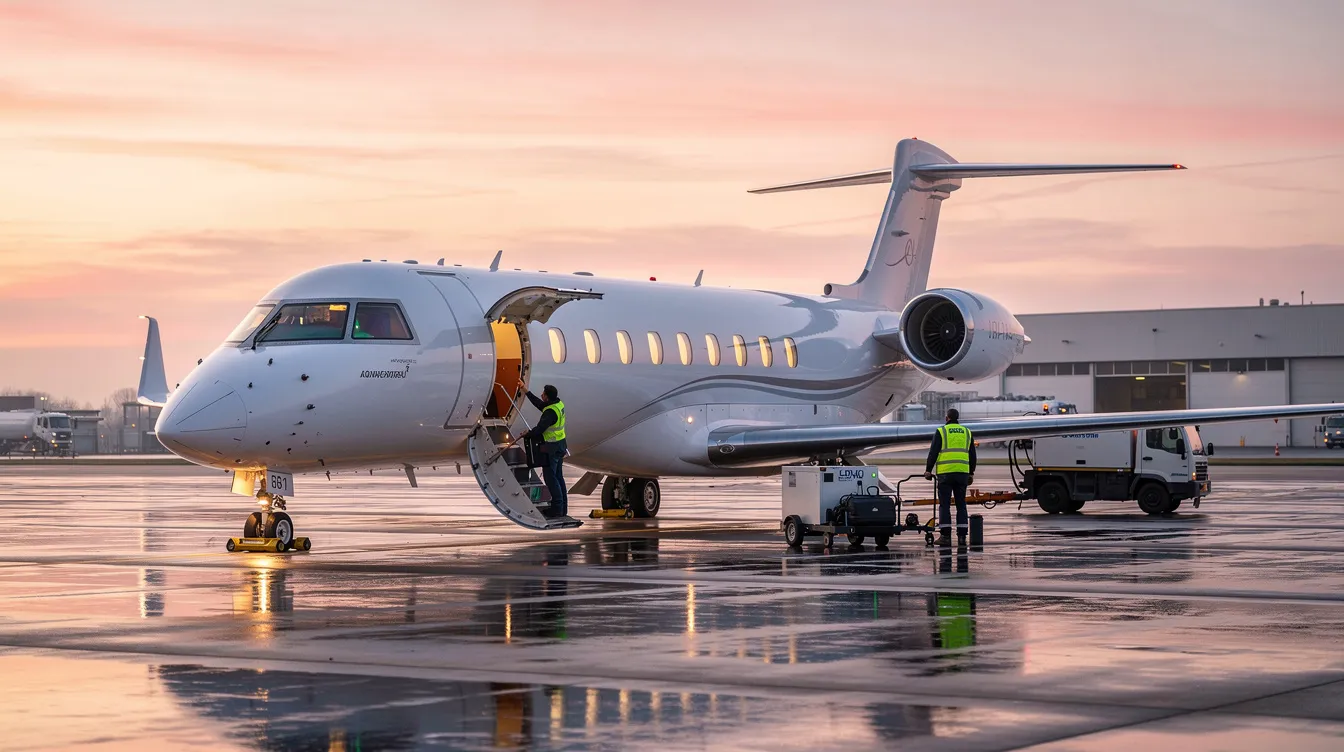
The Bombardier Global Express, commonly referred to as the GLEX, is an ultra-long-range business jet introduced in the late 1990s, known for its large cabin, nonstop intercontinental range of up to about 6,700 nautical miles, and a layout built for productive, private travel. Three decades later, it remains a reference point for cabin size, intercontinental reach, and proven reliability across corporate, government, and private aviation.
For executives, frequent business flyers, and high-net-worth leisure travelers comparing large-cabin private jets or looking for flexible long-haul access without owning an aircraft, the GLEX still sets the standard for time-saving global travel. This guide explains how the Global Express evolved, what its performance, cabin, cockpit, variants, operating costs, safety, and environmental profile look like today, and how to access it through ownership, charter, and BlackJet jet card options.
Why the Bombardier Global Express Matters for Serious Travelers
The original Global Express was developed by Bombardier Aviation to solve a specific problem: connecting global financial centers nonstop in a cabin large enough for productive work and genuine rest. The aircraft connects cities like New York and Tokyo nonstop, a mission that commercial routing typically stretches to 16 or more hours with layovers. On a GLEX, that same trip runs under 14 hours, door to door through private terminals, with zero security lines and no baggage carousel.
The aircraft establishes a benchmark for corporate aviation due to its reliability and luxurious comfort. Its cabin volume of 2,002 cubic feet provides space that first class on a widebody airliner cannot replicate: three working zones, a flat floor, and the privacy to hold calls, sign documents, or sleep undisturbed. For executives whose time carries a quantifiable cost, this combination of range, speed, and productivity is not a luxury; it is arithmetic.
BlackJet members can access Bombardier Global aircraft, including the Global Express and Global Express XRS, through Jet Card programs and on-demand charter, with the broader BlackJet private jet service bypassing the capital requirements of ownership entirely.
Strategic advantages for corporate and UHNWI travelers:
Nonstop reach across six continents (London to Johannesburg, Dubai to Singapore, Los Angeles to Geneva)
Private terminal access eliminating 2-3 hours of airport process per flight
Three-zone cabin enabling simultaneous work, dining, and rest
Predictable scheduling: depart on your timeline, not the airline's
Bombardier Global Express: Origins and Evolution
Bombardier unveiled the Global Express program at NBAA in October 1991. The official programme launch followed in December 1993, and the aircraft completed its first flight on 13 October 1996 from Toronto, Canada. Canadian type certification came in July 1998, with FAA and European approvals shortly after. The jet entered service in July 1999.
From the start, the design targeted roughly 6,500 nautical miles of range at Mach 0.80 and a service ceiling of 51,000 feet (51,000 ft). The airframe uses a semi-monocoque aluminum structure with composite reinforcements, an advanced supercritical wing swept at 35 degrees with winglets, and a T-tail. The fuselage cross section traces back to the Canadair CL-600 Challenger family, giving it a proven structural lineage, while the wings and systems were clean-sheet designs built for intercontinental missions.
The Global Express lineage branched into several variants over the next two decades:
1999: Original Global Express enters service
2003: Global Express XRS introduced with improved hot-and-high performance
2012-2013: Global XRS rebranded as the Global 6000 with avionics and cabin upgrades
2018-2020: Global 5500 and Global 6500 introduced with Pearl 15 engines and redesigned wing
The aircraft has a record of serving various specialized missions beyond corporate transport, including maritime patrol, government VIP transport, and military reconnaissance roles across North America, Europe, and Asia.
Core Performance: Range, Speed, and Mission Profile
The Bombardier Global Express carries a range of 6,700 nautical miles, enough to fly nonstop between most intercontinental city pairs that business aviation demands, placing it firmly in the category of best long-range private jets. At its long-range cruise of Mach 0.80, the aircraft can fly 6,700 nautical miles while maintaining a service ceiling of 51,000 feet, well above commercial traffic and most weather. The Global Express can achieve a 14-hour endurance on full fuel.
The max range of the Bombardier Global Express is approximately 5,940 to 6,100 nautical miles under typical operating conditions with a full passenger load, increasing toward 6,700 nautical miles with reduced payload and favorable winds. The Global Express can cruise at speeds of approximately Mach 0.85 to 0.89 in high-speed configuration, translating to roughly 900 km/h or more. Normal cruise speed sits around 488 KTAS.
Two Rolls-Royce BR710 engines, each producing 14,750 lbf of thrust, power the aircraft. FADEC (Full Authority Digital Engine Control) manages engine performance automatically, contributing to dispatch reliability and consistent fuel burn across varied conditions. The aircraft features a flexible wing design for a smooth ride, reducing turbulence effects at high altitude and high speed.
Sample mission profile for a BlackJet client: An investment team departs New York at 7 PM, arrives in London by 7 AM local, conducts meetings, then continues to Riyadh (3,000 nm) the same evening. The long-range capability of the Global Express handles both legs nonstop, with the crew rotating rest in flight. Total distance flown over 48 hours: roughly 10,000 nautical miles across three continents, with zero commercial connections.
Cabin Experience: Comfort, Layout, and Cabin Altitude
The interior cabin of the Global Express was the largest cabin in its class when introduced and remains competitive with newer aircraft in its category. Cabin dimensions are approximately 48 feet 4 inches long (an unobstructed cabin length of 14.6 meters), 8 feet 2 inches wide, and 6 feet 3 inches high. The cabin width accommodates club seating, divans, and conference groupings without the cramped feeling common in midsize jets.
The cabin typically supports a three-zone configuration: a forward club section seating four, a mid-cabin conference or dining area, and an aft lounge or private suite with a divan. The cabin features a forward galley and crew lavatory, keeping service operations separated from the passenger zones. The Global Express cabin accommodates 12 to 16 passengers in standard layouts, with typical passenger capacity reaching 12 to 19 depending on configuration. The aircraft can accommodate up to 14 passengers in most charter configurations with full comfort.
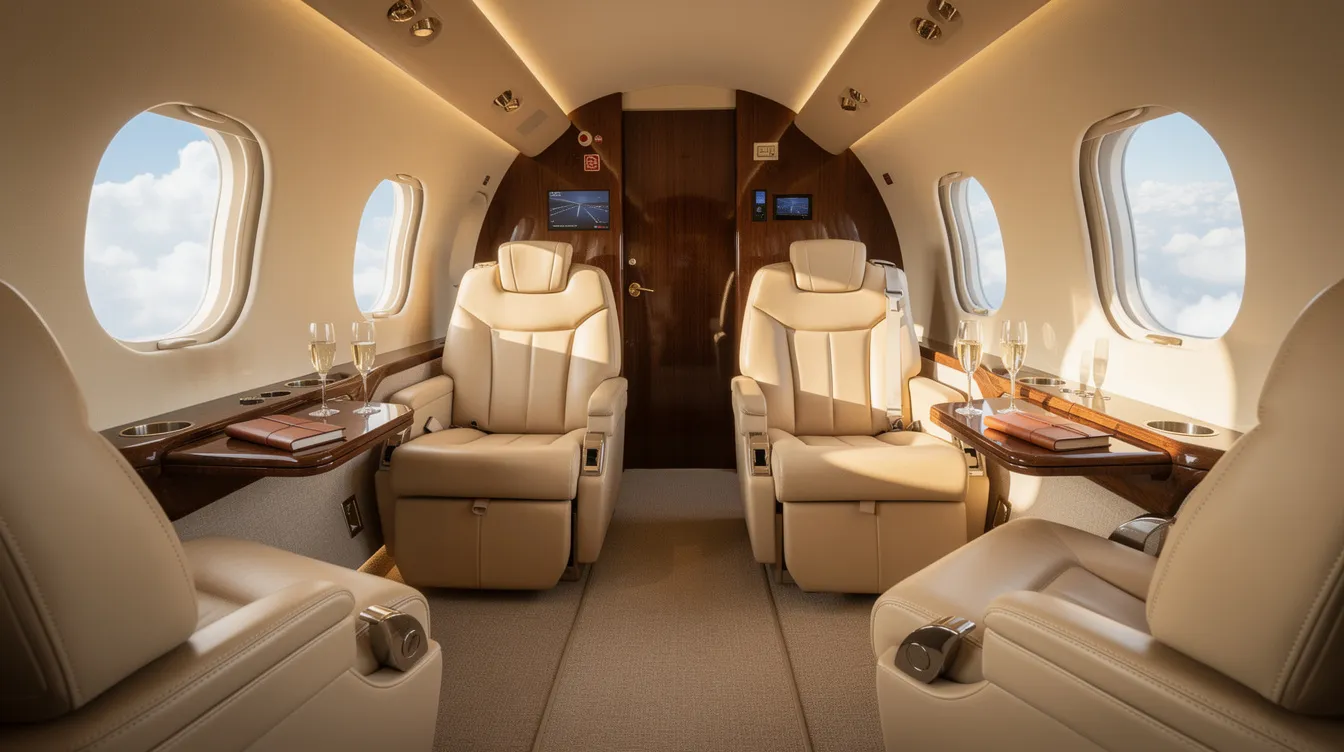
Pressurization is where the GLEX separates itself from commercial alternatives. A 10.3-psi cabin pressurization system maintains a cabin altitude of 4,500 feet at FL 450, compared to 6,000-8,000 feet on most airliners at their typical cruise altitudes. Lower cabin altitude reduces dehydration and fatigue on flights exceeding 10 hours.
Modernized Global Express aircraft now feature refurbished cabins with Nuage seat designs (introduced on later Globals), upgraded LED lighting, and high-speed connectivity via KU or KA band systems. Windows are approximately 25% larger than earlier Bombardier cabin lines, flooding the cabin with natural light.
BlackJet scenario: A Jet Card member departs New York at 9 PM on a Global Express bound for London. Forward cabin: secure calls and laptop work until 11 PM. Mid-cabin: dinner from the onboard galley. Aft cabin: flat bed rest for six hours. Landing at 9 AM London time, ready for a full day of meetings. The aircraft is known for its spacious and comfortable cabin tailored for long-haul flights, fitting squarely among top 16-seat private jet options; this is where that design pays off.
Flight Deck and Technology: From Primus to Bombardier Vision
The original Global Express is equipped with Honeywell Primus 2000 XP avionics, featuring six large displays, dual FMS, and flight guidance systems that were advanced for their 1998 certification year. Older models of the Global Express may require costly retrofits to bring avionics up to current standards, particularly for ADS-B Out compliance and modern oceanic communications requirements.
Many Global Express models have received upgrades to modern avionics and cabin technology over time. The most substantial evolution is the Bombardier Vision flight deck, adopted on the Global 5500 and Global 6500 and available as a retrofit path for earlier airframes. Based on Rockwell Collins Pro Line Fusion, the Vision flight deck replaces legacy displays with large LCDs, adds synthetic vision, and integrates an optional head-up display with the Enhanced Vision System.
Cockpit features that operators and pilots value:
Combined Vision System merging enhanced and synthetic imagery on a single HUD
FANS 1/A+ and CPDLC for efficient oceanic crossings
RNP, WAAS, and LPV approach capability for access to airports with limited ground-based navigation
ADS-B Out (Batch 3.4 upgrades common in the pre-owned fleet)
Graphical flight planning with weather, terrain, and traffic overlays
BlackJet prioritizes aircraft equipped with modernized avionics and current safety systems. Bombardier Vision and equivalent upgrades are selection criteria when matching Global aircraft to member missions.
Variants: Global Express, Global Express XRS, Global 5500, and Global 6500
It is important to distinguish the original Global Express from later models like the Global XRS and Global 6000, because performance, cabin tech, and operating economics differ across generations.
The original Global Express entered service in 1999 with a range exceeding 6,000 nautical miles and seating for 12-16 passengers across three cabin zones. Hundreds of these aircraft have been flown worldwide by corporate flight departments, charter operators, and governments. Many remain in active fleet service after cabin refurbishments and avionics upgrades, making them available through charter and Jet Card access at lower hourly rates than newer production aircraft.
The Global Express XRS, launched in 2003, added improved hot-and-high performance (better takeoff from airports like Mexico City or Aspen), enhanced cabin pressurization, and incremental range gains. Many XRS aircraft were subsequently rebranded as the Global 6000 after receiving avionics and cabin upgrades. KU/KA band connectivity and Batch 3.4 avionics are now standard on most pre-owned XRS airframes in the charter market.
The Global 5500 and Global 6500, introduced in 2018, represent the latest generation. Both use Rolls-Royce Pearl 15 engines delivering up to 13% better fuel burn than the BR710. The optimized Smooth Flex Wing reduces turbulence loads and improves the smooth ride quality. Range reaches about 5,900 nautical miles on the Global 5500 (a shorter-range variant optimized for cabin comfort) and 6,600 nautical miles on the Global 6500. Cabin features include Nuage seat designs, Soleil circadian lighting, l'Opera audio, and Pur Air purification. Eight passengers or fewer on a Global 6500 can fly nonstop from New York to Hong Kong.
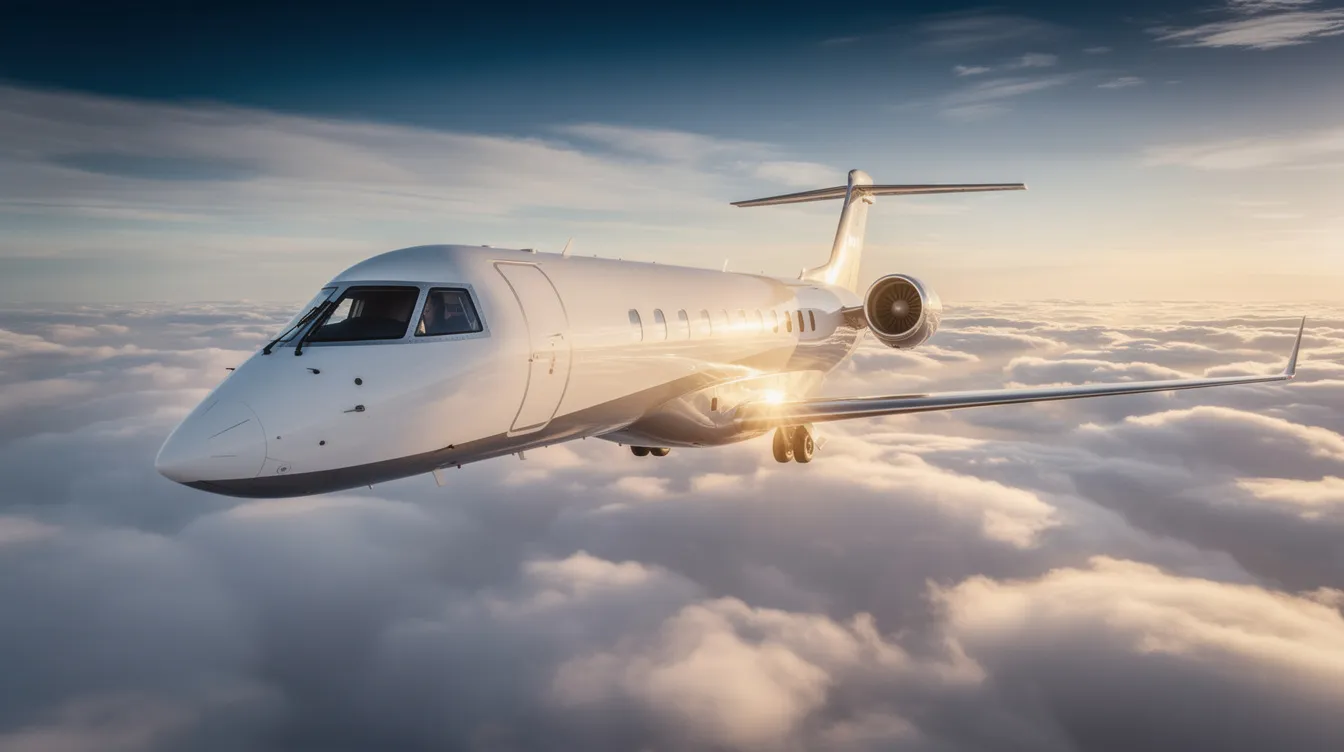
While this article focuses on the classic Global Express, BlackJet clients may be matched to a Global 5500 or Global 6500 when a mission calls for the latest cabin technology, lower emissions, or extreme range.
Market Overview: Ownership, Charter, and Jet Card Access
Roughly 135-150 original Global Express and Global Express XRS aircraft remain active in charter, corporate, and government service across North America, Europe, the Middle East, and Asia-Pacific. At any given time, 15-25 may be listed for sale on the pre-owned market, with asking prices ranging from approximately $8 million to $18 million depending on total time, engine program enrollment, avionics generation, and cabin condition.
The Bombardier Global Express is suitable for corporate, government, and private aviation. Operators range from Fortune 500 flight departments to dedicated charter companies and sovereign air forces, alongside the top private jet companies that manage and operate large-cabin fleets.
Three access models, compared, each with distinct cost structures within the broader private jet price landscape:
Ownership: Full control, but annual fixed costs of roughly $973,159 before a single hour is flown, plus crew, hangarage, insurance, and maintenance management—considerations often underestimated when evaluating the features of a $5 million jet
Ad-hoc charter: Maximum flexibility per trip, but pricing and aircraft availability vary by season and market demand, reflecting the core meaning and mechanics of charter flights
Jet Card membership: Prepaid hours at fixed rates, guaranteed availability within notice windows, and cabin class selection at booking; ideal for travelers flying 25-100+ hours annually and comparing 50-hour jet card costs and value, including those evaluating a 100-hour jet card cost structure
BlackJet's Jet Card model converts the complexity of large cabin aircraft economics into a single hourly rate that includes fuel, crew, taxes, and handling fees, aligning with broader jet card pricing structures and benefits.
Operating Costs, Efficiency, and When a GLEX Makes Sense
Operating a Bombardier Global Express carries real costs. Annual operating cost is $3,760,211 based on industry benchmarks. Hourly operating cost is $8,848 based on 425 hours of annual utilization, covering fuel, crew, maintenance reserves, insurance, and hangar fees. Annual fixed costs are approximately $973,159 regardless of how many hours the aircraft flies.
Major cost events add to the picture. Major inspection costs range from $800,000 to $1.2 million for heavy structural checks and systems overhauls. Engine overhauls can cost around $4 million per pair, though enrollment in programs like Rolls-Royce CorporateCare spreads these expenses into predictable hourly reserves.
Where the GLEX earns its cost back is on missions where nonstop range eliminates compounding expenses. A corporate team of eight passengers flying New York to Dubai on a smaller jet requiring a fuel stop in Shannon adds crew rest requirements, hotel costs, landing fees, and 4-6 hours of lost productivity. The Global Express completes the same mission nonstop.
BlackJet translates these complex structures into transparent Jet Card pricing and helps clients understand jet card cost per hour, so members know the complete cost of a Global Express flight before confirming each booking.
Safety, Certification, and Operational Reliability
The Global Express safety record reflects decades of reliable operation. Operating data and aircraft details are subject to change depending on the specific airframe, installed upgrades, and operator documentation. Across more than one million flight hours accumulated by the fleet, only six hull-loss incidents have occurred, with causes tied to human factors or operational context rather than design or structural deficiencies. The Global Express can operate in all-weather conditions with its complete suite of weather radar, TCAS II, and modern navigation systems.
Safety technologies available on current Global Express and Global Express XRS aircraft include the Bombardier Vision flight deck (on upgraded airframes), Combined Vision System, EVS, FANS 1/A+ for oceanic communications, CPDLC, and RNP/WAAS/LPV approach capability. These systems give crew members enhanced situational awareness during operations at challenging airports and in degraded visibility.
BlackJet's safety standards require:
Operators holding ARGUS Gold or Platinum, Wyvern Wingman, or equivalent third-party security and safety ratings
Flight crews meeting recurrent training requirements beyond regulatory minimums
Aircraft enrolled in recognized maintenance programs with complete data and records
Preference for airframes with current-generation avionics and ADS-B Out compliance
Bombardier's product support network, ranked first in multiple industry surveys, ensures global parts availability and service center access for operators flying Global aircraft in every region.
Sustainability and the Bombardier Global Family
Large cabin business jets consume more fuel per flight hour than light or midsize jets. A classic Global Express burns roughly 486 gallons per hour at cruise. On a lightly loaded short sector, that consumption is difficult to justify environmentally. On a 12-hour transcontinental mission carrying eight to twelve passengers, fuel burn per passenger-mile approaches or beats commercial business class on the same route, especially when compared with the latest sustainable next-generation aircraft of 2026.
Bombardier publishes Environmental Product Declarations and updated specifications for newer aircraft including the Global 5500 and Global 6500, covering manufacturing, operation, and end-of-life impact. The Pearl 15 engines on these models reduce fuel burn by 7-13% and cut emissions and noise footprints compared to the BR710 on earlier Globals.
BlackJet's approach to sustainability:
Carbon-neutral flights by default through verified offset programs
SAF (Sustainable Aviation Fuel) options where supply and airport infrastructure allow
Aircraft-to-mission matching: recommending a midsize jet for a 2,000 nm trip rather than dispatching a Global Express, reducing unnecessary fuel burn
How BlackJet Clients Use the Global Express in Practice
CEO roadshow, three continents in 72 hours. A chief executive and four-person team depart New York on a Global Express charter flight, arriving in London the next morning. Meetings fill the day. That evening, the same aircraft repositions to Riyadh (2,600 nm, under six hours). After a day of investor meetings, the crew flies the team back to New York via London. Total commercial alternative: four separate tickets, two layovers, three hotel bookings, and roughly 18 hours of cumulative airport time eliminated.
Family seasonal relocation. A family of six books a Global 6500 through BlackJet for an overnight Los Angeles-to-Geneva crossing, a mission profile well-suited to private jets for 15 passengers. The kids use the forward cabin with 4K entertainment. Parents dine in the mid-cabin zone, then rest in the aft suite. Cabin altitude stays at approximately 4,500 feet throughout, and everyone arrives with less fatigue than a 14-hour commercial routing through a European hub.
Asia-Pacific deal tour. An investor syndicate charters a Global Express XRS for a Singapore-Tokyo-Sydney-Singapore circuit, choosing an ultra-long-range jet from the class of best long-range private jets for sale and avoiding the complexity of configuring private jets for 50 passengers when a smaller group solution suffices. KA band connectivity keeps the team linked to portfolio companies during each leg. The three-zone cabin configuration allows parallel workstreams: due diligence review forward, calls midship, rest aft. Total distance flown: approximately 9,500 nautical miles over five days.

BlackJet's digital booking tools let members specify large cabin, ultra-long-range aircraft at the time of booking, ensuring each mission is matched to a Bombardier Global or comparable jet.
FAQs: Bombardier Global Express
What is the maximum range of the Bombardier Global Express?
The Global Express offers a maximum range of approximately 6,700 nautical miles at Mach 0.80, enabling nonstop intercontinental flights such as New York to Tokyo.
How many passengers can the Global Express accommodate?
The cabin typically seats 12 to 16 passengers comfortably in a three-zone layout, with configurations supporting up to 19 passengers depending on the interior setup.
What engines power the Bombardier Global Express?
It is powered by two Rolls-Royce BR710 turbofan engines, each producing 14,750 pounds of thrust, managed by Full Authority Digital Engine Control (FADEC).
How does the Global Express cabin compare to commercial first class?
The Global Express cabin volume of 2,002 cubic feet provides a spacious environment with a flat floor, three distinct zones for work, dining, and rest, and a low cabin altitude of 4,500 feet at cruising altitude, surpassing the comfort found in commercial first class.
What are the operating costs of the Global Express?
Annual operating costs average $3.76 million, with hourly costs around $8,848 based on 425 flight hours per year, including fuel, maintenance, crew, insurance, and hangar fees.
Can I access a Bombardier Global Express without owning one?
Yes. BlackJet offers Jet Card programs and on-demand charter services providing flexible, prepaid access to the Global Express and its variants without the capital commitment of ownership.
What safety features are included in the Global Express?
The aircraft features advanced avionics including Honeywell Primus 2000 XP or Bombardier Vision flight decks, combined vision systems, enhanced weather radar, TCAS II, and compliance with modern navigation standards like ADS-B Out and RNP approaches.
How does the Global Express support sustainability?
While a large-cabin jet with higher fuel consumption, BlackJet ensures carbon-neutral flights through verified offset programs and promotes mission-appropriate aircraft matching to minimize environmental impact.
What is the difference between the Global Express and the Global 6000?
The Global 6000 is an upgraded variant of the Global Express XRS with enhanced avionics, cabin technology, and slightly improved range and efficiency, introduced in 2012 with ongoing production updates.
Is the Global Express suitable for all-weather operations?
Yes, the Global Express is certified for all-weather conditions, featuring robust systems for turbulence reduction, advanced navigation, and landing capabilities at challenging airports.
Choosing the Right Bombardier Global for Your Missions
The right variant depends on four factors: typical stage length, passenger count, cabin technology preferences, and budget.
Missions over 6,000 nm, nonstop required: Global 6500 or classic Global Express
Missions under 5,500 nm with priority on latest cabin tech: Global 5500 or late-model Global 6000
Budget-conscious access to large cabin range: Preowned Global Express or XRS via Jet Card
Extreme range beyond 7,000 nm: Consider the Bombardier Global 8000 and other newest flagship private jets
Core questions to answer before booking: How far is the longest leg? Will you carry more than eight passengers? Is nonstop capability essential or preferred? Do you need Nuage seating, Soleil lighting, and the latest cabin production standards, or will a refurbished classic interior serve the mission?
BlackJet's aviation advisors work through these factors with each member, matching Jet Card hours to the aircraft category that fits the itinerary, often recommending the BlackJet 25+ Hour Jet Card for flexible, large-cabin access. The result is predictable access to Bombardier Global aircraft on a carbon-neutral basis, without the overhead of ownership or the uncertainty of spot-market charter.
Explore BlackJet Jet Card membership to discover how the Global Express and its successors can reshape the way you travel between the world's most important destinations.


 Sign up with google
 Sign up with Apple