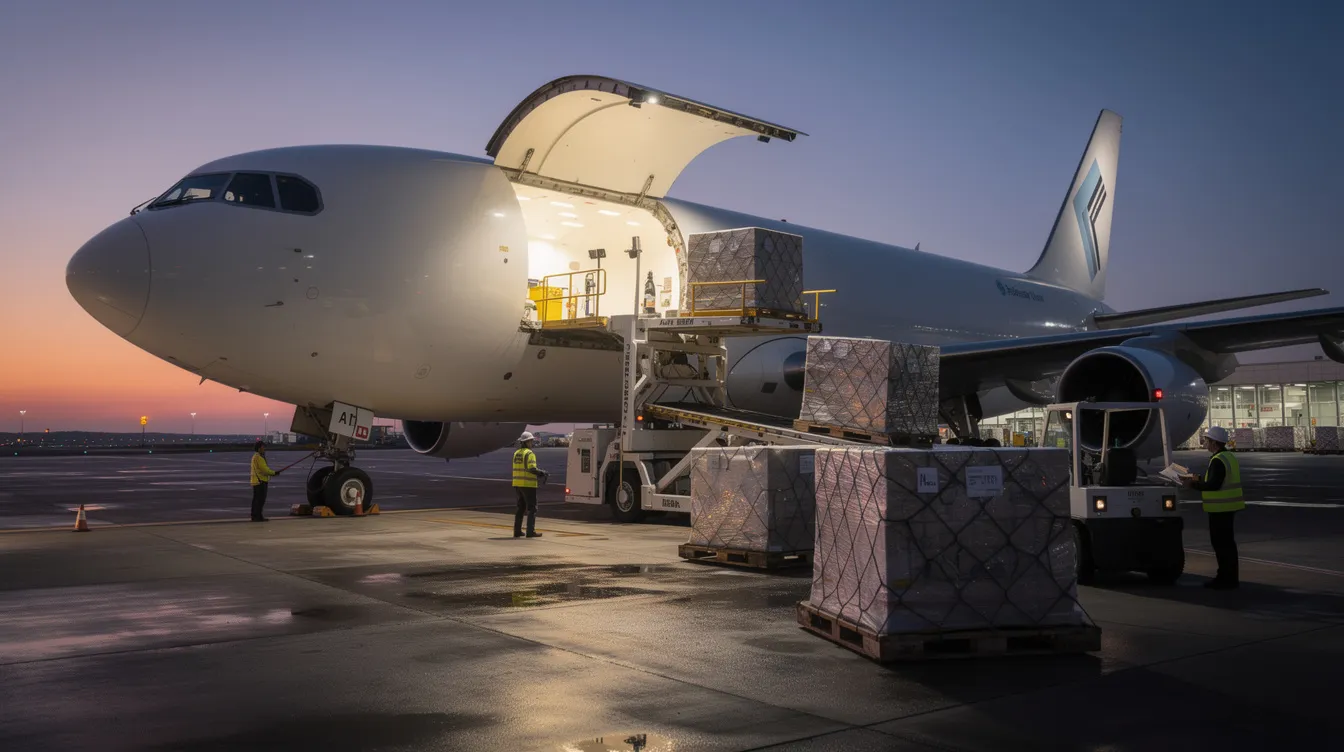
A single grounded assembly line can cost an automotive manufacturer millions per day. A delayed vaccine shipment can leave thousands without protection. A missed trade show setup window can derail a product launch. For these scenarios, scheduled air freight is too slow, too rigid, and too uncertain. A cargo charter plane puts the solution on your terms: your aircraft, your schedule, your route.
Why Cargo Charter Matters for High-Stakes Logistics Today
Over 90% of passenger planes were grounded in 2020, and with them went the belly-hold cargo capacity that global supply chains depended on. Scheduled capacity collapsed. Rates spiked. Companies that relied on passenger aircraft belly space for freight found themselves without options. The global air cargo charter market has grown steadily since that disruption, and dedicated freighter operations now account for roughly 44–46% of international available cargo tonne-kilometres, according to IATA market data.
Cargo charter is no longer a last resort. It is a strategic tool. Businesses use it to bypass supply chain disruptions, guarantee delivery windows for time-sensitive shipments, and reach remote destinations where scheduled flights do not operate. Air cargo charter services are now routine for industries ranging from automotive to pharmaceuticals to humanitarian relief.
Cargo charter planes operate differently from scheduled commercial cargo airlines. They offer dedicated on-demand aircraft capacity for specific customer needs, with routing and timing controlled by the client rather than an airline's network schedule. Cargo charters can bypass congested ground routes and hub airports for urgent deliveries, reducing transit time from days to hours.
BlackJet, known for its Jet Card membership programs and private jet charter services, also coordinates bespoke cargo charter and urgent cargo flights for members and corporate clients. The same operational infrastructure behind BlackJet's passenger flights (safety certification, vetted operators, 24/7 support) powers its cargo charter solutions for clients around the world.
Advantage | What It Means |
|---|
Speed | Overnight delivery where scheduled options would take 2–3 days with connections |
Control | You set the departure time, airport, and customs clearance window |
Direct routing | Fly point-to-point, including secondary or regional airports |
Reduced downtime | Avoid multi-million-dollar production shutdowns or missed launch dates |
Fewer touchpoints | Less handling means lower risk of damage or loss |
What Is Cargo Charter? (And How It Differs from Standard Air Freight)
Cargo charter means exclusive use of a cargo plane or suitably configured aircraft for a single client's shipment. The client controls timing, routing, loading, and ground handling arrangements from origin to destination. Charters offer greater flexibility in scheduling and routing to meet urgent requirements, and they provide dedicated capacity for single customers to prevent cargo overbooking.
Standard air freight on scheduled flights works differently. Cargo is consolidated with other shippers' goods, loaded into belly space on passenger aircraft or onto scheduled freighters that follow fixed timetables and hub-and-spoke routes. Transit involves multiple handling stages, transfers, and wait times.
Dedicated aircraft for cargo charters improve security and control during shipping. Cargo charters minimize the risk of theft or damage through fewer handling touchpoints and simplify transportation processes by reducing handling stages. Charter services are more expensive but allow for customized logistics handling. They reduce transit times compared to traditional freight methods, often cutting days to hours.
Cargo charter: Full control over schedule, route, and aircraft; accommodates oversized or irregular loads; highest cost per tonne but fastest transit
Scheduled air cargo: Fixed timetables, shared capacity, hub transfers; moderate cost; longer transit with consolidation delays
Express integrators (DHL/UPS/FedEx): Fast door-to-door for small parcels; expensive per kilogram for large or heavy freight; standardized packaging requirements limit flexibility
When a Cargo Charter Plane Is the Right Answer
Businesses often choose cargo charters for emergency shipments that require quick delivery. Below are the most common use cases, organized by category.
Urgent manufacturing and AOG (aircraft-on-ground): An automotive manufacturer in Michigan discovers that engine components are stuck in Germany. Every hour of assembly-line downtime costs the company roughly $250,000. Automotive parts are frequently shipped via air cargo charters for exactly this reason: a narrow-body freighter carrying 20 tonnes of components departs overnight and lands at a regional airport near the plant, cutting 36 hours off the scheduled freight timeline. Air cargo charters provide rapid delivery for time-sensitive shipments where the cost of delay far exceeds the cost of the charter.
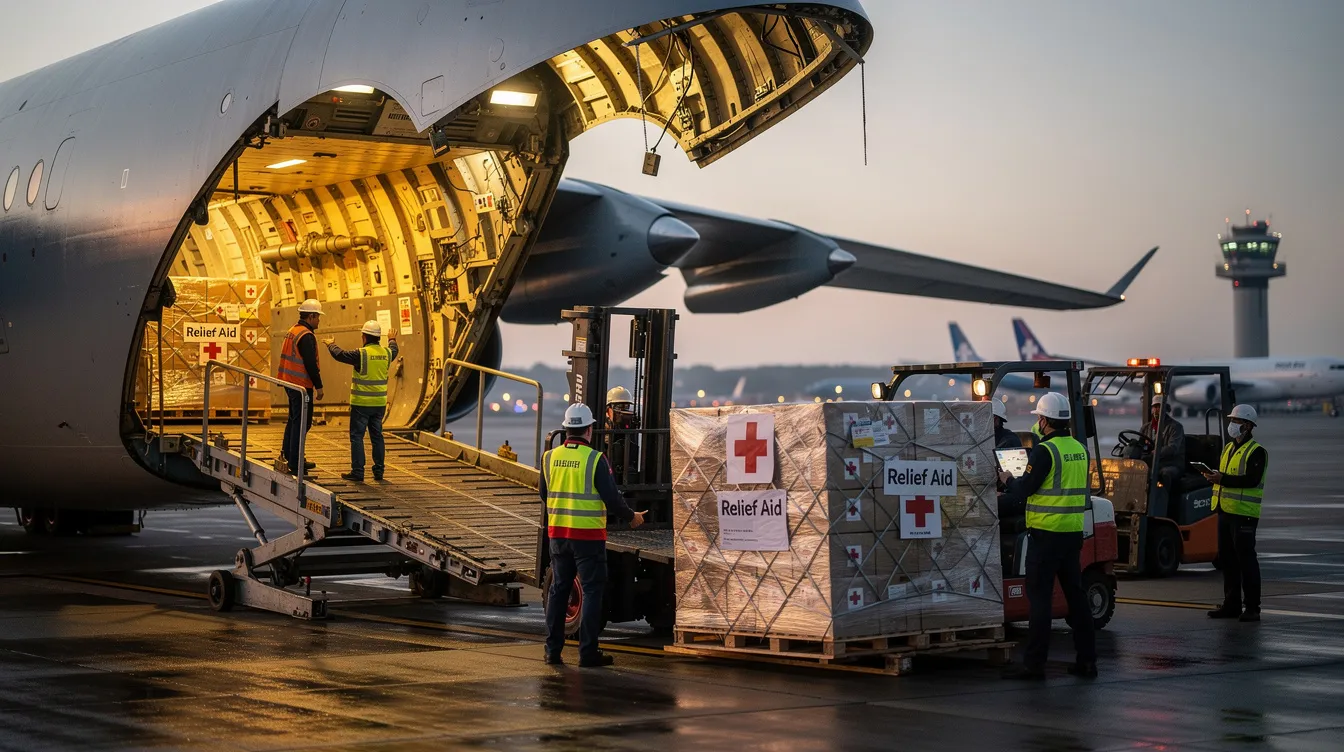
Humanitarian aid and disaster relief:f After the 7.2-magnitude earthquake in Haiti in August 2021, ShelterBox and Airlink chartered two A300-600F aircraft to deliver 71 tons of aid (shelters, solar lights, water carriers) directly to Port-au-Prince. Humanitarian aid is rapidly deployed using air cargo services because standard cargo capacity is overwhelmed or unavailable after natural disasters. Cargo charters are beneficial for transporting time-sensitive humanitarian supplies, and air cargo charters transport urgent medical supplies like vaccines into regions where cold chain logistics must move fast.
High-value and luxury goods: ds Cargo charter services are ideal for high-value or sensitive shipments requiring control. Moving rare artwork, luxury vehicles, or fine jewelry to exhibitions or private collections demands fewer handling stages, climate control, and chain-of-custody documentation that scheduled services cannot guarantee.
Retail launches and event logistics: Entertainment equipment is often moved via air cargo charters for events. A tech firm opening flagship stores across Europe needs display walls, AV gear, and demo units to arrive together, on time, and cleared through customs in a single batch. E-commerce growth continues to drive demand for cargo charters as companies compress launch-to-shelf timelines.
Industrial and oil and gas industries:s Air cargo charters are essential for transporting oversized industrial equipment: turbine components, drilling modules, and heavy machinery that scheduled carriers cannot accommodate. Chartered flights can transport oversized or hazardous goods safely to wellheads, refineries, and offshore staging areas.
Cargo charter planes provide access to remote locations with limited transport infrastructure. Charter flights use small regional or remote airports for direct access to remote destinations. Air cargo charters offer ultimate flexibility for shipping needs, and cargo charter planes can accommodate unique cargo sizes that traditional freight cannot handle.
Cargo Aircraft Types and Capacities
Choosing the appropriate aircraft depends on payload weight, cargo dimensions, route distance, and runway requirements at both ends. Specialized aircraft can accommodate oversized and heavy industrial shipments that standard carriers refuse. Cargo aircraft can be specifically built for unique tasks, from feeder routes to intercontinental heavy-lift operations. An estimated 1,000 freighters are expected to enter the market by 2030, expanding aircraft availability across all categories.
Small aircraft and turboprop aircraftSmall cargo planes like the Cessna Caravan 208B (1.4–1.8 tonnes payload) and King Air B200 (around 1.8 tonnes) handle urgent, lightweight shipments over shorter distances. Regional freight moves on turboprop aircraft like the ATR 72-600F, which features a large side-loading cargo door and carries up to approximately 8–9 tonnes over ranges of 1,400–2,500 km. These aircraft serve regional logistics needs and connect remote destinations to larger hubs.
Narrow-body freighters Boeing 737-400SF, 757F, and Airbus A321P2F models carry roughly 18–30 tonnes. They cover medium-haul routes and are the workhorse for intra-continental cargo flights. Aircraft selection at this tier balances payload against runway length and door dimensions.
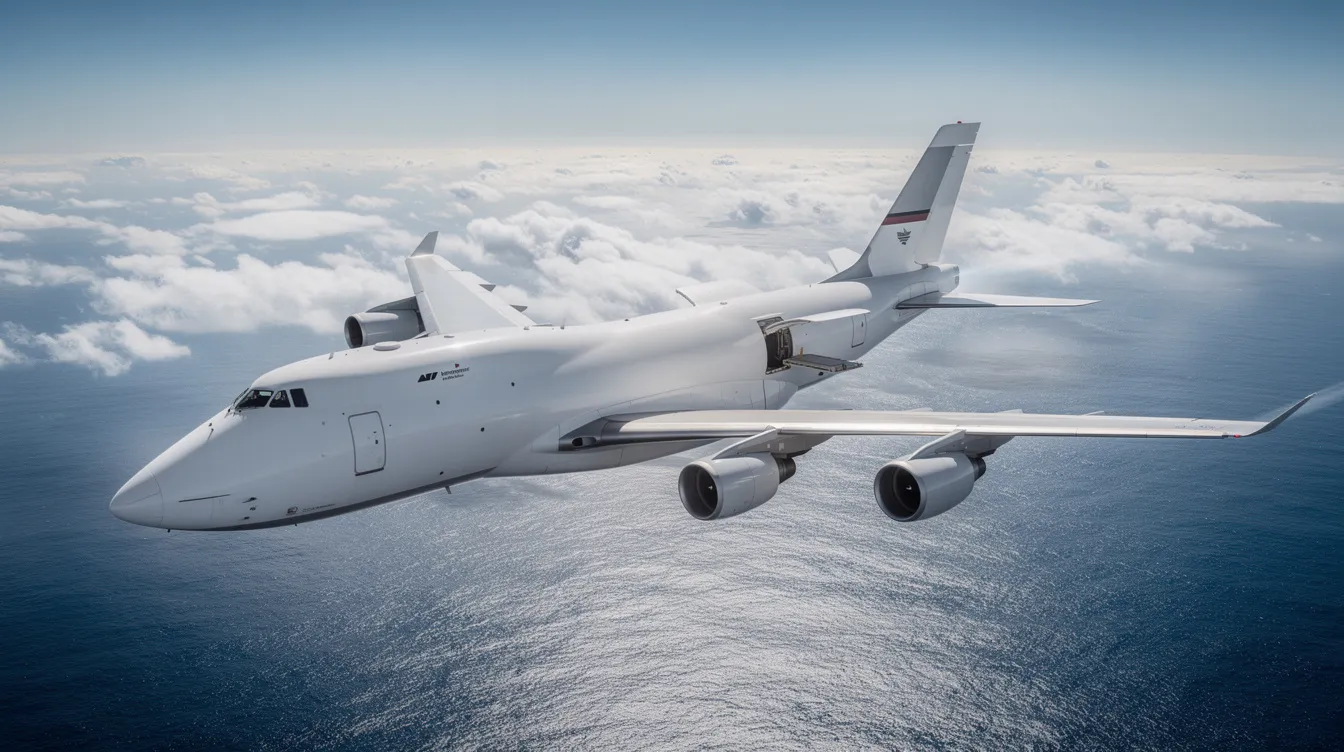
Wide-body and large freighters: rs The Boeing 777F has a payload capacity of 224,900 lbs, making it the backbone of intercontinental air cargo. The Boeing 747-400F can carry a maximum payload of 248,600 lbs and remains the standard for high-volume, long-haul charter options. Both aircraft type categories handle palletized and containerized cargo with reinforced floors, large main-deck doors, and integrated loading systems. This is what distinguishes a cargo aircraft from a typical passenger aircraft or private jet: many freighters were originally designed for passenger service and later converted, while purpose-built freighters add floor reinforcement rated for distributed heavy loads, cargo doors measured in meters rather than centimeters, and ULD (Unit Load Device) compatibility.
Outsized and special-mission aircraft: The Antonov An-124 can carry up to 120 tonnes via nose and rear ramps, handling wind turbine blades, gas industry modules, and heavy machinery that no other civilian aircraft can fit. The Ilyushin Il-76 is designed for oversized cargo transport and operates into austere airstrips where larger freighters cannot land. Cargo charter services handle oversized or specialized cargo that standard carriers cannot.
From Jet Cards to Cargo Charter: How BlackJet Bridges Passenger and Freight Needs
BlackJet's core offering is Jet Card-based private jet access through programs like the 25-hour and 50-hour Jet Card and the BlackJet 25+ Hour Jet Card. Members prepay for flight hours across multiple cabin classes with 24/7 digital booking, safety certification, and carbon-neutral flights. The same operations team that arranges private jet charter travel can coordinate dedicated air cargo services for members who need more than a luggage hold can carry.
Consider a corporate client launching a product in Toronto. The executive team flies from Los Angeles on a super midsize jet through BlackJet's passenger charter, a model similar to chartering a plane for 100 passengers but scaled to a smaller leadership group. Simultaneously, a separate cargo charter plane carries 12 tonnes of trade show exhibits and demo vehicles on a narrow-body freighter, timed to arrive at the same regional airport. BlackJet coordinates both flights, customs clearance, and ground handling arrangements so people and freight converge on schedule.
When does a standard private jet charter suffice for freight? Light loads under 500–1,000 kg, non-hazardous, and within hold dimensions can travel aboard a passenger aircraft. When weight exceeds hold limits, cargo specifications require special handling, or dangerous goods regulations apply, a dedicated cargo charter aircraft is required. That threshold is where BlackJet's cargo team steps in, providing comprehensive logistics support and maximum flexibility.
How a Cargo Charter Flight Is Planned and Executed
The process from inquiry to delivery follows a consistent lifecycle. BlackJet acts as a single point of contact throughout.
Inquiry and cargo specifications: The client provides weight, dimensions of the largest piece and total shipment, packaging type, and hazardous or perishable status. Origin, destination, and time constraints are confirmed.
Feasibility and aircraft selection: The team identifies the right aircraft based on payload, door size, runway length at both airports, and overflight/landing permits. Ground handling availability is verified.
Pricing and quote: Cost is calculated from aircraft hourly rate, fuel surcharges, crew costs, permits, and handling fees. Transparent pricing means the client sees each component.
Contracting and permits: Flight plans are filed. Overflight and landing permits, customs and export/import paperwork, and any dangerous goods approvals are secured.
Ground handling and loading: Cargo is packaged, loaded, and secured. Temperature control equipment, if needed, is confirmed. Loading equipment (tugs, forklifts, ramps) is arranged at origin.
Flight execution: Real-time tracking, weather routing, and crew readiness are monitored. Contingency plans for diversions or weather rerouting are in place.
Delivery and handover: At the destination, customs clearance proceeds on the pre-arranged schedule. Cargo is unloaded and transferred to the consignee or final-mile transportation.
Domestic North American cargo flights can launch within 6–12 hours once cargo specifications and permits are confirmed. Complex intercontinental humanitarian aid missions, especially with outsized cargo or special regulatory requirements, typically require 24–48 hours for permits, ground preparation, and customs coordination. Lead time varies, but planning early where possible reduces repositioning costs and improves aircraft availability.
Cost Drivers: What It Really Costs to Charter a Cargo Plane
Cargo charter costs range from $5,000 to $800,000+ per flight, depending on aircraft type, route, and cargo complexity. Cargo charter pricing varies by distance, urgency, and season, much like private jet pricing across charter and membership models. The primary cost components are:
Aircraft type and size: Larger freighters burn more fuel and carry higher crew and insurance costs. Hourly rates depend on aircraft operation, crew, and insurance.
Route distance and flight hours: Longer sectors cost more. Positioning fees can add $25,000–$45,000 per flight hour when the aircraft must reposition empty to the pickup point.
Cargo weight and volume: Payload drives aircraft selection, which drives cost. Special handling needs (temperature control, hazardous materials) add charges.
Demand and seasonality: Peak seasons (Q4 retail, post-disaster surges) tighten supply and raise rates.
Cost benchmarks (2025–2026 estimates):
Aircraft Category | Approximate Cost Range |
|---|
Regional turboprop (ATR 72F, Cessna Caravan) | $8,000–$15,000 per flight leg |
Narrow-body freighter (737F, 757F) | $18,000–$30,000 per sector |
Boeing 747-400F | $30,000–$50,000 per hour |
Boeing 777F | $35,000–$55,000 per hour |
Wide-body intercontinental (full mission) | $250,000+ per sector |
Narrative examples: A three-hour narrow-body freighter flight carrying 20 tonnes of regional freight within Europe runs approximately $25,000–$35,000, including fuel, handling fees, and landing charges. A transatlantic Boeing 777F charter from Chicago to Frankfurt, carrying 80 tonnes of automotive components, costs $250,000–$350,000 depending on customs, special handling, and ground logistics.
The cost is justified when the value of the cargo, the cost of delay, or the urgency of the mission exceeds what scheduled services can deliver. For companies facing multi-million-dollar shutdowns or life-and-death humanitarian timelines, the math is straightforward.
Safety, Compliance, and Risk Management in Air Cargo
Speed does not come at the expense of safety. Air charter service providers operating under FAA (Part 121/135) and EASA regulations must meet airworthiness, crew duty, and security screening requirements. IATA Dangerous Goods Regulations govern hazardous materials handling, labeling, segregation, and crew training.
Operator vetting: Reputable charter solutions providers check maintenance records, pilot experience on type, and certifications. Industry safety audits such as ARG/US and Wyvern ratings confirm that operators meet or exceed regulatory minimums.
Insurance: Full cargo liability, hull coverage, and war risk (when applicable) protect high-value shipments. Chain-of-custody documentation is standard for fine art, bullion, and pharmaceuticals.
Elevated protocols by cargo type: Pharmaceuticals require cold chain validation and temperature monitors. Hazardous materials follow IATA DGR with special loading, labeling, and segregation. Live animals comply with IATA Live Animals Regulations with veterinary documentation.
BlackJet partners only with audited operators and maintains internal standards that mirror those used for its passenger Jet Card fleet. Clients receive risk briefings covering airport security, weather exposure, and handling procedures before each mission.
Sustainability and Technology in Modern Air Cargo Charter
Newer cargo aircraft reduce fuel burn per tonne-kilometre. The Boeing 777F and ATR 72-600F are fuel-efficient aircraft compared to older converted freighters. Fleet modernization across the industry is gradually lowering the emissions profile of air cargo, though air freight remains carbon-intensive per tonne-kilometre relative to surface transport.
Digital platforms now enable real-time shipment tracking, condition monitoring (temperature, vibration, humidity), and predictive routing. Automated load-planning tools optimize payload versus fuel versus routing, reducing empty legs and improving on-time performance for companies managing complex global supply chains.
BlackJet's sustainability commitment includes carbon-neutral flights for passenger Jet Card members. That ethos extends to cargo: where available, BlackJet can arrange carbon offsets or sustainable aviation fuel (SAF) blending for associated cargo flights. Emerging developments include electric and hybrid cargo aircraft for short-range feeder routes and autonomous cargo drones for last-mile delivery in remote regions, both expected to reach operational scale within the next decade.
Frequently Asked Questions (FAQs) About Cargo Charter Planes
Q: What is a cargo charter plane?
A: A cargo charter plane is an aircraft exclusively rented to transport a specific shipment on a schedule and route controlled by the client, offering flexibility and dedicated capacity compared to scheduled air freight.
Q: How does cargo charter differ from scheduled air freight?
A: Cargo charters provide exclusive aircraft use, direct routing, and flexible timing, while scheduled air freight consolidates shipments on fixed routes with multiple handling stages.
Q: What types of cargo are best suited for charter flights?
A: Time-sensitive shipments, oversized or hazardous goods, high-value items, humanitarian aid, and urgent manufacturing parts benefit most from cargo charters.
Q: How long does it take to arrange a cargo charter flight?
A: Domestic flights can be arranged within 6–12 hours, while complex international or oversized cargo missions typically require 24–48 hours for permits and logistics.
Q: What factors influence the cost of chartering a cargo plane?
A: Aircraft size, route distance, cargo weight and special handling needs, repositioning fees, and seasonal demand all impact pricing.
Q: Can cargo charters accommodate hazardous or temperature-sensitive goods?
A: Yes, cargo charters comply with IATA Dangerous Goods Regulations and cold chain requirements, ensuring safe transport of sensitive shipments.
Q: How does BlackJet ensure safety and compliance in cargo charters?
A: BlackJet partners with audited operators meeting FAA/EASA standards, verifies crew qualifications, and maintains comprehensive insurance and risk management protocols.
Q: Is sustainability considered in cargo charter flights?
A: Yes, BlackJet offers carbon offset options and sustainable aviation fuel blending where available to reduce the environmental impact of cargo flights.
Q: Can cargo charters access remote or secondary airports?
A: Absolutely. Cargo charters can fly point-to-point, including regional or remote airports not served by scheduled cargo flights, enhancing delivery flexibility.
Q: How do I get started with booking a cargo charter through BlackJet?
A: Contact BlackJet's cargo team with your shipment details, including weight, dimensions, origin, destination, and timing. They will guide you through aircraft selection, pricing, and logistics coordination.
Optimizing Your Cargo Charter Strategy and Working with BlackJet
Practical recommendations for logistics teams and procurement decision-makers:
Define cargo specifications upfront. Weight, dimensions of the largest item, packaging constraints, and any hazardous classification. Incomplete specs delay aircraft selection and inflate costs.
Plan when possible. Emergencies aside, early bookings improve aircraft availability and reduce repositioning charges. Experienced brokers and providers can lock in capacity before demand surges.
Consolidate shipments. Fill the aircraft. A half-empty charter is a cost-inefficient charter. Group shipments headed to the same region to maximize payload utilization.
Use secondary airports. Regional airports often have lower fees, less congestion, and faster ground handling than major hubs. Charter flights offer this flexibility by design.
Pair with multimodal solutions. Sea-air combinations reduce cost for bulk freight; ground transport handles the final mile. A single aviation partner that understands both air charter and surface logistics simplifies global trade coordination.
Build long-term relationships. Membership-style models, like BlackJet's Jet Card for passenger travel, translate into priority access and better responsiveness for related cargo needs. One partner, one contact, unified safety and service standards.
Cargo charter is a precision tool. Used well, it protects revenue, saves operations from costly downtime, and delivers where scheduled capacity cannot. Used poorly, it wastes budget on under-filled aircraft or last-minute scrambles that better planning could have avoided.
Whether the challenge is an AOG crisis in Munich, a vaccine shipment to a disaster zone, or a product launch in three cities simultaneously that also requires the best private jet for 20 passengers, having one aviation partner for both people and freight eliminates friction. BlackJet brings the same rigor to cargo that it applies to every private aviation experience, competing alongside top private jet companies for luxury travel: audited operators, transparent pricing, customer satisfaction as a standard rather than an aspiration, and a global network built for speed.
Explore how BlackJet can integrate cargo charter into your broader private aviation strategy. Contact our team to discuss charter options tailored to your operations, and discover what it means to have safety, sustainability, and global reach built into every flight.


 Sign up with google
 Sign up with Apple