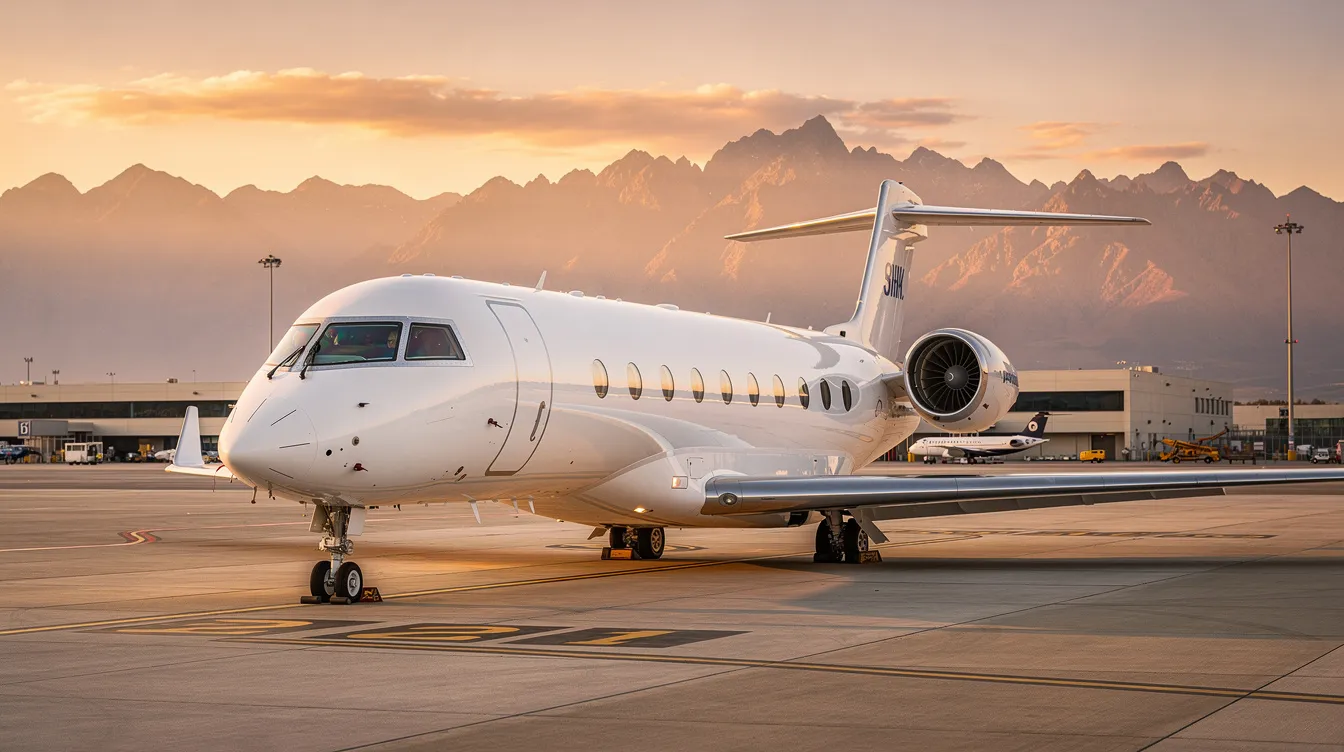
The Gulfstream G700 is an ultra-long-range private jet with a factory list price of $79 million. Market ask prices for near-delivery or low-hour examples frequently land between $88 million and $90,995,000, and the total acquisition cost for a G700 can exceed $100 million once completion, taxes, and options are factored in. For travelers evaluating a Gulfstream business jet at this price tier, understanding the full cost picture is the difference between a strategic asset and a capital trap.
Immediate Answer: Gulfstream G7 (G700) Price Overview
When people search for the "Gulfstream G7 price," they are referring to the Gulfstream G700, the current flagship ultra-long-range business jet in Gulfstream's lineup. The initial acquisition cost of a Gulfstream G700 can range from $75 million to $91 million depending on build year, delivery slot, and interior specification. By mid-2026, dealer ask prices have pushed toward $88 million to $93 million for aircraft with near-term delivery positions, reflecting waitlists that extend into 2028.
After interior completion, connectivity packages, registration, and import duties, a realistic fly-ready budget sits between $82 million and $95 million. Annual operating cost for typical owner use at 300 to 450 flight hours runs approximately $3,920,087 based on published benchmarks, while ownership costs for ultra-long-range jets generally run from $2.2 million to $3.3 million annually for fixed expenses alone.
For travelers flying 25 to 100 hours per year, accessing G700-class aircraft through a Jet Card program and its typical cost structure avoids the $80 million-plus capital outlay entirely. The sections below break down purchase price, fixed costs, hourly costs, cabin length, cabin width, cabin volume, and alternatives including jet cards and charter.
What Makes the Gulfstream G7 (G700) a Strategic Asset in Business Aviation
Ultra-long-range aircraft like the G700 compress time. A commercial first-class itinerary from New York to Hong Kong requires a connection and roughly 20 hours door-to-door. The G700's maximum range of 7,750 nautical miles at Mach 0.85 turns that into a single nonstop leg, cutting total travel time to under 16 hours and eliminating an overnight layover.
At Mach 0.90, the aircraft covers 6,650 nautical miles. Its maximum operating speed of Mach 0.935 makes it the fastest large cabin Gulfstream aircraft in production. Uninterrupted intercontinental flights reduce jet lag and recover working days that connections destroy.
Corporations, family offices, and high-net-worth individuals use the G700 as a mobile boardroom with up to five living areas, a forward galley, dedicated crew rest, and a grand suite with a shower. Two Rolls-Royce Pearl 700 engines power the aircraft, delivering both range and fuel-efficiency gains of 33% over previous generation models.
This capability is why organizations accept an $80 million-plus acquisition price and a multimillion-dollar annual budget: they are purchasing schedule control, privacy, and security. Buyers who fly fewer than 200 hours annually, however, often find that structured access through charter or Jet Card programs delivers the same cabin class at lower total cost.
Gulfstream G7 (G700) Purchase Price in 2024 to 2026
The Gulfstream G700 is priced at $79 million for a new "green" (unfinished interior) aircraft as of Q2 2025, based on published guidance and market reporting from aviation trade sources. Business and Commercial Aviation's 2026 Purchase Planning Handbook lists a typically equipped G700 at $84.9 million.
Limited production slots and strong demand have pushed actual market ask prices to $88 million to $93 million for 2024 to 2026 build years. Qatar Executive and other operators have taken early delivery positions; the remaining queue extends through mid-2028 for both the G700 and its sibling G800.
Key price factors:
Green vs. completed aircraft: Custom interior, connectivity, and options typically add $3 million to $5 million above the green airframe price.
Delivery slot premiums: Early-delivery or pre-owned low-time jets (under 1,000 hours) routinely sell above factory list price because buyers skip a two- to three-year waitlist.
Financing structure: Cash purchases vs. financed deals with 10% to 20% down and 7- to 15-year amortization change total cost over time.
Equipment and jurisdiction: Factors such as cabin configuration and avionics upgrades, Ka- or Ku-band Wi-Fi, bespoke materials, and country of import all influence the final number.
Customization options for the G700 can add millions to the final purchase price. Purchasing a Gulfstream G700 also ties up substantial capital, impacting opportunity costs for owners who could otherwise deploy that cash into core business operations or investments — a trade-off that becomes clearer when you understand the broader private jet price list and access options.
Acquisition Add-Ons: From Green Jet to Fly-Ready G7
The factory list price is only the starting point. Buyers must budget for completion, delivery, and regulatory items before the first aircraft enters service.
Category | Typical Cost Range |
|---|
Interior completion and bespoke design | $2,500,000 to $4,000,000 |
Registration, legal, escrow, ferry flights | $500,000 to $1,000,000 |
Enhanced connectivity (Starlink, Ka/Ku-band) | $300,000 to $800,000 |
Sales tax or import duties (jurisdiction-dependent) | 0% to 10%+ of acquisition price |
Complete interior refurbishment (if pre-owned) | $2,000,000 to $5,000,000+ |
U.S. state sales and use taxes apply unless structured as interstate commerce, and EU-based buyers face VAT in certain basing scenarios. A realistic fly-ready G700 budget generally falls between $82 million and $95 million before financing costs. New paint and interior soft goods on a pre-owned example can run into high six figures alone.
Key G7 (G700) Performance and Cabin Metrics That Drive Price
These are the specs that justify the sticker price. The G700 occupies the top tier of business aviation pricing because no other business jet in service combines this range, speed, and cabin size in a single airframe.
Performance:
Maximum range: 7,750 nautical miles (14,353 km) at Mach 0.85 with full fuel
High-speed range: 6,650 nm at Mach 0.90
Maximum speed (Mmo): Mach 0.935
Takeoff distance at MTOW: approximately 5,995 feet
Wing span and clean wing design contribute to improved aerodynamics and lower drag
Cabin dimensions:
Cabin length: 56 ft 11 in (17.35 m), the longest in the Gulfstream fleet
Cabin width: 8 ft 2 in (2.49 m)
Cabin height: 6 ft 3 in (1.91 m)
Cabin volume: 2,603 cubic feet
Cabin altitude: 2,916 feet at 41,000 feet cruise altitude, reducing fatigue on ultra-long-range legs
Capacity and certification:
Seats up to 19 passengers; sleeping arrangements for up to 13
FAA certified March 29, 2024; EASA certified May 2024
Over 100 aircraft delivered by mid-2026, supporting fleet maturity and residuals
The G700 ranks among the longest-range private jets in service and holds the cabin volume record for production Gulfstream jets.
Inside the G7 Cabin: Layout, Galley and Productivity Design
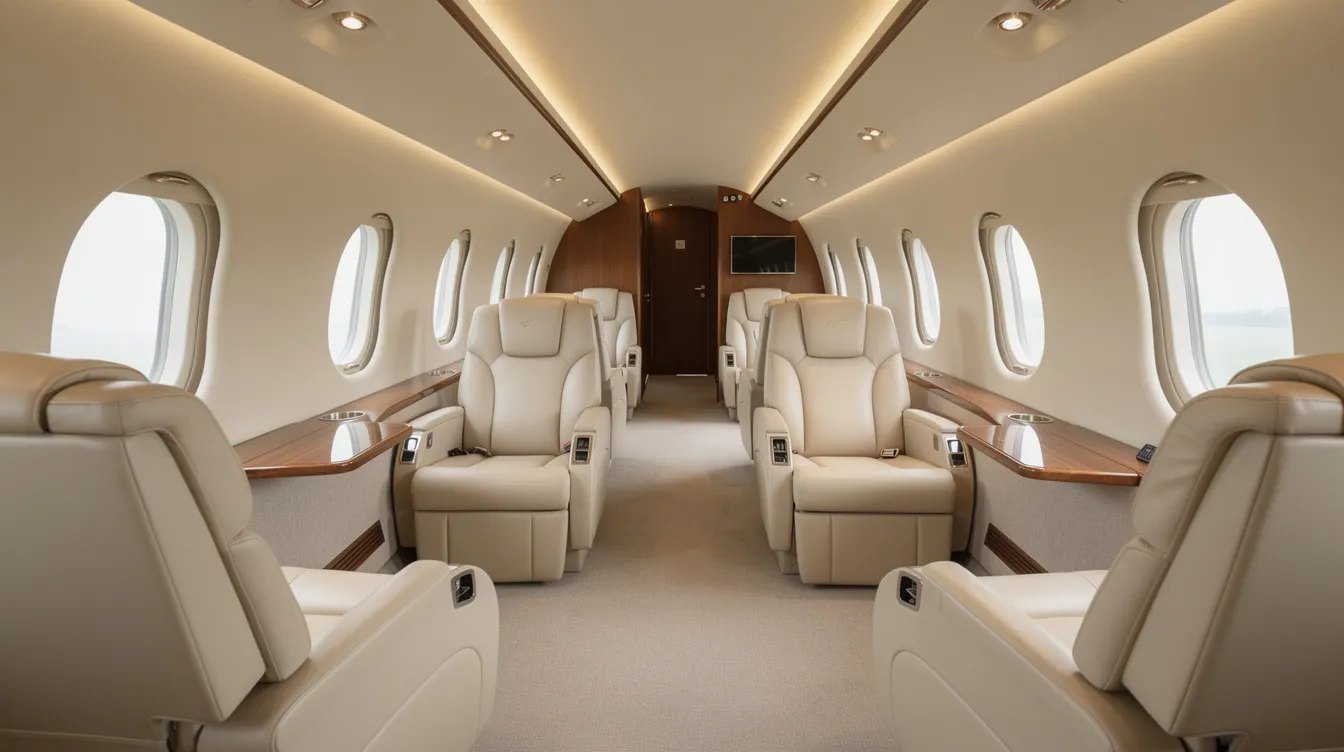
The G700's large cabin supports up to five distinct living areas: a forward club section, mid-cabin conference and dining zone, lounge or media area, aft stateroom, and en-suite with shower. This layout is not decorative; it converts the aircraft into an office, dining room, and bedroom on flights that can last 15 hours or more.
The forward galley configuration includes a full catering workspace with premium appliances, enabling fine dining service for long-haul missions. Twenty large oval windows and an advanced circadian lighting system reduce perceived cabin fatigue. Ergonomic seating converts to fully flat beds, and the aft grand suite with shower supports genuine rest on overnight legs.
Cabin technology includes touch-screen controls, high-speed inflight connectivity, and integrated cabin management systems that turn the aircraft into a functioning office. Bespoke interiors from top designers can add high six figures to low seven figures beyond standard completion budgets. Corporate flight departments that prioritize productivity often specify conference tables, secure VPN-capable Wi-Fi, and presentation screens, each adding to the delivered cost — all areas where BlackJet’s premium private jet card programs mirror large-cabin ownership standards without the capital burden.
Gulfstream G7 Fixed Costs: The Annual Budget You Cannot Avoid
Fixed costs are independent of flight hours and must be carried every year of ownership. These represent the baseline annual budget before the aircraft ever leaves the hangar.
Published benchmarks show fixed costs amount to $1,137,800 annually at 450 hours of utilization. At lower utilization, the per-hour burden increases because the same expenses are spread over fewer hours, and a significant share of that budget is driven by private jet pilot and crew costs.
Typical fixed cost breakdown:
Item | Annual Range |
|---|
Crew compensation (2 to 3 pilots) | $700,000 to $1,100,000 |
Hangar and parking | $150,000 to $300,000 |
Hull and liability insurance | $150,000 to $400,000 |
Recurrent simulator training | $80,000 to $150,000 |
Management fees, subscriptions, admin | $100,000 to $300,000 |
Total annual fixed costs commonly fall between $1,500,000 and $2,800,000 depending on base location, crew structure, and whether owners engage a management company. Spreading these costs over more flight hours lowers the effective per-hour rate, which is why high-utilization operators see better unit economics.
Hourly Variable Costs and Total Annual Operating Cost
Variable costs rise directly with each hour flown: fuel, maintenance, engine reserves, landing fees, and handling charges, mirroring many of the same inputs that determine how much it costs to rent a private jet.
Variable costs for the G700 range from $6,500 to $7,500 per flight hour under typical conditions. Some operators quote total direct operating cost at approximately $8,711 per flight hour based on 450 flight hours annually; this figure includes both the fixed and variable components prorated per hour. Variable costs total $2,782,287 per year at that utilization level.
Hourly variable cost breakdown (approximate):
Fuel: $3,800 to $4,000/hour (roughly 400 to 440 gallons/hour at mid-2026 Jet-A prices)
Engine program and maintenance reserves: $2,000 to $2,500/hour
Landing, handling, catering, navigation: $500 to $1,000/hour
Annual budget examples:
Annual Hours | Variable Costs | Fixed Costs | Total Operating Cost |
|---|
200 | $1,300,000 to $1,500,000 | $1,500,000 to $2,000,000 | $2,800,000 to $3,500,000 |
300 | $1,950,000 to $2,250,000 | $1,500,000 to $2,000,000 | $3,450,000 to $4,250,000 |
450 | $2,782,287 | $1,137,800 | $3,920,087 |
Annual operating cost for the G700 is $3,920,087 at 450 hours. Buyers should model conservative fuel prices and capture reserves for major inspections and cabin refreshes over a 10- to 15-year ownership horizon, while also considering how jet card tax deductions can offset costs when aircraft or card hours are used for business purposes. For a deeper breakdown, see our Gulfstream G700 Price and Cost Guide.
Depreciation, Resale and the Real Long-Term Cost of a G7
Acquisition and annual operating budgets are only part of the equation. Residual value and depreciation shape true ownership economics over a decade.
Ultra-long-range jets typically depreciate by 8% to 12% annually under normal conditions. For the G700, limited supply and strong demand have compressed that rate: the market for pre-owned Gulfstream G700s remains tight due to high demand and low supply, with few publicly listed aircraft as of mid-2026. Mean asking prices for pre-owned examples sit around $87.66 million, roughly 6% above estimated new-build pricing.
Pre-purchase inspections are crucial to avoid unexpected maintenance costs for a Gulfstream G700, especially on aircraft condition items like engine cycles, airframe total time, and interior wear. Owners who stay on OEM maintenance programs (APU enrolled, engine enrolled) and keep cosmetics current protect resale pricing later in the aircraft's life.
Conservative long-term planning should model 10% annual depreciation, adjusted for cycles, total time, and aircraft condition. Tying up $80 million-plus in a single asset carries opportunity cost that owners must weigh against deploying capital into core business operations, especially when more economical private aircraft options and access models can serve shorter or less demanding missions.
G7 vs. Other Gulfstream Aircraft and Long-Range Business Jets
The G700 is the most expensive Gulfstream in current production. Here is how it compares to adjacent models and rival platforms.
Aircraft | Approx. Price (2026) | Range (nm) | Cabin Length | Cabin Volume |
|---|
Gulfstream G700 | $79M to $91M+ | 7,750 | 56 ft 11 in | 2,603 cu ft |
Gulfstream G650ER | $40M to $60M (pre-owned) | 7,500 | 46 ft 10 in | ~2,138 cu ft |
Gulfstream G800 | TBD (similar tier) | 8,000+ | Shorter than G700 | Smaller |
Bombardier Global 7500 | ~$78M | 7,700 | 54 ft 7 in | ~2,637 cu ft |
Dassault Falcon 10X | Not yet in service | 7,500 | ~54 ft | TBD |
The G700's Gulfstream Symmetry Flight Deck, Rolls-Royce Pearl 700 engines, and class-leading cabin altitude position it at the apex of current Gulfstream aircraft pricing. The Symmetry Flight Deck features active control sidesticks that reduce pilot workload, and Enhanced Flight Vision Systems are among the optional avionics for the aircraft.
Buyers should align mission requirements (range, typical passenger load, airport constraints) with cabin size and budget. Many missions can be served by a new Gulfstream at a lower price point or by accessing a comparable long-range jet through on-demand private jet rental and charter or a Jet Card.
Accessing G7-Class Aircraft Without Owning: Charter and Jet Cards
Flying fewer than 200 hours annually may make full ownership of a G700 financially impractical. Most private jet travelers do not need a dedicated $80 million airframe.
Charter rates for G700-class ultra-long-range business jet service run approximately $15,000 to $18,500 per flight hour in 2026, varying by region and availability. On-demand charter offers flexibility and zero capital risk, but G700 tail availability is limited, and pricing can spike during peak seasons; travelers flying solo or in small groups may instead buy a seat on a private jet via shared and semi-private options.
Jet card programs offer prepaid access to private jets at fixed hourly rates. Using memberships or jet cards can optimize flying costs compared to full ownership, and understanding jet card pricing across programs helps buyers benchmark value. A 25-hour jet card provides access to large cabin and ultra-long-range aircraft without ownership costs, crew management, or hangar obligations. Annual jet card spend typically runs $2 million to $4 million for travelers flying 50 to 100 hours on long-range and ultra-long-range cabin classes.
Jet card programs eliminate depreciation risk for users. Instead of absorbing 8% to 12% annual value loss on an $80 million asset, members pay a predictable per-hour rate and redirect capital elsewhere.
BlackJet Perspective: When a Jet Card Beats Buying a Gulfstream G7
BlackJet specializes in efficient private jet access for travelers who value the G700 cabin experience but recognize that ownership economics do not pencil out below 200 annual hours.
Consider an executive flying 80 hours per year on routes like New York to London, Los Angeles to Tokyo, and Dubai to Singapore. Owning a G700 at 80 hours means absorbing roughly $1.5 million in fixed costs plus $600,000 in variable costs, plus depreciation of $8 million or more annually. Through a BlackJet Jet Card, the same 80 hours in G700-class cabins cost a fraction of that total, with zero residual risk — especially when structured via a 100-hour jet card-style program that locks in predictable hourly rates.
Members enjoy 24/7 digital booking and real-time support to plan complex itineraries. BlackJet's operator network is safety-certified through third-party audits; every flight is carbon-neutral by default, and the platform handles the logistics that typically fall on personal assistants, family offices, and corporate travel teams. For details on 2026 Jet Card pricing, BlackJet publishes transparent rate structures across cabin categories, including its flagship BlackJet 25+ Hour Jet Card.
For many customers, the better "G7 price" is not the purchase price; it is the fixed hourly rate and predictable annual budget that a Jet Card offers for the same cabin class.
Safety, Sustainability and Technology: Beyond the Sticker Price
Evaluating the Gulfstream G7 price should also account for non-financial value: safety infrastructure, sustainable aviation practices, and onboard technology.
Safety: The Gulfstream Symmetry Flight Deck pairs active control sidesticks with a Combined Vision System and Predictive Landing Performance System. These avionics reduce pilot workload during approach and landing phases. Operators and access providers layer on additional safety through third-party audits, maintenance tracking, and crew recurrent training — the same criteria used when evaluating the best jet cards for frequent flyers.
Sustainability: The G700's engines produce lower emissions per nautical mile compared to the Rolls-Royce Pearl 700 engines' predecessors. The aircraft features a clean wing design for improved aerodynamics. The G700 supports carbon-neutral flight initiatives, and compatibility with Sustainable Aviation Fuel positions owners for tightening emissions regulations. From BlackJet's perspective, every flight within its network is carbon-neutral through verified offset programs, including for members exploring unlimited private jet flight memberships.
Technology: High-speed in-flight connectivity, secure VPN for corporate work, and digital cabin controls increase both the aircraft's market price and its productive output per hour. These investments matter for buyers and for Jet Card members who access the same equipped cabins, and they mirror the innovations found aboard the most expensive private jets in the world.

FAQs: Gulfstream G7 (G700) Price, Costs and Alternatives
Is there a price difference between "Gulfstream G7" and "G700"?
No. "Gulfstream G7" is an informal market term. The official designation is Gulfstream G700, and all pricing applies identically regardless of which name is used.
What is the typical annual budget to operate a G7 at 200, 300, or 400 hours?
At 200 hours, expect $2.8 million to $3.5 million. At 300 hours, roughly $3.5 million to $4.3 million. At 450 hours, the published benchmark is $3,920,087 per year.
How does G7 pricing compare with a Bombardier Global 7500?
The Global 7500 lists at approximately $78 million. The G700's sale price starts at $79 million,n and market asks run higher. Cabin volume is comparable; the G700 holds an edge in maximum speed. Travelers comparing specific access programs, such as NetJets jet card costs, should factor in these aircraft differences alongside membership pricing.
What cabin volume and cabin length does the G7 offer vs. the G650ER?
The G700 delivers 2,603 cubic feet of cabin volume and 56 ft 11 in of cabin length, compared to roughly 2,138 cubic feet and 46 ft 10 in for the G650ER — both suitable platforms for high-end group travel, though some buyers may instead look at the best private jet for 20 passengers when maximum headcount is the priority.
At what annual flight hours does ownership beat a Jet Card?
Based on industry data, ownership breaks even against charter at approximately 187 hours per year. Below that threshold, Jet Cards and charter offer better economics, and many travelers optimize value with 50-hour jet card programs instead of committing to full ownership.
What is the hourly rate to charter a G700 in 2026?
Typical charter rates for G700-class aircraft run $15,000 to $18,500 per hour. BlackJet's Jet Card pricing structure locks in fixed per-hour rates, avoiding the seasonal volatility of ad hoc charter, much like other providers outlined in our guide to Flexjet jet card costs and options.
Does flying a G7 via Jet Card still allow for carbon-neutral travel?
Yes. BlackJet delivers carbon-neutral flights across its network at no extra cost to members, with verified offset programs applied to every trip, whether you’re accessing a G700-class aircraft or a more modest 12-seater private jet solution.
Next Steps: Choosing the Right G7-Level Solution with BlackJet
The Gulfstream G700 commands $79 million-plus at factory list, with fully delivered examples reaching well beyond $90 million. Annual operating budgets run $3.5 million to $5.5 million at typical owner utilization. For many travelers, BlackJet's Jet Card programs deliver the same cabin experience at a predictable annual cost, without the capital commitment, crew management, or depreciation exposure.
BlackJet benchmarks your expected annual hours, typical routes, and preferred cabin classes to recommend the right mix of jet card and on-demand charter. Every flight includes carbon-neutral performance, 24/7 digital and concierge support, and access to a safety-certified operator network across multiple aircraft categories, including solutions for large private jet groups of up to 50 passengers.
Elevate your travel on your terms. Before committing $80 million to a single asset, explore how BlackJet's Jet Card programs deliver G700-class access with the flexibility, safety, and sustainability built in.


 Sign up with google
 Sign up with Apple