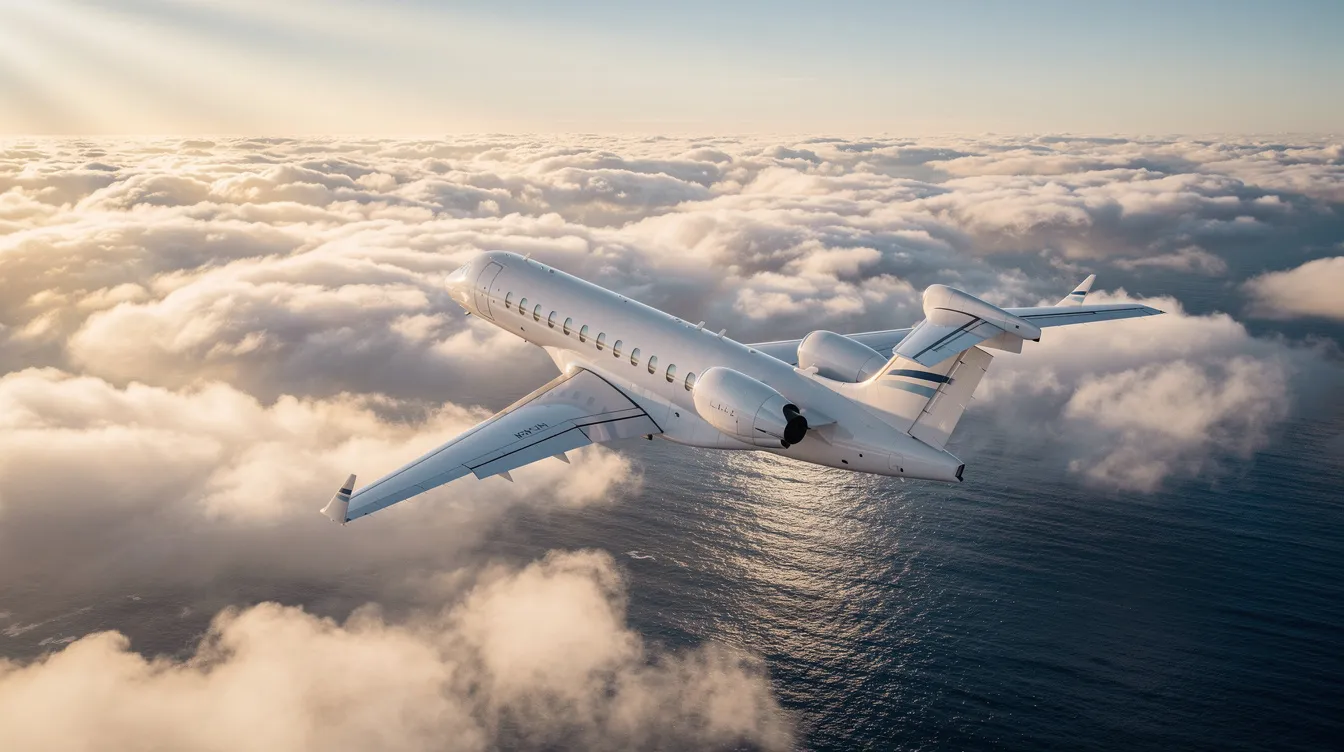
For more than six decades, Gulfstream Aerospace Corporation has defined what it means to fly privately at the highest level. From the first purpose-built business aircraft in 1958 to the ultra-long-range jets connecting continents today, Gulfstream's current generation emphasizes range, efficiency, and passenger comfort in ways that reshape how executives and entrepreneurs move across the globe. This guide is intended for business travelers, aviation enthusiasts, and anyone interested in understanding Gulfstream's impact on private aviation. This guide serves as a comprehensive, reference-style resource covering Gulfstream history, aircraft families, technical capabilities, and the role these jets play in modern business travel.
Overview: Why Gulfstream Matters in Business Aviation
Gulfstream Aerospace Corp is not simply a manufacturer of corporate aircraft. It is the company that established the template for what a business jet should be: fast, long-range, and designed around the passenger rather than the airline schedule.
A business jet is a jet aircraft designed primarily for transporting small groups of people, typically for business purposes. Ultra-long-range refers to jets capable of flying intercontinental distances nonstop, such as from Los Angeles to Tokyo or New York to Hong Kong.
Consider the practical difference. A commercial first-class ticket from New York to London involves airport check-in queues, fixed departure times, and roughly seven hours of flight time—assuming no delays. A Gulfstream G650 or G700 covers the same route nonstop in comparable air time, but the passenger departs on their own schedule, works or sleeps in a private large cabin, and lands at airports closer to their final destination. Over a year of frequent business travel, those saved hours compound into weeks of recovered productivity.
Gulfstream's modern lineup includes the ultra-long-range G700 and G800, aircraft designed to fly nonstop from Los Angeles to Tokyo, Dubai to New York, or São Paulo to London. For executives and UHNW travelers who measure cost in time rather than ticket price, these capabilities are not luxuries. They are operational necessities.
BlackJet provides 25+ Hour Jet Card access to Gulfstream and comparable aircraft, removing the complexity of ownership while preserving the performance, comfort, and flexibility that define premier private aviation.
Gulfstream History: From Gulfstream I to the Ultralong-Range Era
Gulfstream history begins inside Grumman Aircraft Engineering Co. in Bethpage, New York. In 1958, Grumman flew the Gulfstream I, a twin-turboprop that became the first purpose-built business aircraft. About 200 units were produced, proving that corporate executives would pay for a dedicated transport airplane rather than repurposing military surplus.
The Gulfstream II followed with its first flight in 1966, marking the leap to jet power. The Gulfstream II became the first business jet to fly nonstop from the U.S. to Europe, a milestone that cemented Gulfstream's legacy in pioneering nonstop corporate travel. That same year, operations moved to Savannah, Georgia, where they remain today.
In 1974, entrepreneur Allen Paulson acquired the civil aviation line from Grumman. After Grumman merged its defense operations elsewhere, Paulson formed Gulfstream American out of American Jet Industries and later Gulfstream Aerospace. Under his leadership, the Gulfstream III debuted around 11980—the first private jet capable of polar routes, including a record-setting flight around the world.
Subsequent decades brought flagship after flagship. The Gulfstream IV arrived in 1985 with its first flight and entered service in 1987, introducing an all-glass cockpit to business aviation. In 1997, Gulfstream introduced the Gulfstream V, one of the earliest ultra-long-range business aircraft, and it earned the Collier Trophy. The G550 extended that capability in the early 2000s. The G650 entered service in 2012 and received FAA certification for its long range of over 7,000 nautical miles, achieving the fastest speed records in its class. Most recently, Gulfstream announced and introduced the G500, G600, G700, and G800—each pushing range and technology further.
In 1999, General Dynamics acquired Gulfstream Aerospace, providing the capital base for sustained R&D investment and expansion of the Savannah facilities that produce every large cabin aircraft in the product line.
Gulfstream Company Profile and Ownership
Gulfstream Aerospace Corporation operates as a fully owned subsidiary of General Dynamics, with its headquarters located in Savannah, Georgia. Gulfstream's Savannah facility remains a key operational center for the company, housing design, manufacturing, R&D, and completion operations alongside a paint hangar and integration test facility.
Additional locations include Brunswick, Georgia; Appleton, Wisconsin; Dallas, Texas; Long Beach, California; Mesa, Arizona; Van Nuys, California; and West Palm Beach, Florida. International service centers operate from Farnborough and Luton in England, with additional support in Las Vegas among other global sites. The company employs approximately 19,000 to 20,000 people.
Gulfstream has produced over 3,400 aircraft since 1958, with a global fleet exceeding 3,000 in active service. The company specializes in large-cabin, long-range business jets, with the super-midsize G280 rounding out the lower end of the product line. Gulfstream offers multiple cabin classes for various missions, from transcontinental hops to nonstop transoceanic crossings, ideal for travelers considering the best long-range private jets for sale.
Marketing themes center on performance, safety, cabin comfort, and technology—particularly the Symmetry flight deck standard across newer models. Gulfstream provides digital booking tools for real-time support and offers 24/7 real-time flight support services through its global support network, available anytime, anywhere, to keep the worldwide Gulfstream fleet operational.
While Gulfstream manufactures aircraft, companies like BlackJet provide flexible access to these jets through Jet Cards and on-demand charter, bridging the gap between manufacturer capability and traveler convenience.
Key Gulfstream Aircraft Families and Design Philosophy
Gulfstream aircraft families follow letter-number designations that trace an evolution from the turboprop Gulfstream I through the GII, GIII, Gulfstream IV, GV, and into today's G500, G600, G700, and G800. Gulfstream has consistently led in technological advancements within business aviation, and the company has pioneered innovations such as glass cockpits and advanced safety systems across its lineup.
Design priorities have remained consistent across generations:
Long-range performance measured in thousands of nautical miles
High long-range cruise speed, typically Mach 0.80 to 0.90
Large cabin volume with stand-up height and multiple living areas
Low cabin altitude for passenger comfort on long flights
Advanced avionics including enhanced vision system technology
Gulfstream pioneered the design of large-cabin, high-altitude travel aircraft, and the evolution from early swept wings to modern clean-wing configurations with advanced winglets has driven measurable gains in fuel efficiency. Gulfstream aircraft frequently set speed records in business aviation, reflecting continuous aerodynamic refinement. Each generation inherits the mission DNA of its predecessor while extending range, speed, and cabin capability.
Spotlight on the Gulfstream IV and Its Legacy
The Gulfstream IV stands as one of the most consequential aircraft in business aviation history. With its first flight in September 1985 and Federal Aviation Administration type certification on April 22, 1987, the G-IV introduced capabilities that reshaped expectations for corporate aircraft.
Performance specifications tell the story: approximately 4,200 to 4,300 nautical miles of range at long-range cruise, a speed of Mach 0.80 to 0.85, and seating for roughly 12 to 16 passengers depending on interior layout, placing it squarely among top 16-seat private jet options for corporate and group travel. The Gulfstream IV was the first business jet with an all-glass cockpit, replacing analog gauges with integrated digital displays—a leap that every subsequent Gulfstream would build upon.
Key design changes from the GIII included a stretched fuselage, new Rolls-Royce Tay engines, a redesigned wing, and improved fuel efficiency. The GIV SP variant arrived in 1993 (later redesignated G400), while the G450—sometimes called the Gulfstream IV-X—added upgraded avionics and performance. Military variants include the C-20F, C-20G, C-20H, and C-20J, serving U.S. government and armed forces transport missions.
Operationally, the Gulfstream IV earned distinction through record-setting around-the-world flights in the late 1980s and through specialized roles like NOAA's hurricane research Gulfstream IV SP. The aircraft designed a template for modern long-range business jets that BlackJet clients recognize today in newer G-series models.

Current Gulfstream Aircraft in Production
Gulfstream produces the G300, G400, G500, G600, G700, and G800—a lineup spanning super-midsize to ultra-long-range categories. Here is how they break down:
The G280 (soon to be replaced by the G300, a super-midsize business jet awaiting certification) covers regional and transcontinental routes with approximately 3,600 nautical miles of range at Mach 0.80, making it attractive to travelers comparing the cheapest private aircraft options that still deliver strong performance. The G300 will replace the Gulfstream G280 in production, maintaining the shorter-range variant role in the fleet.
The G400 is classified as a large cabin private jet with a range of approximately 4,200 nautical miles, filling the gap between super-midsize and full long-range models and suiting groups evaluating private jets for 15 passengers who prioritize space and nonstop capability. Both the G400 and G300 are newer clean-sheet designs expanding the family.
The Gulfstream G500 and G600 serve long-range corporate missions: approximately 5,200 nautical miles for the G500 and up to 6,700 nautical miles for the G600, both cruising at Mach 0.85 with a maximum speed approaching Mach 0.925.
The G700 is one of the most advanced private jets in the world. It offers approximately 7,750 nautical miles of range at a long-range cruise speed of Mach 0.85, with a cabin volume of roughly 2,600 cubic feet, seating up to 19, and sleeping up to 13. Gulfstream G700 was certified in 2024 for private travel, powered by Rolls-Royce Pearl 700 engines.
The G800 is the ultralong-range leader with the longest range of any purpose-built business aircraft: 8,200 nautical miles at Mach 0.85 for eight passengers. Gulfstream G800 is set for certification in 2025, offering greater range than any competitor and enabling nonstop flights like San Francisco to Singapore.
Technology commonality across the large cabin lineup includes the Symmetry flight deck with dual head-up displays, combined vision system (merging synthetic and enhanced vision), and active control sidesticks—improving safety, pilot training efficiency, and fleet standardization while reinforcing the segment’s reputation for the most expensive private jet experiences at the very top of the market.
Previously Produced Gulfstream Business Aircraft
Gulfstream's legacy fleet includes models that shaped business aviation over five decades:
Gulfstream I (1958–1969): ~200 turboprops built; the original purpose-built business aircraft
Gulfstream II (1966–1979): 256 jets; first business jet to cross the Atlantic nonstop
Gulfstream III (1980–1986): improved aerodynamics and polar capability
GIV / GIV SP / G300 / G400 / G450: produced from 1987 through the 2000s; the workhorse long range platform
Gulfstream V / G550: the GV delivered 6,750+ nautical miles of range; production of the G550 ended in 2021
G650 / G650ER: the G650 features the largest cabin in its class, and the G650 has the longest range in the industry at over 7,000 nautical miles (ER variant extends to ~7,500 nm). Production ended in February 2025
A notable collaboration with Israel Aerospace Industries and Galaxy Aerospace produced the IAI Astra and Galaxy lines, later rebranded as the Gulfstream G100 and G200, eventually evolving into the G280. Some of these lines have been phased out as newer generations arrive.
These earlier models continue to serve corporate, charter, and government roles worldwide. Many Jet Card and charter users, including BlackJet clients, frequently fly on proven legacy airframes—especially G450s, G550s, and G650s—which remain in high demand in the pre-owned long-range private jet market.
Government, Military and Special Mission Use of Gulfstream Aircraft
Gulfstream aircraft are used by 35 governments worldwide for VIP transport, surveillance, reconnaissance, and special missions. Gulfstream's aircraft often serve roles beyond corporate aviation, including government use that leverages the same range, altitude, and reliability that make these jets indispensable for business travel.
The Gulfstream G550 is used for airborne early warning missions, notably in configurations carrying the EL/W-2085 radar system. Gulfstream's aircraft are used for executive transport and special military missions through variants like the U.S. C-20 series (C-20F, G, H, J), derived from the Gulfstream IV and GIV SP platforms.
Specialized configurations include signals intelligence aircraft, NOAA's atmospheric research Gulfstream IV SP for hurricane monitoring, and medevac platforms with dedicated medical interiors, all of which rely on private jet safety standards that often exceed commercial benchmarks. The airframe's long range and high-altitude performance—service ceilings reaching 51,000 feet—make Gulfstream jets attractive platforms for these demanding military and government missions.
Cabin Experience, Performance and Technology
Gulfstream cabins are benchmarks in business aviation for comfort, productivity, and wellness on long-range private jets, particularly in configurations comparable to 16-seat private jet cabins that accommodate large executive teams or family groups. The reason is specificity: every element is engineered for the mission of keeping passengers productive and rested across multiple time zones.
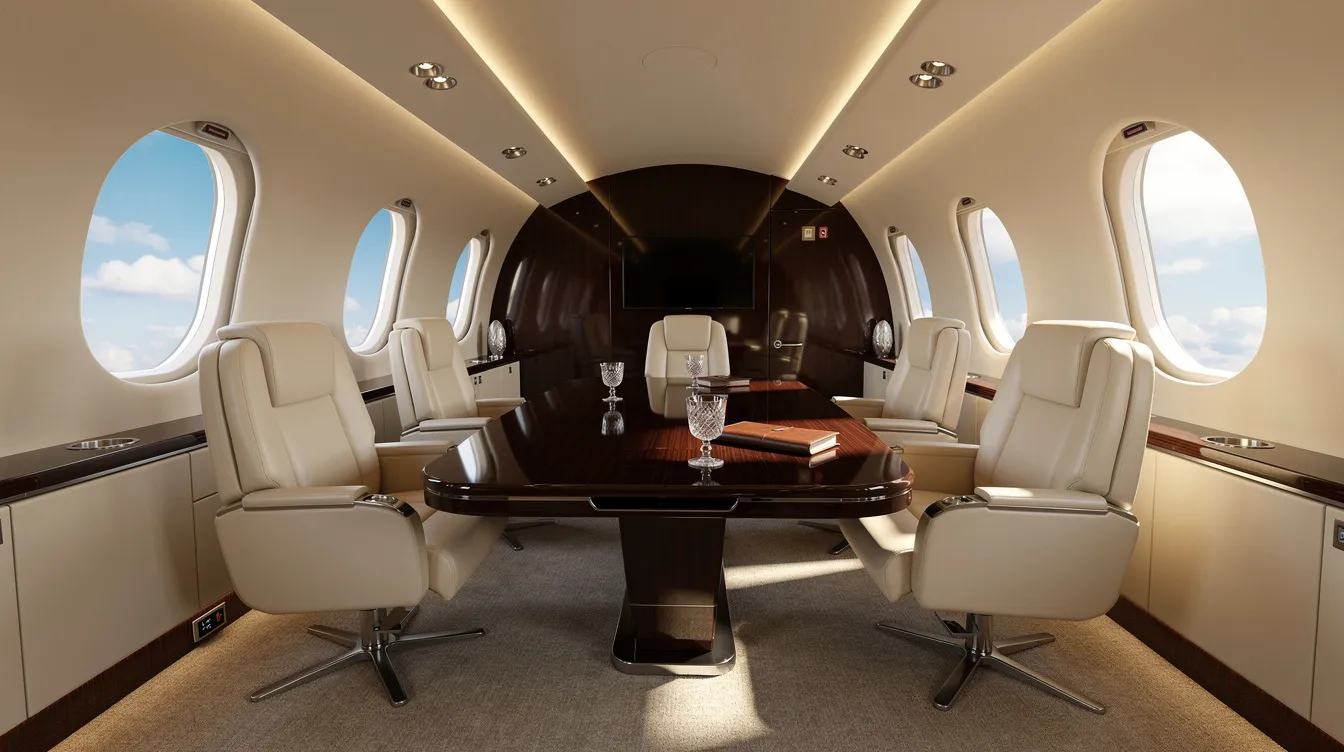
Large cabin features on the G700 and G800 include up to four or five living areas, a conference and dining zone, a private stateroom, a full galley, and enclosed lavatories. Sleeping configurations accommodate up to 13 passengers on the G700.
Environmental systems deliver low cabin altitude (around 3,000 to 4,000 feet even at cruise), high-capacity fresh air renewal, plasma ionization air purification, and circadian-rhythm LED lighting to reduce jet lag on long-range flights. Cabin noise levels are among the lowest in business aviation thanks to structural design and engine placement.
Performance parameters on newer models include a maximum speed approaching Mach 0.935, long-range cruise at Mach 0.85, and high-speed cruise at Mach 0.90. On a 6,000+ nautical mile mission, the higher cruise speed can save an hour or more versus slower alternatives, as reported by Aviation Week and industry analysts profiling long-range private jets for sale.
The Symmetry flight deck integrates active control sidesticks, ten touchscreen displays, and the combined vision system merging EVS II and SV PFD synthetic vision to improve safety and airport access in low visibility. For BlackJet members, this translates to quiet cabins, high-speed connectivity for in-flight productivity, and access to more airports worldwide.
Sustainability and Efficiency in Gulfstream Business Aviation
Gulfstream Aerospace and the broader business aviation industry are addressing environmental responsibility through engineering rather than aspiration alone. Gulfstream's research into aerodynamic improvements—clean wings, advanced winglets, and fuselage shaping—has delivered double-digit percentage gains in fuel efficiency over earlier generations.
Engine technology plays an equal role. The Rolls-Royce Pearl 700 series powering the G700 and G800 offers improved fuel burn and lower emissions while enabling longer range and higher speed. Gulfstream offers carbon-neutral flights through offset initiatives, and the company has conducted SAF demonstration flights as part of its long-term commitment to reducing lifecycle carbon impact.
On the facilities side, Gulfstream's Mesa Service Center achieved LEED Gold certification, and Gulfstream installed solar panels at its Mesa Service Center—tangible steps beyond the flight line.
For a practical example: consider a New York to London round trip on a G600 flown on a SAF blend. The modern airframe already burns meaningfully less fuel per nautical mile than a G550 covering the same route. When that flight is booked through BlackJet, the remaining carbon footprint is offset at no extra cost to the member, making the journey carbon neutral through verified programs.
Gulfstream Aircraft in Business Aviation: Use Cases and Operators
Gulfstream jets serve as both status symbols and practical tools among ultra-high-net-worth individuals, Fortune 500 corporations, and heads of state. But the real value lies in mission capability.
Typical mission profiles include:
Nonstop New York to Tokyo (~6,700 nm) on a G700 or G800
Los Angeles to London (~4,750 nm) on a G600
Dubai to New York (~6,850 nm) on a G800
Multi-leg intra-European trips on a G500 or G280
Fractional ownership providers, charter operators, and Jet Card programs regularly feature Gulfstream aircraft as flagship options. The access models differ substantially in cost and flexibility:
Access Model | Capital Outlay | Flexibility | Utilization Control |
|---|
Full ownership | $50–100M+ | Complete | Owner managed |
Fractional | Share-based | Moderate | Program-managed |
On-demand charter | Per-trip | High | Variable availability |
Jet Card | Prepaid hours | High | Guaranteed access |
BlackJet's Jet Card model lets members prepay for flight hours and select from multiple aircraft categories, including large cabin and ultra-long-range jets comparable to current Gulfstream offerings, via digital booking tools and 24/7 support, aligning with best practices outlined in jet card pricing guides.
Consider a CEO who needs to fly New York to London, then London to Riyadh, within the same week. Using a BlackJet Jet Card, the member books both legs through the mobile platform, selects an ultra-long-range business aircraft for the transatlantic segment and a long-range jet for the second leg, and departs on schedule—no ownership overhead, no broker negotiation.
How to Choose the Right Gulfstream (or Comparable) Aircraft for Your Mission
Selecting the right aircraft comes down to five factors: trip length, passenger count, baggage requirements, airport constraints, and budget, which mirror the variables found in any comprehensive private jet price list.
Range bands simplify the decision and frame whether you should look at super-midsize, long-range, or ultra-long-range private jets:
Up to 3,600 nm (e.g., coast-to-coast U.S., transatlantic with stops): super-midsize like the G280 or G300
4,000–6,700 nm (e.g., New York to London, Miami to São Paulo): long-range large cabin like the G500 or G600
7,000–8,200 nm (e.g., New York to Hong Kong, LA to Dubai): ultralong-range like the G700 or G800
Keep in mind that published maximum range assumes optimal conditions. Real-world nonstop capability is reduced by NBAA IFR fuel reserves, headwinds, ATC routing, and passenger load. A provider like BlackJet simplifies this—members consult aviation specialists who match each trip with the right range business aircraft, balancing comfort, cost, and airport access without requiring the traveler to parse spec sheets or learn how to buy a seat on a private jet through complex broker networks.
Frequently Asked Questions (FAQs) about Gulfstream Aerospace and Private Aviation
What makes Gulfstream aircraft stand out in business aviation?
Gulfstream aircraft are renowned for their ultra-long-range capabilities, large and comfortable cabins, advanced safety features, and state-of-the-art technology such as the Symmetry flight deck. They consistently set speed records and offer unmatched performance for global business travel.
How does Gulfstream ensure safety in its aircraft?
Gulfstream integrates advanced avionics, enhanced vision systems, and active control sidesticks to improve pilot control and situational awareness. Their aircraft meet or exceed FAA Part 135 safety standards, and many government and military agencies worldwide rely on Gulfstream jets for critical missions.
What types of missions are Gulfstream jets used for beyond corporate travel?
Besides executive transport, Gulfstream jets serve 35 governments globally for VIP transport, airborne early warning, surveillance, reconnaissance, medical evacuation, and atmospheric research missions.
How does Gulfstream contribute to sustainable aviation?
Gulfstream emphasizes fuel efficiency through aerodynamic innovations and advanced engines like the Rolls-Royce Pearl 700 series. The company operates LEED Gold-certified facilities with solar panels and offers carbon-neutral flight options through verified offset programs.
What are the differences between Gulfstream’s G300, G400, G500, G600, G700, and G800 models?
The G300 and G400 fill the super-midsize and large cabin categories with ranges of approximately 3,600 and 4,200 nautical miles respectively. The G500 and G600 offer long-range capabilities up to 6,700 nautical miles. The G700 and G800 represent the ultra-long-range segment, with ranges exceeding 7,700 and 8,200 nautical miles, suitable for nonstop intercontinental travel.
How can I access Gulfstream aircraft without owning one?
Through programs like BlackJet’s Jet Card, travelers can prepay for flight hours on Gulfstream-class jets, enjoying guaranteed access, flexible scheduling, and 24/7 mobile booking and real-time support without the complexities of ownership.
What role do mobile booking platforms play in private jet travel?
Mobile booking platforms provide instant access to private jet bookings anytime, allowing travelers to schedule flights quickly and receive real-time updates, enhancing flexibility especially for last-minute travel plans.
Are Gulfstream jets suitable for large groups or families?
Yes, models like the G650, G700, and G800 offer spacious cabins with multiple living areas, conference zones, and sleeping accommodations for up to 13 passengers, making them ideal for large groups or family travel.
How does Gulfstream support real-time flight operations?
Gulfstream offers 24/7 real-time flight support through a worldwide network, including digital booking tools and expert technical assistance to ensure smooth operations and quick resolution of any issues.
What is the significance of Gulfstream’s Savannah facility?
The Savannah, Georgia facility is Gulfstream’s global headquarters and primary manufacturing hub, encompassing design, research and development, production, completion, and customer support services.
BlackJet, Jet Cards and Seamless Access to Gulfstream-Class Aircraft
BlackJet provides premium, carbon-neutral private jet access through Jet Card programs rather than aircraft ownership, similar in structure to many of the best jet cards for frequent flyers. Jet Cards function as prepaid blocks of flight time—25-hour or 50-hour increments—that lock in predictable hourly rates across multiple cabin classes, including large cabin and ultra-long-range jets similar to current Gulfstream aircraft, following the core jet card pricing structure used across the industry.
Safety is foundational. BlackJet's proprietary vetting process, supported by third-party safety ratings and strict operator standards that align with or exceed FAA Part 135 benchmarks, ensures that every flight meets rigorous criteria for business aviation and addresses common questions like "are private jets safe" for new users.
Mobile booking platforms enable 24/7 access to jet bookings. Users can book private jets instantly via mobile apps, and mobile platforms enhance flexibility for last-minute travel plans, echoing the rise of app-based services that let travelers buy a seat on a private jet in a few taps. Real-time updates are available through mobile booking tools, and mobile booking platforms streamline the private jet booking process—so members can schedule Gulfstream-class flights in minutes rather than hours.
Every BlackJet flight is carbon neutral through integrated offset programs, complementing the fuel-efficient design of modern long-range business aircraft that often share platforms with the most expensive private jets flown by heads of state and billionaires.
If you value Gulfstream-level performance and comfort but prefer flexibility over ownership, explore how BlackJet's 25+ Hour Jet Card program can reshape your global travel. Discover premium jet access at BlackJet.com.


 Sign up with google
 Sign up with Apple