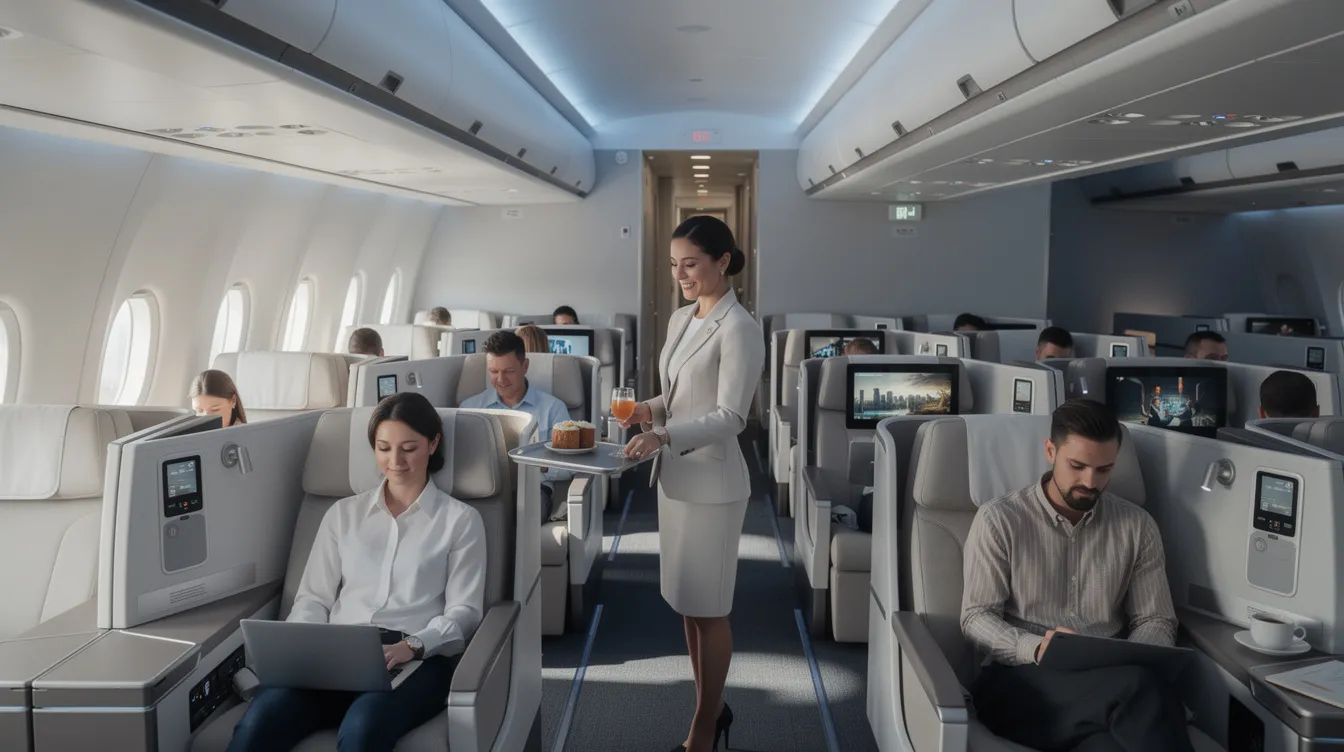
How many flight attendants are on a plane? On most commercial flights, the baseline is at least 1 flight attendant for every 50 installed passenger seats, which is why a 76-seat regional jet often has 2 attendants, a 180-seat narrow-body typically has 4, and a 300- to 350-seat wide-body may carry 10 to 14 on longer routes; on private jets with 8 to 10 seats, there may be no flight attendant at all or one added by choice. The number of cabin crew on any given flight is far from arbitrary. It is driven by regulation, aircraft configuration, route length, and-in private aviation-by the preferences of the passengers themselves.
For frequent business travelers, high-net-worth leisure flyers, and prospective BlackJet clients comparing commercial cabins with private aircraft, those staffing numbers shape more than appearances. They affect emergency readiness, cabin service, privacy, productivity, and the flexibility to tailor the onboard experience. Whether you're boarding a regional turboprop or stepping onto a Gulfstream, understanding how many flight attendants you'll encounter reveals a great deal about safety standards, service levels, and the overall experience that awaits. This guide explains the regulatory minimums, the differences between commercial and private jet staffing, the role aircraft size, flight length, cabin class, and operation type play, and how BlackJet's Jet Card options can help customize crew for private flights.
Quick Answer: How Many Flight Attendants Are On Your Flight?
The short answer: most aviation regulators, including the Federal Aviation Administration in the U.S. and EASA in Europe, mandate a minimum of one flight attendant for every 50 passenger seats on commercial flights. That means the required number scales directly with installed seats, not tickets sold.
Here's what that looks like in practice:
76-seat regional jet (e.g., Embraer 175): typically 2 flight attendants.
180-seat narrow-body (e.g., Airbus A320, Boeing 737-800): typically 4 flight attendants.
300–350-seat wide-body (e.g., Boeing 777-300ER): often 10–14 cabin crew members on long-haul routes.
Private jets with 8–10 seats (flying under Part 91/135): may fly with zero cabin crew, or one optional cabin attendant.
The minimum number required by law is not the same as the actual number most airlines staff. Service expectations, brand positioning, and long-haul rest requirements push many carriers well above regulatory floors.
For private aircraft accessed via BlackJet's premium private Jet Cards, the number of flight attendants is entirely flexible-tailored to your group size, route length, and aircraft category. That level of control is precisely the point.
Why Flight Attendant Numbers Matter For Safety, Service, And Strategy
For commercial airlines, the number of flight attendants is primarily a safety and regulatory requirement. For private jet travelers, it becomes a question of experience, privacy, and productivity in the air.
Flight attendants are safety professionals first. They are trained to manage an emergency evacuation, handle medical situations, coordinate fire response, manage decompression events, and address security threats. In emergency situations, the difference between adequate and inadequate staffing can be measured in lives. The cabin crew on US Airways Flight 1549-the "Miracle on the Hudson"-demonstrated exactly how critical trained attendants are when seconds matter.
Beyond safety, more flight attendants improve service quality for passengers. Airlines use cabin crew ratios as a competitive tool: a 1:4 ratio in first class creates a fundamentally different experience than 1:40 in economy. Premium carriers build their reputations on this differential.
For high-net-worth travelers, the calculus shifts further. On a private flight, the flight crew may include only pilots or expand to include a cabin attendant or chef, depending on the mission. You design the onboard workspace-or the family lounge-rather than accepting a fixed airline product. Understanding how many crew members serve your cabin isn't a trivia question; it's a strategic decision that shapes every trip.
Regulatory Minimums: How Authorities Decide The Minimum Number Of Flight Attendants
Every major aviation authority approaches the question from the same premise: enough cabin crew must be on board to evacuate the aircraft within 90 seconds and manage in-flight safety tasks. Commercial flights must follow FAA-mandated regulations in the U.S., while European operators comply with EASA's framework.
The FAA's rule under 14 CFR Part 121.391 sets clear thresholds:
Aircraft with 20 to 50 seats require at least one flight attendant.
Aircraft with 51 to 100 seats require at least two flight attendants.
Aircraft with 101 or more seats require two flight attendants plus one additional flight attendant for every 50 seats beyond 100.
EASA's approach under ORO.CC.100 follows similar logic, using one cabin crew member for every 50 (or fraction of 50) passenger seats installed, though certification-based methods and exit configurations may raise that floor. International standards for flight attendant ratios may differ from U.S. regulations-some regions require 1 per 32 seats for specific aircraft types.
A critical distinction: these rules apply to commercial operations. Private flights under Part 91 or Part 135 follow different standards, where aircraft with fewer than 20 seats typically require no dedicated cabin attendant.
Here's a concrete example: a Boeing 737-800 with 189 installed seats cannot legally depart with only 2 flight attendants, even if only 80 seats are sold-because the minimum is set by installed seats, not tickets sold. Regulations set minimum flight attendant requirements based on passenger count and configuration, not revenue.
Key Factors That Determine How Many Flight Attendants Are On A Plane
Beyond legal minimums, airlines and private operators weigh four most important factors when staffing each flight:
Aircraft size and seat count: the primary legal driver. Larger aircraft require more flight attendants for safety.
Flight duration: short-haul hops need fewer crew than ultra-long-haul flights, where rest rotations demand additional staffing.
Cabin class and service level: premium cabins receive more dedicated crew per passenger than economy.
Operation type: a commercial flight follows Part 121 rules; a private jet charter or Jet Card program follows Part 135 or Part 91, with different expectations entirely.
Consider the contrast: a 4-hour domestic flight on a 180-seat narrow-body needs 4 attendants. An 18-hour ultra-long-haul on a 350-seat wide-body might need 14. A private jet on that same route might carry 1 or 2 for a dozen passengers.
The following sections unpack each variable in detail.
Aircraft Size And Seat Count: The Starting Point For Cabin Crew Numbers
The aircraft type and its certified seat configuration are the starting point for every staffing decision. Regulators count installed seats-not how many passengers actually board-when determining the flight attendants required.
Aircraft design features, such as the number and location of emergency exits, also influence crew requirements. Twin-aisle wide-body aircraft with multiple floor-level exits demand more cabin crew than single-aisle types with fewer doors.
Here are approximate staffing norms by aircraft size:
Regional turboprops (e.g., ATR 72, ~70 seats): 2 flight attendants.
Regional jets (e.g., Embraer 175, 76–80 seats): 2–3 flight attendants.
Narrow-body workhorses (e.g., Airbus A320, Boeing 737-800, 150–189 seats): typically 4 flight attendants.
Airbus A321neo (up to ~220 seats in high density): 4–5 flight attendants, depending on configuration.
Wide-body long haul (e.g., Boeing 777-300ER with ~360 seats): often 10–14 cabin crew.
The same airframe can be configured very differently. A low-cost carrier's 186-seat A320 requires more flight attendants than a legacy carrier's 150-seat version of the same airplane with more legroom and a business class cabin. High-density layouts don't just squeeze more passengers in-they push staffing requirements upward.
Flight Duration And Long Haul Flights: Why Long Sectors Need More Flight Attendants
Flight duration influences the number of required flight attendants significantly. The distinction matters:
Short haul: under 4 hours (e.g., New York–Miami, London–Paris).
Long haul: 6–12 hours (e.g., New York–London, Los Angeles–Tokyo).
Ultra-long-haul: 14–18+ hours (e.g., Singapore–New York, Perth–London).
Crew members cannot safely work continuous 14–18-hour duties without rest. Airlines often assign additional flight attendants for long-haul flights to allow supervised rest periods in dedicated crew rest areas. Aircraft size influences the number of sleeping compartments available-wide-body aircraft typically feature crew bunks above the cabin or in the tail section.
Long-haul flights often require more flight attendants for rest. A 7-hour transatlantic flight on an Airbus A330 with 250 passengers might carry 8–10 flight attendants. A 17-hour ultra-long-haul on a Boeing 777-200LR could have 12–14 to rotate duty and rest. Airlines may exceed minimum staffing specifically to cover crew rest periods on these extended sectors.
Crew members can rest during long flights, often using designated crew rest areas to manage fatigue-this is both a regulatory requirement and an operational necessity.
In private aviation, the contrast is dramatic. On a long-range 16-seat private jet-say a Gulfstream G650 or Global 7500 flying New York to Dubai-clients may choose 1–2 cabin attendants for 8–14 passengers. The flight time may be comparable, but the passenger-to-crew ratio is incomparably better.
Cabin Classes And Service Levels: Why First Class Sees More Flight Attendants Per Passenger
Cabin segmentation directly shapes how many crew members work each section of the airplane:
Economy: high passenger-to-attendant ratio (often 1:40 or higher), focused on efficiency and passenger safety.
Premium economy: slightly improved ratio, modest service upgrades.
Business class: lower ratio (approximately 1:15–1:20), with multi-course meals and personalized attention.
First class: the lowest ratio (sometimes 1:4 or 1:6), offering turndown service, à la carte dining, and dedicated attendants.
A typical wide-body might allocate 2 flight attendants for 40 business-class passengers but 6 for 240 economy passengers. "All-business-class" boutique transatlantic services with 40–76 seats might achieve a near 1:8 ratio. Airlines may add more flight attendants for premium service levels compared to low-cost carriers as a deliberate brand choice-there are no separate regulatory minimums by class.
On a private jet, these ratios are eclipsed entirely. A 10-passenger super midsize jet with a single flight attendant produces a 1:10 ratio that feels closer to a private concierge than a commercial service model. Through programs like BlackJet, members can explore what to expect across midsize and large cabin categories.
Why Airlines Often Staff More Flight Attendants Than The Minimum Required
The regulatory minimum is a safety baseline, not a target. Many airlines deliberately staff above it, and here's why:
Service standards: delivering hot meal service quickly, managing duty-free sales, and responding to call buttons in reasonable time requires more cabin crew than the bare legal floor.
Brand positioning: premium carriers like Singapore Airlines, Qatar Airways, and Emirates intentionally out-staff competitors. A Gulf carrier may place 15+ flight attendants on an A380 with 500+ passengers to maintain a reputation for attentive service.
Operational resilience: extra crew absorbs disruptions- sick attendants at the last minute, unexpected turbulence requiring all hands in the cabin, or flights at full capacity with many special meals.
Foreign language capability: on international routes, airlines may add more cabin crew with specific language skills to communicate effectively with diverse passenger groups.
Airlines may schedule extra crew members beyond legal minimums to improve service levels. The vast majority of flagship long-haul routes are staffed above minimum. The senior flight attendant-often called the purser-coordinates the team, manages cabin workflow, and serves as the primary liaison with the flight deck.
Deadheading crew (repositioning for another flight operations assignment) sometimes appear as additional uniformed attendants sitting in passenger seats, which explains why travelers occasionally see more crew than expected.
Commercial Flight Examples: Typical Flight Attendant Numbers By Aircraft Type
Here's a practical reference for how many flight attendants you'll typically find on well-known commercial aircraft. Configurations vary by airline, but these represent common norms across the airline industry:
Aircraft | Typical Seats | Minimum FAs (Reg.) | Typical FAs Onboard | Sample Route |
|---|
ATR 72 | ~70 | 2 | 2 | Island hopper, short regional |
Embraer 175 | 76 | 2 | 2–3 | U.S. domestic regional |
Boeing 737-800 | 160–189 | 4 | 4 | New York–Los Angeles |
Airbus A321neo | 190–240 | 4–5 | 4–5 | Transatlantic, domestic trunk |
Boeing 787-9 | 250–290 | 6 | 8–10 | London–Dubai |
Boeing 777-300ER | 300–360 | 8 | 10–14 | International flights, long haul |
Airbus A380 | 450–600+ | 10+ | 18–22+ | Dubai–Sydney flagship |
Wide-body aircraft can have 8 to 10 flight attendants at the lower end and far more on larger aircraft with more passengers and multiple cabin classes. American Airlines, for example, typically staffs its Boeing 777 fleet with 10–13 cabin crew depending on route and configuration.
Wide-body aircraft often have a higher number of flight attendants due to complex service requirements and longer durations. Aircraft with 20 or more seats require certified flight attendants without exception.
Private Jets And Cabin Crew: How Many Flight Attendants Are On A Business Jet?
Private aviation operates under fundamentally different rules. Small private aircraft may not require any flight attendants-and the vast majority of light planes and midsize jets fly with only pilots in the flight deck.
Here's how it breaks down by private jet category types:
Light jets (e.g., Cessna Citation CJ3+, Phenom 300): 4–7 seats. Typically no cabin attendant. Pilots handle safety briefings and light service, and many travelers access them through small plane charter pricing models.
Midsize jets (e.g., Citation XLS+, Hawker 900XP): 7–9 seats. Often no cabin attendant by default, but one can be added on many charters.
Super midsize (e.g., Challenger 350, Citation Longitude): 8–9 seats. Commonly 1 cabin attendant on international or corporate missions.
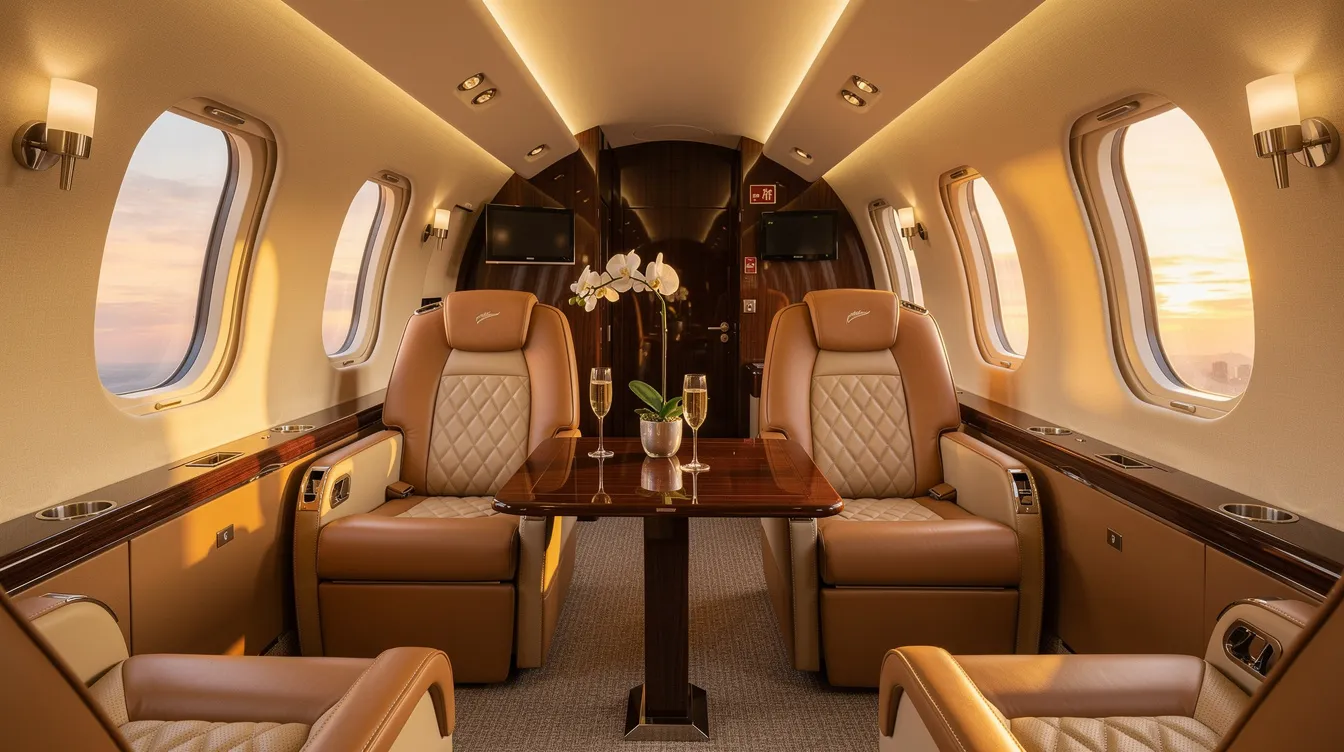
Large cabin / ultra-long-range (e.g., Gulfstream G650, Global 7500, Falcon 8X): 12–16 seats. Usually 1–2 cabin attendants, especially on intercontinental long-haul flights, and they can be ideal when you need a private jet for around 20 passengers.
The Bombardier Global 7500 typically carries up to 4 crew members on long-range missions: pilots on the flight deck, possibly a relief pilot, and a cabin attendant. The ACJ330 business jet conversion can accommodate 3 additional crew beyond pilots, including 2 dedicated cabin crew.
Private cabin attendants handle safety duties-briefings, monitoring, basic first aid-alongside fine dining service, premium beverages, cabin preparation, and discreet concierge-style assistance. BlackJet advises clients on when a dedicated cabin attendant enhances the experience, helping match aircraft category and private jet size to mission needs.
BlackJet's Perspective: Choosing The Right Number Of Cabin Crew For Your Private Flight
For BlackJet members, the question of how many crew members serve your cabin is not dictated by an airline's standard operating procedure-it's a conversation.
BlackJet consults members based on three important factors:
Group size: a family of 5 has different needs than an executive team of 8 preparing for a board presentation upon landing.
Route length: a 2-hour hop from Los Angeles to Las Vegas differs fundamentally from a New York–Dubai overnight.
Service expectations: simple refreshments versus a multi-course dinner with premium wines and a quiet, efficient breakfast before landing.
Consider two scenarios: a 25-hour Jet Card member flying regularly between New York and Miami on a midsize jet may forgo a cabin attendant for speed and simplicity. A CEO comparing that membership to a 25-hour jet card guide and flying New York to London overnight on a large cabin jet may prefer 2 cabin attendants to manage a full dinner service, confidential document handling, and an undisturbed rest period.
Beyond service, secondary considerations matter. An extra trained cabin professional adds reassurance on long or overnight segments. Consistent, vetted cabin crew who understand client preferences over multiple trips enhance privacy and efficiency. And BlackJet's carbon-neutral commitment applies regardless of how many cabin crew are onboard-offsets cover full emissions from every flight, no matter which size of private jet you choose.
Safety Roles Of Flight Attendants: Beyond Serving Drinks
Most people assume cabin crew exists primarily to deliver meals and beverages. The reality is considerably more serious.
Flight attendants conduct pre-flight safety demonstrations for passengers and perform detailed safety checks before every departure: doors, emergency slides, oxygen systems, fire extinguishers, and medical kits-all classified as emergency equipment that must be verified before pushback.
Their core duties include:
Flight attendants must manage emergency evacuations during incidents, directing passengers toward usable exits in under 90 seconds.
They monitor passenger behavior for safety compliance-seatbelts, carry-on stowage, electronic devices, and exit row readiness.
Flight attendants receive training in first aid and CPR, enabling them to stabilize passengers and coordinate with ground-based medical teams via satellite communication.
Minimum flight attendant training lasts from four weeks to six months, covering fire suppression, water survival, security protocols, and crowd management.
In several survivable accidents, flight attendants have been credited with guiding full-cabin evacuations that saved hundreds of lives. During the events of September 11, 2001, fellow flight attendants relayed critical information to ground teams that shaped the national security response.
The minimum number of flight attendants is calculated assuming each must manage a door or exit and a specific number of passengers during an emergency. On a private jet, pilots may handle briefings and safety directly on smaller aircraft, while cabin attendants on large business jets receive advanced training comparable to commercial standards-verified through certifications like IS-BAO and ARGUS, which are important factors when evaluating any private jet price list and options.
Working Conditions: Why "More Flight Attendants" Isn't Just About Luxury
The job of a flight attendant is physically and emotionally demanding. The number of passengers each crew member serves directly influences fatigue, stress, response time, and the quality of every interaction in the cabin.
Historically, working conditions have improved significantly. Secondhand tobacco smoke was largely eliminated from cabins after bans phased in from the late 1980s to late 1990s. Flight attendant unions-such as the Association of Flight Attendants and APFA-have advocated for better staffing ratios, rest rules, and protections. Flight pay structures have evolved, though many attendants are still compensated only for flight time rather than boarding or ground duties.
Modern challenges remain:
Growth in emotional support and service animals adds complexity. Airlines may hire more attendants for emotional support animal management on busy routes.
Complex dietary needs and higher passenger volumes stretch each crew member further.
Unruly passenger incidents have increased substantially, requiring adequate staffing to maintain order.
When airlines reduce staffing close to the legal minimum, the burden on each crew member increases. This can indirectly degrade passenger experience and safety response times. For private aviation, more realistic passenger-to-attendant ratios and calmer cabin environments tend to create better working conditions-and, of course, more attentive service for everyone on board, even when flying on more budget-friendly private aircraft options.
How To Estimate How Many Flight Attendants Will Be On Your Next Flight
Whether you fly commercial or private, you can anticipate cabin crew numbers with a few straightforward steps.
For commercial flights:
Check your aircraft type and seat map on the airline's booking page or tools like SeatGuru.
Count (or approximate) total installed seats and divide by 50 to estimate the minimum number.
Add 1–3 for premium carriers and long-haul flights.
Quick rule-of-thumb:
Seat Range | Expected Flight Attendants |
|---|
Under 80 seats | 1–2 |
80–200 seats | 3–5 |
200–350 seats | 6–10 |
350+ seats | 10–20+ |
For private flights:
Ask your charter provider or Jet Card operator how many pilots and cabin crew will operate your flight. Clarify whether a cabin attendant is included or optional, and what their role covers-safety only, or full catering and concierge service. BlackJet members can review available aircraft and crew configurations before booking.
Practical use cases:
Families planning to bring small gifts for crew-such as Starbucks gift cards or chocolates-can use seat count to estimate how many attendants to prepare for.
Executive assistants scheduling inflight meetings may want to know how many crew members will be present in the cabin to plan accordingly.
How Many Flight Attendants Are On Ultra-Long-Haul And Flagship Routes?
Ultra-long haul and flagship international routes represent the upper extreme of cabin staffing. Long-haul flights can have 8 to 14 flight attendants-and the longest routes push well beyond that.
Specific examples:
A Qatar Airways Boeing 777 on a 14+ hour Doha–Los Angeles flight may carry 12–14 flight attendants for ~300 passengers.
A Singapore Airlines A350-900ULR on Singapore–New York-one of the world's longest flights-operates with a large, augmented crew to manage dual meal services and rest cycles across nearly 19 hours of flight time.
An Emirates Airbus A380 operating Dubai–Sydney with 500+ passengers might have 20+ cabin crew, including dedicated staff for first class suites and the onboard lounge.
The operational reasons are straightforward: multiple full meal services, continuous cabin monitoring during sleeping periods, and ensuring legal rest periods in dedicated crew bunks. Boeing's 2026 industry outlook forecasts that the global airline industry will need over 1,023,000 new cabin crew over the next 20 years, driven in part by the growth of these demanding long-haul routes.
Compare this to a long-range private jet mission of similar distance: a Global 7500 flying New York to Dubai may have 1–2 cabin attendants for at most 14 passengers. The passenger-to-crew ratio is unmatched-and that's exactly the kind of personalized experience BlackJet members design through their Jet Card programs.
Technology, Safety Certification, And How They Influence Cabin Crew Needs
Modern aviation technology has transformed flight operations and cabin safety-but it has not reduced the need for human flight attendants.
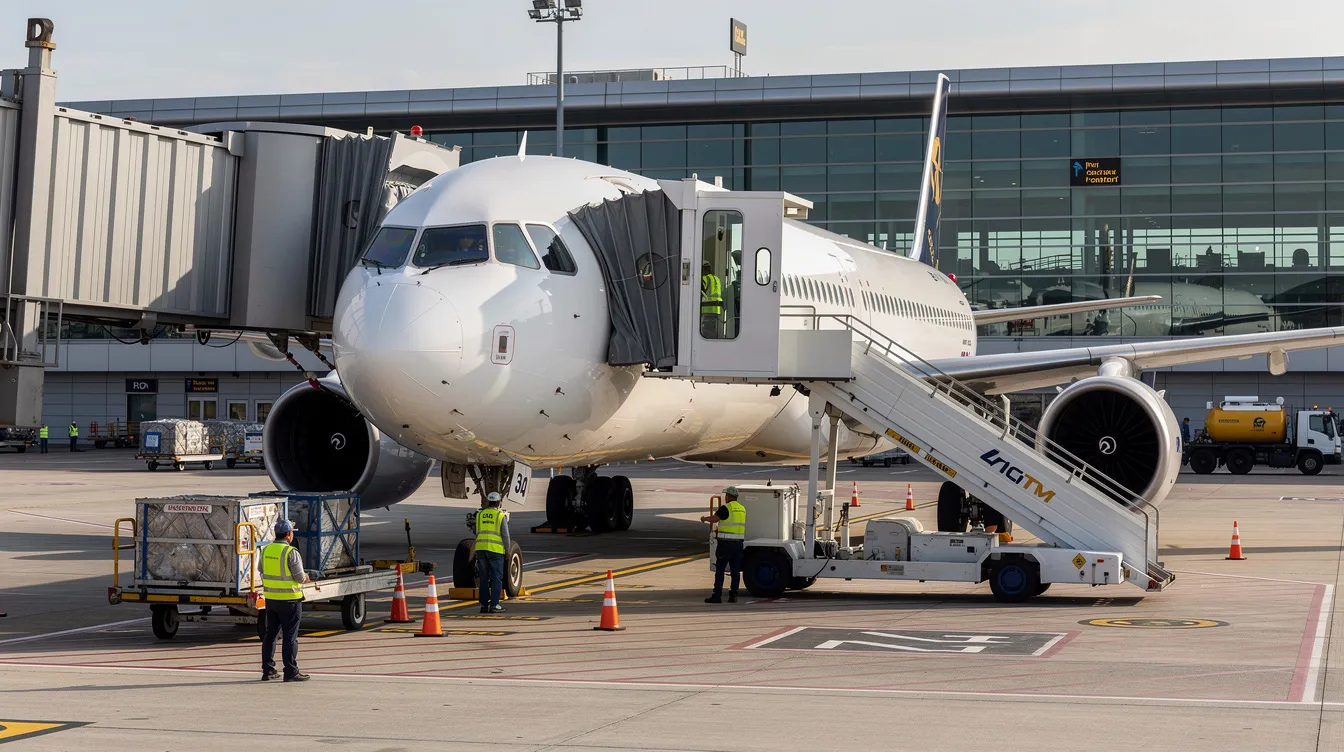
Advanced cabin monitoring systems, smoke detection, automated fire suppression, and improved emergency lighting all support safety. Flight deck door security and cockpit communication systems require close cooperation between pilots and cabin crew. These technologies optimize efficiency but do not substitute for the complex, real-time decisions that trained crew members make during turbulence, medical events, or an emergency landing.
Safety certifications matter as much as headcount. In private aviation, certifications like IS-BAO, ARGUS Platinum, and Wyvern Wingman assess crew training standards and operational procedures-not just whether the minimum number of attendants is present. BlackJet screens partner operators for these rigorous credentials, ensuring cabin crew is trained to commercial-grade standards even on smaller aircraft.
BlackJet's digital platform and real-time flight support coordinate crew resources, passenger preferences, and last-minute changes without inflating in-cabin headcount unnecessarily. Technology handles logistics; trained professionals handle people-a key distinction for travelers comparing the best jet cards for frequent flyers.
Environmental And Cost Considerations: Do More Flight Attendants Affect Sustainability?
Additional crew members do slightly increase aircraft weight and operating cost. Each person-plus baggage and catering-adds to fuel burn. But on a wide-body carrying 200+ passengers and tens of thousands of pounds of fuel, the marginal impact of one or two extra attendants is minimal.
Cost drivers are more significant on the ground: salaries, training (of course, the investment in training is substantial), hotel accommodations, and per diems for augmented crews on international routes all factor into airline economics.
From a sustainability perspective, crew count is a small variable compared to aircraft type, passenger load factor, and route length. For commercial flights, the primary environmental lever is filling seats efficiently, not reducing crew-and for private travelers, understanding jet card pricing structures is often more impactful than shaving off a single attendant.
For private travel, BlackJet addresses this directly: every flight is carbon-neutral, with 100% of emissions offset at no extra cost to members-including emissions attributable to crew carriage. BlackJet can also advise clients on right-sizing aircraft and crew to mission needs, avoiding unnecessary capacity and waste while helping you understand how much it costs to charter a small plane. Sustainability isn't just an add-on; it's embedded in every flight decision.
FAQ: Common Questions About How Many Flight Attendants Are On A Plane
What is the absolute minimum number of flight attendants on a commercial plane?
Under FAA rules, aircraft with 20 to 50 seats require at least one flight attendant. One additional flight attendant is needed for every 50 passengers beyond that threshold. The FAA requires one flight attendant per 50 passengers as the baseline calculation.
Can a commercial airline fly with fewer flight attendants if the flight is not full?
No. Minimums are based on installed seats, not sold tickets. A 189-seat plane requires staffing for 189 seats regardless of the passenger load that day.
Do private jets have to carry flight attendants?
Usually not. Small private jets may not require any flight attendants under Part 91 or Part 135 when they have fewer than 20 seats. Many clients choose to add one for comfort and safety on longer flights.
Why do I sometimes see more crew than expected in passenger seats?
Those are likely deadheading crew-attendants repositioning for their next flight assignment. They're traveling as passengers but may be in uniform.
Are flight attendants trained medics?
They are not doctors, but flight attendants receive training in first aid and CPR, including AED usage. They can stabilize passengers and coordinate with ground-based medical teams via radio or satellite link.
How many crew members are on a private jet?
Typically 2 pilots on the flight deck and 0–2 cabin attendants, depending on aircraft size and client preference. On light planes and midsize jets, a single flight attendant is optional. On large cabin jets, 1–2 is common for long flights.
Conclusion: Matching Flight Attendant Numbers To The Journey You Want
Regulations set a clear minimum number of flight attendants on commercial planes-typically one for every 50 passenger seats. Most airlines exceed those minimums on long-haul flights, premium service routes, and flagship operations to deliver the experience their passengers expect.
Private jets accessed through programs like BlackJet offer something fundamentally different: control. With 0–2 cabin crew serving a small, select group of passengers, the ratio isn't just better-it's designed around you. Whether you need a quiet cabin with no attendants for a short hop or a full-service team for an overnight intercontinental trip, the configuration is yours to define.
For commercial flights, you can estimate how many flight attendants you'll see by knowing the aircraft type and seat count. For private travel, you actively choose your ideal crew configuration in consultation with your provider, matching safety, service, and sustainability to each mission.
Discover how BlackJet's Jet Card programs let you design each flight-aircraft, schedule, and cabin crew included-as a tailored experience rather than a fixed airline product, starting with understanding jet card cost fundamentals and the best jet card options for your flying pattern. Frequent travelers can compare 100-hour jet card pricing, 50-hour jet card value, or even Flexjet jet card costs and NetJets jet card pricing before choosing the BlackJet 25+ Hour Jet Card. Explore premium jet access at blackjet.com.


 Sign up with google
 Sign up with Apple