A private plane international flight is more than a luxury upgrade. For executives, family offices, and discerning leisure travelers, it is a strategic way to protect time, privacy, and control across borders. With BlackJet, members gain premium private jet access through a jet card model built for complex international travel, from aircraft selection and customs clearance to safety oversight and carbon-neutral operations.
Why Flying Private Internationally Is a Strategic Advantage
Commercial air travel is built around scheduled service. You adapt to airline departure times, airport congestion, security queues, connection risk, and baggage delays. Flying private reverses that relationship: the aircraft, route, and timing are shaped around your travel needs.
On commercial flights, international passengers are often advised to arrive two to three hours before departure. For private jet travel, travelers can often arrive at private terminals just 15 to 30 minutes before departure on domestic or simple sectors, while international trips usually require about 45–60 minutes to complete customs and immigration paperwork. That difference alone can save hours before the flight even begins.
Flying private can save between 4 and 9 hours per trip, especially when passengers bypass crowded terminals and long TSA lines. A Los Angeles to London journey that feels like 10–12 hours door-to-door on a commercial itinerary can become a focused 7–8 hour experience when airport dwell time, routing, and ground transfers are optimized.
For a New York executive departing Teterboro for Paris, the experience can be remarkably direct: arrive at a quiet FBO, review flight details, board in minutes, and land closer to the final destination using a conveniently located business airport. Private jets can access approximately 5,000 airports in the U.S. and over 2,200 globally, compared to about 500 served by commercial airlines, allowing landings closer to meetings, villas, yachts, and regional offices.
BlackJet’s role is to make this level of private travel repeatable. Instead of owning a jet or negotiating private jet charter options trip by trip, members use prepaid jet card access, personalized service, and a global network of aviation experts to plan cross-border travel with greater predictability.
Can Private Planes Fly Internationally?
Can Private Planes Fly Internationally? (Short Answer: Yes, Easily)
Yes. Private jets regularly operate international routes on every continent, including North America to Europe, the U.S. to the Middle East, intra-Europe segments, Caribbean routes, and transpacific missions.
Long-range jets such as the Gulfstream G650, Global 6500, and Global 7500 routinely fly nonstop or near-nonstop routes, including New York–London, Los Angeles–Tokyo, Dubai–Paris, and New York–Dubai. Ultra-long-range private jets generally offer an average range of about 7,000 miles or eight hours of nonstop flight time, making them well-suited for international travel.
Midsize jets can also support many international flights, particularly regional cross-border routes. Midsize jets typically cover distances up to about 2,450 miles, roughly equivalent to a nonstop flight from New York to Los Angeles in under five hours without needing to refuel. For longer sectors, a midsize jet may use planned fuel stops.
Private jets can fly internationally, but this requires additional logistics such as overflight permits, customs clearance, and sometimes landing slot reservations. Private operators must file flight plans, coordinate with authorities in each country, and secure approvals before the aircraft can fly through or land in certain airspace.
This work happens behind the scenes. BlackJet coordinates with private aviation operators, ground handlers, and local authorities so the passenger experience remains simple while the operational process remains precise.
Choosing the Right Aircraft for International Travel
The right aircraft determines range, cabin comfort, runway access, luggage capacity, and cost efficiency. International charters utilize both major global hubs and smaller regional business airports, necessitating aircraft with the performance capabilities to land at specific destination runways.
Light jets and turboprops
Light jets, typically seating four to eight passengers, can cover distances up to 1,500 miles before needing to refuel, equating to about three to four hours of flight time. They work well for short private flights, island hops, and connectors to larger gateways, but they are generally not the right aircraft for transoceanic travel.
Turboprops are particularly cost-efficient for flights ranging from 600 to 1,000 miles, making them ideal for short regional trips. For turboprop aircraft, hourly rates generally start around $2,000, while larger jets can command rates exceeding $10,000 per hour, reflecting the varying operational costs associated with different aircraft types.
Midsize and super-midsize aircraft
A midsize jet is often ideal for routes under roughly 2,500 nautical miles, smaller groups, and passengers who want comfort without paying for excess-long-range capability. Midsize and super-midsize jets are ideal for regional international trips, while heavy jets are required for long-haul transoceanic routes.
These aircraft are well-suited to New York–Bermuda, Miami–Cartagena, Los Angeles–Cabo, or intra-Europe business trips. Some super-midsize aircraft can cross the Atlantic with favorable conditions, but fuel stops may be needed depending on passenger load, winds, and weather.
Long-range jets
Long-range jets offer the space, endurance, and equipment required for serious intercontinental travel. They are equipped for overnight missions, oceanic routing, higher cruise altitude, and extended cabin use.
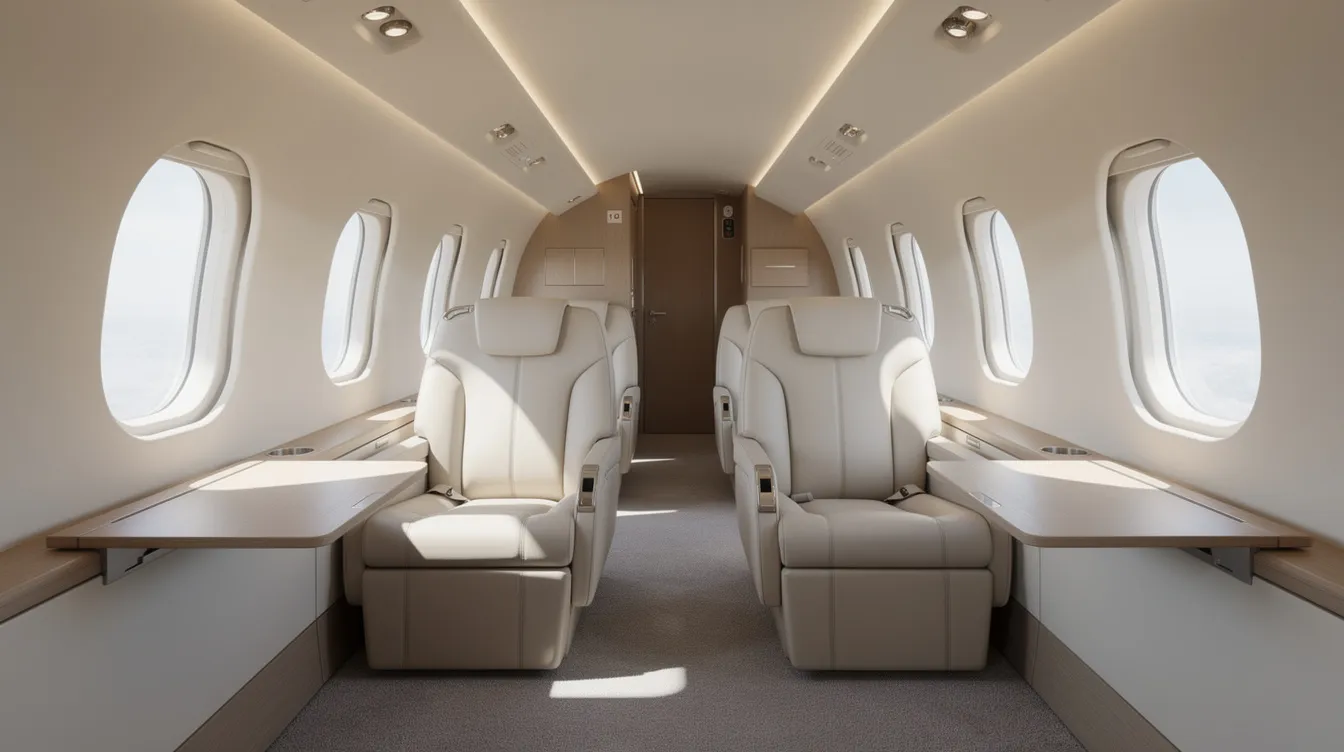
Private jets typically fly at higher altitudes to avoid weather and turbulence, and may feature lower cabin altitude pressure, improving breathing and reducing jet lag. On long-range aircraft, stand-up cabins, lie-flat seating, dedicated crew rest, advanced air filtration, and reliable connectivity—features common to many of the top private jets in the world—turn the journey into usable time.
BlackJet advisors match the aircraft to the trip rather than forcing clients into a single fleet category. A business hop from Miami to the Caribbean may not need a heavy jet; New York to Riyadh likely does.
Midsize Jet vs Long Range Jet: When to Upgrade
Choose a midsize jet when the distance is manageable, the passenger count is modest, and cost matters. New York–Bermuda, Miami–Cartagena, and many regional leisure travel routes are strong fits.
Choose long-range jets when nonstop capability, cabin space, and schedule protection are more important than the hourly rate. New York–London, New York–Dubai, with one fuel stop depending on payload, or Los Angeles–Honolulu–Tokyo demand more aircraft performance.
Here is a simple example:
Trip | Aircraft choice | Likely result |
|---|
NY–London, 7 passengers | Super-midsize | Lower hourly cost, possible fuel stop, less cabin space |
NY–London, 7 passengers | Ultra-long-range jet | Higher hourly cost, nonstop strategy, better res,t, and productivity |
The cost of a private jet flight can vary significantly based on the distance traveled and the type of aircraft chosen, with short flights in smaller planes costing around $2,800 and longer flights in midsize jets reaching approximately $34,500. BlackJet’s jet card helps members compare cabin classes per trip without being locked into one aircraft type.
Key Logistics of a Private Plane International Flight
Booking a private plane for an international flight requires advanced coordination, including selecting an appropriate aircraft, securing overflight and landing permits, coordinating customs pre-clearance, and submitting passenger travel documents in advance.
The charter booking process typically involves a four-stage approach, including inquiry, quote selection, booking confirmation, and pre-flight arrangements. After inquiring about a charter jet, clients are usually assigned a personal charter specialist who provides a selection of quotes with clear breakdowns of aircraft and airports that reflect the true cost to rent a private jet.
Private flights crossing international borders require authorization from civil aviation authorities, which can take days to weeks to secure. Customs and immigration for private flights are conducted at Fixed Base Operators (FBOs). It is advisable to book and finalize itineraries for international travel at least 1-2 weeks in advance to allow for permit approvals.
All passengers on private flights must provide valid passports and any required visas, and the Advance Passenger Information System (APIS) data must be submitted to authorities before departure. BlackJet typically gathers passenger information, passport data, pet travel documents when relevant, and customs notes before the trip, so filings are accurate.
For private jet charters, travelers can often check in as little as 15 minutes before departure, significantly reducing wait times compared to commercial flights. For international private jet flights, it is recommended to arrive at the airport about 45–60 minutes before departure to complete customs and immigration paperwork.
A short route might look like this: book New York–Paris, confirm documents, arrive at Teterboro 45 minutes early, clear formalities in a private lounge, board, fly overnight, and meet a driver at Le Bourget. A longer Los Angeles–Nice trip may include a planned stop in Canada or Iceland. A New York–Dubai mission may require more complex alternatives, crew planning, and permit coordination through Europe and the Middle East.
Customs Clearance on Private Jets: What to Expect
Picture arriving at Teterboro for a New York–London departure. Your passport is checked in a quiet lounge while the crew coordinates with CBP and the handling team. There is no crowded terminal, no long commercial queue, and no search for the right airline counter.
Customs clearance still happens in every international sector. The difference is that customs clearance for international private flights is often handled quickly and discreetly, sometimes right on the tarmac, allowing for a more efficient entry process compared to commercial flights.
On U.S.–EU routes, passengers may clear in a private customs suite at an FBO in Farnborough, Le Bourget, or similar private terminals. On U.S.–Caribbean routes, customs may be handled at Nassau or another island FBO. On U.S.–Middle East travel, airports such as Dubai World Central offer dedicated private aviation facilities.
Documentation matters. Passports must be valid, visas must match the destination, and customs declarations may be required for high-value goods, fine art, pets, sporting equipment, or gifts entering a country. BlackJet’s operations team pre-files forms, coordinates ground handling, and briefs passengers so the process feels nearly invisible.
Fuel Stops and Routing for Long-Range Flights
Fuel stops are not a failure of planning; they are part of intelligent international aviation. Aircraft type, passenger load, headwinds, runway length, temperature, and range reserves all affect whether a stop is required.
A midsize jet flying from New York to Dublin in winter may stop in Gander. Los Angeles–New York–Lisbon may use a strategic refuel before crossing the Atlantic. Shannon, Keflavik, Reykjavik, Athens, and Larnaca are common planning points depending on route direction.
A well-coordinated fuel stop often takes 30–45 minutes. Passengers may stretch, take a call, enjoy catering, or continue working while the aircraft is prepared for the next leg—especially on missions that leverage the largest private jets for global travel.
BlackJet and its partners use real-time weather, performance, and air traffic data to reduce unnecessary stops while preserving safety margins. The goal is not simply to fly far; it is to fly efficiently.
Typical International Routes: New York, Los Angeles, and Beyond
BlackJet members often request New York–London, New York–Paris, Los Angeles–Cabo, Los Angeles–Tokyo, Miami–Caribbean, Dubai–Riyadh, New York–Riyadh via a European stop, and bespoke routes such as private jet charters to and from Karachi.
The New York–London corridor is a core private aviation route. A long-range jet can often complete the journey in roughly 6.5 to 7.5 hours, depending on winds, using Teterboro or White Plains on departure and Farnborough, Luton, or Biggin Hill on arrival to avoid Heathrow congestion.
Los Angeles-originating flights often use Van Nuys for convenience. Cabo is a natural private charter route; Hawaii may be nonstop depending on aircraft, and Europe may require a strategic fuel stop unless an ultra-long-range aircraft is selected.
For U.S.–Middle East travel, New York–Dubai can be operated nonstop on the strongest aircraft under suitable conditions, or with one technical stop when payload, weather, or performance requires it. The cabin experience matters on these routes because rest, privacy, and secure communications are part of the value.

Business Use Case: New York to London Overnight
A CEO departs Teterboro at 9 p.m. New York time on a long-range jet and arrives at Farnborough early the next morning. During the flight, the cabin becomes a secure meeting space: Wi-Fi for document review, closed-door discussion, dinner service, and lie-flat rest before a board meeting.
Compared with commercial business class, the time savings come from reduced airport dwell time on both ends, closer airports, flexible departure, and fewer friction points. Traveling by private jet provides greater flexibility in scheduling, enabling travelers to choose their departure times and routes without being restricted to commercial flight schedules.
With BlackJet’s 25+ Hour Jet Card and other jet card options, guaranteed availability windows help remove the last-minute scramble often associated with charter companies during high-demand periods. For clients who make repeated international trips, that reliability is often more valuable than any single amenity.
Leisure Use Case: Los Angeles to the Mediterranean
A family leaves Los Angeles from Van Nuys after school ends, bound for Nice or Palma de Mallorca in early July. Depending on the chosen aircraft, the trip may include a well-planned fuel stop in Canada or Iceland, with ground transfers waiting on arrival.
The value is practical: baggage space for sports equipment, flexible menus, room for nannies and extended family, and pet travel handled with advanced documentation. Private plane travel involves a limited passenger count, reducing germ exposure and allowing for personalized safety attention along with stringent background checks for passengers and crew.
For multi-stop summer itineraries, BlackJet’s membership model provides predictable hourly rates across cabin classes, following the same principles outlined in our broader guide to jet card cost and value. The family can plan villa, yacht, and onward charter flights without rebuilding the itinerary from scratch each time.
Jet Cards vs On-Demand Charter for International Flights
There are two primary access models for international private flights: on-demand private jet charter and jet card programs. On-demand charter is pay-per-trip and can be useful for occasional travel, but pricing and availability change with the market.
Private jet charter hourly rates typically range from $3,000 to upwards of $17,000, varying by aircraft category. Additional expenses, such as Federal Excise Tax (FET) and peak day surcharges,s can further increase the total cost. This is where many travelers discover that the headline quote is not always the final cost.
A jet card is different. Members prepay for hours, commonly in 25-hour or 50-hour blocks, and receive private jet access across cabin classes with clearer jet card pricing structures, service standards, and booking support.
BlackJet’s model is built for international use: fixed hourly rates, transparent international surcharges, aviation support, customs coordination, and carbon offsets—benefits that mirror those of the best jet cards for frequent flyers. This can be more effective than repeated spot charter for travelers who fly several times per year.
Fractional ownership may suit someone with a very specific, high-volume aircraft need, and it can offer notable tax benefits of fractional jet ownership, but it often involves capital commitments and longer contracts. BlackJet offers private aviation access without ownership, aircraft depreciation, or complex management responsibility.
Shared flights can have a place in the broader air charter market—including options to buy a single seat on a private jet—but BlackJet focuses on private access, privacy, and schedule control for members who value discretion.
How BlackJet’s Jet Card Simplifies International Itineraries
A BlackJet member might book New York–London one week, Los Angeles–Cabo the next, and Dubai–Riyadh later in the year using the same prepaid hours pool, much like a flexible 50-hour jet card structure. The card provides access across aircraft categories without requiring ownership.
The digital platform supports 24/7 booking, while live aviation specialists handle routing, permits, FBO coordination, and local service. Members can review cabin layouts, passenger capacity, and aircraft options before confirming.
Guaranteed availability windows, often based on 24–72 hours of notice depending on the trip, help protect schedules during peak dates. For more complex international travel, BlackJet still recommends finalizing 1-2 weeks in advance when permits, slots, and customs coordination are required.
All-in pricing can include standard catering, positioning logic, and carbon offsets, making multi-country travel easier to budget—especially for travelers evaluating a 100-hour jet card cost and structure. That transparency is a practical advantage for business and leisure clients alike.
Safety, Certification, and Sustainability on International Private Flights
For cross-border private aviation, safety and regulatory compliance matter more than cabin finishes. BlackJet works with vetted operators and emphasizes standards such as Argus Platinum-rated operations, Argus Platinum audits, IS-BAO practices, experienced crews, and well-maintained aircraft.
Long-range trips require disciplined crew duty planning, rest rules, fuel reserves, alternate airports, and route monitoring. A polished cabin is not enough; even a private jet in the $15 million class must be backed by an operator with the systems to manage weather, oceanic procedures, and international authority requirements.
Modern aircraft are equipped with satcom connectivity, real-time weather tools, advanced navigation systems, and performance monitoring—hallmarks of today’s most expensive private jet options. These technologies support comfort, but they also help crews make safer decisions in the air.
Sustainability is now part of responsible luxury. A Nature study reported that private aviation directly emitted CO₂ of at least 15.6 million tonnes globally in 2023. BlackJet addresses this through carbon-neutral flights as standard, verified offset programs, and Sustainable Aviation Fuel, where available at select airports and FBOs.
Why Safety Protocols Matter More on Long-Range Routes
Intercontinental flights may involve oceanic crossings, polar routes, high altitude weather systems, and remote alternates. That requires planning beyond what passengers see when they board.
Crews must understand oceanic clearances, HF communications, contingency procedures, turbulence avoidance, and extended-range planning. On a New York–Middle East flight, alternates, fuel reserves, airspace permissions, and crew scheduling all shape the seamless passenger experience.
BlackJet continuously monitors trip execution and operator standards. The aim is simple: every journey should feel effortless because the discipline behind it is rigorous.
Frequently Asked Questions About Private Plane International Flights
How far can long-range private jets fly?
Many long-range aircraft can fly around 6,000–7,700 nautical miles, depending on model, payload, wind, and runway performance. Heavy jets generally offer an average range of approximately 7,000 miles or eight hours of nonstop flight time, making them well-suited for international travel.
Do passengers still need passports and visas?
Yes. All passengers on private flights must provide valid passports and any required visas, and APIS data must be submitted to authorities before departure. Flying private changes the experience, not the legal requirements.
How much luggage can passengers bring?
Luggage capacity depends on the aircraft. Light jets have limited baggage space, while long-range jets offer larger holds for skis, golf clubs, wardrobe cases, or business materials.
Can pets fly internationally on a private jet?
Yes, but pet travel requires planning. Health certificates, vaccination records, microchip documents, and country-specific import rules may apply.
How much notice should travelers give?
Simple trips can sometimes be arranged quickly, but international travel is best finalized at least 1-2 weeks in advance because civil aviation authorizations, landing slots, and customs coordination can take days to weeks.
Is a private plane international flight cheaper than a commercial first class?
For one passenger, usually no. For a group of 6–10 passengers traveling from New York to London, the comparison changes because the aircraft cost is shared, schedule control improves, and several hours may be saved.
Can private jets land at any international airport?
Not always. Private flights can use major hubs and smaller airports, but runway length, customs availability, slots, aircraft performance, and local restrictions determine the best airport.
How to Book Your First International Flight with BlackJet
Start by contacting BlackJet with your preferred route, dates, passenger count, and destination needs. A personal aviation advisor will review the distance, airport options, aircraft category, and any special requirements.
Next, compare quotes or confirm the trip through your jet card. BlackJet will help select the right aircraft, confirm pricing, and coordinate permits, customs, catering, security, and ground transport.
Then, submit passenger documents in advance. This includes passports, visas when required, APIS information, pet paperwork, and customs declarations for relevant goods.
Finally, arrive at your chosen FBO about 45–60 minutes before an international departure. From there, the experience is intentionally simple: private lounge, discreet processing, direct escort to the aircraft, and wheels up on your schedule.
For many first-time members, a flagship route such as New York–London or Los Angeles–Cabo is the clearest way to feel the difference between commercial air travel and private aviation.
If you have any questions or are ready to book your private plane international flight, contact BlackJet for personalized assistance.
Elevate Your International Travel with BlackJet
Elevate your travel with BlackJet’s jet card programs for seamless international access, rigorous safety, technology-enabled booking, carbon-neutral operations, and refined luxury on every flight. If you make 3–5 or more international trips per year from hubs such as New York, Los Angeles, Miami, London, or Dubai, BlackJet can replace fragmented charter sourcing with a more convenient, efficient, and private way to move around the globe.
Conclusion: Private Plane International Flight Redefined by BlackJet
International private jet travel is no longer an exclusive luxury reserved for the few; it is a strategic tool that empowers high-net-worth individuals, executives, and discerning travelers to reclaim their time, privacy, and control. BlackJet’s jet card programs and expert coordination simplify the complexities of international logistics—from aircraft selection and permit acquisition to seamless customs clearance and carbon-neutral operations. By choosing BlackJet, travelers gain access to a global network of vetted aircraft and operators, ensuring safety, flexibility, and unparalleled convenience on every journey. Whether flying across the Atlantic, to the Caribbean, or the Middle East, BlackJet transforms private aviation into an accessible, efficient, and sustainable experience. Elevate your international travel with BlackJet and discover how effortless, refined private flight can become your new standard.


 Sign up with google
 Sign up with Apple


