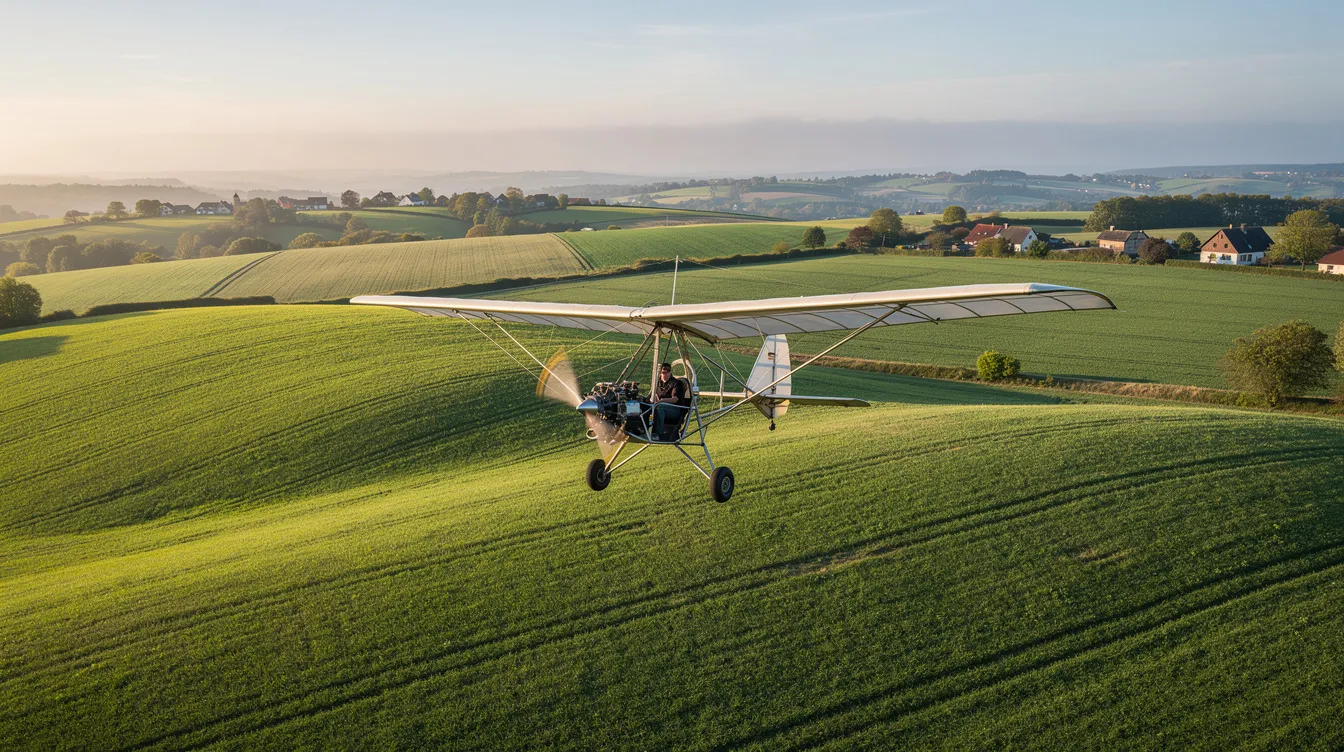
An ultralight vehicle represents the most accessible, visceral form of powered flight available today. This guide covers everything aspiring pilots need to know-from regulations and types to costs, safety, and how ultralight flying fits alongside private jet travel.
Ultralight Vehicles at a Glance (Answering the Basics Fast)
An ultralight vehicle is a lightweight aircraft designed primarily for sport and recreational flying, governed in the United States by 14 CFR Part 103. Unlike conventional planes or light sport aircraft, ultralight vehicles occupy a unique category in aviation, separating them from traditional airplanes through dramatically reduced weight, speed, and regulatory burden.
Here are the core Part 103 limits for powered ultralight aircraft:
Feature | Limit |
|---|
Empty weight | 254 pounds (115 kg) maximum |
Fuel capacity | 5 U.S. gallons maximum |
Top speed | 55 knots (63 mph / 102 km/h) at full power |
Stall speed | 24 knots power-off |
Seats | Single-seat only |
Unpowered weight | 155 pounds (70 kg) empty weight |
Can I fly without a license? Under Part 103, no pilot license is required for ultralight flying in the U.S. You also do not need a medical certificate, aircraft registration, or airworthiness certificate-provided your machine stays within every Part 103 limit.
Most ultralight pilots fly for weekend recreation, low-and-slow sightseeing, short hops to local grass strips, or as an affordable first step into aviation. This article serves as a practical, safety-focused guide for newcomers, covering types of ultralight aircraft, federal aviation regulation details, costs, proper training, and how ultralight aviation differs from light sport aircraft and certified general aviation.
What Is an Ultralight Vehicle? (Definitions & Core Requirements)
The FAA intentionally uses the term "vehicle" rather than "aircraft" for machines qualifying under 14 CFR Part 103. This distinction signals their special regulatory status: ultralight vehicles are officially governed by the eCFR 14 CFR Part 103 regulations in the United States and are exempt from most rules that apply to certificated aircraft.
For a powered ultralight, the technical criteria are specific. Ultralight aircraft must weigh less than 254 pounds empty. They cannot exceed a maximum speed of 55 knots at full power in level flight. The power-off stall speed for ultralight vehicles cannot exceed 24 knots. Maximum fuel capacity is 5 gallons. Most ultralights are designed for single-seat operation, and they may only be used for recreation or sport.
Unpowered ultralight vehicles-such as hang gliders and unpowered sailplanes-must weigh less than 155 pounds empty. Ultralight vehicles can have compact physical dimensions, allowing easier maneuverability, which contributes to their appeal among aviation enthusiasts.
Adding optional equipment like amphibious landing gear (floats) or a ballistic parachute can qualify for specific FAA weight allowances-these safety devices are excluded from the empty weight calculation, and the parachute system can help occupants return safely to the ground during an emergency. However, if you exceed any single Part 103 limit, add a second seat, or push past the speed ceiling, the machine moves into experimental or LSA territory, triggering full certification, registration, and pilot licensing requirements.
Legally, ultralight vehicles carry no N-number, require no airworthiness certificate, and demand no pilot certificate. They must still obey general rules of the air and respect airspace structure.
Types of Ultralight Vehicles and Ultralight Aircraft
Design choice shapes everything in ultralight aviation-handling characteristics, cost, training demands, and the kind of adventure you experience. Here are the main families.
Fixed-wing ultralights resemble traditional airplanes with simplified controls. They use three-axis control (ailerons, elevator, rudder), offer open or enclosed cockpits, and cruise at roughly 40–60 mph. Models like the Quicksilver MX series and Aerolite 103 are popular. The Stream ultralight features retractable landing gear, showing how sophisticated even Part 103 designs can become. Kits typically run $15,000–$30,000. Good for beginners who want airplane-like handling. For a deeper look, see our guide to the best personal ultralight aircraft.
Flex-wing trikes use a delta wing design mounted above a motorized tricycle undercarriage. Pilots steer by shifting weight rather than moving conventional control surfaces. Trikes are beloved for panoramic visibility and simplicity. Costs are comparable to entry-level fixed-wing ultralights. Training focuses on weight-shift technique-a different skill set from three-axis flight.
Powered paragliders (PPGs) and paramotors use lightweight small engines attached to paragliding wings. The pilot either wears the engine as a backpack or sits in a wheeled trike frame. Takeoffs happen from short fields with a running start or gentle roll. Often the most affordable entry-sometimes under $10,000. Minimal ground infrastructure needed, though wind and turbulence sensitivity is higher.
Ultralights include fixed-wing, flex-wing, and powered paragliders, but the category extends further. Gyrocopters use an unpowered rotor for lift and an engine for propulsion, though they're rare under Part 103 because rotorcraft tend to be heavier. Lighter-than-air ultralights like backpack balloons and ultra-simple airships serve niche markets with unique operational considerations-buoyancy control, wind drift, and weather dependence. Amphibious ultralights can take off and land on water and land, though they represent a small fraction of the market. Browse our roundup of the best ultralights for current options across all categories.

Ultralight Aircraft vs. Light Sport Aircraft: Key Differences
Understanding the boundary between ultralight aircraft and light sport aircraft is essential for anyone deciding where to enter aviation. Regulatory classifications of ultralight vehicles vary widely by jurisdiction, so what follows applies specifically to U.S. rules.
LSAs are full aircraft: they carry N-numbers, hold airworthiness certificates, require maintenance records, and allow two seats. Maximum takeoff weight reaches 1,320 lb (1,430 lb for seaplanes), with cruise speeds often 100–120 knots. Pilots need at least a Sport Pilot certificate-formal training, a knowledge test, a practical check ride, and currency requirements. For a thorough breakdown, read our essential guide to light sport aircraft.
Many aircraft marketed as "ultralights" internationally actually qualify as LSAs or microlights under other countries' rules-Europe's categories allow 450–600 kg, for example. Never assume global regulatory equivalence.
Here's a quick comparison:
Feature | Ultralight Vehicle | Light Sport Aircraft (LSA) |
|---|
Pilot license | None required | Sport Pilot certificate minimum |
Cruise speed | Up to 55 knots | Typically 100+ knots |
Seats | Single-seat only | Up to two seats |
Regulatory oversight | Minimal | Full FAA certification |
Acquisition cost | $5,000–$30,000 | $50,000–$200,000+ |
Choose an ultralight vehicle for lower cost, minimal bureaucracy, and solo fun. Consider an LSA for carrying a passenger, flying in more demanding weather, longer cross-country missions, and instrument-quality avionics.
Regulations: FAA Part 103 Rules for Ultralight Aviation
Part 103 exists to permit simple recreational flying with minimal regulatory burden while maintaining basic safety. Ultralight operations are restricted to daylight hours unless equipped with an anticollision light. Ultralight vehicles must fly under Visual Flight Rules and cannot fly blind; instrument-only flight is never permitted.
Ultralights can operate freely in uncontrolled airspace (Class G) with suitable visibility and cloud clearance. Entering controlled airspace (Class B, C, D, or certain Class E) requires prior ATC authorization. Ultralights cannot be flown over congested areas or assemblies of people.
No pilot license is required for ultralight flying in the U.S., and no medical certificate or experience requirements are formally mandated. However, the FAA expects operators to possess basic aeronautical knowledge, be physically and mentally fit, and understand local procedures. Ultralights are sensitive to weather conditions like wind and turbulence, making weather awareness crucial for safe ultralight flying.
Notable edge cases: amphibious ultralights receive extra weight allowance for floats, and ballistic parachute systems are excluded from empty weight calculations under FAA interpretations. If you're uncertain about compliance, consult the full text of 14 CFR Part 103 or contact your local Flight Standards District Office.
Costs, Ownership, and Building Your Own Ultralight Aircraft
Ultralight vehicles offer lower purchase prices than traditional aircraft-dramatically so. Ultralight aircraft can cost between $5,000ando $25,000 depending on condition, design, and propulsion. DIY ultralight kits are more affordable than buying new factory-built machines, though they demand significant time investment.
Three acquisition paths dominate:
Buying used: Lowest upfront cost. Watch for airframe fatigue, engine hours, and documentation gaps.
New factory-built: Turnkey compliance with Part 103. Higher cost but minimal build risk.
Kit building: Build times often range from 100 to 300+ hours. Staying within the 254-lb empty weight limit requires meticulous record-keeping of every component. Explore current options on our ultralight airplane for sale page.
Ongoing costs remain modest. Fuel consumption runs 2–4 gallons per hour for typical two-stroke engines, somewhat more for four-strokes. Ultralight vehicles rely on straightforward mechanical systems for maintenance-inspections of control cables, propeller balance, fabric condition, and engines. Hangar or tie-down fees apply at airports, but many owners store ultralights in trailers or garages thanks to folding wings. Insurance is optional but advisable for liability protection. Ultralight vehicles are limited in speed and range due to regulatory definitions, so budget expectations should match mission scope. Less than 5% of ultralights sold are amphibious models, keeping that niche at a premium. For the most budget-friendly options, check our guide to the cheapest ultralights.
Safety, Training, and Best Practices in Ultralight Aviation
Training for ultralight pilots is strongly advised but not mandatory under Part 103. Responsible ultralight pilots pursue instruction from qualified operators, dedicated flight schools, or experienced mentors-especially before first solo flights and initial landings.
Recommended training topics include basic aerodynamics, stall and spin awareness, weather theory (with emphasis on wind, turbulence, and density altitude), emergency procedures, and airspace and radio communication basics. Proper training transforms ultralight flying from risky to reliably enjoyable.
Accident data reinforces this: a 66-case NTSB study found that pilots with fewer than 40 hours in a specific make and model were significantly more likely to suffer fatal accidents. Loss of control- typically a stall/spin at low altitude-was the leading active failure. Safety and crash protection for ultralight vehicles are limited due to their minimal weight, making prevention through skill and discipline the primary line of defense.
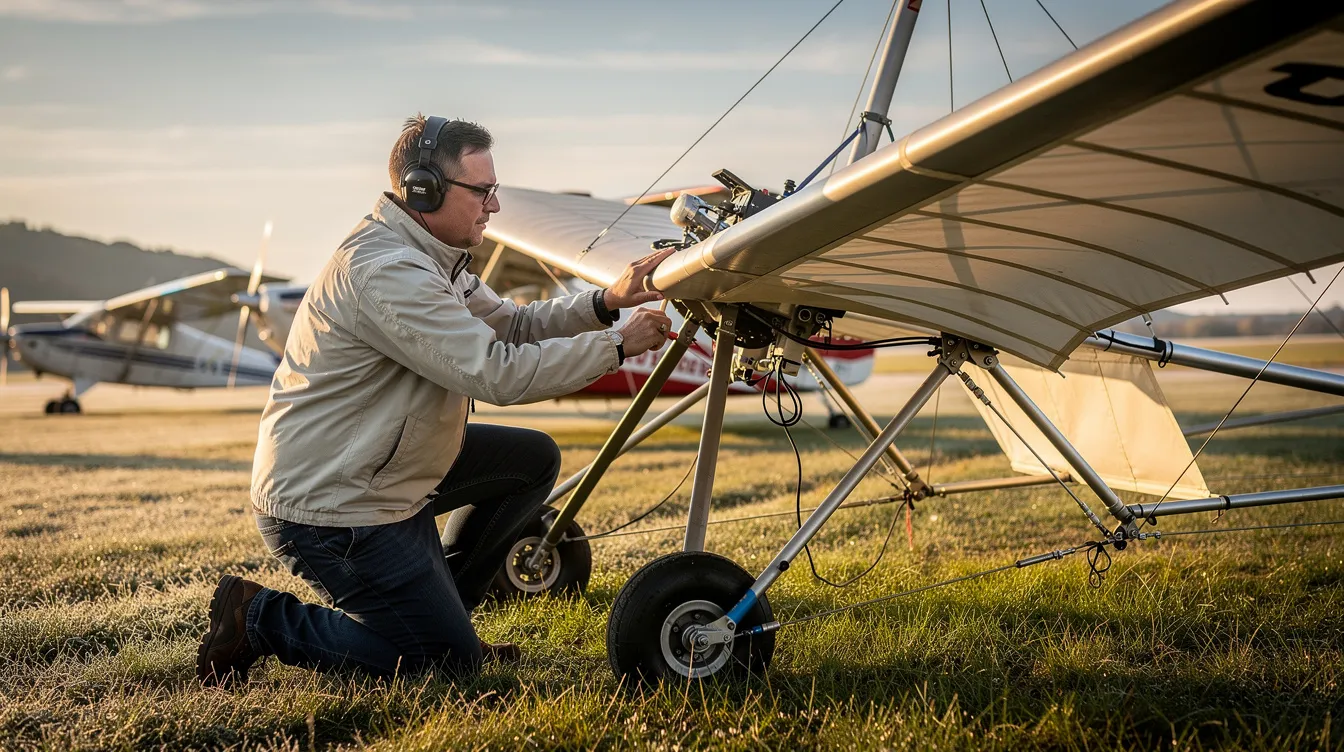
Ultralight pilots must conduct thorough pre-flight inspections. Maintenance demands regular attention to fabric, control cables, engines, propeller condition, landing gear, and fuel lines. Manufacturers provide recommended intervals-follow them conservatively.
The growing use of safety equipment helps: ballistic parachute systems, quality helmets, and simple avionics like GPS and angle-of-attack indicators are increasingly common even on lighter machines equipped for Part 103 compliance. Newcomers should connect with local ultralight clubs, EAA chapters, and national organizations for safety seminars and mentorship. Safety in ultralight aviation is a community-driven culture, not merely a regulatory checkbox.
Ultralight Aviation, Private Jet Travel, and When to Choose Each
Ultralight aviation is pure, minimalist flying-wind on your face, ground close beneath your wheels, total engagement with the air. Private jet travel is strategic transportation: speed, comfort, and schedule control across serious distances. For many dedicated enthusiasts, these aren't competing choices. They're complementary.
Many BlackJet clients who enjoy ultralight aircraft for weekend adventure rely on private jets for business trips, multi-city itineraries, or international travel, often starting with accessible options like buying a single seat on a private jet, exploring the cheapest private jet options for entry-level access, or reviewing the cheapest private aircraft for budget-conscious owners. Consider this: an executive keeps a Part 103-compliant ultralight at a rural airstrip for Saturday morning joy flights, then uses a BlackJet Jet Card from the premium private jet card programs chosen from among the best jet cards for frequent flyers, evaluating options like a 100-hour jet card cost structure or a 50-hour jet card pricing guide, to fly from New York to Miami or Los Angeles to Aspen on short notice with colleagues.
Private jets differ fundamentally from ultralights: multi-passenger cabins, pressurization, high cruise speeds, all-weather capability, access to thousands of airports, and professional flight crews, with many travelers gravitating toward the best small private aircraft for versatile missions. BlackJet delivers transparent pricing, aircraft category choice across multiple private jet types, and carbon-neutral flights-a different tier of aviation safety and certification from self-managed ultralight operations.
BlackJet isn't a replacement for the dream of ultralight flying. It's a premium complement-handling serious travel logistics so clients can keep ultralight aviation purely for leisure and passion.
Frequently Asked Questions (FAQs)
What are the two categories of ultralight vehicles?
Ultralight vehicles generally fall into two categories: powered ultralights, which have engines and are subject to weight and speed limits under FAA Part 103, and unpowered ultralights, such as hang gliders, which must meet stricter weight limits.
Do I need a pilot license to fly an ultralight vehicle?
In the U.S., no pilot license or medical certificate is required to fly a single-seat ultralight vehicle that complies with FAA Part 103 regulations.
Can ultralight vehicles be used for commercial purposes?
Ultralight vehicles under Part 103 are restricted to recreational and sport use only. Commercial operations are not permitted.
What safety measures should ultralight pilots take?
Pilots should undergo proper training, conduct thorough pre-flight inspections, stay aware of weather conditions, and consider safety equipment like ballistic parachutes and helmets.
How do ultralight aircraft differ from light sport aircraft (LSA)?
Ultralights are lighter, slower, and limited to single seats with minimal regulatory oversight, while LSAs are heavier, faster, allow two seats, and require a Sport Pilot certificate.
What is the typical cost range for ultralight aircraft?
Ultralight aircraft typically range from $5,000 to $25,000, depending on whether they are new, used, or kit-built.
Are there restrictions on where and when ultralights can fly?
Ultralights must operate only during daylight hours under Visual Flight Rules, avoid controlled airspace without authorization, and cannot fly over congested areas or gatherings.
What types of ultralight vehicles are available?
Types include fixed-wing ultralights, flex-wing trikes, powered paragliders, gyrocopters, and amphibious ultralights.
How does ultralight flying complement private jet travel?
Ultralight flying offers pure recreational flight experiences, while private jets provide strategic, fast, and comfortable travel for business or long-distance trips. Many enthusiasts enjoy both for different purposes.
What are the future trends in ultralight aviation?
Advances include electric propulsion, lightweight composites, quiet engines, and integration of modern avionics, aligning with broader sustainability goals in aviation.
Future of Ultralight Vehicles and How to Get Started
The future of ultralight vehicles is being shaped by lightweight composites, electric propulsion, and compact glass cockpit technologies. Projects like Whisper Aero's powered glider-which recorded just 52 dB(A) noise at full power-and Pivotal's BlackFly electric VTOL demonstrate that quieter, cleaner ultralight flight is arriving. These experimental electric ultralight efforts mirror broader sustainable aviation goals, connecting directly to BlackJet's own commitment to carbon-neutral private jet flights.
Here's a simple pathway for getting started:
Research regulations beyond Part 103 that apply to your state and local area.
Book an introductory flight or tandem experience with a reputable school to determine which type suits you.
Join an ultralight or EAA chapter for mentorship, group flights, and safety culture.
Set a realistic budget and timeline-whether that's an $8,000 used paramotor or a $25,000 composite fixed-wing kit.
Visit aviation museums and airshows featuring ultralight and light sport aircraft to deepen your aeronautical knowledge.
The skies have never been more accessible. Whether your dream is a Saturday morning flight over open countryside or a seamless coast-to-coast journey for business, aviation offers a path for every ambition. Ultralight vehicles deliver the raw, unfiltered joy of flight. For everything beyond efficient, carbon-neutral travel across larger distances with safety, flexibility, and quality built in, explore BlackJet's Jet Card membership pricing and structure, including a deeper dive into jet card pricing, costs, and benefits, or consider unlimited private jet membership programs and comparisons like Flexjet jet card cost and options and NetJets jet card cost and features, along with strategies to maximize your jet card tax deductions, and discover how refined private aviation becomes your new standard.
Elevate your travel-effortlessly. Join BlackJet's Jet Card program and explore the flexible BlackJet 25+ Hour Jet Card for seamless, premium private travel with safety, sustainability, and flexibility built in.


 Sign up with google
 Sign up with Apple