Every flight begins with a decision most travelers never see: which aircraft type matches the mission? In private aviation, an aircraft type is the specific make and model of aircraft—such as a Gulfstream G650ER or Dassault Falcon 8X—and that choice shapes range, speed, airport access, cabin comfort, and the pilot type rating required to operate it safely.
For high-net-worth executives and discerning leisure travelers who want flexible, private air travel without the demands of aircraft ownership, that invisible decision determines whether a transatlantic crossing takes four hours or fourteen, whether you clear security in minutes or endure it for an hour, and whether you land refreshed or fatigued. This guide explains how aircraft types, categories, and classes affect private jet charter options, licensing and safety standards, environmental impact, and the best fit for each mission—including how BlackJet’s Jet Card programs provide flexible access to different cabin classes.
Executive Overview: Why Aircraft Type Matters for Elite Travelers
In civil aviation, the spectrum ranges from commercial airliners seating hundreds to single-engine piston engine aircraft carrying a pilot and three passengers. Between those extremes sits the segment that matters most to frequent private travelers: professionally crewed jet aircraft sized and configured for the mission at hand.
Consider a CEO departing New York for London in February 2026. On a commercial airliner, door-to-door time-ground transport, check-in, security, boarding, flight, immigration, baggage-easily stretches to twelve hours. Aboard an ultra-long-range business jet departing a private terminal at Teterboro, total door-to-door time drops to roughly seven hours, with the cabin serving as a private office the entire way. That five-hour differential, repeated across dozens of crossings per year, represents thousands of hours reclaimed.
A nonstop NYC–London private jet flight saves an estimated 3–5 hours per crossing compared to premium commercial options.
Private aviation passengers access over 5,000 U.S. airports versus roughly 500 served by scheduled airlines.
Average commercial boarding and security processing adds 90–120 minutes that private terminals eliminate.
Behind every such flight sit aviation regulations, aircraft certification standards, and aircraft classifications-category, class, and type-that govern what flies, who flies it, and how safely it performs. BlackJet curates multiple aircraft categories and cabin classes under a single premium private jet card program, so members gain access to light, midsize, super-midsize, and heavy jets without decoding every regulatory nuance themselves.

Fundamentals: Aircraft Categories, Classes, and Types Explained
Aviation authorities worldwide organize every powered aircraft, unpowered aircraft, and everything in between into a clear hierarchy. Understanding three terms unlocks the entire system.
Aircraft category is the broadest grouping. It classifies machines by their primary mode of flight: airplane, rotorcraft, glider, lighter-than-air, powered lift, and others. Aircraft classifications are determined by their design, certification category, and purpose, and these categories form the backbone of both pilot certification and airworthiness regulation.
Aircraft class is a subdivision within a category based on similar design characteristics. Within the airplane category, for instance, classes include single-engine land, multi-engine land, and seaplane. A pilot certified for single-engine land cannot legally operate a multi-engine propeller aircraft without obtaining the appropriate class rating.
Aircraft type in this legal and regulatory context means a specific make and model; in other words, aircraft refers here to an exact designation such as a Gulfstream G650ER or a Dassault Falcon 8X. Type refers to specific aircraft models requiring special ratings, and pilots need a type rating for aircraft over 12,500 pounds maximum takeoff weight. This means a captain cannot simply step from one large jet aircraft into another without dedicated ground school, simulator sessions, and a checkride on that exact model.
A common misconception: travelers often say "type" when they mean "class" or "size." Legally and operationally, an aircraft type is a precise designation with specific training and safety implications. When you board a BlackJet flight, every cockpit crew member holds the exact type rating for the entire aircraft you are flying on-never a generic qualification.
Regulatory Aircraft Categories in Civil Aviation
The Federal Aviation Administration defines seven main aircraft categories: Airplane, Rotorcraft, Glider, Lighter-Than-Air, Powered Lift, Powered Parachute, and Weight-Shift Control. The International Civil Aviation Organization harmonizes these definitions globally so that pilot training and licensing remain consistent across borders.
Aircraft categories are used to classify aircraft by intended use and operating environment, and each category connects directly to a distinct licensing pathway:
Airplane - fixed-wing, heavier-than-air aircraft generating lift over wings. This is where virtually all commercial aircraft and business jets reside.
Rotorcraft - helicopters and gyroplanes using rotating blades for lift. Rotorcraft includes helicopters and gyroplanes that use rotating blades for lift.
Glider - an engine-less aircraft relying on air currents. Gliders are a category of aircraft designed to fly without an engine.
Lighter-Than-Air - balloons and airships sustained by buoyant gas.
Powered Lift - aircraft capable of vertical takeoff and wing-borne cruise, including tiltrotors and emerging eVTOL concepts.
Powered Parachute and Weight-Shift Control - niche recreational categories with limited commercial relevance.
The FAA uses categories to set baseline standards for pilot training. A pilot certified in the airplane category cannot transition into rotorcraft without completing separate ground instruction, flight hours, and a practical exam. Aircraft categories include Airplane, Rotorcraft, and Glider among the most commonly encountered in general aviation.
Private jet travel sits almost entirely within the airplane category-specifically multi-engine turbine transport-but operationally interacts with rotorcraft when a helicopter shuttle ferries passengers from a city heliport to a nearby jet terminal.
Aircraft Certification Categories: Normal, Transport, and Beyond
Beyond pilot licensing, the term "aircraft category" also applies to the machine itself through aircraft certification. Here, the focus shifts from the aviator's qualifications to the aircraft's structural integrity and design purpose.
The main aircraft certification categories include Normal, Utility, and Transport. Each imposes progressively stricter requirements:
Normal category - smaller aircraft intended for private and commercial operations, with moderate stress limits and simpler system redundancy. Normal category aircraft are small and used for private and commercial operations like flight training and personal flying.
Utility - similar to Normal but approved for limited aerobatic maneuvers, including performing aerobatic flight within defined load factors.
Commuter - multi-engine regional aircraft up to defined passenger and weight thresholds.
Transport - the most demanding standard. Transport category aircraft must meet strict safety standards and are larger in size, requiring fail-safe structural design, multiple redundant systems, and rigorous crashworthiness testing.
Restricted, Limited, and Experimental - covering experimental aircraft, developmental prototypes, and special-purpose platforms. The Experimental Aircraft Association supports builders and operators in this niche, but these aircraft are not used for revenue passenger flights.
To illustrate: a two-seat piston engine aircraft used at a flight school is certified under the Normal category with straightforward system requirements. A Gulfstream G650ER carrying executives across an ocean is certified under the Transport category, demanding triple-redundant hydraulics, dual flight management computers, and structural margins designed to handle extreme aerodynamic loads. BlackJet exclusively partners with operators flying certified conventional aircraft meeting Transport or equivalent standards-never experimental for passenger missions.
Main Operational Aircraft Categories: Commercial, Cargo, Private, and Military
From a traveler's vantage point, the aviation industry organizes around five broad mission categories:
Commercial aircraft - scheduled airline operations carrying fare-paying passengers. Examples include the Boeing 737, Airbus A321, and Airbus A350, regulated under Part 121 in the United States.
Cargo aircraft - dedicated or converted freighters moving freight globally, such as the Boeing 777F and Airbus Beluga XL.
Civil aircraft for private and business use - jets and turboprops operating under Part 91 (private) or Part 135 (charter and on-demand), forming the backbone of the business aviation segment.
Specialized civil aircraft - platforms built for firefighting, medevac, aerial survey, and amphibious aircraft operations.
Military aircraft - combat aircraft, transports, tankers, and surveillance platforms operating under separate federal regulations and military aviation oversight.
Civil aviation regulations from the Federal Aviation Administration, EASA, and ICAO differentiate these operations carefully. An airline flying scheduled routes under Part 121 faces different crew rest, maintenance, and dispatch requirements than a charter operator under Part 135. BlackJet focuses exclusively on business aviation within civil aircraft, leveraging Part 135 operators that meet or exceed BlackJet Certified safety standards, whether you charter an entire aircraft or simply buy a seat on a private jet via shared or semi-private options. Not all aircraft serve the same mission-and not all operators meet the same bar.
Fixed-Wing vs. Rotary-Wing vs. Lighter-Than-Air: How Aircraft Stay Aloft
Aircraft are classified by how they generate lift and their intended purpose. Three fundamental physical categories define the spectrum:
Fixed-wing aircraft generate lift by moving forward through the air over wings. This category encompasses everything from single-engine trainers to intercontinental airliners. Fixed-wing aircraft usually require a runway for takeoff and landing, while rotorcraft do not-a distinction with profound implications for airport access.
Rotary-wing aircraft produce lift through rotating blades and can hover in place, making them indispensable for point-to-point urban transfers, offshore platforms, and remote sites without runways. Rotorcraft produce lift through rotating blades and can hover in place.
Lighter-than-air aircraft remain aloft using buoyant gases like helium or hot air. This category includes hot air balloons, blimps, and modern hybrid airships. Their relevance to executive travel is minimal but historically significant.
Primary aircraft categories include fixed-wing planes, rotorcraft, and lighter-than-air vehicles. Here is a quick comparison relevant to high-end travel:
Large-cabin business jet (fixed wing): cruise speed ~Mach 0.85 (~550 mph), range ~7,000 nm, seats 10–16, forming the core of many private jets for up to 50 passengers when configured on airliner-derived platforms.
Twin-engine VIP helicopter (rotary-wing): cruise speed ~160 mph, range ~400 nm, seats 6–8.
Modern hybrid airship prototype (lighter than air): cruise speed ~80 mph, range ~200 nm, payload-focused rather than passenger-focused.
For BlackJet members, the fixed-wing business jet handles intercity and intercontinental legs, while helicopters solve the last-mile problem-moving passengers from a major airport to a downtown heliport in minutes.
Civil Aircraft Categories by Role: Passenger, Cargo, and Special-Mission
Within civil aviation, aircraft are divided further by the role they serve:
Passenger transport includes commercial airliners, regional turboprops, and business jets-any civil aircraft configured with seats, life support, and cabin service for human occupants. Aviation organizations from ICAO to national authorities set minimum cabin safety, emergency egress, and pressurization standards for each subtype.
Cargo aircraft are built or converted for freight. Design differences include reinforced floors, large cargo doors, and cargo-handling systems. The Boeing 747-8F is a dedicated freighter aircraft, while many cargo aircraft like the Boeing 777F are adapted from passenger models through manufacturer or third-party conversion programs.
Special-mission civil aircraft serve roles outside standard passenger or freight carriage:
The Canadair CL-415, an amphibious aircraft, scoops water from lakes to fight wildfires.
Modified Gulfstream airframes serve as research aircraft for NASA, equipped with atmospheric sensors and flight instrumentation.
Dassault Falcon 7X platforms operate in government VIP configurations for the civilian transport of heads of state.
Each role demands distinct equipment and certification, yet all operate within the same regulatory ecosystem. BlackJet members primarily interact with passenger-role business jets, but the safety architecture-type certificates, airworthiness directives, and recurring inspections are shared across every civil aircraft category.
Commercial Aircraft Types: Narrow-Body, Wide-Body, and Regional
Commercial airliners fall into three main sub-categories defined by fuselage width and mission:
Regional jets - smaller platforms like the Embraer E175, typically seating 70–90 passengers on routes under 1,500 nm. Ideal for hub feeder operations.
Narrow-body aircraft - the workhorses of domestic and short-haul flying. The Boeing 737 can carry approximately 200 passengers, while the Airbus A320neo family covers a similar capacity with modern turbine engines. These aircraft serve routes up to roughly 3,500 nm.
Wide-body aircraft - built for long-haul and ultra-long-haul routes. The Boeing 787, Boeing 777, Airbus A330, and the flagship Airbus A380 dominate intercontinental flying. The Airbus A380 can accommodate over 850 passengers in an all-economy configuration-a scale unmatched by any other modern aircraft.
Consider Los Angeles to Tokyo (~4,700 nm). A commercial wide-body handles this nonstop with 250–350 passengers. An ultra-long-range business jet like the Gulfstream G650ER covers the same distance nonstop with 10–13 passengers in a private cabin-no connections, no terminal queues, and total schedule control. The trade-off is per-seat economics versus per-hour productivity and privacy. For executives whose time carries significant value, the private jet comparison often favors dedicated access.
Cargo Aircraft and Specialized Utility Types
Cargo aircraft form the circulatory system of global commerce. Key segments include:
Dedicated freighters - purpose-built or factory-converted. The Boeing 747-8F is a dedicated freighter aircraft offering massive main-deck cargo capacity. The Boeing 777F, adapted from passenger models, is among the most versatile long-haul freighters in service.
Oversized cargo aircraft - the Antonov An-124 handles oversized military and industrial loads. The Antonov An-225 Mriya was the heaviest aircraft ever built before its destruction in 2022, with a maximum takeoff weight exceeding 640 metric tons. The Airbus Beluga XL transports aircraft sections between Airbus factories.
Passenger-to-freighter conversions - programs like the 737-800BCF extend the economic life of narrowbodies by converting them to cargo aircraft configurations with reinforced floors and large side doors.
Specialized civil aircraft also deserve mention:
Firefighting platforms like the CL-415 and converted DC-10 "SuperTanker" deliver retardant to wildfire zones.
Maritime patrol aircraft based on airliner airframes (such as the P-8A Poseidon derived from the 737-800) bridge military operations and civilian surveillance.
Research aircraft, including NASA-modified Gulfstreams, advance atmospheric science with sensor suites integrated into the airframe.
While BlackJet does not operate cargo aircraft, the same aviation regulations and certification rigor underpin safety across all segments of civil aviation.
Private Aircraft Types: From Piston Singles to Ultra-Long-Range Jets
The world of private civil aircraft spans an enormous range, with distinct private jet sizes:
Single-engine piston planes - the Cessna 172 and Cirrus SR22 are iconic trainers and personal aircraft. Piston-engine aircraft are common for training and personal flying, typically cruising at 120–180 knots with ranges under 800 nm.
Multi-engine piston aircraft - platforms like the Beechcraft Baron add a second engine for redundancy, though speed and range remain modest.
Turboprop aircraft - the Pilatus PC-12 and Beechcraft King Air 350i bridge the gap between piston and jet. Turboprop aircraft are efficient for short- to medium-distance travel, accessing shorter runways that jets cannot use.
Business jets - from very light jets seating four to ultra-long-range cabins seating sixteen. Private jets can range from very light jets to ultra-long-range aircraft, with cruise speeds from 350 to 590 knots and ranges from 1,000 to over 7,700 nm.
The transition from piston engine aircraft to business jets is driven by how different aircraft engines—from piston and turboprop systems to jets—change speed, altitude, weather capability, mission flexibility, and cabin comfort. An owner-flown piston single may suffice for weekend trips, but serious business travelers move to professionally crewed jets for reliability and time savings; among the options, choosing the best small private aircraft depends on mission, range, and budget. Internal combustion engines powering pistons give way to jet engines or turboprops, unlocking higher altitudes, faster cruise, and pressurized cabins.
BlackJet's curated fleet partners focus on turbine-powered, professionally crewed aircraft, while some travelers also explore budget-friendly private aircraft options when cost is the primary driver. For a deeper look at how these categories break down, explore the private jet options guide or review affordable private jet options that balance cost with capability.
Business Jet Classes and Cabin Categories (Very Light to Ultra-Long-Range)
Jet Card programs-including BlackJet-structure access around cabin classes rather than individual aircraft types. Here is the standard hierarchy used across the aviation industry:
Very light jets (VLJs): 4–6 seats, ~600–1,200 nm range. Examples: HondaJet, Embraer Phenom 100.
Light jets: 6–8 seats, ~1,000–1,800 nm. Examples: Citation CJ3+, Embraer Phenom 300E, and other newest private jets bringing cutting-edge comfort and efficiency.
Midsize jets: 7–9 seats, ~2,000–3,000 nm. Examples: Citation Latitude, Learjet 75 Liberty.
Super-midsize jets: 8–10 seats, ~3,000–3,500+ nm. Examples: Gulfstream G280, Challenger 3500.
Heavy jets: 10–14 seats, ~4,000–6,000 nm. Examples: Gulfstream G450, Falcon 900EX, and other private jets ideal for 15 passengers.
Ultra-long-range jets: 12–16 seats, ~6,500–7,700+ nm. Examples: Gulfstream G650ER, Bombardier Global 7500, Gulfstream G800 with a range of approximately 8,200 nm; many of the best long-range private jets for sale sit in this category.
Jets generally provide high speeds and long ranges, and the Gulfstream G650 has a range of approximately 7,000 nautical miles-enough to connect New York to Dubai or London to Buenos Aires nonstop.
Use-case matching:
London–Dubai (~3,400 nm): A super-midsize or heavy jet handles this comfortably nonstop.
New York–São Paulo (~4,200 nm): A heavy or ultra-long-range jet is required for nonstop service.
Los Angeles–Paris (~5,600 nm): Only ultra-long-range jets like the G650ER or Global 7500 make this nonstop.
With a BlackJet Jet Card, members switch between these classes trip-by-trip, matching the right cabin to the right mission without renegotiating contracts or owning multiple aircraft; the BlackJet 25+ Hour Jet Card is a flagship option for frequent travelers seeking fixed rates and flexibility.
Amphibious Aircraft, Seaplanes, and Niche Air Aircraft
Seaplanes and amphibious aircraft occupy a specialized corner of the airplane category. The distinction matters: floatplanes mount pontoons on a conventional airframe, while flying boats integrate the hull as the fuselage-historically exemplified by the Boeing 314 Clipper that pioneered transatlantic passenger service. Modern amphibious aircraft like the DHC-6 Twin Otter on amphibious floats and the ICON A5 sport aircraft combine water and runway capability.
Their roles in civil aviation include remote tourism access, island logistics, firefighting (the Canadair CL-415 scoops water directly from lakes), and search-and-rescue operations in coastal regions. Pilots require additional ratings-single-engine sea or multi-engine sea-to operate these platforms legally.
While not core to BlackJet's offering, seaplanes can complement business travel. Imagine accessing a lakeside lodge in British Columbia or an island resort in the Maldives where no conventional runway exists. A jet carries you to the nearest major airport; a floatplane completes the final leg. It is one example of how different air aircraft categories work together within a single itinerary.
Rotorcraft and Tiltrotors: Helicopters, Gyroplanes, and Powered-Lift
Rotorcraft serve missions where runways are unavailable or impractical:
Single-engine helicopters are used for sightseeing, light utility, and personal transport.
Twin-engine helicopters - the Airbus H145 and Leonardo AW139 dominate corporate shuttle, EMS, and offshore energy support. Their redundancy and cabin size make them viable for VIP transport.
Gyroplanes - a niche general aviation segment using an unpowered rotor for lift and a propeller for thrust, limited to low-speed flight and recreational use.
Tiltrotor and powered lift aircraft - the Bell Boeing V-22 Osprey, primarily a military platform, demonstrated that vertical takeoff combined with airplane-speed cruise is achievable. The AW609 civil tiltrotor remains under development.
For high-end travelers, helicopters solve the first-and-last-mile problem. A BlackJet member might fly a heavy jet from London Luton to Nice, then board a helicopter for a fifteen-minute transfer to Monaco's heliport, avoiding a ninety-minute drive.
Emerging eVTOL aircraft from companies like Joby, Lilium, and Vertical Aerospace fall into powered lift categories currently advancing through certification. Once approved, these autonomous aircraft and piloted electric platforms could integrate with Jet Card ecosystems, offering silent, zero-emission urban transfers. Any aviation enthusiast watching these developments recognizes that powered lift may redefine short-range mobility within the next decade.
Lighter-Than-Air and Gliders in the Modern Era
Lighter-than-air aircraft encompass two distinct families:
Hot air balloons - hot air balloons are used primarily for recreational flying, festival events, and scenic tourism. They offer a unique low-speed flight experience but lack directional control and schedule reliability.
Airships and blimps - airships are steerable balloons often used for advertising and surveillance, with Goodyear's fleet being the most recognizable example. Modern hybrid concepts like the Hybrid Air Vehicles Airlander 10, tested in the UK in the mid-2010s, explore heavy-lift cargo and persistent surveillance roles.
Gliders and sailplanes represent the purest form of unpowered aircraft. Gliders are unpowered aircraft that rely on air currents for lift, demanding exceptional pilot skill in energy management. Competition sailplanes achieve glide ratios exceeding 60:1 and can cover hundreds of kilometers without an engine-an endeavor embraced by many a serious aviation enthusiast. Model aircraft and unmanned platforms also fall under broader aircraft classifications, though their relevance to executive travel is tangential.
These categories are essential to the overall aircraft classification system but rarely intersect with Jet Card travel. An exception: luxury balloon experiences in Cappadocia or the Serengeti occasionally appear on the itineraries of discerning leisure travelers-though they complement, rather than replace, a private jet crossing.
Military Aircraft Types and Their Influence on Civil Aviation
Military aircraft are designed for defense and tactical missions across several specialized roles:
Fighter aircraft - platforms like the F-16 and F-35 are built for air-to-air combat and ground attack. The Lockheed SR-71 Blackbird reached speeds of 2,193 mph-a record for air-breathing powered airplane performance that stood for decades.
Bombers - the B-2 Spirit and the B-21 Raider under development are designed to destroy enemy equipment and strategic targets.
Transport and tanker aircraft - the C-130J and C-17 Globemaster III move troops and cargo, while the KC-46 supports in-flight refueling for extended military operations.
Surveillance and ISR platforms - the E-3 AWACS and RQ-4 Global Hawk represent crewed and uncrewed reconnaissance. Unmanned Aerial Vehicles (UAVs) can be controlled remotely or autonomously. Drones are used for photography, surveying, and military reconnaissance.
Combat aircraft and military aircraft modified for testing roles often pioneer technologies that migrate to civil aviation. Jet engines, composite materials, fly-by-wire controls, GPS navigation, and advanced radar all originated in military programs before appearing in modern Gulfstream, Bombardier, and Dassault business jets. Fighter aircraft drove the development of ejection systems and G-tolerance research, while military aviation logistics created the maintenance paradigms now standard in commercial and business aviation.
BlackJet exclusively uses certified civil aircraft, but benefits indirectly from decades of military-driven innovation. Even air racing projects and epic flight academy training programs borrow from techniques first proven in military aviation contexts.
Aviation Regulations and Aircraft Certification: How Safety Is Built In
Aviation safety begins long before an aircraft carries its first passenger. Aviation regulations govern every phase of an aircraft's life:
Design and testing - manufacturers submit designs to authorities like the FAA, EASA, or Transport Canada. Prototypes undergo static structural tests, systems verification, and hundreds of hours of flight testing.
Type Certificate issuance - once the aircraft meets all applicable standards (FAR Part 23 for Normal category, FAR Part 25 for Transport category), the authority issues a Type Certificate authorizing production.
Production Certificate - grants the manufacturer authority to produce aircraft conforming to the approved design.
Airworthiness Certificate - issued to individual aircraft, confirming they meet the type design and are safe for operation.
Continuing airworthiness - recurring inspections, airworthiness directives, and mandatory service bulletins ensure the aircraft manufactured decades ago remains compliant with evolving federal regulations.
Business jets used in Jet Card programs are almost always certificated under transport-category standards, demanding redundancy in flight controls, engines, and aircraft systems. This means dual or triple hydraulic circuits, multiple electrical generators, and fail-safe structural design.
BlackJet layers additional safety standards on top of regulatory minimums. Partner operators undergo audits by independent aviation organizations such as ARGUS, Wyvern, and IS-BAO, verifying operational discipline beyond what federal aviation mandates require. For more details on these protocols, visit Safety in the Skies.
Pilot Licensing, Type Ratings, and How They Relate to Aircraft Types
A pilot's license reflects the aircraft categories, classes, and types they are qualified to fly:
Category rating - listed on the pilot certificate (e.g., Airplane). This is the broadest qualification.
Class rating - specifies operating characteristics within a category (e.g., single-engine land, multi-engine land). A pilot holding only SEL cannot legally fly a multi-engine jet without earning an MEL class rating.
Type rating - required for specific models, typically jet engine transports rated above 12,500 pounds or turbojet-powered aircraft regardless of weight. Pilots need a type rating for aircraft over 12,500 pounds.
Concrete example: a captain flying a Gulfstream G650 must hold an Airline Transport Pilot (ATP) certificate with a G650 type rating. Similarly, a commercial airline pilot operating an Airbus A320 needs the A320 type rating. Neither pilot can simply swap cockpits without completing a full training program-typically 3–4 weeks of ground school plus simulator sessions-on the new type. A pilot's license reflects years of accumulated category, class, and type qualifications.
Federal aviation authorities worldwide harmonize type designators through ICAO standards, ensuring that pilot certification in one jurisdiction translates meaningfully to another. EASA's Regulation (EU) 2025/134 further tightens requirements, mandating current and appropriate class or type ratings.
For Jet Card members, this means assurance: BlackJet exclusively uses crews who are fully current and type-rated on the specific aircraft they fly, with recurrent pilot training every 6–12 months in full-motion simulators. Pilot certification is not a formality-it is a cornerstone of aviation safety.
Environmental Impact Across Aircraft Types and BlackJet's Sustainability Approach
Different aircraft categories carry different environmental footprints. In 2018, aviation generated 2.4% of global CO₂ emissions, and aviation emissions increased by 70% from 2005 to 2020. Business jets, with smaller passenger loads, face particular scrutiny: studies show private aviation emissions per passenger-kilometer on short routes can reach 449–535 gCO₂-eq, compared to approximately 285 g for commercial short-haul. Jet airliners emitted 88 grams of CO₂ per passenger-km in 2018-a figure that benefits from high load factors and modern turbofan efficiency.
The aviation industry is responding on multiple fronts:
Sustainable Aviation Fuel (SAF) - aviation biofuels can reduce lifecycle emissions by 50–80% compared to conventional jet fuel. Global SAF production reached approximately one million metric tons in 2024, with U.S. production capacity targeting three billion gallons annually by 2030.
ICAO's CORSIA scheme establishes carbon offsetting requirements for international civil aviation.
Emerging electric and hybrid propulsion is promising for short-haul missions under 500–800 nm, though battery energy density remains a constraint.
Net-zero commitments - IATA members aim for net-zero carbon emissions by 2050.
BlackJet's approach combines several strategies: carbon-neutral flights for every member journey through verified offset programs, preference for modern and fuel-efficient aircraft types, and integration of SAF where available across partner fleets. Members can request per-trip sustainability data through the digital platform, ensuring transparency. For more on these commitments, visit BlackJet Sustainability.

Choosing the Right Aircraft Type for Your Mission with a Jet Card
Selecting the optimal aircraft type comes down to four variables: route length, passenger count, airport access, and desired cabin experience. Here is a practical framework:
When to choose each jet class:
Light jet - routes under 1,500 nm, 2–6 passengers, access to smaller airports with shorter runways. Example: London–Geneva day trip (~470 nm). A Citation CJ3+ handles this efficiently with quick turnarounds.
Midsize jet - routes of 1,500–2,500 nm, 5–8 passengers needing a stand-up cabin and more luggage space. Example: New York–Miami weekend (~1,000 nm). Comfort and speed without oversizing the aircraft.
Super-midsize jet - routes of 2,500–3,500 nm, 6–9 passengers wanting transcontinental range and a full galley. Example: Los Angeles–Honolulu (~2,200 nm) with family.
Heavy or ultra-long-range jet - routes exceeding 3,500 nm, 8–16 passengers requiring lie-flat sleeping, full catering, and nonstop intercontinental capability. Example: San Francisco–Tokyo board meeting (~4,500 nm). Only aircraft capable of this range, like the G650ER or Global 7500, avoid fuel stops that add hours and complexity.
With a BlackJet Jet Card-whether a 25-hour program or a 50-hour jet card block-members switch between aircraft classes trip-by-trip. There is no need to own multiple aircraft or renegotiate charter contracts for each mission. The right aircraft type is matched to the right route every time.
Technology, Comfort, and Safety Features by Aircraft Category
The gap between older and newer business jet types manifests across every dimension of the passenger experience:
Cabin comfort:
Modern large-cabin jets maintain cabin altitudes of ~2,800–3,000 feet at cruise (41,000–51,000 ft), versus 6,000–8,000 feet on older or commercial aircraft. Lower cabin altitude reduces fatigue.
Noise levels in current-generation jets are measurably lower thanks to advanced acoustic insulation and next-generation turbofan engines.
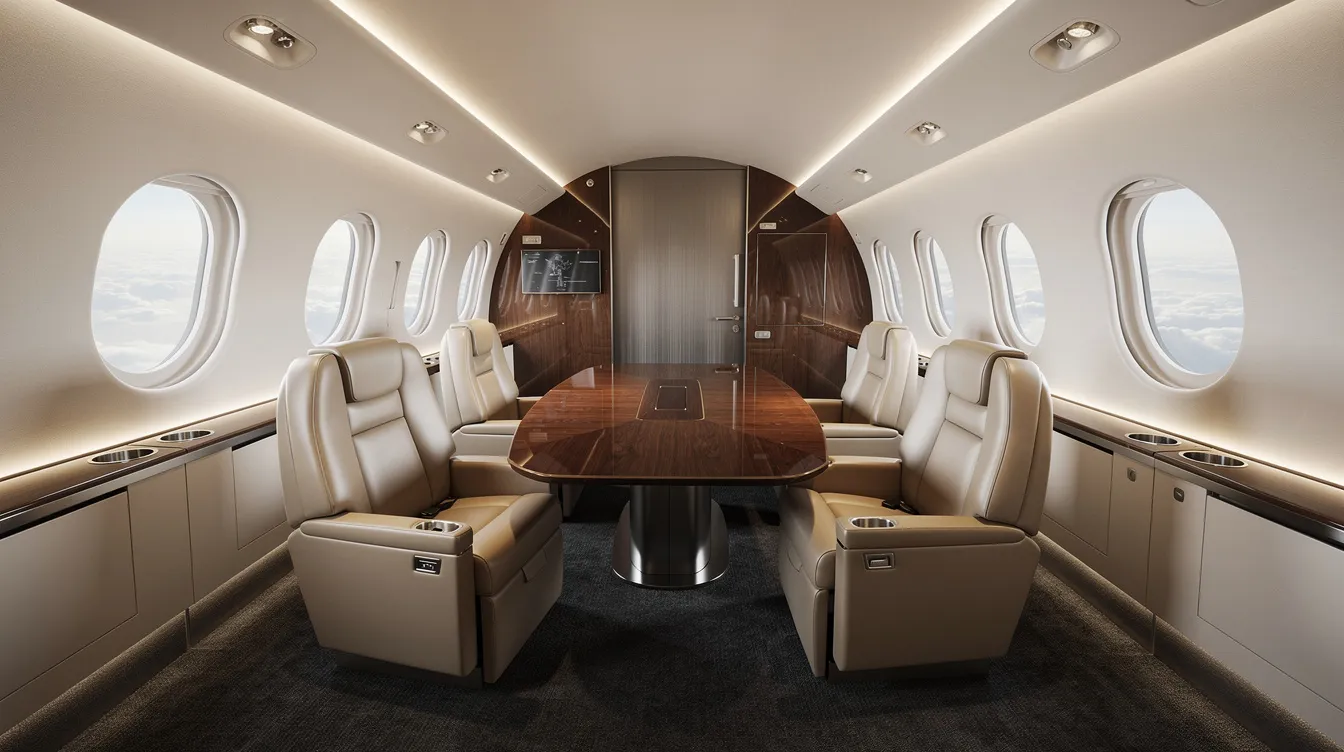
Panoramic windows, multiple living zones, and fully equipped galleys make ultra-long flights productive or restful.
Safety-related technology:
Modern avionics suites (Honeywell Primus Epic, Collins Pro Line Fusion, Garmin G5000) integrate enhanced vision systems, synthetic vision, and advanced autopilot modes into a unified flight deck.
Real-time engine health monitoring transmits aircraft engine data to maintenance teams on the ground, enabling predictive maintenance before issues become airborne problems.
High-speed Ka-Band Wi-Fi, real-time weather datalinks, and satellite communication keep passengers and crews connected.
Why fleet age matters: A legacy Gulfstream IV, while safe and certified, lacks the cabin altitude performance, noise suppression, and avionics integration of a Gulfstream G500 or G700. Jet Card providers that prioritize modern aircraft manufactured in recent years deliver measurably better comfort and lower operating risk.
BlackJet's digital platform surfaces key aircraft details-cabin layout, Wi-Fi availability, year of manufacture, and refurbishment dates-so members align aircraft choice with expectations and understand the broader private jet price spectrum before every booking. For details on what BlackJet Certified means in practice, including fleet age and avionics standards, explore the certification page.
Frequently Asked Questions About Aircraft Types and Private Jet Access
Which aircraft category is best for a family of six on a three-hour flight? A light jet or midsize jet handles this well. The Embraer Phenom 300E seats six comfortably with generous luggage capacity and covers routes up to ~1,800 nm-more than enough for a three-hour mission.
Are older aircraft types less safe than new ones? Older aircraft that remain in compliance with airworthiness directives are legally safe to operate. However, piston engine transports capable of carrying passengers decades ago lacked the redundancy, avionics, and structural margins of modern transport-category jets. Newer aircraft offer measurably better safety margins, lower cabin altitude, and predictive maintenance capabilities.
How do aircraft classifications affect which airports I can use? Runway length, weight limits, and noise restrictions vary by airport. Lighter jets access smaller fields (runways as short as 3,500 feet), while heavy jets and jet engine transports need 5,000+ feet. BlackJet's team matches aircraft to airport suitability automatically.
What is the practical difference between a turboprop and a light jet? Turboprops cruise at 250–320 knots and excel on short runways with lower fuel burn. Light jets cruise at 380–450 knots and offer a pressurized, quieter cabin. For routes over 600 nm, a light jet typically saves 30–60 minutes.
Can I request a specific aircraft type with my BlackJet Jet Card? Yes. Members can express preferences for specific models or cabin configurations. BlackJet's membership team and digital booking tools translate technical aircraft types into simple choices-small cabin for 2–4 passengers, large cabin for overnight intercontinental-and match availability accordingly.
How does BlackJet verify safety certifications across different aircraft categories? Every operator in BlackJet's network holds current Part 135 certification and undergoes independent audits (ARGUS, Wyvern, or IS-BAO). Aircraft must carry valid airworthiness certificates, and crews must hold current type ratings with recurrent simulator training. The safest private jets in BlackJet's network reflect this layered approach.
Conclusion: Turning Aircraft Complexity into Seamless, Strategic Travel
The world of aircraft types, categories, and aviation regulations is vast-from piston engine transports to ultra-long-range jets, from lighter-than-air aircraft drifting above landscapes to fighter aircraft pushing the envelope at Mach 2. Understanding how these classifications work empowers smarter travel decisions, whether you are selecting a cabin class for a transatlantic crossing or evaluating the safety credentials of an operator.
But you should not need a pilot's license to make those decisions. BlackJet exists to distill this complexity into a single, effortless experience. Every Jet Card flight is backed by transport-category certification, type-rated crews, verified operator audits, and carbon-neutral commitment-the three pillars of safety, comfort, and sustainability woven into every journey.
Discover how BlackJet's Jet Card programs give you flexible access to multiple aircraft categories, from light jets for regional hops to ultra-long-range cabins that connect continents nonstop. No ownership burdens, no regulatory puzzles-just the right aircraft, every time.


 Sign up with google
 Sign up with Apple


