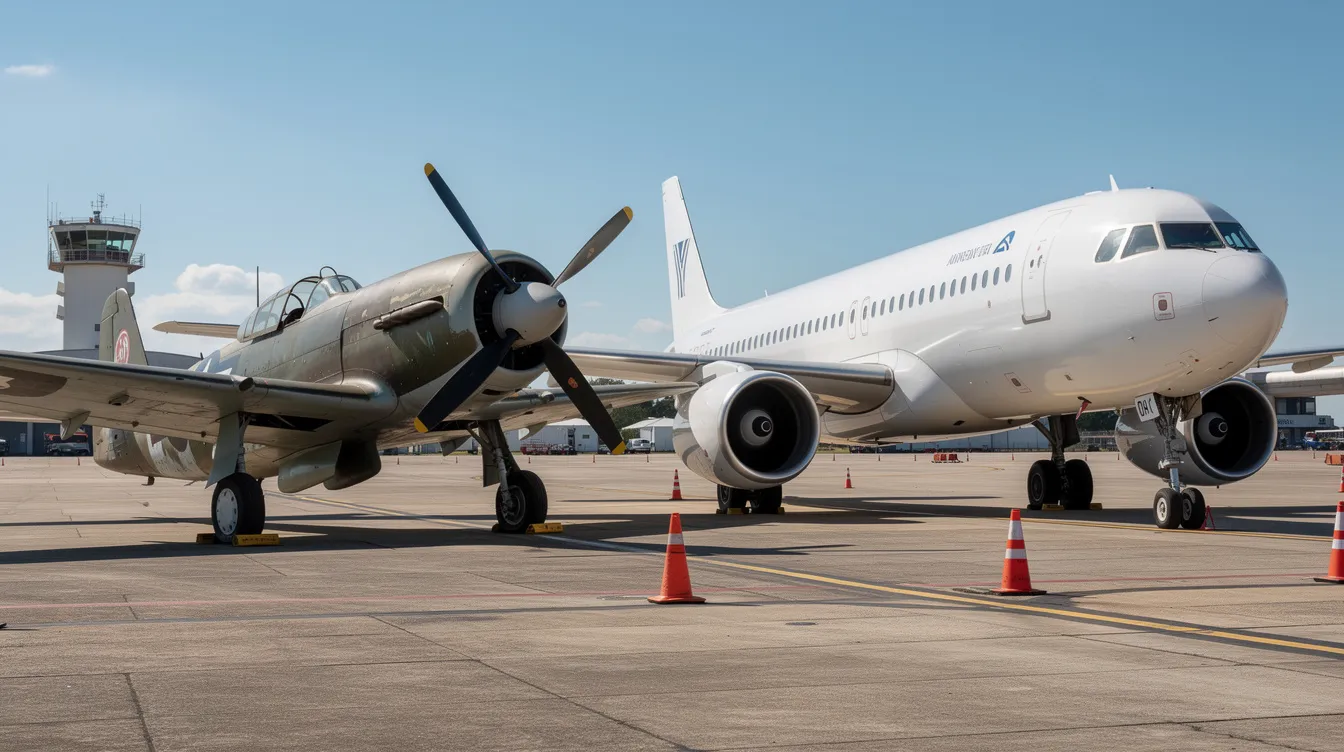
Aircraft engines are the single most consequential technology in aviation. They determine how fast you fly, how high you cruise, how far you can travel nonstop, and how quiet the cabin stays at 41,000 feet. Whether you are boarding a commercial aircraft or stepping onto a private jet, the engines mounted beneath those wings shape every dimension of the journey.
Why Airplane Engines Matter for Modern Private and Commercial Aviation
Airplane engines generate thrust by pushing air backward, and every element of your travel experience follows from how they do it. Engines can be classified based on their design and application, and the differences are anything but academic.
Consider a private flight from New York to Miami: under three hours, direct, landing at a secondary airport minutes from your destination. Commercial aviation often routes you through congested hubs, adding hours. The engine performance behind that private itinerary—how efficiently the aircraft can take off, climb, cruise, and cover range—makes the schedule possible.
Engine type shapes what you feel in the cabin:
Piston engine and turboprop engine aircraft - cruise altitudes of 8,000–30,000 ft, speeds of 120–350 knots, more vibration and cabin noise, ideal for short regional hops.
Turbofan engine aircraft - cruise at 35,000–45,000 ft, Mach 0.80–0.90, dramatically quieter cabins, suited for transcontinental and intercontinental routes.
Turbojet engine designs - fast but fuel-hungry and loud, now largely reserved for military use.
Turboshaft engine platforms - powering helicopters for point-to-point urban transfers.
Jet engines provide higher speeds and altitudes than piston engines, and turbofan engines power most commercial airliners today. BlackJet's Jet Card programs give members access to a curated fleet powered almost entirely by modern turbofan and efficient turboprop aircraft engines, and the BlackJet 25+ Hour Jet Card further refines access with fixed rates on mid, super-mid, and large-cabin jets, each selected for safety, performance, and carbon efficiency.

The Evolution of Aircraft Engines: From Early Pistons to High-Bypass Turbofans
The first aircraft engine was a steam engine used by Henri Giffard in 1852 to power a dirigible. Half a century later, the Wright Brothers flew their first powered aircraft in 1903 with a 12 horsepower engine-a simple gasoline-fed piston design. Piston engines powered early aircraft for roughly 40 years after 1903, reaching their zenith in reliable radial configurations on airliners like the Douglas DC-3 (introduced 1935).
The jet age arrived swiftly. Frank Whittle patented the first turbojet engine in 1930, and turbojet engines were first developed through the 1930s. The first successful turbojet flight was by the Heinkel He 178 in 1939. General Electric built the first American jet engine in 1942. Commercial jet service followed: the de Havilland Comet in 1952 and the Boeing 707 in 1958, transforming commercial aviation overnight.
By the 1960s–1970s, pure turbojets gave way to turbofan designs with increasing bypass ratios-first the Pratt & Whitney JT8D, then high-bypass engines like the GE CF6 (bypass ratio ~5:1). These delivered far better fuel efficiency and met tightening noise regulations.
Recent milestones include the Pratt & Whitney PW1000G geared turbofan, which achieves roughly 16% lower fuel burn and up to 75% less noise compared to its predecessors. Open-rotor propfan research and hybrid-electric propulsion concepts target entry into service between 2035 and 2050. Meanwhile, piston engines and small turboprops remain dominant in flight training, bush flying, and light general aviation.
Core Principles: How an Aircraft Engine Produces Thrust or Shaft Power
Every aircraft engine-from a four-cylinder piston to a massive turbofan-converts chemical energy stored in fuel into mechanical work that can propel aircraft forward. Newton's third law explains the rest: accelerate air backward, and you move the plane forward.
The core difference between piston and jet engines lies in their thrust generation mechanisms:
Piston and turboprop engines produce shaft power that spins a propeller, accelerating a large mass of incoming air at relatively low speed. This yields high propulsive efficiency at lower flight speeds.
Jet engines (turbojet, turbofan) accelerate a smaller mass of air to much higher speed through a nozzle, generating continuous high-speed thrust directly.
Modern jet engines utilize a four-step cycle: intake, compression, combustion, and exhaust. The compressor raises the pressure of compressed air before it enters the combustion chamber, where fuel burns continuously-a key distinction from piston engines, where combustion occurs in discrete strokes. Most turbine engines follow a continuous combustion cycle, producing significant thrust due to continuous combustion at high speed. The main thrust source for jet engines is high-speed exhaust and, in turbofans, a large fan that moves bypass air around the engine core.
Jet engines operate efficiently at high altitudes where thinner air reduces drag. Notably, ramjet engine designs and scramjets have few or no moving parts and compress air using the aircraft's own high speed-though these remain niche propulsion solutions.
Gas turbine engines in BlackJet's preferred aircraft categories are optimized for high-altitude, high-speed cruise, minimizing block time and maximizing comfort for Jet Card members.
Major Aircraft Engine Types: Piston, Turboprop, Turbojet, Turbofan, and Turboshaft
Modern aviation relies on five primary families of aircraft engines. Each form serves distinct missions, aircraft sizes, and operating environments.
Piston engines use reciprocating motion to turn a propeller. An air–fuel mixture is drawn into cylinders, compressed, ignited, and the expanding gases drive pistons that rotate a crankshaft connected to the propeller. Piston engines typically burn aviation gasoline (AVGAS) and are ideal for smaller aircraft and flight training-think Cessna 172 or Cirrus SR22. They are generally more fuel-efficient at lower speeds, though fuel efficiency for piston engines decreases at high altitudes compared to jets. Every pilot who has logged early hours knows the sound of a horizontally opposed four-cylinder on the ground and in the air.
Turboprop engines pair a gas turbine core acting as a gas generator with a reduction gearbox driving a propeller. Models like the Pratt & Whitney PT6 are the backbone of turboprop private aircraft. Turboprop engines are efficient at speeds below 500 mph and typically operate between 250 and 400 knots at 20,000–30,000 ft-more fuel-efficient at lower speeds compared to turbofans.
Turbojet engines route all the air through the engine core. The compressor raises pressure to 3 to 12 times its original level before combustion, and thrust comes primarily from exhaust gases exiting the rear nozzle. Capable of high speeds, turbojets suffer from poor fuel consumption and high noise. They are now mostly equipped on military jets and certain older business aircraft.
Turbofan engines dominate commercial aircraft and many long-range business jets. A large fan sends most incoming air through a bypass duct around the hot core, producing thrust with lower noise and far better efficiency. Jet engines use Jet A or Jet A-1 kerosene as fuel, and typical cruising speeds for jet engines range from 450 to 600+ mph. Turbofans are the most common engine type in commercial aviation, powering everything from the Airbus A320neo to ultra-long-range Gulfstream platforms. Their advantages in fuel burn and noise make them the power component of choice for larger aircraft.
Turboshaft engines share a similar core with turboprops but are optimized to power helicopter rotors and modulate power through a gearbox rather than driving a fixed propeller. Safran Arriel engines on H125 helicopters, for example, enable high-altitude operation, making them essential across VIP and charter rotorcraft. Turboshaft designs are what allow helicopters to hover, achieve vertical lift, and operate in confined space.

Inside a Jet Engine: Components, Combustion Chamber, and Thrust Production
Jet engines power nearly every commercial airliner and large-cabin private jet flying today. Understanding how they work is a front-to-rear tour through precision engineering.
Fan. The large front fan pulls in air and directs most of it around the core through a bypass duct. On the GE9X, just 16 composite blades handle this role-down from 22 on its predecessor-while the bypass ratio reaches approximately 10:1.
Compressor. Multiple stages-including a low pressure compressor and high-pressure compressor-progressively squeeze incoming air. The GE9X achieves an overall pressure ratio near 60:1. Jet engines compress air to increase pressure before combustion, which is critical to maximizing turbine efficiency.
Combustion chamber. Atomized fuel mixes with compressed air and burns continuously. Combustion in jet engines can reach temperatures of 2,700°F, producing hot expanding gases that rush rearward. Hot air and exhaust gases carry immense energy.
Turbine. The turbine in a jet engine drives the compressor and fan via concentric shafts. Turbine blades operate near or above the melting point of conventional metals, demanding single-crystal nickel superalloys, ceramic matrix composites, and advanced thermal barrier coatings-a combination of material science and aerodynamic design.
Exhaust nozzle. Jet engines produce thrust by expelling hot gases through a nozzle at the rear of the engine. The total thrust is a combination of this hot core exhaust and the cooler, high-volume bypass stream.
BlackJet's partner operators rely on these modern turbofan engines, certified under FAA and EASA standards, to deliver quiet cabins and efficient long-range performance for every Jet Card flight.
Engine Selection by Mission: Regional Turboprops vs Long-Range Jet Engines
The engine beneath the wing dictates which airports you can reach, how fast you arrive, and how the cabin feels en route. For travelers who value time and flexibility, engine selection is strategy, just as understanding a comprehensive private jet price list is key to aligning aircraft capabilities with budget.
Turboprop missions. Turboprop engines excel in short runway operations-sectors of 200–600 nautical miles into airfields as short as 3,000 feet. Aircraft like the King Air 350 or ATR 72 serve routes where larger turbofan-powered jets simply cannot operate. They are more fuel-efficient per seat on shorter legs, though cabin noise and vibration are more noticeable, which is why many cost-conscious travelers look at the cheapest private aircraft options or analyze the most affordable private jets and turboprops when pairing engine type with budget.
Turbofan missions. Jet engines are preferred for long-haul flights spanning 600 to 7,000+ nautical miles. Jet engines can reach higher altitudes than turboprops, cruising at Mach 0.80–0.90 with lower cabin noise. Jet engines are suited for carrying heavy loads over long distances due to their superior power-to-weight ratio-essential for nonstop transatlantic or transcontinental operation and for large-cabin jets seating around 20 passengers, specialized aircraft for 30-passenger groups, or even VIP-configured airliners for up to 50 travelers.
How BlackJet matches engine to mission. A 25-hour Jet Card member flying frequently between London and Geneva might use a light jet or turboprop private plane, while a New York–London executive itinerary calls for a large-cabin turbofan-equipped jet. Evaluating jet card cost per hour, using a broad guide to jet card cost, and understanding detailed jet card pricing structures helps align engine choice, aircraft size, and budget. Right-sizing the aircraft reduces both cost and fuel consumption per passenger.
Performance trade-offs are real: turboprops deliver better fuel burn per seat on short hops; turbofans deliver time savings, smoother ride, and cabin comfort on longer sectors. The operation of choosing correctly is what separates an adequate trip from a seamless one, especially when comparing a 100 hour jet card cost structure with a mid-range 50 hour jet card program and matching them to your typical mission profile.

Safety, Reliability, and Maintenance Economics of Aircraft Engines
Safety and reliability-not raw power-are the primary design goals of every certified aircraft engine. For private aviation travelers, this unseen layer of engineering is arguably the most important.
Modern turbofan engines regularly achieve in-flight shutdown rates of less than one per 100,000 engine flight hours. The GE CF34, used on regional jets, has logged over two million engine flight hours with dispatch reliability of 99.99%. Jet engines are more reliable than piston engines, with failure rates significantly lower-piston engines have a higher failure rate reported at one per 3,200 flight hours. ETOPS regulations for twin-engine commercial aircraft require proven reliability for diversions up to 180 minutes from an alternate airport.
Major manufacturers like GE, Rolls-Royce, Pratt & Whitney, and Safran design engines for 20–30-year service lives. Periodic shop visits cover hot-section overhauls, turbine blade inspections, and life-limited part tracking by cycles and hours. Private plane maintenance programs mirror these rigorous standards.
BlackJet's partner operators adhere to manufacturer-required maintenance schedules and undergo third-party safety auditing through programs like ARGUS, Wyvern, and IS-BAO. Engine health monitoring, vibration analysis, and predictive maintenance via real-time data uplinks ensure that every Jet Card flight departs with the highest confidence in reliable, safe operation, while thoughtful planning around jet card tax deductions can further optimize the economics of frequent private flying.
Sustainability and the Future of Aircraft Engines in Private Aviation
Aviation contributes roughly 2–3% of global CO₂ emissions, and aircraft engines sit at the center of every credible reduction strategy. New turbofan engines deliver progressive fuel efficiency improvements of about 1–2% per year through higher bypass ratios, improved compressor stages, and lighter materials.
Sustainable aviation fuel (SAF) offers a near-term lever: responsibly sourced SAF can cut lifecycle CO₂ emissions by up to 80% compared with conventional jet fuel, and modern turbofan engines are already certified to fly on approved SAF blends without modification. Geared turbofans, hybrid-electric research, and hydrogen propulsion programs in Europe and the US target 2035–2050 service entry.
BlackJet's approach to sustainability is direct: every flight is carbon neutral via verified offsets or insets, at no extra cost to Jet Card members. The fleet favors operators using newer, more efficient aircraft engines to reduce emissions per passenger.
High-net-worth travelers can further reduce their footprint by choosing right-sized aircraft, consolidating itineraries, and favoring modern turbofan or efficient turboprop engines. They can also compare the best jet cards for frequent flyers, review NetJets jet card costs, or even opt to buy a seat on a private jet instead of chartering the whole aircraft, while enthusiasts of ultra-long-range performance may gravitate toward the top private jets in the world. The future of private aviation is not a choice between luxury and responsibility-it is both, powered by the most advanced engines ever built.
Frequently Asked Questions About Airplane Engines
Q: What are the main differences between piston engines and jet engines?
A: Piston engines use reciprocating motion to turn a propeller and are generally more fuel-efficient at lower speeds and altitudes. Jet engines, including turbojets and turbofans, produce thrust by expelling high-speed exhaust gases and operate efficiently at higher altitudes and speeds, making them ideal for long-range and high-speed flights.
Q: Why do turbofan engines dominate commercial and private jet aviation?
A: Turbofan engines offer a balance of high thrust, fuel efficiency, and reduced noise by bypassing a large volume of cool air around the engine core. This design improves fuel economy and cabin comfort, which is why most modern airliners and large private jets use turbofan engines.
Q: How do turboprop engines differ from turbofan engines in performance?
A: Turboprops combine a gas turbine engine with a propeller, excelling at lower speeds (typically below 500 mph) and shorter regional flights. They are more fuel-efficient on short routes and can operate from shorter runways, whereas turbofan engines provide higher speeds and are suited for long-haul flights.
Q: What safety measures ensure the reliability of modern aircraft engines?
A: Modern aircraft engines undergo rigorous testing, certification, and maintenance protocols. They feature advanced materials and real-time health monitoring. Private aviation operators like BlackJet adhere to strict safety audits and manufacturer maintenance schedules, ensuring exceptional reliability and low in-flight shutdown rates.
Q: How does BlackJet incorporate sustainability into its aircraft engine selection?
A: BlackJet prioritizes aircraft powered by newer, fuel-efficient turbofan and turboprop engines certified to use sustainable aviation fuel (SAF). Every flight is carbon neutral through verified offsets, aligning luxury travel with environmental responsibility.
Q: Can jet engines use sustainable aviation fuel without modifications?
A: Yes, modern turbofan engines are certified to operate on approved blends of sustainable aviation fuel (SAF) without requiring engine modifications, allowing for a significant reduction in lifecycle carbon emissions.
Q: What is the typical cruising speed range for jet engines?
A: Jet engines typically cruise between 450 and 600+ miles per hour, enabling fast, efficient travel over long distances compared to piston or turboprop-powered aircraft.
Conclusion: The Engine Behind Exceptional Private Aviation
Airplane engines are far more than mechanical components; they are the strategic heart of every flight, defining speed, range, comfort, and sustainability. For discerning travelers and executives, understanding the distinctions between piston, turboprop, turbojet, turbofan, and turboshaft engines unlocks the ability to tailor private aviation experiences precisely to mission needs.
BlackJet’s commitment to safety, efficiency, and environmental responsibility is reflected in its careful selection of aircraft powered by state-of-the-art turbofan and turboprop engines. This ensures that every journey not only saves time and elevates comfort but also aligns with modern sustainability goals through carbon-neutral operations.
Choosing the right engine—and by extension, the right aircraft and Jet Card program—is a critical decision that transforms travel from a routine necessity into a seamless, premier experience. Discover how BlackJet’s expert curation and innovative technology can reshape your travel, offering effortless access to the pinnacle of private jet performance and service.


 Sign up with google
 Sign up with Apple