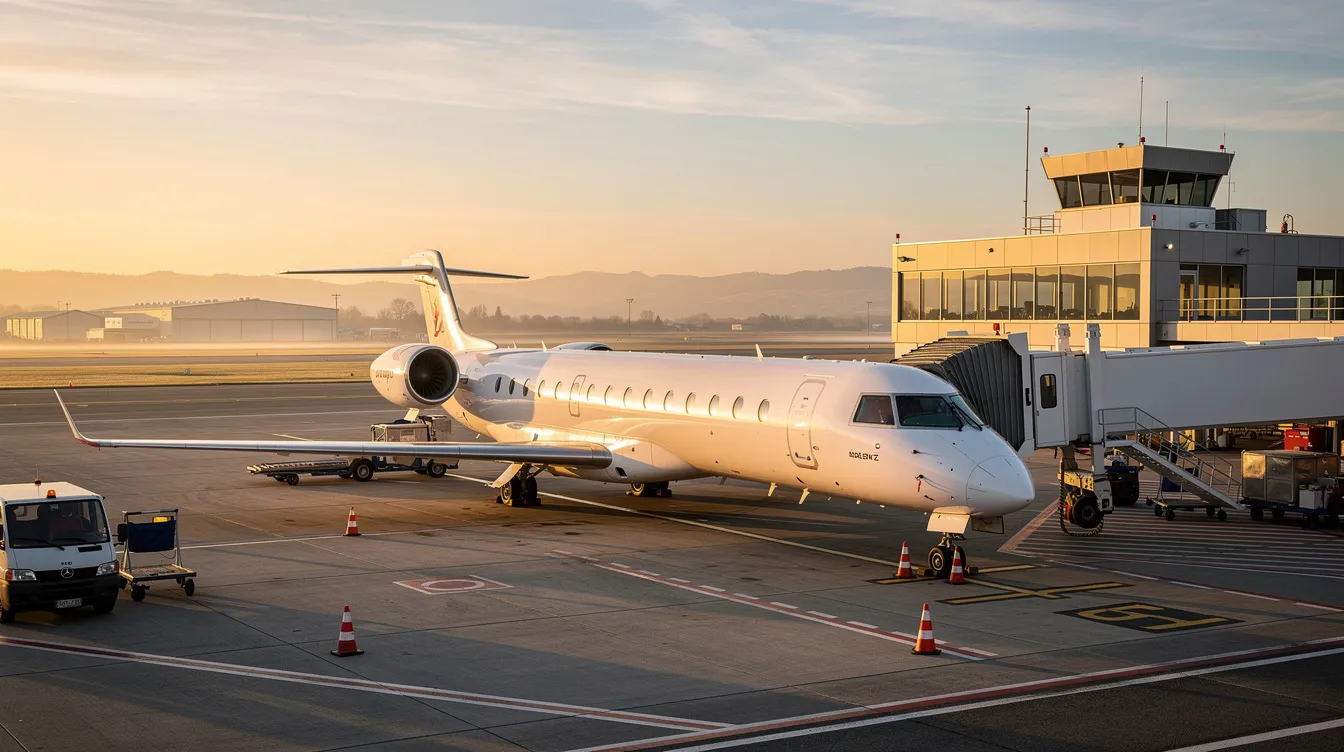
The Embraer 175 long-wing twin jet is a regional twin-engine airliner with a long-wing design and 2+2 seating that has become the backbone of U.S. regional aviation. It connects smaller cities to major hubs millions of times each year, and its cabin feels closer to a mainline airplane than earlier regional jets.
For frequent business flyers and high-net-worth leisure travelers who value flexibility, privacy, safety, and comfort, the E175 is a useful benchmark when comparing commercial regional travel with private aviation. This article looks at the aircraft’s design, performance, cabin comfort, operating role, safety record, and why it dominates the U.S. market, then contrasts the commercial E175 experience with private jet alternatives such as BlackJet’s Jet Card programs. Understanding that tradeoff matters because while the E175 sets the standard for efficient regional service, commercial flights on it still come with schedule, airport, and privacy compromises that private aviation can remove.
Strategic Advantage: Why the Embraer 175 Matters to Premium and Private Travelers
The Embraer 175 occupies a rare position in commercial aviation: it bridges the gap between larger jets operating transcontinental routes and the smallest aircraft serving thin regional markets. Its long wing design, twin-engine reliability, and 2+2 cabin layout give it a feel that surprises passengers who expect a cramped regional experience. For executives and frequent flyers, it is often the plane they encounter most on hub-to-spoke routes-and the one that shapes their expectations of what air travel should deliver.
Yet even at its best, commercial service on the E175 comes with the usual friction: security lines, boarding delays, connections at congested major hubs, and schedules dictated by airline timetables rather than personal needs. A business traveler flying a Delta Connection E175 from a secondary city into Atlanta, or a United Express flight into Chicago O'Hare, can easily spend four hours door-to-door on what is a 90-minute flight. That gap between flight time and total travel time is precisely where private aviation creates strategic advantage.
From E-Jet Concept to Embraer 175: Development and E-Jet Family Origins
Embraer launched the E-Jet family in the early 2000s to replace aging 50-seat regional jets and turboprops with more capable, comfortable aircraft. The program was designed from the start around commonality: shared avionics, cockpit philosophy, and maintenance requirements across models.
The family tree splits into two size categories. The E170 and E175 serve the 70–88 seat segment, while the E190 and E195 are stretched members targeting 100–124 seats. All four share the same wing architecture philosophy and flight deck design.
The E175 is a stretched version of the E170, extended by 1.78 meters to accommodate more passengers while retaining the same wing and systems baseline.
Key milestones: the E170 completed its first flight in 2002. The E175 prototype first flew on 14 June 2003. FAA type certification for the E175 was granted on 31 August 2005, and the aircraft entered commercial service in July 2005 with Air Canada, making it one of the fastest regional jet programs from concept to revenue flights.
The design intent was clear: deliver mainline comfort through a wide 2+2 cabin with no middle seats, while giving regional carriers the economics they needed to replace less efficient 50-seat jets. That combination of passenger experience and operating cost made the E175 an immediate success.
E-Jets Second Generation: How the E2 Program Evolved from the Original E175
Embraer announced its second-generation E-Jet E2 program in 2011, aiming to deliver step-change improvements in fuel efficiency, noise, and maintenance costs while preserving the cabin experience passengers had come to expect.
The E2 program introduced a completely redesigned, higher-aspect-ratio, larger wing, advanced avionics with full fly-by-wire controls, and new Pratt & Whitney PW1000G geared turbofan engines selected in 2013-replacing the GE CF34 family used on first-generation E-Jets.
The E190-E2 earned its type certificates from both FAA and EASA in February 2018 and entered service later that year. The E195-E2 followed in 2019, seating approximately 120–146 passengers depending on configuration.
The E175-E2, with its long wing redesign and new powerplant, promised significant improvements in fuel burn and range. However, its higher maximum takeoff weight exceeds the limits imposed by scope clause restrictions in U.S. pilot contracts, effectively blocking adoption by the airlines that buy the most E175s.
As of early 2025, Embraer formally paused E175-E2 development for an additional four years, citing that scope clauses are unlikely to change before approximately 2027. In the meantime, Embraer continues delivering and improving the first-generation E175, including enhanced winglet and long wing variants.
Design Overview: Long Wing, Twin Jet Layout and Core Aircraft Features
The E175 is a low-wing, long-wing twin jet with two underwing General Electric CF34-8E engines and a conventional tail arrangement. Its double-bubble fuselage cross-section creates a cabin width of 9 ft 0 in and cabin height of 6 ft 7 in-generous dimensions for the regional jet category.
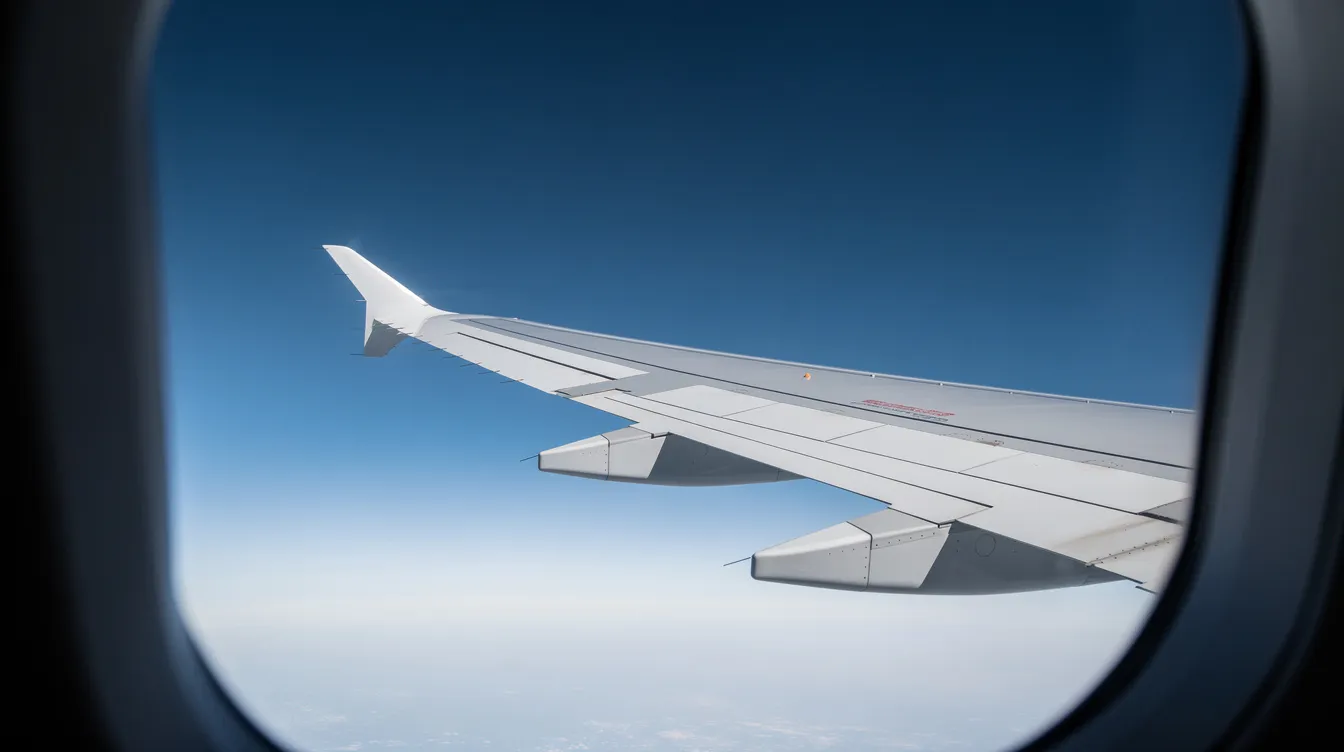
The "long wing" improvements introduced from approximately 2014 onward include extended wingtip fences and enhanced winglets. These changes increase the total wingspan of the extended long-wing design to 28.65 meters (roughly 94 ft), up from the original 85 ft 4 in standard configuration.
The extended wing design enhances fuel efficiency during cruise flight, with the average fuel efficiency of the E175 improving by 5% to 6% due to its extended winglets. The improved aerodynamic efficiency reduces fuel burn and improves climb performance, particularly in hot-and-high airport environments.
The single-aisle cabin uses a 2+2 seating layout with no middle seats-a defining aircraft feature that differentiates the E175 from narrower competitors. Every passenger gets either a window or aisle seat.
The E175 employs a fly-by-wire flight control system and is certified by both FAA and EASA, meeting the same airworthiness standards as larger mainline aircraft.
In typical seating configurations, the aircraft carries 76 passengers in a dual-class layout or up to 88 passengers in high-density single-class arrangements. Maximum speed reaches Mach 0.82, with a service ceiling of 41,000 feet.
Technical Specifications: Engines, Weights and Performance
Specification | Detail |
|---|
Aircraft Type | Regional twin-engine jet |
Seating Layout | 2+2, no middle seats |
Typical Seating Capacity | 76 passengers (dual-class) |
Maximum Seating Capacity | 88 passengers (single-class) |
Cabin Width | 9 ft 0 in |
Cabin Height | 6 ft 7 in |
Length | Approximately 98 ft 1 in |
Wingspan (Long Wing) | 28.65 meters (94 ft) |
Engines | 2 x General Electric CF34-8E turbofans |
Maximum Takeoff Weight (MTOW) | 89,000 lb (40,400 kg) |
Maximum Landing Weight | About 75,000 lb (34,000 kg) |
Maximum Weight | Varies by variant, includes MTOW and ramp weight |
Range | Approximately 2,200 nautical miles |
Cruising Speed | Mach 0.75 (875 km/h) |
Service Ceiling | 41,000 feet |
Safety Certification | FAA and EASA certified |
Flight Control System | Fly-by-wire with envelope protection |
Fuel Efficiency | Improved by 5-6% with extended winglets |
Market Share | Approximately 80% in the U.S. regional jet market |
Primary Operators | SkyWest, Republic Airways, Envoy Air, Horizon Air |
Typical Routes | 300 to 1,000 nautical miles |
Scope Clause Compliance | Designed to meet U.S. pilot union limits |
Cabin Amenities | Wi-Fi, power outlets, streaming entertainment (varies by airline) |
Embraer developed the E175LR variant for longer ranges, and the AR (advanced range) variant pushes MTOW higher for extended mission capability. The STD (standard) base model serves shorter routes. Airlines choose between these production aircraft variants based on route length, airport infrastructure, and contractual requirements.
Cabin and Seating Experience: From Regional Jet Layout to VIP Charter Alternatives
The E175's cabin is where it consistently defies expectations for a regional jet. The 2+2 seating layout eliminates middle seats, and the double-bubble fuselage provides mainline comfort in a smaller airframe, even if it cannot match the bespoke privacy and service of BlackJet's premium private jet card programs.
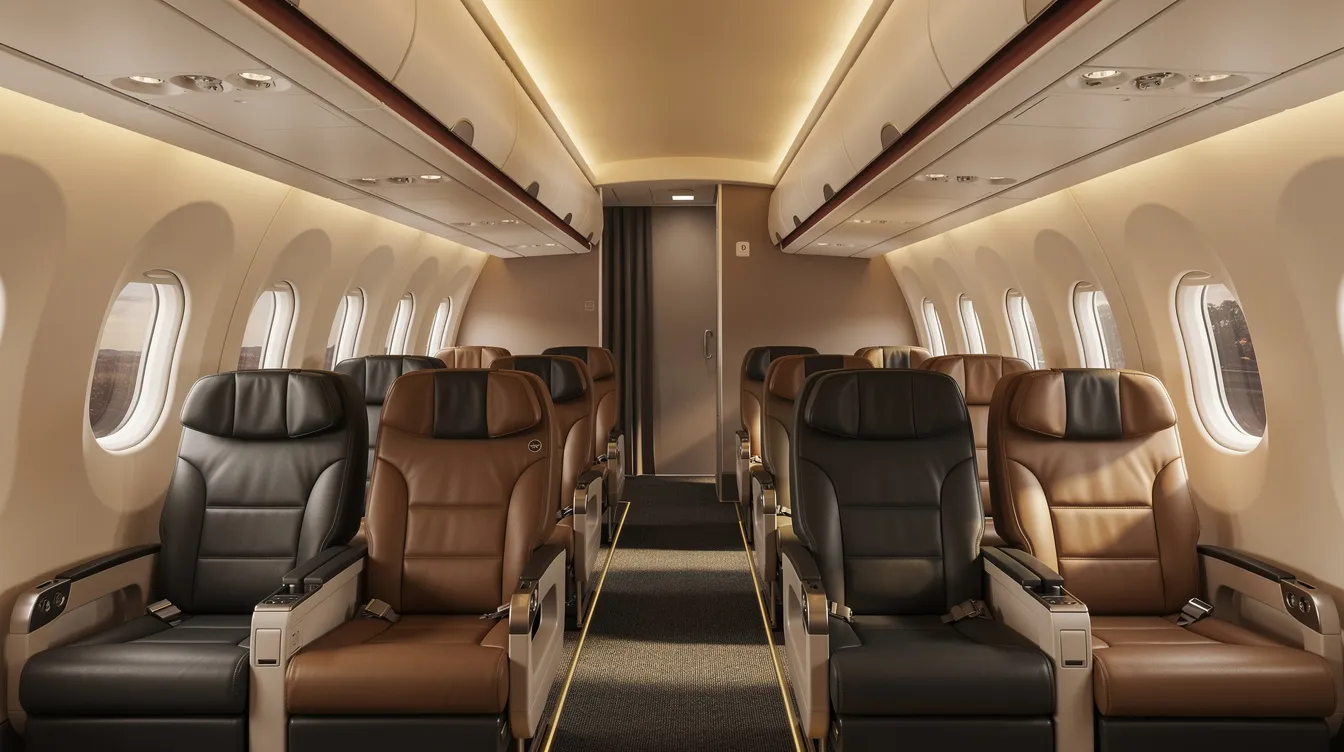
The typical 76-seat dual-class configuration places 12 first-class seats at the front with 1–2 extra inches of pitch, followed by extra-legroom rows and standard main cabin seating. The maximum seating capacity of the E175 is 88 passengers in a single-class arrangement.
Seat width averages around 18.5 inches in economy, with premium rows offering slightly more. Overhead bins are sized closer to mainline narrowbody standards, and the tall 6 ft 7 in sidewalls create a spacious feel unusual for the regional jet category.
On carriers like Delta Connection and American Airlines, E175s commonly offer Wi-Fi, power outlets in first class and extra-legroom sections, and streaming entertainment to personal devices. Some aircraft feature seatback screens in premium cabins.
A typical seat map reads front to back: first class cabin with 3 rows of 1-1 or 2-2 seating, then 2–3 rows of extra-legroom economy, followed by standard economy rows to row 20 or beyond. Galleys are positioned fore and aft, with lavatories at both ends of the cabin.
The passenger service experience on a well-configured E175 is genuinely comfortable for flights under two hours. But it remains commercial service: shared cabin, fixed departure windows, standard airport processing.
Contrast that with a midsize business jet available through BlackJet's Jet Card fleet options: full-cabin privacy, bespoke catering selected by the traveler, dedicated baggage space with no size restrictions, flexible seating arrangements for work sessions or family travel, and departure from private terminals that eliminate security lines—benefits that depend on choosing from the right types of private jets for each traveler.
Operational History: Airlines, Routes and Global Footprint
The E175 entered commercial service in July 2005 with Air Canada, which operated 25 E175s by July 2020. The type was rapidly adopted across North American regional networks.
By the mid-2020s, major operators include SkyWest Airlines, Republic Airways, Envoy Air, and Horizon Air. These regional carriers fly under brands such as American Eagle, Delta Connection, United Express, and Alaska Airlines, connecting smaller cities to hub airports across the continent.
Typical route lengths range from 300 to 1,000 nm. Mission profiles include high-frequency shuttle services between hubs and secondary cities, business-focused morning and evening banks, and point-to-point routes where demand doesn't justify larger jets.
The global footprint extends beyond North America. LOT Polish Airlines, other operators in Europe, and airlines in Asia and Africa deploy E-Jets for domestic and regional services, though the concentration remains heaviest in the U.S. market.
Daily utilization patterns are demanding: E175s commonly fly 4–6 legs per day, underscoring the type's robustness, low maintenance requirements, and dispatch reliability. This operational history spans millions of flights since entering service.
Scope Clauses and U.S. Market Dominance
Scope clauses are provisions embedded in pilot labor contracts at major U.S. airlines. They define which aircraft can be operated by regional partners-and they have shaped the entire regional jet market for two decades.
Current scope clause limits typically cap regional partner aircraft at 76 seats and roughly 86,000 lb maximum takeoff weight. These scope clauses determine what regional carriers can fly under brands like American Eagle, Delta Connection, and United Express.
The E175 was designed to meet U.S. airline pilot union scope clauses, sitting just under these thresholds in its LR configuration. That deliberate engineering choice fueled massive orders from every major U.S. network.
The result: the E175 is considered a dominant player in the regional jet market in the United States, holding approximately 80% market share in the U.S. regional jet segment. It is the only aircraft produced in its market segment as of 2024.
The newer E175-E2 variant is restricted by U.S. scope clauses from replacing the original E175. Its higher empty weight and MTOW exceed current contract limits even when configured to 76 seats. This keeps the first-generation E175 in production far longer than Embraer originally planned-and has led to the E175-E2 development pause through at least 2027.
For Delta Air Lines, United Airlines, and American Airlines, the scope clause dynamic means their regional flying will continue on the same wing platform for years to come. For travelers, that means the E175 experience is the regional jet experience for the foreseeable future.
Safety Record, Incidents and Hull Losses
The E-Jet family has accumulated an exceptional safety record since the early 2000s. The E175 has accumulated millions of flight hours since 2005 across hundreds of aircraft operated worldwide-a scale of operational history that provides strong statistical confidence.
The E175 has zero fatal accidents in scheduled airline passenger service. The E175 has also recorded zero hull losses. These figures place it among the safest passenger planes in commercial aviation.
Across the broader E-Jet family, a small number of incidents have occurred-primarily runway excursions or weather-related events-but none have resulted in passenger fatalities on E175 airframes. Where incidents occurred on other E-Jet variants, they led to procedural or training improvements that benefited the entire fleet.
The flight crew environment contributes to this record: the advanced avionics suite, standardized flight deck across E-Jet models, and comprehensive simulator training programs reduce human-factor risk. No probable cause findings have pointed to fundamental design deficiencies.
At BlackJet, this standard of safety informs our own approach. Our fleet operates under rigorous safety certification standards, including ARGUS Platinum ratings and Part 135 compliance, ensuring that the safety bar for private aviation matches or exceeds what commercial passengers experience on aircraft like the E175.
Comparisons: Embraer 175 vs Other Regional Jets and Small Mainline Aircraft
The E175 competes with the Bombardier CRJ900, historically its closest rival. The E175's wider double-bubble fuselage and 2+2 layout provide noticeably more passenger comfort than the CRJ's narrower cabin. Airlines have increasingly favored the E175 for its lower per-seat operating costs and passenger preference scores, contributing to its market dominance.
The E175's main competitor at the boundary is the Airbus A220-100, which offers more seats (up to 135), greater range, and advanced fuel efficiency from its PW1500G engines. However, the A220 typically exceeds scope clause limits in both weight and capacity, placing it in a small-mainline category rather than the regional jet category-a distinction that matters enormously in U.S. airline contracts.
Within the E-Jet family, the E190 and E195 serve slightly different markets: 100–124 seats on longer routes, often operated as mainline aircraft rather than under regional contracts. Their E2 variants extend those capabilities further.
For the discerning traveler, comparing E175 first class to chartering a private jet via BlackJet reveals stark contrasts: a 12-seat first class cabin versus an entire aircraft dedicated to your party; airline scheduling versus departure on your timetable; commercial terminals versus private FBOs; and a united economy of shared space versus tailored privacy. For business groups of four or more, the cost-per-seat gap narrows considerably.
From Commercial Regional Jet to Business Aviation: Lineage 1000 and Private Use Cases
Embraer's expertise in regional jets directly informed its entry into business aviation, most notably through the Lineage 1000 and other large-cabin aircraft comparable to top 16-seat private jet options for group travel.
The Embraer Lineage 1000 is a business jet derivative of the E190, certified by the FAA in January 2009. It accommodates up to 19 passengers in VIP configuration with a range of approximately 4,200 nm-nearly double that of the commercial E175-and sits in the same category as the best private jet options for 20 passengers used for high-end group travel.
Engine options on the Lineage 1000 include the GE CF34-10E6 or the more powerful CF34-10E7-B, paralleling the commercial E-Jet platform while enabling long-range executive missions. The aircraft demonstrates how production aircraft platforms can be adapted for private use.
Commercial platforms like the E190/E195 and their derivatives have informed cabin ergonomics, noise control, and systems integration seen in modern business jets across the industry. The same wing philosophy and fuselage engineering that make the E175 quiet and comfortable at altitude translate into the refined experience expected in private aviation, including VIP airliners and private jets configured for around 50 passengers.
This lineage bridges from "regional jet comfort" to "true private jet luxury." At BlackJet, we curate aircraft across cabin classes-from light jets for short hops to large-cabin jets for transcontinental travel-that deliver comparable or superior comfort on a far more personalized scale, helping clients navigate private jet sizes and cabin categories to match each mission.
Seat Maps and Onboard Experience with Major U.S. Carriers
A typical Embraer 175 seat map used by Delta Connection or American Eagle features 12 first class seats (rows 1–3 in a 1-2 or 2-2 arrangement), followed by 3–4 rows of extra-legroom economy branded as "Comfort+" or "Main Cabin Extra," and standard economy to row 20 or 21, totaling approximately 76 seats-a very different proposition from buying a single seat on a private jet, where cabin layouts and service are tailored around far smaller passenger counts.
Emergency exits are positioned with two forward doors and two over-wing or aft exits. One forward galley and one rear galley service the cabin, with lavatories typically located forward of the first class cabin and at the rear of the main cabin.
Common amenities include Wi-Fi availability on most domestic flights, power outlets in first class and extra-legroom rows, and streaming entertainment to personal devices via airline apps. Some carriers offer complimentary snacks and beverages throughout the cabin, but they still follow regular airline schedules and processes rather than the bespoke timing typical of charter flights and private services.
The 2+2 seating layout means every seat is either a window or an aisle-a major advantage over larger narrowbodies where middle seats are an unavoidable reality. This makes the E175 a genuine favorite among frequent flyers who select it on their seat map when given the choice, even as some travelers explore the cheapest private jet options to escape the constraints of commercial cabins altogether.
Consider a business traveler commuting weekly between Cincinnati and LaGuardia on an American Eagle E175. The flights are comfortable enough. But the airport arrives 90 minutes early, the connection risk through a crowded hub, and the taxi lines on both ends add up to nearly five hours each way. That same traveler, graduating to a BlackJet Jet Card, departs from a nearby private terminal in 15 minutes, flies direct, and cuts the total trip to under three hours.
Production, Orders and Emerging Markets Including India
The E-Jet family's commercial success is substantial: over 1,800 E-Jets have been delivered worldwide, with the E175 being the majority. The E175 alone has surpassed 1,000 deliveries since its launch, making it one of the best-selling regional jets in aviation history.
Major operators by fleet size include SkyWest Airlines (the largest E175 operator globally), Republic Airways, and Envoy Air. These carriers fly under contract for Alaska Airlines, American Airlines, Delta Air Lines, and United Airlines, collectively operating hundreds of E175s daily across North America.
Embraer is pushing into emerging markets. In 2025 and 2026, memoranda of understanding were signed with India's Adani Group to establish an E-175 final assembly line, supporting production of 70–146-passenger aircraft for domestic Indian demand and export markets.
This India production initiative aligns with the country's regional connectivity goals and indigenous manufacturing ambitions. For a nation with rapidly growing domestic air travel and hundreds of underserved regional airports, the E175's ability to operate from shorter runways with efficient economics makes it a natural fit.
How BlackJet Fits In: From Regional Jet Frequent Flyer to Jet Card Member
BlackJet exists for the traveler who has outgrown the compromises of commercial aviation-even when that commercial experience is delivered on a well-configured aircraft like the E175.
Our Jet Card programs, available in 25-hour and 50-hour options, provide prepaid access to private jets across multiple cabin classes. Whether a light jet for a 300 nm hop or a large-cabin aircraft for a coast-to-coast meeting, the right airplane is matched to the mission, with pricing structured similarly to other jet card cost and membership models.
Safety is foundational, not aspirational. BlackJet operates under Wyvern Wingman and ARGUS-rated standards, with every flight crew vetted and every aircraft maintained to the highest benchmarks. These are the same principles that make the E175's commercial safety record exceptional-applied to private aviation with even greater specificity and aligned with what discerning flyers look for when comparing top private jet companies and operators.
Every BlackJet flight is carbon neutral at no additional cost to members. While the E175's long wing design improves fuel efficiency relative to older regional jets, private aviation through BlackJet goes further by offsetting every gram of carbon produced and providing transparency similar to a detailed private jet price list and cost breakdown.
A practical example: an executive who previously flew weekly on a Delta Connection E175 between Nashville and Detroit-roughly 480 nm-spent nearly nine hours per round trip, accounting for airport processing, connections, and ground transport. Switching to a BlackJet Jet Card, she now departs from a private FBO 10 minutes from her office, flies direct in under two hours, and gains back a full business day each week, while understanding her jet card cost per hour and value with far greater predictability. That is not a luxury. It is a strategic advantage.
Frequently Asked Questions About the Embraer 175 and Private Travel Alternatives
What kind of plane is the Embraer 175? The E175 is a regional jet-a twin-engine, single-aisle aircraft designed for short-to-medium-haul operations. It typically seats 76 to 88 passengers in various configurations and is suitable for regional and short-to-medium-haul operations connecting smaller cities to major hubs, making it distinct from bespoke charter flight arrangements in private aviation.
Is the Embraer 175 a good plane in terms of comfort and safety? Yes. The 2+2 seating layout eliminates middle seats, and the cabin width of 9 ft and height of 6 ft 7 in make it feel closer to a mainline jet than a regional one. Its safety record is exceptional: zero fatal accidents and zero hull losses across millions of flights since 2005.
How fast and how far can the Embraer 175 fly? The E175 cruises at approximately Mach 0.75 (around 875 km/h) with a maximum speed of Mach 0.82. Its range is approximately 2,200 nautical miles, and it can reach a service ceiling of 41,000 feet-comparable to many larger jets and several categories discussed in guides to different types and sizes of private jets.
How does an Embraer 175 experience compare to a private jet charter with BlackJet? The E175 delivers solid comfort for a commercial aircraft, but the experience remains shared: fixed schedules, commercial terminals, security processing, and connection risk. A BlackJet Jet Card provides private terminal access, departure on your schedule, full-cabin privacy, bespoke catering, and significantly reduced door-to-door travel time-typically saving 1.5 to 2.5 hours per trip on regional routes-while offering many of the same advantages outlined in reviews of the best jet cards for frequent flyers.
What is a Jet Card and how does it differ from buying individual charter flights? A Jet Card is a prepaid block of flight hours-typically 25 or 50 hours-that guarantees availability, locked-in pricing, and access to a curated fleet. Unlike booking individual charter flights, a Jet Card eliminates per-trip pricing uncertainty and provides 24/7 digital booking with real-time support, making it ideal for travelers who fly privately multiple times per year and want clarity around jet card pricing structures and fees.
Conclusion: Choosing Between Regional Jet Comfort and Private Jet Control
The Embraer 175 long-wing twin jet has earned its dominance for good reason. Efficient twin-engine performance, a comfortable 2+2 cabin, an impeccable safety record with zero fatal accidents and zero hull losses, and near-total ownership of the U.S. scope clause market make it the definitive regional jet of its generation. With over 1,000 deliveries and 80% market share, it is the aircraft that defines regional air travel for millions of passengers each year, even if it is not positioned among the absolute top private jets in the world for luxury.
But for travelers who measure travel not by ticket price but by total time invested, privacy gained, and flexibility preserved, the E175 represents a ceiling rather than a standard. The same routes flown commercially-Nashville to Detroit, Cincinnati to LaGuardia, Austin to Denver-become fundamentally different experiences when flown privately, especially for those evaluating whether a 100-hour jet card program and its cost align with their annual flying.
Explore how BlackJet's Jet Card can turn your routine regional jet trips into seamless, tailored private journeys-with carbon-neutral flights, rigorous safety certification, and unmatched flexibility built into every hour you fly. As you compare options like a 50-hour jet card and its value,o r how competitors such as Flexjet structure their jet card pricing and how NetJets positions their jet card costs, you can discover what refined, purposeful travel looks like on your terms.


 Sign up with google
 Sign up with Apple