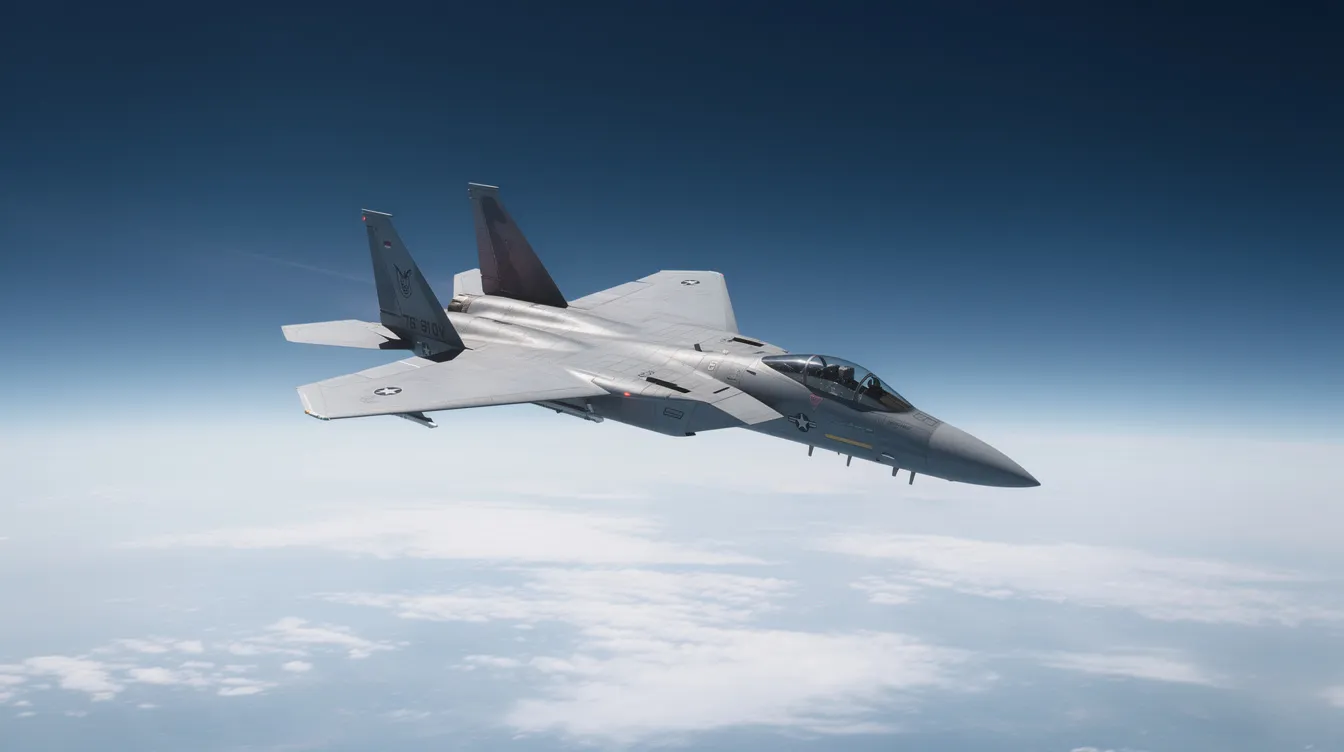
The F-15 Eagle has held its place as one of the fastest operational fighter jets in the world for nearly five decades. Its top speed, combined with an unmatched air-to-air combat record, makes it a benchmark that every other fighter aircraft is measured against. Here's what the numbers actually look like, why the brochure figure rarely shows up in real missions, and what these performance trade-offs can teach anyone who values speed as a strategic asset.
Answering the Big Question: What is the F-15's True Top Speed?
The F-15 has a top speed of Mach 2.5. At altitude, that translates to roughly 1,875 mph (3,017 km/h), according to U.S. Air Force published specifications. The figure applies to all major variants: the F-15A/B/C/D air superiority models, the F-15E Strike Eagle, and the newest F-15EX Eagle II.
That number comes with conditions. "Mach 2.5" assumes a clean configuration: no external weapons, no conformal fuel tanks, no pods hanging from hardpoints. It also assumes high altitude (above 36,000 ft), where thinner air produces less drag. Strip away those ideal conditions, and the maximum speed drops.
F-15 variants achieve Mach 2.5 at high altitude under clean conditions, but operational F-15s rarely exceed Mach 2.3 in service. Typical combat speeds sit closer to Mach 0.8 to 1.2 for most mission profiles, rising to Mach 1.5 or above only during intercepts or engagements where closing speed matters.
The trade-off between raw speed and practical mission performance is not unique to fighter jets. High-net-worth travelers face a similar calculus when selecting private aviation options: the fastest aircraft on paper is not always the one that gets you there most efficiently. BlackJet's approach to private jet travel mirrors this principle, optimizing for schedule reliability and door-to-door time rather than chasing the highest possible cruise Mach number, much like choosing the right jet card cost and structure matters more than headline speed alone.
F-15 Eagle Overview: Air Superiority at Speed
The F-15 Eagle is a twin-engine, fourth-generation air superiority fighter built by McDonnell Douglas (now Boeing). The Air Force launched the FX program in the mid-1960s with a clear set of demands: maximum speed of Mach 2.5, twin engines, an internally mounted gun, and enough range to escort deep-strike missions. McDonnell Douglas won the contract in December 1969.
The F-15's first flight took place in July 1972. The Air Force accepted the first production aircraft in 1976, and the type has served continuously since then. Its core design goal was to outrun, out-climb, and out-fight Soviet threats, particularly the MiG-25 Foxbat, which drove Western intelligence to demand a fighter that could dominate at high speed and high altitude. The F-15 features a multi-mission avionics system for combat, low wing loading for agility, and enough engine performance to accelerate vertically from a standing start.
The eagle destined for air superiority became exactly that. Just as air forces buy F-15s for rapid response across vast distances, BlackJet clients use private jets to compress time and distance for business and lifestyle advantages.
Published Top Speed vs Operational Reality
Thermal and Structural Limits
The gap between an aircraft's advertised maximum speed and what pilots actually fly is substantial. Sustained flight above Mach 2.0 generates intense kinetic heating on the airframe skin, air intakes, and engine inlets. Kinetic heating can degrade an aircraft's structural lifespan during high-speed flight. Titanium components in high-temperature areas help, but exposure time is still restricted.
External Payload Effects
Carrying external payload can increase drag and reduce maximum speed by 15-20% or more. With missiles, bombs, or conformal fuel tanks attached, real-world top speeds fall to roughly Mach 2.0 to 2.2.
Maintenance Cost and Operational Use
Operating near the speed envelope shortens component life and triggers mandatory inspections. In legacy F-15Cs, a "Vmax" switch increases fuel flow for additional thrust, but its use is limited to about six minutes and requires post-flight inspection.
A clean configuration allows for maximum theoretical top speed, but that configuration almost never appears in real combat. Sustained flight near maximum speed is rare for the same reasons private jets are flown below absolute maximums: fuel burn, airframe longevity, range, and comfort all improve when you back off the top number.
Factors Affecting F-15 Top Speed
Factor | Effect on Top Speed | Notes |
|---|
Published Maximum | Mach 2.5 (~1,875 mph) | Clean configuration, high altitude, no external stores |
Thermal Limits | Reduces usable speed | Kinetic heating restricts time at high Mach; titanium helps but doesn't eliminate risk |
External Drag | Drops speed by 15-20%+ | Missiles, bombs, tanks increase drag; real-world top speed Mach 2.0-2.2 |
Maintenance Cost | Limits high-speed use | High-speed flight shortens component life, triggers inspections |
How Fast is Mach 2.5 Really?
Understanding Mach Numbers
A Mach number expresses speed as a multiple of the local speed of sound. At 36,000 to 40,000 feet, where temperatures drop to around minus 56°C, the speed of sound is approximately 660 mph. Mach 2.5 at those altitudes equals roughly 1,650 mph. At slightly warmer conditions or lower altitudes, the figure rises; the F-15 can reach speeds of 1,875 mph (3,017 km/h) under optimal conditions.
Real-World Speed Comparisons
For comparison:
Aircraft / Vehicle | Typical Speed | Mach Number |
|---|
Commercial airliner (cruise) | 560-650 mph | Mach 0.78-0.85 |
F-15 Eagle (top speed) | 1,650-1,875 mph | Mach 2.5 |
Speed of sound (sea level) | ~761 mph | Mach 1.0 |
The F-15's top speed is roughly 2.5 to 3 times faster than a commercial jet's cruise speed.
At Mach 2.5, an F-15 could theoretically sprint from New York to Miami (about 1,090 miles direct) in under 40 minutes of flight time.
In reality, no Air Force pilot would fly that profile: fuel consumption at maximum speed is extremely high, limiting operational flight time to short bursts.
For a deeper look at how aircraft speeds compare across categories, including business jets, the numbers tell a clear story about trade-offs.
F-15C Eagle: The Speed-Optimized Interceptor
The F-15C entered service in 1979 as a single-seat air superiority fighter. Its published maximum speed matches the family standard: Mach 2.5 at altitude. At low altitude, dense air and high drag bring the ceiling down to approximately Mach 1.2 to 1.4 in a light condition with no external stores.
What makes the F-15C faster in practice than later derivatives is subtraction. Without the heavy strike avionics, bomb racks, and LANTIRN system pods of the E models, the F-15C carries less weight and less drag. Its flight control systems and aircraft systems are tuned for the air-to-air mission, not ground attack. The only pilot in the cockpit focuses on one weapon system: air-to-air weaponry.
Air Force intercept missions use the F-15C's speed advantage to rapidly climb to 40,000 or 50,000 feet and close on intruders long before they reach U.S. or allied airspace. The aircraft's advanced radar can detect and track aircraft at ranges up to 100 miles, and the radar feeds target information directly to the head-up display, giving the pilot essential flight information gathered from multiple sensors without looking down at flight instruments. Weapons controls located on the control stick and engine throttles let the pilot manage air-to-air weapons and fly simultaneously. Air-to-air missiles can also be mounted on stations at the lower fuselage corners, adding flexibility during intercept setups.
The first production MSIP (Multi-Stage Improvement Program) Eagles received an upgraded central computer, improved electronic countermeasures, and better threat warning systems that extended the F-15C's relevance well into the 2020s.
F-15E Strike Eagle and F-15EX: Speed with a Heavier Mission
Variant Differences and Payload
The F-15E Strike Eagle and F-15EX represent the multirole evolution of the Eagle platform. They carry more payload, more sensors, and more fuel, with modest trade-offs in usable top speed.
The F-15E added a rear cockpit for a weapons systems officer.
Conformal fuel tanks were installed along the fuselage.
The LANTIRN system was introduced for low altitude navigation and precision attack against tactical targets like artillery sites and armor columns.
It can deliver weapons in adverse weather conditions using infrared visual guidance and terrain-following radar.
Its increased maximum takeoff weight of approximately 81,000 pounds (versus around 68,000 for the F-15C/D) reflects the additional internal fuel, sensors, and ordnance capacity.
Operational Speed and Flight Testing
On paper, the F-15E's maximum speed remains Mach 2.5.
Flight manual data recorded at 35,000 feet in a clean configuration shows a practical ceiling closer to Mach 2.1.
The F-15EX has a maximum speed just below Mach 2.5; during flight testing, a clean-configuration F-15EX reached Mach 2.497.
With weapons and conformal fuel tanks installed, that number drops.
The F-15EX was designed with modern digital flight control systems, open mission systems architecture, and compatibility with hypersonic weapons. It prioritizes acceleration, payload capacity (roughly 29,500 pounds), and survivability in highly contested environments over chasing pure maximum speed records. In many missions, the F-15EX will fly closer to Mach 0.9 to 1.3, similar to how BlackJet-arranged aircraft cruise at their most efficient speeds rather than absolute maximum.
Engines That Make Mach 2.5 Possible
Engine Variants and Thrust
The F-15's twin-engine configuration is the core enabler of its speed, climb rate, and survivability. Two engines mean redundancy: if one fails, the aircraft can still fly and fight.
The engine lineup across variants includes:
Engine | Variant Used In | Afterburner Thrust (per engine) |
|---|
Pratt & Whitney F100-PW-100 | F-15A/B | ~23,830 lbs |
Pratt & Whitney F100-PW-220 | F-15C/D | ~23,830 lbs |
Pratt & Whitney F100-PW-229 | F-15E, F-15EX | ~29,100 lbs |
General Electric F110-GE-129 | F-15EX (option) | ~29,000 lbs |
Combined thrust figures exceed 50,000 pounds for early Eagles and reach approximately 58,000 pounds for the F-15EX, producing a thrust-to-weight ratio near or above 1:1.
The F-15 has a thrust-to-weight ratio exceeding 1:1 even in combat configurations with weapons loaded.
The F-15 can attain higher speeds with upgraded engine variants providing greater thrust, which is why the later production Eagle package retains the same Mach 2.5 ceiling despite heavier airframes.
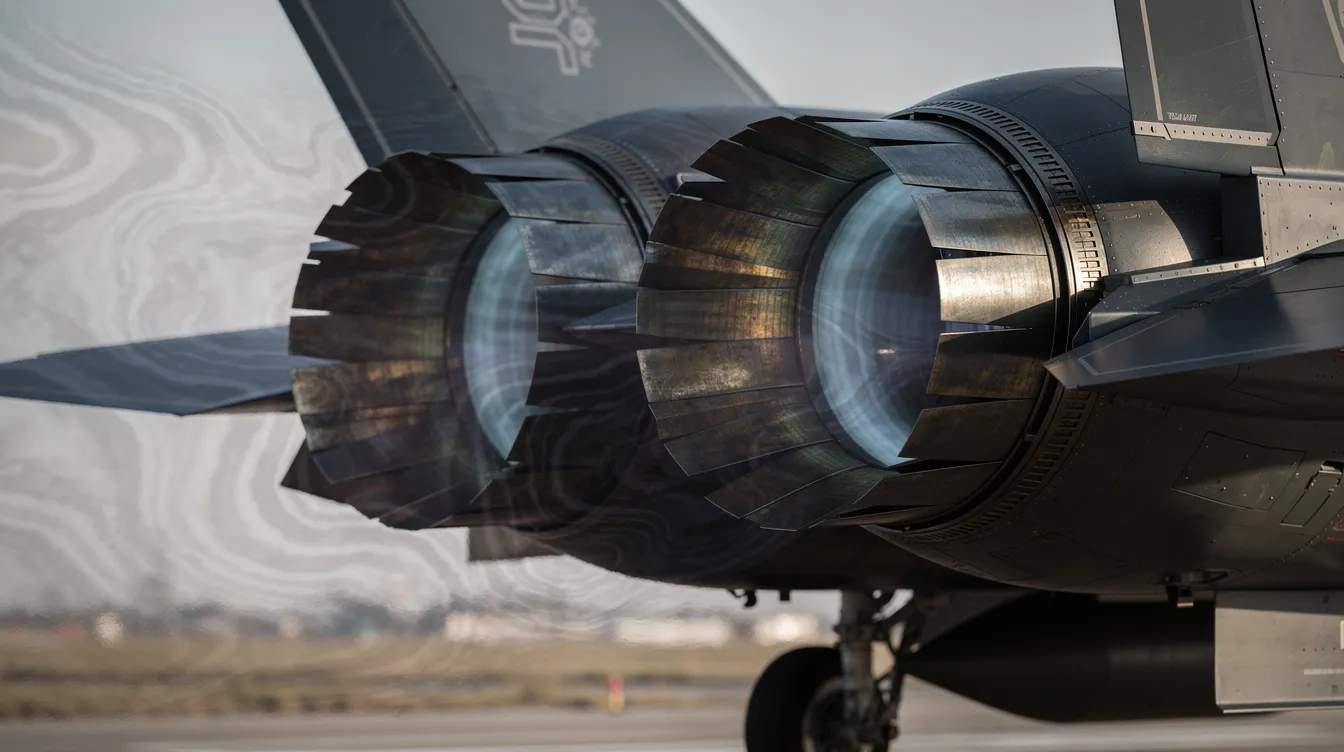
Afterburners work by dumping raw fuel into the exhaust stream downstream of the turbine, igniting it for a short burst of additional thrust. Engine performance in afterburner is dramatic but costly: fuel burn roughly doubles or triples compared to military (dry) power. Pilots treat afterburner as a tactical tool for high-speed penetration and engagements, not for cruise.
Altitude, Drag, and Why Top Speed is Usually a "Dash"
Speed is affected by altitude and air density in a direct, measurable way. At 40,000 feet, air density is about one-quarter of what it is at sea level. Less air means less drag, which means higher achievable Mach numbers for the same thrust output. An F-15 at sea level tops out around Mach 1.2 to 1.4; at 40,000 feet, that same aircraft reaches Mach 2.5.
External stores change the equation further. Every missile, bomb, fuel tank, or sensor pod adds both weight and aerodynamic drag. Low-flying targets and high-flying targets alike may require different weapon loads that alter the F-15's drag profile. The difference between a "dash speed" (a short burst to Mach 2+ for a specific intercept or escape) and typical cruise/loiter speeds is stark: an F-15 might dash for 30 to 60 seconds at Mach 2.0+, then throttle back to Mach 0.9 to conserve fuel.
Private jets follow a similar logic. Long-range business aircraft cruise slightly below their drag-rise Mach number to balance fuel burn, range, and schedule reliability. For context on how fast private jets go and why they rarely fly at their airframe limits, the trade-offs parallel what fighter pilots face daily, just as jet card pricing structures balance budget, access, and flexibility in private aviation.
Climb Rate and Vertical Acceleration: Speed Turned Upwards
Speed is not only about horizontal motion. The F-15 translates its raw thrust into climb performance that no other fighter in U.S. inventory has matched in sheer acceleration.
The F-15 can climb to 30,000 feet in about 60 seconds from a standing start. In test profiles with minimal fuel and no external stores, an F-15 demonstrated a climb from ground level to a service ceiling of 65,000 feet (19,812 meters) in roughly 122 seconds. Few fighter aircraft can match either number, just as few civil aircraft rival how high modern private jets can cruise compared to commercial airliners.
The famous demonstration of an F-15 rotating into a near-vertical climb immediately after takeoff is enabled by a thrust-to-weight ratio that exceeds 1:1 in a light condition. With both engines in full afterburner, the aircraft produces more thrust than it weighs, allowing it to accelerate vertically. This converts runway length into altitude and potential energy within seconds, a capability that is vital in interceptor scrambles where every second of reaction time counts.
F-15 vs Other Fighter Jets: Speed Comparisons
F-15 Speed Compared to Other Fighters
The F-15 remains one of the fastest operational fighter jets in U.S. Air Force history. Among combat aircraft currently in service, only a handful can match its top speed.
Aircraft | Top Speed (approx.) | Primary Role |
|---|
F-15C/E/EX | Mach 2.5 | Air superiority / multirole |
F-22 Raptor | Mach 2.0+ (est. ~Mach 2.25) | Stealth air superiority |
F-35 Lightning II | Mach 1.6 | Stealth multirole |
F-14 Tomcat (retired) | Mach 2.34 | Fleet defense interceptor |
F-4 Phantom II (retired) | Mach 2.23 | Multirole |
SR-71 Blackbird (retired) | Mach 3.2 | Reconnaissance |
The SR-71 Blackbird was faster overall, but it was a reconnaissance platform, not a fighter. Among fighter jets designed to carry weapons, maneuver in dogfights, and engage enemy aircraft, no other fighter in U.S. service exceeds the F-15's Mach 2.5 ceiling. For a broader look at speed across aircraft types, including private jets, the numbers scale down, but the principles remain the same, and the world's top-performing private jets show how designers trade pure speed against range, comfort, and efficiency.
Modern designs like the F-35 intentionally trade some top speed for stealth, sensor fusion, and network capabilities. Speed alone no longer decides the fight, but it remains a factor that shapes tactics.
Combat Record: How Speed Helped the F-15 Go 104-0
The F-15 has an air-to-air combat record of 104 kills and zero losses in aerial combat. No other fighter in any nation's inventory comes close to that ratio across decades of service.
The first F-15 kill was scored by Israel in 1979. Israeli F-15s downed 41 Syrian aircraft during the 1982 Lebanon War, where the F-15's speed and beyond-visual-range missile capability let Israeli pilots dictate engagement geometry against numerically superior forces. During Operation Desert Storm, F-15s accounted for 36 of the 39 air-to-air victories recorded by coalition forces. F-15s have been used in multiple conflicts since their introduction in 1976, and the kill-to-loss ratio has remained at zero losses.
Speed and acceleration are central to why the record exists. An F-15 pilot can choose when to fight and when to disengage because the aircraft can outrun nearly any threat. The automated weapon system enables the pilot to track aircraft, select weapons, and launch at beyond visual range, often engaging small, high-speed targets and high-flying targets before the opponent knows an F-15 is there. The integrated avionics system, combined with advanced radar that feeds target information directly to the pilot's display, makes the F-15 a totally integrated fighter where avionics and weapons controls work as one weapon system.
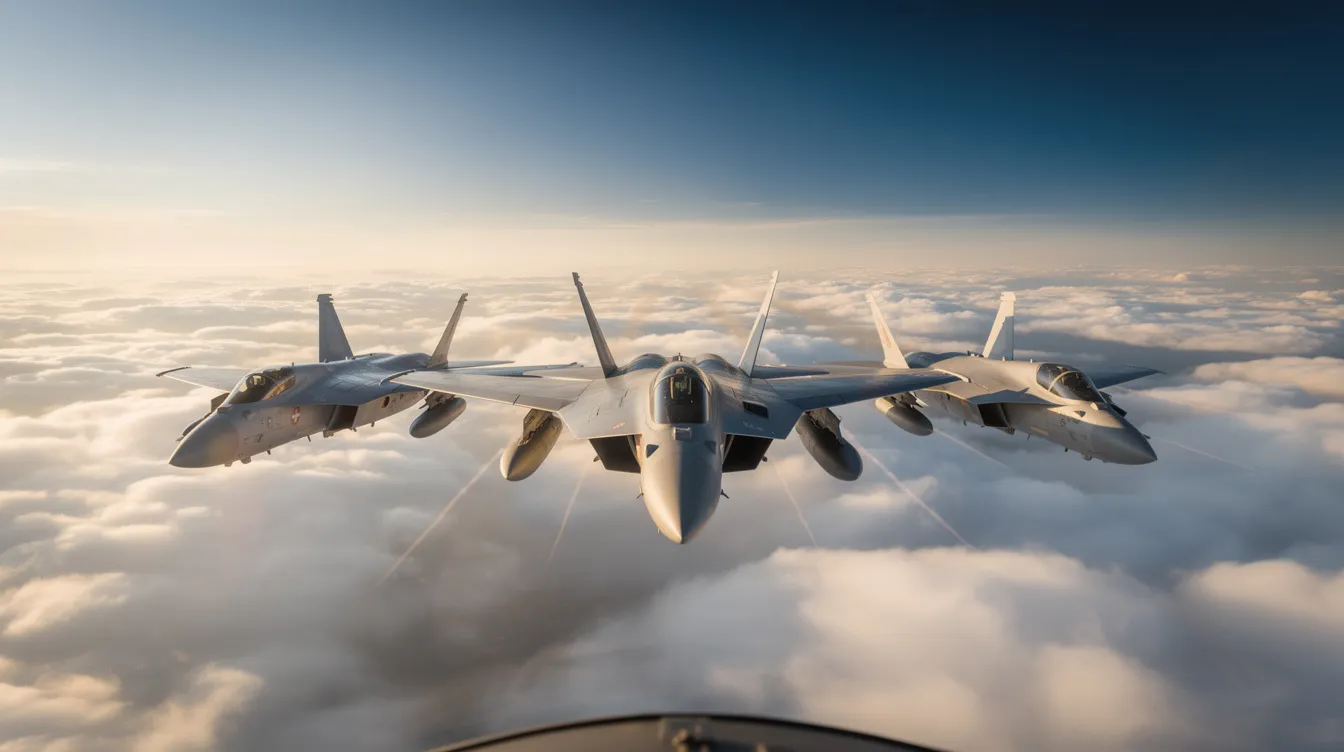
For BlackJet clients, having superior "speed to opportunity" offers a parallel strategic advantage. Arriving first to a key meeting or deal, before competitors, mirrors the F-15 pilot's doctrine of controlling timing and position.
Extreme Durability: Stories That Go Beyond Speed
While the F-15's top speed defines its reputation, its survivability at the edges of the flight envelope has produced stories that border on the implausible.
In November 1983, an Israeli Air Force F-15D collided with another aircraft during a training exercise and lost most of its right wing. The pilot, unaware of the full extent of the damage due to fuel leaking from the wing stub masking the torn structure, managed to fly the aircraft back to base and land safely. The F-15's combination of excess thrust, large remaining lifting surfaces, and robust flight control systems kept the aircraft flyable in a condition that would have destroyed most other fighter aircraft.
Such feats are not repeatable test points. They illustrate the design margins built into the Eagle's airframe. Modern safety in private aviation uses a different toolkit: rigorous FAA certification, redundant aircraft systems, conservative flight envelopes, and continuous oversight. BlackJet emphasizes this layered approach to safety for its members, auditing operators and requiring high safety ratings before any flight is booked, aligning with broader private jet safety best practices.
F-15EX and the Future of Fast Air Power
Key upgrades over earlier variants include:
Digital fly-by-wire flight control systems replacing the older analog/hybrid systems
APG-82 AESA advanced radar with improved range and resolution
EPAWSS (Eagle Passive/Active Warning and Survivability System) for automatic countermeasures and electronic countermeasures in highly contested environments
Open Mission Systems software architecture for rapid integration of new weapons
Weapons management capacity for 12 or more AMRAAMs, or hypersonic weapons on conformal stations
The F-15 has a service life of 8,000 hours after modifications, and the F-15EX airframe is designed to reach that figure from the start. Advanced versions of the Eagle, including the F-15EX, retain the Mach 2.5 speed class but emphasize payload, situational awareness, and survivability over pure velocity. The central computer processes data from multiple sensors, and the inertial navigation system works alongside GPS for effective weapons delivery against tactical targets in any weather.
South Korea, Japan, Saudi Arabia, and other allied nations operate their own advanced versions of the F-15, ensuring the platform's continued relevance through the 2040s and beyond.
Speed vs Stealth vs Information: What Really Wins Fights Today
The modern Air Force values a balance among raw speed, low observability (stealth), and sensor/network power. The F-15's philosophy is "see first, shoot first, move fast." The F-35's approach is "stay hidden, sense more, and coordinate." In private aviation, similar trade-offs appear in routing and aircraft choice, where a precise private jet flight time calculator helps translate raw speed into real-world schedule advantage.
Both work. In practice, data links and shared situational awareness can let a slower but stealthier jet win against faster aircraft in certain scenarios. A networked formation of F-35s can feed targeting data to an F-15EX carrying a heavy load of long-range missiles, combining the F-35's stealth sensing with the F-15's speed and payload. Each combat squadron that operates the F-15EX alongside fifth-generation platforms exploits this complementary dynamic, much like private fliers use a flight time calculator and planning tools to coordinate multiple legs and aircraft types efficiently.
The F-15 remains the platform that can carry the most weapons, fly the fastest, and cover the most distance in the shortest time. When an only pilot in an F-15C or an F-15EX crew needs to reach a threat quickly, no other fighter in the inventory matches its sprint capability.
BlackJet applies a similar principle: using technology, real-time support, and optimized routing to make travel more decisive than simply flying the absolute fastest business jet available, which is the foundation of its premium private jet card and charter programs.
What F-15 Top Speed Teaches About Private Jet Travel
Just as F-15 pilots rarely fly at Mach 2.5, private jet travelers rarely need maximum headline speeds. The F-15's real advantage is not its peak number but its ability to get to the right place at the right time with the right tools.
For BlackJet clients, the same logic applies. A well-planned private flight can save more real-world time than any marginal increase in cruise Mach number. Bypassing hubs, skipping security queues, departing on your own schedule, and landing at airports closer to your destination often compress door-to-door time by two to four hours compared to first-class commercial, regardless of the aircraft's absolute top speed, especially when you apply proven strategies to fly private more affordably.
BlackJet focuses on matching aircraft categories and cabin classes (light, midsize, super-midsize, large cabin) to each mission profile for the best time-to-destination, helping clients navigate the spectrum of private jet sizes and use cases. A midsize jet on a 600-mile trip will get you there faster, door to door, than a large-cabin jet that requires a longer runway at a more distant airport. The parallel to the F-15 is exact: the best fighter is not always the fastest one; it is the one configured for the mission at hand.
Safety at High Speed: Air Force Protocols and Private Aviation Standards
Operating near the limits of speed raises safety and certification challenges for both military and civil aircraft. The U.S. Air Force combines intensive pilot training (years of instruction before a pilot qualifies on the F-15), strict maintenance schedules, and layered procedures to safely exploit the Eagle's performance envelope. Threat warning systems, automatic countermeasures, and redundant flight controls all contribute to survivability at high speed.
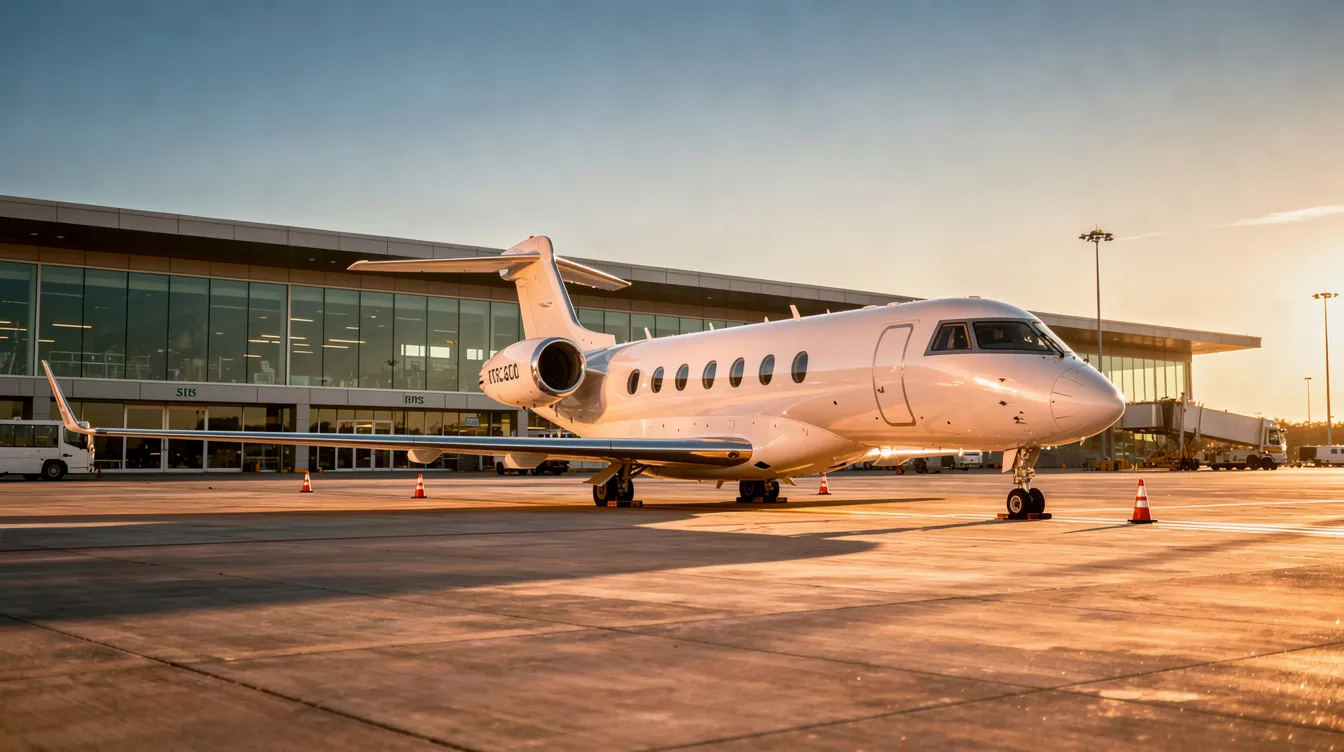
Private jets operate under a different but equally rigorous framework. FAA Part 135 certification, ARGUS and Wyvern safety audits, and conservative speed and load margins keep civil aircraft well inside their structural envelopes. BlackJet applies this standard consistently: every operator in its network meets or exceeds third-party safety certification requirements, with standardized crew qualifications and continuous oversight, reinforcing that private jet travel safety standards can equal or surpass those of commercial aviation.
The principle is the same whether you are flying at Mach 2.5 in a fighter jet or Mach 0.85 in a business jet: safety comes from redundancy, training, and disciplined adherence to limits.
Sustainability: Fast Flight and Environmental Responsibility
High speed means higher fuel burn, which means higher emissions. An F-15 in full afterburner consumes fuel at a rate that would empty a private jet's tanks in minutes. Military aircraft like the F-15 focus on mission effectiveness, not fuel economy. Private aviation faces a different set of expectations.
Discerning travelers increasingly ask how their flights affect the environment. Carbon-neutral flight programs and high-quality offsets can neutralize emissions from a BlackJet-arranged trip without requiring clients to sacrifice schedule or comfort, even on larger-cabin aircraft like those covered in guides to the best private jets for 15 passengers. BlackJet's sustainability commitment makes every flight carbon neutral at no additional cost to the member, which pairs well with smart fly private cheap strategies that lower cost without sacrificing environmental responsibility.
As sustainable aviation fuel (SAF) and more efficient engines continue to develop, private jets will further narrow the gap between speed and environmental responsibility. For more on green private jet travel, the data on offset programs and SAF adoption is evolving rapidly, just as broader private jet price and access models continue to evolve for environmentally conscious travelers.
Technology and Connectivity: From Fighter Cockpits to Private Cabins
Cutting-edge technology once reserved for fighter cockpits now appears in private aircraft cabins. The F-15's glass cockpit, helmet-mounted cueing systems, and integrated avionics were built around high-speed decision-making: the head-up display projects essential flight information gathered from radar, weapons, and navigation systems so the pilot never looks away from the fight. The central computer processes inputs from every sensor, and the radar feeds target information to the weapons management system in real time.
Modern private jets feature their own version of this integration. Digital flight decks display real-time weather and traffic data. In-cabin connectivity lets passengers work, coordinate deals, or manage logistics at 500+ mph. The advantage comes from combining speed, information, and comfort, whether in an F-15 intercepting a threat over contested airspace or a business jet en route to a board meeting.
BlackJet's digital booking platform, 24/7 real-time support, and fleet-wide connectivity are designed around this same principle: information at the point of decision, whether you're comparing top luxury private jet models or using a sophisticated flight time planning tool to align speed with your schedule.
FAQ: F-15 Top Speed and Fast Private Jet Travel
What is the F-15's maximum recorded top speed in service? The highest publicly confirmed figure is Mach 2.497, recorded during F-15EX flight testing in a clean configuration. The published specification for all F-15 variants is Mach 2.5, or approximately 1,875 mph at high altitude.
Why doesn't the Air Force always fly the F-15 at Mach 2.5? Fuel consumption at maximum speed is extremely high, thermal stress shortens airframe life, and external weapons increase drag. Most missions are flown between Mach 0.8 and 1.3. Speeds above Mach 2.0 are reserved for short tactical dashes.
What is the F-15's service ceiling? The F-15 has a service ceiling of 65,000 feet (19,812 meters). In practice, most combat operations occur between 20,000 and 45,000 feet, comparable to how private jets typically cruise between 35,000 and 51,000 feet to optimize speed, comfort, and efficiency.
How fast are typical private jets compared to an F-15? Most private jets cruise at Mach 0.78 to 0.92 (roughly 500 to 610 mph). The fastest private jets approach Mach 0.925. The F-15 is roughly three times faster at its peak.
Does flying faster always get me there sooner on a private flight? Not necessarily. Door-to-door time depends on routing, airport proximity, ground handling, and departure flexibility. A well-matched aircraft on the right routing often beats a faster plane operating from a distant airport.
Is faster flight less safe? Not inherently, but operating near structural or thermal limits requires additional protocols and more frequent maintenance. Private jets operate well within their certified speed envelopes. BlackJet ensures every operator in its network meets rigorous safety standards, regardless of aircraft speed.
How does BlackJet keep flights carbon neutral while still offering rapid travel? BlackJet offsets 100% of flight emissions through verified carbon offset programs at no extra cost to the member, allowing clients to fly at full schedule without compromise, including members exploring unlimited private jet flight programs who want predictable costs without sacrificing sustainability.
What happened to the F-15 that lost a wing? In November 1983, an Israeli Air Force F-15D lost most of its right wing in a mid-air collision. The pilot landed safely, demonstrating the airframe's excess thrust and control authority. The aircraft was repaired and returned to service.
From Eagles to Executive Jets: How BlackJet Turns Speed into Strategy
Speed is a strategic tool, not just a number on a specification sheet. The F-15 Eagle's top speed made it a legend in Air Force service across four decades and multiple wars. But its real power comes from how speed is applied: intercepting threats before they arrive, disengaging when the odds turn, and reaching the fight first. That 104-to-0 combat record did not come from Mach 2.5 alone; it came from pilots using every advantage the platform offered.
BlackJet's Jet Card memberships give clients a similar ability to "scramble" at will, and a guide to the best jet cards for frequent flyers can help you choose the structure that aligns with your travel tempo. A 25-hour or 50-hour program provides prepaid access to private jets across multiple cabin types, with 24/7 booking, carbon-neutral flights, and safety certification that exceeds industry baselines, and the dedicated BlackJet 25+ Hour Jet Card extends that flexibility with fixed rates on mid, super-mid, and large-cabin aircraft.
The F-15 proves that having speed on call, ready when you need it, changes the outcome of every engagement. Your schedule deserves the same advantage.
Explore BlackJet Jet Card programs and discover how premium, tech-enabled private jet access can deliver the speed-to-opportunity advantage to your own calendar.


 Sign up with google
 Sign up with Apple