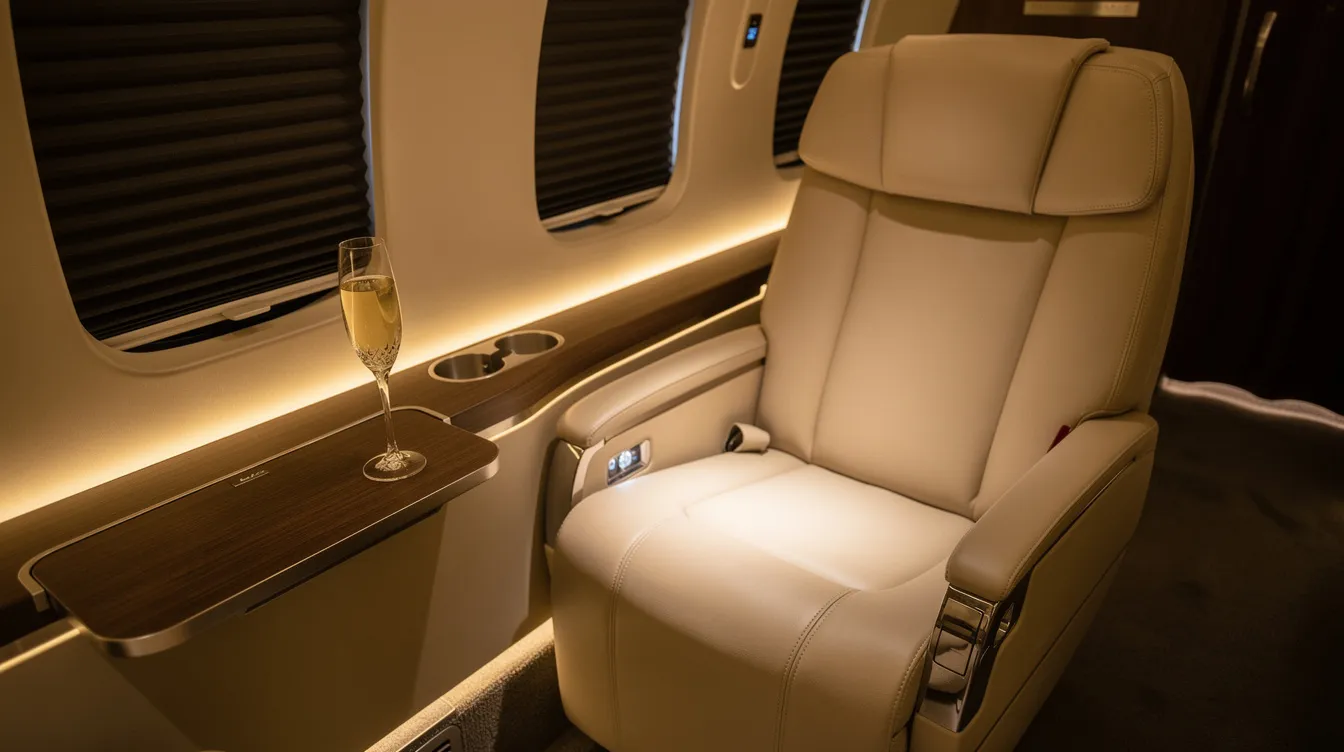
First Class Airfares vs Private Jets: How to Fly at the Top End of the Sky
For travelers who have long left flying coach behind, the real calculus is no longer economy versus business class. It is first-class airfares versus private jets. And in 2026, the numbers make that comparison closer than most people assume.
This guide is designed for premium travelers and business executives considering whether to book first-class airfares or charter a private jet. We compare costs, amenities, and overall value—including flexibility and the travel experience—to help you make the best choice for your travel needs.
Why First Class Airfares Matter in a Private Jet World
A round-trip first class fare on British Airways from JFK to London Heathrow averages about $5,900, with off-peak deals dipping to $4,950 according to KAYAK data. Air France La Première from New York to Paris regularly exceeds $11,400. Emirates first class on routes routed through Dubai to Milan can reach $15,500 to $19,500 round-trip. At the upper end of that range, a pair of first-class tickets costs $30,000 to $39,000, putting commercial first-class airfares within striking distance of entry-level private jet charter or a 25-hour Jet Card allocation.
This article walks through:
What you actually get with international first class and top business class on airlines like Emirates, Cathay Pacific, and Etihad Airways
How first class airfares are structured, discounted, and sometimes inverted against business class
Concrete cost comparisons between purchasing first class tickets and using a BlackJet Jet Card or on-demand charter
When commercial first class delivers the better deal, and when a private jet offers a superior class experience and ROI
Safety, sustainability, and technology differences between the two modes of premium travel
First Class vs Business Class: What's Actually Different in 2024–2025?
The gap between business and first class has narrowed. Business class cabins on carriers like Qatar Airways, Japan Airlines, and Korean Air now include doors, lie-flat beds, and direct aisle access. Business class increasingly features fully flat beds on long-haul flights, a feature that did not exist in any cabin until British Airways introduced the first flat beds in first class in the mid-1990s. But measurable differences persist on ultra-long-haul flights.
Seat and bed size: An Emirates A380 first class suite measures roughly 40 square feet with a separate seat and a fully flat bed. Emirates business class offers about 20 square feet. The difference in sleep quality over a 14-hour flight is not marginal.
Cabin size and privacy: First class cabins typically hold 8 to 14 passengers. Business class cabins on the same aircraft carry 40 to 76 passengers. First class flights typically provide quieter cabin environments simply because fewer people share the space. First class will often have fewer seats in the cabin, contributing to a less crowded experience.
Service ratios: First class typically provides more attentive service than business class. Crew-to-passenger ratios run 1:2 or even 1:1 in first class versus 1:6 or higher in business. First class dining is often higher quality than business class meals, with multi-course à la carte options rather than pre-plated trays.
Ground benefits: First class passengers on carriers like Lufthansa access a dedicated first class terminal in Frankfurt. British Airways offers the Concorde Room at Heathrow. These ground class experiences are unavailable to business class ticket holders on the same airline.
Business and first class are often marketed together as "premium cabins," but the pricing and treatment of first class passengers differ from business class on every metric listed above. For many routes within Europe and much of North America, business class is now the top cabin. True first class is available only on select long-haul flights. First class service varies considerably between domestic and international flights; domestic first class does not typically include lounge access and usually just offers wider seats and priority boarding.
What Do You Really Get with International First Class Airfares?
First class airfare refers to the highest class of service offered on commercial airlines, with options split between U.S. domestic and international first class. Service and amenities vary considerably between domestic and international flights.
This section focuses on long-haul international first class, not the domestic "first" on narrow-body jets (which splits into a separate category of first class airfare options between U.S. domestic and international first class).
The full door-to-door chain for a first class passenger on a top carrier includes:
Airports: Private or separate check-in zones, escort through security and immigration, sometimes limousine transfers to the aircraft door. First class typically includes dedicated check-in counters and expedited security. Priority boarding allows first class passengers to board the plane first. Priority baggage handling ensures first class luggage arrives first, and first class tickets usually come with a higher checked bag allowance.
Lounges: Invitation-only spaces like the La Première Lounge at CDG, The Pier First Class Lounge in Hong Kong (with private cabanas), or the Lufthansa First Class Terminal in Frankfurt. Most international first class tickets include complimentary lounge access. Some airlines allow first class passengers access to spa services or showers in lounges.
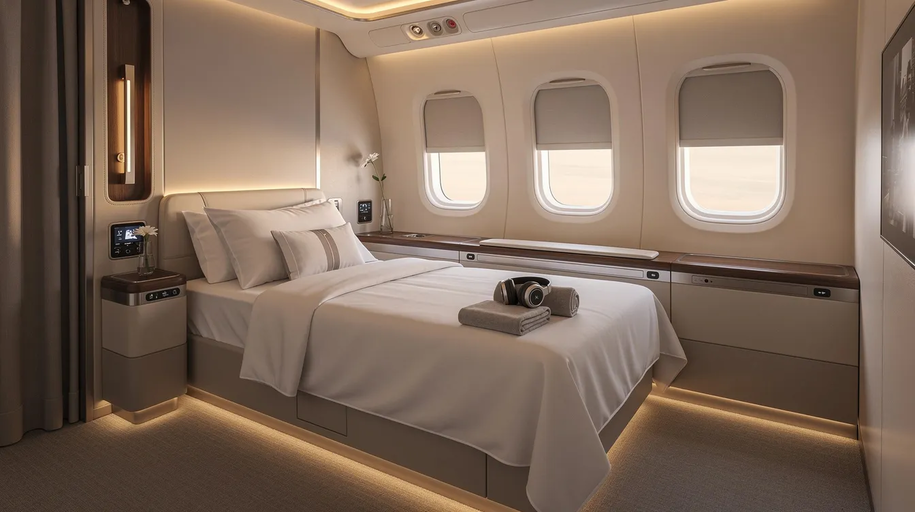
Onboard: First class includes fully flat beds or private suites. First class offers fully enclosed suites for privacy, with high-end bedding, turndown service, and spacious seat configurations that rival hotel rooms. First class meals are often served on real china with quality flatware. Custom meal options are often available on longer flights in first class. Many airlines provide amenities like pajamas and amenity kits on international first class flights. Booking first class can include flexible dining options on international flights. Some international first class cabins feature fully lie-flat beds. First class flyers can expect personalized service from flight attendants.
A top-tier class cabin functions as a mobile office (large work surfaces, Wi-Fi on carriers like Emirates and ANA), a bedroom (true flat beds with pajamas and turndown on Japan Airlines and Emirates), and a restaurant (multi-course fine dining from Air France and Singapore Airlines). Flying first class enhances the overall travel experience with these luxury services layered together.
Note that perks like the shower spa on Emirates' A380 first class or Etihad Airways' A380 first class are aircraft- and route-specific. Buyers must always confirm aircraft type before purchasing.
Major Airlines and Their Flagship First Class Cabins
Here is a survey of recognizable first class brands on key intercontinental routes, with specific notes on what each does best.
Airline/product | Notable first-class features | Best suited to |
|---|
Air France La Première | Four suites on select aircraft, French dining, premium wines, CDG lounge and car transfers | Travelers valuing boutique service and Paris ground handling |
British Airways First | Select 777 and 787 routes, Concorde Room access at Heathrow | Travelers flying through London who value a premium airport experience |
Etihad First | Private suites on selected aircraft; lounge and shower access at Abu Dhabi | Travelers for whom Abu Dhabi is a convenient destination or connection |
Cathay Pacific First | Six open suites on 777-300ER aircraft, wide seats and caviar service | Travelers connecting through Hong Kong |
Emirates First Class | A380 enclosed suites, shower spa and onboard bar; amenities vary by aircraft | Travelers who specifically want the A380 experience and can use Dubai conveniently |
American Airlines Flagship First | Limited 777-300ER routes and Flagship First Dining at selected hubs | Travelers on eligible U.S. international routes |
Air France La Première: Air France's La Première has only four suites per aircraft on select 777-300ERs being retrofitted through 2025. Each private suite features curtained partitions, fine French dining with premium wines, and access to the exclusive CDG lounge with car transfers to the aircraft. Air France ranked #1 for first class in the 2026 Skytrax World Airline Awards. Round-trip CDG to LAX in La Première typically ranges from $9,000 to $14,000 depending on season and booking window.
British Airways First: Available on certain 777s and 787s on routes such as LHR to JFK and LHR to Hong Kong. Passengers access the Concorde Room at Heathrow. The Club Suite (business class) now competes closely on hard product with doors and lie-flat beds, but first still wins on service and exclusivity. British Airways offered around 560,000 first class seats in 2019.
Etihad Airways First: The Apartment on A380 routes offered a private suite with a separate seat, bed, and shower; the carrier continues to offer differentiated first class suites on 787 and 777 aircraft. Etihad Airways offers a private lounge and shower in first class at Abu Dhabi, plus chauffeur service on select routes. The class apartment concept pioneered by Etihad remains a benchmark.
Cathay Pacific First: Six open suites on 777-300ER aircraft; ultra-wide seats, caviar service, and The Pier First Class Lounge in Hong Kong with private cabanas. Routes include HKG to LHR and HKG to LAX. A consistently refined, understated product.
Emirates First Class: Distinguish between Emirates A380 first class with fully enclosed class suites, shower spa, and onboard bar versus older 777 cabins. Emirates provides onboard showers in its A380 first class. Deployed on routes such as DXB to LHR, DXB to JFK, and DXB to Sydney. Dom Pérignon and chauffeur drive included. The Middle East carriers continue investing heavily in first class hardware.
American Airlines Flagship First: Limited to 777-300ER on certain transatlantic and transpacific routes (JFK to LHR, MIA to GRU). Larger open suites without doors. Flagship First Dining available in selected US hubs provides a sit-down restaurant experience before boarding.
Additional carriers worth noting: Singapore Airlines offers fully private suites on A380 aircraft, with a separate seat and bed in a fully enclosed space. ANA's first class features a 43-inch 4K screen in suites. Japan Airlines' A350-1000 first class and SWISS First round out the small group of carriers maintaining international first class, often featuring private suites and gourmet dining. Lufthansa provides caviar service in its first class. Korean Air maintains first class on select routes as well.
First class evolved from a single cabin to multiple classes by the 1950s. Many airlines have withdrawn first class in recent years, including United Airlines. First class is declining as business class offerings improve, yet it still provides a premium experience for marketing to VIP travelers and justifies its price on airlines that invest in the product.
How First Class Airfares Are Priced: Beyond the Sticker Shock
The headline first class fare on a route like JFK to LHR ($12,000 or more during peak demand) is rarely what sophisticated buyers pay. Fare structures contain layers of pricing logic that reward informed purchasers.
Fare classes/buckets: Airlines assign codes like F, A, and P to different first class price levels. Discounted first class tickets hide under specific booking codes with fewer change and cancellation benefits. Full-fare F-class seats are rarely sold; most revenue comes from discounted buckets.
Corporate deals and promotions: First class tickets can be discounted through corporate deals negotiated by travel management companies. Promotions for first class are less common than economy sales, but they exist, particularly in shoulder seasons.
Seasonality and events: Summer transatlantic peak pushes fares highest. British Airways first class round-trip JFK to LHR hit roughly $12,000 during peak April 2024 demand but dropped to around $5,200 off-peak. Events like Wimbledon, Art Basel, and the World Economic Forum inflate fares on affected routes.
Booking windows: Booking 90+ days out often surfaces discounted first-class fare buckets. Last-minute flights in first class can cost two to three times the advance-purchase price.
Miles and points: Using air miles can reduce the cost of first class tickets, though airlines heavily regulate award seat availability for first class tickets. First Class Flyer helps find discounted first class upgrades. Understanding Jet Card cost per hour is equally important on the private side when comparing long-haul premium options. Booking around-the-world tickets can lower first class costs by combining multiple segments under a single award or revenue fare.
Occasional fare inversions occur: in certain sales, business class drops below coach on select routes, and first class can appear only marginally more expensive than business class, creating rare value opportunities.
Finding Deals: When First Class and Business Class Fares Drop
Tracking first class and business class flights on competitive routes is similar to watching volatile markets: price drops create windows.
Fare monitoring: Set alerts on specific routes like LAX to NRT, JFK to LHR, and CDG to JFK for both business and first class. Watching routes where multiple major airlines compete (New York to London with British Airways, American Airlines, and Virgin Atlantic) often surfaces fare wars that make first class tickets unusually cheap.
Close-to-departure discounts: Airlines discount premium cabins near departure to avoid empty suites. Emirates A380 first class DXB to LHR seats have dropped 20 to 40 percent within one to two weeks of departure when loads run soft.
Flexible dates: Shifting travel by plus or minus three days can expose cheaper first class fares by hundreds or thousands of dollars.
Alternative gateways: Departing from Dublin or Madrid instead of London to reach New York, often routing through oneworld connections, can reduce the fare substantially.
Mixed-cabin itineraries: Flying outbound in business class and returning in first class controls total cost while still delivering a first class experience on the longer or more critical leg. This is a fantastic way to access first class without paying full round-trip first class price.
Miles and upgrades: Using bank points (Amex, Chase) to upgrade paid business class to first class works especially well on airlines such as Air France, ANA, and Cathay Pacific, where outright first class awards are scarce. For the average person, this is often the most practical path to affordable luxury in a first-class cabin.
Best deals appear in January, February, and early September for transatlantic routes, and during October and November for transpacific travel to Europe via the Middle East carriers.
First Class vs Private Jet: When BlackJet Becomes the Better First Class Cabin
Once first class airfares reach the mid-five figures for two travelers, comparing against a private jet charter or Jet Card becomes a practical exercise rather than an aspirational one.
Consider two executives flying New York to London on a business trip requiring schedule flexibility. British Airways or American Airlines first-class round-trip tickets for both total $12,000 to $14,000 combined at off-peak rates. At peak rates, that figure climbs to $24,000 or more. A one-way private jet charter on a super-midsize or large-cabin jet runs $75,000 to $120,000, making a round trip $150,000 or more for that specific route.
The economics shift when you factor in:
Time savings: Private jets depart from FBOs like Teterboro (15 minutes from Manhattan) rather than JFK. Passengers arrive 20 to 30 minutes before departure, not 2 to 3 hours. On a multi-city Europe trip with four legs, cumulative airport time saved can exceed 10 hours.
Productivity and privacy: A private jet cabin is a true private suite for the entire party. No strangers, no shared class lounge, no announcements. Sensitive business travel conversations happen freely.
Group economics: For a group of 4 to 8 travelers, the per-person cost of a private charter drops below the per-person cost of commercial first-class tickets on many regional and medium-haul routes, especially on missions where chartering a private jet is clearly worth it.
Flexibility: Retiming a private flight by two hours requires a phone call, not a rebooking fee and fare difference.
For ultra-long-haul nonstop routes beyond 5,000 nautical miles (London to Singapore, New York to Tokyo), the required aircraft is a large or ultra-long-range jet at $14,000 to $17,000 per flight hour. On those routes, first class on Emirates, Singapore Airlines, or Cathay Pacific remains more economical for one or two travelers. The trade-off should be evaluated route by route.
Inside the Private Jet "Class Cabin": How BlackJet Categorizes Aircraft
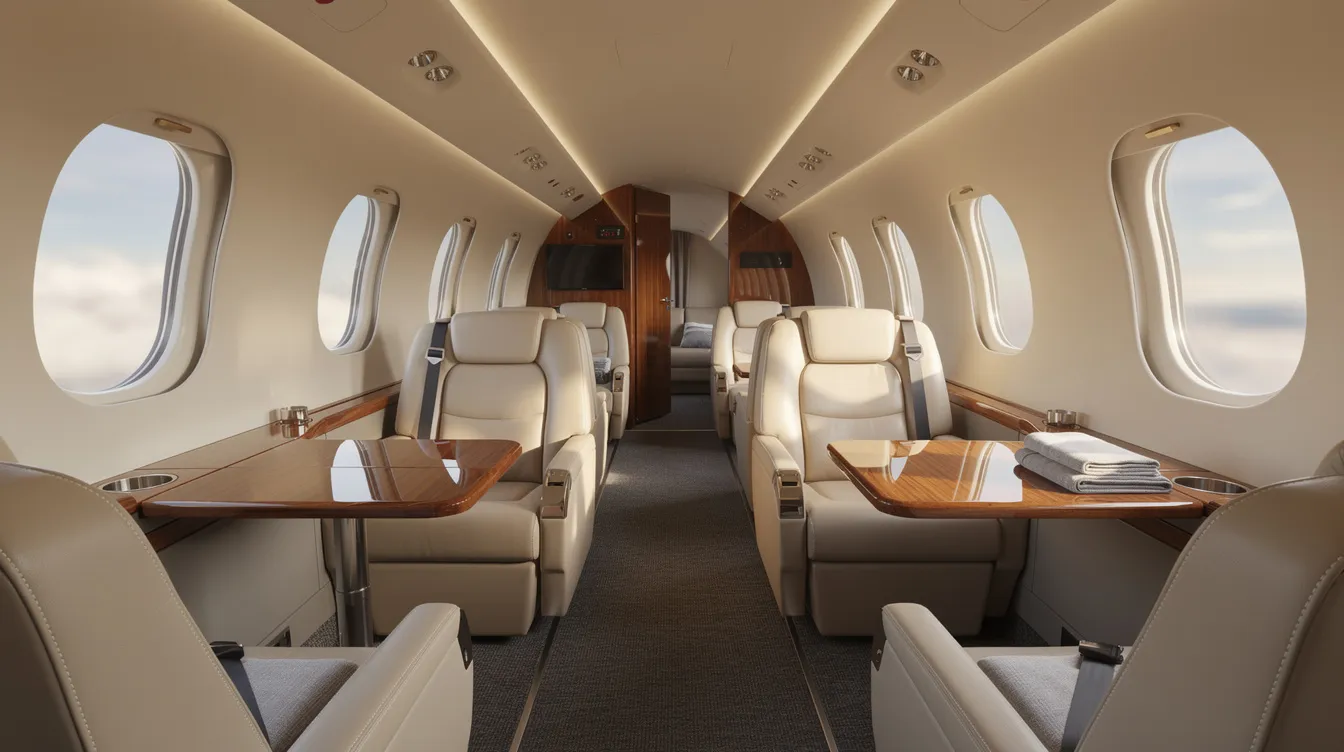
In private aviation, "cabin classes" refer to aircraft categories rather than rows on a single plane. These categories parallel economy, business, and first class in function.
Light jets (Phenom 300, Citation CJ3): 5 to 7 passengers, range up to 2,400 nautical miles. Ideal for regional flights like Los Angeles to Aspen or London to Geneva. Comfort exceeds domestic first class and is comparable in cost to chartering a small private plane when evaluated per seat. Jet card rates run a median of $8,500 per hour.
Midsize and super-midsize jets (Challenger 350, Citation X, Hawker 800XP): 7 to 9 passengers, range up to 3,000 nautical miles. Common for New York to Miami, London to Marrakesh. The experience matches or exceeds international business class for small groups and can be optimized for larger delegations by choosing the best private jet for 15 passengers. Rates run $9,500 to $12,500 per hour.
Large-cabin, long-range jets (Gulfstream G500/G600, Global 6000/7500): 10 to 19 passengers, ranges of 4,500 to 6,000+ nautical miles. Full stand-up cabins, lie-flat seating for every passenger, bespoke onboard service. This is the "true private first class" for transatlantic and transpacific missions and overlaps with aircraft that rank among the best private jets for 20 passengers. Rates run $14,000 to $17,000 per hour.
BlackJet's Jet Card lets clients pre-purchase hours by cabin type, locking in a "class" of air travel regardless of specific tail number or operator. A 25+ Hour Jet Card large-cabin card provides enough flight time for 3 to 4 transatlantic round trips.
Safety, Certification, and the First Class Passenger Standard
Travelers who pay for first class tickets on major airlines like Air France, Emirates, and American Airlines expect rigorous safety standards. Those airlines follow strict FAA, EASA, and national civil aviation regulations with scheduled maintenance cycles and public safety audits.
BlackJet matches or exceeds that standard by working only with operators meeting top-tier safety certifications, a core part of the value proposition when you compare any private jet price list and access model:
ARGUS Platinum and Wyvern-rated operators, with IS-BAO compliance where applicable
Background-checked and experience-verified flight crews
24/7 flight monitoring with real-time operational oversight
Transparent safety records accessible to every member before each flight
The difference: in a commercial first-class cabin, you share space with 8 to 14 strangers and trust the airline's system-wide safety record. On a BlackJet flight, you fly in a controlled environment with known companions, vetted operators, and a highly personalized safety profile for every trip.
Sustainable Luxury: Carbon-Neutral Flights vs Commercial First Class
Many first class passengers and corporate travel managers now treat sustainability as non-negotiable, even at the top end of premium travel.
Some airlines invest in newer, more efficient aircraft and limited sustainable aviation fuel (SAF) usage. Air France and Cathay Pacific have public commitments, but few guarantee carbon-neutral first-class flights by default.
BlackJet makes every Jet Card flight carbon-neutral as part of the service, at no additional cost to the client, via vetted offset projects and SAF partnerships, even on programs built around the cheapest private aircraft and budget-friendly options.
BlackJet clients access carbon-neutrality reporting for every journey, useful for corporate ESG disclosures. This level of per-flight emissions documentation goes beyond what any airline offers when you purchase individual first-class tickets.
For travelers whose corporate boards or personal values demand accountability, the ability to present verified carbon-neutral flight records for every private trip is a material advantage over commercial first class.
Technology and Service: Booking First Class vs Booking with BlackJet
Premium travelers expect digital tools that match the quality of the flight itself.
Shopping for first class airfares typically means searching multiple OTAs and airline sites, navigating complex fare rules, dealing with limited change flexibility, and piecing together fragmented information about aircraft type and class cabin product. Even last-minute flights in first class require navigating the same frustrating systems.
BlackJet's model works differently from both traditional airline booking and newer options like buying a seat on a private jet:
Members use a mobile or web platform to request flights by route and time window, review aircraft and cabin options, and receive firm pricing linked to their Jet Card membership balance
24/7 real-time support from dedicated concierges who adjust schedules, coordinate ground transfers, and handle changes within minutes, a level of service that complements the best Jet Cards for frequent flyers
Centralized trip records covering safety profiles, carbon-neutrality tracking, and cost reporting for individuals and corporate accounts, along with transparent Jet Card pricing structures
The difference between booking a first-class flight on a commercial airline and booking through BlackJet is the difference between shopping and being served.
Frequently Asked Questions About First Class Airfares and Private Jets
Can business class really be cheaper than first class by only a small margin?
On competitive routes like New York to Paris or London to Hong Kong, seasonal sales occasionally bring first class fares within 20 to 30 percent of discounted business class. These moments are rare and route-specific.
Is it better value to buy first class tickets or invest in a BlackJet Jet Card if I fly 5 to 10 times a year internationally?
For 5 to 10 annual long-haul trips, a 25- or 50-hour Jet Card amortizes the cost across flights and eliminates per-booking fare volatility. Solo travelers on ultra-long routes may still find first class cheaper per trip. Groups of three or more almost always save with private.
Which airlines still offer true international first class?
Emirates, Singapore Airlines, Air France, Lufthansa, ANA, Japan Airlines, Cathay Pacific, Etihad Airways, SWISS, and selected American Airlines and British Airways routes. The list shrinks each year as first class is declining and business class offerings improve, nudging frequent flyers toward alternatives like NetJets jet card programs.
Can I combine commercial first class with private jets on the same trip?
Yes. For example, fly Emirates A380 first class from DXB to LAX, then use BlackJet for intra-US segments or charter a small plane for shorter hops. This hybrid approach optimizes cost on the ultra-long leg and flexibility on shorter connections.
How flexible are first class tickets compared to private jet schedules?
Commercial first class tickets carry change fees ($0 to $500 depending on fare class) and are subject to seat availability. A private jet trip can be retimed within hours, especially if you hold a larger balance such as a 100-hour Jet Card program.
What about security and privacy?
First class cabins are shared, though quieter. A private jet cabin is an exclusive, controlled environment for sensitive conversations, documents, and business travel that demands discretion, even when flying larger groups on private jets for up to 50 passengers. An unforgettable experience in a different sense than what commercial first class experiences provide.
When to Choose First Class, When to Choose BlackJet
The decision framework rests on five variables: route length, number of travelers, need for flexibility, privacy requirements, and total budget.
Solo or couple on a long nonstop like London to Singapore: consider first class on Singapore Airlines or Cathay Pacific, where the fare per person remains well below the cost of an ultra-long-range private jet
Group of 4 to 8 executives on a multi-city Europe tour: consider a Jet Card and private jets, where per-person costs drop, schedule control increases, and total time in airports shrinks by hours per leg
Business traveler flying 25+ hours per year across mixed distances: a BlackJet Jet Card delivers locked-in rates, guaranteed cabin class, and the freedom to fly from smaller airports closer to home or the meeting, while still leaving room to consider the cheapest private jet options for shorter or lighter missions
Once first class airfares for two or more passengers cross into the $20,000 to $30,000 range for a trip, a private jet with BlackJet—often on aircraft that rank among the top private jets in the world—often delivers a superior class experience, better schedule control, and comparable total cost.
Elevate your journey on your terms. With BlackJet, private flight comes with rigorous safety certification, carbon-neutral performance on every trip, and the flexibility to fly when and where your schedule demands. Explore BlackJet's Jet Card programs and discover how premium travel becomes your new standard.


 Sign up with google
 Sign up with Apple