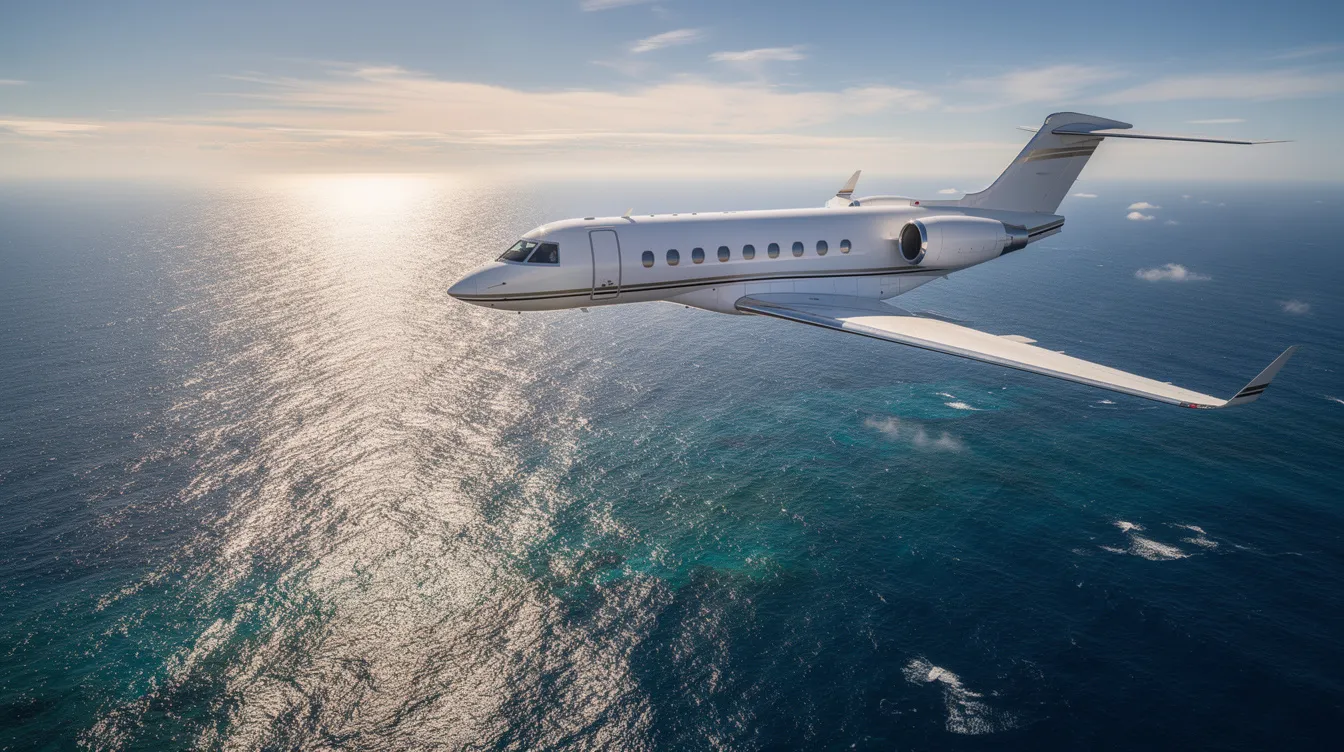
The global airplane has transformed how executives and high-net-worth travelers move across continents. A 'global airplane' refers to ultra-long-range business jets, such as the Bombardier Global series, designed for nonstop intercontinental travel. Instead of layovers, crowded terminals, and rigid schedules, ultra-long-range business jets deliver nonstop access between the world's financial capitals, turning a 20-hour commercial itinerary into a single, seamless flight.
This guide explores the Bombardier Global series of business jets, their features, and how BlackJet provides access to these aircraft for executives and high-net-worth travelers seeking efficient, luxurious global travel.
Why Global Business Jets Are a Strategic Advantage
On a route like New York to London, flying a Global-class business jet instead of commercial first class saves 90 to 180 minutes per leg-time lost to check-in, security, and boarding. On city pairs like Los Angeles to Tokyo, a global aircraft eliminates the connection.
The aviation industry supports over 65 million jobs worldwide, and passenger traffic has historically doubled every 15 years. Open Skies agreements have deregulated international aviation routes, and Open Skies policies have removed restrictions on routes and fares, fueling demand. Point-to-point travel is growing post-pandemic with low-cost carriers, yet for leaders who need privacy and productivity, the business jet remains unmatched.
Global 5500 / 6500: Nonstop transatlantic reach for routine board meetings
Global 7500: Ultra-long range for city pairs like New York–Hong Kong
Global 8000: The fastest business jet in production, cruising at Mach 0.95, converting hours of calendar time into productive flight time
BlackJet's Jet Card model gives members predictable hourly rates and guaranteed availability on these aircraft without ownership. A private equity partner trading weekly between London and Dubai, for example, saves four-plus hours per round trip versus commercial business class while maintaining full schedule flexibility.
The Bombardier Global Family at a Glance
The Bombardier Global line spans three decades of ultra-long-range innovation. The global airline industry is experiencing record demand and supply chain constraints in 2026, and the industry faces a constrained supply of new aircraft, making access to proven platforms even more valuable. Global supply chains for aircraft span multiple countries for manufacturing, and each Global model reflects that complexity.
Global Express: Announced in 1991, service entry in 1999. Range of 6,500 nautical miles. The predecessor to all subsequent Globals.
Global 5500: Delivered from mid-2020. Approximately 5,900 nmi range.
Global 6500: Service entry October 2019. Approximately 6,600 nmi range.
Global 7500: In service since December 2018. Range around 7,700 nmi.
Global 8000: Unveiled 2022, deliveries from 2025. Targets 8,000 nmi at Mach 0.85.
Their role in business aviation is clear: transoceanic connectivity, reduced cabin altitude for passenger wellness, and cabin comfort that sustains productivity on 14-plus-hour missions. BlackJet sources Global-family aircraft through audited, registered operators for Jet Card and on-demand charter flights.
Bombardier Global Express: The Original Global Airplane
The Bombardier Global Express was unveiled in October 1991 with a singular intent: to create a clean-sheet ultra-long-range plane capable of connecting continents nonstop. The Global Express program cost $800 million. The prototype performed its maiden flight on 13 October 1996, and the Global Express entered service in July 1999.
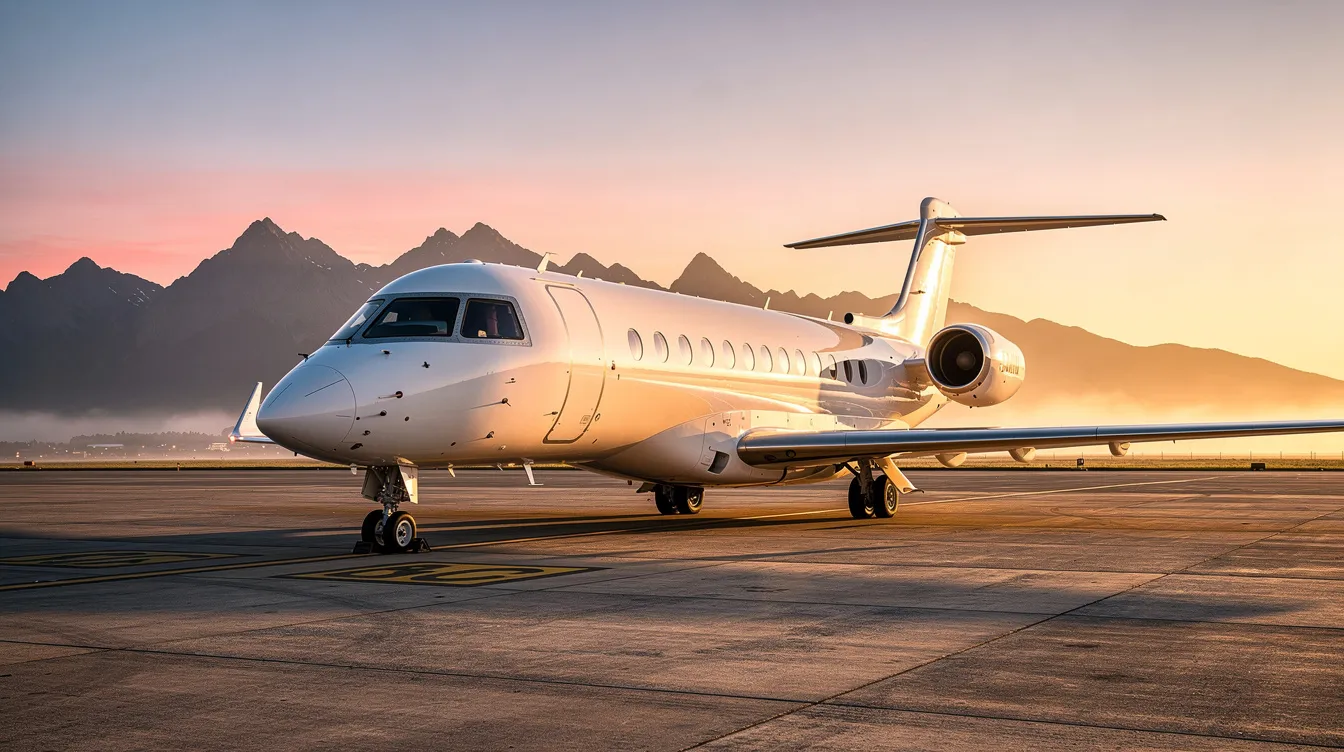
Range: The Global Express has a range of 6,500 nautical miles with NBAA IFR reserves under ISA conditions, and the Global Express can fly at a speed of Mach 0.80
Ceiling & cabin: Service ceiling up to 51,000 ft; cabin altitude around 4,500 ft at cruise; large stand-up cabin with lavatory and 14–15 suitcase baggage capacity
Specifications: Honeywell Primus 2000XP avionics, supercritical swept wings with winglets, dual Rolls-Royce BR-710 engines delivering reliable thrust
Suppliers: Globalization has transformed airplane manufacturing into a global supply chain. Mitsubishi Heavy Industries built the wings, with assemblies from Canadair and Short Brothers. Modern aircraft require advanced logistics for global assembly.
Legacy: Over 600 Global Express aircraft have accumulated more than 1.5 million flight hours across thousands of missions. The platform developed into the Global 5000/6000 and then the current Global 5500/6500, each upgrade building on proven aerodynamics and systems.
Global 5500 and Global 6500: Modern Longest-Range Workhorses
The Global 5500 and Global 6500 represent the next page in the Global Expresslineage, upgraded with Rolls-Royce Pearl engines, an optimized wing, and the Bombardier Visionflight deck. They evolved from the Global 5000 (range of 4,800 nautical miles at Mach 0.85) and Global 6000 (range of 6,000 nautical miles).
Globalization has spurred the rise of low-cost carriers, increasing travel accessibility, while globalization has made international travel more accessible through low-cost carriers, butfor executives who need nonstop reach and onboard productivity, these Globals occupy a different class entirely.
Global 5500: Range approximately 5,900 nmi, cruise up to Mach 0.90. Ideal for nonstop Los Angeles–London or São Paulo–Lisbon. Quieter cabin with Nuage seat configuration for zero-gravity comfort.
Global 6500: Range approximately 6,600 nmi with superior payload flexibility for missions like New York–Dubai or Hong Kong–London. Enhanced air filtration, lower cabin altitude, and a configuration designed for 10-to-12-hour legs.
BlackJet clients typically select the 6500 for westbound transatlantic missions where headwinds test fuel margins, while the 5500 delivers a more cost-efficient solution on shorter long-range routes.
Global 7500: The Flagship Global Airplane for Ultra-Long Range
The Bombardier Global 7500 is the aircraft that set a new standard for ultra-long-range flight. Entering service in December 2018, it set a record with a nonstop Sydney-to-Detroit flight covering over 8,200 nmi, and completed a sub-4-hour Los Angeles–New York run at top speed near Mach 0.925.
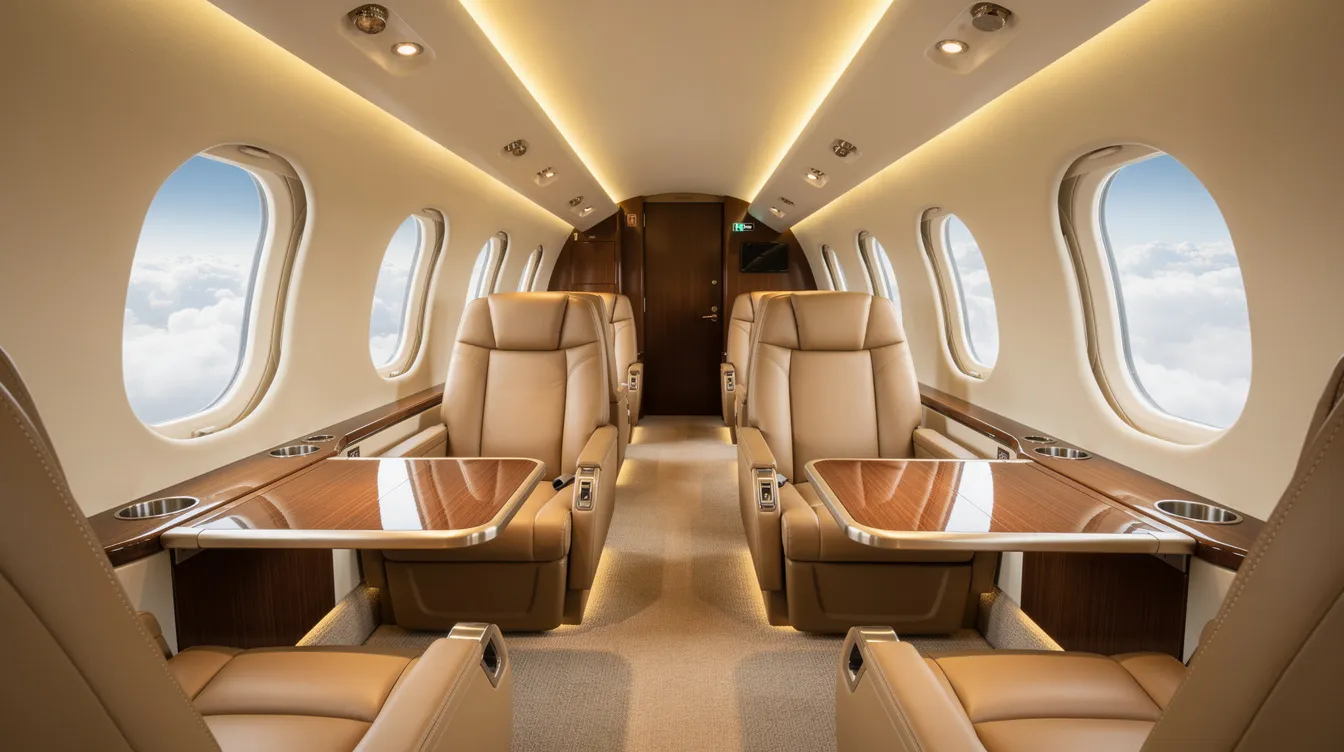
Performance: Range approximately 7,700 nmi at Mach 0.85 cruise; service ceiling 51,000 ft; passengers experience minimal turbulence at high altitude
Cabin: Four true living spaces plus a dedicated crew rest area, an optional permanent bed, and a stand-up shower, with large panoramic windows in every seat row
Wellness: Low cabin altitude, Soleil circadian-based lighting, advanced air filtration features that support recovery on 14-to-16-hour missions
Technology: Smooth Flĕx Wing and fly-by-wire controls for a smoother ride; GE Passport engine with health monitoring. Airlines are utilizing AI to manage dynamic operations and predict maintenance, and similar data-driven diagnostics now support business aviation fleet reliability.
Avionics: Bombardier Vision flight deck with synthetic vision, head-up displays, and integrated flight management systems
BlackJet positions Global 7500 access within higher-tier Jet Card or bespoke charter plans for clients based in York or San Francisco who need to connect city pairs like New York–Hong Kong or Singapore–San Francisco.
Global 8000: Fastest Business Jet and Next-Generation Global Airplane
Following its unveiling in May 2022, the Bombardier Global 8000 writes the next chapter in speed and range. As of this writing, it stands as the fastest purpose-built business jet in production.
Speed & range: The Global 8000 has a top speed of Mach 0.95, and it offers a range of 8,000 nautical miles at long-range cruise. Over 50,000 long-haul narrowbody flights are expected in 2026, yet no narrowbody can match this combination of speed and nonstop reach.
Cabin: It features four true living spaces in its cabin. The cabin altitude is just 2,691 ft, industry-leading for its class. The Global 8000 is designed to combat jet lag effectively through pressurization, lighting, and fresh-air systems.
Runway performance: The Smooth Flĕx Wing enables access to 30% more airports worldwide, including challenging approaches. This improves runway performance significantly over its predecessor.
Connectivity: Support for systems like JetWave and Starlink enables continuous productivity on transoceanic legs. Testing of high-mach flight profiles has validated the aircraft's supersonic-adjacent cruise envelope, drawing comparisons to the Concorde's ambition of shrinking the world.
Adoption: Early launch customers include major fractional operators. BlackJet plans to integrate Global 8000 access into future premium Jet Card offerings as charter availability grows. The aircraft's increased thrust and improved engine efficiency also support arguments for operators upgrading from the Challenger family or older Globals.
Inside the Cabin: Comfort, Cabin Altitude, and Wellness
Reduced cabin altitude is not a marketing feature-it's a physiological advantage. A global aircraft like the 7500 maintains cabin altitude between 4,500 and 5,700 ft at cruise, while commercial wide-bodies commonly run 6,000 to 8,000 ft. The difference translates to less fatigue, better oxygenation, and faster recovery.
While airports are increasingly adopting biometric technology to reduce passenger wait times and biometric identification is replacing traditional security checks at airports, private aviation sidesteps these bottlenecks entirely. Airports are pushing for self-service technologies to optimize resources, and airlines are moving toward total self-service in passenger operations-but BlackJet members bypass those queues altogether.
Nuage seats across the Bombardier Global family offer zero-gravity positioning for sleep and relaxation.on
Four-zone cabin layouts: lounge, dining/conference area, private suite with bed, and dedicated crew rest
Soleil lighting systems synchronize with circadian rhythms on overnight flights.
HEPA filtration and fresh-air systems maintain healthy cabin air across all hours of flight
BlackJet curates cabin experiences through pre-flight preferences, bespoke catering, and connectivity setups tailored to each member's workflow.
Bombardier Vision Flight Deck and Safety Technology
The Bombardier Vision flight deck equips Global 5500, 6500, 7500, and 8000 with large-format displays, synthetic vision, enhanced vision via head-up displays, and integrated flight management technologies.
The airline industry is undergoing digital transformation and sustainability initiatives, and these advances extend to business aviation avionics. Airlines adjust capacity in response to geopolitical events, and globalization introduces vulnerabilities to international travel and manufacturing, making robust, redundant cockpit systems essential.
GE Passport engines feature advanced health monitoring and predictive diagnostics.
Combined Vision Systems reduce pilot workload in low-visibility approaches
Performance-based navigation enables precise access to short or steep-approach airports
BlackJet's safety approach is determined by strict standards: partnering only with operators holding ARGUS, Wyvern, or IS-BAO certification, and assigning crew members who are Global-qualified with high hours in type—criteria that mirror those of the top private jet companies for luxury travel.
Global Airplane Performance: Range, Speed, and Field Capabilities
Range figures below assume NBAA IFR reserves, ISA conditions,s and typical passenger loads:
Model | Range (nautical miles) | Top Speed (Mach) | Cabin Altitude (ft) | Notable Features |
|---|
Global Express | ~6,500 | 0.80 | ~4,500 | Original Global, Honeywell Primus 2000XP, dual Rolls-Royce BR-710 engines |
Global 5500 | ~5,900 | 0.90 | Lower than Express | Rolls-Royce Pearl engines, quieter cabin, Nuage seats |
Global 6500 | ~6,600 | 0.90 | Lower than Express | Enhanced air filtration, payload flexibility |
Global 7500 | ~7,700 | 0.925 | 4,500 - 5,700 | Four living spaces, stand-up shower, Soleil lighting |
Global 8000 | ~8,000 | 0.95 | 2,691 | Fastest business jet, Smooth Flĕx Wing, advanced connectivity |
Field performance matters: the 7500 requires approximately 5,800 ft for takeoff at sea level, with landing distances around 2,400 ft, granting access to airports closer to city centers, similar to other large private jets built for global reach.
While the industry is investing in electric vertical takeoff and landing aircraft and urban air mobility initiatives are being established for short-range transit, Globals remain the definitive solution for intercontinental missions, while smaller airframes can serve travelers seeking the cheapest private aircraft options.
Alliances among airlines reduce costs in maintenance, sales, and personnel, but they cannot replicate the point-to-point directness of a global airplane or the flexibility of buying a seat on a private jet.
BlackJet Jet Cards: Accessing Global Business Jets Without Ownership
BlackJet's Jet Card programs offer 25-hour and 50-hour blocks with prepaid, predictable rates on Global-class aircraft, supported by a broader suite of premium private jet card services.
A member flying quarterly New York–London board meetings uses roughly 14 to 16 flight hours round-trip on a Global 6500, locking in rates across the year rather than facing fluctuating charter quotes, similar in concept to a 100-hour jet card cost structure.
Sustainability and Carbon-Neutral Flights in Global Aviation
Decarbonization has become an operational imperative for airlines, and the airline industry is focused on achieving long-term emission reduction targets. Airlines are investing in Sustainable Aviation Fuel to lower emissions, though sustainable aviation initiatives face challenges regarding carbon emissions at scale.
Using a newer Global nonstop can produce lower total emissions than older jets requiring fuel-intensive tech stops.
FAQs About Global Airplanes and BlackJet Access
What is considered the fastest business jet?
The Bombardier Global 8000 stands as the fastest purpose-built business jet currently in production, reaching a top speed of Mach 0.95.
How far can a Global 7500 or Global 8000 fly nonstop?
The Global 7500 reaches approximately 7,700 nmi. The Global 8000 has a range of 8,000 nautical miles at long-range cruise.
What does cabin altitude mean for passenger comfort?
Cabin altitude is the equivalent pressure altitude inside the aircraft. Lower values (2,691 ft on the 8000, ~4,500 ft on older Globals) reduce fatigue and jet lag versus commercial cabins at 6,000–8,000 ft.
How does BlackJet ensure safety on Global Jet flights?
BlackJet partners exclusively with operators certified to ARGUS, Wyvern, or IS-BAO standards, with type-rated crew and strict maintenance schedules.
Can I specify a Global aircraft with my Jet Card?
Yes. Higher-tier Jet Cards allow members to request Global 5500, 6500, or 7500 access depending on availability.
How much notice is required to book an ultra-long-range flight?
While some bookings can be made 24–48 hours ahead, intercontinental missions typically require several days for overflight permits and crew positioning.
Are Global flights with BlackJet carbon neutral?
Yes. Every BlackJet flight includes carbon offsetting at no additional charge through certified programs.
How to Choose the Right Global Airplane for Your Mission
Selecting the right Bombardier Global depends on your mission profile:
Trip distance: For flights under ~6,000 nmi, a Global 5500 often suffices. For Asia–U.S. or Australasian routes, the 7500 or 8000 is warranted—each competing with models listed among the top private jets in the world.
Passengers and payload: Larger groups or heavier luggage favor the 6500 or 7500 for their payload margins, while charters needing even more capacity may consider the best private jets for 50 passengers.
Onboard feature priorities: If a dedicated sleeping suite, shower, or four living zones matter, the 7500 or 8000 deliver, alongside other of the largest private jets designed for maximum luxury.
Airport access: Shorter runways or steep approaches favor the 7500/8000 with their superior field performance, which is a key consideration when evaluating a UK-based private jet purchase.
BlackJet advisors evaluate route distance, weather data, runway length, and schedule to recommend the optimal aircraft, including guidance for clients weighing the cheapest private jet options. Consider total door-to-door time, including ground transfers and airport proximity, not just airborne hours, whether you’re chartering an entire aircraft or simply buying an individual seat on a private jet. A slightly slower but direct Global often outperforms any commercial combination, especially on emerging city pairs such as private jet charters from Karachi.
Conclusion: Elevate Your Travel with the Bombardier Global and BlackJet
The Bombardier Global series represents the pinnacle of private aviation, combining unmatched range, speed, and cabin comfort to transform how discerning travelers connect the world. From the trailblazing Global Express to the record-setting Global 8000, these aircraft offer strategic advantages that go beyond luxury — saving time, enhancing productivity, and supporting wellness on every journey.
BlackJet’s Jet Card programs unlock access to this elite fleet without the burdens of ownership, providing seamless, carbon-neutral flights backed by rigorous safety and certification standards. Whether flying transatlantic board meetings, intercontinental leisure trips, or critical business missions, BlackJet’s curated Global experience ensures each journey is effortless, premier, and precisely tailored to your needs.
Discover how BlackJet can reshape your travel with exclusive access to the world’s most advanced global airplanes — where every flight is not just transportation, but a strategic asset for success.


 Sign up with google
 Sign up with Apple