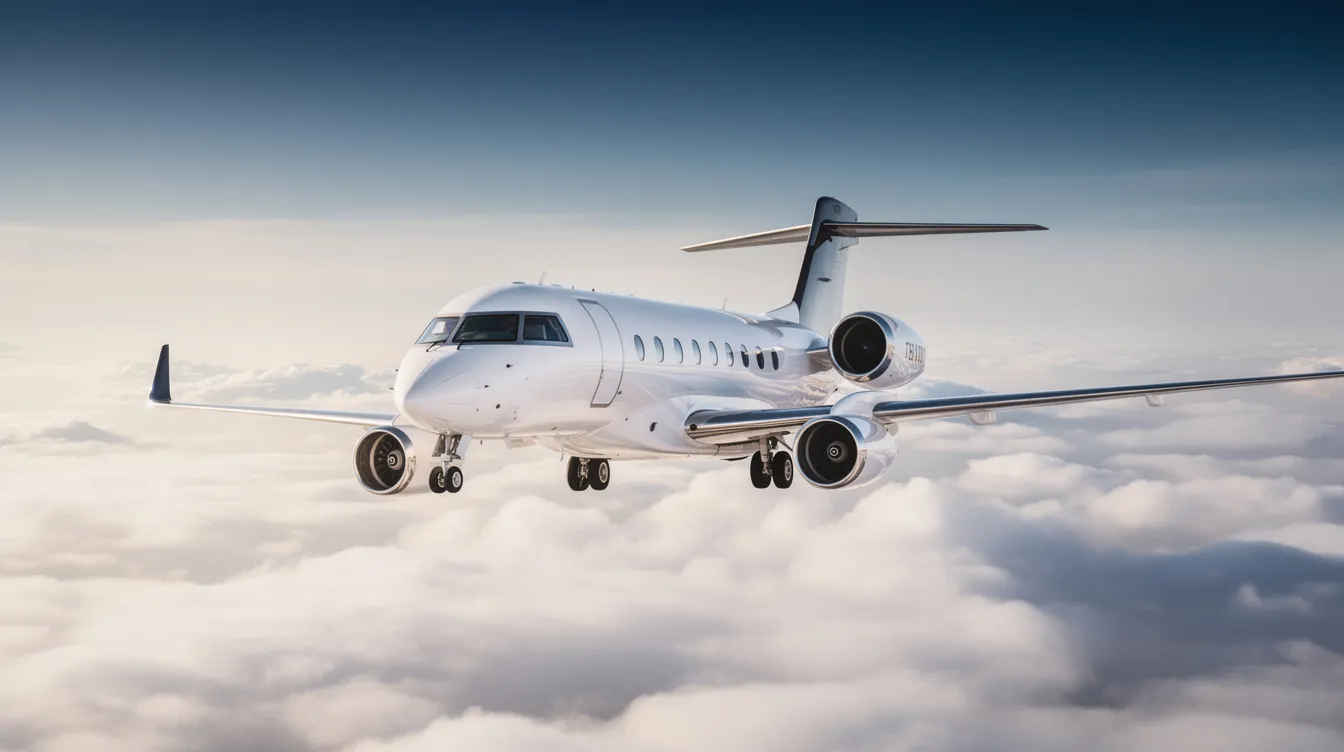
The HondaJet Echelon is Honda Aircraft Company's next-generation light jet, designed to bridge the gap between light jets and midsize cabin performance with a 450 KTAS cruising speed, 2,625 nautical miles of range, seating for up to 11 occupants, and the ability to fly nonstop on many transcontinental missions while still accessing shorter runways. For frequent business travelers, high-net-worth leisure flyers, and Jet Card members comparing advanced private aircraft, that combination matters because it promises fewer fuel stops, more point-to-point flexibility, and a more efficient way to reach airports that larger jets often cannot.
This article looks at how the HondaJet Echelon is positioned, what its design and cabin mean in practice, how its performance, safety systems, and avionics stack up, where it sits relative to other jet categories, when it is expected to enter service, and why its efficiency and sustainability profile make it a notable option in modern private aviation.
HondaJet Echelon and Honda Aircraft Company at a Glance
A nonstop flight from Teterboro to Van Nuys on a commercial itinerary, including connections, security queues, and ground transport on both ends, consumes roughly 8 to 10 hours of a traveler's day. The same city pair in a capable light jet takes under five hours, gate to gate, with departure and arrival at airports minutes from Manhattan and Los Angeles. That gap is where the HondaJet Echelon (HA-480) fits: Honda Aircraft Company's innovation in purpose, built to deliver nonstop transcontinental flight capability in an aircraft sized and priced below conventional midsize jets.
Honda Aircraft publicly named the Echelon at NBAA-BACE 2023, transitioning from the earlier "2600 Concept" designation. The aircraft targets a cruising speed of 450 KTAS (roughly 834 km/h), an NBAA IFR range of 2,625 nautical miles with one pilot and four passengers, and a service ceiling of 47,000 feet. It can accommodate up to 11 occupants in its cabin, including crew. These numbers, if confirmed through certification, would make the Echelon the first production light jet capable of routine coast-to-coast U.S. missions without a fuel stop, a convenience typically reserved for larger, costlier aircraft.
Production milestones are progressing. As of September 2026, Honda Aircraft completed the first major subassembly, its first wing structure, with five wing structures now in various stages on specialized assembly lines in Greensboro, North Carolina. Mainline final assembly is targeted for early 2027, with the actual first flight now expected in 2028 and type certification around 2031. These timelines have shifted from earlier projections; the original schedule called for first flight in 2026 and certification in 2028. All published specifications remain preliminary and subject to change as the development phase advances. At BlackJet, we track aircraft like the Echelon closely to refine our light and midsize jet offerings, ensuring our Jet Card members have access to the most capable aircraft available.
Specification | Target Value |
|---|
Max Cruising Speed | 450 KTAS (~834 km/h) |
NBAA IFR Range (1 crew + 4 pax) | 2,625 nm |
Service Ceiling | 47,000 ft (FL470) |
Takeoff Distance | ~3,300 ft |
Landing Distance | ~2,550 ft |
Wing Span | ~56 ft 8 in (~56.72 ft) |
Overall Length | ~57 ft 9 in (~57.79 ft) |
Cabin Height | ~5 ft 2 in (~5.21 ft) |
Cabin Width | ~5 ft 1 in (~5.08 ft) |
Cabin Length | ~25 ft 4 in (~25.38 ft) |
Typical Passenger Capacity | 8–10 passengers (max 11 occupants) |
Combined Stowage Volume | 120 cu ft |
Design, Cabin Experience, and Technical Capabilities of a Next Generation Business Jet
The original HondaJet (HA-420) earned its reputation through unconventional engineering: natural laminar flow wings, composite fuselage construction, and the now-iconic over-the-wing engine mount. The HondaJet Echelon grows that foundation into a larger airframe while preserving the design enhancements that made Honda Aircraft a serious name in business aviation. The result is an aircraft that transcends conventional category definition, delivering what Honda describes as midsize-like performance within a light-jet footprint.
Airframe and aircraft performance
The Echelon's external dimensions reflect its category-crossing ambition. With a wingspan of approximately 56 feet 8 inches and an overall length of roughly 57 feet 9 inches, the airframe is compact enough for hangars and ramp spaces that accommodate current light jets, yet large enough to house a spacious cabin suited for transcontinental missions.
The aircraft's design targets a 3,300-foot takeoff distance and a landing distance of about 2,550 feet. Those numbers matter because they open access to thousands of regional and secondary airports where longer-runway midsize jets cannot operate. For context, many popular midsize jets require 4,000 to 5,500 feet of runway. That difference determines whether a traveler can land at White Plains (Westchester County, 6,549 ft available) or must divert to a larger, more congested facility.
The NBAA IFR range of 2,625 nm covers New York to Los Angeles (~2,135 nm), Chicago to San Diego, Miami to Seattle, and dozens of other city pairs across North America and into Central America, all without refueling. This range capability enables nonstop transcontinental flight under single-pilot operation, a combination no other production light jet currently offers.
Propulsion and Evaluate Key Aircraft Systems Onboard
The HondaJet Echelon incorporates twin Williams International FJ44-4C turbofan engines, each producing approximately 3,450 pounds of thrust. The FJ44-4C is a mature engine platform already powering several light and midsize business jets, which reduces development risk compared to an all-new powerplant. The aircraft features over-the-wing engine mounting to reduce cabin noise, continuing the OTWEM (Over-The-Wing Engine Mount) approach that distinguished the HA-420.
Honda Aircraft's engineering team has emphasized increased electrical architecture throughout the Echelon's systems. By reducing the number of hydraulic and hydromechanical components and replacing them with electrically powered alternatives, the aircraft gains several benefits: lighter weight in certain subsystems, easier maintainability, increased reliability, and the ability to support several category-leading technologies in avionics and safety automation.
The avionics suite centers on a Garmin G3000-class integrated flight deck. Several systems leading this category are installed to augment pilot capabilities and lower workload:
Autothrottle: provides more precise control of engine power settings during climb, cruise, and approach, reducing pilot fatigue on longer flights
Autobrake: automates braking after touchdown for consistent stopping performance
Emergency Autoland: allows the aircraft to land itself at the nearest suitable airport if the pilot becomes incapacitated
Runway Overrun Awareness and Alerting System (ROAAS): monitors approach parameters and alerts the crew if conditions predict a runway overrun
Advanced Steering Augmentation System (ASAS): improves ground handling precision
These systems onboard collectively enhance safety during the most critical phases of flight. The HondaJet Echelon is designed for single-pilot operation, and these automation features are what make that certification target credible for long-range missions.
Cabin layout and combined stowage
The Echelon's stretched fuselage creates a two-zone cabin: a forward club seating area and an aft section configurable as either a second club arrangement or a divan, plus an enclosed aft lavatory. The typical configuration allows for flexible cabin layouts depending on mission requirements.
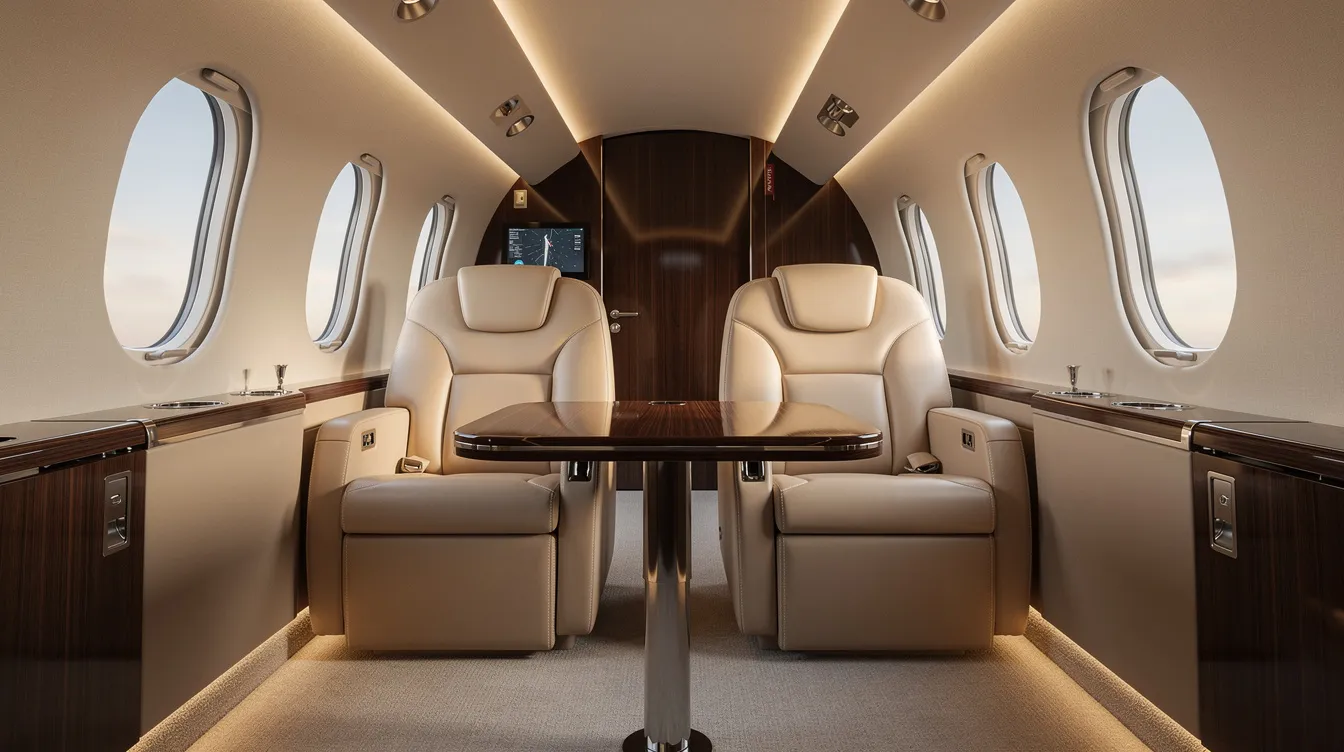
Three main seating configurations are planned:
Executive layout: fewer seats with generous legroom, optimized for 4-6 passengers who need workspace and privacy
Dual club seating: two facing-pair groups of seats, suitable for corporate groups of 6-8
Higher-density configuration: up to 10 passengers plus one crew member (11 total occupants), or 9 passengers with two pilots
The cabin height of approximately 5 feet 2 inches and width of about 5 feet 1 inch mean most passengers can stand and move between zones without crouching, a more spacious cabin experience than very light jets where cabin heights often fall below 4 feet 10 inches. The combined stowage volume of 120 cubic feet, split between cabin closets and external baggage compartments, accommodates multiple roll-aboard bags, garment bags, golf clubs, and ski equipment for 6-8 travelers. This capacity is an important differentiator for weekend leisure trips and multi-city business tours.
Comfort and inflight experience
The HondaJet Echelon features a class-leading cabin altitude of 6,363 feet at cruise, meaning the pressurization system maintains an internal environment equivalent to roughly 6,363 ft elevation even while the aircraft flies at FL470. Lower cabin altitude reduces passenger fatigue, headaches, and dehydration on flights exceeding three hours; a practical advantage for travelers who need to arrive ready to work.
The over-the-wing engine placement, combined with composite fuselage construction, isolates engine vibrations and noise from the cabin more effectively than rear-fuselage-mounted engines that transmit vibrations through the airframe. Honda's heritage with this mounting approach across more than 230 HA-420 deliveries provides real-world validation of the noise reduction claims.
Consider two mission profiles that illustrate how these cabin features combine with range and speed:
Executive roadshow: A CEO departs New York (Teterboro) at 7:00 AM for a board meeting in Dallas (Love Field, ~1,370 nm). After a two-hour ground meeting, the aircraft repositions to San Francisco (~1,470 nm) for an evening dinner. The 450-knot cruising speed and nonstop range make both legs feasible in a single day; the two-zone cabin allows the executive to conduct calls in the forward club while a colleague reviews documents on the aft divan.
Family leisure trip: A family of five departs Miami for Aspen (~1,400 nm) nonstop, carrying ski gear in the 120 cu ft stowage. The premium comfort of the pressurized cabin at 6,363 ft altitude keeps younger travelers comfortable, and the enclosed lavatory provides a convenience that smaller jets lack.
Development Status, First Flight, and Milestones
The HondaJet Echelon program has passed several design gates since its initial public concept reveal. Honda Aircraft completed a structural test rig in Q4 2021 and has since cleared Preliminary Design Review, with Critical Design Review targeted for completion. Production tooling installation at Greensboro was largely finished by the end of 2024, and the Advanced Systems Integration Test Facility (ASITF) is operational, allowing engineers to evaluate key aircraft systems and predict aircraft performance through enhanced aircraft integration testing before the aircraft leaves the ground.
The updated timeline, as of September 2026, places first flight in 2028 and type certification with first deliveries around 2031. These dates reflect the complexity of certifying an aircraft with this many advanced systems. Specifications remain subject to change as flight testing progresses, a reality that every new aircraft program navigates. Honda Aircraft has reported almost 500 letters of intent signed, with numbers increasing over the last several months, indicating strong market interest.
For BlackJet members, the practical takeaway is clear: the Echelon's technical attributes translate into fewer fuel stops, better access to secondary airports closer to final destinations, smoother rides at higher altitudes, and increased scheduling flexibility. This is just the beginning of how Honda's dream of expanding mobility skyward and challenging expectations reshapes the aircraft available within premium jet card programs.
Strategic Value for Jet Card Users and BlackJet Members
The HondaJet Echelon redefines what "light jet" access means for frequent travelers. An aircraft that matches or exceeds the range and cabin volume of many midsize jets, while maintaining light-jet operating economics, creates an exciting next chapter for premium private jet card holders who fly 2,000+ nm routes regularly. Honda Aircraft Company's relentless pursuit of category-leading technologies in aerodynamics and automation positions this aircraft as transforming aviation economics for private travelers.
Comparing options: Echelon versus alternatives
The differences between the Echelon and adjacent categories come down to specific trade-offs:
Factor | Very Light Jets | HondaJet Echelon (projected) | Typical Midsize Jets |
|---|
Range | 1,000–1,700 nm | 2,625 nm | 2,500–3,500 nm |
Cabin Height | 4 ft 4 in – 4 ft 11 in | ~5 ft 2 in | 5 ft 5 in – 5 ft 9 in |
Typical Passengers | 4–6 | 8–10 | 7–9 |
Takeoff Distance | 2,500–3,200 ft | ~3,300 ft | 3,800–5,500 ft |
Fuel Stops (NYC-LAX) | 1–2 | 0 | 0 |
Versus owning a jet outright, which involves capital outlay often exceeding $10 million, crew management, hangar costs, and residual-value risk, a jet card program provides the same point-to-point access without those fixed obligations. Jet card membership pricing structures offer prepaid access to private jets through programs that typically include 25-hour or 50-hour options, matching travel frequency to cost
. Compared to commercial first or business class, the math favors private aviation on routes involving connections. A one-stop commercial itinerary from White Plains to Scottsdale consumes 7-9 hours including ground transport; a direct flight in an Echelon-class aircraft takes roughly 4.5 hours, with departure and arrival at airports within 15 minutes of the traveler's home and destination, and a predictable jet card cost per hour that simplifies budget planning.
How BlackJet would position Echelon-class aircraft
When the Echelon enters service, aircraft in this class would fit BlackJet's fleet mix on high-frequency executive routes: Teterboro to Van Nuys, White Plains to Scottsdale, Chicago Midway to San Jose. These city pairs demand nonstop performance, efficient turn times, and access to airports that larger aircraft cannot reach, making them a natural fit for BlackJet 25+ Hour Jet Card members who need consistent capacity at fixed rates.
The spacious cabin and flexible layouts make the Echelon equally suited for corporate groups of 6-8 executives traveling to a quarterly offsite and for affluent families combining business and leisure. Range and runway performance allow BlackJet to serve smaller airports closer to clients' actual destinations, enhancing travel efficiency and cutting hours off round-trip itineraries, while still competing with the top private jets in the world on comfort and capability.
Safety, certification, and technology
When available, aircraft from the HondaJet Echelon program would be sourced exclusively from operators meeting top third-party safety standards such as ARGUS Platinum, IS-BAO, and Wyvern, in line with BlackJet's safety policy. The onboard safety systems, including Emergency Autoland and the runway overrun awareness alerting system, complement BlackJet's 24/7 operational oversight. Jet card users benefit from real-time flight support services throughout every mission, alongside transparent private jet price list comparisons that clarify total trip value.
Pilot training expectations for Echelon operations would include type-rated captains, recurrent simulator training, and standardization check flights. The advanced electrical architecture for safety, autothrottle, autobrake, and enhanced situational awareness systems all exist to lower workload in the cockpit, but they require pilots trained to manage those systems effectively. Technology and human expertise combine to produce outcomes neither achieves alone.
Sustainability and efficiency
The aircraft aims for improved fuel efficiency compared to traditional light jets. Honda Aircraft states targets of roughly 20% better fuel efficiency versus conventional light jets and over 40% improvement versus midsize jets on typical mission profiles. Those gains translate directly to lower CO₂ per passenger-mile and place the Echelon alongside the best aircraft of 2026 in terms of innovation and sustainability.
BlackJet layers additional commitments on top of aircraft-level efficiency. Jet cards offer carbon-neutral flight options for travelers; every eligible flight is offset through verified projects at no additional cost to the member. BlackJet's sustainability commitment means choosing a green private jet option does not require sacrificing performance or comfort. Trip-planning teams can also use the Echelon's 2,625 nm range to minimize repositioning legs and deadhead miles, further reducing emissions per revenue hour and aligning with affordable private jet options for efficiency-minded travelers.
Honda Aircraft has also targeted SAF (Sustainable Aviation Fuel) compatibility for the Echelon's engines, aligning with broader industry regulatory direction and the preferences of environmentally conscious travelers.
Practical jet card use cases
Scenario 1: Bi-weekly executive commute. A CEO based in New York commutes twice monthly to Denver (~1,620 nm). Using a 50-hour jet card, each round trip consumes roughly 7.2 flight hours. Over a year, 24 round trips total about 173 hours. The 450-knot cruising speed means each leg takes approximately 3.6 hours; the onboard workspace replaces the 2-3 hours of dead time a commercial itinerary would impose at each end. 50-hour jet card pricing combined with Jet cards' 24/7 digital booking tools means trip adjustments happen in minutes, not days.
Scenario 2: Seasonal family travel. A family holds a 25-hour card and uses it for four trips per year: Los Angeles to Sun Valley for skiing, LA to Cabo San Lucas for spring break, and two summer trips to the Pacific Northwest. The 25-hour jet card guide shows how the Echelon's combined stowage of 120 cu ft handles sports equipment and luggage for five travelers. The dual club cabin layout separates adults conducting work calls from children watching screens in the aft section.
Scenario 3: Multi-city corporate team travel. A chief commercial officer takes a team of six from Boston to Nashville (~860 nm) for a client meeting, then continues to Austin (~930 nm) for a tech conference. Both legs are well within the Echelon's range; the more spacious cabin with seating for all six allows informal strategy sessions between stops and offers an alternative to booking a private jet for 30 passengers when group sizes are more modest. Additional targets on the itinerary, like a side trip to a regional office, can be added without worrying about fuel range limitations.
Frequently Asked Questions about the HondaJet Echelon
What distinguishes the HondaJet Echelon from other light jets?
The HondaJet Echelon offers a unique combination of transcontinental nonstop range (2,625 nm), seating for up to 11 occupants, and single-pilot operation capability. It bridges the gap between light jets and midsize jets, providing midsize-like performance with the operating economics and runway flexibility of a light jet.
When is the HondaJet Echelon expected to enter service?
The current timeline targets the first flight in 2028, with type certification and first deliveries expected around 2031. These dates are subject to change as the development phase progresses.
How does the HondaJet Echelon enhance safety for private travelers?
The aircraft includes advanced safety features such as Emergency Autoland, autothrottle, autobrake, Runway Overrun Awareness and Alerting System (ROAAS), and an Advanced Steering Augmentation System (ASAS). These technologies reduce pilot workload and enhance situational awareness, supporting safe single-pilot operation.
What cabin configurations are available in the HondaJet Echelon?
The Echelon offers flexible cabin layouts including executive seating for 4-6 passengers, dual club seating for 6-8 passengers, and a higher-density configuration accommodating up to 10 passengers plus crew. The two-zone cabin design provides spacious comfort with a class-leading cabin altitude of 6,363 feet.
How does the HondaJet Echelon support sustainability in private aviation?
The Echelon targets roughly 20% better fuel efficiency compared to traditional light jets and over 40% improvement versus midsize jets, reducing CO₂ emissions per passenger-mile. It is also designed to be compatible with Sustainable Aviation Fuel (SAF), aligning with environmental goals.
Can the HondaJet Echelon access smaller airports?
Yes, with a takeoff distance of approximately 3,300 feet and landing distance of about 2,550 feet, the Echelon can operate from thousands of regional and secondary airports that many midsize jets cannot access, increasing travel flexibility.
How does the HondaJet Echelon fit within BlackJet's Jet Card programs?
The Echelon-class aircraft will serve high-frequency executive routes and provide premium comfort and nonstop range for both corporate groups and families. It fits naturally within BlackJet's 25+ Hour Jet Card offerings, providing consistent capacity at fixed rates with carbon-neutral flight options.
What is the cruising speed and maximum altitude of the HondaJet Echelon?
The Echelon cruises at 450 knots true airspeed (KTAS) and has a service ceiling of 47,000 feet, allowing efficient and smooth travel at high altitudes.
How does the HondaJet Echelon compare to owning a private jet?
Jet card membership with access to the Echelon-class aircraft offers the same point-to-point convenience without the capital outlay, crew management, hangar costs, and residual-value risk associated with ownership. It provides flexibility and cost predictability for frequent travelers.
What kind of support do Jet Card members receive when flying on the HondaJet Echelon?
Members benefit from 24/7 digital booking tools, real-time flight support services, and access to operators meeting the highest safety standards, ensuring seamless and secure travel experiences.
Explore private jet access built for your travel pattern.
The HondaJet Echelon is one entry in a broader wave of next-generation aircraft that will reshape private aviation over the coming years, alongside other newest private jets redefining long-range travel and cabin comfort. For travelers who fly today, the strategic advantage is not in waiting for a specific airframe; it is in establishing a travel framework that adapts as new aircraft enter service.
BlackJet's Jet Card programs deliver that framework: prepaid access across multiple cabin classes, 24/7 digital booking, real-time support, rigorous operator safety standards, and carbon-neutral performance on every eligible flight. Whether you fly 25 hours per year or 200, the right card level matches your route profile and frequency to the most capable aircraft available, supported by clear jet card pricing structures that explain how each option is billed.
Speak with a BlackJet advisor to align your travel pattern with the right Jet Card program. Resources like a 100-hour Jet Card cost guide can clarify how higher-usage tiers compare to smaller blocks. As Honda Aircraft and other manufacturers bring aircraft like the Echelon to market, your access evolves with them- no ownership risk, no crew management, and no compromise on range, comfort, or safety.


 Sign up with google
 Sign up with Apple