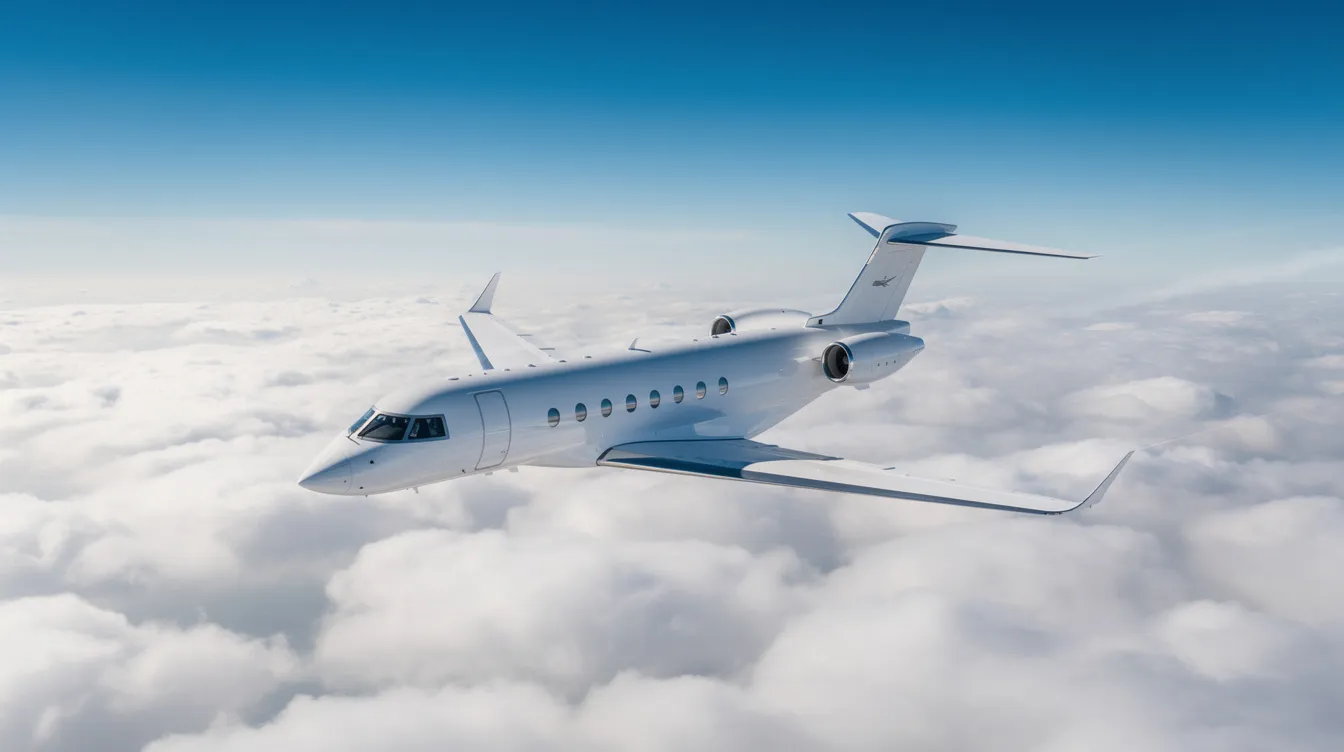
Private jet access is not simply a luxury; for executives, families, and principals who measure time in opportunity cost, it is a strategic advantage. This guide is intended for private flyers, aviation enthusiasts, and anyone considering chartering or learning about the Learjet 35. The Learjet 35 is an iconic American twin-engine light business jet, renowned for its speed and efficiency. The Learjet 35 became an icon because it could fly fast, use regional airports, and turn routes like New York–Miami or Los Angeles–Denver into efficient point-to-point travel. This guide covers the Learjet 35 history, technical specs, wingtip fuel tanks, military variants, safety record, and its place in the modern private jet charter market.
Strategic value of the Learjet 35 for private travelers
The Learjet 35 is an iconic American twin-engine light business jet and the most successful, highest-selling model in Learjet history. With cruise speed around 451–470 KTAS, a maximum speed of 510 mph, and access to short runways, it helped private flyers bypass hub congestion, security queues, and rigid airline schedules. For a BlackJet member, the same advantage now comes through curated light-jet access: predictable hourly rates, 24/7 digital booking, vetted operators, and carbon-neutral flight without owning a private Learjet through BlackJet’s premium Jet Card programs.

Design origins and development of the Bombardier Learjet 35
The aircraft's design originated from the earlier Learjet 25, with developments led by aviation pioneer Bill Lear. The Learjet 35 completed its first flight on August 22, 1973, and achieved official FAA certification by July 1974. Production of the Learjet 35 spanned from 1973 until 1993, with over 730 units built; production of the Learjet 35/36 series ceased in 1994, with over 600 units of the Model 35A built by the end of its production run.
The shift to fuel-efficient Garrett TFE731 turbofans more than doubled its range compared to earlier models. Its swept wings, T-tail, aft fuselage engines, single slotted flaps, landing gear, and wingtip fuel tanks distinguish the airplane immediately. The Learjet 35a was powered by two Honeywell TFE731-2-2B engines, with 3,500 pounds of thrust each, while references to TFE731 2 2 B engines remain common in maintenance records. Bombardier acquired Learjet in 1990, and Bombardier Learjet support evolved even after production ended.
Learjet 35 vs Learjet 35A: key differences
The original Learjet 35 entered service around 1974; the improved Learjet 35A became the dominant Learjet model. The 35A brought higher takeoff weight, refined fuel management, improved hot-and-high performance, and an operational range often discussed between 2,000 and 2,400 nautical miles, depending on payload and reserves.
Historically, the 35 favored shorter corporate hops. The 35A favored longer charter, medevac, and air taxi work. The related Learjet 36 was the longer range model, using a larger fuselage fuel tank and shortened passenger area to trade seats for distance.
Cabin experience and performance for private travelers
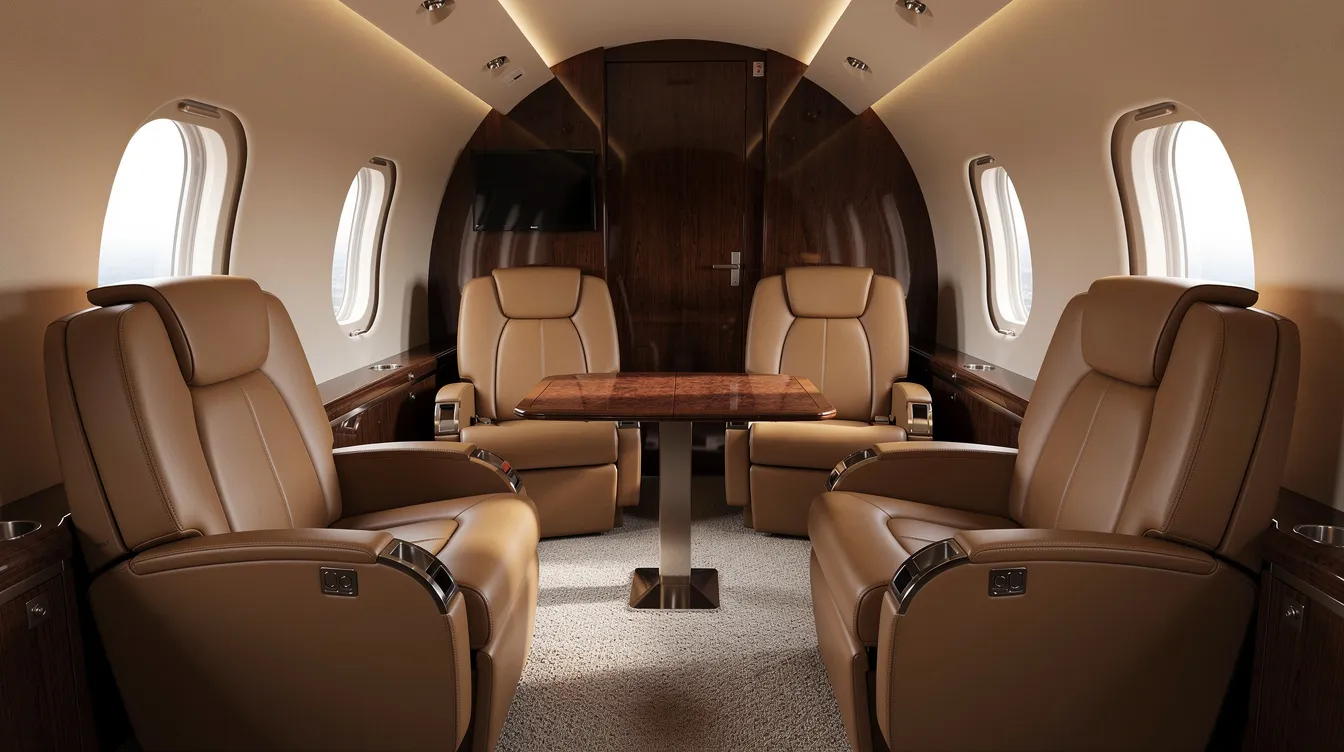
The Learjet 35 typically accommodates six to eight passengers in a tight cabin configuration, whereas large-cabin aircraft are better suited when evaluating the best private jet for 20 passengers. It can carry up to eight passengers in a cabin measuring 12.9 feet long by 4.9 feet wide by 4.3 feet tall, with 268 cubic feet of cabin volume. Travelers get swivel seats, five windows per side, side ledges, and 40 cubic feet of baggage space; the Learjet 35 has a baggage capacity of 40 cubic feet, accessible in-flight under certain conditions.
The Learjet 35 is historically celebrated for its speed and transcontinental range but criticized for its cramped cabin and limited baggage space, especially when compared with the top 10 best private jets in the world. Its 9.4 psi pressure differential allows a comfortable sea-level cabin altitude at high altitudes. A BlackJet Jet Card member flying Chicago–Aspen or London–Ibiza may choose a modern Learjet-class jet with more space, comfortable cabins, Wi-Fi, and quieter interiors while preserving the speed and airport flexibility through the BlackJet 25+ Hour Jet Card.
Technical specifications and unique engineering features, including wingtip fuel tanks
For buyers, charter users, and enthusiasts considering longer nonstop missions and ownership, the best long-range private jets for sale offer very different capabilities, but for the Learjet 35, the key numbers are straightforward. The Learjet 35 has a maximum cruising speed of up to 464 knots, or Mach 0.81, fast cruise capabilities of up to 451 knots true airspeed, maximum operating altitude up to 45,000 feet, maximum range of 2,789 miles, and typical range around 1,900–2,056 nm in many charter profiles.
Fuel capacity is about 931 U.S. gallons, with fuel tanks in the wings and tip pods. Refueling accomplished at ground level through each wingtip tank helped simplify service at smaller airports. Passenger capacity is up to eight plus two pilots, usually a pilot and a co-pilot, so operators turn to larger aircraft when they need the best private jet for 50 passengers. Original aircraft were equipped with analog avionics; many now add Garmin-style GPS, weather radar, ADS-B, optional Wi-Fi, and updated autopilots. Aging aircraft need scheduled inspections, corrosion checks, pressurization work, and engine programs.
Specification | Learjet 35 / 35A |
|---|
Engines | 2 × Honeywell TFE731-2-2B turbofans |
Thrust per engine | 3,500 pounds |
Maximum cruising speed | Up to 464 knots (Mach 0.81) |
Maximum speed | 510 mph (872 km/h) |
Typical cruise speed | Up to 451 knots true airspeed (KTAS) |
Maximum operating altitude | 45,000 feet |
Maximum range | 2,789 miles (2,424 nautical miles) |
Typical range | 1,900–2,056 nautical miles |
Fuel capacity | 931 U.S. gallons |
Cabin dimensions (L×W×H) | 12.9 ft × 4.9 ft × 4.3 ft |
Cabin volume | 268 cubic feet |
Passenger capacity | 6–8 passengers |
Baggage capacity | 40 cubic feet (mounted storage) |
Military variants, government use, and special missions
The Learjet 35/35A airframe produced several military variants for the air force and government users. The United States Air Force operates a modified version of the Learjet 35, designated as the C-21A, for cargo and medical evacuations. As a military transport aircraft manufactured from a business jet platform, the C-21A could carry up to eight passengers, cargo, litters, and theater commanders, with military radios, TACAN, autopilot, and weather radar.
The Learjet 35 was used by the Finnish Air Force during the Cold War for monitoring Soviet aircraft over the Baltic Sea and Arctic regions. Other aircraft performed similar functions for liaison, reconnaissance, maritime patrol, and training; some variants carried training assessment devices, firing training assessment devices, or a missile seeker simulator. That breadth reinforces the platform’s good handling characteristics, reliability, and usefulness beyond civil charter.
Safety record, notable incidents, and modern safety standards
The Learjet 35 and 35A have a long global service history, including serious accidents. As of January 2018, the U.S. National Transportation Safety Board database records 25 fatal accidents involving the Learjet 35/35A models. Industry lessons often involve operational factors: unstable approaches, runway overruns, training events, loss of control, or aging-system failures rather than a single inherent flaw. On November 1, 2023, a Learjet 35A crashed in Cuernavaca, resulting in the deaths of all four occupants after the aircraft overran the runway and caught fire. On July 23, 2024, a Learjet 35 crashed shortly after takeoff from Matupá Airport, killing both occupants in a post-crash fire; reports described the site near a eucalyptus plantation.
Modern mitigation is clear: disciplined crew training, standardized operating procedures, third-party safety audits, modern avionics, and maintenance programs. BlackJet partners with vetted operators aligned with top audit concepts such as ARGUS and IBAC standards, and many Jet Card flights use newer aircraft with enhanced situational awareness, comparable to fleets operated by the top private jet companies worldwide.
Learjet 35 in today’s private aviation landscape
Several hundred Learjet 35A examples remain active in private, corporate, medevac, and air taxi service, especially across the continental United States and Latin America, alongside newer models that support buying a seat on a private jet through shared or shuttle-style services. A Learjet 35 in good condition costs around USD$8 million, though older or less-refurbished examples can trade lower depending on condition and the operating company or seller context, and some buyers instead explore the cheapest private jet options to balance purchase price with ongoing costs. The price of chartering a Learjet 35 varies depending on the length of the journey and the airports involved. ACMI wet lease rates for the Learjet 35 vary based on factors such as the aircraft’s age, the length of the lease term, the guaranteed block hours, and the average cycle ratio, similar to broader private jet leasing structures and costs.
Operators still value low fuel burn relative to older turbojets, strong speed, and proven dispatch performance. BlackJet members, however, often expect newer cabins, full connectivity, and sustainability built into every journey, increasingly looking at the newest private jet innovations that redefine comfort and performance.
BlackJet Jet Card access vs owning a Learjet 35
Owning a vintage Learjet 35A means purchase exposure, crew payroll, hangar costs, insurance, inspections, and engine reserves. Heavy maintenance can quickly exceed the apparent simplicity of buying one jet.
BlackJet’s 25-hour Jet Card programs and 50-hour Jet Card options give clients access to light, midsize, and large-cabin options with no asset risk, no downtime surprises, and no need to manage 6,000-landing or 12,000-hour events. For example, a client flying 50–75 hours per year can select the right aircraft for each trip instead of committing to one cabin, one range profile, and one maintenance line, and frequent travelers can evaluate whether a 100-hour Jet Card structure better matches their annual flying.
Sustainability, technology, and the evolution beyond the Learjet 35
The Learjet 35 was designed before carbon accounting and digital ecosystems became central to private aviation. BlackJet ensures every arranged flight is carbon neutral through verified offset or insetting programs, a standard not inherent to original Learjet operations, while transparent jet card pricing structures help members understand the full cost of that flexibility.
Modern aircraft in BlackJet’s network commonly offer glass cockpits, real-time weather and traffic, satellite communications, and high-speed cabin Wi-Fi. In a Learjet 35A, those capabilities depend on retrofit investment. BlackJet curates access that preserves Learjet-level performance while elevating safety, sustainability, technology, and comfort for travelers, comparing the best jet cards for frequent flyers.
FAQ: Learjet 35, charter access, and BlackJet
What is the range of a Learjet 35A?
Typical range is about 1,900–2,056 nautical miles in many operating profiles, while the operational range of the Learjet 35 is often cited between 2,000 and 2,400 nautical miles depending on load, weather, and reserves.
How many passengers can a Learjet 35 carry?
The aircraft typically seats six to eight passengers, plus two pilots. Full fuel, cargo, and passenger count affect dispatch planning.
Is the Learjet 35 still used for private charters?
Yes. Some operators still fly the Learjet 35 in charter, medevac, and special-mission service, though availability varies by region and aircraft condition.
Can I request a Learjet-class jet with a BlackJet Jet Card?
Yes. BlackJet focuses on aircraft class, mission fit, safety, and comfort, so members can access comparable or superior light-jet performance without depending on one vintage airframe.
Are Learjet 35 flights carbon-neutral with BlackJet?
BlackJet ensures flights arranged for members are carbon neutral across its partner fleet through verified sustainability programs.
Why did the Learjet 35 become one of the successful light jets?
Its blend of speed, range, small-airport access, and efficient engines made it a breakthrough business aircraft for executives and government users.
Conclusion and call to action
The Learjet 35 and Learjet 35A reshaped light-jet travel by combining fast cruise, efficient range, and access to smaller airports with minimal wasted time on the ground. It remains a respected classic with rich civil and military history, but today’s discerning travelers expect quieter cabins, connectivity, safety certification, and carbon-neutral operations. Explore BlackJet’s Jet Card programs to access Learjet-class performance with modern assurance.
Elevate your travel on your terms-discover how BlackJet can deliver Learjet-level speed with a next-generation private aviation experience.


 Sign up with google
 Sign up with Apple