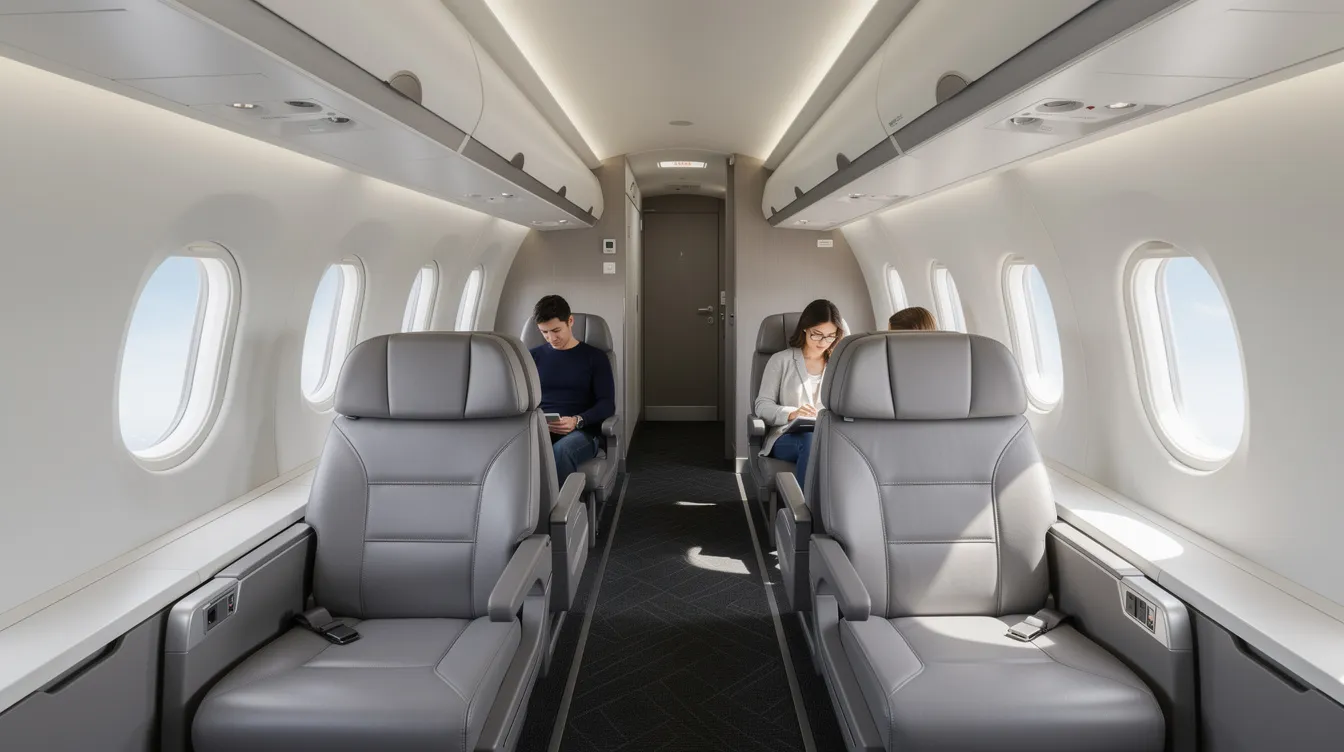
The Embraer 175 is one of the most commonly flown aircraft in North America, and if you’re searching for SeatGuru Embraer 175 seat maps or advice, you’re in the right place. This guide is for travelers comparing seat options on the Embraer 175, whether flying commercial or considering private jet alternatives. Choosing the right seat can significantly impact comfort and productivity on regional flights. The Embraer 175 is a popular regional jet, and understanding its seat map is essential for maximizing your travel experience.
Quick Facts: Embraer 175
Seating layout: 2-2 seating configuration (two seats on each side of the aisle, no middle seats) in economy and premium cabins
Total seats: Typically 76 passengers
Best seats: Solo A seats in first class (2A, 3A, 4A); front-row Economy Plus/Main Cabin Extra; exit row windows in main cabin
Worst seats: Last row near lavatory (limited recline, noise); windowless/misaligned window seats (e.g., 19F)
Overhead bin space: Tighter than mainline jets; late boarders may need to gate-check bags
Wi-Fi: Available on most flights
Entertainment: Bring Your Own Device (BYOD) streaming; no built-in seatback screens
Embraer 175 Basics: Aircraft Type, Layout & How Many Seats
The Embraer 175 is a twin-engine regional jet and a workhorse of the E-Jet family. The Embraer 175 is a popular regional jet. Here is how many seats it carries and how they break down:
Total capacity: The Embraer 175 typically seats 76 passengers in most American Airlines and United configurations. Some "Spacious Cabin" variants at other airlines drop to 70 seats to allow more premium space.
Seating configuration: All cabins on the E175 use a 2-2 seating configuration (two seats on each side of the aisle, no middle seats).
Class configurations: The E175 features a dual-class (first and economy) or tri-class (first, premium economy, and economy) seating configuration, depending on the airline.
Cabin Class | Seat Count | Seat Pitch (inches) |
|---|
First Class | 12 | 37 |
Premium Economy | 16–20 | 33–34 |
Main Cabin | 44–48 | 30–31 |
All cabins on the E175 use a 2-2 seating configuration, so there are zero middle seats on this aircraft. Passengers report that the Embraer 175 has a more spacious cabin feel compared to older regional jets, largely because of this layout.
The Embraer 175 can have quite different configurations by airline. United's E175 has 12 first-class seats and 64 main cabin seats. Delta's E175 also uses a 2-2 seating configuration with no middle seats. Operators include Republic Airways, SkyWest Airlines, and regional affiliates flying under American Eagle, United Express, and Delta Connection brands.
This aircraft serves routes roughly one to three hours long, connecting regional cities to major hubs, which is also the distance band where many travelers first explore how to buy a seat on a private jet instead of flying commercial.
With the basics covered, let's move on to a SeatGuru-style overview of the best and worst seats on the Embraer 175.
Quick Answer: Best Seats on the Embraer 175 (SeatGuru-Style Overview)
The Embraer E175 is a popular regional jet typically configured with 76 seats across a dual-class or tri-class seating configuration (dual-class: first and economy; tri-class: first, premium economy, and economy). American Airlines, United Airlines, and Delta Connection all operate this aircraft type on short- to medium-haul routes, and the seat map matters because small differences in row and position translate into real comfort gains on a one- to three-hour flight.
Best seats at a glance:
First class cabin: Solo A seats on the left side (2A, 3A, 4A) offer a window plus aisle access with no seatmate. These are consistently the best seat picks.
Economy Plus / Main Cabin Extra: Front-row premium economy seats just behind first class (row 7 on many United layouts, equivalent rows on American Airlines) deliver extra legroom and a quieter ride.
Main cabin seats: Exit row windows provide the most room in standard economy. Avoid the last row near lavatories.
A defining advantage of the Embraer 175 is that there are no middle seats anywhere on the plane. First class uses a 1-2 layout, while all other cabins use a 2-2 configuration, meaning every passenger gets either a window or an aisle. That alone makes it more comfortable than 3-3 narrowbody jets like the 737 or A320.
For travelers who have moved past seat selection optimization entirely, a BlackJet Jet Card eliminates the seat map altogether: full cabin privacy, flexible scheduling, and carbon-neutral flights by default, all within premium private jet card programs.
First Class on the Embraer 175: Comfort, Specs & SeatGuru Insights
First class on the E175 has 12 seats with 37-inch pitch, about 19.5–20-inch seat width, and roughly 5 inches of recline. American Airlines' E175 has 12 first-class seats in a 1-2 layout: a solo seat A on the left side and paired C/D class seats on the right.
Solo A Seats: The Best in First Class
Seats 2A, 3A, and 4A give you both a window and an aisle with no seatmate, making them the sweet spot for privacy.
They sit farther from the forward galley than row 1, reducing noise and light disturbance.
Row 1 offers extra legroom but sacrifices under seat storage during takeoff and landing, and seats 1C/1D catch more galley traffic.
First Class Amenities
AC power outlets at every seat
USB ports
Priority boarding
Dedicated overhead bins
Complimentary catering on qualifying flights
Adjustable armrests and a quieter front cabin
That said, even the best first class cabin on the Embraer 175 means sharing the cabin with up to 11 other travelers, flying on a fixed schedule, and clearing TSA before you board—constraints that have fueled interest in private plane rideshare options.
First Class vs. a BlackJet Private Cabin
Consider an executive flying New York to Chicago twice a month. On an Embraer 175 in first class, the journey includes 60–90 minutes of pre-flight time for parking, security, and boarding, plus a shared cabin with limited privacy.
With a BlackJet Jet Card, that same traveler drives to a private terminal, boards within 15 minutes, and controls the entire cabin, departure time, and onboard service. A BlackJet Jet Card offers private boarding and flexible scheduling across multiple aircraft types.
Key differences:
Privacy: Hold confidential meetings or calls mid-flight without nearby passengers. On an E175, conversations carry across the first-class cabin.
Pricing model: Commercial first class is priced per seat per flight. A Jet Card is prepaid by the hour (a 25-hour block, for example), covering multiple trips, with details broken down in guides to Jet Card pricing structures.
Sustainability: BlackJet flights are carbon-neutral at no extra cost through integrated offsets, even as they help clients evaluate the cheapest private aircraft options that balance budget and environmental impact. Commercial passengers rarely have direct control over emissions.
If you are routinely booking E175 first class, a 25-hour Jet Card program may be the more strategic play.
Now, let's compare premium economy and standard main cabin options for those not flying up front.
Main Cabin Extra / Economy Plus vs Standard Main Cabin
Premium economy on the Embraer 175 sits between first class and standard economy. On American Airlines it is called Main Cabin Extra; on United Airlines it is Economy Plus.
Premium Economy Features
20 seats with 34-inch pitch on most layouts. Some 70-seat "Spacious Cabin" variants expand this zone to 30+ seats.
Standard economy class has 44 seats with 30-inch pitch and the same 18–18.5 inch seat width.
Both zones use the 2-2 layout, so even standard economy avoids the dreaded middle seats found on larger jets.
Common complaints for the Embraer 175 include firm seat cushion comfort, which is more noticeable in standard economy where pitch is tighter. The premium economy zone eases this with more knee room and often earlier boarding access.
Finding the Best Seats in the Main Cabin
For travelers sticking with main cabin seats, here is where to aim:
Front-row Economy Plus / Main Cabin Extra (row 7 on many United configurations, rows 5–6 on some American Airlines layouts): best legroom in economy, quick deplaning, quieter cabin position.
Rows 8–10 on AA's E175 often hit the same point of balance between speed off the plane and reasonable pitch.
Exit row windows: Genuine extra legroom, though armrests are fixed and you must meet safety requirements.
Seats to watch out for:
Bulkhead economy rows gain legroom but lose under seat storage.
Certain window seats in the rear suffer from poor window alignment. Seats like 19F on some American Airlines and United layouts lack a usable window and are flagged on seat map tools.
Travelers who find themselves repeatedly stuck in subpar seats often start exploring the cheapest private jet options as an upgrade path from regional jets like the E175.
With main cabin options covered, let's look at which seats to avoid and why.
Seats to Avoid: Rear Rows, Galley Proximity & Window Oddities
Rear Row Drawbacks
Galley Proximity Issues
Window Alignment Problems
Windowless or misaligned windows: Certain rear window seats (19A, 19F on some layouts) have windows positioned too high or missing entirely, a frustrating surprise for travelers who specifically chose a window seat.
Overhead Bin Space
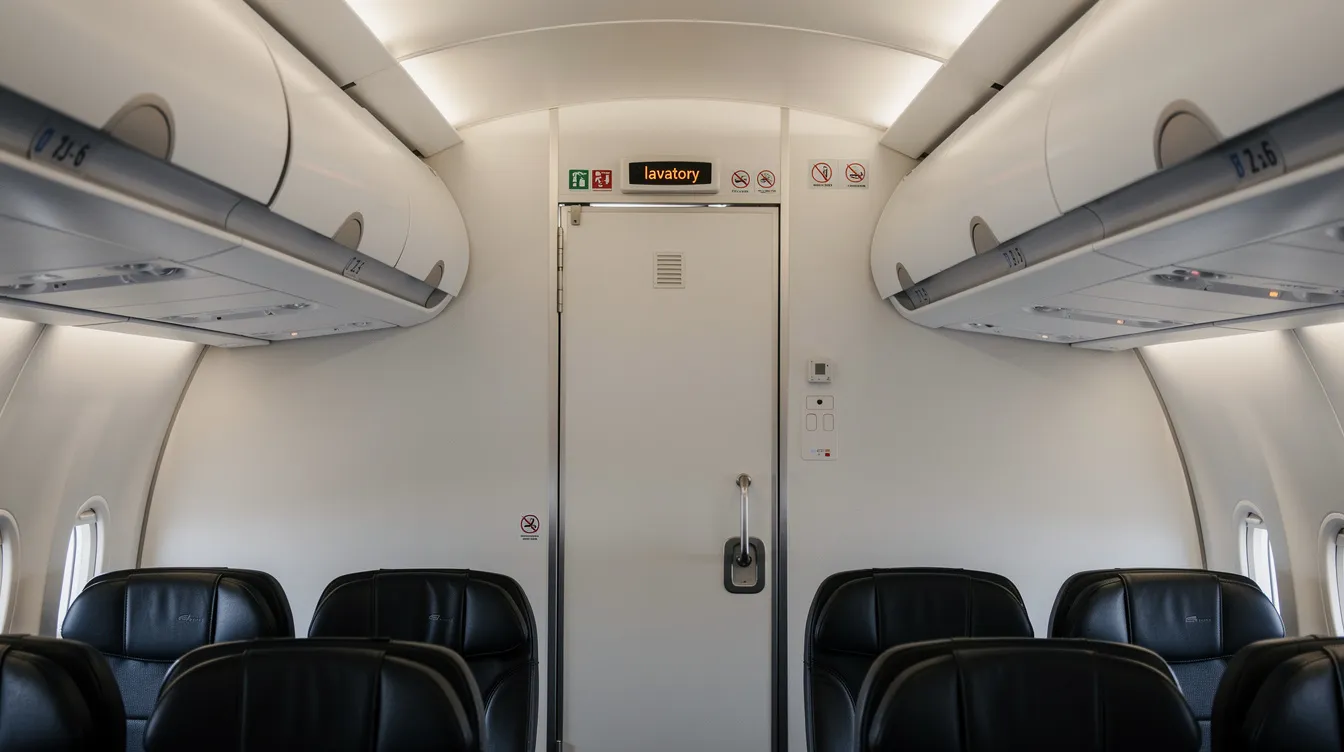
With seat selection pitfalls in mind, let's review the onboard technology and amenities available on the Embraer 175.
Wi‑Fi, In‑Seat Power & Entertainment on the Embraer 175
Wi‑Fi Availability
Most modern Embraer 175s are equipped with Wi‑Fi, though speed and provider vary by airline. American Airlines uses Viasat Ka-band; some United Express jets now feature Starlink connectivity.
Entertainment Options
The Embraer 175 has no built-in seatback screens.
Most modern Embraer 175s feature Bring Your Own Device entertainment, meaning content is streamed to personal devices through the airline's app on your own device.
Power Outlets and USB Ports
First class seats include power outlets for charging devices (AC power at every seat).
USB ports are available in many Main Cabin Extra rows.
Rear economy seats on older or unrefitted jets may lack any power source.
Wi-Fi is available on most Embraer 175 flights, though bandwidth is shared among 70+ passengers, and video calls can be unreliable at cruising altitude.
Technology & Productivity: E175 vs BlackJet
For business travelers, Wi‑Fi on an E175 handles email and messaging reliably but struggles with video conferencing or large file transfers. The shared bandwidth is a real constraint.
Contrast this with a BlackJet scenario: a client booking a midsize jet through a 25-hour Jet Card uses stable onboard connectivity to run a virtual board meeting en route from Los Angeles to Denver, with tailored power and connectivity pre-specified via BlackJet's digital booking platform—exactly the kind of use case profiled in overviews of the best Jet Cards for frequent flyers. That level of control simply does not exist when you are choosing seat 7A on a commercial plane.
With amenities and connectivity covered, let's examine how the E175 compares to private jet travel in terms of safety, comfort, and sustainability.
Safety, Comfort & Sustainability: E175 vs Private Jet Travel
The Embraer 175 complies with FAA Part 121 regulations and boasts a strong safety track record. It is a contemporary, well-maintained aircraft operated by all major carriers. It is a modern, well-maintained aircraft across all major carriers.
Embraer's enhanced winglets reduce fuel burn by 6.4%, making the E175 one of the more efficient regional jets in service, though pilots and owners looking for efficiency at a smaller scale often gravitate toward the best, cheapest planes.
BlackJet operators meet or exceed commercial safety benchmarks under FAA Part 135, with proprietary vetting, maintenance tracking, and crew standards across the Jet Card network, comparable to other leading providers whose programs—like Flexjet Jet Cards and their costs—many travelers research when weighing private options.
On sustainability: BlackJet flights are carbon-neutral through integrated offsets at no additional cost. Commercial passengers have limited visibility or control over airline emissions programs.
Comfort Trade-Offs & Strategic Time Savings
A typical E175 day trip, say Dallas to Nashville on American Airlines, involves 60–90 minutes of pre-flight time (parking, security, boarding), the flight itself, and arrival logistics. Even with the best seat selection, that overhead is fixed, which is why many travelers eventually evaluate whether chartering a private jet is worth it.
On a similar regional-length route via BlackJet, the journey compresses: arrive at a private terminal 15–20 minutes before departure, walk directly to the aircraft, and depart on your schedule. Business travelers who fly E175 first class weekly can reclaim dozens of hours annually by shifting key routes to a Jet Card model and understanding their Jet Card cost per hour.
With these strategic differences in mind, let's look at how to use seat maps versus Jet Cards for optimizing your travel.
Using Seat Maps Strategically vs Choosing a Jet Card
SeatGuru-style maps for the Embraer 175 help you find seats like 2A in first class, row 7 in Economy Plus, or exit rows in the main cabin while steering clear of rear rows and windowless spots. This micro-optimization genuinely improves a two-hour flight.
But it has limits. You cannot change boarding processes, weather delays, or the fact that you share the cabin with 70+ other passengers. The gains are incremental.
A BlackJet Jet Card program is macro-optimization: instead of competing for the best seat, you control the entire aircraft, departure time, and routing under predictable, prepaid Jet Card pricing. Jet Card tiers like the 25-hour block serve regional business travelers, while50-hourr Jet Card options cover those combining domestic and transcontinental trips.
If you routinely research the best seat on every flight, your travel volume may already justify a shift to private aviation for at least a portion of your journey schedule—and it may be time to consult a private jet price list guide to understand the full range of options.
Two Example Traveler Scenarios
Scenario 1: Weekly consultant, Boston → Washington. She books Main Cabin Extra on an American Airlines Embraer 175 every Monday, always aiming for front-row seats to maximize productivity. Despite smart seat selection, she loses roughly five hours per week to security, boarding, and taxi queues. Shifting two round trips per month to a Jet Card saves her 10+ hours monthly-hours redirected to billable work, and heavy users like her eventually compare options such as a 100-hour Jet Card cost guide.
Scenario 2: Family of four, Chicago → Aspen ski trip. On a United E175, they deal with checked ski gear fees, tight overhead bins, limited legroom for teenagers, and rigid departure times. Chartering a light jet via BlackJet Jet Card hours gives them flexible departure, room for luggage and equipment, pet-friendly access, and a direct route to mountain airports—illustrating the dynamics covered in guides on how much it costs to charter a small plane.
With these scenarios in mind, let's answer the most common SeatGuru Embraer 175 questions.
Key SeatGuru-Style FAQs: Embraer 175 & American Airlines
How many seats are on the American Airlines Embraer 175? Typically 76 seats: 12 first class, 20 Main Cabin Extra, and 44 main cabin. Minor variations exist depending on the regional partner operator.
Are there middle seats on the Embraer 175? No. First class is 1-2, and economy is 2-2. Every seat is either a window or an aisle.
What are the best seats on the Embraer 175?
First class: 2A, 3A, 4A (solo, quiet, full access)
Economy Plus: front row (often row 7)
Main cabin: exit row windows for extra legroom
Which seats should I avoid?
Last rows near lavatories
Windowless seats like 19F on certain layouts
1C/1D if you want quiet and storage
Does the Embraer 175 have Wi‑Fi and power outlets? Yes. Most AA and UA E175s offer Wi‑Fi. First class has full AC power. Main Cabin Extra often has USB or AC power. Rear economy may lack outlets on older jets.
How does flying first class on an Embraer 175 compare with a private jet via a Jet Card? First class is a shared cabin with fixed schedules and per-seat pricing. A Jet Card provides full privacy, prepaid hourly access, departure flexibility, and BlackJet's carbon-neutral guarantee.
With your most pressing questions answered, let's wrap up with a summary and invitation to explore private jet alternatives.
Conclusion & Invitation to Explore BlackJet
The Embraer 175 is a solid regional jet: no middle seats, a respectable first class product, and clear winners on every seat map. Smart seat selection—choosing solo first class seats, Main Cabin Extra front rows, and avoiding the rear—meaningfully improves the experience.
But it cannot eliminate queues, delays, or cabin-sharing. For travelers who have outgrown those limitations, BlackJet offers the next step:
Safety: Operators vetted to meet or exceed commercial benchmarks
Sustainability: Every flight is carbon-neutral through integrated offsets
Control: Choose your aircraft, schedule, and cabin environment through a 24/7 digital platform
Explore BlackJet Jet Card programs and discover what travel looks like when the entire cabin is yours.


 Sign up with google
 Sign up with Apple