Introduction
This guide is for frequent business travelers, high-net-worth individuals, and anyone interested in the intersection of commercial and private aviation. The Embraer 175 is designed, built, certified, and supported by Embraer S.A., the Brazilian aircraft manufacturer based in São José dos Campos. It is one of the most common aircraft you will encounter on regional routes across North America and beyond, which makes its maker worth knowing if you are a frequent business traveler or high-net-worth leisure flyer comparing commercial regional service with private aviation options.
A "regional jet" is a type of aircraft designed for short to medium-haul routes, typically seating up to 150 passengers. Embraer manufactures regional and commercial jets seating up to 150 passengers, making them a dominant force in this market segment.
This guide explains the manufacturer behind the E175, its design and operating history, technical specifications, safety record, role in regional aviation, the effect of scope clauses on where it flies, and how it connects to private jet planning and sustainability goals. For travelers building efficient, flexible, premium itineraries, understanding who makes the Embraer 175 helps clarify the aircraft’s comfort, safety, and operating context—and how regional airline flights can complement a broader private travel strategy.
Quick Answer: Who Makes the Embraer 175?
The embraer e175 is designed, built, certified, and supported by Embraer S.A., a Brazilian aircraft manufacturer headquartered in são josé dos campos, São Paulo state. Embraer is one of the world's largest producers of commercial aircraft by delivery volume, with particular dominance in the regional jet category spanning 70 to 150 seats.
The E175 belongs to Embraer's first-generation e jet family, which includes the E170, E175, E190, and E195. The program was launched in the late 1990s, with the E175 entering service in the early 2000s as a stretched member of the E170 platform. It has since become the defining aircraft in North American regional aviation, operated by dozens of regional airlines under major airline brands.
For travelers who frequently combine commercial and private legs, understanding who builds the regional jets that feed passengers into major hubs is more than trivia. It explains why certain airports and schedules pair so well with private jet itineraries and why cabin quality varies so dramatically between regional aircraft types.
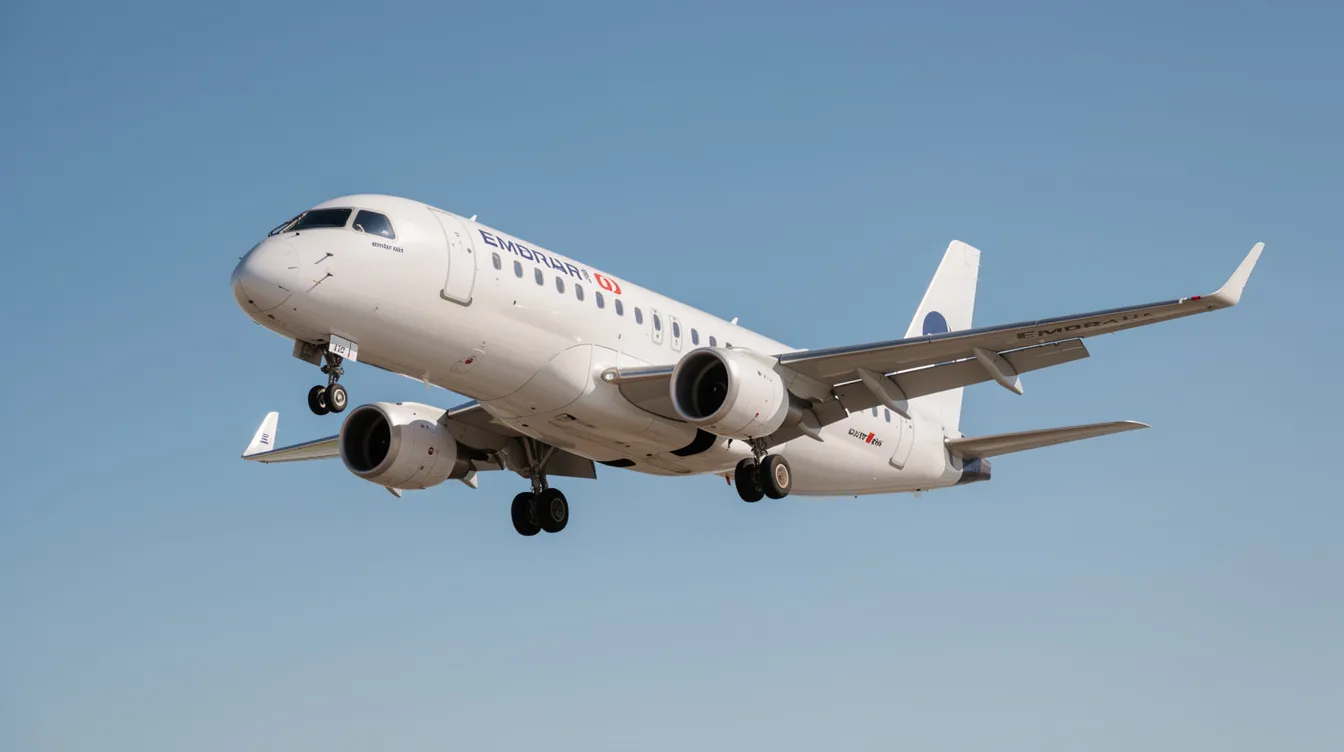
Embraer: The Aircraft Manufacturer Behind the E175
Founding and Early Years
The brazilian manufacturer embraer was founded in 1969 by the brazilian government as a state-owned enterprise with a singular mission: make Brazil self-reliant in aviation manufacturing. Headquartered in são josé dos campos, the company began with turboprops like the EMB-110 Bandeirante and later the EMB-120 Brasília, which served domestic routes and earned export contracts throughout latin america and beyond.
Privatization and Expansion
Privatized in 1994, Embraer pivoted aggressively into regional jets. The ERJ family (37–50 seats) arrived in the mid-1990s and found immediate success with regional carriers worldwide. That momentum carried into the late 1990s with the announcement of the E-Jet program, targeting the larger 70–120 seat market with a clean-sheet design.
Current Business Segments
Today, Embraer operates across four core segments:
Embraer Commercial Aviation: The E-Jets, E-Jet E2 family, after-sales, and leasing
Executive Aviation: Business jet lines including the Phenom and Praetor series
Defense & Security: Military aircraft like the Super Tucano and C-390 transport, plus systems for the brazilian air force
Services & Support: MRO, training, parts, and more than 80 service centers globally
Listed on both the NYSE and Brazilian stock exchange, Embraer maintains offices and support centers across the US, Europe, and the asia pacific region, underscoring its scale as a flagship company in aerospace.
How the Embraer 175 Fits into the E‑Jet Family
E-Jet Family Overview
The e jet family is Embraer's core commercial jets lineup, comprising four models with typical seating from roughly 70 to 124 passengers. The E170 seats about 66–78 passengers, while the larger E190 and E195 push capacity toward 100 and 124 respectively. For a broader perspective on how these models compare with other commercial plane models, each E-Jet variant was designed to serve a specific market niche.
E175’s Place in the Family
The E175 is the stretched variant of the E170. It shares the same wing, the same GE CF34-8E engines, and the same flight deck, but features a longer fuselage that accommodates additional rows. This commonality simplifies maintenance and flight crew training across both types.
Embraer launched the E-Jet concept in the late 1990s. The E170 completed its maiden flight in February 2002, and the E175 followed with its first flight in June 2003. The E175 entered commercial service in 2005 and has since become arguably the most important production aircraft in Embraer's commercial portfolio.
It is worth distinguishing the first-generation E-Jets from the second-generation E-Jet E2 models. The E175-E2 offers newer engines and aerodynamic improvements but exceeds weight thresholds set by US scope clauses, making it effectively non-viable for the us market. As a result, the original E175 remains in active production, a rare case where contractual constraints keep a legacy design in demand long after its successor was engineered.
Development Timeline: From Concept to Regional Jet Workhorse
Embraer launched the E-Jet program to capture the 70–120 seat market with an aircraft that offered mainline-jet comfort at regional jet economics. The design goals were ambitious: 2+2 seating with no dreaded middle seat, large windows, fly-by-wire controls, and operating costs competitive enough to replace aging 50-seat regional airliners.
Key milestones in the E175's development:
Late 1990s: E-Jet family announced to complement the smaller ERJ series
February 2002: First E170 prototype flight from são josé dos campos
June 2003: E175 prototype completes its first flight, powered by two GE CF34-8E engines
December 2004: Type certification by Brazil's ANAC
January 2005: EASA certification (Europe)
July 2005: First delivery; entering service with air canada's regional partner
August 2006: FAA certification (US)
The E175 is offered in several weight and range configurations-STD, LR (long range), and AR (advanced range)-allowing airlines to tailor the aircraft to their specific network. Operators focused on short haul routes can optimize for payload, while those needing extended reach can select variants with higher fuel capacity and maximum range up to approximately 2,200 nautical miles.
By the mid-2010s, the E175 had thoroughly dominated the 70–76 seat segment in North America. American airlines placed a landmark order in December 2013 for 60 firm aircraft plus 90 options, signaling the type's ascent as the standard-bearer for US regional aviation.
Technical Profile of the Embraer 175 Regional Jet
Headline Specifications
The E175 is a twin-engine, single-aisle regional jet built for short to medium-range routes, often serving the same clientele who may compare NetJets jet card costs and programs when deciding how to handle longer or more time-sensitive legs by private aircraft instead. Its design reflects Embraer's philosophy of delivering a mainline-like experience in a right-sized airframe. For a deeper dive into performance metrics, see our Embraer 175 Jet: Performance and Features Explained.
Here are the headline specifications:
Specification | E175 (STD / LR / AR) |
|---|
Typical seating | 76 (dual class) to 88 (high density) |
Maximum takeoff weight | ~85,500–89,000 lb (~38,790–40,370 kg) |
Maximum landing weight | ~74,957–75,178 lb |
Maximum range | ~2,150–2,200 nm (depending on variant) |
Cruise speed | Mach 0.75 typical; max Mach 0.82 |
Service ceiling | 41,000 ft |
Wing span | ~26.00 m (85 ft 4 in) |
Length | ~31.68 m (103 ft 11 in) |
Key Systems
Key systems include fly-by-wire controls for spoilers and rudder, carbon brakes, and a Honeywell Primus Epic glass cockpit featuring advanced avionics with full redundancy. The flight deck is common across the E170/E175, reducing training costs and improving dispatch reliability for operators running mixed fleets.
Cabin Design
The "double-bubble" fuselage cross-section is one of Embraer's signature design choices. It creates a cabin approximately 2.74 meters wide with near-vertical sidewalls and generous overhead bins—remarkably spacious for an aircraft in the regional jet category. This design is part of why many frequent flyers consider the E175 the most comfortable commercial jets option under 100 seats.
Engines and Performance: The GE CF34‑8E on the E175
Every embraer aircraft in the E175 family is powered exclusively by two General Electric CF34-8E turbofan engines, selected for their proven reliability in regional commercial service. Each engine produces approximately 14,500 pounds of thrust at maximum takeoff, with a bypass ratio of roughly 5:1 and an overall pressure ratio of about 28.5:1.
The CF34 lineage traces back to the TF34, a military engine originally developed for the US Navy and later adapted to civil regional jets. That heritage translates to a powerplant built for durability, consistent performance across varying conditions, and straightforward maintenance—qualities that regional carriers operating four to six flight cycles per day demand.
Engine management is handled by a dual-channel full authority digital engine control system (sometimes referred to as FADEC or authority digital engine control). This system automates start sequences, thrust settings, and operating limits, reducing pilot workload and optimizing fuel burn across every phase of flight. The result is an aircraft that is notably fuel efficient relative to older regional jets it replaced, with competitive short-field performance that opens access to smaller cities and constrained airports.
The engine choice also provides commonality across the E170 and E175 pair. Airlines operating both types benefit from shared spare parts, unified maintenance procedures, and streamlined training for both flight crew and ground technicians.
Cabin Experience: Why Many Travelers Prefer the E175
Step aboard an E175 configured for a US carrier and you will find something unusual for a regional jet: no middle seats. The 2+2 seating layout means every passenger sits in either a window or aisle seat, eliminating the dreaded middle seat that makes commercial aviation on larger jets an endurance test.
Most US operators configure the E175 in a 76-seat dual-class arrangement—typically 12 seats in first class and 64 in main cabin. International operators and those outside scope clause constraints may opt for 78–88 seat single-class or even a three class configuration on select routes. For a detailed look at how these layouts work, explore our Embraer 175 Seat Map and Layout Options and our guide to the best small private aircraft for different missions.
Embraer's double-bubble fuselage delivers roughly 18 to 18.5 inches of seat width, with overhead bins large enough for standard carry-on bags—a meaningful upgrade from older regional airliners where bins often forced gate-checking. Recent cabin enhancements include mood lighting, upgraded seat materials from suppliers like Recaro, and satellite connectivity planned for retrofit by approximately 2026.

For travelers accustomed to private jets, the E175's first class offers a reasonable commercial alternative on well-served regional routes. But the comparison has clear limits: there is no private terminal, no custom departure time, and no bespoke catering. For BlackJet clients, the E175 represents the best of commercial regional flying—useful for low-stakes segments—while a business jet arranged through a BlackJet 25+ Hour Jet Card handles the legs where privacy, time, and flexibility are non-negotiable.
Operational History: From First Flights to Regional Jet Mainstay
Early Adoption
The operational history of the E175 reads as a case study in market timing and product-market fit. The aircraft entered airline service in 2005, and its adoption curve accelerated rapidly as US carriers sought to replace aging 50-seat regional jets with new aircraft offering better economics and passenger comfort.
Key milestones in the E175's commercial life:
2004: First E-Jet deliveries begin with the E170
July 2005: embraer delivered the first E175 to air canada's regional partner, marking the type's commercial debut
Growth in North America
Global Expansion
The aircraft is operated today by a roster of major regional carriers. republic airways, SkyWest, and Envoy Air fly E175 fleets under brands like united express, American Eagle, and Delta Connection, serving many of the same high-frequency travelers who evaluate whether a 100 hour jet card investment makes sense for their annual flying pattern. horizon air operates them for alaska airlines on West Coast routes. Together, these operators have made the E175 the world's largest operator fleet type in the 76-seat segment.
Internationally, lot polish airlines (also known as polish airlines) uses E175s on European routes. star air and other carriers in the middle east, along with operators in Japan and the broader asia pacific region, round out a global footprint that spans every major aviation market. delta air lines and united airlines both rely heavily on E175-equipped regional partners to connect smaller cities to their hub networks, just as large-cabin aircraft highlighted in our guide to the best private jet for 20 passengers connect groups point-to-point without hubs.
Scope Clauses: Why the E175 Still Dominates US Regional Jets
Scope clauses are provisions in US major airline pilot union contracts that limit the size and weight of aircraft flown by regional affiliates on behalf of the mainline carrier. These contractual rules cap the number of seats—typically at 76—and impose a maximum takeoff weight ceiling of approximately 86,000 to 89,000 pounds, depending on the specific agreement.
The first-generation E175, when configured in a 76-seat dual-class layout with appropriate weight limitations, fits neatly within these scope clause limits. This is not an accident. Embraer engineered and marketed the aircraft specifically to sit at the intersection of maximum capability and scope compliance. The company even introduced the E175SC variant, limited to 70 seats, for carriers facing even tighter scope clause restrictions.
The second-generation E175-E2, despite offering newer engines and improved fuel efficiency, exceeds these weight thresholds. Its higher maximum takeoff weight makes it non-compliant under most current contracts, which is why US regional airlines continue ordering the original E175 rather than upgrading. The E175-E2 has no firm orders in the us market as of mid-2026, and analysts do not expect significant US adoption until scope clauses are renegotiated—likely not before 2028 at the earliest.
This dynamic creates a fascinating market reality: the E175 remains in production not because it is the most technologically advanced option, but because it is the largest and most capable regional jet that scope clauses permit. US majors rely on E175 fleets to connect passengers from smaller cities into major hubs, and those hub connections in turn shape where private jets—via providers like BlackJet—offer the greatest time and flexibility advantage over commercial regional travel.
Where the Embraer 175 Flies: Global Operators and Typical Routes
The E175 is deployed primarily on short to medium-haul routes, typically covering 300 to 1,000 nautical miles. It feeds passengers from regional cities into airline hub airports and occasionally connects secondary city pairs directly on business-heavy routes where schedule frequency matters more than aircraft size.
North America
The largest concentration of E175s operates in the United States and Canada. Fleet highlights include:
SkyWest Airlines: Operates E175s for united express, delta air lines, and alaska airlines
republic airways: Flies primarily for american airlines (American Eagle) and united airlines (United Express)
Envoy Air: American Eagle branded service
horizon air: Alaska Airlines regional routes across the Pacific Northwest
Typical city pairs include Chicago to Des Moines, New York to Richmond, Denver to Boise, and dozens of similar hub-to-spoke routes that connect smaller cities to the nationwide network.
Europe, Asia, and Beyond
lot polish airlines operates E175s on intra-European routes from Warsaw, connecting to cities like Prague, Budapest, and london city. In Asia, Fuji Dream Airlines runs E175s on Japanese domestic routes. Operators in the middle east and agricultural aviation markets in select developing regions have also adopted the type for modernization programs.
While the E175 is firmly a commercial service aircraft, its cabin quality and performance profile make it familiar to travelers who also fly private jets, including those chartering the best private jet options for 30 passengers on larger group trips. For complex itineraries mixing commercial and private segments, understanding which regional routes are served by comfortable E175s versus older, less pleasant 50-seat aircraft helps informed travelers plan smarter.
Embraer and the Wider Regional Jet Landscape
To understand why Embraer dominates regional aviation, it helps to look at the competitive landscape. Historically, Bombardier's CRJ series was the E175's primary rival. But Bombardier exited regional jet production, selling the CRJ program to Mitsubishi in 2019. Mitsubishi itself subsequently suspended its SpaceJet program, leaving Embraer as the sole Western manufacturer of purpose-built regional jets in the 70–100 seat class.
Other competitors occupy adjacent niches:
Bombardier CRJ900: Older design, narrower cabin, still in service but no longer in production
Airbus A220-100: Larger capacity and range, but generally outside US scope clause constraints; competes more with larger jets and mainline narrowbodies
COMAC ARJ21: Chinese-manufactured regional jet with limited international presence
Embraer carved out a profitable space between the 50-seat regional jets that once dominated feeder routes and full-size narrowbodies like the Boeing 737 and Airbus A320, just as large-group charter solutions in the best private jet for 50 passengers category bridge the gap between scheduled airlines and bespoke private travel for sizeable parties. The E175 is the quintessential "right-sized" embraer aircraft for this niche, while in the private sphere options like Flexjet’s jet card programs and pricing illustrate how travelers scale up or down capacity without owning an aircraft. For a comprehensive look at types of planes across categories, the E175 sits squarely at the intersection of regional capability and mainline comfort.
This competitive landscape directly affects route planning for airlines, which in turn shapes where private jets offer the strongest value proposition compared with premium cabins on regional airliners.
From Regional Jets to Business Jets: Embraer's Executive Aircraft
While the Embraer 175 is a regional airliner, the same manufacturer builds a full range of private jets and business jet platforms that directly intersect with the world of premium travel. Embraer's executive aviation division leverages the same engineering and manufacturing base that produces its commercial jets.
Key Embraer executive jet families include:
Phenom 100EX and Phenom 300E: Light jets popular in charter and jet card fleets
Praetor 500 and 600: Super-midsize jets with intercontinental range capability
Legacy 450/500: Midsize platforms now evolved into the Praetor line
Lineage 1000E: A business jet derivative of the E190, seating up to 19 passengers with true intercontinental range
Embraer ranks among the best private jet manufacturers globally, with its executive jets prized for airline-grade systems, cabin refinement, and competitive operating costs, even as newer flagships like the latest generation of private jets push the envelope on technology and in-flight comfort. The company's investment in noise reduction, advanced avionics commonality, and cabin design across its executive lineup makes these aircraft natural fits for high-net-worth and corporate clients, particularly when paired with transparent jet card pricing structures that keep total trip costs predictable.
Consider the practical scenario: a premium traveler flies an E175 on a commercial feeder route from a smaller city into a major hub, then steps into an Embraer Praetor 600 arranged via a BlackJet Jet Card for a nonstop transcontinental or international leg. Both aircraft share the same manufacturer's DNA—engineering rigor, safety philosophy, and build quality—while serving entirely different roles in a single journey, especially when paired with BlackJet’s broader suite of premium private jet card programs and services.
Safety Record: How Safe Is the Embraer 175?
Since entering commercial service in 2005, the E175 has compiled an exceptional safety record: no fatal accidents involving passengers and no total hull losses in airline operations. This places it among the safest commercial aircraft types currently flying.
The E175 holds type certificates from three major aviation regulators:
ANAC (Brazil): Certified December 2004
EASA (Europe): Certified January 2005
FAA (United States): Certified August 2006
Each certification requires the aircraft to meet stringent airworthiness standards equivalent to those imposed on larger jets. Key safety technologies include fly-by-wire envelope protection, redundant avionics and hydraulic systems, integrated FADEC for engine management, and a robust structural design tested for the repeated short-haul cycles that characterize regional operations.
While a small number of minor incidents have involved E175s—ground collisions, minor runway excursions—none resulted in in-flight passenger fatalities. Each event led to procedural or technical improvements under regulatory oversight.
For travelers who move between commercial and private aviation, safety pedigree matters across both domains. Just as the E175 operates under rigorous airline safety regimes, quality private aviation providers screen operators for top-tier certifications. BlackJet, for instance, works with operators meeting standards like ARGUS Platinum and Wyvern Wingman, ensuring that private legs meet or exceed the safety bar set by commercial aviation, similar to the rigorous vetting you’ll find among the top private jet companies for luxury travel.
Sustainability and Innovation: Embraer's Future Beyond the E175
Embraer is investing significantly in lower-emission aircraft technologies while continuing to refine its existing regional jets. The company's "Energia" concept family envisions 30-seat hybrid-electric and potentially hydrogen-powered regional aircraft targeted for the 2030s, signaling a long-term commitment to greener commercial aviation.
In the nearer term, the E-Jet E2 family uses Pratt & Whitney geared turbofan engines and aerodynamic refinements to deliver approximately 16–24% lower fuel burn and significantly reduced noise compared with first-generation E-Jets like the E175. The E190-E2 and E195-E2 are already in service with international operators, and the E175-E2 awaits scope clause evolution before US deployment.
For the current E175 fleet, Embraer has introduced incremental improvements: upgraded weather radar, larger overhead bins borrowed from E2 designs, enhanced connectivity, and compatibility with sustainable aviation fuel (SAF).
Sustainability in private aviation follows a parallel trajectory. Many Embraer business jets already operate with carbon offset programs, and companies like BlackJet ensure carbon-neutral flights through high-quality offsets at no additional cost to the traveler. For discerning clients, choosing providers that prioritize modern, efficient aircraft and verified environmental commitments is an increasingly important dimension of responsible travel, especially when evaluating the best private jets in the world for long-range missions.

Embraer 175 and Private Aviation: How BlackJet Clients Actually Use Regional Jets
While the Embraer 175 is not a private jet, it plays a practical role in many high-net-worth and corporate travelers' overall travel strategies. The most sophisticated itineraries often blend commercial and private segments, optimizing each leg for time, cost, and experience, and sometimes even leveraging options to buy an individual seat on a private jet instead of chartering the whole aircraft.
Consider two typical scenarios:
Scenario 1: An executive based in a mid-sized city flies commercially on an E175 into a major hub—say, from Des Moines to Chicago O'Hare. At the hub, she transfers to a BlackJet-arranged midsize jet for a nonstop flight to Los Angeles, bypassing connections, crowds, and two seats worth of proximity to strangers. The E175 handles the well-served, time-insensitive feeder leg; the private jet delivers speed and privacy where it matters most, with decisions often guided by a clear view of jet card cost per hour across aircraft types.
Scenario 2: A family uses private jets for remote seasonal destinations—think Jackson Hole or Nantucket—but chooses a premium seat on an E175 for a well-served route like Boston to Washington, where schedule frequency on regional routes matters more than cabin exclusivity. For many such travelers, a 25 hour jet card program offers a balanced way to cover only the trips where private aviation creates outsized value.
The distinction between regional jet first class and a private cabin on a business jet comes down to control: control over schedule, ground handling, catering, and who shares your space, with savvy travelers often comparing the best jet cards for frequent flyers to decide how to lock in that control. A Jet Card program like BlackJet's 25- or 50-hour options lets clients reserve private aviation for the segments delivering the greatest return—time saved, meetings added, privacy protected—while still leveraging high-quality regional jets when commercial solutions are perfectly adequate; a detailed 50 hour jet card cost guide can clarify when that commitment level makes sense. Travelers comparing options can benefit from a broader guide to jet card cost and membership pricing when deciding how much private access to commit to.
This approach is not about choosing sides between commercial and private. It is about deploying each tool where it performs best, with safety-vetted fleets, carbon-neutral flights, and digital booking tools that make the entire experience seamless, and a clear understanding of when chartering a private jet is actually worth it compared with flying on regional jets like the E175.
FAQs About the Embraer 175 and Its Manufacturer
Who makes the Embraer 175?
The E175 is built by Embraer S.A., a Brazilian aircraft manufacturer headquartered in são josé dos campos, Brazil. Embraer is one of the world's largest producers of regional and commercial jets.
Is the Embraer 175 a regional jet?
Yes. The E175 is a regional jet with typical seating of 76 to 88 passengers, deployed on short to medium-range routes connecting smaller cities to major hubs.
Is the E175 comfortable?
The E175 features a 2+2 seating layout with no middle seats, relatively wide seats, large windows, and spacious overhead bins. It is consistently rated as one of the most comfortable regional jets in service.
What is the difference between the Embraer 170 and 175?
The E175 is a fuselage stretch of the E170, adding approximately 10 seats while sharing the same wing (with a slightly larger wing on some variants), engines, and cockpit. Flight crew can transition between both types with minimal additional training.
How does flying an E175 compare with a private jet?
The E175 offers a solid commercial experience, but a private jet provides a fully bespoke cabin, custom scheduling, private terminals, and door-to-door time savings. For a detailed comparison of access models, see our guide on jet card vs charter vs fractional vs ownership.
What other aircraft does Embraer make?
Beyond the E-Jet family, Embraer produces the ERJ regional jet series (including the Embraer 135), business jets like the Phenom and Praetor, military aircraft such as the Super Tucano and C-390, and the Lineage 1000E executive jet.
Where is Embraer based?
Embraer's headquarters and primary manufacturing facility are in são josé dos campos, Brazil, with major offices and service centers across North America, Europe, and the asia pacific region.
Conclusion: What Travelers Should Take Away About Who Makes the Embraer 175
The Embraer 175 is a Brazilian-built regional jet manufactured by Embraer S.A., engineered to sit at the precise sweet spot of regional capacity, performance, and passenger comfort. From its first flight in 2003 through more than two decades of commercial service, it has compiled an enviable record: zero fatal accidents, dominant market share in North America, and a cabin experience that sets the standard for regional airliners.
Embraer's stature as a leading aircraft manufacturer spans far beyond regional aviation. The same company builds business jets trusted by corporate travelers worldwide and military aircraft relied upon by air forces across multiple continents. That breadth of engineering capability underpins every E175 flying today.
For BlackJet's audience, the practical takeaway is clear: you will encounter E175s on the regional commercial flights that connect smaller cities to hub airports. Knowing the manufacturer's pedigree gives confidence in the safety, reliability, and comfort of those segments. And for the legs where time, privacy, and flexibility matter most, a BlackJet Jet Card ensures you travel on safety-vetted, carbon-neutral private jets that elevate your journey from efficient to exceptional.
Discover how BlackJet can reshape your travel. Explore our Jet Card programs and experience the difference between simply getting there and arriving on your terms.


 Sign up with google
 Sign up with Apple


