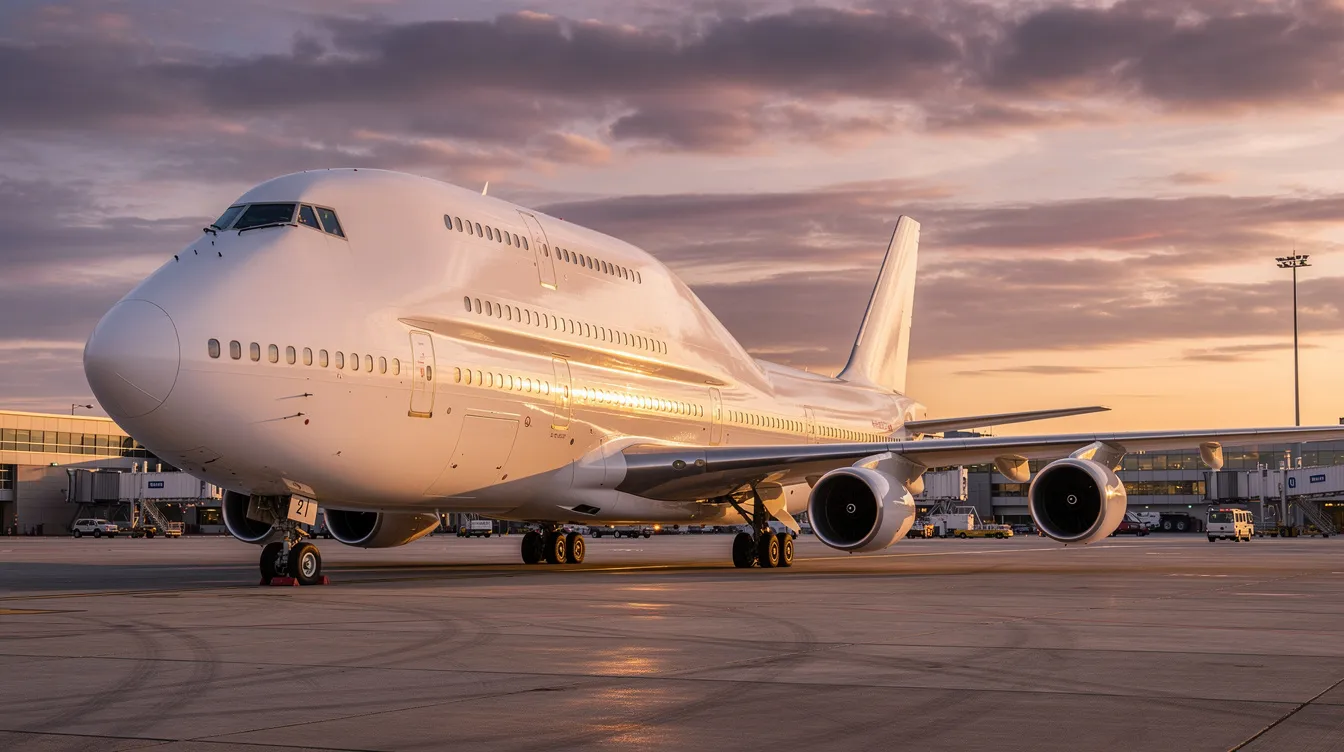
The Airbus A380, the world's largest passenger aircraft, was built to carry over 500 airline travelers across continents. A small group of designers and billionaires saw a different possibility: converting all that space into a flying palace for a private owner and a select entourage of 50 to 100 VIP passengers. No completed version of this aircraft has ever entered service. Here is what the concept entails, what it costs, and why most private air travel clients achieve the same level of comfort through more practical means.
A Quick Answer: What Is the Airbus A380 Flying Palace?
The flying palace is the ultra-luxury private jet vision of the Airbus A380, not a standard production model. Airbus Corporate Jets (ACJ) marketed the ACJ380-800 as a blank airframe for royal families and heads of state, with bespoke interiors including master bedrooms, en suite spa bathrooms, dining rooms, garages, and even prayer rooms. As of the mid-2020s, no fully completed ACJ380 flying palace has entered service.
The concept is based on the A380-800, the largest passenger plane ever built. It features two full-length passenger decks with wide-body dimensions, a cabin layout that can accommodate roughly 50 to 100 VIP passengers instead of 500+ airline seats, and an extended range of up to 9,400 nautical miles in lighter VIP configurations. The average purchase price of a new A380 is $455 million; a bespoke flying palace interior is projected to be $300 to $500 million on top of that.
For most BlackJet clients, the practical path to flying-palace-level comfort runs through large-cabin private jets and VIP airliners like the ACJ330 or BBJ 787, building on the full spectrum of types of private jets for every traveler. These aircraft models deliver comparable privacy, range, and luxurious amenities without requiring the infrastructure, crew, or hundreds of millions in capital that a private Airbus A380 demands.
Origins of the Flying Palace: From A3XX Concept to Private A380
Airbus began concept work on an ultra-large commercial aircraft in the late 1980s under the project name A3XX, aiming to break Boeing's monopoly on the hub-to-hub widebody market. In December 2000, Airbus announced the formal launch of what became the A380 program. The first test flight took to the air on 27 April 2005. Commercial entry into service followed on 25 October 2007, when Singapore Airlines operated the inaugural revenue flight from Singapore to Sydney.
The idea of a private Airbus A380 surfaced almost immediately. Airbus Corporate Jets began promoting the ACJ380-800 as the pinnacle private plane for royal courts and presidential fleets. At the 2007 Dubai Airshow, Prince Alwaleed bin Talal of Saudi Arabia placed an order for an ACJ380 flying palace, echoing the Saudi prince's private plane luxury and features seen across the region, complete with renderings showing a concert hall, a Turkish bath, a garage for luxury cars, and holographic tables in a boardroom. Despite the global publicity, that order was cancelled in 2015. The airframe (serial number 002) was never fitted out for private use and never entered service, underlining just how ambitious the concept was.
Total Development Cost and Economics of the Airbus A380
The projected development cost of the A380 in 2000 was roughly €9.5 billion. That estimate proved optimistic. Wiring incompatibilities between French and German production lines, certification delays, and weight issues pushed the figure toward €18 to €20 billion by the mid-2000s. By 2014, analyst estimates of the total development cost reached approximately $25 billion. Government launch aid from France, Germany, the UK, and Spain covered between €3.5 and €5.9 billion of that sum.
Airbus needed to sell an estimated 400 to 500 aircraft at or near list price to break even. Only 251 were delivered before the program ended in 2021. The reported cost per airframe exceeded sale revenues on many units, making the project structurally unprofitable. When an aircraft designed for 500+ passengers is reconfigured for a passenger count of 50 to 100, its fuel burn, maintenance burden, and maximum takeoff weight make the economics especially difficult on a per-passenger basis. That economic reality is one reason no private owner has taken delivery of a completed flying palace.
Design Vision: What Makes the A380 a "Flying Palace"?
The A380 features over 5,500 square feet of floor space spread across three decks: the main deck, the upper deck, and a repurposed lower cargo area sometimes called the third deck in design proposals. That is more space than most urban penthouses and rivals the interior square footage of a 50-meter superyacht.
Due to its scale, the A380 accommodates unique concepts like onboard lounges and bars. The A380's size allows airlines to install heavy amenities without sacrificing passenger capacity, a trait that designers redirected toward private use. Firms such as Design Q and Edese Doret Industrial Design envisioned master cabins, grand staircases linking the decks, sky lounges, full dining rooms, and wellness areas. The A380's double-deck design creates an airy cabin atmosphere with higher ceilings and wider aisles. Airbus describes the A380 as having a wider cabin, wider seats, and more personal space than competitors. Boutique-hotel design cues appear throughout concept renderings: sound-insulated walls, large windows, and mood lighting that shifts from boardroom to spa to cinema.
The flying palace concept is about extreme customization. There is no catalog. Each layout is a blank canvas tailored to a royal court, presidential entourage, or business partners traveling as a group, reflecting the wider debate over whether a private jet Airbus A380 is worth it for ultra-wealthy travelers.
Main Deck: Business, Suites, and Social Spaces
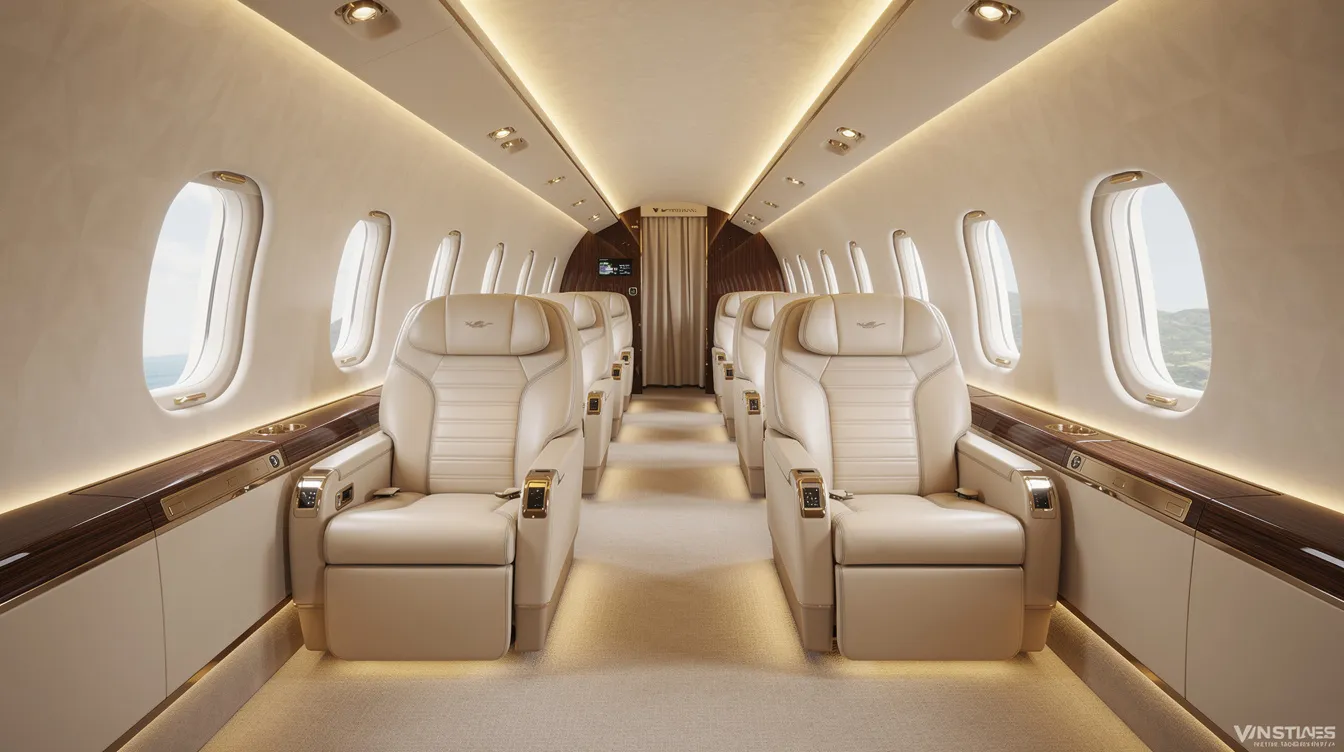
The main deck serves as the operational and social heart of the flying palace. Just aft of the cockpit sit the primary galley and crew facilities, engineered to support fine-dining service at 40,000 feet. Behind them, a dedicated business center houses secure conference rooms and briefing spaces equipped with encrypted communications for heads of state or corporate leaders. Some layouts include two conference rooms to separate classified briefings from general business meetings.
A380 flying palace concepts typically place 15 to 25 private suites on this deck, each comparable to or exceeding Singapore Airlines Suites in scale. Lie-flat beds, personal wardrobes, and ensuite bathrooms are standard in these layouts. The aircraft can have multiple lounges and dining areas; formal dining salons seating 12 to 20 guests at a single table appear in nearly every published concept. Optional spaces include a prayer room, library, and media room, all designed with soundproofing and discrete crew corridors so service never intrudes on privacy. Passenger capacity on this deck alone can exceed that of most other aircraft configured for private use.
Upper Deck: Private Residences in the Sky
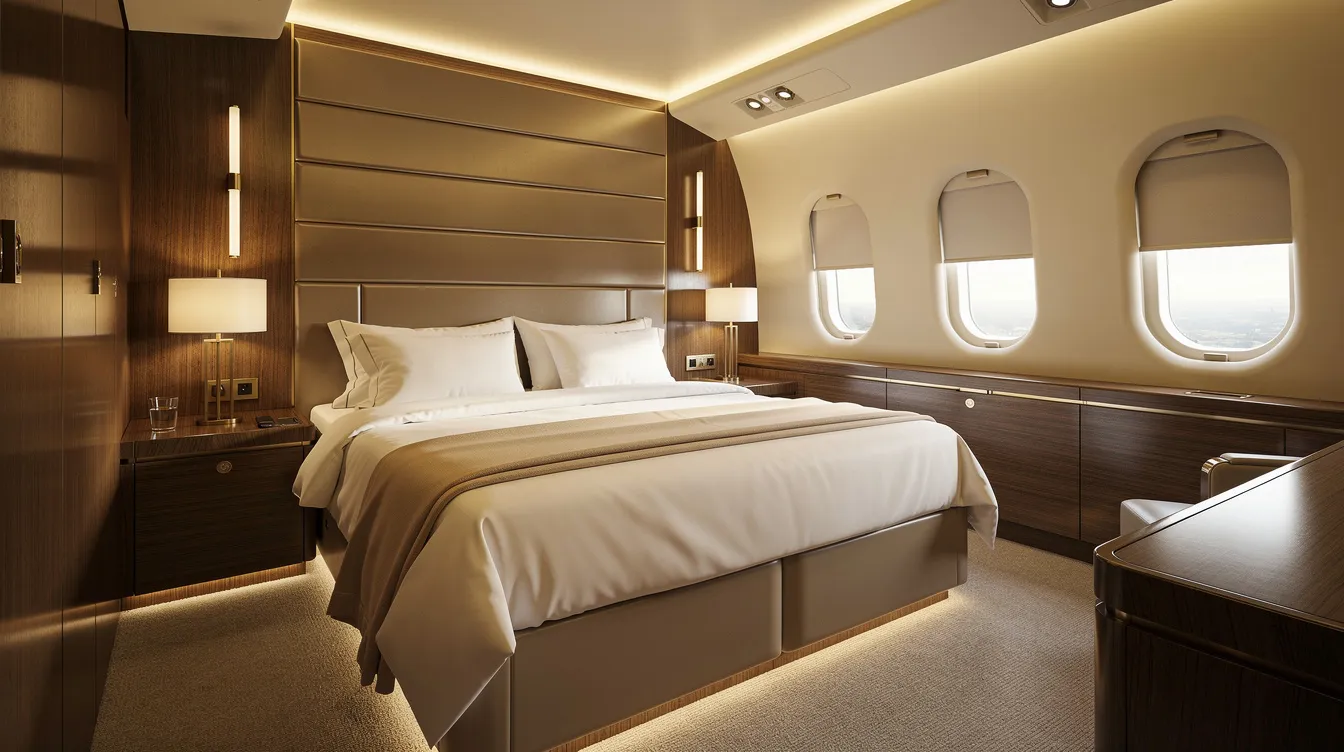
The A380's upper deck often serves as the primary living space for the principal and inner circle, mirroring the owner's suite deck on a superyacht. A common concept positions 4 to 5 master bedrooms along this level, each with a king-size bed, walk-in dressing area, and ensuite bathroom with shower or full-size bathtub. Panoramic windows line the fuselage, offering views that no other private plane can match in width.
At the center of the upper deck, designers place a private family lounge or salon with sofas, a bar, and state-of-the-art entertainment. A dedicated private office or "situation room" occupies a forward section, equipped with secure communications, video conferencing, and large display walls. One system display and one engine parameter display concept adapted from the flight deck have even appeared in certain head-of-state proposals, giving the principal real-time situational awareness.
Staircases at the fore and aft allow the principal to move between decks without crossing more public areas, preserving discretion.
Lower Deck: Garages, Wellness, and Support Areas
Flying palace concepts repurpose parts of the cargo hold to create amenities not found on any other private jets. The most publicized idea: a "garage" with space for one or two luxury cars, a Rolls-Royce or Bentley that can be driven off shortly after landing. Some governmental proposals substitute armored vehicles and specialty security equipment, similar to how private jets for 50 passengers integrate security and protocol needs for large delegations.
Wellness areas with Turkish baths and spa facilities occupy a dedicated zone. Concept designs by Design Q describe a relaxation lounge with ambient lighting and a large floor-mounted screen linked to exterior cameras, creating a simulated "glass floor" view of the terrain below. A Turkish bath lined with marble, full-body massage rooms, a steam room, and spa treatments with integrated oxygen and humidity control round out the wellness deck. The lower deck also houses crew rest compartments, security team quarters, technical spaces, and luggage storage, all engineered to balance maximum passenger comfort with weight and safety regulations.
Real-World Benchmarks: Singapore Airlines, Suites, and VIP A380 Use
Singapore Airlines provides the closest commercially operating reference for what A380 luxury looks like in practice. Its Suites product, launched in 2007 and upgraded in 2017, features fully enclosed cabins with sliding doors, a separate bed and seat, and the option to join two suites into a shared double bed. On routes like Singapore to London (roughly 13 hours), the privacy and dining rival many smaller private jets, including some of the best private jets in the world used for long-haul VIP missions.
These Suites cabins are not private jets; dozens of other passengers fly on the same aircraft. But their layout and service concepts, including private sleep zones, restaurant-style dining, and spa-like bathrooms, directly influenced flying palace designers. Emirates and Qantas also operate the A380 on high-demand routes. Yet only a handful of A380 airframes have ever been earmarked for true private or governmental VIP use, and none reached completion.
Costs: From Acquisition to Operating an A380 Flying Palace
Owning an A380 can cost between $300 million and $600 million when acquisition and interior completion are combined. Here is how the numbers break down:
<table> <thead> <tr> <th>Cost Category</th> <th>Estimated Range</th> </tr> </thead> <tbody> <tr> <td>New airframe (list price)</td> <td>$445–$455 million</td> </tr> <tr> <td>Pre-owned A380 airframe</td> <td>~$50 million</td> </tr> <tr> <td>Flying palace interior build-out</td> <td>$300–$500 million</td> </tr> <tr> <td>Simpler VIP interior</td> <td>$150–$200 million</td> </tr> <tr> <td>Operating costs per flight hour</td> <td>$25,000–$35,000</td> </tr> <tr> <td>Fuel costs per flight hour</td> <td>$10,000+</td> </tr> </tbody> </table>
Pre-owned models from airlines retiring the type can be acquired for around $50 million for the airframe alone. But the completion cost for a palace-level interior pushes the total well above half a billion dollars. Operating costs for an A380 range from $25,000 to $35,000 per flight hour, driven by fuel burn of 10 to 11 tonnes per hour, large crews, and A380-specific maintenance.
BlackJet's Jet Card model offers an alternative: prepaid access to large-cabin jets and VIP airliners that deliver similar comfort and range without tying up hundreds of millions in a single aircraft asset, and travelers can dive deeper into understanding jet card cost and value before committing.
Cabin Layout, Comfort, and Technology on Board
The double-deck cabin layout lets designers separate zones for work, rest, and entertainment more thoroughly than on any other aircraft. Typical zoning: main deck for guests and business, upper deck for private suites and family, lower deck for wellness and support, all linked by staircases and, in some concepts, private elevators, a level of separation that group travelers also seek when choosing the best private jet for 20 passengers.
The A380 is designed to reduce jet lag with optimized humidity and pressure profiles. The cabin architecture emphasizes passenger comfort with larger windows and mood lighting. The A380 is widely celebrated as one of the quietest commercial jets, with cabin noise levels lower than comparable widebodies thanks to advanced wing designs and acoustic insulation. Spacious cabins and more space per passenger create an environment where meetings or rest can continue uninterrupted across 15-hour flights.
In-cabin advanced technology includes high-speed satellite Wi-Fi, encrypted VPNs, video conferencing studios, and tablet-based control of lighting and climate. Fly-by-wire controls in the cockpit feed data to cockpit displays, while innovative technologies in the cabin allow modular furniture and movable partitions to reconfigure between boardroom settings, informal lounges, and sleeping areas depending on mission profile—capabilities that trickle down into top 16-seat private jet options designed for smaller executive groups.
Safety, Certification, and Support for a Private Airbus A380
The A380 has recorded zero hull-loss accidents since its 2007 entry into service, a record spanning over 15 years of commercial airline operations across multiple carriers.
Any A380 or flying palace must comply with EASA and FAA airworthiness standards, including evacuation testing, fire safety, and structural certification for heavy custom interiors. The aircraft uses fly-by-wire controls with multiple redundancy in avionics and hydraulics, while the inboard and outboard engines are managed through advanced aircraft systems as part of performance and safety redundancy. Cockpit instrumentation follows airline-grade standards, and strict pilot training regimes carry over from commercial operations. Private or governmental A380 operators rely on Airbus-backed MRO networks and airline-grade engineering teams for inspections, checks, and parts support, just as the top private jet companies for luxury travel emphasize rigorous maintenance and training standards.
BlackJet's approach to safety and certification applies the same rigor: every operator in the network must meet noise restrictions set by regulators and pass top third-party audits such as ARG/US Platinum and Wyvern before carrying Jet Card members, mirroring the standards upheld by major providers like those discussed in NetJets jet card cost and programs.
Sustainability and Environmental Impact of a Flying Palace
The A380 incorporates technologies that reduce CO2 and NOx emissions relative to older four-engine widebodies. Its fuel consumption per seat is impressive in commercial use; in an all-economy configuration carrying 853 passengers, per-seat fuel burn is competitive with twin-engine narrowbodies. But the A380 has higher carbon emissions per flight when used privately with 50 to 100 passengers. Private A380 operations are resource-intensive and less efficient than commercial service, creating a significant environmental impact per traveler.
The aviation industry is addressing this gap. Sustainable aviation fuel can help reduce the A380's environmental impact; SAF blending is available at a growing number of key destination airports. Greater fuel efficiency on a per-trip basis comes from optimized routing and maximizing load factors. High-quality carbon offsetting programs provide additional mitigation, though they do not eliminate emissions, and many operators now factor these measures directly into their jet card pricing and benefits.
BlackJet's commitment to environmental responsibility is concrete: every flight arranged through BlackJet is carbon-neutral through verified offsets at no additional cost to members, with optional SAF integration where regionally available.
Is the A380 Flying Palace Practical vs Other Private Jets?
For most missions, ultra-long-range private jets like the Global 7500 or Gulfstream G700, or VIP airliners such as the ACJ330 or BBJ 787, deliver a better balance of range, cost, and airport access, especially for corporate or entertainment groups that might otherwise consider private jets for 30 passengers.
The A380 requires runways of 9,000 to 10,500 feet. It is classified as a Code F aircraft, demanding specialized heavy-duty runways, wide taxiways, and suitable rescue and fire services at airports. The A380 cannot land at smaller private aviation airfields, which effectively rules out hundreds of convenient airports near private estates and business hubs. A380 operations require specialized ground handling that adds further to operating costs, pushing many travelers toward more flexible ways to buy a seat on a private jet instead.
While the A380 flying palace is unmatched in raw space and spectacle, high-net-worth travelers often prefer more discreet jets that can reach regional airports. A BlackJet Jet Card lets members select from light jets to large-cabin and VIP airliner categories on demand, matching Flying-Palace levels of comfort to each specific trip without the overhead of a mega-airliner, and aligns with many of the best jet cards for frequent flyers in how it balances cost, access, and predictability.
BlackJet's Role: Experiencing Flying-Palace-Level Luxury Without an A380
BlackJet operates as a high-touch private aviation partner for clients who want flying-palace comfort paired with modern efficiency, safety, and sustainability, whether they are exploring charter, jet cards, or even premium private jets for sale in the UK as a step toward full ownership. The Jet Card model, available in 25-hour or 50-hour programs, gives prepaid, guaranteed access across aircraft categories, and prospective members can review the dedicated BlackJet 25+ Hour Jet Card details alongside broader guidance on 50-hour jet card cost and value.
Consider a CEO and family flying New York to London to Dubai for meetings and leisure, or a business leader shuttling regularly between hubs like Karachi on private jet charter and European capitals. A large-cabin jet with a private bedroom, lounge, and dining area echoes the A380 flying palace amenities, but with access to dozens more airports at each destination and operating costs a fraction of a private Airbus. BlackJet's pillars, including rigorous operator safety vetting, 24/7 real-time flight support, a digital booking platform, and automatic carbon-neutral flights, ensure each journey meets the standard these travelers expect.
The A380 flying palace remains the most ambitious concept the aviation industry has produced. For travelers ready to experience that caliber of comfort on real-world routes, explore BlackJet Jet Card membership and access flying-palace-grade travel on aircraft that fit your actual routes, group size, and strategic needs, starting with an overview of BlackJet premium private jet card programs.


 Sign up with google
 Sign up with Apple