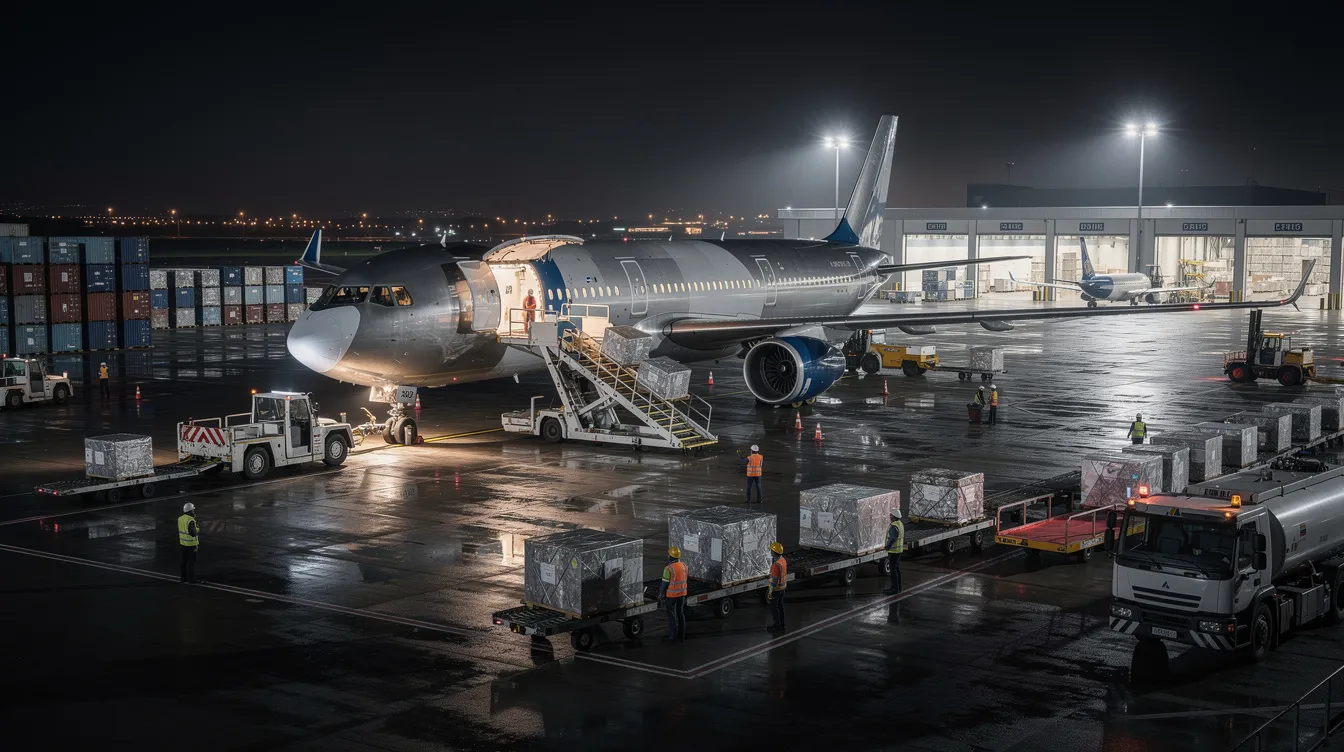
Few aircraft have shaped the movement of goods across continents as decisively as the Boeing 747‑400F. Introduced in 1993, this dedicated freighter variant transformed how the world's cargo moves - and continues to do so more than three decades later. Here is a comprehensive look at what makes this jumbo freighter essential, how it evolved, and why it still matters to anyone who depends on the seamless flow of global commerce.
Strategic Role Of The Boeing 747‑400F In Global Logistics
The Boeing 747‑400F stands as one of the most consequential cargo aircraft in modern aviation. Entering service with Cargolux in November 1993, it quickly became the benchmark for intercontinental freight operations, and it remains critical in the air cargo industry in 2026. Its combination of a payload capacity of 274,100 pounds, a range over 4,450 nautical miles, a length of 231 feet 10 inches, a height of 63 feet 8 inches, and a distinctive nose cargo door created a freighter capable of bridging continents without frequent fuel stops, connecting major international trade hubs from Shanghai to Chicago, Frankfurt to São Paulo.
While passenger Boeing 747 variants have largely disappeared from airline fleets, the freighter version continues in front-line service. Express carriers, e-commerce logistics networks, and heavy-industry supply chains still rely on its sheer volume and loading flexibility. At an average cruise speed of approximately Mach 0.85, it delivers time-sensitive shipments across oceans overnight.
For high-net-worth individuals and corporations who travel privately through premium private jet cards and membership programs, the 747‑400F is an unseen but indispensable partner. It quietly underpins the just-in-time manufacturing, luxury retail, and pharmaceutical logistics that BlackJet's members depend on daily. Every designer handbag arriving in Manhattan, every turbine blade reaching an oil platform, every critical aircraft spare part shipped to keep a private jet operational - many of these journeys begin in the belly or on the main deck of a 747‑400F.
Development History: From Pan Am's Vision To The 747‑400F Freighter
The Boeing 747 program began in the mid-1960s when Pan Am sought a large widebody airplane to open high-capacity, long-haul air travel. From the outset, Boeing designed the airframe with a future freighter role in mind - the wide fuselage and elevated cockpit were deliberate engineering choices that would later prove transformative for cargo operations.
Early freighter variants like the 747-200F served airlines such as Lufthansa beginning in 1972. But the 747‑400 family represented a generational leap. Final assembly of the first 747‑400 began in September 1987. The plane rolled out on January 26, 1988, flew for the first time on April 29, 1988, and received FAA certification on January 9, 1989. The first 747‑400 was delivered on May 31, 1989, with Northwest Airlines among the earliest passenger operators. Boeing produced 422 standard 747‑400 passenger examples before production of the 747‑400 passenger version ceased on March 15, 2007.
The freighter variant followed a parallel development path. The 747‑400F was introduced in 1993 as a factory-built cargo airplane with structural reinforcements, a strengthened main deck, and integrated nose and side cargo doors. Cargolux was its launch customer; Atlas Air, UPS, and Korean Air Cargo followed, proving the type's economics on trans-Pacific and North Atlantic freight corridors. In total, Boeing delivered approximately 126 factory-built 747‑400F aircraft, plus around 40 of the extended-range 747‑400ERF variant - deliveries that coincided precisely with the acceleration of globalized trade and express freight networks.
Design And Airframe: What Makes The 747‑400F A Cargo Workhorse
The Boeing 747's widebody fuselage and iconic "hump" define its freight DNA. The stretched upper deck positions the cockpit and crew rest area above the main deck, leaving the entire nose section free for cargo loading - an architectural advantage no other large freighter has replicated at this scale.
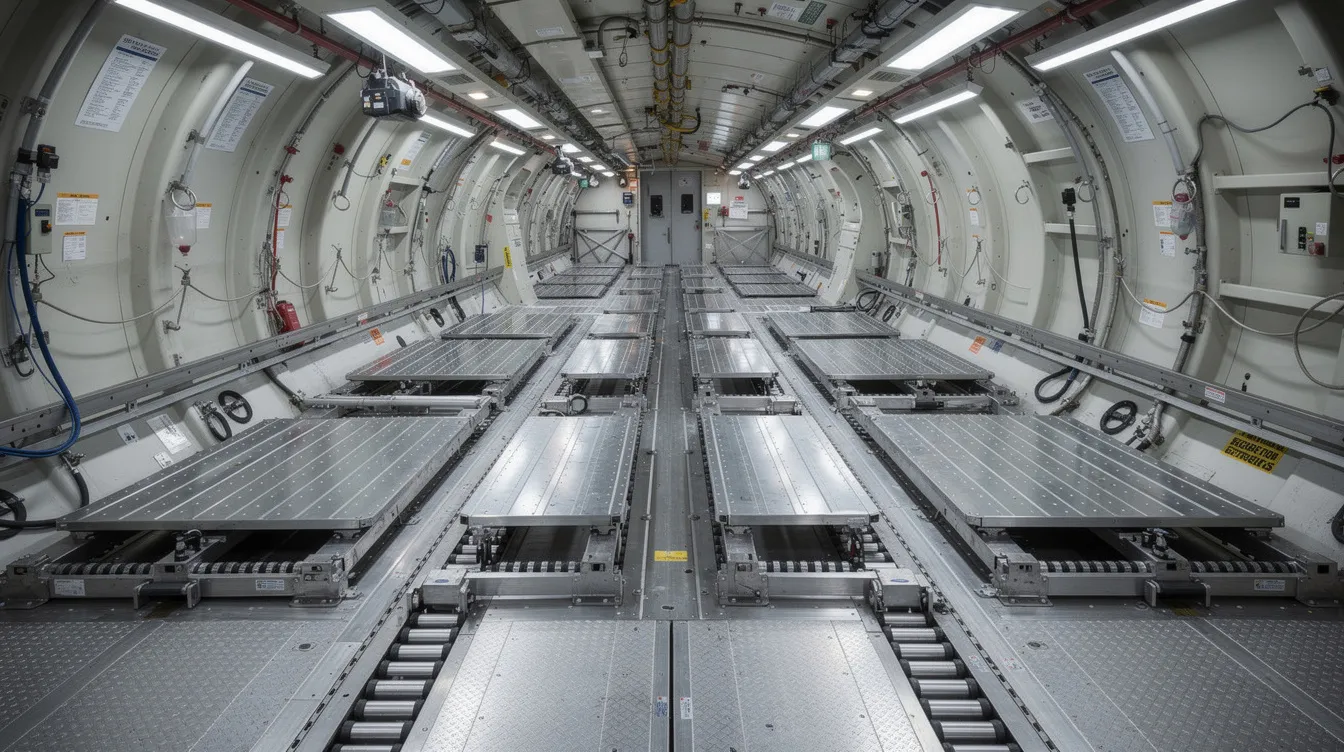
The 747‑400F uses reinforced structures to handle the stress of heavy cargo. Stronger floor beams, heavy-duty tie-down points, and high-density internal roller systems for efficient cargo handling allow rapid movement of pallets and containers across the main deck. The nose section is reinforced to withstand tens of thousands of opening cycles of the massive nose door, while the underfloor structure is thickened to support dense loads.
Aerodynamically, the 747‑400F introduced blended winglets and improved wing surfaces over earlier 747 variants, reducing drag and extending range. Operators could select from engines by GE, Pratt & Whitney, or Rolls-Royce, each offering different trade-offs in thrust and fuel economy. Key performance figures tell the story: a maximum takeoff weight of 875,000 pounds, cruising speed near Mach 0.85, and proven reliability in punishing cargo schedules that demand near-continuous utilization.
An important distinction exists between the factory-built 747‑400F and converted variants. The 747‑400BCF (Boeing Converted Freighter) and 747‑400BDSF (Bedek Special Freighter) are derived from retired passenger airframes. These converted aircraft generally lack the nose door, carry slightly less payload, and incur extra weight from retrofit modifications - making them capable but less versatile than the purpose-built freighter.
Main Deck Layout, Cargo Volume, And Loading Flexibility
The main deck is the heart of the 747‑400F. At 185 feet long, it serves as the primary cargo area, designed to accept 10-foot-high containers and standard industry pallets that form the backbone of global air freight.
The numbers speak for themselves. The 747‑400F offers 26,766 cubic feet of interior volume, with a total cargo volume of approximately 735 cubic meters spread across the main deck, lower holds, and bulk compartment. In practical terms, a typical configuration holds 30 pallets measuring 96 inches by 125 inches on the main deck, plus 30 LD-3 containers in the lower holds, with additional bulk space for smaller or irregular shipments.
Floor strength is designed for density. Automotive components, machine tools, and even small helicopters can be transported thanks to reinforced flooring and heavy-duty tie-down systems. The roller-track systems allow loading crews to slide pallets into position quickly, minimizing ground time - essential for express carriers operating overnight schedules at hubs like Louisville, Anchorage, and Leipzig.
Unlike a passenger 747, the freighter interior is stripped of windows, seats, and cabin fittings. Simplified linings and the absence of passenger amenities reduce dead weight and maintenance complexity, allowing the airplane to carry more revenue cargo per flight. Every square foot is optimized for freight, making loading easy and turnaround times shorter than competing large freighters.
Nose Cargo Door And Side Cargo Door: Signature Features
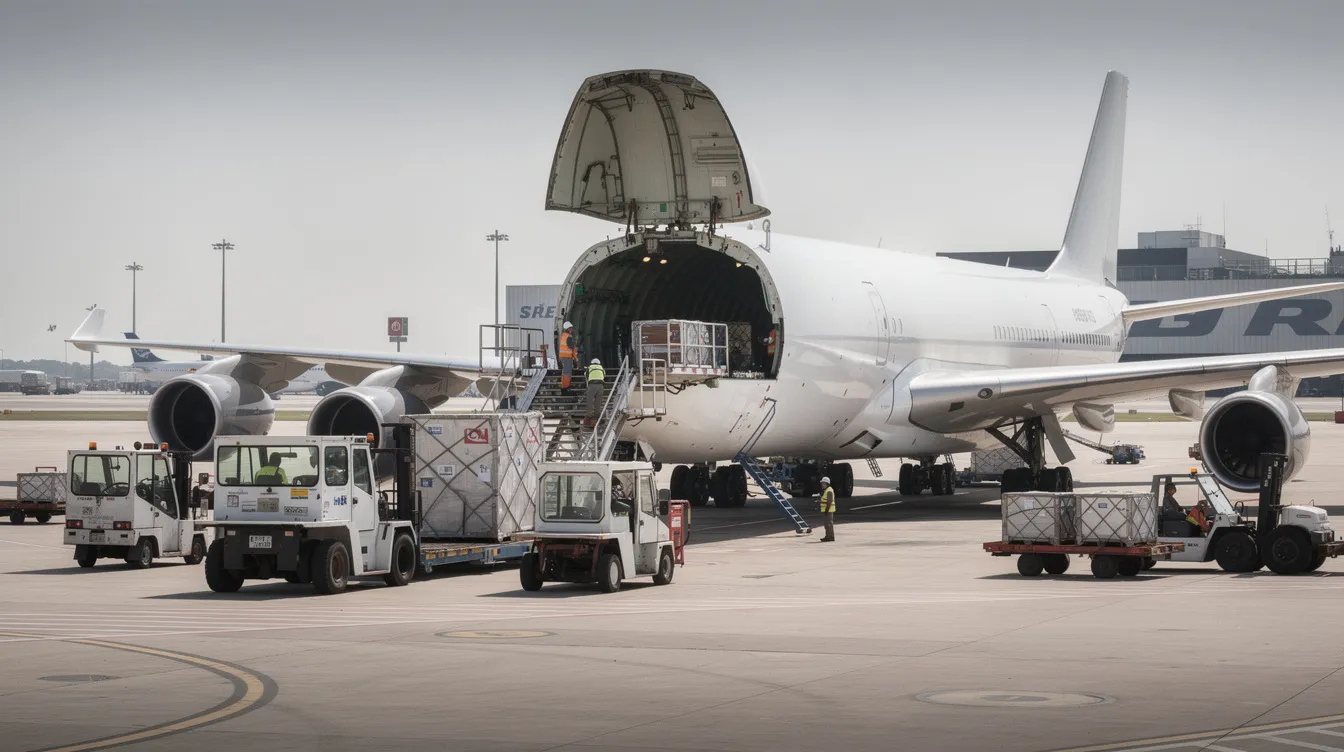
The nose cargo door is the 747‑400F's most distinctive feature. It hinges upward to open the entire front of the fuselage, permitting straight-in loading of long, heavy, or irregular items that simply cannot fit through any other opening. Aerospace components, oil-and-gas drilling equipment, landing gear assemblies, and oversize industrial modules - all enter through this single, massive door. The 747‑400F is popular for transporting oversized industrial freight precisely because of this nose-loading capability, which makes it ideal for large machinery and aerospace components.
On the left side of the fuselage sits the main deck side cargo door, featuring a main deck cargo door measuring 134 by 123 inches. This door handles standard pallet and container loading on most flights, and is the primary access point when nose-door loading is unnecessary. Lower-deck forward and aft doors provide access for ULDs in the belly holds.
Only factory-built 747‑400F and 747‑400ERF models are fitted with the nose cargo door. Converted freighters like the BCF and BDSF rely solely on the side cargo door, which limits their ability to accept very long or irregularly shaped payloads. This distinction matters enormously in real-world operations: when a company needs to move a 40-foot pipeline section from Rotterdam to Doha overnight, or ship satellite components from Los Angeles to a launch site in French Guiana, the nose door is the difference between a single flight and a logistical puzzle.
Operating the nose door requires specialized ground equipment - nose-loading ramps, conveyor systems, and trained crews who follow strict safety protocols. This operational complexity explains why not all cargo aircraft feature such a system, and why operators that invest in nose-door infrastructure command premium rates for oversize cargo missions.
Upper Deck, Crew Facilities, And Long‑Haul Operations
The upper deck of the 747‑400F is a compact, functional space located above the main deck. It houses the cockpit, a small galley, lavatory facilities, and crew rest areas arranged in a 2-1 seating configuration - designed for the augmented crews required on long-haul flights of 10 to 13 hours.
The forward positioning of the flight deck is directly tied to the freighter design. Because the cockpit sits above and ahead of the main deck, the nose can swing open without disrupting crew spaces. Pilots and relief crew operate in an environment physically separated from the cargo hold, which enhances safety by isolating them from noise, temperature fluctuations, and potential contaminants in the freight area.
A ladder or stair connects the upper deck to the main deck, allowing cargo supervisors to inspect the hold in flight or manage sensitive shipments as required by regulations. While passenger 747‑400s famously used the upper deck for premium cabin lounges and first-class seating, the freighter variant dedicates this space entirely to operational efficiency and crew comfort. The separation of crew and cargo spaces also supports security protocols and compliance with hazardous-materials regulations - an important consideration for modern air freight.
Performance, Range, And Operating Economics
The 747‑400F's performance profile is built for intercontinental trunk routes. The maximum structural payload ranges from 113 to 128.5 metric tonnes, depending on variant and configuration. At full payload, the aircraft can carry a maximum payload of 274,100 pounds over a design range of approximately 4,450 nautical miles, cruising at Mach 0.85 at altitudes between 35,000 and 40,000 feet.
In fuel-efficiency terms, the four-engine 747‑400F is less economical per tonne-kilometer than modern twin-engine freighters like the Boeing 777F. Its operating economics are shaped not only by fuel and acquisition costs but also by cargo yields rather than passenger ticket prices. However, its low acquisition cost on the secondary market and enormous volume make it competitive where consolidated, high-volume shipments justify a single large aircraft rather than multiple smaller ones. Typical mission profiles include trans-Pacific routes between Asia and the US West Coast, Europe-to-Asia trunk routes, and express overnight services linking North America and Europe, mirroring the long-haul patterns flown by private jets for up to 50 passengers on large-group charters.
The 747‑400ERF (Extended Range Freighter) variant offers approximately 22,000 pounds of additional payload or an extra 525 nautical miles of range compared to the standard 747‑400F, targeting weight-limited routes or hot-and-high airports where extra performance margins matter, much like ultra-long-range private jets for sale that prioritize nonstop intercontinental reach. This makes the ERF a popular choice among operators serving challenging destinations in the Middle East, Africa, and South America.
The 747‑400F In Service: Operators, Conversions, And Special Variants
The 747‑400F has been operated by some of the world's most prominent cargo airlines. Atlas Air operates roughly 28 airframes, UPS Airlines flies 11, and operators in Atlanta, Luxembourg, Seoul, and Taipei have built entire freight networks around the type. Cargolux, the launch customer, still counts the 747‑400F among its popular choices for European and trans-Atlantic freight.
The passenger side of the 747‑400 story has largely concluded. Delta Air Lines retired its last 747‑400 in December 2017. KLM retired its 747‑400 fleet in March 2020, with KLM retiring its last passenger 747‑400 on October 25, 2020, even as leading private jet companies expanded their modern business aviation fleets. British Airways retired 31 Boeing 747‑400s in 2020. Qantas announced 747‑400 retirement by the end of 2020. The last 747‑400ER was retired in July 2020. Air India retired its last 747‑400 on April 29, 2022. As of September 2021, only 42 passenger 747‑400s remained operational worldwide.
Passenger-to-freighter conversion programs launched in the mid-2000s extended the type's commercial life. The 747‑400BCF and 747‑400BDSF gave airlines a way to keep surplus passenger airframes flying as freighters rather than replacing them immediately. However, these converted variants lack the nose door, carry slightly reduced payloads, and serve a different market segment than factory-built freighters.
The Boeing 747 Large Cargo Freighter - the "Dreamlifter" - deserves mention as a highly modified 747‑400 used exclusively by Boeing to transport 787 Dreamliner fuselage sections. It is a separate, non-commercial variant with a swing-tail design that is not available on the open market.
During the COVID-19 era, the e-commerce cargo boom temporarily increased demand for 747‑400F and converted freighters, as passenger belly cargo capacity evaporated. Despite production ending, many 747‑400Fs are still in operation due to their reliability, though rising fuel costs and environmental pressure are accelerating retirement schedules.
Succession: From 747‑400F To 747‑8F, 777‑8F, And New‑Generation Freighters
The Boeing 747‑8F, launched in the late 2000s, was built directly on the 747‑400F concept. It features a stretched fuselage, new-generation GEnx engines, raked wingtips replacing the older blended winglets, and improved fuel efficiency - all while retaining the critical nose door and upper deck configuration that cargo operators require.
The market is now shifting decisively toward twin-engine freighters. The Boeing 777F has become a workhorse for carriers replacing aging 747‑400Fs, and the planned 777‑8F, introduced to the market in 2022 with dozens of launch orders, promises even lower operating costs and better environmental performance. The Airbus A350F enters as a competing new-generation widebody freighter, offering similar range and payload with modern technologies and substantially lower fuel burn per tonne-kilometer.
These newer aircraft are accelerating the retirement of some 747‑400F fleets as more missions shift toward large private jets for around 20 passengers and modern twin-engine freighters. Singapore Airlines, for example, is replacing its seven 747‑400F freighters with A350Fs beginning in late 2025. Yet the 747‑400F's unique combination of volume, capacity, and nose door capability ensures it remains in service where smaller or side-door-only aircraft simply cannot serve, complementing a broad spectrum of private jet sizes used for passenger travel. The jumbo freighter era is slowly closing, but the 747‑400F continues to bridge the gap until newer freighters fully take over global cargo networks.
Safety, Sustainability, And The 747‑400F's Environmental Footprint
Cargo aircraft like the 747‑400F undergo the same rigorous safety and certification oversight as passenger airliners. Regular heavy checks, structural inspections of the main deck floor beams, nose cargo door seals, wing-root attachments, and landing gear components ensure airworthiness throughout the aircraft's long service life. Regulatory bodies including the FAA and EASA issue airworthiness directives that operators must follow without exception.
The environmental profile of older four-engine freighters is a genuine concern. The 747‑400F burns more fuel and produces higher CO₂ emissions per tonne-kilometer than modern twinjets, and its noise footprint exceeds current standards at many airports. These factors are expensive - emissions trading schemes, noise surcharges, and night-flight restrictions add cost and complexity for operators.
Mitigation efforts include more efficient flight planning with autopilot optimization, weight-reduction programs, single-engine taxi procedures, and growing adoption of sustainable aviation fuel (SAF) in blended quantities. While SAF supply remains a small fraction of total jet fuel, industry forecasts project significant scaling by 2050.
BlackJet does not operate 747‑400F freighters in its private jet programs, but its carbon-neutral flight policy, guidance on more affordable private jet options, and proprietary safety certification standards reflect the same industry-wide commitment to cleaner, safer aviation. For BlackJet members, understanding the environmental trajectory of air freight adds context to their own travel choices - and to the broader ecosystem their journeys depend on.
How The 747‑400F Underpins Premium And Private Air Travel Ecosystems
The 747‑400F does not carry a single passenger, yet it is deeply embedded in the lifestyle and commerce that define private aviation. When a luxury brand ships its newest collection from Milan to New York overnight for a VIP launch event, that cargo often travels on a 747‑400F in parallel with executives flying on ultra-long-range private jets. When a private jet operator needs a replacement engine or avionics unit shipped from a manufacturer to keep a client's aircraft operational, often supporting fleets that include some of the largest private jets for sale and charter, the supply chain frequently runs through a jumbo freighter.
For BlackJet members, this connection is invisible but consequential. The fashion, technology, automotive, and pharmaceutical goods that drive high-end global commerce are transported across oceans on aircraft like the 747‑400F, arriving precisely when needed to support groups traveling on private jets configured for around 15 passengers. BlackJet's Jet Card programs, including its flexible 25+ Hour Jet Card solutions, and on-demand charter services serve as the passenger-facing counterpart to this global cargo network - both rely on advanced scheduling, safety oversight, and real-time support to ensure time-critical movements across continents.
Choosing The Right Aircraft: 747‑400F Versus Private Jets For Time‑Critical Missions
The Boeing 747‑400F is designed exclusively as a cargo aircraft. It cannot carry passengers in passenger service. But when a corporation needs to move heavy equipment, prototypes, or event infrastructure in sync with an executive's travel schedule, chartering space on a 747‑400F for freight while the company's leadership flies separately on a right-sized private jet is often the most efficient solution.
BlackJet's real-time support team can coordinate private jet departure and arrival times around known cargo schedules and customs windows, minimizing downtime for everything from executive shuttles to charter flights for around 100 passengers. Using a dedicated cargo aircraft for freight and a properly sized jet for people, selected from the full range of types of private jets and size categories, rather than attempting to route everything through commercial passenger networks - delivers better value, greater flexibility, and more predictable outcomes.
The same precision and control that global logistics companies achieve with aircraft like the 747‑400F is exactly what BlackJet delivers for personal and executive travel, whether you’re booking a whole aircraft or simply buying a seat on a private jet. Explore BlackJet's Jet Card and charter solutions to discover how seamless private aviation can reshape the way you move across the world.
Frequently Asked Questions About the Boeing 747‑400F.
Q: What is the maximum payload capacity of the Boeing 747‑400F?
A: The 747‑400F can carry a maximum payload of approximately 274,100 pounds (124,000 kilograms), making it one of the highest capacity freighters in commercial aviation.
Q: How does the nose cargo door enhance the 747‑400F’s capabilities?
A: The nose cargo door swings upward to provide full, unobstructed access to the main deck. This allows loading of oversized and unusually shaped cargo that cannot fit through conventional side doors, making the 747‑400F ideal for transporting large industrial machinery and aerospace components.
Q: What is the typical range of the 747‑400F when fully loaded?
A: The 747‑400F has a design range of over 4,450 nautical miles (about 8,250 kilometers) at full payload, enabling long-haul intercontinental cargo flights without frequent refueling stops.
Q: How does the 747‑400F compare to converted freighters like the 747‑400BCF?
A: Factory-built 747‑400Fs have a nose cargo door and reinforced structures optimized for freight, while converted freighters usually lack the nose door and carry slightly less payload due to retrofit modifications. This makes factory-built freighters more versatile for outsized cargo.
Q: Are there environmental concerns associated with operating the 747‑400F?
A: Yes, as a four-engine aircraft, the 747‑400F consumes more fuel and produces higher emissions per tonne-kilometer than modern twin-engine freighters. Operators are adopting sustainable aviation fuels and efficiency measures to mitigate environmental impact.
Q: Which airlines currently operate the Boeing 747‑400F?
A: Major cargo operators such as Atlas Air, UPS Airlines, and Cargolux continue to operate 747‑400Fs. However, many fleets are gradually retiring in favor of newer models like the 747‑8F and Boeing 777F.
Q: Can the Boeing 747‑400F carry passengers?
A: No, the 747‑400F is a dedicated freighter variant and does not have passenger seating or amenities.
Q: How does the 747‑400F support private and premium travel industries?
A: Though it does not carry passengers, the 747‑400F plays a vital role in transporting critical cargo such as aircraft parts, luxury goods, and time-sensitive shipments that underpin private aviation and high-end commerce.
Conclusion: The Enduring Legacy of the Boeing 747‑400F in Global Cargo
The Boeing 747‑400F has undeniably redefined global air freight with its unmatched combination of volume, payload, and unique loading capabilities, standing at the cargo end of a spectrum that includes many types of private jets on the passenger side. More than three decades after its introduction, it remains a cornerstone of international logistics, bridging continents and industries with efficiency and reliability. While newer, more fuel-efficient twin-engine freighters are gradually reshaping the market, the 747‑400F’s ability to handle outsized cargo through its iconic nose door ensures it will continue to serve specialized roles for years to come.
For discerning travelers and corporations that depend on seamless, time-critical movement of goods and people, understanding the 747‑400F’s role offers valuable insight into the complex ecosystem that supports private aviation and global commerce, and helps frame decisions about the best jet cards for frequent flyers. As the industry advances toward sustainability and innovation with the newest generation of private jets, the legacy of the 747‑400F stands as a testament to engineering excellence, operational versatility, and strategic importance in the world’s interconnected economy.
BlackJet invites you to explore how the intersection of premier private jet access and global cargo networks can elevate your travel and business experience, ensuring every journey and shipment arrives on time, every time, while you travel aboard one of the world’s best private jets.


 Sign up with google
 Sign up with Apple