For anyone evaluating regional jet options—whether booking a commercial flight or chartering a plane for a corporate team—the Embraer 145 seating capacity is the essential starting point: the ERJ 145 seats up to 50 passengers in a single-class commercial layout, while private and semi-private configurations typically carry 25 to 30 for more space and comfort. Aimed at frequent business travelers, high-net-worth leisure flyers, corporate clients, and groups comparing charter and premium regional travel options, this introduction breaks down commercial versus private seating, cabin configurations and comfort, ERJ family variants, charter and jet card use cases, onboard amenities, and how BlackJet uses the aircraft for premium group travel. Knowing those tradeoffs helps you judge whether the Embraer 145 is the right fit for your trip based on passenger count, privacy, scheduling flexibility, comfort, and overall cost.
Embraer ERJ 145 seating capacity at a glance
The Embraer ERJ 145 has a maximum seating capacity of 50 passengers in a single-class economy layout, arranged in a 1–2 seat configuration across the cabin. This is the standard setup used by regional operators such as Envoy Air (flying as American Eagle) and other carriers serving regional routes across the United States. The 50-seat limit is not arbitrary-it aligns with scope-clause restrictions in major airlines' pilot contracts, which cap outsourced regional jet capacity at 50 seats to protect mainline jobs.
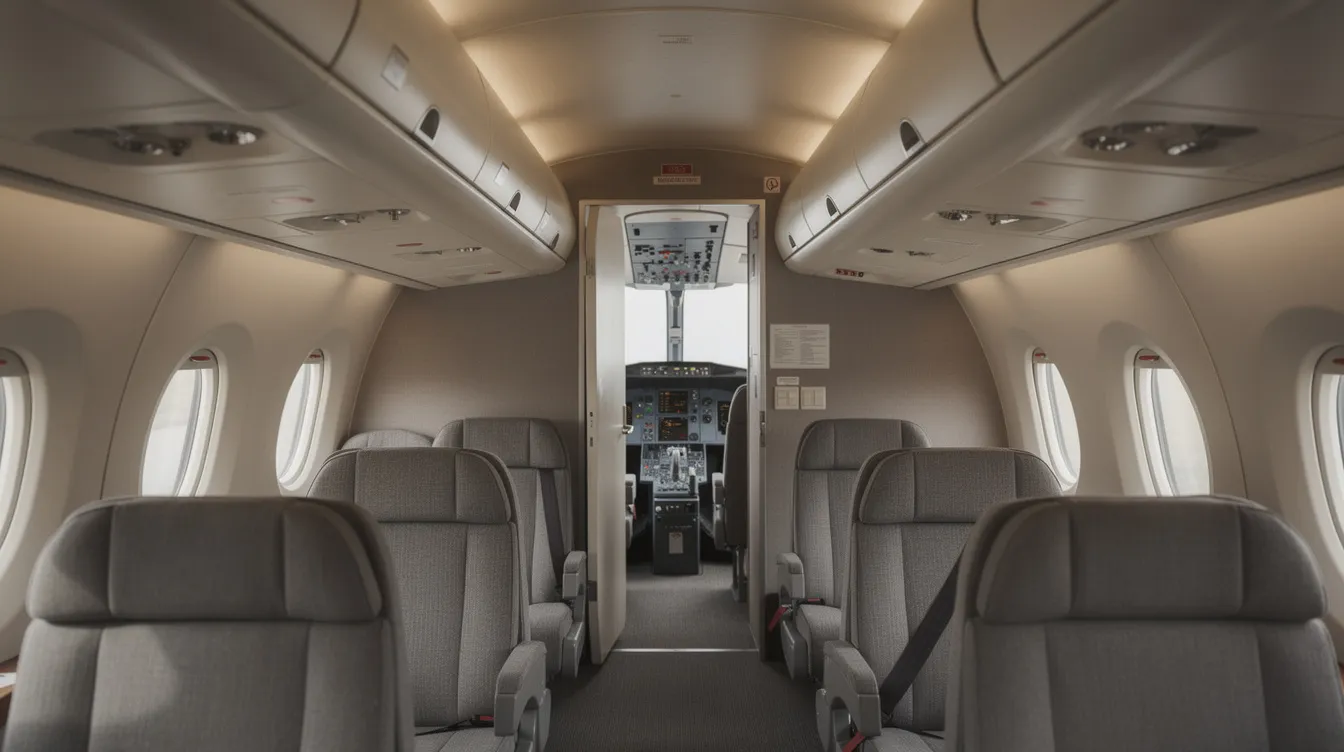
Standard seat pitch is approximately 31 inches, with a seat width of about 17 inches. There is no First or Business class section; the entire cabin is a single economy product. The designations "Embraer 145," "Embraer ERJ 145," and "EMB 145" all refer to the same regional jet platform. The ERJ-145 can be configured for 30 to 50 seats depending on the operator's goals. In private and semi-private layouts, capacity is deliberately reduced to 25–30 passengers, creating a more spacious environment suited to jet card and charter customers.
Commercial Embraer 145 seat map and cabin layout
On typical regional routes under two hours, the ERJ 145 cabin is arranged for maximum throughput and practicality rather than luxury. The cabin features a 1-2 seating configuration: one seat on the left (labeled "A"), an aisle, and a paired row on the right ("B" and "C"). Seating arrangements of 1-2 mean there are no middle seats anywhere in the aircraft-a small but meaningful comfort advantage over larger narrowbodies.

A typical American Airlines / Envoy Air ERJ 145 layout runs from the cockpit and a compact forward galley through rows 1 to roughly 18 in a continuous economy cabin, with the lavatory rear-mounted on the right side near the tail. Across those rows, the plane holds about 50 seats. The central aisle is narrow, and overhead bin space is limited, especially above the single A seats, where bins may be shallow or absent on some airframes.
Bulkhead seats at row 1 and exit rows (often rows 10–12, varying by operator) are sometimes marketed as extra-legroom or "Economy Plus" seats, though the cabin class technically remains economy-only. Most commercial ERJ 145s do not offer in-seat entertainment, power outlets, or wi fi; passengers should expect a simple, functional ride with basic beverage service only.
Seat dimensions, comfort, and onboard experience
The ERJ 145 was developed for short sectors, so passenger comfort is adequate for flights of roughly 90–120 minutes but not calibrated for long-haul standards. Here are the key dimensions travelers should be aware of:
Spec | Commercial Standard |
|---|
Seat pitch | ~31 inches |
Seat width | ~17 inches |
Recline | ~3 inches |
Headrests | Mostly non-adjustable |
Some back-row seats offer little to no recline due to the rear pressure bulkhead. Cabin height and width make the aisle feel cramped-taller passengers may need to duck slightly, and aisle seat occupants are more exposed to galley carts and foot traffic throughout the flight.
Overhead bin limitations deserve attention. Bins above the A side can be shallow or missing on certain airframes, meaning many standard rollaboard carry-ons must be gate-checked. Passengers can bring a 45lbs bag on the ERJ-145, but soft-sided bags are the safer bet for overhead storage options, and understanding how much it costs to charter a small plane helps frame whether regional jets or lighter aircraft are the better value for a given trip. Ride quality is comparatively smooth and benefits from low noise levels relative to older turboprops, though low cruising altitudes and regional weather can make the tiny plane feel bumpier than a large mainline jet.
Connectivity is limited across most commercial fleets. The majority of ERJ 145s lack wi fi and AC power; a few refurbished jets may add USB ports. Board with fully charged devices and offline content, or consider buying a seat on a private jet when connectivity and schedule control are mission-critical.
Best and worst seats on the ERJ 145 for airline passengers
Seat choice has an outsized impact on comfort in a 50-seat regional jet. Here's a quick breakdown:
Seats to target:
Bulkhead row (row 1): Extra legroom, first to deplane. Trade-offs include fixed armrests, tray tables stored in armrests, and no under-seat storage during takeoff and landing.
Emergency exit rows (rows 10–12): Exit row seats offer up to 38 inches of legroom-noticeably more spacious than the standard 31-inch pitch. Some operators designate these as premium seats.
Forward A seats (2A–6A): Each is a single seat with both window and aisle access and no seatmate, ideal for business travelers who want to work or rest undisturbed.
Seats to avoid:
Last two rows (17–18): Proximity to the lavatory brings odors, line-ups, head traffic, and limited recline.
Seats directly ahead of exit rows: These often have zero recline for safety reasons.
Seat 1A: Galley noise, light from the service area, and constant crew activity make this a less restful option despite the legroom.
Quick picks by traveler type: Solo travelers should choose forward A seats; couples favor B–C pairs over the wing; tall passengers aim for exit rows; nervous flyers benefit from an over-wing window seat for a more stable ride.
Embraer 145 variants and how they affect seating capacity
The ERJ family includes several fuselage lengths and range variants, but the classic ERJ 145 consistently centers around a 50-seat benchmark in airline service.
ERJ 135: ~37 seats
ERJ 140: ~44 seats
ERJ 145: ~50 seats
All three share the same Rolls-Royce AE 3007 engines, Honeywell Primus 1000 avionics (including the engine indication and crew alerting system), and cockpit design, differing primarily in fuselage length, weight, and fuel capacity.
Extended range versions-the ERJ 145ER, LR, and XR-focus on performance rather than seating changes. The XR variant achieves a maximum range of approximately 1,783 miles, capable of flying non-stop for about three-and-a-half hours. The ERJ 145 has a maximum cruise speed of 428 knots, a maximum takeoff weight of 36,375 lb, a service ceiling of 41,000 feet, and requires a takeoff distance of 5,614 feet. Most retain the 50-seat configuration in commercial layouts.
Airlines sometimes remove a row or two for corporate shuttle layouts, bringing capacity into the mid-40s while improving pitch and perceived comfort. When the Embraer ERJ 145 is converted for VIP or semi-private service, seating can drop to 16–30 seats in exchange for club seating, tables, and enhanced amenities, overlapping with many top 16-seat private jet options that balance cabin space with efficient group travel. The Legacy 600/650 business jets, derived from the same platform, feature completely different bespoke interiors designed for executive operations.
From regional jet to private shuttle: ERJ 145 in charter and jet card use
Picture a packed 50-seat commercial ERJ 145 on a Tuesday afternoon shuttle-then imagine the same airframe reconfigured with 30 seats, club-style groupings, and room to move. That is the transformation a charter company or operating company brings to this aircraft.
Typical private or corporate shuttle layouts use 25–30 seats in 1–1 or de-densified 1–2 formats with increased pitch, tables for working or dining, and intentionally empty buffer rows that create quiet zones, making them a strong alternative to private jets for 20 passengers when range and airport access line up. The ERJ 145 can be configured with as few as 30 seats for more legroom, making the cabin feel genuinely spacious. This setup works well for sports teams, touring musicians, executive roadshows, incentive trips, and destination weddings needing regional jet capacity with private jet privacy, and the same logic scales to chartering planes for around 100 passengers when events or conferences require even larger movements.
Unlike commercial flights, charter customers can specify catering requirements, branded headrest covers, privacy curtains, and request aircraft equipped with high-speed wi fi and in-seat power outlets, choosing from different private jet sizes to match cabin features to passenger expectations. Chartering the ERJ-145 offers flexible scheduling for groups-departures built around the client's itinerary, not an airline timetable- and some clients even leverage private plane rideshare options when they want to trade exclusivity for lower per-seat costs.
Chartering the ERJ-145 is cost-effective for short-haul flights: when moving 30–40 people point to point, the per-seat cost can rival or undercut dozens of last-minute business class tickets on major airlines, while saving hours of airport and connection time. Commercial operators like Envoy Air focus on high-utilization scheduled service; private aviation providers repurpose the EMB 145 on-demand around the client's schedule, route, and cabin preferences.
How BlackJet leverages ERJ 145 seating for premium group travel
BlackJet's jet card and private charter solutions tap into regional jet capacity-including Embraer ERJ aircraft-for clients who need more than a traditional 8–13 seat business jet, building on its core premium private jet card programs. In BlackJet's network, an ERJ 145 might be configured for 25–30 passengers with increased legroom, mixed club and forward-facing rows, and optional work or dining tables, deliberately trading raw seating capacity for ensuring passenger comfort, just as with other types of private jets in the fleet.
Use cases for BlackJet members include:
Corporate roadshows across the Midwest with multiple landing stops in a single day
Silicon Valley teams visiting Western hubs on tight schedules
High-net-worth families and friends shuttling to a major sporting event with full privacy, leisure, and branding, similar in profile to groups exploring private jets for 15 passengers
BlackJet sources aircraft and crews from top-tier, audited operators meeting or exceeding Part 135 standards, and the proven ERJ 145 platform carries an excellent safety record across decades of regional service. Members benefit from 24/7 digital booking tools, real-time flight support, multi-leg itinerary coordination, ground transport, and custom onboard experiences tailored around the chosen seating layout.
Every BlackJet flight-including regional jet charters-is carbon-neutral by default through verified offsets, allowing customers to move sizeable teams without compromising sustainability commitments, even when they are focused on the most affordable private jet options.
Connectivity, power, and amenities: commercial vs. BlackJet ERJ 145 experiences
The base ERJ 145 design predates today's expectations for constant connectivity, which is why most airline-operated aircraft still lack wi fi and seat power as standard.
Feature | Commercial ERJ 145 | BlackJet Charter ERJ 145 |
|---|
Wi fi | Rare / none | High-speed available |
Power outlets | None standard | AC or USB at most seats |
Seating | 50 seats, 31" pitch | 25–30 seats, 35–40" pitch |
Catering | Basic beverage | Tailored to client preferences |
Terminal | Standard airline facilities | Private FBO center access |
On a BlackJet-arranged charter, reduced seating capacity further enhances the experience: easier aisle movement, less overhead bin competition, more space to work or hold informal meetings, and the ability to leave buffer rows empty for privacy. BlackJet's teams can advise whether an ERJ 145, a super-midsize jet, or a larger cabin class is the better fit for a given group size, range requirement, and desired onboard experience, drawing on deep knowledge of the best small private aircraft for every need.
Amenities can also align with brand and event goals- Wi-Fi–enabled product demos for a corporate launch, curated menus for a premium leisure group, or a leading entertainment setup for a celebration flight- and some clients eventually graduate from regional jets to the largest private jets for sale or charter when missions become truly global.
Frequently Asked Questions about Embraer 145 Seating Capacity
Q: What is the maximum seating capacity of the Embraer ERJ 145?
A: The Embraer ERJ 145 has a maximum seating capacity of 50 passengers in a single-class economy layout, typically arranged in a 1–2 configuration.
Q: How does the seating configuration differ between commercial and private jet uses?
A: Commercial ERJ 145s usually seat 50 passengers in a dense 1–2 economy layout, while private or charter configurations reduce seating to 25–30 to provide more legroom, club seating, and enhanced comfort.
Q: Are there any seats with extra legroom on the ERJ 145?
A: Yes, bulkhead seats (row 1) and emergency exit rows (often rows 10–12) offer extra legroom, with exit rows providing up to 38 inches of pitch, significantly more than the standard 31 inches.
Q: Does the ERJ 145 have power outlets and Wi-Fi onboard?
A: Most commercial ERJ 145 aircraft lack Wi-Fi and power outlets, though some refurbished jets may offer USB ports. Private charters arranged through BlackJet often include high-speed Wi-Fi and power at most seats.
Q: What are the luggage restrictions for carry-on bags on the ERJ 145?
A: Passengers can bring a 45lbs bag on board, but overhead bin space is limited, especially above single A seats. Larger rollaboards often must be gate-checked; soft-sided bags are recommended for cabin storage.
Q: How does BlackJet customize the ERJ 145 experience for group travel?
A: BlackJet configures the ERJ 145 with fewer seats for added space, offers tailored catering, branded amenities, Wi-Fi, and real-time support, ensuring a premium, comfortable, and efficient group travel experience.
Choosing the right Embraer 145 configuration with BlackJet
Understanding ERJ 145 seating capacity-50 seats in airline use, fewer in private layouts-helps BlackJet members decide whether a regional jet is the optimal solution compared with smaller private jets or split charters.
Quick scenario guide:
8–12 executives on a 2-hour leg: A super-midsize jet is likely the ideal account of comfort and cost.
20–30 people on sub-three-hour routes: A de-densified ERJ 145 balances comfort, cost, and scheduling efficiency-glad to say, it's one of the most versatile options in the company's network.
40+ travelers with heavy baggage capacity needs: Consider a full 50-seat configuration or a larger aircraft category entirely.
BlackJet advisors use details like route length, passenger count, baggage volume (sports equipment, instruments), need for onboard meetings, and required wi fi and power outlets to recommend the right configuration. A private ERJ 145 can fly direct to secondary airports closer to the final destination, bypassing congested hubs and minimizing total door-to-door travel time for the entire group.
Ready to reshape your next group trip? Explore BlackJet's Jet Card programs and on-demand charter options, or speak with a specialist about tailoring an Embraer 145 or other regional jet to your itinerary. Every detail-from seating layout to catering to sustainability-is built around you.


 Sign up with google
 Sign up with Apple


