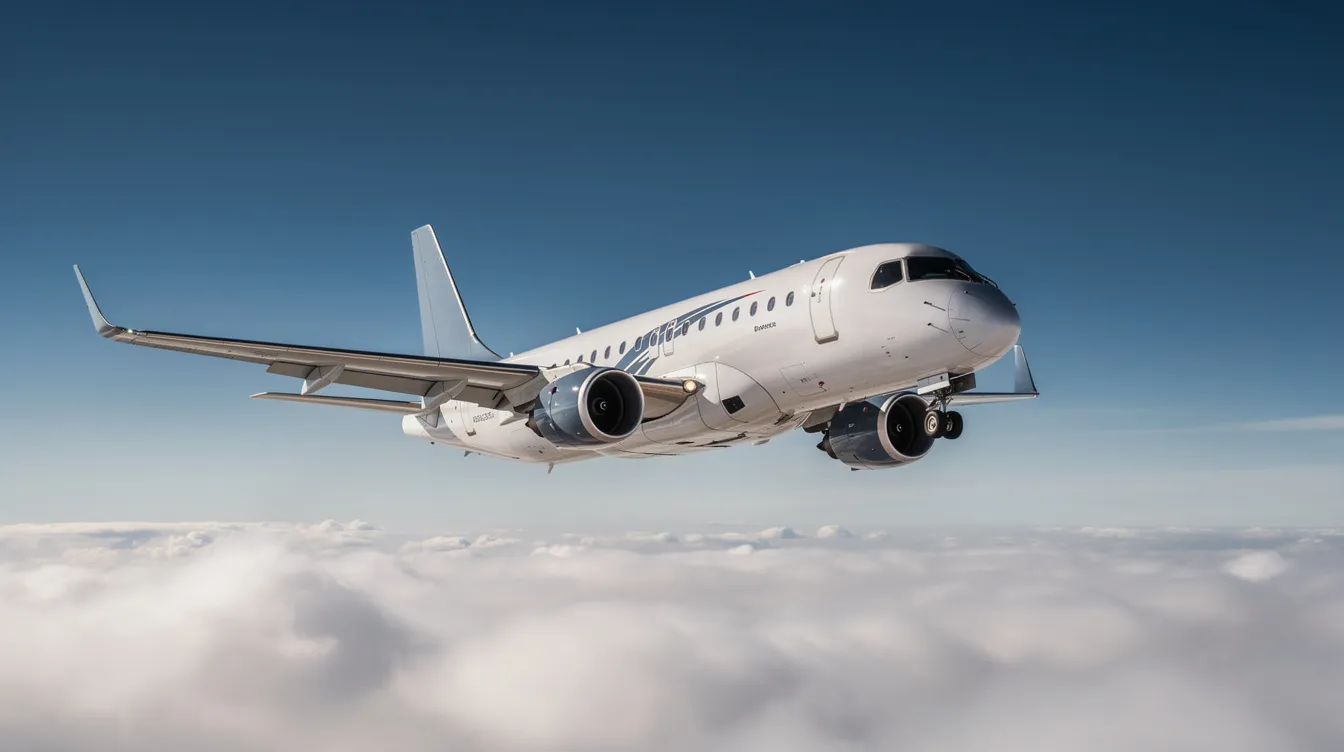
For discerning travelers who treat time as their most valuable asset, understanding how fast an aircraft actually flies during the cruise phase is more than a technical curiosity. It determines how quickly you reach your destination, how reliably you keep your schedule, and how efficiently every dollar of flight time is spent. Here is everything you need to know about the Embraer 175 cruise speed and what it means for private aviation.
Embraer 175 cruise speed at a glance
Cruise speed matters because it directly governs block time, fuel cost, and schedule predictability. For corporate travelers moving between cities on tight itineraries, even a modest difference in cruise Mach can add up across dozens of flights per year. The Embraer 175 delivers competitive performance that places it alongside much larger airliners.
Here are the concrete numbers:
The typical cruise speed of the Embraer 175 ranges from Mach 0.75 to Mach 0.82, with normal operations generally falling between Mach 0.78 and Mach 0.80. The maximum operating speed of the E 175 is 0.82 Mach, which also marks its certified Mmo ceiling.
In true airspeed terms at cruise altitude, these Mach numbers translate to a nominal cruising speed of around 495 to 545 mph, or approximately 450 to 490 knots depending on altitude and temperature.
Cruise speeds for the Embraer 175 vary based on airline configurations and specific conditions, including weight, wind, flight level, and operator cost-index settings.
Understanding the difference between indicated airspeed (what the cockpit instruments display, corrected for air density), true airspeed (actual speed through the air mass), and Mach number (ratio of aircraft speed to the local speed of sound) is essential. Published cruise figures almost always reference Mach or TAS, not IAS.
Compared to the Boeing 737-800 or Airbus A320 family, which typically cruise at Mach 0.78 to 0.80 with a similar maximum near Mach 0.82, the E jet is fully competitive. Many large-cabin private jets cruise between Mach 0.80 and 0.85, meaning the E175 sits comfortably within that range rather than lagging behind it.
Specification | Value |
|---|
Typical Cruise Speed | Mach 0.75 to Mach 0.82 |
Normal Operational Range | Mach 0.78 to Mach 0.80 |
Maximum Operating Speed | Mach 0.82 |
Nominal True Airspeed | 495 to 545 mph (450 to 490 knots) |
Embraer 175 overview for private and regional operations
The Embraer 175 belongs to Embraer's E jet family, which includes the E170, E175, E190, and E195 models. Produced by the Brazilian manufacturer, the airplane had its first flight in 2003 and entered service in 2004. It was designed for short- to medium-haul routes, filling the gap between smaller regional jets and full-size narrow-body airliners. With an overall length of 98 ft, a low-wing monoplane layout, and a wing design that supports aerodynamic efficiency and easier maintenance access, the plane is purpose-built for dense domestic and intra-regional networks.
Key specifications relevant to speed and mission planning:
The Embraer 175 typically accommodates 76 to 88 passengers in standard airline seating, arranged 2-2 across the cabin with no middle seats, a layout that significantly improves passenger comfort.
The service ceiling is 41,000 ft (FL410), and the maximum operating altitude for the Embraer 175 is 41,000 feet.
The range of the Embraer 175 varies from 1,700 to 2,200 nautical miles depending on variant and payload. The AR version extends that envelope to approximately 2,200 nautical miles under favorable conditions.
For BlackJet's clientele, the E175 is particularly attractive in scenarios that call for moving larger groups. Corporate shuttles, VIP sports and entertainment travel, and executive team movements of 20 to 70 passengers all benefit from the aircraft's capacity, cabin width, and the ability to reach destinations across domestic and European city pairs without the per-seat cost premium of flying multiple smaller jets, while many of the same planning principles apply when evaluating the cost of chartering aircraft for around 100 passengers.
Specification | Details |
|---|
Passenger Capacity | 76 to 88 passengers |
Overall Length | 98 ft |
Service Ceiling | 41,000 ft (FL410) |
Range | 1,700 to 2,200 nautical miles |
How cruise speed works on the Embraer 175
The E 175 does not simply take off and instantly reach its fastest speed. Here is how the cruise phase unfolds in practice:
After takeoff, the aircraft climbs at roughly 2,000 feet per minute to cruise altitudes typically between FL340 and FL390, with lighter loads sometimes reaching FL410. Approximate climb time to FL350 under typical mission reserves and standard payload is around 18 to 20 minutes.
Once level, the flight deck crew sets a planned cruise Mach. Economic cruise sits near Mach 0.78, while faster segments use Mach 0.80 to 0.82. The Embraer 175 is capable of high cruise speeds ranging from Mach 0.74 to 0.80 during normal operations, with Mach 0.82 reserved for maximum speed cruise.
A pilot or charter operator selects cruise Mach based on cost index, a flight planning parameter that balances fuel cost against time value. Winds aloft, schedule urgency, and passenger comfort all factor in.
Claims of cruising at Mach 0.90 occasionally surface in forums. This exceeds the published Mmo of 0.82 and is not realistic in certified operation. The FAA-certified performance envelope does not permit it.
On short sectors under 250 nautical miles, the aircraft may never spend meaningful time at true cruise before beginning its descent.
Speed, range, and typical mission profiles
Cruise speed and fuel burn exist in a constant trade-off. Slightly reducing cruise Mach from 0.82 down to 0.78 extends the range and lowers fuel cost, while higher-speed cruise shortens block time at the expense of greater burn. The maximum range of the E-175 is 2,000 nautical miles in the STD configuration, stretching to approximately 2,200 nautical miles in the AR variant with optimized loading.
Here are concrete example missions:
Route | Distance (nm) | Typical Cruise Mach | Approximate Block Time |
|---|
New York to Chicago | ~650 | 0.78 to 0.80 | ~2 hours |
London to Rome | ~760 | 0.80 to 0.82 | ~2.5 hours |
São Paulo to Buenos Aires | ~1,100 | 0.78 | ~3 hours |
Headwinds and tailwinds at altitude can shift effective groundspeed by 50 knots or more even when indicated cruise Mach remains constant. A strong tailwind can deliver arrival times that match what Mach 0.82 would achieve in still air, while headwinds erode that advantage regardless of throttle setting.
For corporate teams visiting multiple offices in a single day, the E175 hits a sweet spot: fast enough to fly between hubs on tight schedules, with enough seats and cargo capacity to carry the entire group and their luggage, all while fitting into broader private jet price planning and comparison across fleet types.
Embraer 175 vs classic private jets: cruise speed and experience
How does the Embraer 175 stack up against traditional private jets? The answer depends on what you prioritize.
Speed: Large-cabin and super-mid business jets from manufacturers like Gulfstream and Bombardier cruise between Mach 0.80 and 0.88. The E175's maximum of Mach 0.82 places it near the lower end of that private jet spectrum but ahead of many light and midsize jets. For regional sectors, the speed difference is measured in minutes, not hours.
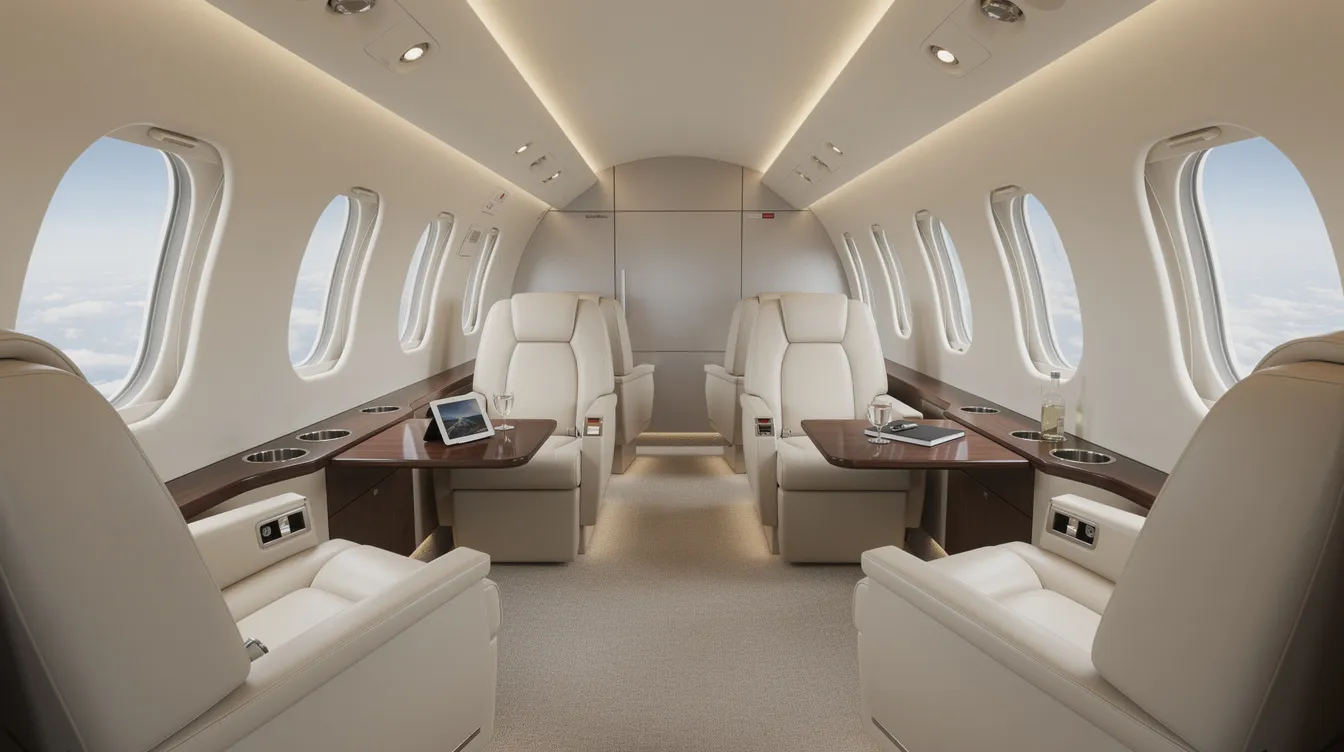
Cabin experience: The E175 offers a full stand-up cabin, wide aisle, generous overhead bins, and a 2-2 seat map that eliminates middle seats. Reconfigured for VIP or semi-private use, the cabin can include lounge zones, club seating pods, and dedicated workspaces. Details on specific layouts are covered in our Essential Guide to the Embraer 175 Seat Map.
Operational economics: When moving 40 to 70 passengers, the per-seat cost on an E175 corporate shuttle is dramatically lower than chartering multiple smaller jets. Fuel burn per hour is higher in absolute terms, but divided among more seats, the economics become compelling, much like the dynamics outlined when evaluating the best private jet solutions for 50 passengers.
Trade-offs: Ultra-long-range jets may cruise slightly faster and reach higher altitudes (some up to FL510), offering smoother rides above certain weather systems. They also access shorter runways and more remote airports with greater flexibility. But on dense regional sectors where schedule and volume matter more than marginal speed gains, the E175 excels.
Cabin layout and seat map considerations
The standard Embraer 175 seat map features 2-2 seating across roughly 20 rows, with no middle seats. For private and semi-private operations, this layout can be reimagined considerably:
Reduce total seats to 40 to 60 to increase legroom and add premium amenities.
Install club seating with face-to-face pods and fold-out tables for in-flight meetings.
Convert the front cabin into a dedicated VIP zone with wider seats, additional galley space, and a private lavatory.
Add workspace-focused layouts with power outlets, Wi-Fi connectivity stations, and conference-style tables.
These choices carry performance implications. Removing 10 to 15 seats reduces payload by roughly 1,000 to 1,500 pounds, freeing weight margin for additional fuel or enabling a higher cruise altitude where true airspeed improves. However, seat map changes also shift the center of gravity, requiring careful flight planning to ensure stability and performance.
At cruise, cabin pressure is maintained at the equivalent of approximately 6,000 to 8,000 feet, and sound suppression keeps noise levels comfortable even on longer segments. For a deeper look at the first-class experience, including what the smallest aircraft in the E jet family can offer in premium configurations, the difference from airline service is substantial, and similar considerations apply when selecting the best private jet options for groups of around 30 passengers.
Operational factors that affect E175 cruise speed
Published specifications mark the beginning of understanding performance, not the end. Real-world operations involve constant adjustments:
Payload and fuel load: The E-175 has a maximum payload capacity of 22,112 lbs. Heavier departures slow the climb, may cap achievable altitude, and reduce true airspeed at lower flight levels. Typical cruise altitudes for heavier loads sit at FL330 to FL360, while lighter loads allow FL370 to FL410.
Outside air temperature: Warmer-than-standard (ISA +10°C) conditions reduce engine efficiency and available thrust margins. Colder air at altitude increases true airspeed for a given Mach number.
Cost index: A private or charter operation may prioritize time over fuel, selecting a higher cruise Mach to shorten the trip. Airlines flying the same aircraft on scheduled service often choose lower cost indices that favor fuel savings.
Air traffic control: Route constraints, altitude restrictions, and congested airspace can force lower altitudes or speed reductions that prevent reaching optimal cruise conditions.
De-icing, hot-and-high airports, and short sectors: The aircraft requires a minimum runway length of 4,137 ft for takeoff, and hot-and-high departure airports may limit climb gradient. Ice accretion reduces performance margins. On sectors under 250 nm, the airplane may spend most of the flight in climb and descent, never reaching sustained cruise Mach.
Safety, certification, flight deck, and engine performance at cruise
The engines of the Embraer 175 are General Electric CF34-8E turbofan engines, optimized for reliable, fuel-efficient performance at cruise. The GE CF34 family delivers consistent thrust and specific fuel consumption across the Mach 0.78 to 0.80 sweet spot, with certified operation up to the service ceiling of FL410.
Additional details on certification and systems:
The Embraer 175 features a fly-by-wire flight control system, providing precise handling and automated protections that keep the aircraft within its certified performance envelope at all times.
Flight management systems, autothrottle, and VNAV automation maintain stable cruise speeds with minimal pilot workload, allowing instructors and check airmen to focus on situational awareness rather than manual speed management.
Certification standards include full systems redundancy, engine-out capability, and compliance with ICAO noise and emissions regulations. Maintenance schedules follow manufacturer specifications and regulatory requirements.
BlackJet partners exclusively with operators who meet rigorous third-party safety audits, including ARGUS and IS-BAO certifications. This ensures disciplined adherence to every speed, altitude, and weight limit, with no shortcuts on performance margins.
Technology and real-time cruise monitoring with BlackJet
Raw performance specifications only become valuable when translated into precise, real-time trip planning. BlackJet's digital platform bridges that gap:
Block time estimates are generated using actual Embraer 175 cruise speed data, historical flight records, and current winds aloft, producing arrival time predictions that corporate travel managers can build schedules around.
Operations teams monitor every flight in real time. When ATC constraints or weather force altitude changes or rerouting, updated ETAs are communicated to clients promptly.
Client-facing features include live tracking on the BlackJet site, ETA notifications pushed to mobile devices, and post-flight performance summaries showing achieved cruise Mach, fuel consumed, and cost versus plan.
Whether you search for a specific route or need a response on short notice, the platform ensures each mission uses optimal cruise settings prepared for the day's conditions.
Sustainability at cruise: efficiency and carbon-neutral flights
The cruise phase accounts for the majority of fuel burn and emissions on any flight, making efficiency at altitude a critical lever for sustainability.
The E175 delivers better fuel burn per seat than older regional jet types and many narrow-body airliners, particularly when loaded near capacity and cruising at Mach 0.78 rather than pushing toward maximum speed.
Modern cruise profile optimization techniques, including step climbs as fuel burns off and continuous descent operations from cruise, reduce unnecessary fuel consumption and emissions. Flight planning software ensures these profiles are applied consistently.
BlackJet's sustainability commitment includes carbon-neutral flights by default through verified carbon offset and sustainable aviation fuel programs, at no extra cost to the traveler.
Concrete example: a fully booked E175 corporate shuttle flying 1,000 nm at Mach 0.78 might produce approximately 25 tons of CO���2. Through SAF blending or verified offsets, net emissions can be reduced by 80 percent or more. Over a year of twice-weekly service, that adds up to a meaningful mark on a corporation's environmental ledger.
Choosing an Embraer 175 via Jet Card vs ad-hoc charter
Accessing an Embraer 175 through BlackJet's Jet Card program versus booking one-off charters changes the economics and convenience of every trip, especially for organizations considering a commitment at the scale of a 100-hour jet card.
Jet Card users benefit from pricing transparency, guaranteed availability tiers, and predictable hourly rates informed by a clear understanding of jet card cost per hour and how those economics scale with a 50-hour jet card program. When you know the E175 will deliver Mach 0.80 cruise on your regular route, scheduling becomes a repeatable, reliable process.
The E175 makes the most sense for Jet Card holders who regularly move 20 to 70 passengers between the same city pairs at speeds competitive with major airlines, minus the terminal delays, security lines, and connection risks.
Sample scenario: A corporation shuttling executives between New York and Toronto (approximately 490 nm) twice weekly, where a 25-hour jet card might provide an efficient entry point for testing regular E175 shuttle service. At Mach 0.80 cruise, expect roughly 1 hour and 50 minutes in the air plus 20 minutes for climb and descent, yielding a block time of about 2 hours. Over a month of eight round trips, prepaid Jet Card hours deliver cost efficiency that one-off charters and commercial business class simply cannot match when factoring in total journey time, flexibility over departure hours, and the number of passengers on board, particularly when you understand the broader landscape of jet card membership pricing, how jet card pricing structures differ across providers, and where unlimited private jet flight memberships might fit for ultra-frequent use cases.
Compared to owning a similar-size aircraft, Jet Card access eliminates the capital outlay, crew management, hangar costs, and utilization risk and can also open opportunities to optimize jet card-related tax deductions. Compared to commercial first class, it eliminates airport dwell time and schedule dependency, while still allowing flexibility to mix full-aircraft charters with single-seat private jet options and explore more budget-friendly private aircraft choices when appropriate for smaller groups.
Discover how BlackJet Jet Cards can reshape the way your organization travels. Explore our fleet and membership options to find the right fit for your next trip, using our overview of the best jet cards for frequent flyers, detailed analyses like NetJets jet card costs, and contextual guides on the most affordable private jet options as reference points.
Frequently asked questions about Embraer 175 cruise speed
What is the typical cruise speed of an Embraer 175?
The E-175 cruises between Mach 0.75 and Mach 0.82 under normal operations. Most operators settle on Mach 0.78 to 0.80 for the best balance of speed and fuel efficiency. In true airspeed terms at FL350 to FL410, that translates to approximately 450 to 490 knots, or roughly 495 to 545 mph. The E-175 has a cruise speed of 0.82 Mach at maximum, matching its certified maximum operating speed.
Is the Embraer 175 faster than a Boeing 737 or Airbus A320?
They are comparable. The 737-800 and A320 family also cruise at Mach 0.78 to 0.80, with maximum operating Mach numbers near 0.82. The advantage of larger narrow-bodies lies in greater passenger capacity and slightly longer range, not significantly higher cruise speed.
At what altitude does the E 175 usually cruise?
Operational cruise levels range from FL330 to FL390 under typical loading, with lighter configurations climbing to FL400 or FL410. The service ceiling is 41,000 ft.
Does changing the seat map or cabin layout affect cruise speed?
Yes. Reducing passenger count lowers payload weight, enabling higher cruise altitudes where true airspeed is greater. The effect is modest on any single flight but contributes to marginally better performance and fuel efficiency over time. Changes also affect center-of-gravity position, requiring careful planning.
Can I select cruise speed when booking with BlackJet?
You cannot directly dial in a specific Mach number, but BlackJet advisors coordinate with operators to prioritize faster cruise settings when schedule demands it. During trip planning, your advisor can provide route-specific performance details, including expected cruise Mach, flight time, and historical data for your city pair. Post your comment or question to a BlackJet advisor for a personalized response on any page of our platform.
Conclusion: Why the Embraer 175 Cruise Speed Matters for Private Aviation
The Embraer 175 stands out as a premier choice for private and corporate travelers who demand a blend of speed, efficiency, and capacity without compromise. Its cruise speed, ranging up to Mach 0.82, places it competitively alongside larger commercial jets and many private aircraft, ensuring swift, reliable travel across short- and medium-haul routes. Beyond raw speed, the E175’s design from Brazil’s renowned aerospace manufacturer combines advanced technology, safety certification, and sustainable operational practices that align with the discerning traveler’s priorities.
For BlackJet members, understanding the Embraer 175’s cruise capabilities translates into smarter trip planning, optimized schedules, and cost-effective travel solutions that scale from intimate executive groups to larger corporate shuttles. Whether flying from New York to London or São Paulo to Buenos Aires, the aircraft’s performance and cabin comfort redefine what private jet access means in today's fast-paced world.
Ultimately, the Embraer 175’s cruise speed is not just a number but a strategic advantage — one that maximizes your time, enhances your experience, and supports sustainable, safe, and seamless journeys every time you fly with BlackJet.
Discover more about how private jet technology and operational excellence come together with BlackJet’s exclusive Jet Card programs. Explore premium jet access and elevate your travel experience with confidence and ease by learning about private jet safety certifications, sustainable aviation initiatives, and the best private jet options for groups. For a deeper dive into aircraft performance, see our detailed guide on the Embraer 175 seat map.


 Sign up with google
 Sign up with Apple