Executive Summary: Why Embraer 175 Performance Matters for BlackJet Travelers
The Embraer E175 is the most widely deployed mid-range regional jet in North America, and its performance characteristics directly affect the schedules, comfort, and reliability that business travelers encounter on feeder routes. Whether you fly privately through a BlackJet Jet Card or combine commercial segments with private legs, the E175 is likely part of your travel ecosystem.
Key performance facts at a glance:
Typical seating of 76 to 88 passengers depending on configuration
Part of the Embraer E-Jet family of first-generation regional aircraft
Cruising speed around Mach 0.82 (approximately 545 mph / 877 km/h)
Maximum range of approximately 2,200 nautical miles
Ability to operate from runways as short as 4,100 feet
The E175 holds approximately 80% market share in regional jets
Is the Embraer 175 a good aircraft? By any measurable standard, yes. It carries a strong safety record with zero hull loss accidents and no fatal accidents involving passengers since entering commercial service in 2005. Its 2+2 cabin layout eliminates middle seats entirely—a rarity in commercial aviation. Its environmental efficiency makes it one of the more responsible ways to move 76 passengers between cities.
While BlackJet primarily arranges private jets, understanding Embraer 175 performance helps members combine scheduled flights on regional carriers like Delta Connection or American Eagle with private segments for strategic, time-saving itineraries.
Embraer 175 Overview within the E‑Jet Family
The term "E-Jet" refers to Embraer's family of twin-engine, narrow-body jets designed to bring mainline comfort to regional operations. The Embraer E-Jet family includes four first-generation models—E170, E175, E190, and E195—plus their newer E2 successors.
The Embraer E175 is a twin-engine regional jet optimized for short- to mid-range routes, typically covering 300 to 1,500 nautical miles and seating 76 to 88 passengers depending on cabin layout. It is the only regional jet currently in active production as of the mid-2020s, making it the default choice for airlines needing scope-clause-compliant capacity.
Within the E-Jet family, the E170 and E175 form the smaller pair, while the E190 and E195 serve higher-capacity routes. Major commonality in cockpit, avionics, and systems across all four models simplifies crew training, maintenance, and parts logistics for operators running mixed fleets.
The Embraer E175 is a stretched derivative of the E170—approximately 1.78 meters longer—maintaining the same basic wing geometry and GE CF34 engine family while increasing passenger capacity to meet the 76-seat threshold imposed by U.S. scope clause restrictions.
Development Timeline, Certification, and Operational History
Embraer developed the E-Jet program in the late 1990s with a clear ambition: deliver mainline jet comfort and performance on regional routes that had long been served by cramped turboprops and older regional jets.
Key milestones in the E175's operational history:
Late 1990s: E-Jet program launch
June 2003: E175 first flight
2004–2006: Certifications from Brazil's ANAC, EASA, and FAA
July 2005: Entry into commercial service with Air Canada as launch customer
By 2025: Embraer delivered over 1,800 E-Jet first-generation aircraft worldwide
The importance of U.S. scope clause limits cannot be overstated. These labor agreements between major airlines and pilot unions restrict regional partners to aircraft with no more than 76 seats and a maximum takeoff weight of around 86,000 lbs. The E175 was engineered to fit precisely within these boundaries, enabling widespread adoption by United Express for United Airlines, American Eagle for American Airlines, Delta Connection, and Alaska Airlines partners.
The E175's reach extends beyond North America. Operators in Europe—including LOT Polish Airlines—as well as carriers in South America, Africa, and parts of Asia use the aircraft for short- and medium-haul connectivity between secondary airports and major hubs.
Place in the E‑Jet Family and Relationship to the E2 Series
The E-Jet family is structured around two size brackets. The E170 and Embraer 175 share the same cockpit and core systems, with the E175's longer fuselage accommodating more seats. The E190 and E195 serve higher-capacity missions with larger airframes.
The planned E175-E2 represents a generational leap: a new wing design, Pratt & Whitney PW1000G geared turbofan engines, and improved fuel efficiency and environmental efficiency. However, the E175-E2's higher weight exceeds current U.S. scope clause limits, and Embraer effectively paused active development for U.S. customers in February 2022.
This means first-generation E175s will remain the dominant regional aircraft on U.S. feeder routes for the rest of this decade. For BlackJet clients, the practical implication is clear: the E175 shapes the schedule landscape on high-frequency regional routes, and understanding its capabilities helps in planning which legs to fly commercially and which to cover with a private jet via a Jet Card.
Technical Specifications and Core Aircraft Features
Dimensions
Length: approximately 31.68 m (103.9 ft)
Wingspan: approximately 26 m (85.3 ft), including winglets
Cabin width: approximately 2.74 m (9 ft), supporting 2+2 seating
Weight and Payload
Maximum takeoff weight: 86,000 lbs (39,000 kg) for the LR variant, with the advanced range variant reaching up to 89,000 lbs
Maximum payload (LR): approximately 21,636 lbs
Fuel capacity: approximately 3,071 gallons (about 11,625 liters)
Performance Features
Service ceiling: 41,000 feet
Powered by: Two General Electric CF34-8E engines, each producing 14,500 lbf (64.5 kN) of thrust
High-aspect-ratio wing with winglets for reduced drag
Advanced avionics for precise navigation and reduced pilot workload
Carbon brakes with anti-skid for durability across thousands of landing cycles
Fly-by-wire flight controls that provide envelope protection and consistent handling
The maximum takeoff weight of the Embraer 175 varies from 85,500 to 89,000 lbs across its STD, LR, and advanced range variants, giving operators flexibility to match range requirements with payload needs.
Engines and Systems: GE CF34‑8E and Fly‑By‑Wire Technology
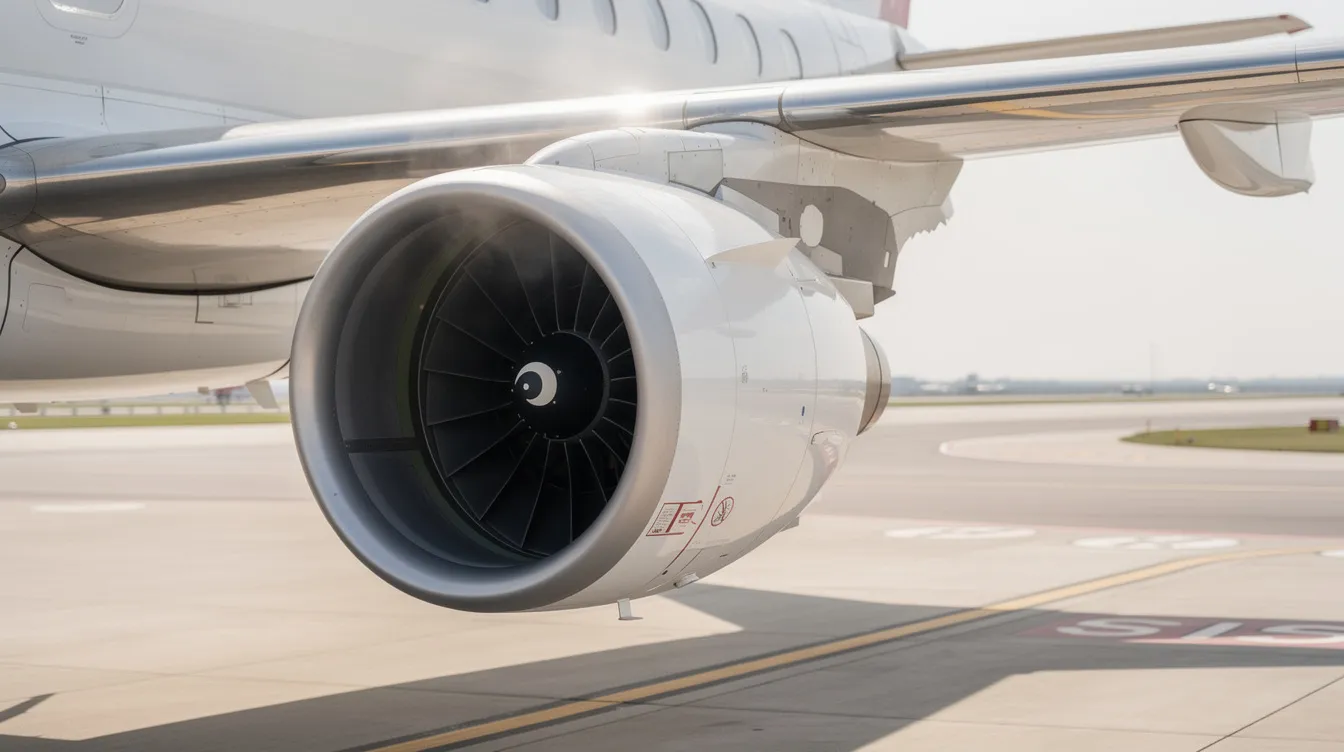
GE CF34-8E Engines
The E175's performance, fuel efficiency, and dispatch reliability are driven by its GE CF34-8E powerplants and digital flight systems.
The CF34-8E is a twin turbofan setup descended from the military TF34 engine family, which has accumulated hundreds of millions of flight hours across military and commercial applications.
Each engine produces 14,500 lbf of thrust, providing ample power for climb performance and efficient cruise at altitudes up to 41,000 feet.
For a deeper look at how turbofan engines deliver efficiency, see this overview of jet turbine efficiency.
Digital Engine and Avionics Systems
A dual-channel authority digital engine control (FADEC) system manages thrust automatically across all flight phases—from takeoff to cruise to approach—optimizing fuel burn and providing engine protection without requiring constant pilot intervention.
The avionics suite, based on the Honeywell Primus Epic platform, integrates flight management, weather radar, and Category III ILS capabilities when equipped. These advanced avionics reduce flight crew workload and increase dispatch reliability.
Fly-By-Wire and Safety Systems
The E175 employs advanced fly-by-wire flight control systems with four flight control modules.
Built-in envelope protection guards against stall and overspeed conditions, contributing directly to the aircraft's safety margins.
Automatic spoilers, carbon brakes with anti-skid, and landing gear engineered for high-cycle regional operations round out the performance-critical systems.
Cabin Layout, Seat Maps, and Passenger‑Oriented Design
Cabin Configuration
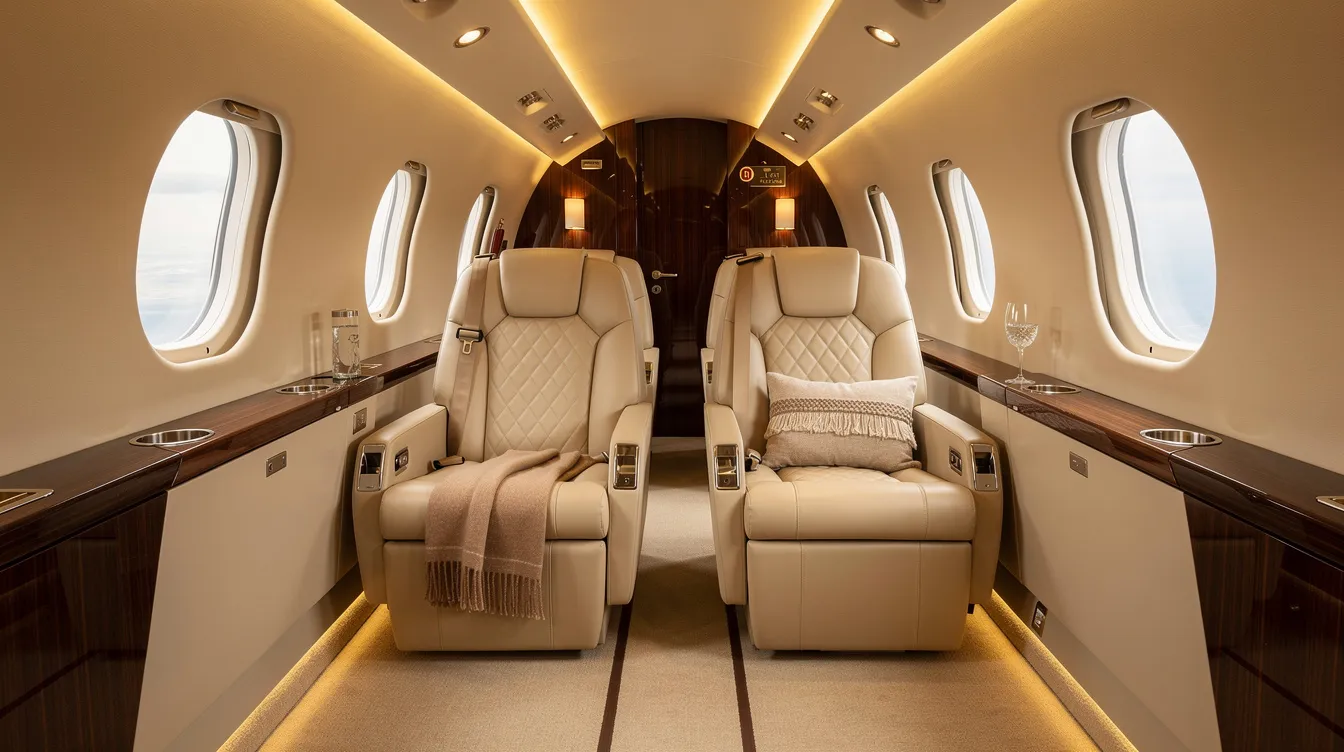
Cabin design directly affects how passengers perceive an aircraft's "performance," and for travelers accustomed to private jet standards, the E175 delivers a surprisingly refined experience for a production aircraft in the regional category.
Typical Dual Class Configuration
Approximately 12 First Class seats with wider spacing
12–20 premium economy or extra-legroom seats
44–52 main cabin seats
Total: roughly 70–76 seats
Seat Dimensions and Amenities
Seat width runs approximately 18 to 18.3 inches in standard economy, with typical seat pitch of 31 to 32 inches.
First Class seats widen to roughly 20 inches or more.
Cabin height reaches about 6 ft 6 in to 6 ft 8 in.
Large overhead bins sized to accept standard roll-aboard luggage reduce the need for gate-checking.
The cabin features large windows measuring 185 square inches—noticeably bigger than those on many competing regional aircraft.
The E175 can be configured for up to 88 seats in a high-density layout, as used by some international operators. Aircraft configurations can be adjusted based on market demand, and VIP or corporate shuttle layouts can significantly reduce seat count in favor of business-style seating and additional personal space.
Onboard Amenities and In‑Flight Experience
Many E175s include Wi-Fi and in-seat power outlets, particularly in First Class, with USB ports increasingly available throughout the main cabin. Streaming entertainment via airline apps, LED mood lighting, and modern air-conditioning systems are standard on newer deliveries, making the onboard amenities competitive with much larger jets.
Cabin noise and ride quality rank among the E175's strengths. The aircraft is significantly quieter than most turboprops, with low cabin noise during climb and cruise that supports working on laptops or reviewing documents during typical 1- to 3-hour regional flights.
Delta Connection E175 services, for example, offer First Class, Comfort+ extra-legroom sections, and standard economy—all with the same 2+2 seating geometry. American Airlines and United Airlines likewise offer dual-class E175 service through American Eagle and United Express on many regional routes.
For private charter or corporate shuttle configurations, catering, branding, and meeting-style seating can be customized more like a business jet. However, most airframes remain in airline layouts under long-term capacity purchase agreements.
How does this compare to a private jet experience? A BlackJet-arranged super midsize or large-cabin jet offers full privacy, personalized service, and a cabin tailored entirely to your preferences—the next step up in passenger comfort for those who demand it, whether you charter the whole aircraft or simply buy a seat on a private jet on select routes.
Performance Metrics: Range, Cruising Speed, and Typical Mission Profile
Cruising Speed
The E175 typically cruises between Mach 0.78 and 0.80 for optimal fuel efficiency, with a top speed of Mach 0.82.
At common cruise altitudes, this translates to approximately 440–460 knots or 505–530 mph.
For context on how aircraft speed affects travel planning, see this comprehensive guide to aircraft speed.
Typical Range
The maximum range of the E175 is approximately 2,200 nautical miles for the LR and AR variants.
Common commercial missions cover 300–1,000 nautical miles in block times of roughly 1 to 3 hours.
The Embraer 175 is optimized for short- to medium-haul operations where frequency matters more than ultra-long range.
Runway Performance
Takeoff field length for the Embraer 175 is around 4,130 to 4,150 feet under sea-level standard conditions with a typical mission load.
The E175 can operate from runways as short as 4,100 feet, giving it access to many secondary airports and regional airports that cannot accommodate larger narrow-body aircraft.
Daily Utilization
Airlines typically fly E175s on 4 to 6 legs per day, accumulating 8 to 12 block hours with turnarounds of 30 to 45 minutes.
This high utilization on mid-range routes drives the schedule frequency that makes the aircraft so useful for connections.
Concrete route examples:
Environmental Efficiency and Sustainability
The E175's environmental efficiency matters for both the commercial aviation sector and for travelers increasingly conscious of their carbon footprint—including BlackJet members who already fly carbon-neutral.
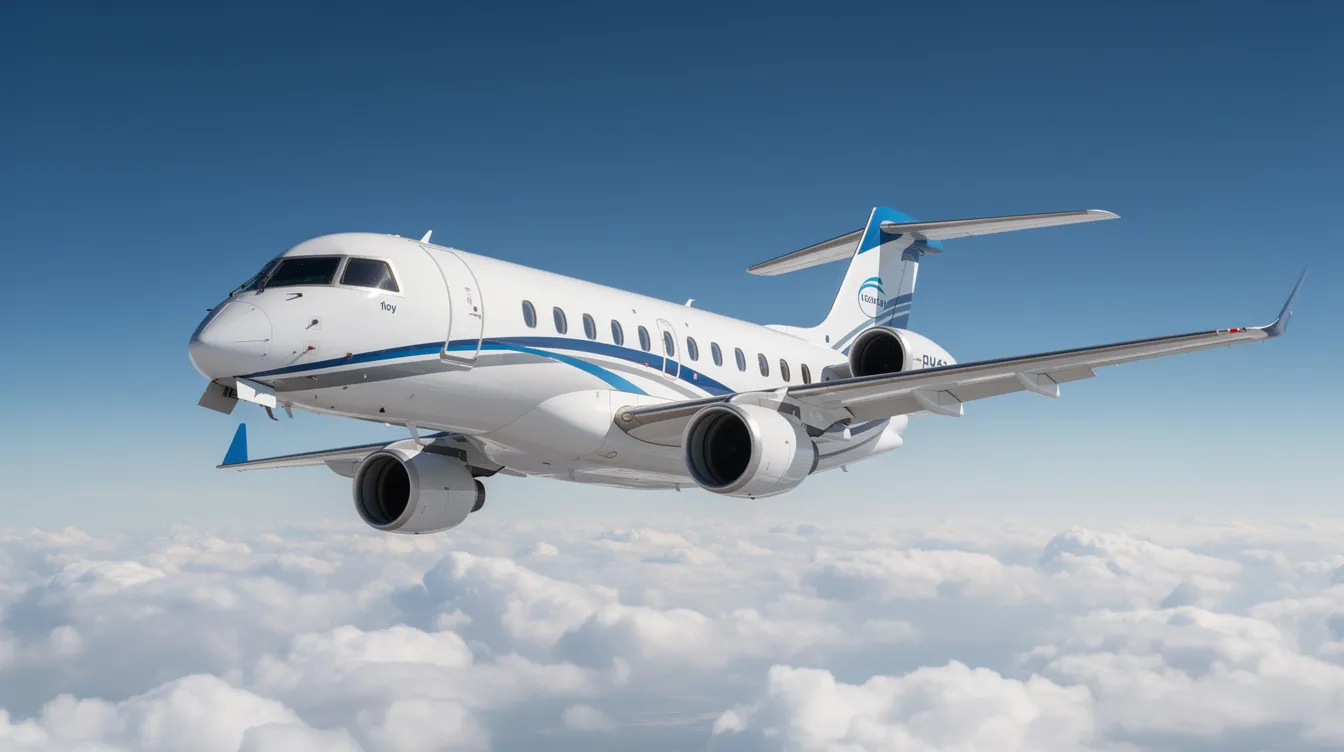
From an aerodynamic and engine perspective, the E175's winglets, updated wing design, and GE CF34 engines meet or exceed ICAO noise and emissions standards.
Embraer's aerodynamic improvements have reduced fuel consumption by 6.4% on typical flights compared to earlier variants, a meaningful gain across the millions of flight hours the fleet accumulates annually.
Operators like SkyWest Airlines have reported measurable CO₂ reductions per seat-mile when replacing older 50-seat jets (such as the CRJ-200) with E175s on the same routes—a direct win for environmental efficiency.
The E175 is compatible with sustainable aviation fuel blends, and airlines operating high frequency regional routes are increasingly incorporating SAF into their fuel mix.
This compatibility, combined with efficient per-seat economics, positions the E175 as one of the more responsible ways to move 60–80 passengers between cities.
BlackJet approaches sustainability with all flights carbon-neutral via offsets as a baseline, with options to specify SAF on select partner operators. For ultra-premium, time-critical missions, BlackJet matches travelers to right-sized private aircraft with similar sustainability commitments, including modern long-range private jets for nonstop international travel when missions demand it. The E175 serves as the efficient backbone for volume movement, while private jets handle bespoke legs where flexibility and privacy justify the premium.
Safety Record, Reliability, and Certification
For BlackJet's clientele, proven safety and reliability are prerequisites. The E175's record is one of the strongest reasons it dominates regional fleets across North America.
The Embraer 175 has zero hull loss accidents and has recorded no fatal accidents involving passengers since entering commercial service in 2005.
The E175 has accumulated millions of flight hours across nearly 800 aircraft in service, and the accident rate of the E175 is statistically negligible—modeled at approximately 0.04 per million flights in certain assessments.
Major certifications include initial approval by Brazil's ANAC in 2004, followed by EASA (2005) and FAA (2006), with continuous airworthiness directives and updates maintaining the fleet's regulatory oversight posture.
Dispatch reliability for E-Jets typically runs in the high-90s percentage range. Modular avionics and extensive global MRO networks keep aircraft support at a high level, minimizing schedule disruptions from maintenance issues.
A small number of non-catastrophic incidents—system anomalies, bird strikes, minor mechanical issues—have led to updated procedures, enhanced crew training programs, and system refinements. This continuous improvement culture reinforces the E175's strong safety record rather than undermining it.
BlackJet only partners with operators holding top-tier third-party safety ratings such as ARG/US Platinum, Wyvern, and IS-BAO. Any aircraft used for group missions—whether an E175 or a large-cabin business jet—must meet these BlackJet Certified standards.
Operators and Route Networks: Where the Embraer 175 Flies
The E175's performance has made it the backbone regional aircraft for brands tied to every major U.S. airline. As of mid-2026, approximately 793 E175 aircraft are in service globally, with over 90% concentrated in North America.
Key operators and their airline partnerships include:
SkyWest Airlines: largest operator with roughly 265–340 units, flying for Delta Connection, United Express, American Eagle, and Alaska Airlines
Republic Airways: approximately 250–280 units serving American Eagle and United Express
Envoy Air: roughly 130–150 units operating as American Eagle
Horizon Air: operating under Alaska Airlines branding
These regional airlines fly E175s on behalf of major hub-and-spoke networks including American Airlines and United Airlines, serving high-frequency shuttles between major hubs and secondary cities, "thin" routes that cannot support larger jets, and point-to-point services linking business centers. Airline schedules built around the E175 offer the frequency and reliability that make it practical to plan connections involving private segments.
International operators include LOT Polish Airlines in Europe and carriers in South America and parts of Asia, covering typical routes such as Warsaw to Budapest or São Paulo to regional Brazilian cities.
For BlackJet travelers, this dense route network means E175 regional flights often complement private segments, offering reliable coverage into slot-constrained hubs while private jets handle bespoke or multi-stop legs, including aircraft drawn from premium UK private jets for sale when ownership enters the conversation.
Embraer 175 in Private Charter and Group Travel Scenarios
While the E175 is primarily an airline workhorse operating under capacity purchase agreements, its performance profile makes it attractive for large groups when available on charter.
Typical charter use cases include:
Corporate roadshows with 60–80 staff
Sports teams traveling to seasonal fixtures
Entertainment tours requiring coordinated group movement, sometimes better matched to a private jet for 20 passengers than a full E175
Large family events or wedding groups
The performance advantage over multiple smaller jets is significant: one E175 flight replaces four or more light or midsize private jets, delivering better per-seat economics, simpler logistics, and a unified group experience. Cabin layout options range from airline-style dual class to all-economy high density or semi-VIP layouts with reduced seat counts and enhanced catering.
BlackJet positions the E175 as a specialized solution when group size justifies it. Smaller groups benefit more from super midsize or 16-seat large-cabin private jets booked via BlackJet Jet Cards.
Concrete scenario:
Comparing the Embraer 175 to Other Regional Aircraft and Private Jets
How does the E175 stack up against alternatives? This comparison helps decision-makers choose between scheduled service, large group charter, and private jets.
E175 vs. older regional jets (CRJ-700/900):
Both serve similar seat counts, but the E175 offers a wider cabin with 2+2 seating and no middle seats versus the CRJ's tighter configuration.
Large overhead bins, better perceived comfort, and improved operational efficiency give the E175 a clear edge.
Truly bespoke comfort is reserved for ultra-luxury $15 million private jets and similar aircraft.
Airlines have been steadily replacing older regional jets with E175s for exactly these reasons.
E175 vs. turboprops (ATR 72, Dash 8-Q400):
Turboprops can use even shorter runways and may burn less fuel at very short ranges below 300 nautical miles.
The E175 delivers higher cruising speed, lower cabin noise, a higher service ceiling, and a "mainline jet" passenger experience that business travelers prefer on mid-range flights.
Efficient $5 million light and midsize jets offer yet another alternative for smaller groups.
E175 vs. private jets:
The E175 excels for groups of 60–88 passengers.
For parties of 4–9, light and midsize private jets offer privacy and access to smaller airports.
Super midsize and large-cabin jets serve 8–16 passengers with longer range, lie-flat seating, and fully private cabins.
Travelers can use this guide to private jet sizes to benchmark which cabin category best fits a given mission.
Operational flexibility favors business jets, which can access FBOs and regional airports that the E175 cannot always serve.
BlackJet advisors can model the trade-off between multiple private jets, a regional aircraft charter, and premium cabin seats on scheduled E175 flights to find the right balance of cost, time, and privacy, drawing on the full suite of premium private jet card programs BlackJet offers.
Using Commercial E175 Flights Alongside BlackJet Jet Card Travel
Experienced travelers often combine commercial E175 segments with private jet legs for optimal efficiency. This hybrid approach maximizes value by using each mode where it performs best.
Sample itinerary:
Fly commercially on an Embraer 175 with Delta Connection into Atlanta, then connect to a BlackJet-arranged private jet for same-day travel to a smaller city in the Southeast with no scheduled service.
The E175 leg covers the high-frequency hub connection reliably, while the private segment handles the last mile where flexibility and access matter most, funded through BlackJet 25+ Hour Jet Card hours for predictable costs.
Schedule control:
E175 flights on high frequency regional routes offer the predictability needed for tight connections.
Private jets deliver bespoke routing, flexible departure times, and access to secondary airports closer to final destinations.
BlackJet's real-time support team coordinates arrival and departure buffers, FBO transfers, and ground transportation so that movement between commercial and private segments feels seamless. Jet Card hours can be allocated to the most strategically valuable legs—multi-stop tours, last-minute meetings, off-network destinations—while E175 flights cover routine hub connections, and the largest long-range private jets for sale and charter handle global missions.
On critical travel days, BlackJet provides backup options such as last-minute private flights if an E175 commercial leg faces significant delays or cancellation—risk management that commercial tickets alone cannot offer, including access to private jets for 30 passengers when large teams need contingency lift.
FAQ: Embraer 175 Performance, Comfort, and Private Alternatives
Is the Embraer 175 comfortable for business travelers?
Yes. The 2+2 cabin layout means no middle seats, and the cabin offers approximately 6 ft 6 in to 6 ft 8 in of headroom with large windows and a quiet interior. Seat width in economy runs 18 to 18.3 inches with 31 to 32 inches of pitch. For comparison, a typical super midsize private jet offers fully private seating with lie-flat capability—an entirely different category of comfort that BlackJet arranges through its Jet Card programs.
What is the Embraer 175's cruising speed and typical range?
The E175 cruises between Mach 0.78 and 0.82, translating to roughly 505–530 mph at altitude. The maximum range of the E175 is approximately 2,200 nautical miles in the LR variant, though most commercial missions cover 300 to 1,000 nautical miles. Routes like LaGuardia to O'Hare or Dallas to Denver fall well within the typical range.
Can the Embraer 175 use smaller regional airports?
The E175 can operate from runways as short as 4,100 feet under standard conditions, giving it access to many regional airports that cannot accommodate larger jets. However, high-altitude or hot-weather airports may require longer runways, and the aircraft still needs standard instrument approach infrastructure—limiting it compared to smaller business jets that can access even more remote fields.
How safe is the Embraer 175 compared to other jets?
The E175 has zero hull losses and no fatal accidents involving passengers across its entire operational history since 2005. It has accumulated millions of flight hours with an accident rate that is statistically negligible. BlackJet maintains its own safety standards requiring all partner operators to hold ARG/US Platinum or equivalent ratings, ensuring that every aircraft in the network—regional or private—meets the highest benchmarks.
When should I choose a BlackJet Jet Card over flying in First Class on an Embraer 175?
A Jet Card wins when you need schedule flexibility, full privacy, multi-stop itineraries, or access to airports without scheduled service. For routine hub-to-hub connections where the E175 offers frequent, reliable service, flying commercially can be the smarter use of your time and budget. The best strategy often combines both.
Conclusion: Leveraging Embraer 175 Performance with BlackJet
The Embraer 175 has earned its position as the dominant regional jet through reliable performance, efficient cruising speed and range, strong environmental efficiency, and a passenger-friendly cabin layout that respects travelers' time and comfort. Its clean safety record and continuous presence in active production make it a fixture of regional aviation for the foreseeable future.
E-Jet family aircraft like the Embraer 175 complement rather than compete with private jets. They form the regional backbone that BlackJet clients can strategically pair with bespoke private segments—using each mode where it delivers the most value, reserving the world's top private jets for missions where ultimate range and luxury are essential.
BlackJet's commitment to safety, sustainability through carbon-neutral flights and SAF options, and technology-enabled convenience through digital booking and real-time support means your entire travel plan is covered, whether the leg involves a scheduled E175 or a dedicated private cabin comparable to the most expensive private jets in the world.
Explore BlackJet Jet Cards or speak with a BlackJet advisor to design a travel plan that leverages both premium commercial and private aviation. Insights into the top private jet companies and how they compare to BlackJet's model can further refine your strategy. Mastering aircraft performance details—like those of the Embraer 175—is part of turning air travel from a constraint into a strategic advantage.


 Sign up with google
 Sign up with Apple