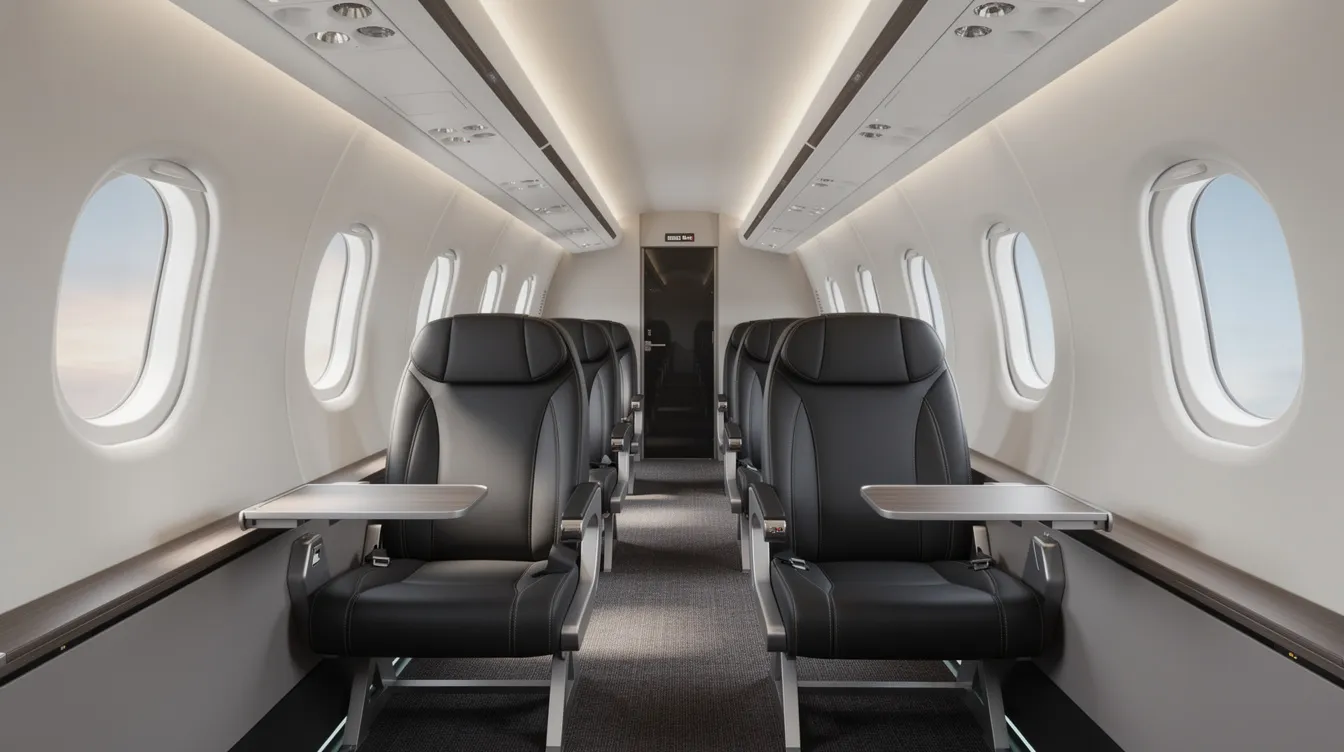
Understanding the Embraer seat map is a strategic advantage for any time-pressed traveler flying regional routes across North America. Whether you are logging weekly segments on an Embraer 175 or weighing whether private aviation makes more sense, knowing how to read the seat layout can directly influence your comfort, productivity, and speed through your travel day.
Key Takeaways
The Embraer 175 has 76 total seats across three cabin classes: 12 first class seats, 20 Main Cabin Extra, and 44 standard economy - all in a 2-2 seating configuration with no middle seats anywhere on the aircraft.
Best seats include solo first-class cabin positions (Row 1A–4A) for privacy, forward main-cabin extra rows for the legroom sweet spot, and exit-row economy for extra knee room.
Seats to avoid: last rows near lavatories and galleys, and window seats with misaligned windows.
The Embraer 175 reduces CO2 emissions by 6.4% thanks to enhanced winglets, while BlackJet flights are carbon-neutral at no extra cost through integrated offsets.
For travelers whose trip demands exceed what any commercial seat map can solve, BlackJet Jet Card programs replace seat selection stress with private cabins, flexible departure times, and tailored aircraft choice.
Why Embraer Seat Maps Matter for Strategic Travelers
High-net-worth and executive travelers weigh every minute. On a Dallas–Denver flight aboard an American Airlines Embraer 175, seat selection can mean the difference between a productive 2.5-hour segment and a frustrating one - proximity to galleys, recline limitations, and overhead bins that fill before you board all affect outcomes.
Consider the same point of comparison from a private jet perspective: a BlackJet Jet Card member flying that route arrives at a private terminal 15–20 minutes before departure, bypasses TSA security lines entirely, and controls the cabin environment. Many of our members graduated from optimizing Embraer seat maps to optimizing aircraft choice itself.
Embraer 175 Seat Map Overview (American Airlines & Similar Operators)
The Embraer 175 is a widely operated regional jet across North America, flown by American Airlines, Delta, United, and regional partners like SkyWest Airlines. The Embraer E170 typically accommodates 66 to 78 passengers, while the E175 standardizes at 76 seats in the most common configurations used through 2026. Larger models like the Embraer E-195 can seat up to 124 passengers, reflecting the brand's range across regional aircraft sizes.
Cabin configurations can vary depending on the airline operating the Embraer aircraft, but the standard dual-class seat layout features 12 first class, 20 Main Cabin Extra (premium economy within the main cabin), and 44 standard economy seats. Galleys sit at the front and rear, lavatories are positioned one forward and one aft, and overwing emergency exits appear in the economy cabin mid-section. The 2-2 seat layout and absence of middle seats are consistent hallmarks of this plane, providing a less claustrophobic feeling compared to older regional jets.
Cabin Classes on the Embraer 175
The Embraer 175 has three cabin classes: First Class, Main Cabin Extra, and Standard Economy. The first class cabin uses a 1-2 layout with solo seats on the left, while the rest of the aircraft uses a 2-2 layout with identical row width but varying pitch. This design makes the Embraer 175 feel notably more private than larger 3-3 narrowbodies. Many airlines use a staggered, alternating layout in Business Class for Embraer jets on international variants, though domestic U.S. operators typically stick with the 1-2 first class arrangement.
First Class Cabin Layout
First Class on the E175 typically has 12 seats in a 1-2 configuration across four rows. Specifications include seat pitch around 37 inches, seat width roughly 19.9–20 inches, and recline in the 5–6 inch range. First class seats offer around 37 inches of legroom and power outlets at every position. Solo A-side seats (1A–4A) deliver either a window or direct aisle access without a neighbor - wide seats with genuine privacy for executives working at cruising altitude. Note that bulkhead Row 1 offers extra legroom but limited under seat storage during takeoff and landing.
Main Cabin Extra / Premium Economy Zone
Main Cabin Extra features 20 seats with approximately 34 inches of pitch in a 2-2 layout directly behind first class. Seat width measures around 18.2–19.3 inches. Seating pitch in Economy on Embraer jets typically ranges from 30 to 34 inches, making these main cabin seats the clear sweet spot. Soft perks may include earlier boarding groups and preferred seating location. These rows are ideal for cost-conscious travelers who want more room without paying for class seats in first.
Standard Economy Cabin Layout
The economy cabin fills 44 seats across the mid-to-rear section. Standard economy includes 44 seats with 30 inches of pitch, seat width around 18.2–19.3 inches, and recline at roughly 3 inches. Aft rows sit in proximity to the rear galley and lavatory - increasing noise and foot traffic. The last row often has limited recline, making it a common "avoid" zone. Overhead bins on newer Embraer models are designed for standard roll-aboard bags, though they remain shallower than on mainline Boeing or Airbus jets, so gate-checking bags is common on full flights.
Embraer 175 Seat Map Specifications at a Glance
Cabin Class | Seat Count | Seating Configuration | Seat Pitch (Legroom) | Seat Width | Recline | Notable Features |
|---|
First Class | 12 | 1-2 | ~37 inches | ~19.9–20 inches | ~5–6 inches | Solo seats on left side, power outlets, privacy |
Main Cabin Extra | 20 | 2-2 | ~34 inches | ~18.2–19.3 inches | ~3 inches | Extra legroom, preferred boarding |
Standard Economy | 44 | 2-2 | ~30 inches | ~18.2–19.3 inches | ~3 inches | Proximity to galley/lavatory in rear, less legroom |
No Middle Seats: Why the Embraer Layout Feels More Private
Every passenger on the Embraer 175 gets either a window or an aisle seat - there are no middle seats anywhere. Compared to a standard 3-3 narrowbody like an Airbus A320, this economy class arrangement provides noticeably more shoulder room and easier aisle access. Embraer's designs provide a less claustrophobic feeling compared to older regional jets, and no middle seats are a notable comfort advantage across most Embraer E-Jets, including the ERJ145 and E190.
Seat Map Numbers and Technical Layout Details
On most seat maps, first class occupies Rows 1–4, Main Cabin Extra spans roughly Rows 5–9, and standard economy runs from mid-cabin to about Row 24. Overwing exits typically appear around Rows 12–13, defining the best-legroom exit-row seats in the main cabin. Some airlines publish power outlet and USB availability row-by-row, which is worth checking before seat selection.
Best Seats on the American Airlines Embraer 175
Top Seat Choices
First class 1A–4A: Solo window seats with no seatmate. Maximum privacy and direct aisle access.
Forward Main Cabin Extra rows (5–7): Strong blend of legroom, quietness, and quick deplaning speed.
Exit-row economy: Best legroom in the economy cabin, though seats must remain upright during taxi, takeoff, and landing.
Row 1 provides extra legroom due to the bulkhead, but under seat storage is limited. For executives making video calls or reviewing documents in flight, the solo first class positions remain unmatched on this aircraft.
Seats to Avoid on the Embraer 175
Seats to Avoid
Last-row seats in both first class and economy frequently have limited or no recline and sit adjacent to lavatories or galleys.
Certain window seats suffer from window alignment issues - you may end up staring at fuselage wall rather than sky.
Seats near galleys can experience light disturbance during early-morning or late-night flights, a real trade offs consideration for travelers wanting to sleep.
In-Seat Amenities: Power, Storage & Comfort Features
Modern Embraer aircraft often feature in-seat power and USB charging. First class seats have power outlets for charging devices, while Main Cabin Extra and some economy rows offer USB ports or shared power outlets depending on refit status. In seat amenities across all cabins include adjustable headrests, basic recline, personal tray tables, and overhead air vents. Bulkhead rows offer more legroom but less storage, and equipment boxes beneath some seats can limit room for laptop bags.
Wi‑Fi, Streaming Entertainment & In-Flight Tech
The Embraer 175 features in-flight Wi-Fi for all passengers, suitable for messaging, email, and light browsing. Performance can vary for HD streaming or demanding video calls. Built-in seatback screens are rare; passengers can access streamed entertainment via personal devices through the airline's portal - board with a fully charged own device and headphones. Entertainment options are largely self-directed. Power outlets and USB ports become less common toward the rear of the plane.
In a BlackJet private cabin, connectivity is shared among far fewer people, making bandwidth more reliable for confidential calls and real-time collaboration.
Embraer ERJ145 & E190 Seat Map Highlights
The ERJ145 seats around 50 passengers in a 1-2 layout - a single-class cabin with no middle seats, commonly flying short regional routes, and it also appears in large-group private configurations discussed in our guide to private jets for 30 passengers. The E190 is a larger aircraft seating 96–114 passengers in 2-2 configurations across both business and economy cabins, and variants of this size show up among the best private jets for 20 passengers when configured for group charters. While this article focuses on the E175, the no-middle-seats philosophy is consistent across the Embraer family, helping travelers anticipate comfort on mixed-fleet itineraries and compare them with 16-seat private jet options for team or family travel.
How to Read Any Embraer Seat Map Strategically
Step 1: Identify Cabin Class Boundaries
Scan the seat map to determine where first class, Main Cabin Extra, and standard economy begin and end. This helps you quickly locate your preferred class and understand the layout.
Step 2: Locate Exits and Lavatories
Find the positions of exits and lavatories. Overwing exits typically appear around Rows 12–13, and lavatories are usually at the front and rear. This step helps you avoid noisy or high-traffic areas.
Step 3: Evaluate Legroom and Amenities
Assess legroom and in-seat amenities by row. Cross-check with independent seat-rating tools like SeatMaps.com to flag misaligned windows, restricted recline, or missing power outlets. Think in terms of mission—short flights may prioritize proximity to the door and bins, while longer flights make pitch and quietness more important.
Log your preferred seats for future reference.
Safety, Efficiency & Sustainability of the Embraer 175
The Embraer 175 is a modern, FAA Part 121–certified regional jet with reliable safety records worldwide. The E175's enhanced winglets improve fuel efficiency significantly - the aircraft reduces CO2 emissions by 6.4% compared to earlier wing designs, making it one of the more sustainable regional options. While commercial passengers have limited control over fleet choices, they can favor airlines operating fuel-efficient Embraer fleets.
BlackJet takes sustainability further: every flight is carbon-neutral at no extra cost, covering CO₂, water vapor, aerosols, and nitrous oxide emissions through integrated offsets, while its premium private jet card programs emphasize comfort, safety, and flexible aircraft choice for frequent travelers.
Comparing Embraer 175 First Class to a BlackJet Private Cabin
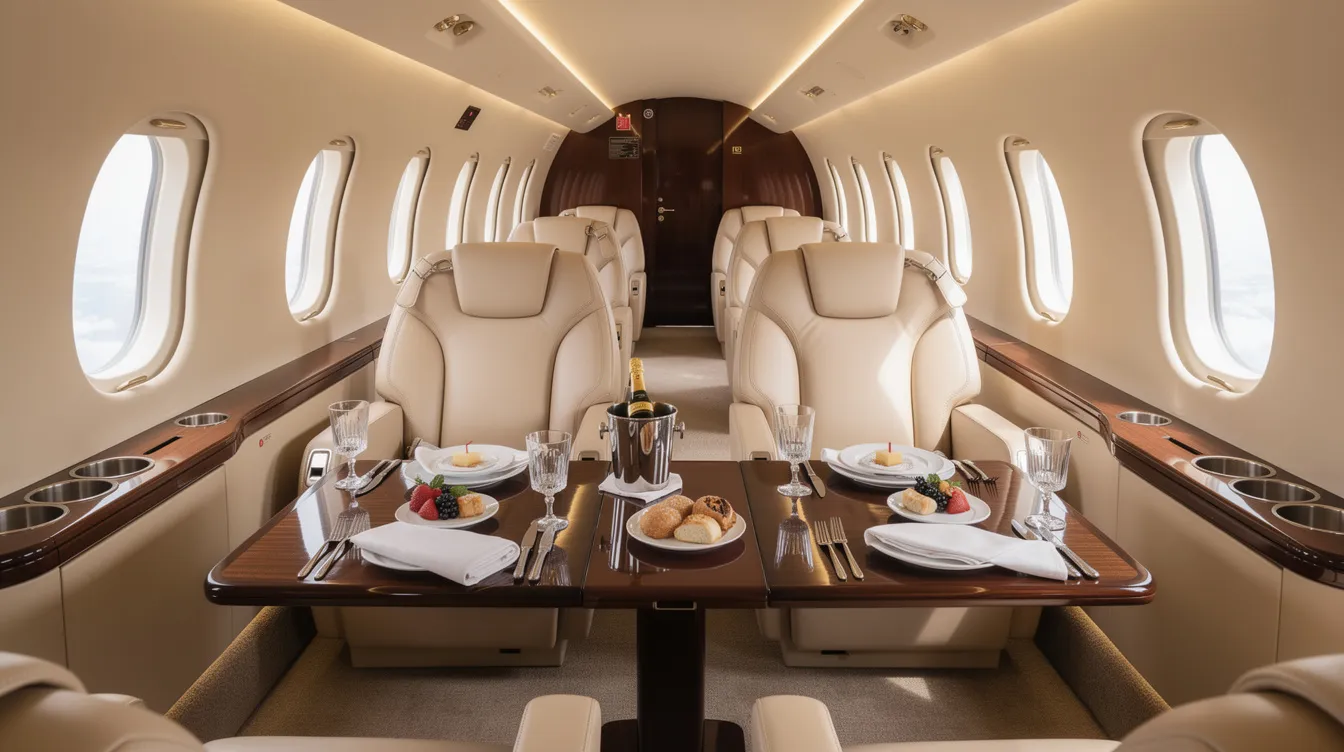
In E175 first class, you share the class cabin with up to 11 other passengers, follow fixed schedules, and pass through TSA security. In a BlackJet private cabin, private jet travel allows for flexible departure times, full cabin privacy for travelers, and private flights eliminate the need for TSA security lines. Private jet travel provides custom catering options tailored to your preferences. BlackJet flights operate under rigorous safety standards that meet or exceed FAA Part 135 requirements, and its advisors help clients match private jet sizes to specific trip lengths, group sizes, and comfort needs.
Seat Maps vs Jet Cards: Where Control Really Comes From
Commercial travelers control only their seat choice within a fixed aircraft and schedule. Jet Card members control departure windows, routing, aircraft category, and cabin layout itself, benefiting from the predictable pricing and flexibility outlined in our guide to understanding jet card cost. Instead of choosing between Main Cabin Extra and first class, BlackJet clients choose between a light jet for a quick Dallas–Houston hop or a larger cabin for New York–Aspen with family and bags. BlackJet flights are carbon-neutral at no extra cost - sustainability is built into access, not treated as an add-on.
BlackJet Jet Card Programs in Practice
The 25-hour Jet Card suits executives or families flying 8–12 regional trips per year, replacing repeated Embraer 175 segments with private flights on demand. The 50-hour Jet Card serves higher-frequency travelers mixing regional and longer domestic missions across multiple aircraft sizes. BlackJet's digital booking platform shows aircraft categories, cabin layouts, and availability in real time, while 24/7 support handles complex itineraries and helps optimize jet card cost per hour across different aircraft types.
Consider a New York–Chicago weekly commuter who used to micro-optimize Embraer 175 Main Cabin Extra seats and now evaluates the best jet cards for frequent flyers as a more strategic upgrade path. Today, that same passenger books private departures timed around meetings, cutting door-to-door time by hours each week.
Two Realistic Travel Scenarios: Optimizing Embraer Seats vs Flying Private
Scenario 1: A weekly Dallas–Houston commuter selects Main Cabin Extra Row 8 on an American Airlines E175 for legroom and quick deplaning, but still faces 60–90 minutes of preflight overhead. On a BlackJet light jet, they arrive at a private terminal 15–20 minutes before departure and are airborne within minutes.
Scenario 2: A family of four flying New York–Miami debates four first class seats in Rows 2–3 on the E175 versus a BlackJet midsize jet. The private option offers privacy, flexible baggage, pet travel, and custom catering - none of which any seat map can provide.
Both approaches have their place. BlackJet exists for travelers whose time, privacy, and schedule sensitivity justify moving beyond commercial cabins, and for some, a 100 hour jet card program delivers the right balance of flexibility and guaranteed access.
When the Embraer 175 Seat Map Is "Good Enough"
For infrequent leisure travel, short-notice bookings on high-demand days, or routes without convenient private options, a well-chosen Embraer 175 seat - a solo first class position or exit-row Main Cabin Extra - remains a rational, efficient choice. Apply the best seats and avoid-seats insights from earlier sections. Thoughtful seat selection meaningfully improves comfort and productivity on regional flights when flying commercial makes sense.
When to Step Beyond Seat Maps and Choose BlackJet
Clear thresholds exist where private aviation becomes strategically superior: back-to-back meetings across multiple cities, transporting teams or families, or flights with tight lead times. With BlackJet, considerations like middle seats, overhead bin space, or proximity to the lavatory disappear - every seat is effectively a private first class experience, equipped with everything you need, especially with flexible options like the BlackJet 25+ Hour Jet Card. For travelers who have mastered commercial seat maps, the next logical optimization is mastering which jet, not which row.
FAQ about Embraer Seat Maps & BlackJet
How many seats are on the American Airlines Embraer 175, and how are they arranged?
The widely used American Airlines Embraer 175 configuration seats 76 passengers: 12 first class seats in a 1-2 layout, 20 Main Cabin Extra in a 2-2 layout, and 44 standard economy in a 2-2 layout. No middle seats exist anywhere on the aircraft. Minor variations exist by operator, but this dual-class configuration is the norm through at least 2026.
Are there any middle seats on Embraer regional jets like the E175, ERJ145, or E190?
There are no middle seats on the Embraer 175, ERJ145, or E190 in typical commercial configurations. All use 1-2 or 2-2 layouts, giving every passenger a window or aisle seat. This is a key reason frequent flyers prefer Embraer-operated regional flights when they must fly commercial.
Which Embraer 175 seats have the best legroom and in-seat amenities?
First class offers the best legroom at around 37 inches of pitch with AC power outlets at every seat.
Exit-row seats in economy provide extra knee room.
Main Cabin Extra rows deliver about 34 inches of pitch, while standard economy offers about 30 inches.
USB or shared outlets are more common in forward rows than in the rear.
How does flying first class on an Embraer 175 compare with using a BlackJet Jet Card?
Embraer 175 first class offers a comfortable, semi-private experience with wide seats and better service, but you still share the cabin, follow fixed schedules, and pass through standard airport security. BlackJet Jet Card flights let you board via private terminals, control departure times, choose your aircraft category, and enjoy a truly private cabin. BlackJet flights are carbon-neutral and operate under rigorous safety standards, offering an alternative to legacy programs such as those outlined in our breakdown of NetJets jet card cost.
Is flying on an Embraer 175 environmentally responsible, and how does BlackJet address emissions?
The Embraer 175 is one of the more fuel-efficient regional jets, with redesigned winglets cutting fuel burn and CO₂ emissions by roughly 6.4% compared to earlier designs.
Commercial passengers have limited say in fleet choice and offsetting.
BlackJet integrates carbon offsetting into every flight, covering CO₂ and non-CO₂ effects like water vapor and aerosols, at no extra cost to members - making every Jet Card journey carbon-neutral by design, even on routes flown with the cheapest private jet options and other entry-level aircraft.
For travelers not yet ready for full membership, learning how to buy a seat on a private jet via shared or semi-private options can be a useful bridge between commercial first class and dedicated jet cards.
Environmentally conscious travelers can also explore the cheapest private aircraft options, which often pair lower operating costs with smaller, more efficient airframes and flexible access models like Jet Cards.
Conclusion & Invitation to Explore BlackJet
The Embraer 175 seat map, with its 2-2 layout and absence of middle seats, delivers one of the more comfortable commercial regional experiences available. Careful attention to cabin class, row position, and in-seat amenities can transform an ordinary regional hop into a genuinely productive segment, and the same mission-first thinking applies when evaluating 10 million-dollar private jet options for ownership or long-term access.
Yet for those whose journey demands exceed what any seat map can answer, BlackJet's Jet Card model bypasses these constraints entirely - private cabins, carbon-neutral flights, rigorous safety standards, and a digital platform that puts aircraft choice at your fingertips, making it easier to navigate the broader private jet price list and access models.
Elevate your travel - effortlessly. Explore BlackJet's Jet Card programs and discover how refined, seamless private travel becomes your new standard, whether you are comparing them with competitors like Flexjet's jet card pricing and options or other membership models.


 Sign up with google
 Sign up with Apple