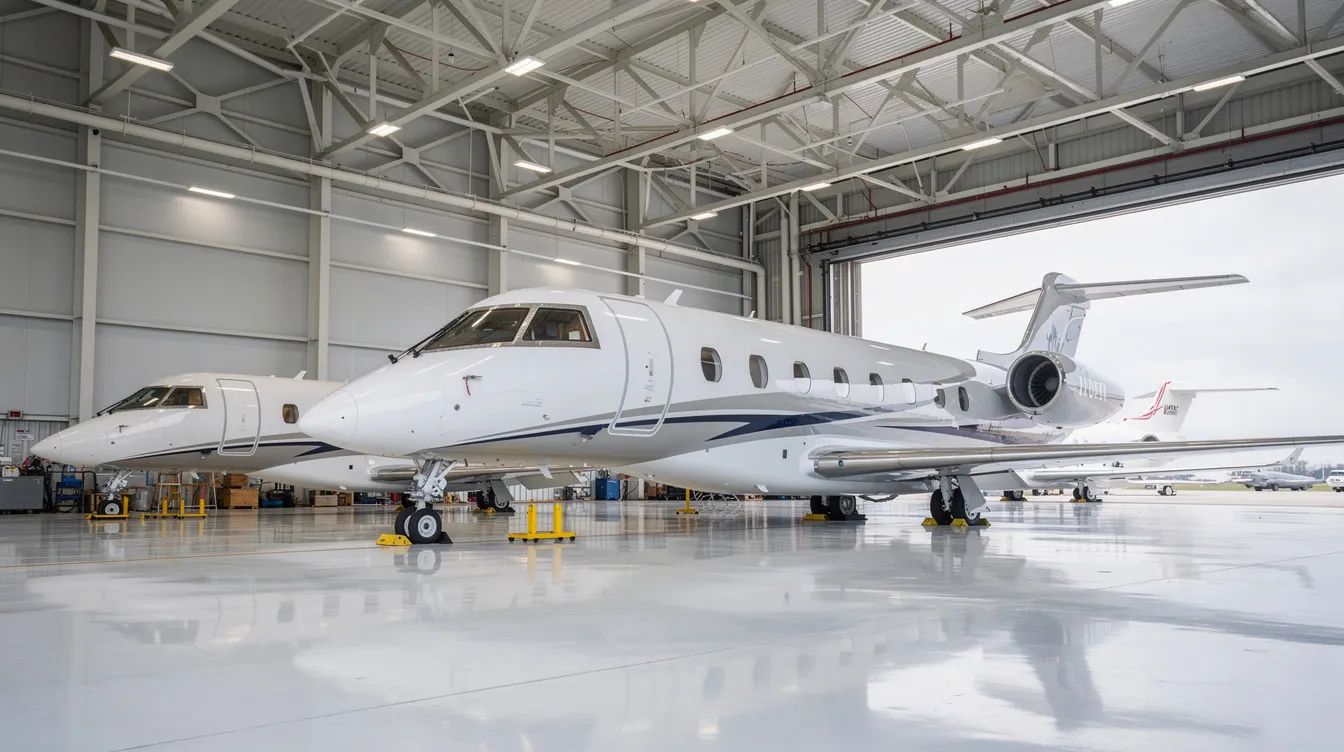
Folding wings are movable outer wing sections that fold upward or inward on the ground to reduce an aircraft’s footprint, allowing larger aircraft and future business jets to fit standard gates and hangars without giving up aerodynamic efficiency in flight. A folding wing is a wing or wingtip section that can be moved or rotated to reduce the aircraft's wingspan on the ground. Moving from aircraft carriers to commercial runways and, soon, to the business jets that serve the world’s most discerning travelers, the technology matters to frequent business flyers, high-net-worth leisure travelers, and BlackJet members who value more range, better airport access, lower fuel burn, and a more sustainable way to fly through premium private jet card and charter programs.
This article is intended for frequent business flyers, private jet travelers, and aviation enthusiasts interested in the latest aircraft technology.
Here is what that shift means in practice: how folding-wing systems work, what programs such as the Boeing 777-9 show about engineering and certification, where the operational advantages appear at airports, and why the design could shape the next generation of private jets built for long-range, efficient, luxury travel.
Why Folding Wings Matter For High-End Travelers Today
Folding wingtips are no longer confined to military hangars. Boeing's 777-9, with a wingspan of 235 feet, 5 inches, uses folding wingtips to fit into the same gates as its predecessor. Airbus is testing "Wing of Tomorrow" prototypes. The ICON A5, a light sport plane, folds its wings for trailering in a residential garage. These are production or late-stage systems, not sketches on a whiteboard.
For a BlackJet Jet Card member arriving at London Heathrow or New York JFK on a large-cabin jet, the difference is practical: an aircraft with a wing fold can taxi into a standard stand at a congested hub instead of being rerouted to a secondary airport with wider ramp space. Folding wings allow modern wide-body airliners to fit into existing airport gate categories, and the same principle applies to future commercial aircraft and business jets alike.
The efficiency case is equally direct, with Boeing's 777-9 using its extended, foldable wing as a defining feature that helps drive roughly 10% lower fuel burn relative to the 777-300ER. Folding wings can save up to 10 percent in fuel consumption on certain platforms. Those reductions translate into fewer carbon emissions per flight, a priority BlackJet builds into every Jet Card program.
The Engineering Behind The Wing Folding Mechanism And Wing Tips
A folding wing, in its simplest form, is a movable outer section attached to the fixed wing structure by hinges, actuators, and a locking system. Full wing folds, where the entire outer panel rotates, have been standard on carrier-based fighters for decades. Today's civilian designs focus on folding wingtips: smaller outer segments that fold upward or inward to reduce ground span.
The core folding mechanism includes a hinge joint at the outer wing panel, hydraulic or electric actuators that drive the fold, locking pins or latches that secure the tip in position, and sensors connected to the flight deck that confirm lock status. On the Boeing 777-9, the wingtips fold automatically after landing once ground speed drops below 50 knots; the process takes about 20 seconds. A torque tube transmits rotational force to drive the fold smoothly, and the tips sit flush against the wing's leading edge when in the folded position.
The ICON A5 takes a different approach. Its wing folding mechanism is entirely manual and user-friendly. A pilot pulls the wing fold handle, rotates the wing 90 degrees, and walks it back to latch against the horizontal tail. The ICON A5's wings can be folded in minutes; the effective weight of each wing during folding is 35 pounds, keeping it competitive with some of the cheapest modern private jets and light aircraft in terms of handling and ownership practicality. No electrical power is required.
Folding wings introduce additional weight and mechanical complexity, but they can also help manage bending load on the wing and airframe, while modern composite materials and precision engineering keep the penalty small relative to the aerodynamic gains.
Manual vs. automatic folding systems at a glance:
Feature | Manual Folding Wings (ICON A5) | Automatic Folding Wings (Boeing 777-9) |
|---|
Operation | Pilot-operated, no electrical power required | Sensor-triggered, hydraulic/electric actuators |
Time to fold/unfold | A few minutes | Approximately 20 seconds |
Weight handling | Effective wing weight in hands ~35 pounds | Mechanically assisted, no direct manual handling |
Locking mechanism | Three locking latches, warning light in cockpit | Multiple redundant locking pins, cockpit warnings |
Maintenance complexity | Simpler maintenance due to manual system | More complex with hydraulic/electric components |
Use case | Light sport aircraft, trailering, storage convenience | Large wide-body commercial aircraft, airport compatibility |
One experimental frontier: Airbus's AlbatrossONE test aircraft demonstrated free-swinging, semi-aeroelastic wingtips that can unlock in flight to absorb turbulence loads. A modified Cessna Citation VII is expected to fly with this system around 2026.
Case Study: The Boeing 777-9 Folding Wing And Airport Access
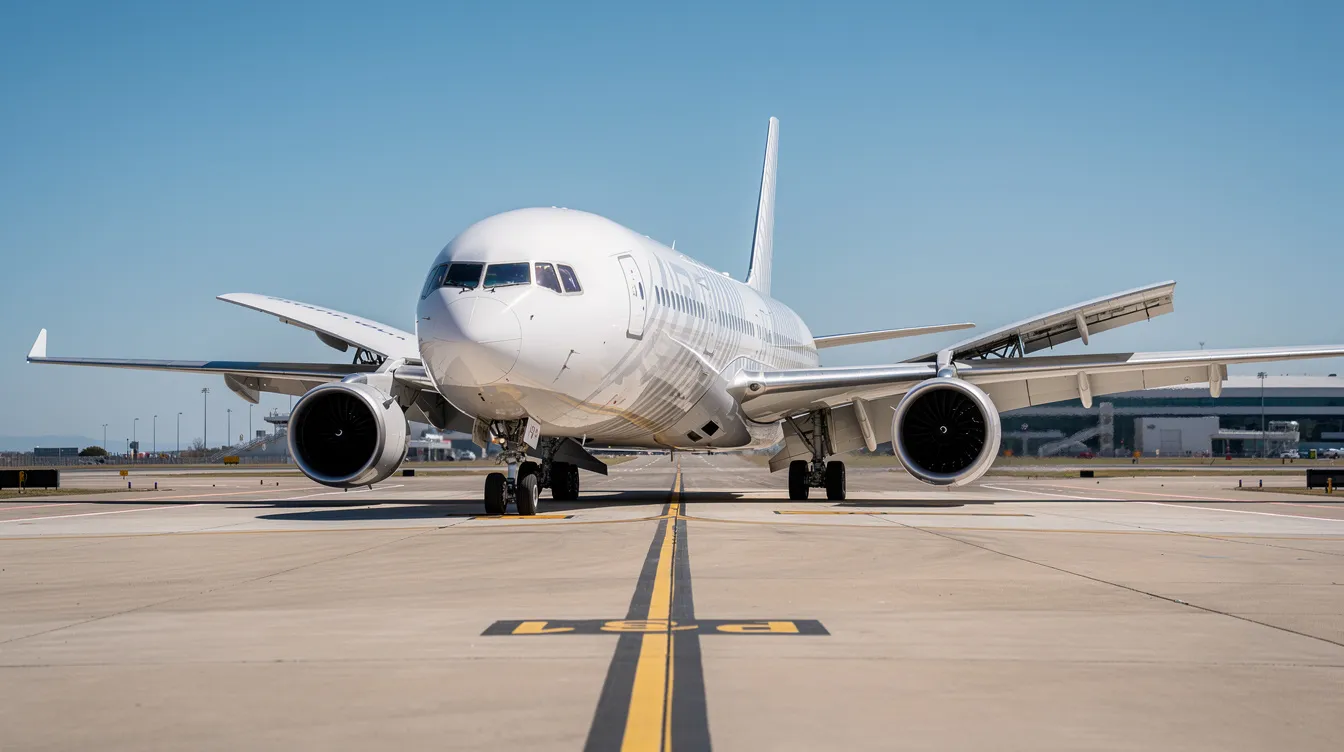
The Boeing 777-9's wingspan is 235 feet 5 inches when extended. Each outer tip, about 3.5 meters per side, is built from advanced composite materials and can fold upward on the ground. Folding wingtips reduce the wingspan to 212 feet, 9 inches, bringing the plane from ICAO Code F down to a code E aircraft classification. Folding wingtips help the 777X access airport infrastructure built for its predecessor, the 777-300ER.
Most major hubs, from Singapore to Los Angeles, operate gates sized for Code E. Singapore Airlines, among the first carriers expected to receive the 777-9 from Boeing's final assembly line, can route the aircraft into existing stands without costly terminal modifications. The wing tips fold upward automatically; cockpit systems and ground crews confirm correct position before the plane taxis into tighter gates.
Earlier Boeing 777 concepts considered folding larger wing sections that included ailerons, but those were deemed too complex for production. The current design is refined and focused on the outer tips only, with the leading edge of each folding section sealed and secured by redundant latches.
Picture a BlackJet member connecting from a 777-9 arrival into a large-cabin private jet at the same airport, perhaps comparing options to programs like Flexjet’s jet card offerings when planning their wider travel portfolio. Both aircraft park at the same ramp area because both use compact ground wingspans. No repositioning. No shuttle to a remote hangar. That is the airport access advantage folding wings deliver at scale.
Learning From Nature: Semi-Aeroelastic, Free-Swinging Wing Tips
The albatross locks and unlocks its wingtips in flight, letting them flex to ride out gusts with minimal strain on the wing root. Airbus's AlbatrossONE demonstrator replicated this principle on a scaled-down, uncrewed airframe. Sue Partridge and colleagues at Airbus UK tested free-swinging, semi-aeroelastic hinged tips that pivot during turbulence, reducing bending moments at the wing root while maintaining stability throughout the tested flight envelope (source).
The follow-up plan calls for fitting a modified Cessna Citation VII with a movable tip section roughly two meters long, bringing the concept to business-jet scale by around 2026. Long and narrow wings reduce induced drag by minimizing wingtip vortices, and aerodynamic efficiency improves with longer wings used in folding wing designs—precisely the kind of innovation shaping the best long-range private jets available for sale. Semi-aeroelastic hinges make those longer wings practical by cutting structural weight; designers can build thinner wings without adding material to handle peak gust loads.
In-flight folding wings can optimize performance under varying flight conditions, and early research suggests fuel-burn reductions on the order of 5 to 10 percent when combined with high aspect ratio wing planforms. For comfort-focused BlackJet travelers, the payoff is twofold: lower fuel consumption and a smoother ride, because the wing tip absorbs energy that would otherwise reach the cabin as abrupt bumps.

Folding Wings And Next-Generation Business Jets
Aircraft manufacturers developing long-range private jets face a basic tension. Efficient cruise at Mach 0.85 or above over 7,000 nautical miles demands wingspans of 35 meters or more. But most FBO ramps, hangars, and regional airports were built for jets with wingspans under 30 meters.
Folding wingtips resolve this. A next-generation large-cabin jet could extend new wings to 35 or 37 meters in flight, then fold to 27 or 28 meters on the ground. Folding wings reduce an aircraft's footprint by up to 50% in some configurations. Combined with new engines and advanced composite airframe construction, and with wing tanks that shift fuel storage into the structure instead of the fuselage to better manage weight and efficiency, such a plane could operate nonstop city pairs like New York to Tokyo or London to Los Angeles, even with headwinds, while fitting into the same space as today's super-midsize jets.
Several OEMs are known to be exploring folding tip designs for clean-sheet jets intended for the late 2020s and early 2030s. These programs pair the wing fold with features like higher-pressure cabin systems, lower cabin altitudes, and quieter fuselage insulation. The hope is that the form factor of a compact-parked jet will combine with the range and lift of a much larger wingspan, a combination increasingly visible in premium UK-based private jets for sale.
BlackJet monitors these developments to ensure its 25+ Hour Jet Card fleet evolves with the most efficient airframe technologies available. When production folding-wing business jets reach the runway, Jet Card holders will have access to them without owning or managing the aircraft themselves.
Operational Advantages: Airport Compatibility And Hangar Efficiency
Folding wings reduce aircraft wingspan for airport access, and the operational payoff extends well beyond gates. Consider a crowded winter ramp at Aspen or Zurich: a jet with a 32-meter fixed wingspan might require its own heated hangar bay, while a folding-wing variant that shrinks to 27 meters can share premium hangar space with another aircraft. Fewer planes left outside means less de-icing, faster turnarounds, and reduced ground delays.
Folding wings improve storage and transport convenience for light aircraft too. The ICON A5's fold lets pilots trailer the plane home, making it comparable in practicality to many of the most affordable new planes for aspiring pilots. Folding wings are useful for hobby model aircraft and drones to ease transport, and the same principle applies at scale to business jets that need repositioning between bases.
History developed this idea decades ago. Grumman's Sto-Wing on WWII carrier fighters let dozens of planes fit below deck. The V-22 Osprey rotates its wing 90 degrees over the fuselage for shipboard storage. The Grumman F-14 Tomcat has variable-sweep wings that change geometry in flight, a related but distinct concept. Each generation has refined the mechanism for its context, just as designers continually refine small private aircraft optimized for specific missions.
For BlackJet, compact parked footprints reduce ground handling risks, specifically wingtip strikes when towing in tight spaces at premium airports. For large groups, private jets for around 20 passengers benefit directly from reduced ramp congestion and safer towing clearances. Fewer repositioning flights to distant hangars means less wasted fuel, less crew fatigue, and more jets positioned where members need them.
Safety, Certification, And Redundancy In Folding Mechanisms
Every folding wing adds moving parts, and regulators treat those parts with scrutiny. The FAA issued special conditions for the Boeing 777-8 and 777-9 because existing Part 25 standards did not cover folding wingtips. Those conditions require multiple independent locking mechanisms, cockpit warnings if a wing is not locked, and prevention of takeoff with tips in an unsafe position.
The ICON A5 applies the same philosophy at a smaller scale. The A5 has a warning light for unsecured wings in the cockpit, and the A5's wings were tested to levels above normal operating conditions to confirm structural integrity. Three locking latches and two ball detents per wing secure the fold, with indicator lights confirming status to pilots before engine start.
Redundancy strategies on larger aircraft include dual or triple-redundant locking pins, mechanical over-centre locks backed by hydraulic actuators, and manual override procedures for ground crew use. During inspection, worn folding-wing components are replaced to maintain proper locking function and safety margins. Software and mechanical safeties together ensure that a folding wing tip cannot unlock during flight; the system is designed so that inadvertent folding is engineered out of normal operations.
BlackJet sources aircraft that conform to ARG/US and Wyvern safety standards, the same high benchmarks frequent flyers look for when comparing the best jet card programs and their benefits. When folding-wing business jets enter the fleet, they will meet the same certification rigor. In the air, a properly locked folding wing behaves identically to a conventional fixed wing. Passengers will not notice a difference in stability or ride quality.
Folding Wings, Fuel Efficiency, And Sustainable Private Aviation
The aerodynamic logic is straightforward. Longer wings with higher aspect ratios produce less induced drag, which directly lowers fuel burn. Folding wings decrease induced drag and boost fuel economy by letting the aircraft extend its full wingspan during cruise while keeping ground span manageable.
Folding wings allow for more efficient flight with reduced drag, and research programs report savings on the order of 5 to 10 percent in block fuel burn. On a route like New York to London (roughly 5,500 km), that translates into hundreds of kilograms of jet fuel saved per crossing. The ICON A5's wing weighs approximately 35 pounds when folded, illustrating that even at the lightest end of aviation, weight penalties from a fold system remain modest.
These efficiency gains complement BlackJet's existing sustainability commitments, including carbon-neutral flights and modern fleet selection, and align with next-generation aircraft entering service around 2026. A BlackJet member using a 50-hour Jet Card who flies 10 transatlantic round trips per year could see thousands of kilograms of CO2 avoided annually by traveling on a next-generation folding-wing aircraft compared with an older fixed-wing design.
Efficiency also means operational range. Longer wings with lower drag can extend legs far enough to avoid tech stops, reducing noise and local emissions at intermediate airports. For a company that operates jets across cabin classes and continents, every percentage point of fuel savings compounds into measurable environmental and financial benefit.
What Folding Wings Mean For BlackJet Members And Future Jet Card Travel
Folding wings and wing tips are enablers, not endpoints. They make it possible to build quieter, more efficient, longer-range aircraft that still fit into the airports and FBOs BlackJet members use most. Whether the plane is a compact-wing light jet flying into a short regional strip or a large-cabin flagship crossing the Pacific, the underlying technology serves the same goal: more capability in less space.
BlackJet's role is to curate access to these aircraft across cabin classes so that members gain the benefits of advancing wing and engine technology without the complexity of ownership. Digital booking tools and real-time flight support make it straightforward to select the right aircraft for each mission, whether you’re reserving a whole aircraft or buying a single seat on a private jet.
A few points that come up often: folding wings do not affect cabin comfort, because the tips are locked rigid throughout flight. Fold and unfold cycles are automated and take roughly 20 seconds on wide-body aircraft, so they do not delay turnarounds. And folding-wing designs are fully compatible with carbon-neutral operations; they reduce emissions at the source.
Frequently Asked Questions About Folding Wings in Private Aviation
Q: What is a code e aircraft, and how do folding wings relate to it?
A: A code e aircraft classification refers to airport infrastructure designed for aircraft with wingspans up to approximately 65 meters. Folding wings allow larger aircraft, like the Boeing 777-9, to reduce their wingspan on the ground to fit code e gates, improving airport access without sacrificing in-flight performance.
Q: How do folding wings improve fuel efficiency?
A: Folding wings enable longer, narrower wings with higher aspect ratios that reduce induced drag during flight. This aerodynamic efficiency can save up to 10% in fuel consumption, lowering emissions and operational costs.
Q: Are folding wings safe and reliable?
A: Yes. Folding wing systems undergo rigorous certification processes, including multiple locking mechanisms, cockpit warnings, and fail-safe designs to prevent accidental unlocking during flight. For example, the ICON A5 has warning lights to ensure wings are securely locked before takeoff.
Q: Can folding wings affect flight comfort or stability?
A: No. When locked in flight position, folding wings behave like conventional fixed wings, maintaining stability and passenger comfort with no noticeable differences.
Q: Will folding wings delay airport turnaround times?
A: Folding and unfolding cycles are typically fast—around 20 seconds for automatic systems like the Boeing 777-9 and a few minutes for manual systems like the ICON A5—so they do not significantly impact turnaround times.
Q: Are folding wings used in private jets today?
A: While folding wings are common in commercial and military aviation, several next-generation private jets are exploring folding wingtip designs to balance long-range efficiency with airport compatibility. BlackJet monitors these innovations to offer members access as they become available.
Q: How do folding wings affect hangar and ramp operations?
A: Folding wings reduce an aircraft’s footprint on the ground by up to 50%, allowing more efficient use of hangar space, safer towing, and fewer repositioning flights, which benefits operators and travelers alike.
Q: What is an example of a folding wing system in a light aircraft?
A: The ICON A5 features a manual wing fold system where the pilot can fold the wings in minutes without electrical power, making it practical for storage and transport while maintaining safety and ease of use.
Conclusion: The Future of Folding Wings in Private Aviation
Folding wing technology represents a strategic advancement in private aviation, marrying aerodynamic efficiency with practical airport compatibility. For BlackJet members and discerning travelers, this innovation promises longer range, reduced fuel consumption, and seamless access to premier airports worldwide without compromising safety or comfort. As manufacturers refine folding wing systems—drawing from military, commercial, and experimental designs—the next generation of private jets will deliver unprecedented flexibility and sustainability. To learn more about how these advancements integrate with our offerings, explore BlackJet’s Jet Card programs and discover the future of private jet charter with enhanced private aviation safety and sustainability features.
BlackJet remains committed to integrating these cutting-edge aircraft into its Jet Card programs, ensuring members enjoy effortless, efficient, and environmentally responsible travel. Discover how folding wings and other innovations can elevate your private jet experience by exploring BlackJet’s premium jet access offerings today.


 Sign up with google
 Sign up with Apple