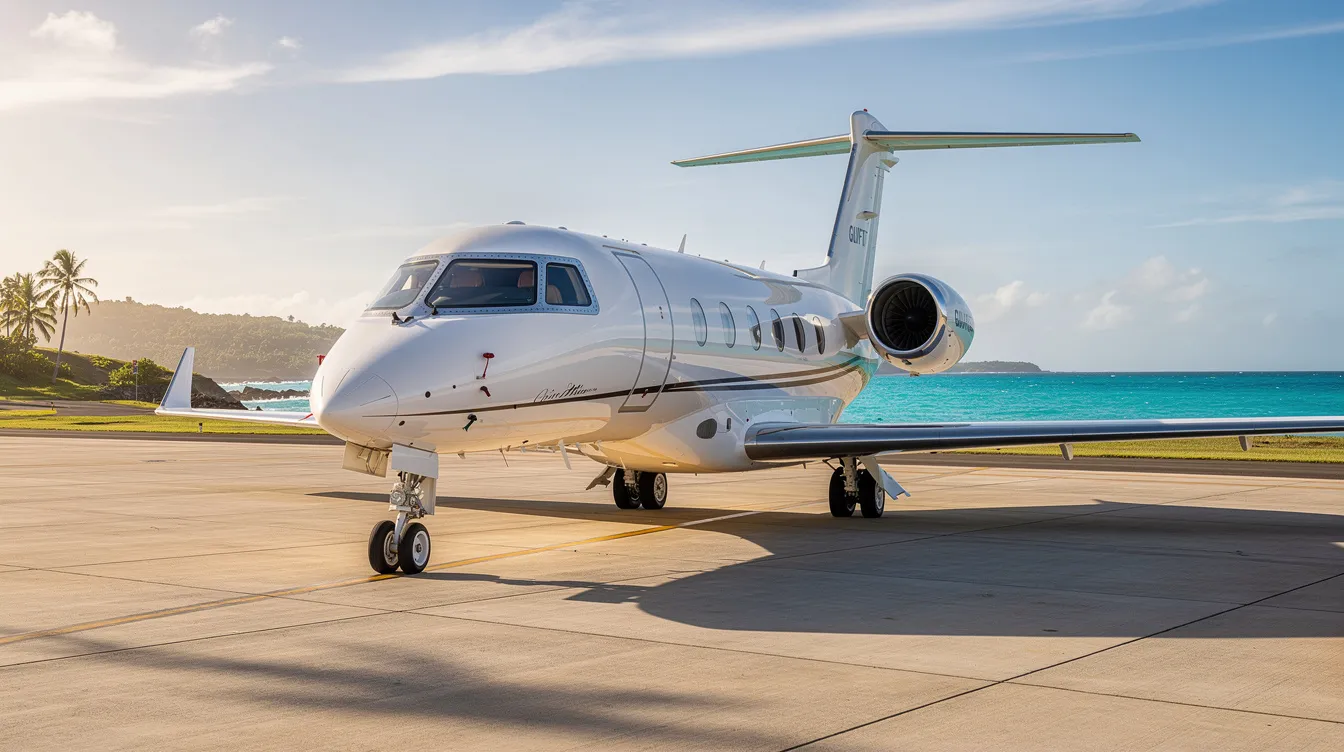
For executives and high-net-worth travelers who measure every trip in hours saved, Gulfstream aircraft represent more than prestige. They are a strategic advantage in modern business aviation.
Why Gulfstream Matters for Serious Private Flyers
Consider a typical New York–London business trip. Commercial first class means a drive to JFK, security queues, fixed departure windows, and a shared cabin at 38,000 feet. Door-to-door, you lose twelve or more hours. Fly Gulfstream from Teterboro on your schedule, and you cut that to under eight—arriving rested, having held a confidential strategy session at altitude with zero interruptions. Gulfstream aircraft are renowned for ultra-long-range and high-speed cruise capabilities that make these gains possible.
Many aircraft in the BlackJet partner network are Gulfstream models, making this guide directly practical for our Jet Card members and for travelers exploring premium private jet card programs and membership options. The world's finest aviation experience is not just brand prestige; it is a measurable combination of range, cabin environment, advanced technology, and end-to-end service.
This article covers Gulfstream history, the current Gulfstream fleet, a deep dive into the flagship Gulfstream G700, government and special mission use, cabin comparisons with commercial first class, and what it all means for BlackJet members, especially those comparing the best jet cards for frequent flyers as their primary access model.
Gulfstream History: From Gulfstream I to the Flagship G700
Gulfstream Aerospace Corporation traces its origins to the late 1950s, when Grumman merged its civilian aircraft ambitions with a bold idea: a purpose built business aircraft designed exclusively for corporate travel. The Gulfstream I, a twin-turboprop seating about twelve passengers, debuted in 1958 and could fly approximately 1,910 nautical miles nonstop—a breakthrough that ultimately paved the way for today’s largest private jets for sale and charter in the ultra-long-range category.
By 1967, Gulfstream introduced the Gulfstream II, one of the first business jets capable of transatlantic flight. The Gulfstream II completed nonstop New York–London crossings, opening a new era for intercontinental corporate travel. Grumman separated the civilian division to Georgia, and Allen Paulson later acquired and renamed the company Gulfstream Aerospace Corp. Corporate milestones followed: Chrysler purchased the company in 1985, Paulson bought it back in 1989, and parent company General Dynamics acquired Gulfstream Aerospace in 1999—where it remains today.
The product line evolved rapidly. The Gulfstream IV arrived in 1987, the GV in 1997 with Rolls-Royce engines and intercontinental range, and the G650 earned Federal Aviation Administration certification in 2014, capable of flying over 7,000 nautical miles. Gulfstream has over 3,400 aircraft in service globally, and Gulfstream Aerospace designs advanced large-cabin business jets that define the industry. Gulfstream consistently invests in developing innovative new aircraft for the future, and this continuous innovation track aligns directly with BlackJet's preference for late-generation, high-performance aircraft.
The Gulfstream Fleet Today: Models, Missions & Capabilities
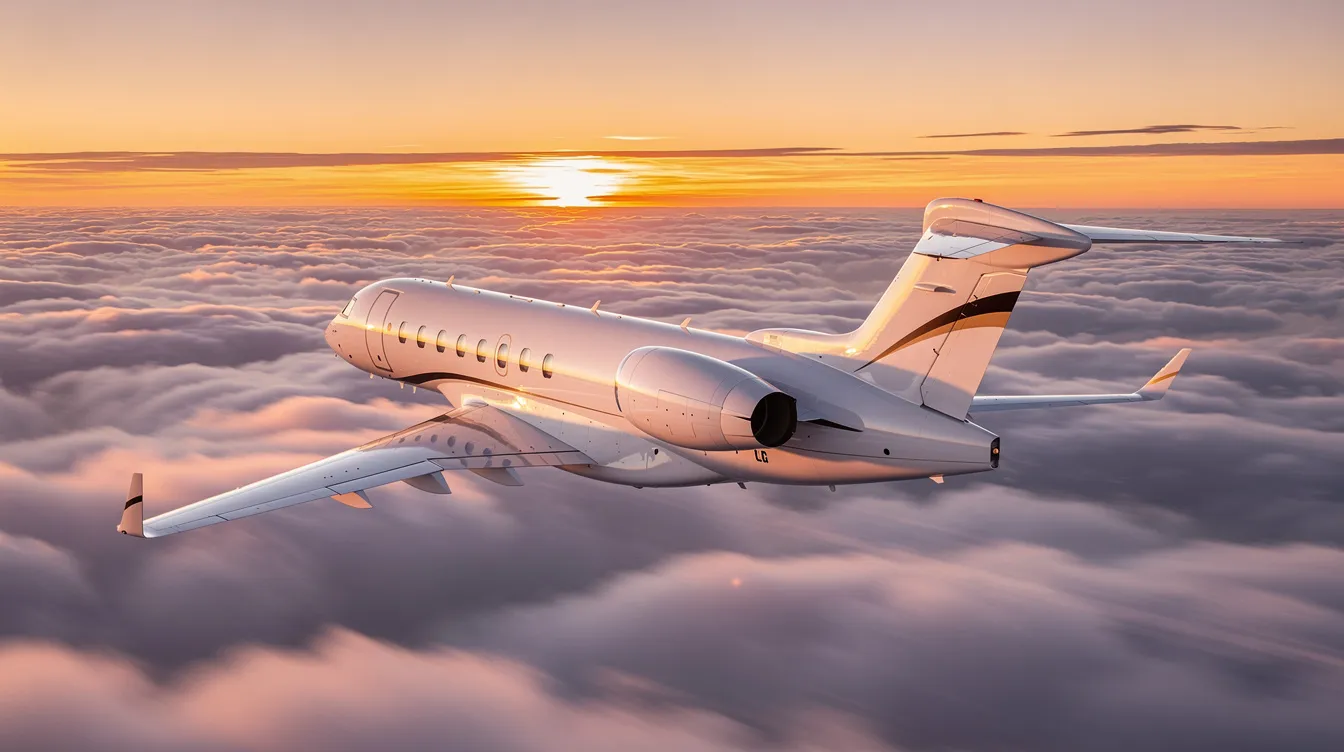
The Gulfstream fleet refers to a family of business aircraft optimized for different ranges and cabin sizes, all sharing common design DNA rooted in performance and excellence. Current Gulfstream aircraft include models such as G800, G700, G600, G500, and G400, along with the super-midsize G300 and G280.
Here is what Gulfstream's next generation family offers:
G280 / G300 (super-midsize): The Gulfstream G300 has a maximum range of 3,600 nautical miles—ideal for regional US hops like Dallas to Las Vegas or West Palm Beach to California.
G400 (large cabin): The Gulfstream G400 will have a range of approximately 4,200 nautical miles, bridging the gap between super-midsize and true long-range business aircraft.
G500 / G600 (long range): The Gulfstream G500 and G600 replaced older private jets with modern efficiency. The Gulfstream G600 offers a maximum range of 6,600 nautical miles-enough for transcontinental missions like New York–Los Angeles or transatlantic crossings.
G700 (ultralong range): Flagship with ~7,750 nm range and the largest cabin in its class.
G800 (longest range): The Gulfstream G800 has a maximum range of 8,200 nautical miles, making it the longest-range business aircraft in the world. Gulfstream's G800 is set for FAA certification in 2025.
Gulfstream jets provide high-speed cruise capabilities up to Mach 0.925, and many Gulfstream aircraft are designed for long-range private travel without frequent fuel stops, standing alongside other newest private jet models redefining innovation and luxury. A single ultra-long-range Gulfstream can replace complex multi-leg itineraries that older jets or commercial connections require-saving hours, fuel, and logistical headaches, whether you are flying between U.S. hubs or arranging bespoke private jet charters in Karachi and beyond.
While BlackJet does not manufacture aircraft, our Jet Card and on-demand charter products frequently utilize these models for their safety, performance, and passenger experience.
Inside the Gulfstream G700: Flagship of the World's Finest Aviation Experience
The Gulfstream G700 stands as the flagship of Gulfstream Aerospace—an ultra-large cabin Gulfstream that earned its FAA type certificate in March 2024, ushering in a new benchmark for private aviation.
Performance is formidable. Maximum speed reaches Mach 0.935, making it among the fastest production business jets. At Mach 0.85, range stretches to approximately 7,750 nm, connecting city pairs like New York–Hong Kong and London–Buenos Aires nonstop. At a high-altitude cruise of 41,000 feet, cabin altitude stays as low as 2,840 feet—dramatically reducing fatigue across time zones.
The cabin itself spans nearly 57 feet in length, with up to five living areas: conference room, lounge, grand suite with stand-up shower, and dedicated crew space, making it comparable to other top 16-seat private jet options for large groups. Gulfstream jets feature large panoramic oval windows for natural light—twenty of them, the largest in business aviation — and cabins configured to rival the best private jets for 15 passengers in usable space. High-speed Wi-Fi and integrated cabin management make the G700 ideal for executives conducting board-level meetings around the world at 51,000 feet.
The Symmetry Flight Deck integrates advanced safety technologies in Gulfstream aircraft, including active control sidesticks, touchscreen avionics, dual head-up displays, and enhanced vision systems—giving pilots unprecedented situational awareness.
BlackJet members may request G700-class aircraft for critical long-range trips, and our Jet Card structures can be optimized for these missions, much like travelers who evaluate Flexjet jet card pricing and options to match specific route profiles.
Government & Special Mission Gulfstream Aircraft (Including C-37A/B)
Gulfstream aircraft are used by 35 governments worldwide, including highly visible operations by the United States military. The C-37A, based on the Gulfstream V, and the C-37B, based on the Gulfstream 550, serve the U.S. Air Force for VIP and command transport.
Typical operators include the 89th Airlift Wing at Joint Base Andrews in Maryland, the 15th Airlift Wing at Hickam in Hawaii, and the 86th Airlift Wing at Ramstein in Germany. Israel Aerospace Industries, through its Galaxy Aerospace subsidiary, also contributed to the development of aircraft like the IAI Astra and the G280 airframe, though Gulfstream remains the design authority for its advanced fleet.
Mission types span heads-of-state transport, airborne early warning, intelligence, surveillance, reconnaissance, medical evacuation, and high-altitude research—profiles that at the very top end intersect with the most expensive private jets and head-of-state aircraft. American Jet Industries and other defense-adjacent entities have historically supported these programs.
The reliability, secure communications, and advanced avionics that governments demand are the same capabilities that make Gulfstream a natural choice for discerning private operators—and why BlackJet sources from operators held to equivalent standards.
Gulfstream Cabin Experience vs. Commercial First Class
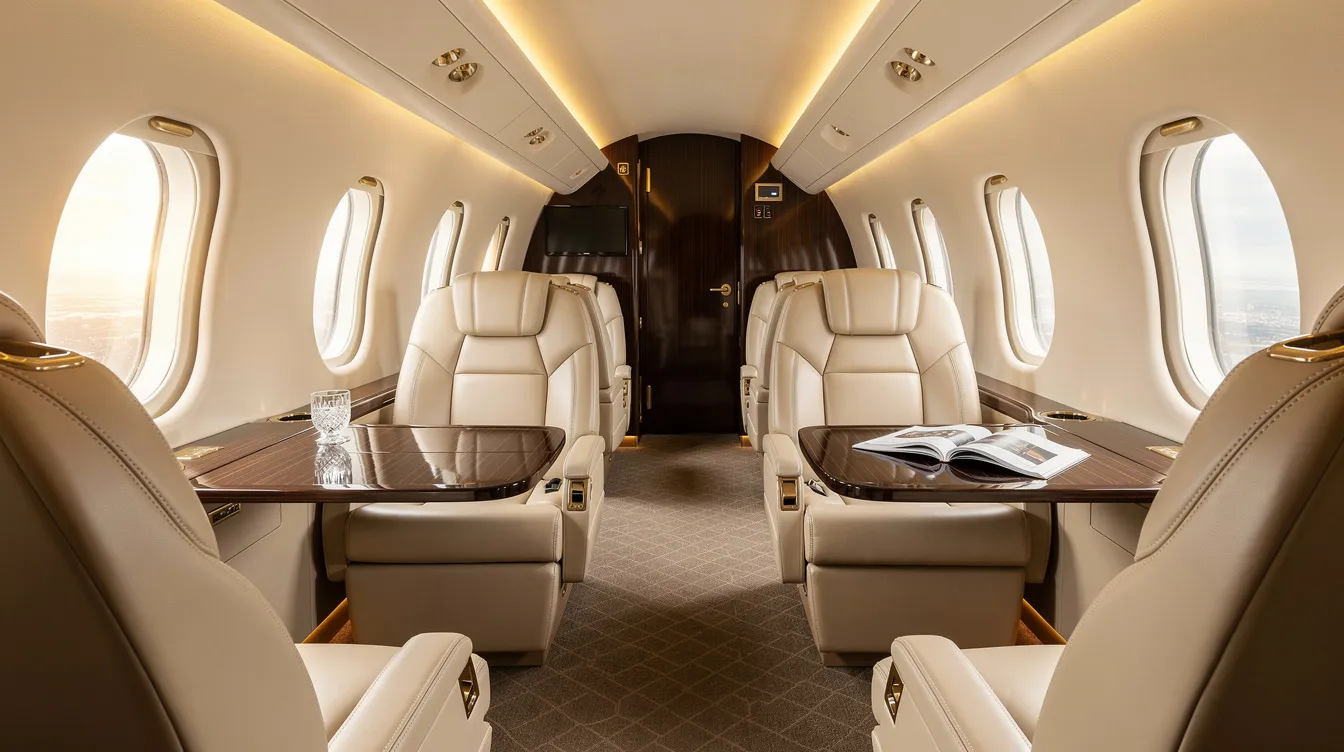
The gap between a Gulfstream cabin and commercial first class is not merely one of luxury—it is physiological. Gulfstream jets maintain low cabin altitudes and use 100% fresh air systems, regenerating cabin air every two to three minutes. Commercial airliners typically pressurize cabins to 6,000–8,000 feet; Gulfstream aircraft cruise at around 2,800–3,000 feet cabin altitude, reducing jet lag measurably on a New York–London or Los Angeles–Tokyo trip.
Gulfstream aircraft have spacious cabins designed for luxury and comfort during long flights. Privacy is absolute: the entire cabin belongs to your group, with custom departure times and the ability to land at secondary airports closer to your final destination—Teterboro instead of JFK, Farnborough instead of Heathrow.
Noise levels in Gulfstream cabins run far below commercial aircraft. Lie-flat divans, conference tables, tailored catering, and dedicating resources to your specific event or meeting make the space genuinely productive.
Mini-scenario: A BlackJet Jet Card member boards a Gulfstream G600 at Teterboro for an overnight flight to Farnborough. A strategy session runs until midnight; the cabin transitions to sleep mode with circadian lighting. The member lands rested for a full business day in London—no security lines, no connections, no lost hours.
Safety, Technology & Sustainability in Gulfstream Operations
Safety, advanced technology, and sustainability are non-negotiable pillars for BlackJet when sourcing Gulfstream aircraft.
Modern Gulfstream jets carry enhanced vision systems, head-up displays, advanced weather radar, and sophisticated flight management with GPS and performance monitoring. The Symmetry Flight Deck—standard on newer models—gives pilots predictive landing performance data and combined vision systems that operate in degraded weather. These technologies protect both pilots and passengers during every phase of flight.
BlackJet works only with operators and crews that meet strict third-party safety standards such as ARGUS, Wyvern, and IS-BAO. For travelers planning annual private flying, a solid grasp of overall jet card cost and membership pricing complements these safety benchmarks. Real-time operational data, satellite communications, and secure networks support both safety and passenger connectivity throughout every trip.
On sustainability: Gulfstream aircraft utilize Rolls-Royce Pearl engines for improved fuel efficiency and reduced emissions. Gulfstream's broader network of service centers includes Mesa as a standout example: its Mesa facility received LEED Gold certification, and Gulfstream installed solar panels there—evidence that the company backs its environmental commitments with facilities investment in Florida and beyond. Carbon-neutral flights are offered through BlackJet's Jet Card programs via verified carbon offsets, ensuring every journey is carbon-neutral at no extra cost to you.
How BlackJet Jet Cards Unlock Gulfstream Access
Owning a Gulfstream outright means $70–80 million in capital for a G700, plus crew, hangar, maintenance, insurance, and depreciation on idle hours—costs that mirror the considerations outlined for the best features of a $20 million private jet. Jet cards offer prepaid access to private jets without any of that burden.
Common jet card programs include 25-hour and 50-hour options, and travelers evaluating a 50-hour jet card cost and value breakdown often find these structures ideal for predictable annual flying. Jet card users can access multiple cabin types of jets—super-midsize for a weekend Miami–New York hop, or an ultralong range Gulfstream for an intercontinental business summit — while some flyers instead consider unlimited private jet flight memberships when their travel pattern is even more intensive. This flexibility to fuel business growth without fixed-asset risk is why the model works for owners who fly enough to value it, but not enough to justify a dedicated aircraft—and why many also explore strategies to maximize jet card tax deductions alongside their broader aviation planning.
Jet cards provide 24/7 digital booking tools for users,s and real-time support is included with jet card programs—making multi-stop itineraries, last-minute schedule changes, or upgrades to a larger cabin seamless, while a clear view of jet card cost per hour and pricing drivers helps members budget with confidence. Gulfstream has announced multiple innovative new aircraft in recent years, and BlackJet ensures members can access them as they enter service.
Whether your next trip is a three-hour transcontinental hop or a fourteen-hour crossing to John F. Kennedy from Tokyo, the right Gulfstream aircraft is available through BlackJet's advanced fleet network, whether you are comparing that access to the features of a well-equipped $5 million private jet or to full ownership of a larger aircraft.
Explore how BlackJet's Jet Card programs can reshape your travel with Gulfstream-level performance, safety, and sustainability built into every flight.


 Sign up with google
 Sign up with Apple