For private jet travelers, fuel is far more than what goes in the tank. It determines whether you fly nonstop, which airports you can access, how much your Jet Card hour actually costs, and whether your flight aligns with your sustainability commitments. Here is what you need to know.
This article is designed for private jet travelers, Jet Card users, and charter clients who want to understand the different types of jet fuel, their specifications, safety protocols, cost structures, and how these factors impact private aviation. Whether you're new to private flying or a frequent flyer, this guide will help you make informed decisions about fuel and sustainability.
Why Jet Fuel Matters for Private Jet Travelers
Consider the numbers: a midsize private jet burns roughly 250–300 gallons of jet fuel per hour, while an Airbus A320 in cruise burns approximately 350–450 gallons per hour spread across 150+ passengers. When you fly privately, every gallon is yours alone. That makes fuel type, price, and availability strategic factors-not technical afterthoughts.
BlackJet members typically fly on turbine engines that power aircraft from light jets through large-cabin long-range models, all running on kerosene-based fuel grades like Jet A or Jet A-1. The fuel type loaded into the tanks directly affects range, dispatch reliability, and the economics embedded in your hourly rate.
Practical examples bring this to life:
New York–Miami (~3 hours, midsize jet): ~900 gallons of fuel, requiring confident pricing and fuel farm availability at both ends.
London–Geneva (~1.5 hours, super-midsize): Jet A-1 with enhanced cold-weather performance for high-altitude European routing.
Los Angeles–Aspen (~2–3 hours): High-elevation runway demands careful fuel-load and payload trade-offs.
This article covers the main types of aviation fuel-conventional jet fuel (Jet A, Jet A-1, Jet B), aviation gasoline (AVGAS), and sustainable aviation fuel (SAF)-along with fuel specifications, safety protocols, cost structures, and what all of it means for Jet Card and charter users, complementing our broader overview of types of jet fuel used in aviation.
Core Aviation Fuel Types: Jet Fuel vs. Aviation Gasoline
The term aviation fuel is an umbrella covering two main types of products designed for fundamentally different engine technologies. Jet engines are powered by specialized petroleum distillates-refined kerosene-based fuels engineered for stability at extreme temperatures and altitudes. Aviation gasoline serves an entirely separate category of powerplant.
Jet fuel is the kerosene-type fuel that powers turbine engines on jet aircraft, turboprops, and helicopters. It is typically straw colored, with an energy density of roughly 42–44 MJ/kg. All jet fuels possess similar energy density by weight, which is why range calculations across grades remain consistent. Jet turbines generally run on these kerosene-based fuels designed for stability and performance. Unlike diesel fuel, jet fuel must meet far more stringent requirements for thermal stability, volatility, and contamination control.
Aviation gasoline (AVGAS), by contrast, is a high-octane rating gasoline formulated to prevent engine knocking in piston-engine aircraft. It contains tetraethyl lead and is used almost exclusively in small piston engine airplanes-training aircraft, legacy props, and light recreational models. Unleaded alternatives like G100UL received FAA approval in 2021 but have virtually no relevance for modern private jets.
Most BlackJet-card-eligible aircraft-from light jets through large-cabin models-use Jet A or Jet A-1 to power aircraft across every cabin class.
Conventional Jet Fuel Grades: Jet A, Jet A-1, Jet B
Conventional jet fuel is a complex mixture of petroleum-derived kerosene hydrocarbons, produced from crude oil and refined to meet strict international fuel specifications. Within civil aviation, three grades dominate, and understanding these fuels is foundational when you review any comprehensive private jet price list and cost options.
Jet A is primarily used in the United States and is certified under ASTM D1655. It has a maximum freezing point of –40 °C and a higher freezing point than its international counterpart. Jet A is the most commonly used fuel across U.S. domestic private and commercial aviation.
Jet A-1 is the global standard for commercial aviation outside the U.S. Jet A-1 has a maximum freeze point of –47 °C, delivering a lower freezing point that makes it the preferred choice for flights crossing high latitudes or operating at extreme altitudes. DEF STAN 91-91 specifies requirements for Jet A-1 fuel, and it requires mandatory static dissipater additives to manage static charges during fueling. Despite these differences, Jet A and Jet A-1 are chemically similar and perform similarly in most turbine engines; flight operators can use these fuels interchangeably in many approved configurations.
Jet B is the only other jet fuel grade used in civil operations, a wide-cut blend (roughly 70% gasoline, 30% kerosene) with a low freezing point of –60 °C. Gasoline-blended fuels like Jet B are more volatile but riskier to handle, offering higher volatility and a lower flash point that increases fire risk. Jet B is a common alternative in very cold climates, northern Canada, and Alaska, but is rarely encountered in mainstream business aviation.
For reference, military equivalents include JP-8, which is used in NATO military aircraft, and JP-5, which has a higher flash point than Jet A, reducing fire risks on aircraft carriers. BlackJet's network of operators and FBOs primarily uplifts Jet A in the U.S. and Jet A-1 internationally, ensuring seamless cross-border operations.
Jet Fuel Specifications and Global Standards
Fuel specifications exist to guarantee safety, engine compatibility, and consistent performance across various aircraft and geographies. Civilian jet fuels differ by freezing points, volatility, and chemical additives-and these differences are codified in internationally recognized standards.
Key specifications include:
Standard | Region | Fuel Grade | Key Parameters |
|---|
ASTM D1655 | U.S. / Global | Jet A, Jet A-1 | Freeze point, flash point, density, sulfur |
DEF STAN 91-091 | UK / Europe | Jet A-1 | Tighter cold-weather, mandatory antistatic |
AFQRJOS Checklist | Global | Jet A-1 | Harmonized quality for international supply |
Jet A-1 must meet ASTM specification D1655 and, for European operations, the state standard DEF STAN 91-091. Jet A has a maximum freeze point of –40 °C while Jet A-1's is –47 °C. Flash point minimums (typically ≥38 °C for Jet A / A-1) ensure safe handling; by comparison, TS-1 jet fuel has a flash point of 28 °C minimum, reflecting different regional risk tolerances. Jet fuel must resist thermal breakdown and coking under high heat, and the clean-burning qualities of jet fuel reduce internal carbon deposits in aircraft engines over time.
Military jet fuels include additives for anti-icing and corrosion prevention beyond what civilian specs require. Additives in commercial fuels-static dissipater additives, corrosion inhibitors, icing inhibitors-are tightly regulated and must remain within precise concentration ranges.
All aircraft flown under the BlackJet platform must be fueled with product meeting recognized aviation turbine fuel specifications, verified through our safety and quality review process.
Fuel Handling, Safety, and Quality Control
Fuel quality is inseparable from private jet safety. Even trace water contamination or particulate intrusion can damage turbine engines and compromise dispatch reliability.
The typical "refinery-to-wing" chain includes:
Refinery production - crude oil refined into kerosene
Transport - pipeline, rail, or marine delivery to regional terminals
Airport fuel farm storage - settling tanks and filtration
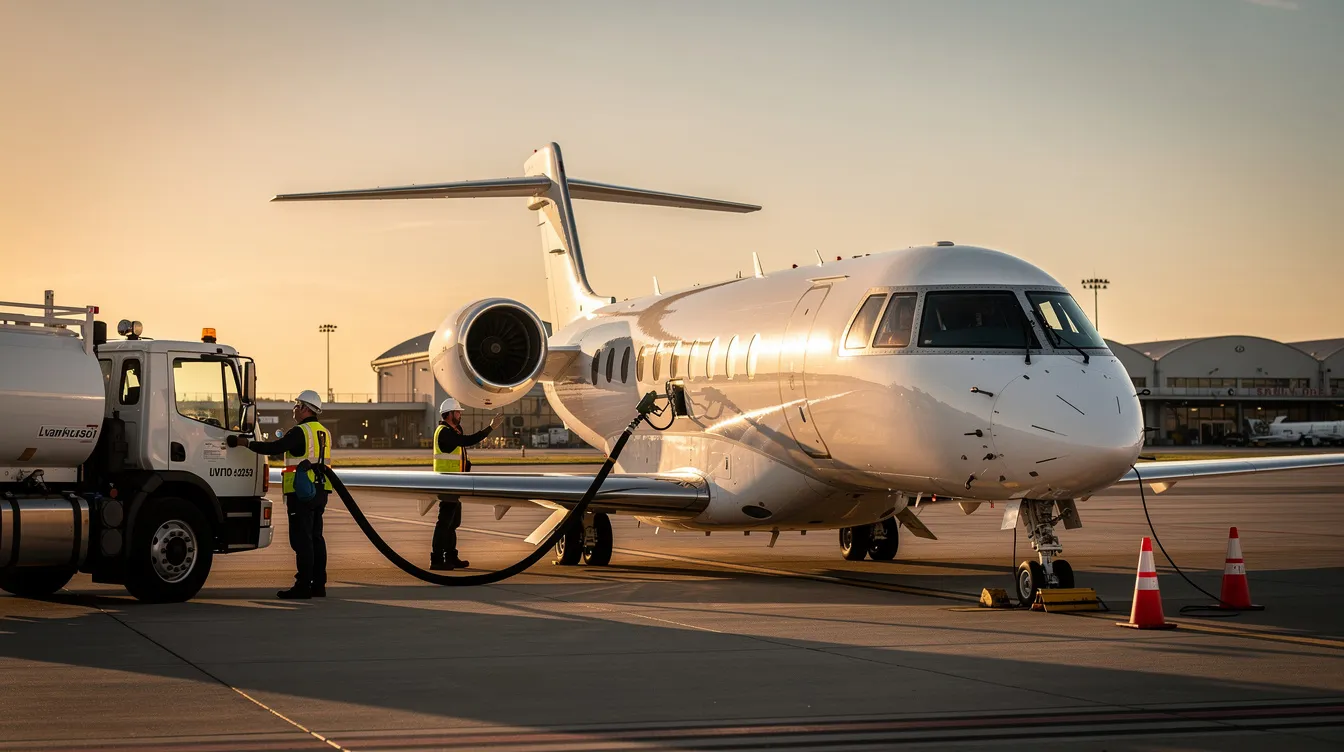
FBO delivery - refueler trucks uplift fuel directly to the aircraft wing
At each stage, quality checks prevent contamination. Fuel must pass a visual "clear and bright" inspection. Density measurement detects dilution. Water detection via chemical paste or electronic sensors catches free water. Filter and water separator systems on refueler equipment provide a final safeguard.
Misfuelling prevention is critical. Jet A-1 nozzles are typically marked in white text on a black background, distinct from AVGAS markings (often red). These identifiers ensure ground crews never load the wrong fuel type-a scenario that could catastrophically damage jet engines.
BlackJet only partners with operators and FBOs that adhere to Joint Inspection Group (JIG) standards and IATA guidance. Fuel sourcing and handling are embedded in our proprietary safety-vetting criteria.
Jet Fuel, Range, and Aircraft Categories
For BlackJet members, fuel planning answers two practical questions: Can I go nonstop? And which cabin class do I need?
Fuel consumption scales predictably across aircraft categories:
Category | Typical Burn Rate | Example Nonstop Route |
|---|
Light jet | ~140–180 gal/hr | New York → Chicago (~800 mi) |
Midsize | ~250–300 gal/hr | New York → Dallas (~1,400 mi) |
Super-midsize | ~300–400 gal/hr | New York → Los Angeles (~2,450 mi) |
Large-cabin | 400+ gal/hr | New York → London (~3,450 mi) |
Fuel planning goes beyond tank capacity. Reserves for contingency, alternate airports, and final hold (often 30+ minutes) are mandatory. Winds aloft, air temperature, and even fuel density at low temperatures all influence how much usable fuel can actually be loaded. BlackJet's 24/7 operations team and digital tools surface realistic routings-not theoretical maximums.
Importantly, sustainable aviation fuels are certified as "drop-in" replacements. When SAF is blended with conventional jet fuel within approved limits (up to 50%), fuel capacity and range remain unchanged-no aircraft modification required.
Cost of Jet Fuel and Its Impact on Private Jet Pricing
Jet fuel is among the largest direct operating costs in business aviation, often accounting for 20–30% of variable expenses and directly shaping hourly rates for charter and Jet Card programs, so grasping how Jet Card cost per hour is structured helps put fuel economics into context.
Jet A pricing tracks commodity benchmarks like Platts and Argus. While wholesale Jet A indexed around $3.50/gallon in mid-2026, delivered retail prices at full-service fuel stations averaged approximately $8.07/gallon across the Lower 48, with remote locations like Alaska pushing above $9.
A concrete example: that New York–Miami flight on a midsize jet (~900 gallons at $8/gallon) generates roughly $7,200 in fuel cost alone-before crew, landing fees, or fuel surcharges are applied, all of which roll into the overall private jet charter pricing you ultimately pay.
BlackJet's Jet Card model-whether a 25-hour or 50-hour block-smooths fuel price volatility for members through fixed or capped hourly rates. This means you benefit from cost predictability even as global energy markets fluctuate, especially when you understand jet card pricing structures, fees, and benefits.
Sustainable aviation fuel currently carries a price premium: approximately $9.90/gallon versus $7.73 for Jet A at U.S. FBOs. BlackJet absorbs or offsets a portion of this premium through our carbon-neutral flight programs, rather than passing full costs to members, integrating sustainability commitments directly into our premium private jet card and membership services.
Sustainable Aviation Fuel (SAF) and Sustainable Aviation
Sustainable aviation fuel represents a new generation of aviation fuels produced from biomass, waste oils, or synthetic processes, engineered to deliver similar performance to conventional jet fuel at the molecular level. Biofuels are a type of sustainable aviation fuel, alongside synthetic and power-to-liquid pathways.
Key SAF feedstocks include:
Used cooking oil → Hydroprocessed into HEFA-SPK, the most commercially mature pathway
Agricultural residues → Converted via alcohol-to-jet (ATJ) processes
Municipal solid waste → Gasified and refined into synthetic paraffinic kerosene
Captured CO₂ + green hydrogen → Power-to-liquid fuels offering the highest long-term scalability
Certified SAF grades like HEFA-SPK and FT-SPK are blended up to 50% with Jet A or Jet A-1 and must meet the same fuel specifications under ASTM D7566. Sustainable aviation fuel can reduce greenhouse gas emissions by 60–80% on a lifecycle basis compared to conventional jet fuel-a meaningful reduction for private travelers seeking to align their mobility with ESG goals.
BlackJet is committed to sustainable aviation by ensuring every Jet Card flight is carbon neutral through a combination of SAF uplift (where available) and high-quality carbon offset or insetting programs-at no additional cost to members, making it easier for travelers exploring the cheapest private jet options and access models to fly responsibly.
Synthetic Jet Fuels, Biofuels, and Future Energy Options
Synthetic and bio-based jet fuels serve as the bridge between today's kerosene-based aviation fuels and tomorrow's zero-emission propulsion technologies.
Fischer–Tropsch synthetic jet fuels (FT-SPK) have been validated in real-world operations, including USAF trials on B-52H, C-17, and F-15 aircraft using synthetic jet fuel blends. On the commercial side, KLM operated the first flight using synthetic kerosene on February 8, 2021, demonstrating that these fuels deliver the same gas turbine performance as petroleum-derived kerosene. Synthetic jet fuels can be blended with conventional jet fuel up to 50%.
Advanced biofuels and alcohol-to-jet processes are additional approved sustainable aviation fuels, chemically indistinguishable from conventional jet fuel once refined. These remain among the most commonly used fuels in SAF blending programs today.
Emerging alternatives-hydrogen propulsion and battery-electric aircraft-hold promise for short-haul regional routes but face fundamental limitations in energy density, infrastructure, and safety. These technologies are unlikely to power transcontinental or oceanic private jets before the mid-2030s, so today's flyers still balance fuel types against the most affordable private aircraft options available.
BlackJet actively tracks developments in sustainable aviation fuels and emerging propulsion to future-proof member access and maintain leadership in low-carbon private aviation.
Regulation, Emissions, and Carbon-Neutral Private Flights
The aviation industry aims for carbon neutrality by 2050 using sustainable fuels and emerging technologies-a target codified through ICAO's CORSIA framework and reinforced by regional schemes like the EU ETS and ReFuelEU Aviation mandates.
Jet fuel combustion produces CO₂, NOx, water vapor, and particulates. At cruise altitude, these carbon emissions and contrail formation carry outsized climate relevance, affecting both airlines and business aviation equally.
Key regulatory levers shaping the fuel landscape include:
Blending mandates requiring minimum SAF percentages at airports
Tax incentives such as U.S. IRC Section 40B SAF credits
Carbon pricing through emissions trading schemes and potential aviation fuel taxes
BlackJet's carbon-neutral policy works in concrete terms: we calculate emissions per flight hour and route, select certified offset projects (reforestation, renewable energy, methane capture), and increasingly prioritize SAF-based insetting over traditional offsets.
For corporate travelers with ESG reporting obligations and family offices with sustainability mandates, fuel and emissions choices are part of an overall wealth and reputation strategy-not just an operational detail, intersecting with strategies to maximize jet card-related tax deductions where appropriate.
Choosing the Right Jet Card and Aircraft with Fuel in Mind
Understanding jet plane fuel helps BlackJet members select the right Jet Card structure and private jet size for their mission profile.
Consider these scenarios:
Regional business hops (e.g., New York–Boston, Dallas–Houston): A 25-hour light-jet Jet Card on Jet A delivers cost-efficient access with minimal fuel overhead, similar in spirit to the flexible access offered by the BlackJet 25+ Hour Jet Card.
Frequent transcontinental travel (e.g., New York–Los Angeles, Chicago–San Francisco): A 50-hour super-midsize card balances range, cabin comfort, and fuel economics, while very frequent flyers may evaluate 100 hour jet card cost and value for even greater access.
Intercontinental trips (e.g., New York–London, Los Angeles–Tokyo): Ad hoc upgrades to large-cabin aircraft running Jet A-1 provide the range, the lower freezing-point tolerance, and the cabin space for productive long-haul travel, paralleling considerations you would weigh when reviewing costs and options for a 12-seater private jet.
BlackJet's mobile booking platform surfaces aircraft options, route feasibility, and estimated emissions in real time, allowing you to request SAF participation or specify sustainability preferences at the moment of booking and to compare that experience with renting a private jet on an hourly basis.
Behind every effortless BlackJet itinerary is sophisticated fuel planning, quality assurance, and sustainability management handled by our operations and safety teams, whether you're chartering a small private plane for a short hop or chartering a larger aircraft. You see a seamless departure. We see fuel type selection, spec compliance, reserve calculations, and carbon offset execution-all working together, alongside considerations like pilot staffing and compensation in private jet operations, charter economics for large 100-passenger group flights, regional private jet pricing dynamics in markets like India, and even how fuel costs flow through competitors' jet card pricing structures such as NetJets.

Explore how BlackJet's Jet Card programs deliver fuel-smart, carbon-neutral private travel tailored to your routes. Speak with a membership specialist to discover the card structure, cabin class, and sustainability options that match the way you fly.


 Sign up with google
 Sign up with Apple