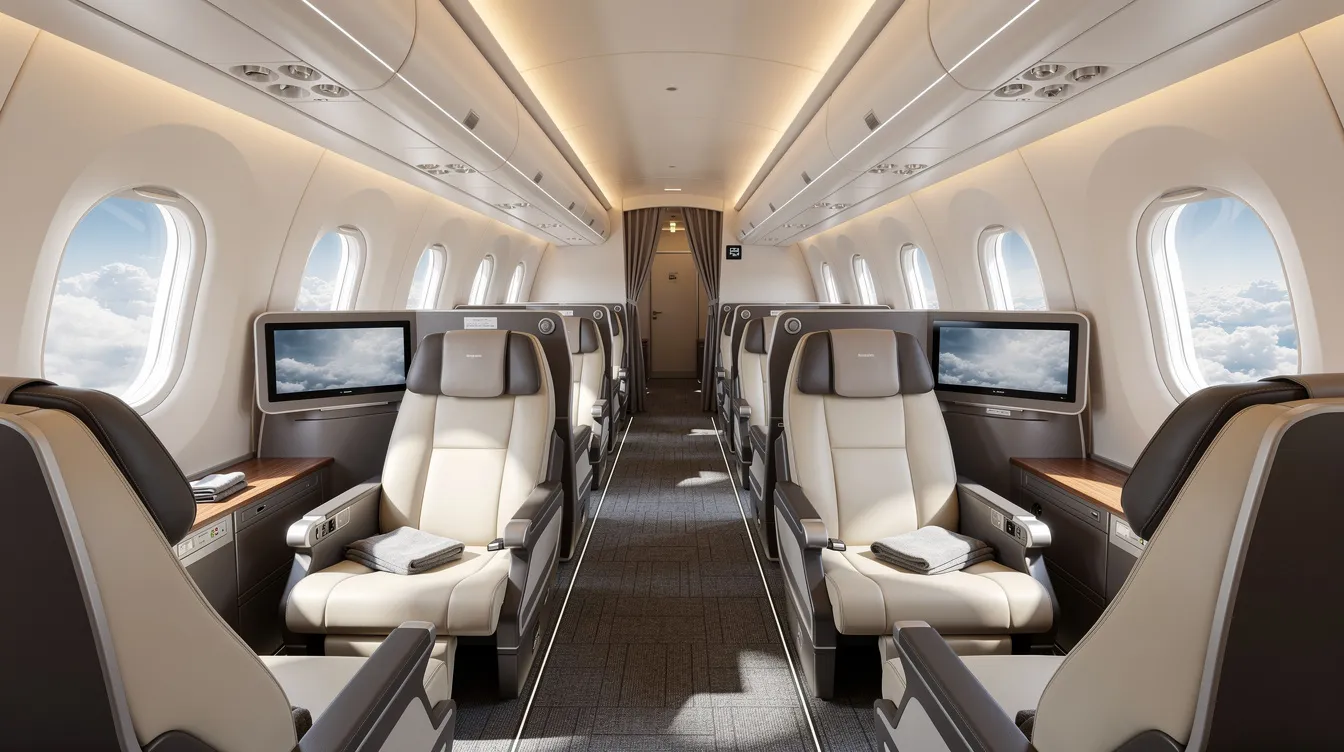
Comfort levels in air travel vary by aircraft model and airline configuration more than most travelers realize. Picking the right plane for a 12-hour flight can mean the difference between arriving rested and arriving wrecked. This guide breaks down which commercial aircraft deliver the best passenger comfort, which cabin classes and airlines make the most of those aircraft, and when private aviation becomes the smarter path entirely.
Quick Answer: What Is the Most Comfortable Plane Today?
The Airbus A350 and Boeing 787 Dreamliner are often regarded as the gold standards for passenger comfort on long-haul flights. Add the Airbus A380 for sheer cabin quiet and volume, and you have the top three commercial aircraft for comfort in service as of mid-2026.
Your experience depends on both aircraft type and cabin class. A well-configured premium cabin on an A350 can still feel better than regular economy on the same route, but even a standard seat on a better aircraft often beats business class on a poorly maintained older jet. But the aircraft model itself predicts comfort more reliably than any airline's marketing.
Here is how the top three compare:
Airbus A350: Best all-rounder. Composite fuselage keeps cabin altitude low (~6,000 ft) and humidity at roughly 20%. The Airbus A350 has the highest comfort rating at 87/100 across industry surveys. Economy seats reach 18 inches wide on most airlines. The Airbus A350 typically features a 3-3-3 economy configuration.
Boeing 787 Dreamliner: Excellent environmental engineering. The Boeing 787 maintains a cabin pressure equivalent to 6,000 feet. Largest windows in commercial aviation. But economy seat width varies more across airlines, from 17.0 to 18.1 inches depending on layout.
Airbus A380: Quietest passenger aircraft in service, measured at approximately 60 decibels in cruise. Double-decker design gives the most spacious cabin feel. Production ended in 2021, so availability is shrinking.
For travelers who fly long-haul four or more times per year, a private jet accessed through a Jet Card from a premium provider like BlackJet bypasses all of these trade-offs: you choose the cabin, the schedule, and the route.
The rest of this article explains how to identify the best aircraft on any route, when upgrading cabin class is worth the cost, and when private aviation becomes the most comfortable plane of all.
Why Aircraft Type Matters More Than Airline Hype
The best airline branding in the world cannot override physics. Cabin width, cabin pressure, humidity control, and noise insulation are built into the airframe. An airline can choose seat padding and pitch, but it cannot widen a fuselage or lower cabin noise by 5 dB through better service.
Passenger comfort can vary even on the same aircraft type operated by different airlines. Japan Airlines configures its A350-1000 economy with seats roughly 18.1 inches wide and 33-34 inches of pitch. Another carrier flying the same aircraft might pack rows tighter than another airline configuration, with 17-inch seats and 31-inch pitch. Airlines may configure the same aircraft model with varying seat pitches affecting comfort, which is why checking the specific aircraft and layout matters more than choosing the "best airline" label.
A SeatInside analysis of 81 aircraft configurations found that the median economy seat width on A350s is about 18.0 inches, while on 787s it is about 17.1 inches. Thirty-one of 33 A350 configurations reached 18 inches or wider; only 5 of 48 Boeing 787 configurations did. That gap comes from the A350's wider fuselage, not from airline generosity.
What the aircraft model determines and the airline cannot easily change:
Fuselage width, which caps maximum seat width and aisle space
Cabin pressure altitude (composite vs. older aluminum aircraft)
Humidity range (composite airframes retain more moisture)
Baseline cabin noise from engines, airflow, and structure
Window size and placement
What the airline does control:
Seats per row (e.g., 9-abreast vs. 10-abreast on a 777)
Seat pitch and recline
Cabin finishes, IFE screens, and service quality
Both matter. But the aircraft model sets the ceiling. The airline decides how close to that ceiling your experience gets.
Key Comfort Metrics: What Actually Makes a Plane Comfortable?
Airplane cabin comfort is influenced by physical space and environmental engineering. Comfortable seats result from several measurable design choices, not just thicker cushions.
Physical space metrics:
Seat width and pitch are critical factors in determining airplane comfort. Target 18 inches or wider for economy on flights over 6 hours. Premium economy typically offers 19-20 inches; business class 21-26 inches.
Seat pitch directly affects legroom in airplane cabins. Standard economy seats on long-haul routes range from 31 to 34 inches. Premium economy class runs 38-40 inches. Business class lie-flat beds extend to 60-80 inches when fully reclined.
The layout of airplane seating affects personal space and aisle access. A 2-4-2 layout means fewer passengers stuck in a middle seat. A 3-4-3 layout creates two middle seats per center block. A 3-3-3 layout is a common compromise on wide-body aircraft.
Environmental metrics:
Modern aircraft maintain lower cabin altitude pressures to enhance comfort. Newer composite jets pressurize to the equivalent of ~6,000 feet; older aluminum aircraft sit around ~8,000 feet. That 2,000-foot difference reduces fatigue and improves sleep.
Higher humidity levels in aircraft cabins can reduce fatigue and dehydration. Composite airframes (A350, 787) allow roughly 15-20% relative humidity in cruise. Traditional aluminum aircraft often drop below 10%.
Cabin noise levels heavily influence the comfort of the flying experience. Measured in-cabin noise during cruise ranges from ~69.5 dB(A) on an A380 to ~74-77 dB(A) on an A350 or 787. A 5 dB difference is perceptible and affects the ability to rest.
Newer aircraft models often feature better air filtration and humidity control, including HEPA filters that clean cabin air and LED mood lighting to help reduce jet lag.
How private jets compare (and how different types of private jets shape the experience):
Passenger density drops from hundreds to 6-14 people, which cuts noise per passenger and allows personal climate control
Cabin heights in heavy and ultra-long-range jets reach 1.70-1.90 meters, with full stand-up space
Direct routing eliminates extra climb/descent cycles that add to fatigue
The Airbus A350: Today's Best Aircraft for Long-Haul Comfort
The Airbus A350 is the most comfortable long-haul commercial aircraft in regular service as of mid-2026. That claim rests on measurable engineering, not opinion.
The A350's composite fuselage enables cabin pressure equivalent to approximately 6,000 feet at cruise altitude, matching the 787 and beating older widebody aircraft by roughly 2,000 feet. The Airbus A350 features 20% humidity levels in the cabin, which keeps skin, eyes, and airways from drying out on international flights exceeding 10 hours. Newer aircraft with these composite materials deliver a cabin environment that older aluminum aircraft cannot replicate without structural modification.
The A350 has the widest standard economy seat at 18 inches across most airlines. When carriers like Qatar Airways and Cathay Pacific configure the aircraft at 9-abreast (3-3-3), they preserve that 18-inch width while still fitting a competitive number of economy seats. Good cabin design includes larger windows and improved lighting to reduce jet lag, and the A350 delivers both with its LED mood lighting system and wide panoramic windows.
Noise performance is strong. While the A380 holds the "quietest" title, the A350 cabin is still quieter than older wide-bodies like the Boeing 777 or A330 classics by 3-5 dB, thanks to its Rolls-Royce Trent XWB engines and aerodynamic nacelles.
Routes where you can find A350 service on long-haul flights:
Singapore Airlines operates the A350-900ULR on Singapore to New York, one of the world's longest nonstop routes
Qatar Airways flies A350s on London to Doha and across Asia
Korean Air deploys A350s on US to Asia services
Cathay Pacific uses A350-1000s on major trans-Pacific routes
Air France has introduced A350s on long-haul routes from Paris
The sections below detail which airlines configure their A350 economy and business class cabins most generously.
Boeing 787 Dreamliner: A Strong Runner-Up in Passenger Comfort
The Boeing 787 Dreamliner shares most of the A350's environmental advantages. The Boeing 787 maintains cabin pressure equivalent to 6,000 feet, and its composite airframe holds cabin humidity around 15% during cruise. On paper, it matches the A350 in the two metrics that matter most for reducing fatigue on long flights.
Where the 787 stands apart is its windows. The Dreamliner has the largest windows in commercial aviation, paired with electrochromic dimming that replaces traditional plastic shades. Passengers at window seats can adjust tint electronically, and the effect on natural light and circadian rhythm is measurable. The aircraft also uses advanced mood lighting and efficient air filtration systems.
The 787's weakness is layout variability. Many airlines configure economy in a 3-3-3 arrangement with seat widths of only 17.0-17.3 inches, below the 18-inch threshold where shoulder contact with neighbors becomes a persistent issue. Some carriers push pitch down to 30-31 inches. The same aircraft on another airline might offer generous 18-inch seats in a 2-4-2 premium economy layout.
How to check your 787 layout before booking:
Look up the airline's seat map for the specific 787 variant (787-8, 787-9, or 787-10)
Count seats per row in economy; 9 across (3-3-3) is standard, but width per seat varies
Use third-party seat-map tools to verify pitch and width numbers
Operators and routes where 787 comfort tends to be above average:
Japan Airlines' 787 offers an 18-inch wide seat in a 2-4-2 configuration, one of the most generous layouts on this aircraft model
ANA flies 787s across the Pacific with competitive pitch and modern cabins
Qantas uses the 787-9 on Perth to London, one of the longest 787 routes
US carriers like Delta Air Lines and United operate 787s on transatlantic and trans-Pacific routes, though economy layouts tend to be denser than Asian carriers
Airbus A380: The Quiet Giant with Room to Stretch
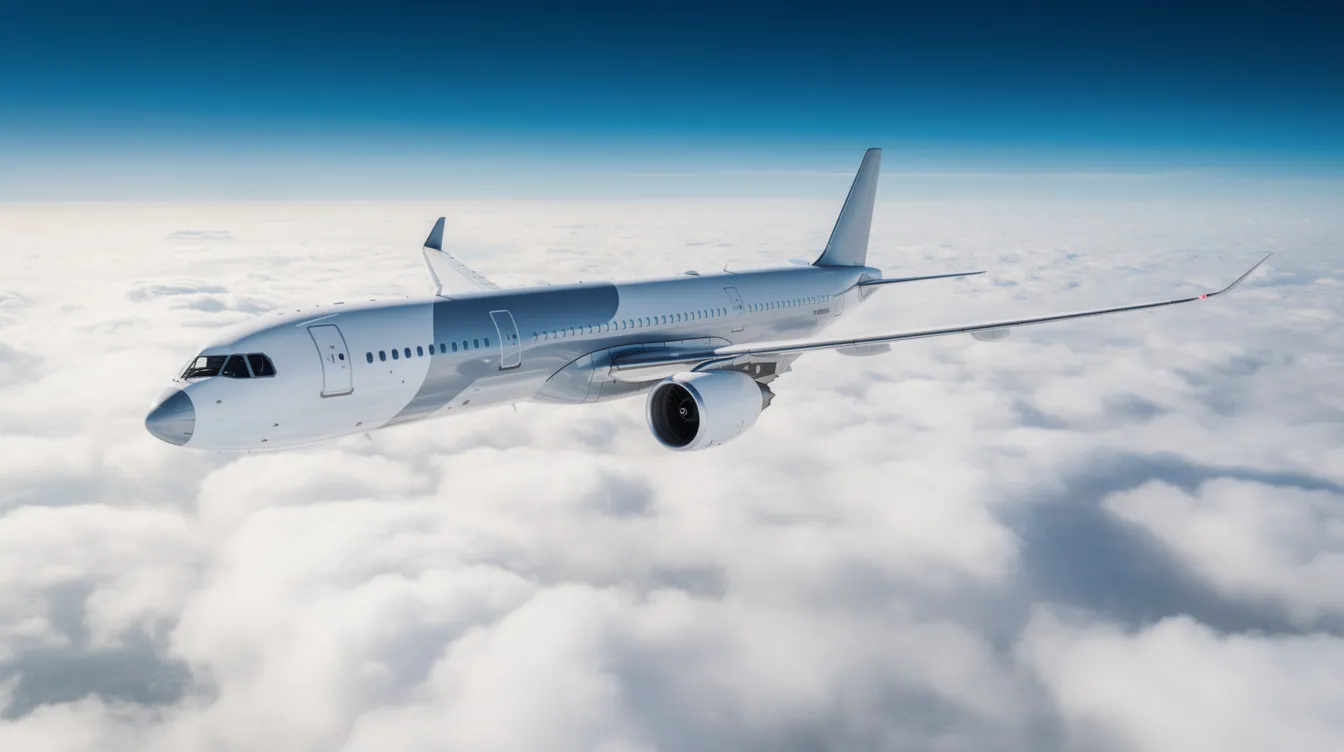
The Airbus A380 is the quietest and most spacious passenger aircraft ever built for commercial service. As a double-decker plane, its volume is unmatched by any single-deck widebody aircraft.
The A380's four-engine layout and massive fuselage contribute to lower cabin noise than any other commercial aircraft type. In-cabin measurements show cruise noise around 69.5 dB(A) and 83.7 dB(C), several decibels below the A350 and 787. That gap is perceptible: quieter cabins make conversation easier, reduce the need for noise-canceling headphones, and improve sleep quality on long flights.
The upper deck on many airlines operates as a more private, calmer space. The Airbus A380's upper deck economy seats are in a 2-4-2 configuration on carriers like Emirates and Qantas, which means fewer passengers per row and better aisle access than 3-4-3 main-deck layouts. Singapore Airlines has configured some A380 upper deck economy sections with seats up to 19 inches wide.
Emirates operates the largest fleet of A380s with 50 aircraft, making it the easiest carrier to find A380 flights on. Key routes include:
Emirates A380 services from New York, Los Angeles, and other US hubs to Dubai
Singapore Airlines A380 on long-haul Asia-to-Europe routes
Qantas A380 on Sydney to London via Singapore
Korean Air A380 on select transpacific services
The only downside: Airbus ended A380 production in 2021. The number of operators is declining. Some carriers are retiring their A380 fleets, while others (Emirates, Singapore Airlines) plan to keep theirs flying into the 2030s. To find A380 flights, use airline booking tools that display aircraft type, or filter by equipment code "388" on flight search engines.
Emirates also outfits its A380s with onboard bars and lounge areas in business and first class, features no other aircraft offers at scale.
Other Comfortable Long-Haul Wide-Bodies (A330neo, 777, 767, 330 Classics)
Many long-haul routes still rely on aircraft that are not A350, 787, or A380. Some of these offer perfectly good comfort; others are worth avoiding.
Airbus A330-900neo: This aircraft shares much of the A350's technology. Its Rolls-Royce Trent 7000 engines are quiet, cabin altitude sits around 6,500 feet, and many airlines use a 2-4-2 economy layout with 18-inch-wide seats. Air Canada and other carriers deploy it on transatlantic and medium-range long-haul routes. It is a strong choice when available, but less common on ultra-long-haul services than the A350.
Airbus A330-200/300 (classics): The 2-4-2 layout in economy is kind to couples and solo travelers who hate the middle seat. But these older aluminum aircraft have cabin altitude around 8,000 feet and humidity below 10%, which adds to fatigue on flights over 8 hours. Cathay Pacific and Air France still operate A330 classics on some routes, though some high-net-worth travelers at this point start weighing private jets under $10 million as a way to sidestep aging cabins entirely.
Boeing 777-300ER and 777-200LR: The Boeing 777-300ER offers 18-inch seats in a 3-3-3 configuration, which is comfortable. But the Boeing 777-300ER's economy configuration can vary from 3-3-3 to 3-4-3. When airlines shift to 10-abreast (3-4-3), seat width drops to roughly 17 inches, and two middle seats per center block make the experience cramped on long flights. British Airways, many US carriers, and several Asian airlines now use 3-4-3 on their 777s.
Boeing 767-400ER and 767-300ER: A sleeper hit. Delta Air Lines operates these on transatlantic routes with a 2-3-2 economy layout, which means only one middle seat per row. Seat width is around 18 inches, and the absence of a long center block of four seats makes these older aircraft feel more open than a densified 777. The cabins are aging, but the layout itself makes all the difference on a 7-8 hour crossing—and it is this kind of layout-versus-price trade-off that mirrors how you evaluate Jet Card cost per hour in private aviation.
The rule: check the seat map before booking any of these. A 2-4-2 A330neo is a better economy ride than a 3-4-3 777-300ER, even though the 777 is a newer and larger aircraft.
The Most Comfortable Economy Class Cabins (If You Stay Commercial)
For travelers who want maximum economy class comfort without upgrading to premium cabins, the specific aircraft and airline pairing matters more than any single factor.
Standout economy products on the most comfortable planes:
Japan Airlines A350-1000 and 787: JAL's "SKY WIDER" economy seats deliver 33-34 inches of pitch and roughly 18.1 inches of width. Skytrax has named this the "World's Best Economy Class Seat" in recent rankings.
Cathay Pacific A350-1000: Cathay Pacific's economy class was awarded World's Best Economy Class in 2025. Seats are 18 inches wide with a modern slimline design that maximizes knee space.
Emirates A380 economy: 34 inches of pitch and 4 inches of recline. On the upper deck, the 2-4-2 layout reduces middle seat frequency.
Singapore Airlines A380 economy: Up to 19 inches of seat width, among the widest economy seats in commercial aviation.
JetBlue A321LR "Core" transatlantic economy: A narrowbody standout with 18-inch seat width, strong legroom, and personal seatback screens. Proves that widebody aircraft are not the only path to comfort on shorter flights.
Realistic targets for comfortable economy on long-haul international flights: seat pitch of 32-34 inches, seat width of 18 inches or more, and a layout that avoids center blocks wider than three seats. Standard economy seats below these thresholds are common on densified fleets.
To verify numbers before purchasing, check the airline's published seat dimensions for the specific aircraft variant, then cross-reference with third-party seat-map tools that show row-by-row pitch and width.
Business Class vs Economy Class: When the Upgrade Actually Changes the Plane
Moving from economy class to business class on a long-haul flight is not about a wider seat and a glass of champagne. On modern aircraft, the entire cabin architecture changes.
Typical business class features on the A350, 787, and A380 include fully lie-flat beds measuring 76-80 inches long, direct aisle access in 1-2-1 layouts, high privacy shells, premium bedding, and noise-dampening partitions. Quality cabin service contributes to passenger comfort and satisfaction, and business class flight attendants on top carriers provide a level of attention that further separates the experience.
Concrete examples:
Qatar Airways Qsuite (A350 and 777): Fully enclosed suites with sliding doors, lay-flat seat converting to a 79-inch bed, and the option to combine adjacent suites for couples.
Singapore Airlines business class (A350 and A380): 1-2-1 layout, 28-inch wide seats, adjustable mood lighting, and direct aisle access for every passenger.
Cathay Pacific business class (A350 and 777): Reverse herringbone layout with 20-inch seats and lie-flat beds.
Emirates A380 business: Includes access to the onboard lounge and bar area, a feature unique to the A380.
Business class mitigates aircraft shortcomings. Flying a 777 with a cramped seat in 3-4-3 economy becomes irrelevant in business class because the seat layout is completely different: 1-2-1 with direct aisle access. For flights over 7-8 hours, the upgrade delivers the largest quality-of-life improvement versus economy or premium economy.
For a deeper look at first class cabin options, which take this further with fully enclosed suites on select airlines, see our guide.
Best Airlines for Long-Haul Comfort (If You Must Fly Commercial)
While aircraft type is the primary comfort predictor, certain airlines consistently configure cabins for comfort across their fleet. Airlines from Asia and the Middle East consistently rank high for passenger comfort in global surveys.
Leading comfort-focused carriers and their strongest aircraft:
Singapore Airlines (A350, A380): Singapore Airlines was named World's Best Airline in 2018 by Skytrax and remains a benchmark, including as the first airline to introduce notable cabin-comfort innovations. Generous economy pitch, top-tier business class, consistent cabin layouts across the fleet.
Japan Airlines and Nippon Airways (A350, 787): Both airlines maintain among the widest economy seats in their respective fleets. JAL's SKY WIDER seats set the industry standard for economy class comfort on long-haul routes.
Emirates (A380, A350): The largest A380 operator. Generous economy pitch, the only carrier with onboard bars in business, and competitive first class suites.
Qatar Airways (A350, 787): Qatar Airways ranked number 1 in 2019's Skytrax rankings. The Qsuite business class product is widely considered the best in the industry.
Cathay Pacific (A350, 777): Strong across all cabin classes. Economy and business class both benefit from thoughtful configuration on the A350-1000.
Korean Air (A380, 777, A330): Consistent product quality and competitive economy pitch on long haul routes across the Pacific.
Air France (A350, 787, A330): Business class products on the A350 are competitive with Asian carriers, though economy density is average.
Contrast with some major US carriers where the same aircraft can be configured with tighter pitch and narrower seats, particularly on 777 and 787 routes. The best airline for a given route is often the one flying the best aircraft in the most generous configuration, not necessarily the carrier with the most airline miles partner options or the highest overall rating.
Planes and Layouts to Avoid for Long-Haul Economy
Knowing what to avoid saves as many hours of discomfort as knowing what to choose.
Uncomfortable layouts to watch for:
10-abreast 777 (3-4-3): The Boeing 777-300ER's 3-4-3 configuration reduces seat width to 17 inches, and the center block creates two middle seats per row. On a 12-hour flight, this makes all the difference between adequate rest and constant shoulder contact.
High-density 787s: Some carriers push pitch to 30-31 inches in economy, which eliminates any meaningful knee space for passengers over 5'10".
Older 747-8 economy: Noisy rear cabins, dated interiors, and inconsistent pitch across sections.
A330 classics with legacy interiors: Higher cabin altitude and very low humidity compound the effects of a cramped seat on overnight flights.
Ultra-low-cost carriers often provide tighter seating configurations to maximize passenger capacity, and this practice has spread to some mainline carriers on competitive routes, which is why some travelers instead look at the cheapest private jet options or entry-level charters as an escape from ultra-dense cabins.
Red flag combinations: long-haul flights over 8 hours on a 777-300ER in 3-4-3 on certain US carriers, or overnight transatlantic services on aging A330s with 31-inch pitch.
If you are stuck on one of these flights, damage control:
Choose window seats or aisle; avoid the middle seat in a center block of four
Pay for extra-legroom exit rows or bulkhead seats
Bring noise-canceling headphones; cabin noise on older aircraft can exceed 78 dB(A)
Avoid back rows near galleys and lavatories where noise and traffic peak
Short- and Medium-Haul Comfort: When Narrowbodies Are Fine (or Even Great)
For flights under 5 hours, certain narrowbody aircraft deliver comfort that rivals wide-bodies on shorter flights.
The Airbus A220 is the most comfortable narrowbody in service. The Airbus A220 has a 2-3 seating configuration in economy, which means every row has at most one middle seat. The Airbus A220 features a 2-3 configuration for economy seating, with seats wider than those on A320s or 737s. Large windows and a quieter cabin than either A320neo or 737 MAX make it a standout on regional jets and domestic routes. Delta Air Lines, Air Canada, and several European carriers fly the A220 on 2-5 hour missions.
The Airbus A320neo family has a slightly wider cabin than the Boeing 737 MAX, which allows marginally wider economy seats. JetBlue has demonstrated that narrowbodies can serve transatlantic routes with its A321LR "Mint" business class and "Core" economy products. The A321LR proves that for shorter flights and even transatlantic crossings, a well-configured narrowbody can be the right choice.
Embraer E-Jets (like the E175) use a 2-2 layout with no middle seat at all. Leg room varies by carrier, but the layout itself is among the most favorable for regional jets.
These are not contenders for the "most comfortable plane overall," but they can be the best choice on specific shorter routes where no widebody aircraft operates—especially if you are comparing them with top personal planes designed for shorter hops that you might own or charter.
How to Check Which Aircraft You're Really Booking
Many travelers do not realize they can identify and select their aircraft model before purchasing a ticket.
Where aircraft type appears:
Airline booking engines: most display the aircraft type (e.g., "Airbus A350-900" or "Boeing 787-9") in the flight details
Third-party OTAs: some show equipment codes; others require clicking into flight details
ITA Matrix-style search tools: display aircraft codes for every segment
Seat-map sites: show row-by-row layouts tied to specific aircraft and airline combinations
Step-by-step process:
Find the aircraft code (e.g., "359" for A350-900, "789" for 787-9)
Cross-reference against the comfort rankings in this article
Pull up the airline's seat map for that specific aircraft variant on a guide to aircraft types
Count seats per row in economy: 9 across is acceptable on A350; 10 across on a 777 is a warning sign
If two flights serve the same route, choose the better aircraft model first, then adjust departure time
Aircraft substitutions can happen day-of: airlines swap equipment for operational reasons. But choosing a better plane at booking still improves your average outcome over dozens of trips. For the frequent flyer, this habit compounds.
Case Study: New York to Tokyo: Choosing the Most Comfortable Plane
A traveler based in New York needs to fly to Tokyo Haneda for a week of meetings. The flight is roughly 14 hours. Three commercial options appear:
Option A: Japan Airlines A350-1000 (JFK to HND). JAL's A350-1000 economy offers 33-34 inches of pitch and 18.1-inch seats. The composite fuselage keeps cabin humidity around 20% and cabin altitude at 6,000 feet. The aircraft offers one of the best economy experiences on this route. In business class, JAL provides lie-flat beds in a 1-2-1 layout.
Option B: ANA Boeing 787-9 (JFK to HND). ANA's 787-9 shares the low cabin altitude and enhanced humidity. Economy seats are configured generously for a 787. The largest windows in commercial aviation and electronic dimming make the cabin feel open, even on window seats. A strong option, especially in business class.
Option C: US carrier Boeing 777-300ER (JFK to NRT). A typical US carrier 777-300ER in 3-4-3 economy: 17-inch seats, 31-inch pitch, and two middle seats per center block. For a 14-hour flight, this is the least comfortable option by every measurable metric. The last flight you want on this route.
The logic for choosing: the JAL A350-1000 offers more seat width, better cabin air, and lower noise than the 777-300ER. Trading a less convenient departure time for the better aircraft model is worth it on a 14-hour flight. Using airline miles to book the JAL flight, even in economy, can be a smart move.
What if you flew private instead? A BlackJet member could use a Jet Card to book a large-cabin or ultra-long-range jet direct to Tokyo, choosing from different private jet sizes matched to the route. Benefits over commercial:
Skip check-in lines, security queues, and boarding processes entirely
Depart from a private terminal 20-30 minutes before wheels-up
Choose departure time down to the hour
Work or sleep in a spacious cabin with 6-10 passengers instead of 300+
Arrive at a less congested airport closer to Tokyo's business district
For executives making this trip four or more times per year, the cumulative time and energy savings reshape the entire calculation.

Why Private Jets Redefine "Most Comfortable Plane"
For high-net-worth and executive travelers, the most comfortable plane may no longer be a commercial aircraft at all. The right class of private jet eliminates every variable discussed in this article.
Fundamental differences between commercial and private:
Passenger density: 6-14 passengers instead of 200-400. Cabin noise drops, personal space multiplies, and air quality improves.
Seating: Fully reclining club seats, divans, and in some aircraft, private beds. No middle seat. No cramped seat. No seat-width lottery.
Routing: Direct flights to 5,000+ airports worldwide, many inaccessible to commercial aircraft. Nonstop routes that commercial airlines do not offer.
Catering and schedule: Bespoke meals, departure times chosen by the traveler, and no connection stress.
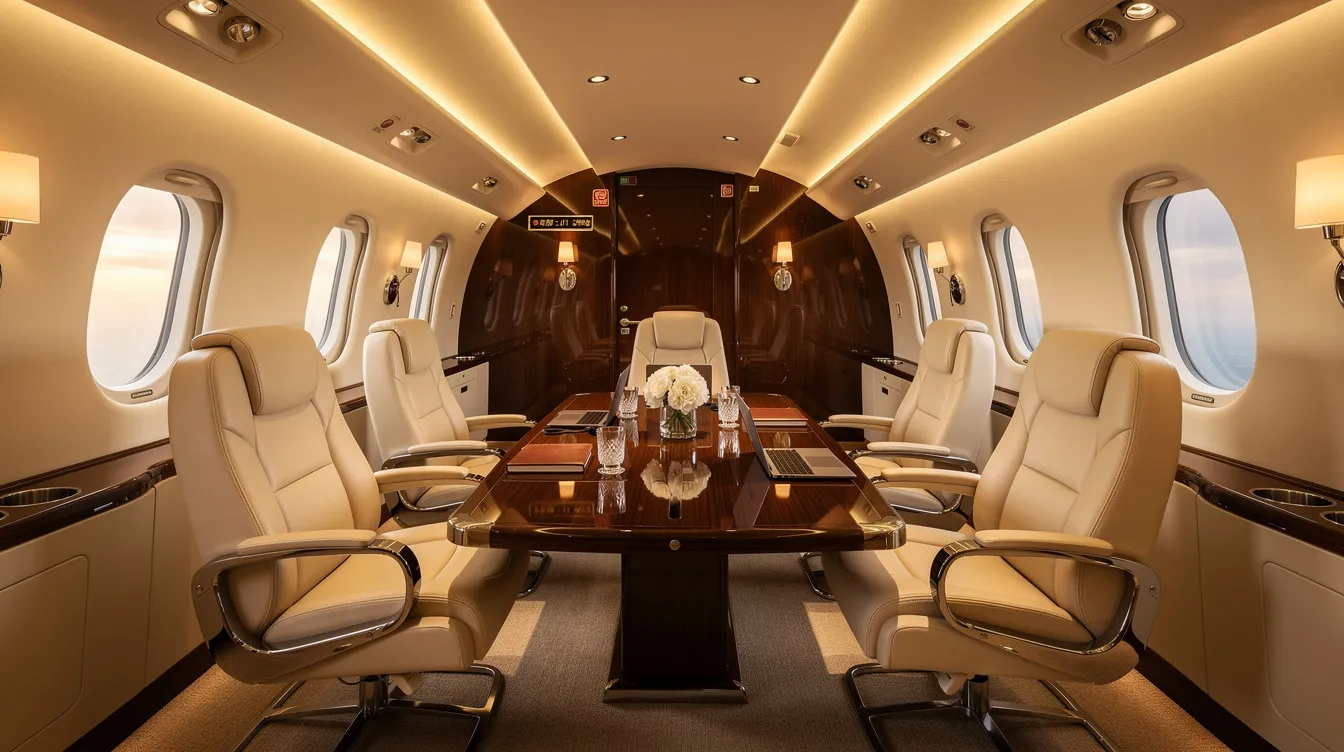
Private jet cabin categories vary. Light jets (Phenom 300-class) carry 4-7 passengers with cabin heights under 5 feet; ideal for shorter flights of 2-3 hours. Super-midsize jets (Citation Longitude-class) offer stand-up cabins and 3,000+ nautical mile range. Heavy and ultra-long-range jets (Global 7500, G700-class) provide multiple living zones, cabin heights of 6+ feet, enclosed lavatories, and range exceeding 6,000 nautical miles.
A comparison: a CEO flying New York to London on an Airbus A350 business class arrives after navigating a commercial terminal, sitting through boarding, and sharing a cabin with 200+ other passengers. The same CEO on a large-cabin private jet departs from a private terminal in 20 minutes, works uninterrupted for 7 hours, sleeps flat for the last flight segment, and arrives ready for a 9 a.m. meeting. The time saved is 3-4 hours door-to-door. The energy saved is harder to quantify but shapes every meeting that follows.
For a look at the top private jets available today, including some of the largest private jets for sale and charter, see our ranked guide.
How Jet Cards Like BlackJet's Change the Comfort Equation
A Jet Card is prepaid hours on private aircraft across cabin types, without the complexity of aircraft ownership or one-off charter negotiations. Understanding how Jet Cards work is the first step toward predictable private travel.
BlackJet's Jet Card model offers 25-hour or 50-hour blocks that give members access to a curated fleet of private jets. As you compare programs, a detailed50-hourr Jet Card cost guide can help frame value versus commitment. Each block covers multiple cabin types, so a member can choose a light jet for a 2-hour regional hop and a large-cabin jet for an intercontinental mission, all under the same program.
Compared to commercial business class, Jet Cards reduce variables:
Guaranteed cabin type and aircraft category on every flight
No equipment swaps, no last-minute downgrades, no middle seat surprises
Ability to match aircraft size to mission: a super-midsize jet for coast-to-coast, a heavy jet for transatlantic
Consistent safety and comfort standards across every operator in the network
BlackJet's technology layer adds convenience: 24/7 digital booking, real-time flight support, and scheduling flexibility that makes selecting your most comfortable plane as simple as choosing a meeting time. For frequent travelers, Jet Cards turn private jet access into a repeatable, predictable comfort upgrade rather than an occasional indulgence.
Private Jet Categories and Comfort: Matching Aircraft to Mission
The goal in private aviation is not always the biggest jet. It is the right jet for the route, group size, and comfort requirements.
Light jets (e.g., Phenom 300-class): Carry 4-7 passengers with ranges of 1,500-2,000 nautical miles. Cabin heights of roughly 4.8-5.0 feet mean limited stand-up room. Best for shorter flights of 2-3 hours; think New York to Miami or London to Geneva.
Midsize and super-midsize jets: 6-10 passengers, cabin heights of 5.5-6 feet, enclosed lavatories, and ranges up to 3,600 nautical miles. These aircraft provide comfort approaching commercial business class in privacy and flexibility, with the added benefit of two seats or more configured as club seating with work surfaces.
Heavy and ultra-long-range jets (e.g., Global 7500, G700): 10-19 passengers, full stand-up cabins, multiple living zones, private bedrooms on some configurations, and ranges exceeding 6,000 nautical miles. Cabin humidity and air pressure are managed for small groups, producing a fresher environment than any commercial cabin. These aircraft handle true intercontinental missions.
In commercial aviation, you cannot tailor aircraft size to your group; you can only choose cabin class. In private aviation, a BlackJet advisor can help a member choose between a super-midsize and large-cabin jet for a specific trip, or even a private jet suitable for 20 passengers, balancing comfort against cost per hour. That flexibility is impossible on any commercial airline.
Safety and Certification: Comfort Starts with Confidence
True comfort includes the confidence to sleep deeply at 41,000 feet. That confidence comes from operational rigor, not marketing claims.
Reputable private aviation providers vet operators and crews against established safety standards. BlackJet only partners with audited operators and aircraft that meet or exceed stringent maintenance and crew training benchmarks. This includes Part 135 operations, dual-pilot requirements, and regular third-party safety audits aligned with frameworks like Wyvern Wingman and ARG/US, reflecting the broader reality that private jets are exceptionally safe when operated under these frameworks.
Both commercial and private aviation are heavily regulated. Private jets add layers of personalized risk management: tailored weather and routing decisions for small groups, crew-to-passenger ratios that commercial airlines cannot match, and aircraft maintained to standards that reflect the smaller fleet sizes and higher per-flight scrutiny of Part 135 operators.
For informed travelers, safety is a non-negotiable baseline before comparing comfort features like seats and cabin pressure. Understanding how major providers structure their programs and pricing, such as NetJets’ jet card cost and benefits, helps put BlackJet’s own standards in context. BlackJet treats it as a quiet background constant: always present, never compromised.
Sustainability and Comfort: Can Flying Green Also Feel Better?
High-end travelers increasingly want the most comfortable plane without ignoring environmental impact. The good news: fuel efficiency and cabin comfort tend to move together.
Next-generation commercial aircraft like the Airbus A350, A330neo, and Boeing 787 achieve 20-30% better fuel efficiency per seat than the aircraft they replace. The same composite materials and engine technologies that improve fuel efficiency also produce quieter cabins, lower vibration, and better air pressure management. Modern aircraft built for sustainability are, by engineering default, built for comfort.
Private aviation is addressing its footprint through efficient modern business jets, route optimization that eliminates unnecessary connecting segments, and verified carbon offset programs. Travelers exploring more affordable private plane options will also see how newer light jets and VLJs improve efficiency alongside comfort. BlackJet ensures every Jet Card flight can be carbon-neutral through integrated offset programs, without adding friction to the booking process. Members do not need to calculate or purchase offsets separately; the program handles it.
The connection is direct: many of the quieter, more efficient other aircraft also deliver superior cabin environments. Choosing a newer, greener plane is not a trade-off against comfort; it is a reinforcement of it.
Technology and Onboard Experience: Beyond the Seat Cushion
The flight deck may determine how a plane flies, but the cabin technology determines how it feels.
On cutting-edge commercial aircraft, passengers can expect 4K seatback screens with Bluetooth audio, USB-C and AC power outlets, smart LED lighting calibrated to destination time zones, and quiet ventilation systems. Reliable high-speed Wi-Fi and in-flight entertainment improve passenger experience on flights where passengers spend 10-16 hours in a single seat.
On private jets, the technology layer is different. Travelers stream from personal devices, connect to onboard Wi-Fi for video calls, use conference tables with integrated power, and control cabin lighting and temperature individually. The cabin functions as a flying office or living room, with no shared entertainment system constraints, even on smaller private aircraft optimized for short- and medium-haul missions.
BlackJet's focus on aircraft with modern connectivity and cabin tech ensures that members can work through a full day of calls or fully disconnect and sleep. For many executives, the most comfortable plane is the one that lets them land genuinely prepared for a meeting: stable Wi-Fi, reliable power, and a peaceful environment that allows concentration or rest on demand—exactly the kind of experience outlined in guides to the best Jet Cards for frequent flyers.
Practical Checklist: How to Choose the Most Comfortable Plane for Your Next Trip
Use this process before every long-haul booking:
Confirm the aircraft type. Look for the aircraft model in booking details. If it is not listed, call the airline or check with a third-party tool.
Check the cabin layout. Count seats per row. Prefer 2-4-2 or 3-3-3 over 3-4-3 in economy class.
Verify seat dimensions. Target 18 inches of seat width or more and 32 inches of seat pitch or more on long-haul international flights. Japan Airlines, Cathay Pacific, and Emirates tend to meet or exceed these thresholds.
Compare airlines on the same aircraft. Passenger comfort can vary on the same aircraft operated by different airlines. Check at least two carriers on your route.
Decide on cabin class. For flights over 7-8 hours, premium economy class or business class removes most discomfort variables. For flights under 5 hours, well-configured economy is usually sufficient.
Weigh commercial vs. private. If you fly long-haul 4-6 times per year or more, evaluate a Jet Card to standardize comfort and eliminate the guesswork of aircraft selection, using a detailed guide to Jet Card cost and value to benchmark programs.
Rules of thumb (and remember that understanding Jet Card cost per hour helps compare private options fairly):
A350, 787, and A380 over older aircraft types in every cabin class
Composite-fuselage aircraft (lower cabin altitude, higher humidity) over older aluminum aircraft
Airlines from Asia and the Middle East over most airlines from North America and Europe for economy class configuration
A private jet via BlackJet over any commercial cabin if the frequency, route, and budget align
FAQ: Most Comfortable Planes, Cabins, and Private Jet Options
What is the most comfortable plane for long-haul economy class?
The Airbus A350, configured at 3-3-3 with 18-inch seats and 32+ inches of pitch, is the most comfortable plane for economy on long-haul flights. Japan Airlines and Cathay Pacific are among the airlines that configure their A350s most generously.
Is the Airbus A350 more comfortable than the Boeing 787?
For economy class, yes. The A350's wider fuselage accommodates 18-inch seats more consistently across airlines. The 787 matches the A350 on cabin pressure and humidity but is more often configured with narrower 17-inch economy seats.
Are business class seats worth it on overnight international flights?
On flights over 7-8 hours, business class with lie-flat beds and direct aisle access transforms the experience. Sleep quality on a flat surface at low cabin altitude is categorically different from dozing upright in economy.
Which is better for comfort: Airbus A380 or Boeing 777?
The A380 wins on noise (approximately 60 dB vs. 74+ dB on the 777), cabin volume, and layout options. The 777's comfort depends on configuration: a 3-3-3 layout is acceptable, but a 3-4-3 layout with 17-inch seats is a huge difference on long flights.
How do private jets compare to first class on the best airlines?
Private jets offer comparable or superior seating, lower noise, no shared cabin, direct routing, and 3-4 hours of time savings per trip. First class on Singapore Airlines or Emirates offers excellent comfort but cannot match the schedule flexibility, privacy, and door-to-door speed of a private jet.
What is a Jet Card and how does it affect comfort and convenience?
A Jet Card provides prepaid hours on private jets across multiple cabin types. It standardizes comfort by guaranteeing aircraft category, safety standards, and service quality on every flight, without the variability of commercial bookings, and a dedicated Jet Card pricing guide can clarify how those benefits translate into predictable costs.
Is Cathay Pacific A350 economy comfortable for US-Asia flights?
Yes. Cathay Pacific's A350-1000 economy earned the World's Best Economy Class award in 2025. Seat width is 18 inches, and the cabin environment benefits from the A350's composite-fuselage advantages.
Are Korean Air A380s still a good choice?
Korean Air continues to operate A380s on select transpacific routes. The aircraft remains one of the quietest and most spacious commercial options, though availability is limited as the fleet ages.
Which commercial aircraft have the most comfortable business class cabins?
The A350 and A380 lead. Qatar Airways Qsuite (A350/777), Singapore Airlines business (A350/A380), and Emirates business (A380) with lounge access set the standard for modern long-haul business class.
Are private jets as safe as commercial aircraft?
When operated under Part 135 regulations with audited operators, private jets meet or exceed commercial safety benchmarks. BlackJet's certification standards ensure every flight operates under rigorous safety protocols.
Can private jet flights be carbon-neutral?
Yes. BlackJet integrates verified carbon offset programs into every Jet Card flight, making each trip carbon-neutral without additional cost or effort from the member—whether you hold a 25-, 50-, or even 100-hour Jet Card.
The Bottom Line: Redefining the "Most Comfortable Plane" for Your Travel Style
For commercial travel, the Airbus A350, Boeing 787, and Airbus A380 are the most comfortable planes when properly configured. Seat width, seat pitch, cabin pressure, humidity, and cabin noise are the true comfort levers. Smart travelers book flights based on aircraft type and layout rather than brand alone.
For executives and high-net-worth individuals who fly long-haul regularly, the calculation shifts. The ultimate most comfortable plane is a well-chosen private jet accessed through a Jet Card: no layout lottery, no cramped seat, no boarding queues, and no compromise between schedule and comfort. Every trip meets the same standard, and comparing structures like Flexjet’s jet card pricing and terms can help frame which model best fits your flying pattern.
Explore BlackJet's Jet Card programs to make every flight a consistently comfortable, carbon-neutral private experience, instead of gambling on which aircraft shows up at the gate—or, if full ownership is on your radar, consider BlackJet’s curated premium private jets for sale in the UK as a longer-term solution.


 Sign up with google
 Sign up with Apple