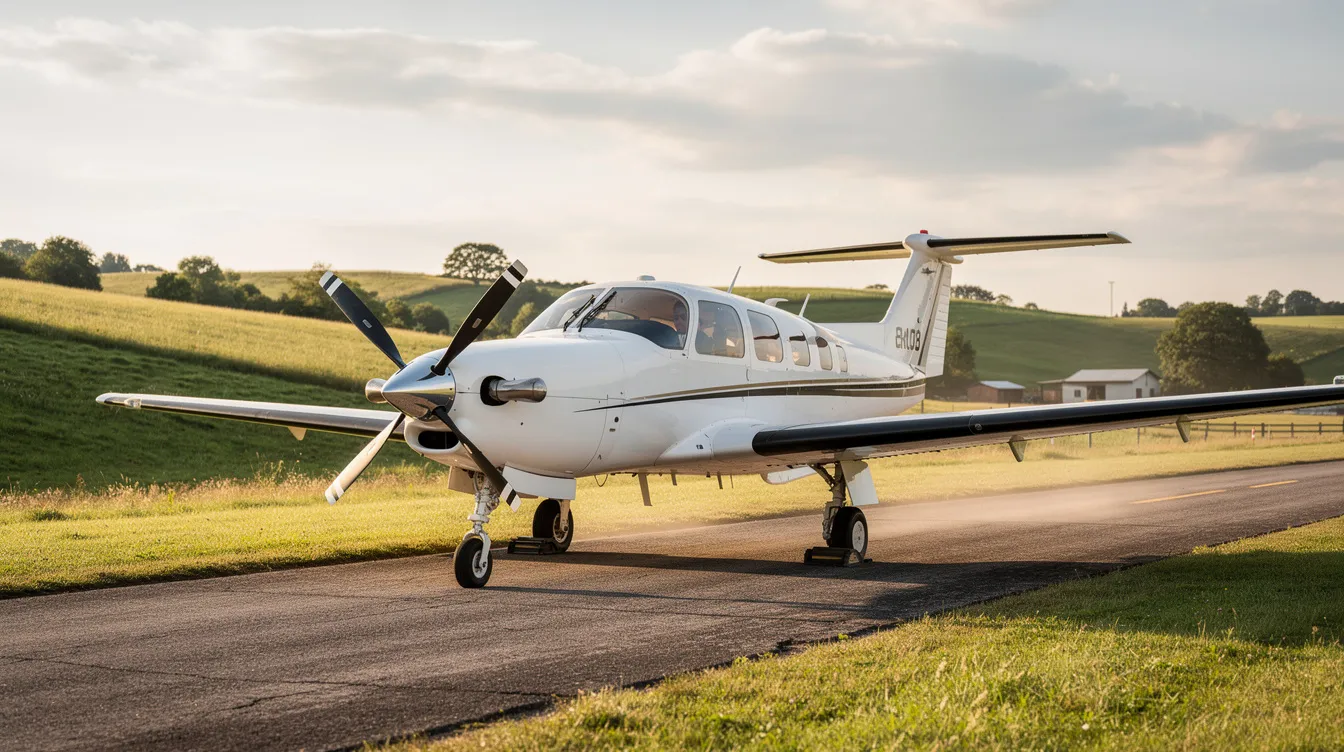
Private aviation defaults to jet aircraft in most conversations. But for routes under 800 nautical miles, a propeller passenger plane often delivers faster door-to-door times, lower costs, and access to airports that jets cannot reach. This article breaks down how turboprop aircraft work, when they outperform jets, and how BlackJet integrates both into a single Jet Card portfolio.
Key Takeaways for High-End Travelers
Modern turboprop aircraft carry 4 to 9 passengers on missions under roughly 800 nautical miles with lower operating costs and better runway flexibility than light jets.
Propeller planes with turboprop engines can operate from runways as short as 1,100 meters, opening access to smaller airports and remote locations that regional jets cannot serve.
Turboprops can use up to 50% less fuel than jets on comparable regional routes, producing lower emissions per passenger-kilometer.
Propeller-driven aircraft are optimal for short-distance flights and regional routes under 1,500 km, where speed differences shrink, and ground-time savings dominate.
BlackJet members choose between propeller planes and jets trip-by-trip through a single Jet Card, with real-time pricing aligned to its comprehensive private jet price list and route-specific recommendations built into the booking platform.
Introduction: Why Propeller Passenger Planes Still Matter in 2026
A propeller passenger plane is any aircraft using propeller engines to carry passengers; in private and regional aviation, this almost always means turboprop planes. Turboprop technology dates back to the mid-20th century, yet modern turboprops bear little resemblance to their ancestors in avionics, cabin comfort, or propulsion system efficiency. Aviation history shows a steady refinement from piston aircraft to gas turbine propulsion, and the results in 2026 are aircraft like the Pilatus PC-12 NGX, the Beechcraft King Air 350, and the ATR 72-600.
Compared to jet planes, turboprops cruise slower (roughly 300 knots vs. 400 to 470 knots for light jets) but land on shorter runways, burn less fuel, and reach smaller airfields closer to final destinations. For the aviation industry, these are not relics; they are precision tools. BlackJet treats propeller planes as a tactical option within its Jet Card programs and broader premium private jet services, not a downgrade from jets.
How Propeller Passenger Planes Generate Thrust
Each propeller blade works as a rotating airfoil. As the engine spins the propeller, each blade accelerates air backward, generating forward force by Newton's third law. Approximately 90% of a turboprop's thrust comes from the propeller itself, with the remaining fraction produced by exhaust from the jet engine core.
Three key propeller types are fixed, variable, and constant speed. Fixed pitch propellers have a set blade angle that cannot change, which limits efficiency across different flight phases. Variable pitch propellers allow pilots to adjust blade angles during flight, matching propeller pitch to climb, cruise, or descent demands. Constant-speed propellers automatically adjust pitch to maintain RPM, removing the need for manual adjustment. Modern turboprops often use constant-speed, full-feathering propellers with variable pitch mechanisms for maximum efficiency.
Inside the aircraft engine, a gas turbine spins at tens of thousands of RPM. A reduction gearbox converts that speed to a lower, optimal propeller RPM. Air enters the combustion chamber, fuel ignites to reach optimum pressure, and the expanding gases drive the turbine. The propeller shaft transfers that power to blade tips spinning at controlled speed. Reversible propellers can be used as airbrakes during landing, shortening the rollout on compact strips. The result: strong low-speed thrust, better climb off shorter runways, and precise power control during approaches into small airports.
Propeller Planes vs Jet Aircraft: Performance, Time and Cost
On a 500-nautical-mile route with six passengers, a turboprop cruising at around 300 knots (550 km/h) completes the flight in roughly 1 hour 40 minutes. A light jet at 450 knots covers the same distance in about 1 hour 10 minutes. The raw difference is 30 minutes. But turboprops often land at smaller airports closer to the final destination, cutting 20 to 40 minutes of ground transfer. Door-to-door, the gap can shrink to 10 minutes or vanish entirely.
Turboprops operate efficiently below 725 km/h, and that efficiency translates directly to cost:
Factor | Turboprop (PC-12 / King Air) | Light Jet |
|---|
Cruise speed | 260 to 320 knots | 400 to 470 knots |
Fuel burn per hour | 60 to 80 gallons | 180 to 250 gallons |
Variable cost per hour | $1,100 to $1,500 | $2,500 to $4,000 |
Minimum runway | ~2,500 ft (some as short as 1,100 m) | 4,000 to 5,000 ft |
Lower operating costs make turboprops economically viable for short routes, and BlackJet's Jet Card pricing and guidance on jet card cost per hour reflect these differences. A New York to Martha's Vineyard flight (roughly 200 nm) on a King Air costs roughly half what a light jet charges, with access to the same or closer airports, illustrating how the cheapest private aircraft options can still deliver premium access. Los Angeles to Napa, Geneva to Courchevel: these routes favor propeller propulsion because jets simply cannot use the short strips involved, making them classic missions for the best small private aircraft.

Types of Propeller Passenger Planes: Piston, Turboprop and Executive Models
Not all propeller planes use the same engine or serve the same market, and mission profile matters as much as budget when considering the cheapest private jet options. The three main categories:
Piston aircraft use reciprocating piston engines to turn propellers. Examples include the Cessna 172 and Piper PA-34. These are slower, lower-altitude planes common in flight schools and personal flying. They carry 1 to 5 passengers at 120 to 180 knots. Piston engines lack the power and altitude capability for premium charter; they are outside BlackJet's fleet mix.
Turboprop aircraft replace the piston engine with a gas turbine driving the propeller through a reduction gearbox. This is the beating heart of regional and executive propeller-driven aircraft. The Beechcraft King Air 350 cruises at 303 to 320 knots with 6 to 9 passengers and a range of roughly 1,800 nm. The Pilatus PC-12 NGX, a single-engine turboprop, offers 290 knots cruise, 1,803 nm range, and a cabin pressurized for flight up to FL300. The Daher TBM 960 pushes past 330 knots, making it one of the fastest turboprop singles flying.
Regional turboprops such as the ATR 72-600 and Dash 8 Q400 scale the same propulsion system to carry 68 to 78 passengers. Airlines and regional carriers like Austrian Airlines operate these on short-haul routes across Europe and beyond, and cargo operators use them for freight into smaller communities. Some serve as massive military transports in modified configurations. The underlying technology is the same; the scale differs.
Cabin Experience: Comfort, Noise and Layout on Turboprop Planes
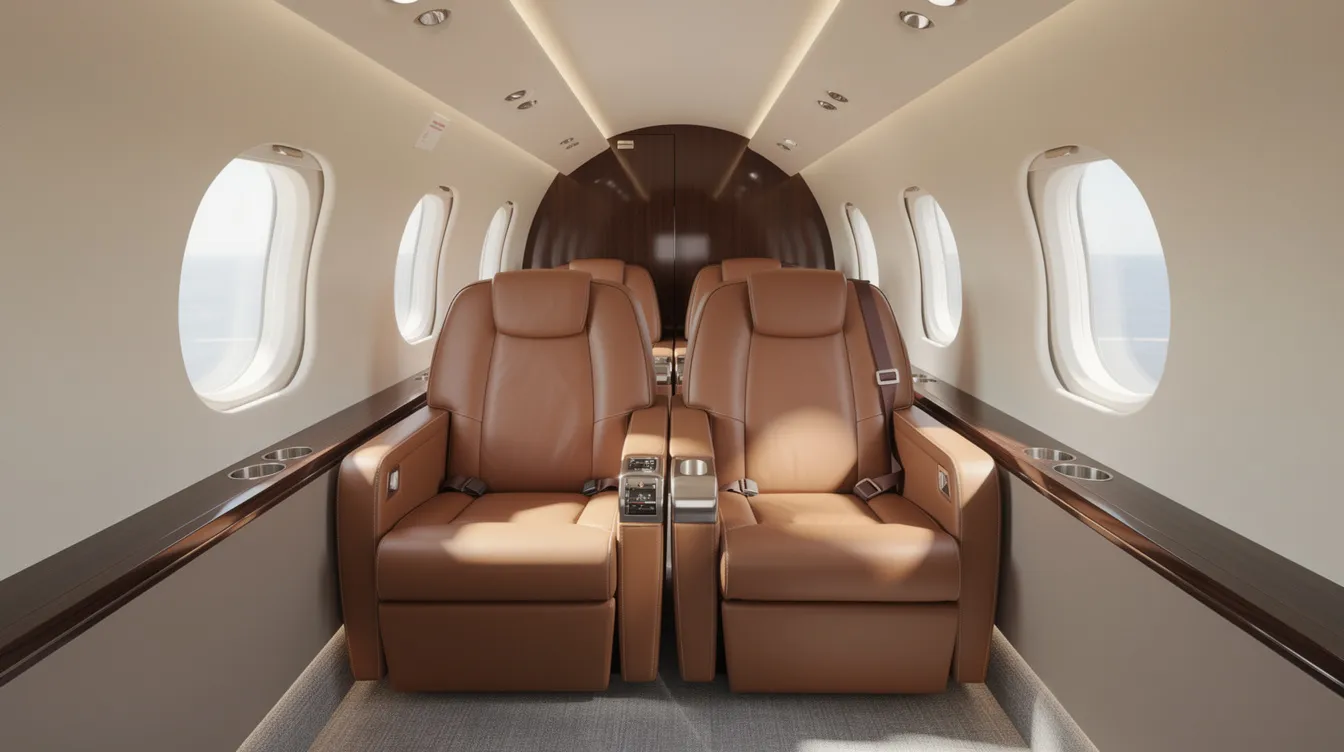
A PC-12 NGX cabin measures roughly 330 cubic feet with seating for six to nine passengers in club configuration. Work tables fold out between facing seats. A belted lavatory sits at the rear. Luggage loads through a large cargo door. The King Air 350 offers a similar layout with a slightly wider fuselage and dual-engine redundancy. Both aircraft include power outlets, LED lighting, and optional Wi-Fi.
Cabin noise is the honest trade-off. Propeller planes are louder than jet aircraft because propeller blade rotation generates mechanical and aerodynamic noise. But second-generation composite five-blade propellers, optimized blade tips running at lower RPM, and improved cabin insulation have narrowed the gap. Pilots can select low-prop-speed cruise modes that reduce interior sound levels further.
BlackJet crews offer noise-cancelling headsets, personalized cabin configurations, and optimized cruise altitudes to manage comfort. For flights lasting 60 to 120 minutes, most members report that direct airport access and schedule control matter more than the difference in cabin sound between a turboprop and a light jet, especially when comparing budget-friendly private aircraft and other affordable private jet options.
Operational Advantages: Short Runways, Remote Airports and Weather
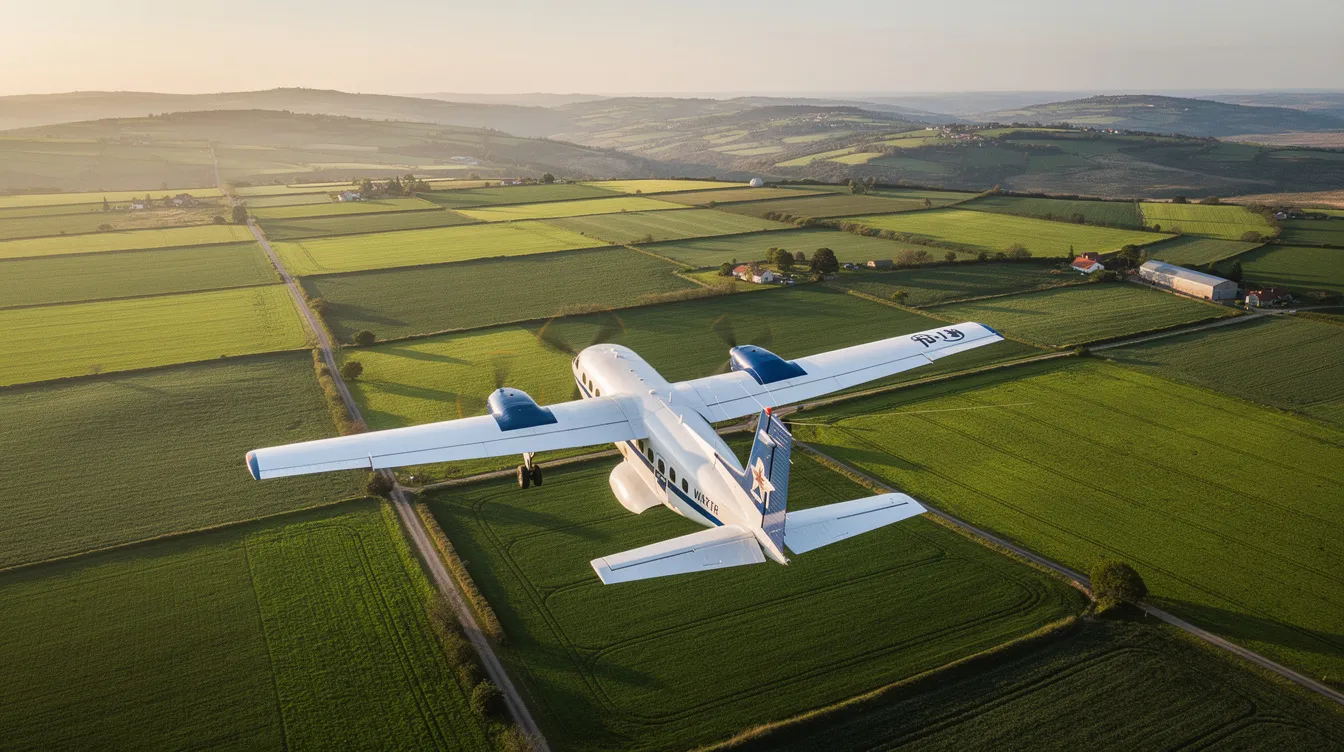
Approximately 34% of airports globally rely on turboprop aircraft because their runways are too short for jets. Turboprop aircraft can operate from runways as short as 1,100 meters. The PC-12 NGX clears a 50-foot obstacle on takeoff in roughly 2,485 feet and lands in about 2,170 feet. Some turboprops have short takeoff and landing (STOL) capabilities that allow operations from grass, gravel, or unpaved surfaces.
The performance of turboprops excels in hot and high conditions, where thin air reduces jet engine thrust but propeller-driven aircraft maintain strong forward force at low speed. This makes them the preferred choice for ski resort strips, island runways, and airports requiring smaller runways in mountainous terrain. Mission types that rely on these strengths include remote estate access, factory visits in secondary cities, renewable energy site inspections, and resort travel.
BlackJet's flight support team evaluates runway length, field conditions, weather, and alternate airports for each booking, then recommends whether a turboprop or jet is the better fit. Members see this analysis in the booking platform before confirming.
Safety, Certification and Maintenance for Propeller Aircraft
Every propeller passenger plane in BlackJet's network operates under FAA Part 135 or equivalent EASA standards. These regulations cover crew training, duty limits, maintenance programs, emergency equipment, and operational audits. The standard is identical to what governs jet aircraft in the charter fleet.
The most common aircraft engine in executive turboprops is the Pratt & Whitney Canada PT6A series, a powerplant that also features in several of the best aircraft of 2026. These turboprop engines have accumulated millions of flight hours across thousands of airframes. Time-between-overhaul intervals range from 3,600 to 10,000 hours depending on the model; hot section inspections occur at roughly half those intervals.
Maintenance checks specific to propeller aircraft include:
Propeller blade tracking and balancing
Hub and reduction gearbox inspections
Vibration harmonic analysis
Feathering mechanism and constant-speed governor testing
BlackJet partners only with operators that pass proprietary vetting, maintain current certifications, and provide transparent maintenance costs and safety records to members.
Sustainability and Efficiency: Turboprops in a Carbon-Neutral World
A 2026 study found turboprops burned 37% less fuel than jets on comparable regional missions. Across broader datasets, turboprops can reduce emissions by up to 50% compared to jets on routes under 800 nm. Turboprops emit roughly 780 kg CO₂ per hour, while equivalent light jets produce more. The environmental impact is about 26% lower when measured per passenger-kilometer.
The physics behind this: propeller propulsion accelerates a large fan of air at lower velocity, which is more fuel-efficient than a jet engine accelerating a smaller mass of air at higher velocity. Turboprops excel in low-speed fuel efficiency for regional flights. They also cruise at lower altitudes, which reduces contrail formation; contrails contribute to climate forcing beyond CO₂ alone.
BlackJet's commitment to carbon-neutral flights includes automatic carbon offsetting and support for sustainable aviation fuel where certified for use. By offering turboprops alongside jets, BlackJet gives members a way to fly with lower emissions on shorter distances without changing their Jet Card program.
When to Choose a Propeller Plane vs a Jet with BlackJet
The decision rests on five variables: distance, passenger count, luggage volume, runway length at origin and destination, and schedule sensitivity.
Choose a turboprop when:
The route is under 500 to 800 nautical miles
The destination airport has runways under 4,000 feet
You are flying with 4 to 9 passengers and moderate cargo
Fuel efficiency and lower emissions matter for your travel policy
Ground transfer time from a secondary airport would erase the jet's speed advantage
Choose a jet when:
The route exceeds 1,000 nm nonstop
Cabin size, stand-up height, or heavy payloads are priorities
Speed is non-negotiable (time-critical meetings, tight connections)
Route examples: Dallas to Santa Fe (roughly 500 nm) favors a propeller jet because Santa Fe's airport runway suits turboprops and sits minutes from the city center, while other travelers may opt to buy a seat on a private jet on similar regional sectors. Vancouver to Tofino (about 150 nm) on a small coastal strip is turboprop-only territory. London to Isle of Man works well as a King Air mission, landing at Ronaldsway's 5,700-foot strip and skipping the commercial connection through Manchester.
Jet Card members flex between turboprops and jets without changing programs, whether they hold a 100-hour Jet Card or a 50-hour Jet Card option, using BlackJet's digital booking tools and real-time aviation services.
BlackJet Jet Cards, Booking Flow and Fleet Access
BlackJet's Jet Card model offers prepaid 25-hour Jet Card blocks and 50-hour Jet Card programs, including the flexible BlackJet 25+ Hour Jet Card, across multiple cabin categories, including turboprop planes. Members enter route, dates, and passenger count in the mobile or web platform. The system returns side-by-side comparisons: turboprop vs. jet options with transparent pricing, estimated flight time, and runway analysis.
Filters let members sort by cabin class, short-field performance, and sustainability preference while applying BlackJet's broader jet card pricing framework and understanding overall jet card membership costs. A member who wants the lowest-emission option for a 400 nm route sees turboprops ranked first, while those focused on top-tier luxury can explore the top private jets in the world alongside the best small private aircraft. Aviation specialists are available around the clock to advise on regional jets vs. turboprop aircraft trade-offs for each mission.
Explore BlackJet's Jet Card programs, compare the best jet cards for frequent flyers, and request a tailored comparison for your most frequent routes. The right aircraft is not always the fastest; it is the one that matches the mission.
Frequently Asked Questions About Propeller Passenger Planes
How much slower is a turboprop than a light jet, and does it affect my day? Modern turboprops typically cruise at around 300 knots (550 km/h). A light jet cruises at 400 to 470 knots. On a 500 nm mission, the flight-time difference is roughly 30 minutes. Because turboprops land at smaller airfields closer to your destination, the door-to-door gap often drops to 10 to 15 minutes, which can matter more than marginal speed when evaluating overall jet card membership pricing and broader private jet cost structures. For regional routes, the speed difference rarely changes the shape of your schedule.
Are single-engine turboprop aircraft like the Pilatus PC-12 safe for business travel? The PT6A engine powering the PC-12 has one of the longest track records in aviation, with millions of cumulative flight hours and TBO intervals up to 10,000 hours on certain models. Every charter operator in BlackJet's network holds FAA Part 135 or equivalent EASA certification, with crew training and maintenance costs audited regularly. Single-engine turboprops are certified to the same safety standards as twin-engine aircraft for passenger operations, just as the large-cabin jets that serve 20-passenger private flights and 50-passenger group charters must meet rigorous regulatory benchmarks.
Will the cabin feel less comfortable than a jet? Turboprop cabins are narrower and louder than midsize jets. But the PC-12 NGX cabin measures roughly 330 cubic feet with club seating, a work table, and a belted lavatory. Composite propellers and improved insulation have reduced noise levels from older generations. For flights under two hours, most passengers find the trade-off between cabin sound and direct airport access well worth it.
How do I know if a propeller plane is the best option for my itinerary with BlackJet? Enter your route into BlackJet's booking platform. The system analyzes runway length, distance, and fleet availability, then presents turboprop and jet options with pricing. You can also speak with a BlackJet aviation specialist who will recommend the right aircraft based on your passenger count, luggage, and schedule. Jet Card hours work across both aircraft types.
Conclusion: Choose the Aircraft That Fits the Mission
A propeller passenger plane is not a compromise when the route favors efficiency, airport access, and a shorter journey from runway to destination. Modern turboprops can carry business teams and families to regional airports that jets may not serve, while using significantly less fuel on many short-haul missions. For longer distances or journeys where maximum speed and cabin space are essential, a jet may be the better choice. Compare aircraft options with BlackJet’s private jet services and explore how aircraft choice shapes private jet pricing.
BlackJet members can compare turboprops and jets through one Jet Card program, with digital booking, real-time support, and access to vetted, certified operators. Whether a regional aircraft is right for a meeting in a secondary city or a jet better suits a cross-country itinerary, the decision can be tailored to the trip rather than limited by a single fleet type. Explore BlackJet’s Jet Card programs to discover private air travel built around your schedule, safety, and sustainability priorities.


 Sign up with google
 Sign up with Apple